Linking Averaged and Unaveraged Three-Body Dynamics Near Smaller Primaries: Symmetric Periodic Orbits
Pith reviewed 2026-06-27 18:10 UTC · model grok-4.3
The pith
Averaged equilibria in three-body dynamics correspond to symmetric periodic orbits in the unaveraged models.
A machine-rendered reading of the paper's core claim, the machinery that carries it, and where it could break.
Core claim
Averaged equilibria are explicitly linked to symmetric periodic orbits in the unaveraged three-body systems through a unified frequency framework that characterizes the mapping of invariant tori, with an initialization scheme based on resonance ratio parity allowing a priori prediction of solution multiplicity and symmetry types.
What carries the argument
The unified frequency framework for mapping invariant tori across averaged and unaveraged dynamical models, together with the resonance-ratio-parity initialization scheme for apse configurations.
If this is right
- Symmetric periodic orbit families can be traced through their global evolution using bifurcation and frequency analysis.
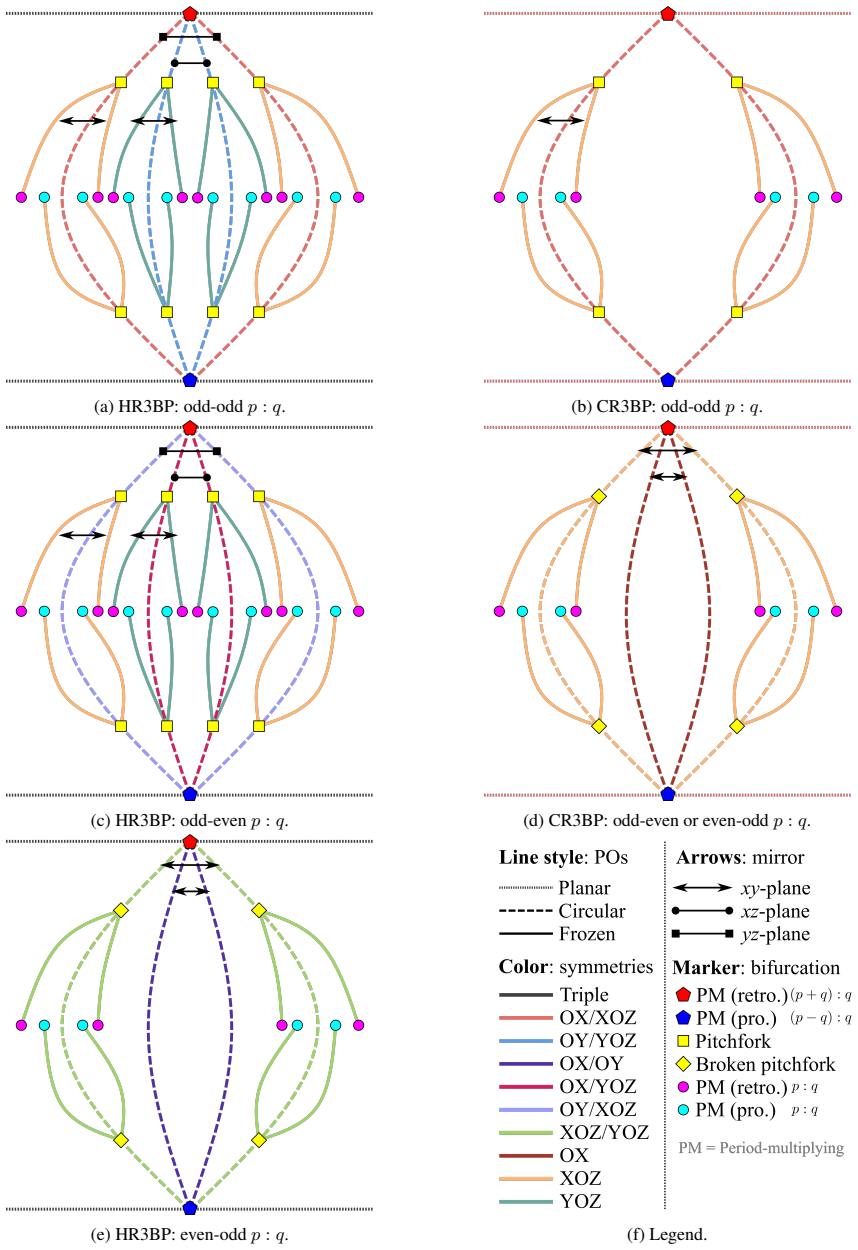
- Archetypical bifurcation diagrams provide an atlas of the symmetric periodic orbit web within the HR3BP and CR3BP.
- The topological origins of complex periodic orbit families become visible from the averaged starting points.
- The resulting atlas supplies a practical reference for selecting initial conditions in multi-body trajectory design.
Where Pith is reading between the lines
- The same resonance-parity rule could be tested for orbit families that are not required to be symmetric.
- Extending the frequency mapping to include small additional perturbations would check robustness outside the exact restricted problems.
- The initialization scheme might reduce the computational cost of generating starting guesses for long-period families in higher-fidelity ephemeris models.
Load-bearing premise
The parity of the resonance ratio enables an a priori initialization scheme to identify admissible apse configurations and predict solution multiplicity and symmetry types.
What would settle it
A numerical continuation search in the CR3BP for a chosen resonance ratio that yields a different count or symmetry set of symmetric periodic orbits than the multiplicity predicted by the parity-based initialization scheme.
Figures
read the original abstract
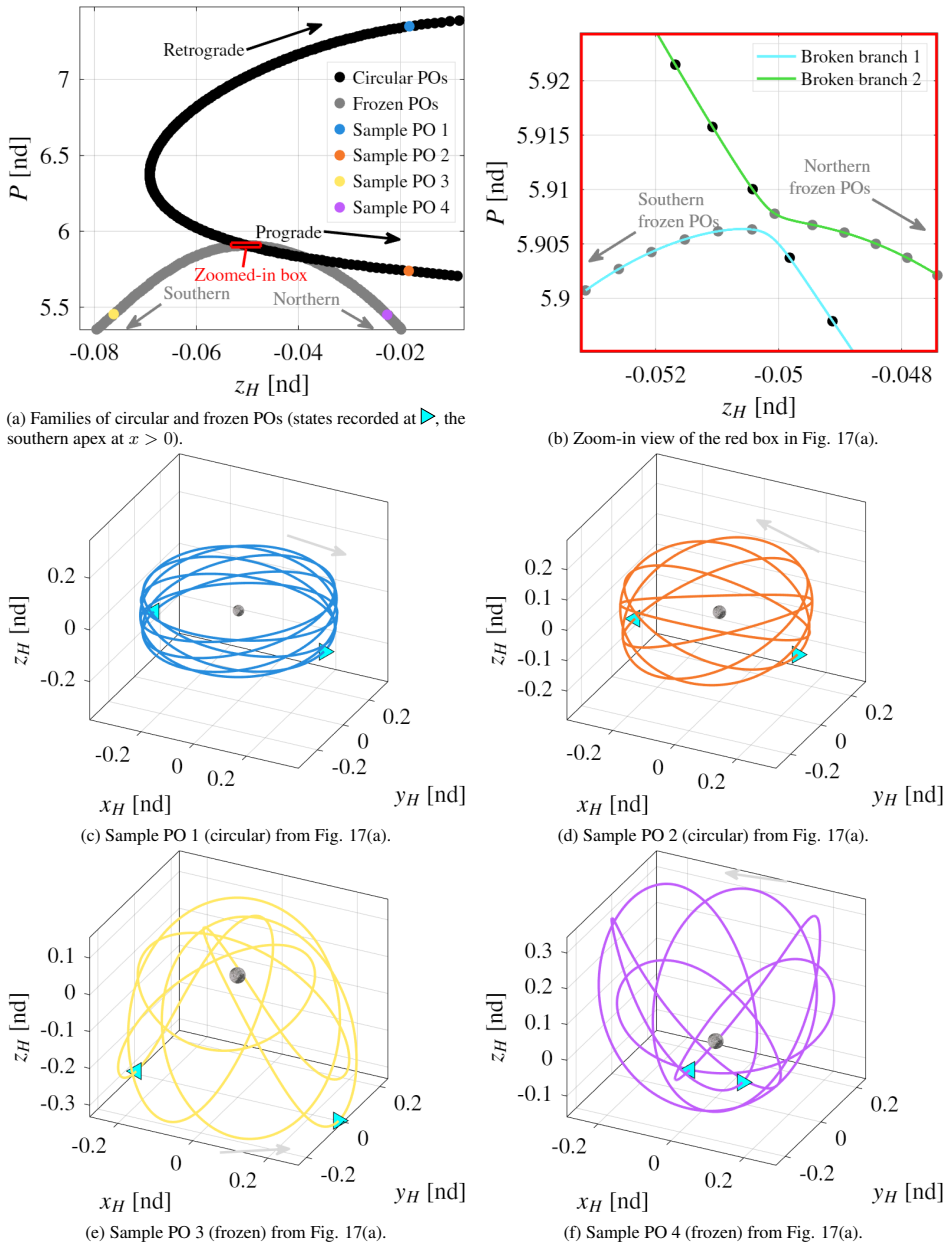
Within a three-body system comprised of two celestial bodies and a spacecraft, the dynamical environment near a smaller primary is significantly perturbed, motivating a balance between global insight and model fidelity. While averaged dynamics offer an integrable model to classify solution landscapes, they inherently lack the accuracy of the unaveraged dynamics, such as the Hill Restricted Three-Body Problem and Circular Restricted Three-Body Problem. This work establishes a systematic bridge between the averaged and unaveraged regimes by explicitly linking averaged equilibria to symmetric periodic orbits in the unaveraged three-body systems. A unified frequency framework is introduced to characterize the mapping of invariant tori across the dynamical models. Leveraging the parity of the resonance ratio, an initialization scheme is developed to identify admissible apse configurations, enabling the a priori prediction of solution multiplicity and symmetry types. Furthermore, the global evolution of families derived from averaged equilibria is traced via bifurcation and frequency analysis. These findings are synthesized into archetypical bifurcation diagrams, providing a comprehensive atlas of the symmetric periodic orbit web within the HR3BP and CR3BP. The resulting framework not only clarifies the topological origins of complex periodic orbit families but also offers a versatile tool for trajectory design in cislunar and multi-body environments.
Editorial analysis
A structured set of objections, weighed in public.
Referee Report
Summary. The paper claims to establish a systematic bridge between averaged and unaveraged three-body dynamics near smaller primaries by explicitly linking averaged equilibria to symmetric periodic orbits in the HR3BP and CR3BP. It introduces a unified frequency framework to characterize the mapping of invariant tori, develops an initialization scheme leveraging the parity of the resonance ratio to predict solution multiplicity and symmetry types, traces the global evolution of families via bifurcation and frequency analysis, and synthesizes the results into archetypical bifurcation diagrams providing an atlas of the symmetric periodic orbit web.
Significance. If the central mappings and diagrams hold, the work offers a practical atlas and versatile tool for trajectory design in cislunar and multi-body environments by clarifying topological origins of periodic orbit families. The systematic linking of averaged and unaveraged regimes via frequency analysis is a strength when supported by explicit constructions.
minor comments (2)
- The abstract asserts the existence of the bridge, framework, and bifurcation diagrams but supplies no derivations, error analysis, or verification steps; consider adding a dedicated section or appendix with explicit numerical verification of at least one mapped orbit family to strengthen the claims.
- The initialization scheme based on resonance parity is described at a high level; clarify the precise definition of 'parity' and the admissible apse configurations with an example in §3 or §4 to improve reproducibility.
Simulated Author's Rebuttal
We thank the referee for the positive assessment of our manuscript on linking averaged and unaveraged three-body dynamics and for recommending minor revision. The summary accurately captures the central contributions of the unified frequency framework, resonance-parity initialization, and archetypical bifurcation diagrams.
Circularity Check
No significant circularity
full rationale
The paper's core claim is a systematic continuation from averaged equilibria to symmetric periodic orbits in the HR3BP/CR3BP using a frequency map and resonance-parity initialization. This is a standard dynamical-systems construction resting on external models (averaged three-body dynamics, continuation methods) rather than any self-definition, fitted-input prediction, or self-citation chain that reduces the result to its inputs. No load-bearing step is shown to be equivalent to its own assumptions by construction; the parity device is presented as an a-priori selection rule, not a derived output. The derivation is therefore self-contained against external benchmarks.
Axiom & Free-Parameter Ledger
Reference graph
Works this paper leans on
-
[1]
S. Fuller, E. Lehnhardt, C. Zaid, and K. Halloran. Gateway program status and overview.Journal of Space Safety Engineering, 9(4):625–628, 2022. doi:10.1016/j.jsse.2022.07.008
-
[2]
O. Grasset, M. K. Dougherty, A. Coustenis, E. J. Bunce, C. Erd, D. Titov, M. Blanc, A. Coates, P. Drossart, L. N. Fletcher, et al. JUpiter ICy moons Explorer (JUICE): An ESA mission to orbit Ganymede and to characterise the Jupiter system.Planetary and Space Science, 78:1–21, 2013. doi:10.1016/j.pss.2012.12.002
-
[3]
J. R. Spencer and F. Nimmo. Enceladus: An active ice world in the Saturn system.Annual Review of Earth and Planetary Sciences, 41(1):693–717, 2013. doi:10.1146/annurev-earth-050212-124025
-
[4]
Szebehely.Theory of orbits: The restricted problem of three bodies
V . Szebehely.Theory of orbits: The restricted problem of three bodies. Elsevier, 2012
2012
-
[5]
H. von Zeipel. Sur l’application des séries de m. lindstedt à l’étude du mouvement des comètes périodiques.Astronomische Nachrichten, 183:345–418, 1910. doi:10.1002/asna.19091832202
-
[6]
M. L. Lidov. Evolution of the orbits of artificial satellites of planets as affected by gravitational perturbation from external bodies.Artificial Earth Satellites, 8:5–45, 1961. Originally in Russian. English translation:Planetary and Space Science,9, 719–759, 1962, https://doi.org/10.1016/00 32-0633(62)90129-0
work page doi:10.1016/00 1961
-
[7]
Y . Kozai. Secular perturbations of asteroids with high inclination and eccentricity.The Astronomical Journal, 67:591–598, 1962. doi:10.1086/108790
-
[8]
T. Ito and K. Ohtsuka. The Lidov-Kozai oscillation and Hugo von Zeipel.arXiv preprint arXiv:1911.03984, 2019. doi:10.48550/arXiv.1911.03984
-
[9]
D. J. Scheeres, M. D. Guman, and B. F. Villac. Stability analysis of planetary satellite orbiters: application to the Europa orbiter.Journal of Guidance, Control, and Dynamics, 24(4):778–787, 2001. doi:10.2514/2.4778
-
[10]
A. F. B. de Almeida Prado. Third-body perturbation in orbits around natural satellites.Journal of Guidance, Control, and Dynamics, 26(1):33–40, 2003. doi:10.2514/2.5042
-
[11]
R. A. Broucke. Long-term third-body effects via double averaging.Journal of Guidance, Control, and Dynamics, 26(1):27–32, 2003. doi:10.2514/2.5041
-
[12]
T. A. Ely. Stable constellations of frozen elliptical inclined lunar orbits.The Journal of the Astronautical Sciences, 53:301–316, 2005. doi:10.1007/BF03546355
-
[13]
D. Folta and D. Quinn. Lunar frozen orbits. InAIAA/AAS Astrodynamics Specialist Conference and Exhibit, page 6749, 2006. doi:10.2514/6.2006-6749
-
[14]
T. A. Ely and E. Lieb. Constellations of elliptical inclined lunar orbits providing polar and global coverage.The Journal of the Astronautical Sciences, 54(1):53–67, 2006. doi:10.1007/BF03256476
-
[15]
M. Lara and R. Russell. Computation of a science orbit about Europa.Journal of Guidance, Control, and Dynamics, 30(1):259–263, 2007. doi:10.2514/1.22493
-
[16]
R. P. Russell and A. T. Brinckerhoff. Circulating eccentric orbits around planetary moons.Journal of Guidance, Control, and Dynamics, 32(2):424–436, 2009. doi:10.2514/1.38593
-
[17]
S. McArdle and R. P. Russell. Circulating, eccentric periodic orbits at the Moon.Celestial Mechanics and Dynamical Astronomy, 133(4):18, 2021. doi:10.1007/s10569-021-10013-z
-
[18]
C. J. Franz and R. P. Russell. Database of planar and three-dimensional periodic orbits and families near the Moon.The Journal of the Astronautical Sciences, 69(6):1573–1612, 2022. doi:10.1007/s40295-022- 00361-9. 36
-
[19]
K. C. Howell and J. V . Breakwell. Almost rectilinear halo orbits.Celestial mechanics, 32(1):29–52,
-
[20]
doi:10.1007/BF01358402
-
[21]
E. M. Zimovan-Spreen, K. C. Howell, and D. C. Davis. Near rectilinear halo orbits and nearby higher-period dynamical structures: orbital stability and resonance properties.Celestial Mechanics and Dynamical Astronomy, 132(5):28, 2020. doi:10.1007/s10569-020-09968-2
-
[22]
R. P. Russell. Global search for planar and three-dimensional periodic orbits near Europa.The Journal of the Astronautical Sciences, 54(2):199–226, 2006. doi:10.1007/BF03256483
-
[23]
R. L. Restrepo and R. P. Russell. A database of planar axisymmetric periodic orbits for the solar system. Celestial Mechanics and Dynamical Astronomy, 130(7):49, 2018. doi:10.1007/s10569-018-9844-6
-
[24]
A. Moreno, C. Aydin, O. van Koert, U. Frauenfelder, and D. Koh. Bifurcation graphs for the CR3BP via symplectic methods: On the Jupiter–Europa and Saturn–Enceladus systems.The Journal of the Astronautical Sciences, 71(6):51, 2024. doi:10.1007/s40295-024-00462-7
-
[25]
C. Aydin. Exploration of vertical self-resonant bifurcations from DRO in the Earth-Moon CR3BP. arXiv preprint arXiv:2508.17286, 2025. doi:10.48550/arXiv.2508.17286
-
[26]
C. Aydin and A. Batkhin. Studying network of symmetric periodic orbit families of the Hill prob- lem via symplectic invariants.Celestial Mechanics and Dynamical Astronomy, 137(2):1–77, 2025. doi:10.1007/s10569-025-10241-7
-
[27]
K. C. Howell, D. J. Grebow, and Z. P. Olikara. Design using Gauss’ perturbing equations with applications to lunar south pole coverage. InAAS/AIAA Space Flight Mechanics Meeting, Sedona, Arizona, January 2007
2007
-
[28]
R. P. Russell and M. Lara. Long-lifetime lunar repeat ground track orbits.Journal of Guidance, Control, and Dynamics, 30(4):982–993, 2007. doi:10.2514/1.27104
-
[29]
M. Lara and J. F. San Juan. Dynamic behavior of an orbiter around Europa.Journal of Guidance, Control, and Dynamics, 28(2):291–297, 2005. doi:10.2514/1.5686
-
[30]
M. Lara, R. Russell, and B. Villac. Classification of the distant stability regions at Europa.Journal of Guidance, Control, and Dynamics, 30(2):409–418, 2007. doi:10.2514/1.22372
-
[31]
D. C. Koblick and P. Kelly. Novel three-body tulip-shaped orbit families for lunar missions.The Journal of the Astronautical Sciences, 72(4):32, 2025. doi:10.1007/s40295-025-00510-w
-
[32]
L. Peng, P. Shi, Y . Liang, and N. Pushparaj. Analog of lunar Sun-synchronous orbits based on spatial distant retrograde orbits.Journal of Guidance, Control, and Dynamics, 48(6):1439–1448, 2025. doi:10.2514/1.G008375
-
[33]
J. Zhang, X. Jiang, Y . Yuan, and H. Dai. Time-regularized bifurcation framework for constructing tulip orbits in the CRTBP.Nonlinear Dynamics, 114(9):620, 2026. doi:10.1007/s11071-026-12465-0
-
[34]
D. A. Vallado.Fundamentals of astrodynamics and applications, volume 12. Springer Science & Business Media, 2001
2001
-
[35]
J. M. Longuski, F. R. Hoots, and G. E. Pollock IV .Introduction to Orbital Perturbations, volume 40. Springer Nature, 2022. doi:10.1007/978-3-030-89758-1
-
[36]
T. Nie and P. Gurfil. Lunar frozen orbits revisited.Celestial Mechanics and Dynamical Astronomy, 130 (10):61, 2018. doi:10.1007/s10569-018-9858-0
-
[37]
V . I. Arnold.Mathematical methods of classical mechanics, volume 60. Springer Science & Business Media, 2013. doi:10.1007/978-1-4757-1693-1
-
[38]
A. Celletti. From infinite to finite time stability in celestial mechanics and astrodynamics.Astrophysics and Space Science, 368(12):106, 2023. doi:10.1007/s10509-023-04264-5
-
[39]
C. Aydin. The linear symmetries of Hill’s lunar problem.Archiv der Mathematik, 120(3):321–330,
-
[40]
doi:10.1007/s00013-022-01822-1
-
[41]
I. A. Robin and V . V . Markellos. Numerical determination of three-dimensional periodic orbits generated from vertical self-resonant satellite orbits.Celestial Mechanics, 21(4):395–434, 1980. doi:10.1007/BF01231276. 37
-
[42]
Springer Berlin Heidelberg, 2002.isbn: 9783540459491
M. Hénon.Generating families in the restricted three-body problem. Springer, 2002. doi:10.1007/3- 540-69650-4
work page doi:10.1007/3- 2002
-
[43]
E. Strömgren. Connaissance actuelle des orbites dans le problème des trois corps.Bulletin astronomique, Observatoire de Paris, 9(1):87–130, 1933. doi:10.3406/bastr.1933.14090. English translation by Maxime Murray and J. D. Mireles James (2018)
-
[44]
D. Guzzetti, N. Bosanac, A. Haapala, K. C. Howell, and D. C. Folta. Rapid trajectory design in the Earth–Moon ephemeris system via an interactive catalog of periodic and quasi-periodic orbits.Acta Astronautica, 126:439–455, 2016. doi:10.1016/j.actaastro.2016.06.029
-
[45]
Bifurcations of highly inclined near halo orbits using Moser regularization
C. Joung, D. Koh, and O. van Koert. Bifurcations of highly inclined near halo orbits using Moser regularization.arXiv preprint arXiv:2512.03849, 2025. doi:10.48550/arXiv.2512.03849. 38
work page internal anchor Pith review Pith/arXiv arXiv doi:10.48550/arxiv.2512.03849 2025
discussion (0)
Sign in with ORCID, Apple, or X to comment. Anyone can read and Pith papers without signing in.