REVIEW 3 major objections 4 minor 126 references
The isolation of Luminous Blue Variables resembles aging B-type supergiants, not the most massive unevolved stars
T0 review · 3 major / 4 minor · reviewed 2026-08-14 · deepseek-v4-flash
Pith's one-line read The paper argues that a photometric sample of bright blue stars is contaminated by older, roughly 20-solar-mass B supergiants, so the apparent similarity to luminous blue variables reflects old comparison stars, not young LBVs.
desk verdict A convincing reanalysis showing the photometric BBS sample is dominated by aging B supergiants, not young O stars, so A19's comparison does not undermine the binary-blue-straggler case for LBVs—though the key SIMBAD comparison would benefit from a KS test and a completeness discussion. read the letter →
The pith
A machine-rendered reading of the paper's core claim, the machinery that carries it, and where it could break.
The reading
What carries the argument
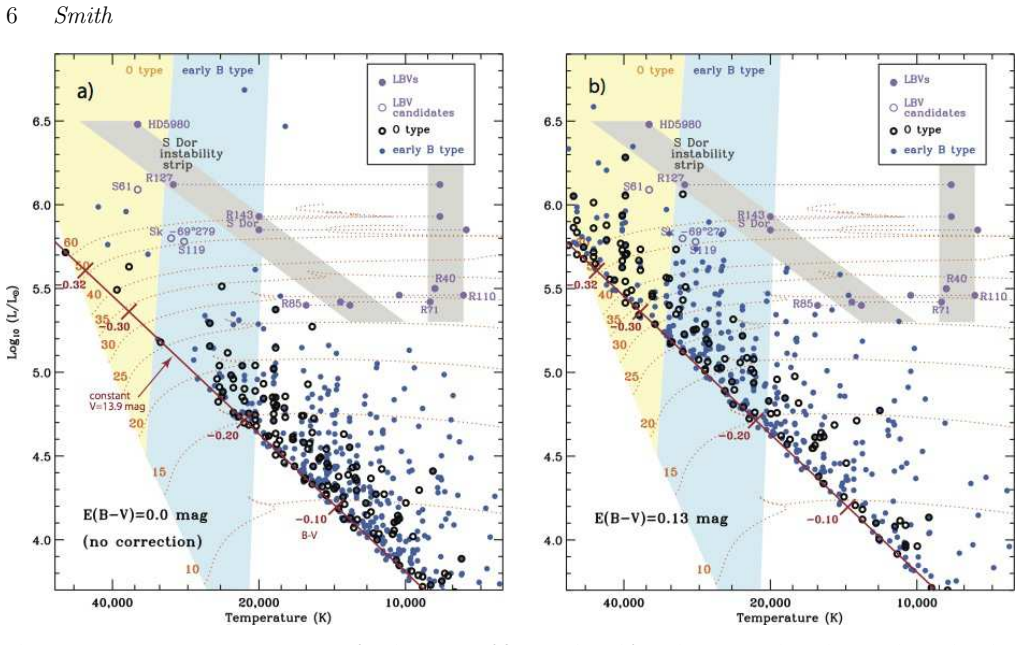
The central mechanism is the cumulative distribution of angular separation to the nearest neighbor in a reference stellar population, used as a relative age indicator: young massive stars are born in clusters that disperse with time, so larger separations signal older populations. The paper combines this with the observed color degeneracy of O and early B stars at visual wavelengths, the reddening-free index $Q = (U-B) - 0.72(B-V)$ used by the photometric selection, and a spectroscopically confirmed early B supergiant sample matched in magnitude and in the exclusion of the 30 Doradus region. The key comparison is that the photometric BBS separation distribution is indistinguishable from the early B supergiant distribution and matches cluster-dispersal predictions for roughly 20 $M_\odot$ stars at about 10 Myr, while known early O stars are about 10 times more clustered. This diagnosis isolates contamination by older B supergiants as the reason the BBS sample appears so dispersed.
What would settle it
Obtain spectra for all bright blue stars in a representative area of the LMC and compare the nearest-neighbor separation of only the confirmed O-type stars to the LBV sample; if the pure O-star subset retains a median separation near 31 pc and matches the LBV distribution, the contamination explanation would fail and LBV youth would become viable again.
Extended reading notes
Core claim
The paper's central claim is that the observed isolation of LBVs from the most massive unevolved stars is not an artifact of an incomplete O-star catalog, and that the photometric bright-blue-star sample used in the contrary analysis is dominated by older, lower-mass B supergiants. The LBV median nearest-neighbor separation is identical whether measured to spectroscopic O stars or to the photometric BBS sample (about 180 arcseconds), so incompleteness in the O-star list cannot fabricate LBV isolation; what differs is that the BBS sample is far more dispersed than known O stars (median 31 pc versus about 3 pc for early O stars). Spectral types show roughly half of the spectroscopically observed BBS stars are B supergiants, and the full BBS separation distribution matches known early B supergiants and a roughly 10 Myr dispersing population rather than a 3 to 4 Myr one. The conclusion is that the similarity between the BBS and LBV separation distributions arises because the BBS sample is old, not because the LBVs are young. This keeps LBVs' avoidance of O-star clusters as evidence that they are rejuvenated binary products, massive blue stragglers, rather than the most massive single stars.
Load-bearing premise
The argument assumes that the SIMBAD collection of spectroscopically confirmed early B stars is a fair spatial map of the B supergiants contaminating the photometric sample, even though the completeness of that spectral sample is unknown.
Editorial extensions
If this is right
- LBVs' isolation from spectroscopically confirmed O-type stars remains a real signal: incomplete O-star catalogs cannot explain it, since the LBV median separation is identical when measured against the more complete photometric sample.
- Photometric samples of bright blue stars in the LMC, M31, and M33 do not trace the youngest massive stars; they are dominated by evolved roughly 20 $M_\odot$ B supergiants, so their spatial dispersion cannot be used to infer LBV youth.
- Visual-wavelength color cuts cannot reliably separate O stars from early B supergiants because the intrinsic color difference is smaller than reddening variations and photometric errors; spectral classification is required for such age-sensitive comparisons.
- In unresolved galaxy populations, blue light will tend to trace ages around 10 to 15 Myr rather than 3 to 4 Myr, so bluer does not automatically mean younger, with consequences for interpreting supernova host environments.
- The environments of LBVs remain consistent with binary evolution producing rejuvenated massive blue stragglers, rather than with the standard single-star scenario in which LBVs immediately follow the most massive O-type main-sequence stars.
Reading between the lines
- A direct test of the paper's logic would be to rebuild a photometric blue-star sample after removing all spectroscopically confirmed B supergiants; the prediction is that the remaining O-dominated subset should show a much smaller median separation and restore the LBV-to-O-star contrast.
- The same color-degeneracy problem likely affects other photometric searches for young massive stars, such as color-selected star-forming region surveys, so age estimates based on blue colors may need revision.
- If bright blue light in galaxies mainly traces roughly 10 Myr old binary-rejuvenated supergiants, then correlations between supernova type and host-galaxy color may be partly measuring binary fraction rather than initial mass.
- One could extend the analysis to the Milky Way by using Gaia parallaxes to build a volume-complete spectroscopic sample of early B supergiants and compare their isolation to LBVs.
Signed reviews
Editorial analysis
A structured set of objections, weighed in public.
Referee Report
Summary. This paper re-examines Aadland et al. (2019, A19), who used a photometrically selected sample of bright blue stars (BBS) in the LMC as a reference population and concluded that LBVs are not appreciably more isolated than massive young stars. The author argues the opposite: the BBS sample is not a clean tracer of the most massive unevolved stars. The paper presents three main lines of evidence: (i) LBVs have essentially the same median separation to BBS stars (181 arcsec) as to spectroscopically confirmed O-type stars (180 arcsec), so incompleteness in the O-star sample cannot explain LBV isolation (Section 2); (ii) the BBS sample is spatially far more dispersed than known O stars, with only ~4% of members closer than ~5 pc to a neighbor, and among the spectroscopically observed subset roughly 51% are early B stars rather than O stars (Sections 2 and 4.3); and (iii) the BBS separation distribution closely matches that of SIMBAD-selected early B supergiants and is consistent with a ~10 Myr dispersing-cluster population, not the 3-4 Myr population expected for the most massive single stars (Sections 5 and 7). The paper concludes that the BBS-LBV similarity arises because the BBS sample is old, not because LBVs are young, and that bright blue stars in general are unreliable tracers of the youngest massive stellar populations.
Significance. If correct, the paper removes a major empirical challenge to the binary-evolution interpretation of LBV isolation (Smith & Tombleson 2015) and sharpens the debate with A19. Its strongest evidence is partly external to the author's own models: A19's spectral data show that about half of the classified BBS stars are B-type (Section 4.3), and the BBS separation distribution resembles spectroscopically confirmed early B stars (Section 5). The paper also makes a useful quantitative check of the 30 Dor exclusion (Section 3), showing it does not drive the discrepancy. A falsifiable consequence is stated clearly: complete samples of early B supergiants should reproduce the BBS separation distribution, and unresolved blue light in galaxies should appear to trace ~10-15 Myr rather than ~3-4 Myr populations. The main caveat is that the key comparison in Section 5 rests on a SIMBAD sample of unknown completeness and selection, so the central empirical match is not yet formally established.
major comments (3)
- [Section 5, Figure 1] The claim that the BBS separation distribution is 'indistinguishable' from the SIMBAD early B sample is presented without a quantitative statistical test. The abstract and the Figure 1 caption use the word 'indistinguishable,' but the text (Section 5) only says the distributions 'match' and shows a visual comparison. Because the conclusion that the BBS sample is old rests directly on this match, please report a two-sample Kolmogorov-Smirnov test (or an equivalent) for the BBS versus early B cumulative distributions, both with and without the 10-arcmin 30 Dor exclusion, and give the sample sizes. Without such a test, the reader cannot judge whether the match is closer than the A19 KS comparison that the paper itself criticizes in Section 6.
- [Sections 4.2 and 5, footnote 4] The early B comparison sample is drawn from SIMBAD and has unknown completeness and selection properties, as the paper itself states in Section 4.2: 'we don't know the level of incompleteness for either.' This is load-bearing because the claim that the BBS sample is old requires that the SIMBAD early B stars be spatially representative of the B-type stars contaminating the BBS sample. The footnote in Section 5 only excludes one direction of bias, namely past spectroscopy being concentrated toward clusters; it does not address the opposite bias, in which the SIMBAD early B sample preferentially includes field stars because crowded regions are under-represented spectroscopically. Please quantify or bound this selection effect, for example by repeating the comparison with a homogeneous complete early B catalog or with an incompleteness model, and state explicitly how a bias toward or against clusters would shift the early B separation distribution and affect the conclusion.
- [Section 7 (Summary)] The quantitative statement that the BBS median separation corresponds to an age of 9-10 Myr is taken from Aghakhanloo et al. (2017), a dispersal model that includes one of the present authors as a co-author. The empirical match to spectroscopically confirmed early B stars is independent, but the specific age interpretation is not. Please make explicit which parts of the conclusion depend only on the observed early B separation distribution and which parts depend on Aghakhanloo et al.'s model, and quote the model's uncertainty when assigning a numerical age to the BBS sample.
minor comments (4)
- [Section 5, sample definition] The text refers to the early B sample as 'early B supergiants' but the stated selection is 'O9.5 to B2, of any luminosity class'; please clarify whether the V < 13.9 mag cut effectively restricts the sample to supergiants, or give the luminosity-class distribution of the SIMBAD sample.
- [Section 6] The 'evenly spaced grid of blue stars' argument is heuristic; a brief simulation of the grid-spacing effect would make the point quantitative and would parallel the Aghakhanloo et al. models cited elsewhere in the paper.
- [Section 7] The broad statement that unresolved blue light in distant galaxies generally traces evolved blue supergiants akin to SN 1987A's progenitor goes beyond the LMC data analyzed here; consider qualifying this extrapolation or citing supporting evidence.
- [Throughout] There are several typographical errors, for example 'suprisingly' in the Abstract and 'distribition' in Section 2, which should be corrected in a revised version.
Circularity Check
No material circularity: the central claim rests on external SIMBAD early-B data and A19's own spectral classifications, not on the author's models.
full rationale
The paper's load-bearing comparison is that the A19 photometric BBS separation distribution matches spectroscopically confirmed early B supergiants drawn from SIMBAD, not O-type stars. That comparison is external to the author's modeling: the early-B sample is selected by spectral type and V magnitude, and the match is displayed directly rather than produced by a fitted parameter or an equation that assumes the conclusion. The 51% B-star fraction among BBS stars with spectra is taken from A19's own spectroscopic classifications, again independent of the author's models. The age interpretation does cite the author's prior work (Smith & Tombleson 2015; Aghakhanloo et al. 2017), but these citations are not load-bearing in a circular sense: Aghakhanloo et al. calibrated a dispersal model against O-star subtype distributions, not against the BBS sample, and the claim that BBS is old also stands on the independent match to known early B supergiants. The paper explicitly concedes incomplete knowledge of sample completeness in Section 4.2 ('we don't know the level of incompleteness for either') and the Section 5 footnote only excludes the bias where past spectroscopy targeted clusters; that is a legitimate empirical representativeness concern, not a circularity. No step reduces by construction, no fitted quantity is renamed as a prediction, and no uniqueness theorem is imported from the authors. The derivation chain is therefore self-contained with respect to external benchmarks, and no circular step is identified.
Assumptions & free parameters
assumptions (4)
- domain assumption Massive stars are predominantly born in clusters and their spatial separation grows as clusters disperse with age.
- domain assumption O-type and early B-type stars have nearly identical intrinsic UBV colors, so photometric color cuts cannot reliably separate them.
- domain assumption The SIMBAD sample of spectroscopically confirmed early B stars is spatially representative of the B-type stars contaminating the BBS sample.
- domain assumption The Aghakhanloo et al. (2017) cluster dispersal model correctly converts a median separation of ~30 pc into an age of ~10 Myr and initial masses of ~20 solar masses.
Cite this review
Pith. "Pith review of The isolation of Luminous Blue Variables resembles aging B-type supergiants, not the most massive unevolved stars." pith.science (2026). https://pith.science/paper/VDYU3VJE
@misc{pith2026190806104,
  author       = {Pith},
  title        = {Pith review of: The isolation of Luminous Blue Variables resembles aging B-type supergiants, not the most massive unevolved stars},
  year         = {2026},
  howpublished = {\url{https://pith.science/paper/VDYU3VJE}},
  note         = {Machine review of arXiv:1908.06104}
}
read the original abstract
Luminous blue variables (LBVs) are suprisingly isolated from the massive O-type stars that are their putative progenitors in single-star evolution, implicating LBVs as binary evolution products. Aadland et al. (A19) found that LBVs are, however, only marginally more dispersed than a photometrically selected sample of bright blue stars (BBS) in the LMC, leading them to suggest that LBV environments may not exclude a single-star origin. In both comparisons, LBVs have the same median separation, confirming that any incompleteness in the O-star sample does not fabricate LBV isolation. Instead, the relative difference arises because the photometric BBS sample is far more dispersed than known O-type stars. Evidence suggests that the large BBS separation arises because it traces less massive (~20 Msun), aging blue supergiants. Although photometric criteria used by A19 aimed to select only the most massive unevolved stars, visual-wavelength color selection cannot avoid contamination because O and early B stars have almost the same intrinsic color. Spectral types confirm that the BBS sample contains many B supergiants. Moreover, the observed BBS separation distribution matches that of spectroscopically confirmed early B supergiants, not O-type stars, and matches predictions for a ~10 Myr population, not a 3-4 Myr population. A broader implication for ages of stellar populations is that bright blue stars are not a good tracer of the youngest massive O-type stars. Bright blue stars in nearby galaxies (and unresolved blue light in distant galaxies) generally trace evolved blue supergiants akin to SN 1987A's progenitor.
Figures

Reference graph
Works this paper leans on
-
[1]
2018, AJ, 156, 294 (A19)
Aadland E, Massey P, Neugent KF, Drout MR. 2018, AJ, 156, 294 (A19)
2018
-
[2]
2017, MNRAS, 472, 591
Aghakhanloo M, Murphy J, Smith Nm Hlozek R. 2017, MNRAS, 472, 591
2017
-
[3]
Anderson J, James PA. 2008,
2008
-
[4]
Anderson J, et al.\ 2012,
2012
-
[5]
1989, ARA&A, 27, 629
Arnett WD, Bahcall JN, Kirshner RP, Woosley SE. 1989, ARA&A, 27, 629
1989
-
[6]
2019, MNRAS, 486, 266
Beasor, ER, Davies, B, Smith N, Bastian, N. 2019, MNRAS, 486, 266
2019
-
[7]
1961, BAN, 15, 265
Blaauw A. 1961, BAN, 15, 265
1961
-
[8]
1964, ARAA, 2, 213
Blaauw A. 1964, ARAA, 2, 213
1964
Show all 126 references
-
[9]
2016, MNRAS, 458, 1999
Blagovest P, Vink JS, Gr\"afener G. 2016, MNRAS, 458, 1999
2016
-
[10]
1959, ApJ, 130, 482
Blanco VM, Williams AD. 1959, ApJ, 130, 482
1959
-
[11]
1997, in
Bohannan B. 1997, in
1997
-
[12]
2005, A&A, 438, 301
Bouret JC, Lanz T, Hillier DJ. 2005, A&A, 438, 301
2005
-
[13]
J., Hunter, I., et al
Brott, I., Evans, C. J., Hunter, I., et al. 2011, A&A, 530, A115
2011
-
[14]
1976, Mem.\ Soc.\ R.\ Sci.\ Lie'ge, 9, 193
Conti PS. 1976, Mem.\ Soc.\ R.\ Sci.\ Lie'ge, 9, 193
1976
-
[15]
Conti PS. 1984. IAUS, 105: 233
1984
-
[16]
2006, A&A, 446, 279
Crowther PA, Lennon DA, Walborn NR. 2006, A&A, 446, 279
2006
-
[17]
2007, ARAA, 45, 177
Crowther PA. 2007, ARAA, 45, 177
2007
-
[18]
2008, Asp Conf Ser, 388, 109
Crowther PA, Lennon DA, Walborn NR, Smartt SJ. 2008, Asp Conf Ser, 388, 109
2008
-
[19]
Dalcanton et al. 2012
2012
-
[20]
Phys., Conf.\ Ser., 318, 012022
de Koter A, et al.\ 2011, J. Phys., Conf.\ Ser., 318, 012022
2011
-
[21]
de Mink SE, et al.\ 2014, ApJ, 782, 7
2014
-
[22]
Dwarkadas VV, Owocki
-
[23]
2012, A&A, 537, A146
Ekstr\''om, S., Georgy, C., Eggenberger, P., et al. 2012, A&A, 537, A146
2012
-
[24]
2008, MNRAS, 384, 1109
Eldridge JJ, Izzard RG, Tout, CA. 2008, MNRAS, 384, 1109
2008
-
[25]
2011, MNRAS, 414, 3501
Eldridge JJ, Langer N, Tout CA. 2011, MNRAS, 414, 3501
2011
-
[26]
2017, PASA, 34, 58
Eldridge JJ, Stanway ER, Xiao L, et al. 2017, PASA, 34, 58
2017
-
[27]
2007, A&A, 464, 289
Evans CJ, Lennon DJ, Dufton PL, Trundle C. 2007, A&A, 464, 289
2007
-
[28]
2019, A&A, 621, A22
Farrell EJ, Groh JH, Meynet G, Kudritzki RP, Eldridge JJ, Georgy C, Ekstrom S, Yoon SC. 2019, A&A, 621, A22
2019
-
[29]
1990, ApJ, 363, 119
Fitzpatrick EL, Garmany CD. 1990, ApJ, 363, 119
1990
-
[30]
1996, ApJ, 469, 355
Flower PJ. 1996, ApJ, 469, 355
1996
-
[31]
2006, ApJ, 637, 1025
Fullerton AW, Massa DL, Prinja RK. 2006, ApJ, 637, 1025
2006
-
[32]
K.\ Davidson, A.F.J.\ Moffat, & H.J.G.L.M.\ Lamers (Dordrect: Kluwer), 185
Gallagher, J.S.\ 1989, in Physics of Luminous Blue Variables, ed. K.\ Davidson, A.F.J.\ Moffat, & H.J.G.L.M.\ Lamers (Dordrect: Kluwer), 185
1989
-
[33]
Gal-Yam, A., et al.\ 2007,
2007
-
[34]
Gal-Yam A., Leonard C. D.,
-
[35]
1982, ApJ, 263, 777
Garmany CD, Conti PS, Chiosi C. 1982, ApJ, 263, 777
1982
-
[36]
1987, ApJS, 64, 545
Gies DR. 1987, ApJS, 64, 545
1987
-
[37]
2017, A&A, 608, 11
G\"otberg Y, de Mink SE, Groh JS. 2017, A&A, 608, 11
2017
-
[38]
2018, A&A, 615, A78
G\"otberg Y, de Mink SE, Groh JS, Kupfer T, Crowther PA, Zapartas E, Renzo M. 2018, A&A, 615, A78
2018
-
[39]
Gr\"afener G, Vink JS,
-
[40]
Gr\"afener G, Owocki SP,
-
[41]
Groh JH, Hillier DJ, Damineli A.\
-
[42]
Groh JH, Hillier DJ, Damineli A,
-
[43]
2013a, A&A, 558, A131
Groh JS, Meynet G, Georgy C, Ekstr\" o m S. 2013a, A&A, 558, A131
-
[44]
2013b, A&A, 550, L7
Groh JS, Meynet G, Ekstr\" o m S. 2013b, A&A, 550, L7
-
[45]
2009, AJ, 138, 1243
Harris J, Zaritsky D. 2009, AJ, 138, 1243
2009
-
[46]
L., Woosley S
Heger A., Fryer C. L., Woosley S. E., Langer N., Hartmann D. H., 2003, ApJ, 591, 288
2003
-
[47]
Hubble E, Sandage A.\ 1953, ApJ, 118, 353
1953
-
[48]
Humphreys RM, Davidson K.\ 1994, PASP, 106, 1025
1994
-
[49]
Humphreys RM, Davidson K,
-
[50]
2016, ApJ, 825, 64
Humphreys RM, Weis K, Davidson K, GordonMS. 2016, ApJ, 825, 64
2016
-
[51]
2014, ApJ, 796, 121
Justham S, Podsiadlowski P, Vink JS. 2014, ApJ, 796, 121
2014
-
[52]
2012, ApJ, 759, 107
Kelly PL, Kirshner RP. 2012, ApJ, 759, 107
2012
-
[53]
2016, ApJ, 831, 205
Kelly et al. 2016, ApJ, 831, 205
2016
-
[54]
2018, Nature Astronomy, 2, 334
Kelly et al. 2018, Nature Astronomy, 2, 334
2018
-
[55]
Kenyon, S.J., & Gallagher, J.S.\ 1989, ApJ, 290, 542
1989
-
[56]
King NL, Walterbos RAM, Gallagher
-
[57]
2000, Ph
King NL. 2000, Ph. D.Thesis, NMSU
2000
-
[58]
S.\ 2006,
Kotak, R., & Vink, J. S.\ 2006,
2006
-
[59]
1994, A&A, 290, 819
Langer N, Hamann WR, Lennon MD, Najarro F, Pauldrach AWA, Puls J. 1994, A&A, 290, 819
1994
-
[60]
1989, in Physics of Luminous Blue Variables, ed
Lortet MC. 1989, in Physics of Luminous Blue Variables, ed. K.\ Davidson, A.F.J.\ Moffat, & H.J.G.L.M.\ Lamers (Dordrect: Kluwer), 45
1989
-
[61]
1974, ApJS, 255, 28
Lucke PB. 1974, ApJS, 255, 28
1974
-
[62]
1980, AJ, 85, 1046
Lynds, B.T. 1980, AJ, 85, 1046
1980
-
[63]
1989, in Physics of Luminous Blue Variables, ed
Maeder A. 1989, in Physics of Luminous Blue Variables, ed. K.\ Davidson, A.F.J.\ Moffat, & H.J.G.L.M.\ Lamers (Dordrect: Kluwer), 15
1989
-
[64]
2002, A&A, 382, 999
Martins F, Schaerer D, Hillier DJ. 2002, A&A, 382, 999
2002
-
[65]
1995, ApJ, 438, 188
Massey P, Lang CC, Degioia-Eastwood K, Garmnany CD. 1995, ApJ, 438, 188
1995
-
[66]
Massey P., et al.\ 2000, AJ,
2000
-
[67]
Massey P., et al.\ 2007, AJ, 134, 2474
2007
-
[68]
Massey P, Neugent KF, Morrell N, Hillier DJ, 2014, ApJ, 788, 83
2014
-
[69]
2017, MNRAS, 469, 4649
Menon A, Heger A. 2017, MNRAS, 469, 4649
2017
-
[70]
2003, A&A, 404,975
Meynet G, Maeder A. 2003, A&A, 404,975
2003
-
[71]
2011, Bull.\ Soc.\ R.\ Sci.\ Lie'ge, 80, 266
Meynet G, Georgy C, Hirschi R, Maeder A, Massey P, Przybilla N, Nieva MF. 2011, Bull.\ Soc.\ R.\ Sci.\ Lie'ge, 80, 266
2011
-
[72]
Moe M., Di Stefano R., 2017, ApJS, 230, 15
2017
-
[73]
2018, ApJ, 863, 181
Neugent KF, Massey P, Morrell N. 2018, ApJ, 863, 181
2018
-
[74]
Nota A, et al.\ 1995, ApJ, 448,
1995
-
[75]
Nota A, Lamers HJGLM. eds. 1997,
1997
-
[76]
2016, A&A, 590,
Oh S, Kroupa P. 2016, A&A, 590,
2016
-
[77]
2005, in The Fate of the
Owocki SP. 2005, in The Fate of the
2005
-
[78]
1997, in
Owocki SP, Gayley KG. 1997, in
1997
-
[79]
Owocki SP, Cranmer SR, Gayley
-
[80]
2004, ApJ, 616, 525
Owocki SP, et al. 2004, ApJ, 616, 525
2004
-
[81]
Owocki SP, Townsend RHD,
-
[82]
1961, Acta Astron., 17, 355
Paczynski B. 1961, Acta Astron., 17, 355
1961
-
[83]
2010, New Astron
Podsiadlowski P. 2010, New Astron. Rev., 54, 39
2010
-
[84]
1992, ApJ, 391, 246
Podsiadlowski P, Joss PC, Hsu JJL. 1992, ApJ, 391, 246
1992
-
[85]
Poveda A, Ruiz J, Allen
-
[86]
1967, MNRAS, 135, 251
Reddish VC. 1967, MNRAS, 135, 251
1967
-
[87]
2019, A&A, 624, A66
Renzo M, Zapartas E, de Mink SE, et al. 2019, A&A, 624, A66
2019
-
[88]
2012, Science, 337, 444
Sana H, de Mink SE, de Koter A, et al. 2012, Science, 337, 444
2012
-
[89]
2014, ApJ, 780, 117
Schneider FRN, Izzard RG, de Mink SE, et al. 2014, ApJ, 780, 117
2014
-
[90]
Smith L, Crowther PA, Prinja RK. 1994,
1994
-
[91]
2011, in Active OB Stars:
Smith N. 2011, in Active OB Stars:
2011
-
[92]
2014, ARAA, 52, 487
Smith N. 2014, ARAA, 52, 487
2014
-
[93]
2016, MNRAS, 461, 3353
Smith N. 2016, MNRAS, 461, 3353
2016
-
[94]
Smith N, Arnett D., 2014, ApJ, 785, 82
2014
-
[95]
2008, ApJ, 679, 1467
Smith N, Conti PS. 2008, ApJ, 679, 1467
2008
-
[96]
Smith N, McCray R.\ 2007, ApJ,
2007
-
[97]
2006, ApJ, 645, L45
Smith N, Owocki SP. 2006, ApJ, 645, L45
2006
-
[98]
2015, MNRAS, 447, 602
Smith N, Tombleson R. 2015, MNRAS, 447, 602
2015
-
[99]
Smith N, Davidson, Gull TR,
-
[100]
Smith N, Vink JS, de Koter A
-
[101]
Smith N, Li W, Foley RJ, Wheeler
-
[102]
et al., 2010, AJ, 139, 1451
Smith N. et al., 2010, AJ, 139, 1451
2010
-
[103]
2011a, MNRAS, 415, 773
Smith N, Li W, Silverman JM, Ganeshalingam M, Filippenko AV. 2011a, MNRAS, 415, 773
-
[104]
Smith N, Li W, Filippenko AV,
-
[105]
Smith N, Andrews JE, Mauerhan
-
[106]
2018, MNRAS, 475, 772
Smith N, G\"otberg Y, de Mink SE. 2018, MNRAS, 475, 772
2018
-
[107]
Smith N, et al.\ 2019, MNRAS, in press (arXiv:1805.03298)
2019 arXiv
-
[108]
1983, AA, 127, 49
Stahl O, et al. 1983, AA, 127, 49
1983
-
[109]
Stothers RB, Chin CW. 1996,
1996
-
[110]
Tammann GA, & Sandage A 1968, APJ, 151, 825
1968
-
[111]
2010, AJ, q40, 1158
Torres G. 2010, AJ, q40, 1158
2010
-
[112]
Trundle C., Kotak R., Vink
-
[113]
Vanbeveren D, De Loore C, van
-
[114]
Vanbeveren D, Van Bever J,
-
[115]
2013, A&A, 552, A105
Vanbeveren D, Mennekens N, Van Rensbergen W, De Loore C. 2013, A&A, 552, A105
2013
-
[116]
Van Dyk SD, et al.\ 2011, ApJ, 741, L28
2011
-
[117]
Van Dyk SD, et al.\ 2014, AJ,
2014
-
[118]
2001, A&A, 366, 508
van Genderen AM. 2001, A&A, 366, 508
2001
-
[119]
van Marle AJ, Owocki SP,
-
[120]
Vink JS, Gr\"afener G. 2012,
2012
-
[121]
2003, A&A, 408, 205
Weis K. 2003, A&A, 408, 205
2003
-
[122]
Wolf & Stahl 82, AA, 112, 111
-
[123]
2001, MNRAS, 328, 370
Yadav RKS, Sagar R. 2001, MNRAS, 328, 370
2001
-
[124]
2002< AJ, 123, 855
Zaritsky D, Harris J, Thompson IB, Grebel EK, Massey P. 2002< AJ, 123, 855
2002
-
[125]
2004, AJ, 128, 1606
Zaritsky D, Harris J, Thompson IB, Grebel EK. 2004, AJ, 128, 1606
2004
-
[126]
write newline
" write newline "" before.all 'output.state := FUNCTION fin.entry write newline FUNCTION new.block output.state before.all = 'skip after.block 'output.state := if FUNCTION new.sentence output.state after.block = 'skip output.state before.all = 'skip after.sentence 'output.stat...
Reviewed August 14, 2026 · model on record in the stance chip above.
Discussion (0). Continue with ORCID to comment.