An agglomeration-based multigrid solver for the discontinuous Galerkin discretization of cardiac electrophysiology
Pith reviewed 2026-05-15 21:34 UTC · model grok-4.3
The pith
An agglomeration-based multilevel preconditioner accelerates iterative solvers for the discontinuous Galerkin discretization of cardiac electrophysiology models.
A machine-rendered reading of the paper's core claim, the machinery that carries it, and where it could break.
Core claim
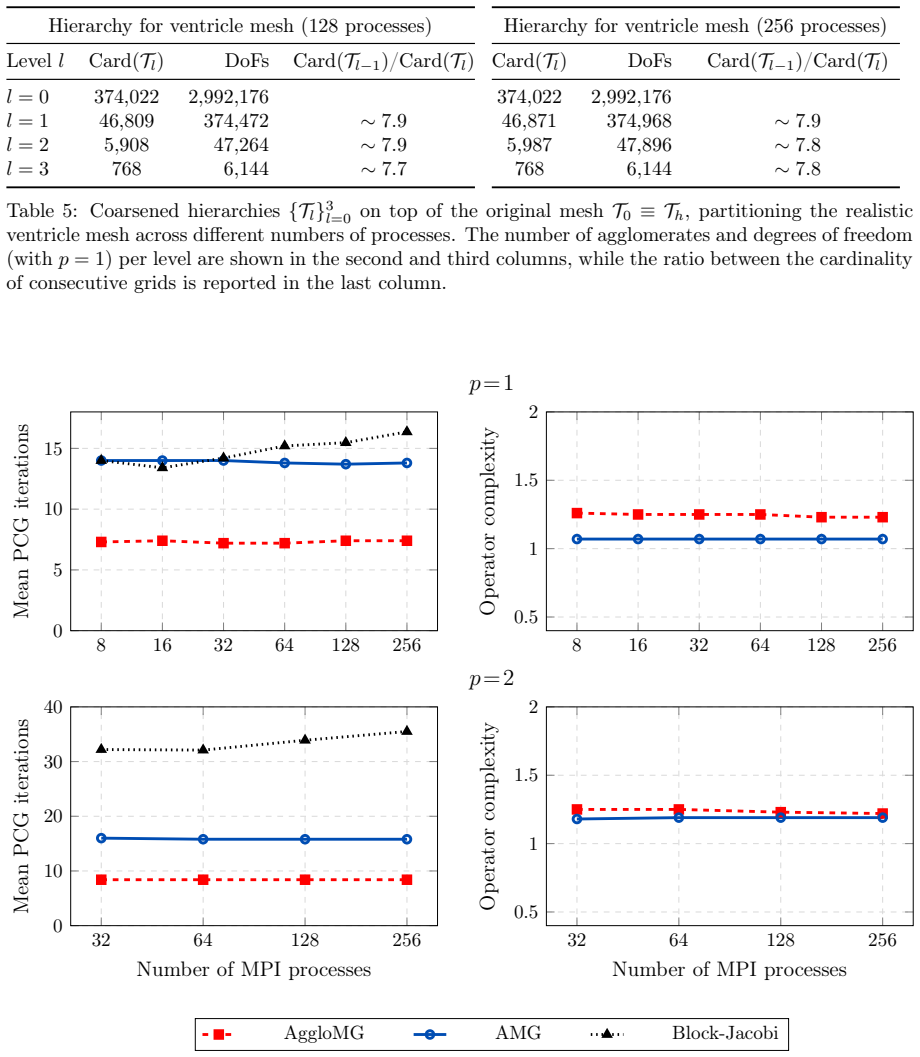
The central discovery is that agglomerating elements from a fine initial mesh produces a hierarchy of polytopic grids that supports an effective multilevel preconditioner for the DG-discretized monodomain equations. The preconditioner leverages these general coarse elements to achieve robust convergence of iterative solvers. Tests confirm strong performance and favorable scaling with respect to polynomial degree and number of levels on unstructured geometries and different ionic models.
What carries the argument
The agglomeration strategy for constructing nested hierarchies of polytopic grids from a fine mesh, which supports the multilevel preconditioner while preserving necessary stability properties.
If this is right
- The solver remains effective across increasing polynomial degrees in the discontinuous Galerkin discretization.
- Favorable scalability holds with respect to the number of levels in the multigrid preconditioner.
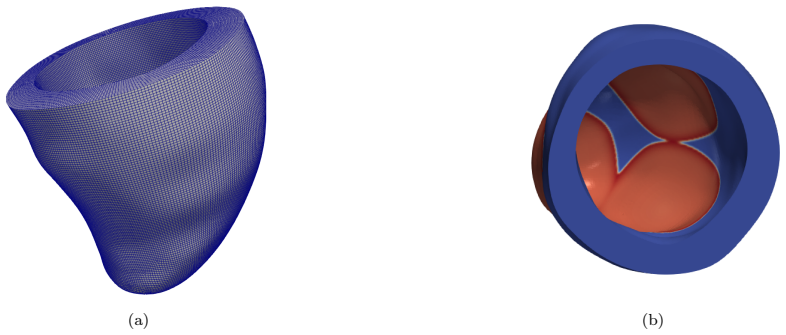
- The approach applies successfully to realistic 3D unstructured geometries and multiple ionic models.
- General polytopic elements at coarser levels maintain the approximation properties required for the preconditioner.
Where Pith is reading between the lines
- Such preconditioners could support larger-scale simulations of cardiac wave propagation by reducing the computational cost of each solve.
- The agglomeration technique might generalize to other partial differential equations discretized with discontinuous Galerkin methods on complex domains.
- Integrating this with adaptive refinement could further improve efficiency in modeling heterogeneous heart tissue.
Load-bearing premise
The agglomeration procedure must produce polytopic elements regular enough to preserve the stability and approximation properties of the discontinuous Galerkin method across levels.
What would settle it
If numerical experiments on a realistic 3D heart geometry show iteration counts growing rapidly or divergence when using high polynomial degrees or many multigrid levels, that would indicate the claim does not hold.
Figures





read the original abstract
This work presents a novel agglomeration-based multilevel preconditioner designed to accelerate the convergence of iterative solvers for linear systems arising from the discontinuous Galerkin discretization of the monodomain model in cardiac electrophysiology. The proposed approach exploits general polytopic grids at coarser levels, obtained through the agglomeration of elements from an initial, potentially fine, mesh. By leveraging a robust and efficient agglomeration strategy, we construct a nested hierarchy of grids suitable for multilevel solver frameworks. The effectiveness and performance of the methodology are assessed through a series of numerical experiments on two- and three-dimensional domains, involving different ionic models and realistic unstructured geometries. The results demonstrate strong solver effectiveness and favorable scalability with respect to both the polynomial degree of the discretization and the number of levels selected in the multigrid preconditioner.
Editorial analysis
A structured set of objections, weighed in public.
Referee Report
Summary. The paper proposes an agglomeration-based multilevel preconditioner to accelerate iterative solvers for linear systems arising from discontinuous Galerkin discretizations of the monodomain model in cardiac electrophysiology. It constructs nested hierarchies of polytopic grids via element agglomeration from an initial mesh and evaluates performance through numerical experiments on 2D and 3D domains with different ionic models and realistic unstructured geometries, claiming strong solver effectiveness together with favorable scalability in both polynomial degree and number of multigrid levels.
Significance. If the agglomeration procedure reliably preserves the shape-regularity constants required for uniform DG stability and approximation properties, the method would supply a practical, scalable solver for high-order simulations of cardiac electrical propagation on complex geometries, addressing an important computational bottleneck in electrophysiology modeling.
major comments (1)
- [Abstract] Abstract: the claim of favorable scalability with respect to polynomial degree and number of levels rests on the unverified assertion that the agglomeration strategy produces polytopic coarse elements whose shape-regularity constants (minimum angles, diameter ratios) remain controlled. No a priori bound, quality metric, or analysis is supplied showing that the coercivity/continuity constants of the DG bilinear form for the monodomain operator stay uniform; numerical results alone therefore leave the central scalability claim dependent on an unproven assumption about the coarse-grid geometry.
minor comments (2)
- [Numerical experiments] Add a table or figure panel that explicitly reports iteration counts, convergence factors, and effective condition-number estimates versus polynomial degree and level count to make the scalability statements quantitatively transparent.
- Clarify the precise definition of the agglomeration criterion (e.g., any angle or aspect-ratio threshold) and state whether it is applied uniformly across all tested geometries and ionic models.
Simulated Author's Rebuttal
We thank the referee for the careful review and constructive feedback on our manuscript. We address the major comment below and have revised the manuscript to clarify the nature of our scalability claims.
read point-by-point responses
-
Referee: [Abstract] Abstract: the claim of favorable scalability with respect to polynomial degree and number of levels rests on the unverified assertion that the agglomeration strategy produces polytopic coarse elements whose shape-regularity constants (minimum angles, diameter ratios) remain controlled. No a priori bound, quality metric, or analysis is supplied showing that the coercivity/continuity constants of the DG bilinear form for the monodomain operator stay uniform; numerical results alone therefore leave the central scalability claim dependent on an unproven assumption about the coarse-grid geometry.
Authors: We agree with the referee that the manuscript provides no a priori analysis or bounds establishing that the agglomeration procedure preserves shape-regularity constants uniformly, and therefore does not prove that the DG coercivity and continuity constants remain independent of the number of levels or polynomial degree. The scalability statements in the original abstract were based solely on the numerical experiments reported in Sections 4 and 5. To correct this, we have revised the abstract to state that the observed scalability is empirical: “The results demonstrate strong solver effectiveness and favorable scalability with respect to both the polynomial degree of the discretization and the number of levels selected in the multigrid preconditioner, as observed across the numerical experiments.” We have also added a brief remark in the introduction and conclusion noting that a theoretical analysis of the agglomeration’s effect on mesh-regularity constants lies outside the scope of the present work. These changes remove the implication of a proven uniform bound while preserving the paper’s focus on practical performance. revision: yes
Circularity Check
No circularity: solver construction and numerical validation remain independent of fitted self-references
full rationale
The paper introduces an agglomeration-based multilevel preconditioner for DG discretizations of the monodomain equation. The core construction relies on standard agglomeration operators to generate coarse polytopic grids and on established multigrid theory for the hierarchy; neither the bilinear-form stability constants nor the reported p- and level-scalability are obtained by fitting parameters to the target performance metrics themselves. Numerical experiments on 2-D/3-D cardiac geometries and ionic models supply external evidence that the agglomeration preserves sufficient shape-regularity for the observed convergence rates. No self-definitional loop, fitted-input-renamed-as-prediction, or load-bearing self-citation chain appears in the derivation or the claimed results.
Axiom & Free-Parameter Ledger
axioms (2)
- domain assumption The monodomain model is a sufficient approximation for the electrical activity in cardiac tissue under the tested conditions.
- domain assumption Agglomerated polytopic elements maintain the necessary approximation and stability properties for the DG method and multilevel preconditioner.
Lean theorems connected to this paper
-
IndisputableMonolith/Foundation/RealityFromDistinction.leanreality_from_one_distinction unclear?
unclearRelation between the paper passage and the cited Recognition theorem.
agglomeration-based multilevel preconditioner ... R-tree data structure ... inherited bilinear forms Al+1(u,v):=Al(Pl l+1 u,Pl l+1 v)
-
IndisputableMonolith/Cost/FunctionalEquation.leanwashburn_uniqueness_aczel unclear?
unclearRelation between the paper passage and the cited Recognition theorem.
no reference to recognition cost, golden-ratio ladder or 8-tick structure
What do these tags mean?
- matches
- The paper's claim is directly supported by a theorem in the formal canon.
- supports
- The theorem supports part of the paper's argument, but the paper may add assumptions or extra steps.
- extends
- The paper goes beyond the formal theorem; the theorem is a base layer rather than the whole result.
- uses
- The paper appears to rely on the theorem as machinery.
- contradicts
- The paper's claim conflicts with a theorem or certificate in the canon.
- unclear
- Pith found a possible connection, but the passage is too broad, indirect, or ambiguous to say the theorem truly supports the claim.
discussion (0)
Sign in with ORCID, Apple, or X to comment. Anyone can read and Pith papers without signing in.