GeV emission around SS 433 with 17 years Fermi-LAT observation
Pith reviewed 2026-06-30 20:49 UTC · model grok-4.3
The pith
SS 433 outflows accelerate cosmic-ray protons to GeV energies
A machine-rendered reading of the paper's core claim, the machinery that carries it, and where it could break.
Core claim
The emission from the West excess and J1913+0512 can be explained by GeV particles accelerated in SS 433, distributed throughout the source volume, and interacting with localized dense gas targets. Under reasonable assumptions regarding particle transport and energetics, both proton-proton and bremsstrahlung scenarios are viable, although the hadronic scenario is more naturally accommodated. These findings may therefore represent the first observational evidence for the acceleration of cosmic-ray protons in large-scale outflows from Galactic microquasars.
What carries the argument
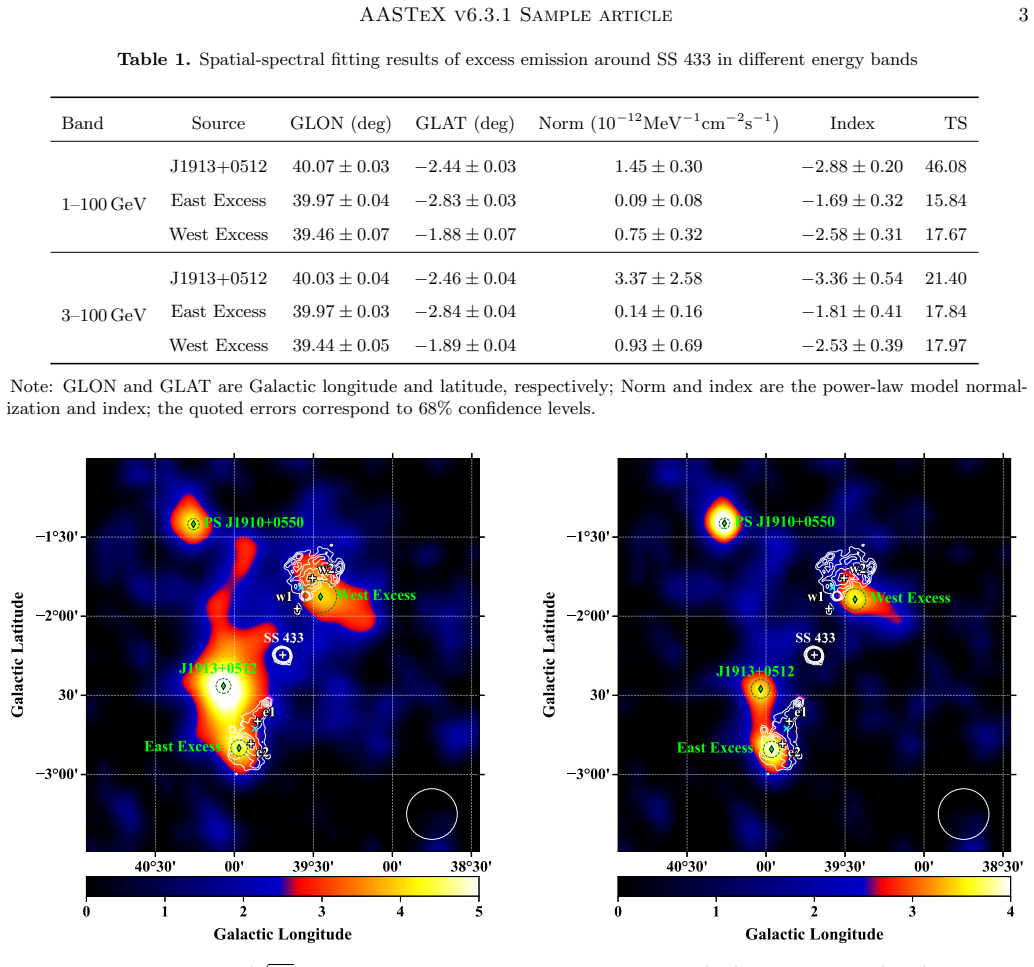
The soft-spectrum West excess (photon index ~2.6) and its spatial offset from known X-ray and TeV regions, which together indicate hadronic interactions with dense gas targets rather than the leptonic processes seen in the East excess.
If this is right
- The hadronic channel is preferred for the West excess and J1913+0512 under standard transport assumptions.
- Microquasars can accelerate cosmic-ray protons in their outflows at GeV energies.
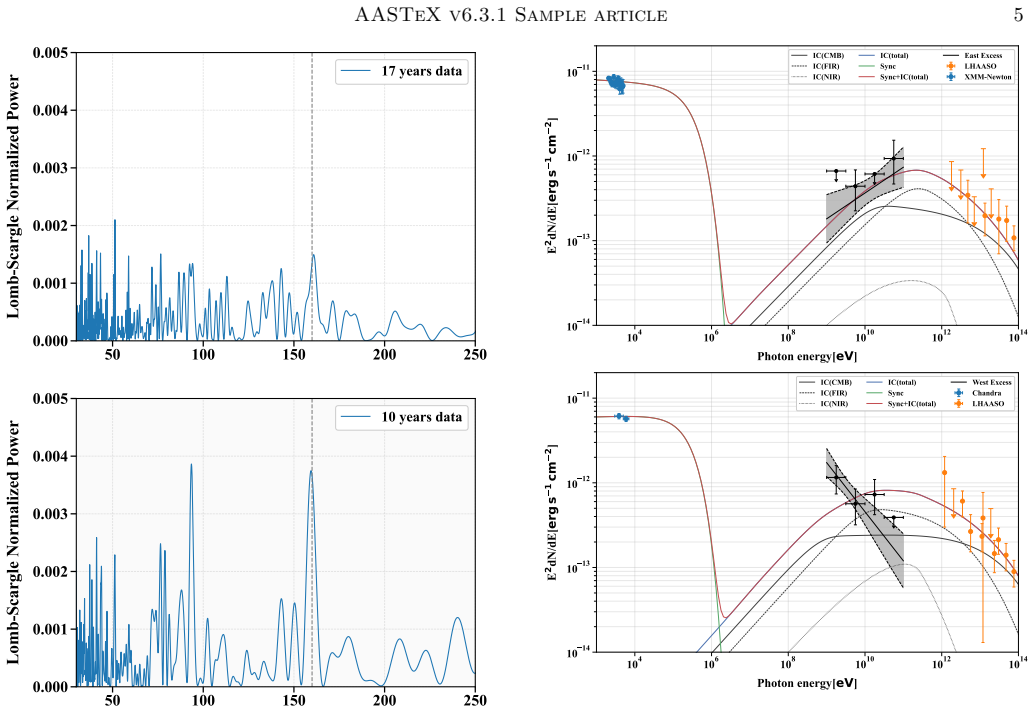
- The lack of detected periodicity in J1913+0512 over the full dataset removes earlier claims of modulation.
- The East excess is produced by the same relativistic electrons responsible for the X-ray and TeV emission via inverse Compton.
Where Pith is reading between the lines
- Similar GeV features may appear around other microquasars that drive outflows into dense interstellar gas.
- Higher-resolution gamma-ray or radio maps could directly correlate the West excess with specific dense gas clumps inside W50.
- If confirmed, microquasar outflows would join supernova remnants as contributors to the Galactic cosmic-ray spectrum below the knee.
Load-bearing premise
The GeV emission in the West excess and J1913+0512 comes from particles accelerated inside SS 433 that then interact with dense gas targets.
What would settle it
A future observation showing that the West excess has a hard spectrum matching the East excess, or exhibits the same periodic modulation as the central source, would undermine the hadronic interpretation.
Figures

read the original abstract
We present an analysis of 17 years of Fermi-LAT observations of the microquasar SS~433. We detect four GeV sources in the region: a newly identified source, PS J1910+0550, located outside W50; the previously reported source J1913+0512; and two features, denoted as the East and West excesses, apparently associated with the X-ray lobes. We focus on the three sources located within W50. We do not confirm the previously reported periodic modulation from J1913+0512, as no significant periodicity is found in the full 17-year dataset. The East and West excesses exhibit distinct morphological and spectral properties, suggesting different physical origins. The East excess shows a hard spectrum with photon index $\sim1.7$, consistent with inverse Compton emission from relativistic electrons accelerated together with the particles responsible for the X-ray and TeV emission. In contrast, the West excess has a much softer spectrum with photon index $\sim2.6$ and is spatially offset from the known X-ray and TeV emission regions in the western lobe. The spectral shape and offset position of the West excess make it strikingly similar to J1913+0512. The emission from these two regions can be explained by GeV particles accelerated in SS~433, distributed throughout the source volume, and interacting with localized dense gas targets. Under reasonable assumptions regarding particle transport and energetics, both proton-proton and bremsstrahlung scenarios are viable, although the hadronic scenario is more naturally accommodated. These findings may therefore represent the first observational evidence for the acceleration of cosmic-ray protons in large-scale outflows from Galactic microquasars.
Editorial analysis
A structured set of objections, weighed in public.
Referee Report
Summary. The manuscript analyzes 17 years of Fermi-LAT data on the microquasar SS 433, detecting four GeV sources including a new source outside W50, the previously reported J1913+0512, and East/West excesses associated with the X-ray lobes. It reports no significant periodicity in J1913+0512 over the full dataset, describes the East excess as having a hard spectrum (photon index ~1.7) consistent with inverse Compton emission, and the West excess as softer (~2.6) and offset from known lobes, similar to J1913+0512. The emission from J1913+0512 and the West excess is interpreted as arising from GeV particles accelerated in SS 433 outflows, distributed throughout the volume, and interacting with localized dense gas targets, with both pp and bremsstrahlung scenarios viable but the hadronic one preferred under reasonable transport and energetics assumptions. This is presented as possible first evidence for cosmic-ray proton acceleration in large-scale outflows from Galactic microquasars.
Significance. If the associations and hadronic interpretation hold after quantitative verification, the result would be significant as the first observational indication of proton acceleration in microquasar outflows, with implications for cosmic-ray origins in Galactic sources. The extended 17-year dataset and explicit non-confirmation of prior periodicity represent a strength in reassessing earlier claims.
major comments (3)
- [Discussion] The central claim that the West excess and J1913+0512 represent GeV particles from SS 433 outflows interacting with dense gas targets rests on 'reasonable assumptions regarding particle transport and energetics' without explicit calculations (e.g., required proton luminosity, diffusion timescales, or target column densities) matched to observed HI/CO structures at those precise locations.
- [Results (J1913+0512 analysis)] The non-confirmation of the 162-day periodicity in the full 17-year dataset removes the primary prior link for J1913+0512; the manuscript should quantify the periodicity search sensitivity and discuss what alternative morphological or spectral evidence now supports the outflow association.
- [Morphological and spectral analysis] The spatial offset of the West excess from the X-ray/TeV lobes is noted as making it similar to J1913+0512, but without a propagation model or comparison of energy budgets, the assertion that particles are 'distributed throughout the source volume' remains unquantified and load-bearing for the hadronic scenario.
minor comments (2)
- [Abstract and Results] Photon indices are quoted approximately (~1.7, ~2.6); reporting best-fit values with statistical uncertainties and the energy range of the fits would improve clarity.
- [Introduction/Results] The newly identified source PS J1910+0550 is mentioned but not analyzed in detail; a brief statement on why it is excluded from the W50-focused discussion would aid context.
Simulated Author's Rebuttal
We thank the referee for the constructive and detailed comments. We address each major comment below and indicate the revisions made to the manuscript.
read point-by-point responses
-
Referee: The central claim that the West excess and J1913+0512 represent GeV particles from SS 433 outflows interacting with dense gas targets rests on 'reasonable assumptions regarding particle transport and energetics' without explicit calculations (e.g., required proton luminosity, diffusion timescales, or target column densities) matched to observed HI/CO structures at those precise locations.
Authors: We agree that explicit calculations strengthen the discussion. In the revised manuscript we add order-of-magnitude estimates of the required proton luminosity to produce the observed GeV flux, diffusion timescales using standard ISM coefficients, and references to published HI and CO maps to estimate target column densities at the source locations. These calculations confirm that the hadronic scenario remains viable. revision: yes
-
Referee: The non-confirmation of the 162-day periodicity in the full 17-year dataset removes the primary prior link for J1913+0512; the manuscript should quantify the periodicity search sensitivity and discuss what alternative morphological or spectral evidence now supports the outflow association.
Authors: We have added a quantitative assessment of the periodicity-search sensitivity, showing that a modulation of the previously reported amplitude would have been detected at high significance in the 17-year data set. We now explicitly discuss the supporting morphological (location inside W50) and spectral (soft index consistent with hadronic emission and similarity to the West excess) evidence that remains after the periodicity is ruled out. revision: yes
-
Referee: The spatial offset of the West excess from the X-ray/TeV lobes is noted as making it similar to J1913+0512, but without a propagation model or comparison of energy budgets, the assertion that particles are 'distributed throughout the source volume' remains unquantified and load-bearing for the hadronic scenario.
Authors: We acknowledge that a full propagation model lies beyond the scope of this observational work. In revision we have added a comparison of the total energy in relativistic particles required by the observed flux with the known power of SS 433 outflows; this shows that the required energy can be supplied and distributed throughout the volume under plausible conditions. We have clarified the qualitative nature of this argument in the text. revision: partial
Circularity Check
No circularity: observational analysis with interpretive claims under explicit assumptions
full rationale
The paper performs Fermi-LAT data analysis, source detection, periodicity searches, and spectral fitting on 17 years of observations. The central claim is an interpretation that the observed GeV emission 'can be explained by' particles from SS 433 interacting with dense targets, presented as viable under 'reasonable assumptions' rather than derived from first principles or forced by any fit. No equations, predictions, or uniqueness theorems are invoked that reduce to the input data or self-citations by construction. The non-confirmation of prior periodicity is explicitly stated, removing reliance on earlier links. This is a standard observational report whose interpretation remains falsifiable against external gas maps and energetics constraints.
Axiom & Free-Parameter Ledger
axioms (1)
- domain assumption Assumptions regarding particle transport and energetics in the SS 433 outflows allow the hadronic scenario to be viable
Reference graph
Works this paper leans on
-
[1]
U., Albert, A., Alfaro, R., et al
Abeysekara, A. U., Albert, A., Alfaro, R., et al. 2018, Nature, 562, 82, doi: 10.1038/s41586-018-0565-5
-
[2]
Aharonian, F. A., Atoyan, A. M., & Kifune, T. 1997, MNRAS, 291, 162, doi: 10.1093/mnras/291.1.162
-
[3]
Alfaro, R., Alvarez, C., Arteaga-Vel´ azquez, J. C., et al. 2024, ApJ, 976, 30, doi: 10.3847/1538-4357/ad7e1b
-
[4]
J.6971071–1102 doi:10.1088/0004-637X/697/2/1071
Atwood, W. B., Abdo, A. A., Ackermann, M., et al. 2009, ApJ, 697, 1071, doi: 10.1088/0004-637X/697/2/1071
-
[5]
Blundell, K. M., & Bowler, M. G. 2004, ApJL, 616, L159, doi: 10.1086/426542 AASTeX v6.3.1 Sample article9
-
[6]
Bordas, P., Bosch-Ramon, V., Paredes, J. M., & Perucho, M. 2009, A&A, 497, 325, doi: 10.1051/0004-6361/200810781
-
[7]
2015, ApJL, 807, L8, doi: 10.1088/2041-8205/807/1/L8
Bordas, P., Yang, R., Kafexhiu, E., & Aharonian, F. 2015, ApJL, 807, L8, doi: 10.1088/2041-8205/807/1/L8
-
[8]
2009, International Journal of Modern Physics D, 18, 347, doi: 10.1142/S0218271809014601
Bosch-Ramon, V., & Khangulyan, D. 2009, International Journal of Modern Physics D, 18, 347, doi: 10.1142/S0218271809014601
-
[9]
2011, A&A, 528, A89, doi: 10.1051/0004-6361/201016364
Bosch-Ramon, V., Perucho, M., & Bordas, P. 2011, A&A, 528, A89, doi: 10.1051/0004-6361/201016364
-
[10]
1996, A&A, 312, 306
Brinkmann, W., Aschenbach, B., & Kawai, N. 1996, A&A, 312, 306
1996
-
[11]
2007, A&A, 463, 611, doi: 10.1051/0004-6361:20065570
Burwitz, V. 2007, A&A, 463, 611, doi: 10.1051/0004-6361:20065570
-
[12]
Cherepashchuk, A. M., Dodin, A. V., & Postnov, K. A. 2025, arXiv e-prints, arXiv:2506.01106, doi: 10.48550/arXiv.2506.01106
-
[13]
Clark, D. H., & Murdin, P. 1978, Nature, 276, 44, doi: 10.1038/276044a0 de la Cita, V. M., del Palacio, S., Bosch-Ramon, V., et al. 2017, A&A, 604, A39, doi: 10.1051/0004-6361/201630060
-
[14]
The Jets and and Supercritical Accretion Disk in SS433
Fabrika, S. 2004, Astrophys. Space Phys. Res., 12, 1, doi: 10.48550/arXiv.astro-ph/0603390
work page internal anchor Pith review Pith/arXiv arXiv doi:10.48550/arxiv.astro-ph/0603390 2004
-
[15]
Fang, K., Charles, E., & Blandford, R. D. 2020, ApJL, 889, L5, doi: 10.3847/2041-8213/ab62b8 H. E. S. S. Collaboration, Aharonian, F., Ait Benkhali, F., et al. 2024, Science, 383, 402, doi: 10.1126/science.adi2048
-
[16]
2024, ApJL, 961, L12, doi: 10.3847/2041-8213/ad103b
Kaaret, P., Ferrazzoli, R., Silvestri, S., et al. 2024, ApJL, 961, L12, doi: 10.3847/2041-8213/ad103b
-
[17]
2022, PASJ, 74, 1143, doi: 10.1093/pasj/psac060
Kayama, K., Tanaka, T., Uchida, H., et al. 2022, PASJ, 74, 1143, doi: 10.1093/pasj/psac060
-
[18]
Cygnus X-3: A variable petaelectronvolt gamma-ray source
Khangulyan, D., Aharonian, F. A., & Kelner, S. R. 2014, ApJ, 783, 100, doi: 10.1088/0004-637X/783/2/100 LHAASO Collaboration, Cao, Z., Aharonian, F., et al. 2025a, National Science Review, 12, nwaf496, doi: 10.1093/nsr/nwaf496 —. 2025b, arXiv e-prints, arXiv:2512.16638, doi: 10.48550/arXiv.2512.16638
work page internal anchor Pith review Pith/arXiv arXiv doi:10.1088/0004-637x/783/2/100 2014
-
[19]
Li, J., Torres, D. F., Liu, R.-Y., et al. 2020, Nature Astronomy, 4, 1177, doi: 10.1038/s41550-020-1164-6
-
[20]
Margon, B., Ford, H. C., Grandi, S. A., & Stone, R. P. S. 1979, ApJL, 233, L63, doi: 10.1086/183077
-
[21]
2026, ApJ, 1001, 92, doi: 10.3847/1538-4357/ae4e18
Oka, T., Ariyama, R., & Kotani, T. 2026, ApJ, 1001, 92, doi: 10.3847/1538-4357/ae4e18
-
[22]
Rasul, K., Chadwick, P. M., Graham, J. A., & Brown, A. M. 2019, MNRAS, 485, 2970, doi: 10.1093/mnras/stz559
-
[23]
1997, ApJ, 483, 868, doi: 10.1086/304274
Safi-Harb, S., & ¨Ogelman, H. 1997, ApJ, 483, 868, doi: 10.1086/304274
-
[24]
2022, ApJ, 935, 163, doi: 10.3847/1538-4357/ac7c05
Safi-Harb, S., Mac Intyre, B., Zhang, S., et al. 2022, ApJ, 935, 163, doi: 10.3847/1538-4357/ac7c05
-
[25]
B., & Sanduleak, N
Stephenson, C. B., & Sanduleak, N. 1971, Publications of the Warner & Swasey Observatory, 1, 1
1971
-
[26]
2019, A&A, 626, A113, doi: 10.1051/0004-6361/201935621
Sun, X.-N., Yang, R.-Z., Liu, B., Xi, S.-Q., & Wang, X.-Y. 2019, A&A, 626, A113, doi: 10.1051/0004-6361/201935621
-
[27]
2025, arXiv e-prints, arXiv:2510.14938, doi: 10.48550/arXiv.2510.14938
Sunyaev, R., Khabibullin, I., Churazov, E., et al. 2025, arXiv e-prints, arXiv:2510.14938, doi: 10.48550/arXiv.2510.14938
-
[28]
Investigation of the Microquasar SS 433 with VERITAS
Tsuji, N., Inoue, Y., Khangulyan, D., et al. 2025, ApJL, 993, L24, doi: 10.3847/2041-8213/ae0e73 VERITAS Collaboration, Archer, A., Bangale, P., et al. 2026, arXiv e-prints, arXiv:2603.22105, doi: 10.48550/arXiv.2603.22105
work page internal anchor Pith review Pith/arXiv arXiv doi:10.3847/2041-8213/ae0e73 2025
-
[29]
Wang, J., Reville, B., & Aharonian, F. A. 2025, ApJL, 989, L25, doi: 10.3847/2041-8213/adf3a4
-
[30]
2019, ApJ, 872, 25, doi: 10.3847/1538-4357/aafc60
Xing, Y., Wang, Z., Zhang, X., Chen, Y., & Jithesh, V. 2019, ApJ, 872, 25, doi: 10.3847/1538-4357/aafc60
-
[31]
Zhang, B. T., Kimura, S. S., & Murase, K. 2025, PhRvD, 112, 123015, doi: 10.1103/p6r1-qg5q
discussion (0)
Sign in with ORCID, Apple, or X to comment. Anyone can read and Pith papers without signing in.