REVIEW 2 major objections 3 minor 60 references
When Influence Misleads: Informational and Strategic Limits of Social Learning in Trading Networks
T0 review · 2 major / 3 minor · reviewed 2026-08-06 · deepseek-v4-flash
Pith's one-line read Investors on a large social trading platform copy others based on popularity, not performance, and a calibrated model shows that shifting the balance toward performance would improve returns by 6.6%.
desk verdict A genuinely interesting descriptive study of popularity bias on eToro, undercut by a model counterfactual that assumes exactly the return persistence the data say is absent. read the letter →
The pith
A machine-rendered reading of the paper's core claim, the machinery that carries it, and where it could break.
The reading
What carries the argument
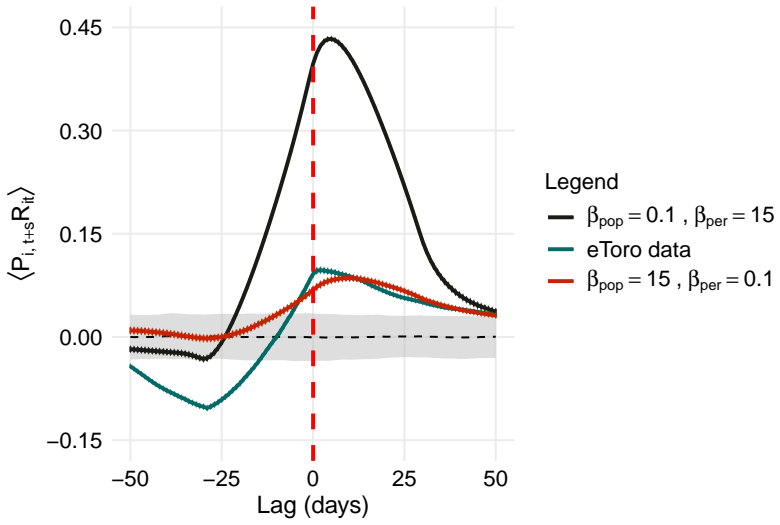
The load-bearing machinery is a temporal-network model of mirroring combined with the logistic choice rule that governs which trader gets copied. Each trader $i$ has a fixed mirror capacity $\kappa_i$ and a daily revision rate $\eta^+_i$; when revising, $i$ chooses target $j$ with probability $\logit^{-1}[\beta_{\mathrm{per}} R_{jt} + \beta_{\mathrm{pop}} P_{jt}]$, where $R_{jt}$ is the 30-day rolling return and $P_{jt}$ is popularity, then drops the lowest-ranked existing mirror to keep capacity constant. Returns on day $t$ are the average of the previous day's mirrored returns plus an independent component modeled with an Ornstein-Uhlenbeck process, a mean-reverting stochastic process with short-term correlation, calibrated to individual return dynamics (mean reversion $\theta=0.65$). Changing $\beta_{\mathrm{pop}}$ and $\beta_{\mathrm{per}}$ in this model shifts what gets copied, and the Ornstein-Uhlenbeck process determines whether past performance carries enough information for performance-weighted copying to pay off.
What would settle it
Re-estimate the model's independent-return component directly from the platform's daily closed trades and rerun the simulation with that measured persistence, or with returns made effectively independent day to day; if the 6.6% platform-ROI gain from performance weighting disappears, the design prescription rests on assumed return persistence rather than on the measured mirroring behavior.
Extended reading notes
Core claim
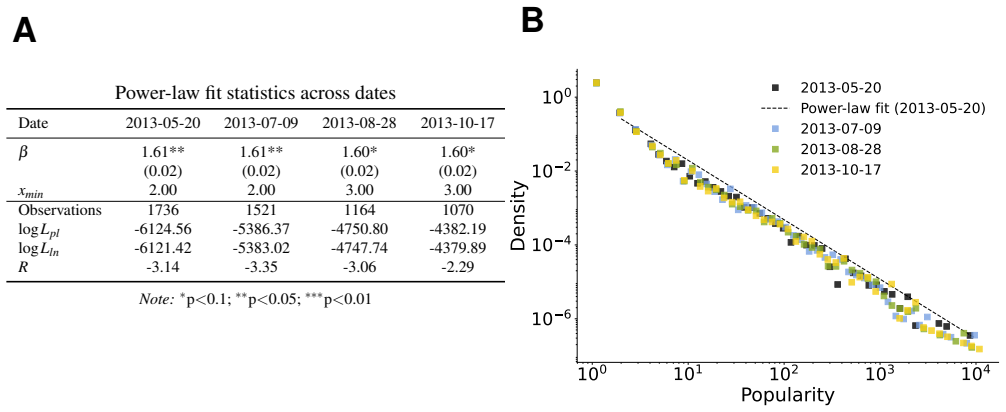
The paper's central claim is that social learning on the platform is driven by popularity rather than performance, and that this bias is why copying others is costly. In a logistic regression with day and trader fixed effects predicting who gets mirrored, popularity enters with log-odds $\beta_{\mathrm{pop}}=15.68$ versus $\beta_{\mathrm{per}}=0.34$ for 30-day performance. Popularity and performance are nearly unrelated (mean correlation $0.11$), popularity autocorrelates strongly across months, while performance autocorrelation matches a shuffled-returns null model, and users terminate mirrors using the same popularity-weighted ranking they used to create them. A temporal-network model using these estimated weights reproduces the platform's aggregate loss, weak popularity-performance correlation, and the advantage of frequently revising mirrors. In that model, reducing the popularity-to-performance weight ratio by 10% improves platform-wide returns by 6.6%.
Load-bearing premise
The counterfactual improvement from performance-based mirroring assumes that a trader's independent returns are persistent enough from one day to the next that past performance carries usable information; if daily returns are actually independent, as the paper's own shuffled-return comparison suggests, the promised gain would shrink or disappear.
Editorial extensions
If this is right
- If platforms reweight the signals behind mirroring toward rolling performance, aggregate investor ROI rises; a 10% cut in the popularity-to-performance ratio is estimated to improve platform performance by 6.6%.
- Users who frequently revise their mirroring relationships (trading explorers) outperform users who hold fixed mirrors, and the gap grows when performance signals are emphasized; in simulations the most adaptive traders can achieve up to 3 times the performance of the least adaptive.
- Because popularity and performance are only weakly correlated, and popularity autocorrelates strongly while performance does not, platform features that rank traders by follower count will keep steering capital toward strategies with no persistent edge.
- The calibrated model reproduces the observed negative average return of social learners, the weak popularity-performance correlation, and the explorer advantage, so the same mechanism can be used to evaluate design changes before deployment.
- If designers reduce the influence of popularity-based signals, performance becomes a leading indicator of future popularity, aligning social influence with realized returns.
Reading between the lines
- Beyond the paper, the same decoupling between a visible popularity signal and an objective quality signal may apply to influencer markets, news recommendation, and content platforms, where follower counts are easy to process and quality is noisy; the design lesson would be to reorder or reweight the displayed signal rather than asking users to ignore popularity.
- A testable extension would randomize the ordering of traders shown to new users; if performance-sorted lists increase mirroring of high-ROI traders, the causal role of display bias is confirmed.
- The model's equal-weighting and homogeneous-risk assumptions mean the 6.6% performance gain may not transfer to heterogeneous risk preferences; a version with risk-averse utility could show smaller or larger gains.
- The explorers' advantage suggests that even a modest weight on performance can be amplified by frequent revision, so platforms might nudge users to re-evaluate their mirrors periodically rather than only improving the ranking.
Editorial analysis
A structured set of objections, weighed in public.
Referee Report
Summary. The paper studies social learning on the eToro social trading platform, using trade and mirroring data from a seven-month stable period. It reports that mirroring decisions are driven far more by popularity than by past performance (logistic regression log-odds 15.68 vs. 0.34), that most traders maintain few and slowly changing mirrors, and that traders who revise their mirrors more frequently (explorers) perform better. The authors build a data-informed agent-based model of mirroring dynamics with an Ornstein-Uhlenbeck process for independent returns, and use it to argue that shifting weight from popularity to performance in the mirroring choice would improve platform performance by about 6.6% (Fig. 3A). The paper concludes that platform design should prioritize performance signals.
Significance. If the model-based counterfactual were sound, the paper would provide a valuable design principle for social trading platforms and a quantitative illustration of how popularity bias degrades collective outcomes. The descriptive findings—popularity bias in mirroring, the explorers vs. keepers performance gap, and the weak correlation between popularity and performance—are interesting and are supported by careful empirical analyses, including fixed-effects logistic regression, attention to missing data, and null-model comparisons. The authors also provide code and data. However, the central prescriptive claim depends on an assumption about return persistence that the paper's own empirical analysis contradicts, so the headline result is currently unsubstantiated.
major comments (2)
- [SI §4.1, Eq. (7); SI §5.2, Fig. 10A; Fig. 3A] The Ornstein-Uhlenbeck process in Eq. (7) is calibrated with θ = 0.65, which gives a one-day autocorrelation of independent returns of roughly exp(-0.65) ≈ 0.52. This is the mechanism that makes past performance predictive of future performance in the simulator. Yet SI §5.2, Fig. 10A shows that the autocorrelation of the 30-day rolling performance Rit in the eToro data is indistinguishable from a null model constructed by shuffling daily returns, and the main text explicitly states that past performance is not predictive of future performance (Results, 'Informational limitations'). The model is never validated against this key autocorrelation statistic. Consequently, the counterfactual in Fig. 3A — that shifting mirroring weight from popularity to performance raises platform ROI by 6.6% — is a direct consequence of an assumed persistence that the data do not exhibit. Without evidence of performance persistence, or an alternative mechanism (e.g., persistent latent trader skill) that the data support, the claim that prioritizing performance dramatically improves outcomes is not established.
- [SI §4, model setup; main text, 'Dynamic strategy limitations'] The model draws each trader's mirror capacity κi from a Poisson distribution with mean 10, while the empirical average reported in the main text is ⟨κit⟩ = 2.26 ± 0.01 simultaneous mirrors. This is a factor-of-four mismatch in a quantity that is central to the model's representation of cognitive limits and to the definition of γi = ηi/κi. The paper claims the model mimics the empirical distributions and the absence of correlation between η and κ, but the mean capacity is not calibrated to the data. This discrepancy may materially affect the quantitative conclusions in Fig. 3A and the comparison of explorer vs. keeper performance in Fig. 3C, and it should be corrected or explicitly justified.
minor comments (3)
- [Main text, 'Informational limitations'] The text cites SI Appendix Text 5.3 for the claim that past performance is not predictive of future performance, but the relevant analysis is the autocorrelation study in SI §5.2, Fig. 10A; SI §5.3 concerns cross-correlation between performance and popularity.
- [SI Fig. 11] The legend contains a typo: 'βperf' should be 'βper'.
- [Main text, Fig. 3A] The phrase 'reducing the ratio of popularity to performance used by users in their mirroring decisions by 10%' is ambiguous; the authors should clarify whether βpop is reduced by 10%, or whether the ratio βpop/βper is reduced by 10%, and report the resulting change in the metric.
Circularity Check
The Fig. 3A counterfactual is installed by the fitted OU persistence parameter θ=0.65 (SI Eq. 7), which contradicts the paper's own SI §5.2 finding that eToro performance is unpredictable; the headline design principle is a fitted input.
-
fitted input called prediction
[Methods / SI §4.1 Eq. (7); Figure 3A; SI §5.2 Figure 10A]
"To simulate the independent trading performance εit, we use an Ornstein-Uhlenbeck (OU) process, which is the simplest stochastic process with temporal correlation... The OU process parameters were calibrated to reproduce individual performance in the eToro platform. ... To approximate the empirical patterns observed on eToro... we set µ = −0.1bps and θ = 0.65."
With the Euler discretization of SI Eq. (7), θ=0.65 makes daily independent returns an AR(1) process with coefficient exp(−0.65)≈0.52, so past 30-day performance R_jt contains information about future ε_jt. The Fig. 3A counterfactual then follows directly: increasing β_per makes traders select the high-R_jt agents, who are by construction the ones with high expected future independent returns, so the simulated platform ROI rises. That 'prediction' is installed by the fitted OU persistence, not derived from eToro. The paper's own SI §5.2/Fig.
full rationale
Most of the paper is a self-contained empirical study: the logistic regression in Eq. 1, the popularity-vs-performance correlations, and the explorers-vs-keepers result are all estimated directly from eToro data, and no circularity was found in those descriptive parts. No load-bearing self-citation or imported uniqueness theorem is used. The circularity is localized to the model-based counterfactual in Fig. 3A. The OU process in SI Eq. (7) is calibrated with θ=0.65 (SI §4.1) to reproduce eToro moments, but that value injects strong day-to-day autocorrelation into independent returns. In that simulator, past 30-day performance is genuinely predictive of future returns, so increasing β_per automatically selects better-performing traders and raises average ROI. The paper's own SI §5.2 shows that in the actual eToro data performance autocorrelation matches a shuffled null model—performance is not predictive—so the simulated 'prediction' is not an independent result but a direct consequence of a fitted, internally contradicted input. This warrants a score of 6: one central prescriptive claim reduces to a fitted parameter, while the descriptive findings remain independent. The correct fix would be to calibrate or validate the OU persistence against the autocorrelation evidence, or to replace it with a persistent-trader mechanism supported by data.
Assumptions & free parameters
free parameters (7)
- βpop =
15.68
- βper =
0.34
- OU mean reversion θ =
0.65
- OU long-term mean μ =
-0.1 bps
- Mirror capacity κ distribution =
Poisson(10)
- Mirror propensity η distribution =
Uniform(0,1)
- Mirrored/independent investment split =
0.5/0.5
assumptions (5)
- domain assumption Logistic form for mirror choice probability (Eq. 1) with trader and day fixed effects
- domain assumption Ornstein-Uhlenbeck process for independent returns (Eq. 7)
- ad hoc to paper Mirrored return is the previous day's average of mirrored traders' returns (Eq. 5)
- domain assumption Stability of the observation window Ω
- ad hoc to paper When adding a mirror, remove the existing mirror with lowest selection probability
Cite this review
Pith. "Pith review of When Influence Misleads: Informational and Strategic Limits of Social Learning in Trading Networks." pith.science (2026). https://pith.science/paper/VGCQQF7I
@misc{pith2026250701817,
  author       = {Pith},
  title        = {Pith review of: When Influence Misleads: Informational and Strategic Limits of Social Learning in Trading Networks},
  year         = {2026},
  howpublished = {\url{https://pith.science/paper/VGCQQF7I}},
  note         = {Machine review of arXiv:2507.01817}
}
read the original abstract
Social learning is a fundamental mechanism shaping decision-making across numerous social networks, including social trading platforms. In those platforms, investors combine traditional investing with copying the behavior of others. However, the underlying factors that drive mirroring decisions and their impact on performance remain poorly understood. Using high-resolution data on trades and social interactions from a large social trading platform, we uncover a fundamental tension between popularity and performance in shaping imitation behavior. Despite having access to performance data, people overwhelmingly choose whom to mirror based on social popularity, a signal poorly correlated with actual performance. This bias, reinforced by cognitive constraints and slow-changing popularity dynamics, results in widespread underperformance. However, traders who frequently revise their mirroring choices (trading explorers) consistently outperform those who maintain more static connections. Building an accurate model of social trading based on our findings, we show that prioritizing performance over popularity in social signals dramatically improves both individual and collective outcomes in trading platforms. These findings expose the hidden inefficiencies of social learning and suggest design principles for building more effective platforms.
Figures


Figures from the paper (8 more)




Reference graph
Works this paper leans on
-
[1]
author Woolley, A. W. , author Chabris, C. F. , author Pentland, A. , author Hashmi, N. & author Malone, T. W. journal title Evidence for a collective intelligence factor in the performance of human groups . Science volume 330 , pages 686--688 ( year 2010 )
work page 2010
-
[2]
author Riedl, C. , author Kim, Y. J. , author Gupta, P. , author Malone, T. W. & author Woolley, A. W. journal title Quantifying collective intelligence in human groups . Proceedings of the National Academy of Sciences volume 118 , pages e2005737118 ( year 2021 )
work page 2021
-
[3]
title The Wisdom of Crowds ( publisher Anchor , year 2005 )
author Surowiecki, J. title The Wisdom of Crowds ( publisher Anchor , year 2005 )
work page 2005
-
[4]
author Rendell, L. et al. journal title Why copy others? insights from the social learning strategies tournament . Science volume 328 , pages 208--213 ( year 2010 )
work page 2010
-
[5]
author Pan, W. title Reality hedging: Social system approach for understanding economic and financial dynamics ( year 2015 )
work page 2015
-
[6]
author Riedl, C. & author Seidel, V. P. journal title Learning from mixed signals in online innovation communities . Organization Science volume 29 , pages 1010--1032 ( year 2018 )
work page 2018
-
[7]
author Weng, L. , author Flammini, A. , author Vespignani, A. & author Menczer, F. journal title Competition among memes in a world with limited attention . Scientific Reports volume 2 , pages 335 , 10.1038/srep00335 ( year 2012 )
-
[8]
author Watts, D. J. journal title The “new” science of networks . Annu. Rev. Sociol. volume 30 , pages 243--270 ( year 2004 )
work page 2004
Show all 60 references
-
[9]
author Lazer, D. et al. journal title Computational social science . Science volume 323 , pages 721--723 , 10.1126/science.1167742 ( year 2009 )
2009 doi
-
[10]
author Lo, A. W. journal title Reconciling efficient markets with behavioral finance: The adaptive markets hypothesis . Journal of Investment Consulting volume 7 , pages 21--44 ( year 2005 ). note Available at SSRN: https://ssrn.com/abstract=1702447
2005
-
[11]
, author Hagerty, K
author Saavedra, S. , author Hagerty, K. & author Uzzi, B. journal title Synchronicity, instant messaging, and performance among financial traders . Proceedings of the National Academy of Sciences volume 108 , pages 5296--5301 , 10.1073/pnas.1018462108 ( year 2011 )
-
[12]
, author Peng, L
author Hirshleifer, D. , author Peng, L. & author Wang, Q. title News diffusion in social networks and stock market reactions . type NBER Working Paper number 30860 , institution National Bureau of Economic Research ( year 2023 ). note Revised February 2024
2023
-
[13]
, author Hirshleifer, D
author Bikhchandani, S. , author Hirshleifer, D. & author Welch, I. journal title A theory of fads, fashion, custom, and cultural change as informational cascades . Journal of Political Economy volume 100 , pages 992--1026 , 10.1086/261849 ( year 1992 )
-
[14]
author Shiller, R. J. title Irrational Exuberance ( publisher Princeton University Press , address Princeton, NJ , year 2000 )
2000
-
[15]
journal title Crises and collective socio-economic phenomena: Simple models and challenges
author Bouchaud, J.-P. journal title Crises and collective socio-economic phenomena: Simple models and challenges . Journal of Statistical Physics volume 151 , pages 567--606 , 10.1007/s10955-012-0687-3 ( year 2013 )
2013 doi
-
[16]
, author Altshuler, Y
author Pan, W. , author Altshuler, Y. & author Pentland, A. title Decoding social influence and the wisdom of the crowd in financial trading network . In booktitle Privacy, Security, Risk and Trust (PASSAT), 2012 International Conference on and Social Computing (SocialCom) , p...
2012
-
[17]
title Social trading platform market size, share & growth analysis – 2031
author The Insight Partners . title Social trading platform market size, share & growth analysis – 2031 . howpublished https://www.theinsightpartners.com/reports/social-trading-platform-market ( year 2025 ). note Accessed: 2025-04-05
2025
- [18]
-
[19]
author Almaatouq, A. et al. journal title Adaptive social networks promote the wisdom of crowds . Proceedings of the National Academy of Sciences volume 117 , pages 11379--11386 , 10.1073/pnas.1917687117 ( year 2020 ). note Publisher: Proceedings of the National Academy of Sciences
2020 doi
-
[20]
author Dorfleitner, G. et al. journal title To follow or not to follow - an empirical analysis of the returns of actors on social trading platforms . The Quarterly Review of Economics and Finance volume 70 , pages 160--171 , DOI here if available ( year 2018 )
2018
-
[21]
author Krafft, P. M. et al. journal title Popularity and performance: A large-scale study . arXiv preprint arXiv:1406.7729 ( year 2014 )
2014 arXiv
-
[22]
, author Yang, M
author Liu, Y. , author Yang, M. & author Tan, Y. title Coevolution of Trader Networks and Follower Dynamics in Social Trading , 10.2139/ssrn.4528456 ( year 2023 )
2023 doi
-
[23]
& author Galesic, M
author Barkoczi, D. & author Galesic, M. journal title Social learning strategies modify the effect of network structure on group performance . Nature Communications volume 7 , pages 13109 , 10.1038/ncomms13109 ( year 2016 )
2016 doi
-
[24]
author Lu, J. S. title To mirror or not to mirror – modeling relationships in social trading . howpublished https://dspace.mit.edu/bitstream/handle/1721.1/112852/1015683926-MIT.pdf ( year 2017 ). note Accessed: 2023-03-06
2017
-
[25]
, author Altshuler, Y
author Somin, S. , author Altshuler, Y. , author Pentland, A. & author Shmueli, E. journal title Remaining popular: power-law regularities in network dynamics . EPJ Data Science volume 11 , pages 1--14 , 10.1140/epjds/s13688-022-00373-3 ( year 2022 ). note Number: 1 Publisher:...
-
[26]
author Miritello, G. et al. journal title Time as a limited resource: Communication strategy in mobile phone networks . Social Networks volume 35 , pages 89--95 ( year 2013 )
2013
-
[27]
& author Selten, R
author Gigerenzer, G. & author Selten, R. journal title Decision making: Nonrational theories . Encyclopedia of the Social and Behavioral Sciences pages 13347--13351 ( year 2001 )
2001
-
[28]
& author Veldkamp, L
author Van Nieuwerburgh, S. & author Veldkamp, L. journal title Information acquisition and under-diversification . The Review of Economic Studies volume 77 , pages 779--805 , 10.1111/j.1467-937X.2009.00583.x ( year 2010 )
2009 arXiv
-
[29]
& author Albert, R
author Barab \'a si, A.-L. & author Albert, R. journal title Emergence of scaling in random networks . Science volume 286 , pages 509--512 , 10.1126/science.286.5439.509 ( year 1999 )
1999 doi
-
[30]
author Lera, S. C. , author Pentland, A. & author Sornette, D. journal title Prediction and prevention of disproportionally dominant agents in complex networks . Proceedings of the National Academy of Sciences volume 116 , pages 8255--8260 , 10.1073/pnas.1819617116 ( year 2019 )
-
[31]
author Salganik, M. J. , author Dodds, P. S. & author Watts, D. J. journal title Experimental Study of Inequality and Unpredictability in an Artificial Cultural Market . Science volume 311 , pages 854--856 , 10.1126/science.1121066 ( year 2006 ). note Publisher: American Assoc...
-
[32]
journal title The social brain hypothesis
author Dunbar, R. journal title The social brain hypothesis . Evolutionary Anthropology: Issues, News, and Reviews volume 6 , pages 178 ( year 1998 )
1998
-
[33]
author Leys, A. J. & author Vanclay, J. K. journal title Social learning: A knowledge and capacity building approach for adaptive co-management of contested landscapes . Land Use Policy volume 28 , pages 574--584 , 10.1016/j.landusepol.2010.11.006 ( year 2011 )
-
[34]
, author Lara, R
author Miritello, G. , author Lara, R. , author Cebrian, M. et al. journal title Limited communication capacity unveils strategies for human interaction . Scientific Reports volume 3 , pages 1950 , 10.1038/srep01950 ( year 2013 )
1950 doi
-
[35]
author Maller, R. A. , author M \"u ller, G. & author Szimayer, A. journal title Ornstein--uhlenbeck processes and extensions . Handbook of financial time series pages 421--437 ( year 2009 )
2009
-
[36]
author Banerjee, A. V. journal title A simple model of herd behavior . The Quarterly Journal of Economics volume 107 , pages 797--817 ( year 1992 )
1992
-
[37]
& author Goldstein, D
author Gigerenzer, G. & author Goldstein, D. G. journal title Reasoning the fast and frugal way: Models of bounded rationality . Psychological Review volume 103 , pages 650--669 ( year 1996 )
1996
-
[38]
, author Valone, T
author Giraldeau, L.-A. , author Valone, T. J. & author Templeton, J. J. journal title Potential disadvantages of using socially acquired information . Philosophical Transactions of the Royal Society of London. Series B: Biological Sciences volume 357 , pages 1559--1566 , 10.1...
-
[39]
& author Watts, D
author Mason, W. & author Watts, D. J. journal title Collaborative learning in networks . Proceedings of the National Academy of Sciences volume 109 , pages 764--769 , 10.1073/pnas.1110069108 ( year 2012 )
2012 doi
-
[40]
author Barber, B. M. & author Odean, T. journal title All that glitters: The effect of attention and news on the buying behavior of individual and institutional investors . The Review of Financial Studies volume 21 , pages 785--818 , 10.1093/rfs/hhm079 ( year 2008 )
-
[41]
& author Thaler, R
author Barberis, N. & author Thaler, R. title A survey of behavioral finance . type Working Paper number 9222 , institution National Bureau of Economic Research ( year 2002 ). 10.3386/w9222
2002 doi
-
[42]
, author Aral, S
author Muchnik, L. , author Aral, S. & author Taylor, S. J. journal title Social influence bias: A randomized experiment . Science volume 341 , pages 647--651 , 10.1126/science.1240466 ( year 2013 )
2013 doi
-
[43]
author Loader, B. D. , author Vromen, A. & author Xenos, M. A. journal title Performing for the young networked citizen? celebrity politics, social networking and the political engagement of young people . Media, Culture & Society volume 38 , pages 400--419 , 10.1177/016344371...
-
[44]
title Entertaining the Citizen : When Politics and Popular Culture Converge
author van Zoonen, L. title Entertaining the Citizen : When Politics and Popular Culture Converge . Critical Media Studies : Institutions , Politics , and Culture Series ( publisher Rowman & Littlefield , year 2005 )
2005
-
[45]
& author Azam, M
author Shamim, K. & author Azam, M. journal title The power of social media influencers: unveiling the impact on consumers’ impulse buying behaviour . Humanities and Social Sciences Communications volume 11 , pages 1461 , 10.1057/s41599-024-03796-7 ( year 2024 )
-
[46]
author Barquero Cabrero, J. D. , author Castillo-Abdul, B. , author Talam \'a s-Carvajal, J. A. , author Herrero-Diz, P. & author Tapia-Frade, A. journal title Owned media, influencer marketing, and unofficial brand ambassadors: differences between narratives, types of prescri...
-
[47]
journal title Want to be on the top? Algorithmic power and the threat of invisibility on Facebook
author Bucher, T. journal title Want to be on the top? Algorithmic power and the threat of invisibility on Facebook . New Media & Society volume 14 , pages 1164--1180 , 10.1177/1461444812440159 ( year 2012 ). note Publisher: SAGE Publications
2012 doi
-
[48]
, author Roy, D
author Vosoughi, S. , author Roy, D. & author Aral, S. journal title The spread of true and false news online . Science volume 359 , pages 1146--1151 , 10.1126/science.aap9559 ( year 2018 ). note Publisher: American Association for the Advancement of Science
2018 doi
-
[49]
, author Mansoury, M
author Abdollahpouri, H. , author Mansoury, M. , author Burke, R. & author Mobasher, B. title The Connection Between Popularity Bias , Calibration , and Fairness in Recommendation . In booktitle Proceedings of the 14th ACM Conference on Recommender Systems , RecSys '20, pages ...
-
[50]
W. Pan, Y. Altshuler, and A. Pentland. Decoding social influence and the wisdom of the crowd in financial trading network. In Privacy, Security, Risk and Trust (PASSAT), 2012 International Conference on and Social Computing (SocialCom) , pages 203--209, Amsterdam, Netherlands,...
2012
-
[51]
powerlaw: A python package for analysis of heavy-tailed distributions
Jeff Alstott, Ed Bullmore, and Dietmar Plenz. powerlaw: A python package for analysis of heavy-tailed distributions. PLoS ONE , 9(1):e85777, January 2014
2014
-
[52]
P. M. Krafft, Erez Shmueli, Thomas L. Griffiths, Joshua B. Tenenbaum, and Alex Pentland. Bayesian collective learning emerges from heuristic social learning. Cognition , 212:104469, July 2021
2021
-
[53]
Peter M. Krafft. A Rational Choice Framework for Collective Behavior . PhD thesis, Massachusetts Institute of Technology, Cambridge, MA, 2016. Ph.D. Dissertation, Department of Electrical Engineering and Computer Science
2016
-
[54]
Krafft, Julia Zheng, Wei Pan, Nicolás Della Penna, Yaniv Altshuler, Erez Shmueli, Joshua B
Peter M. Krafft, Julia Zheng, Wei Pan, Nicolás Della Penna, Yaniv Altshuler, Erez Shmueli, Joshua B. Tenenbaum, and Alex Pentland. Human collective intelligence as distributed Bayesian inference, August 2016. arXiv:1608.01987 [cs]
2016 arXiv
-
[55]
Efficient estimation of maximum likelihood models with multiple fixed-effects: the r package fenmlm
Laurent Bergé. Efficient estimation of maximum likelihood models with multiple fixed-effects: the r package fenmlm. Technical Report 2013-13, CREA Discussion Papers, 2018
2013
-
[56]
Hagberg, Daniel A
Aric A. Hagberg, Daniel A. Schult, and Pieter J. Swart. Exploring network structure, dynamics, and function using networkx. In Gaël Varoquaux, Travis Vaught, and Jarrod Millman, editors, Proceedings of the 7th Python in Science Conference (SciPy2008) , pages 11--15, Pasadena, ...
2008
-
[57]
Oliphant, Matt Haberland, Tyler Reddy, David Cournapeau, Evgeni Burovski, Pearu Peterson, Warren Weckesser, Jonathan Bright, St \'e fan J
Pauli Virtanen, Ralf Gommers, Travis E. Oliphant, Matt Haberland, Tyler Reddy, David Cournapeau, Evgeni Burovski, Pearu Peterson, Warren Weckesser, Jonathan Bright, St \'e fan J. van der Walt, Matthew Brett, Joshua Wilson, K. Jarrod Millman, Nikolay Mayorov, Andrew R. J. Nelso...
2020
-
[58]
John D. Hunter. Matplotlib: A 2d graphics environment. Computing in Science & Engineering , 9(3):90--95, 2007
2007
-
[59]
, " * write output.state after.block = add.period write newline
ENTRY address archive author booktitle chapter edition editor eprint howpublished institution journal key month note number organization pages publisher school series title type url doi volume year label INTEGERS output.state before.all mid.sentence after.sentence after.block ...
-
[60]
write newline
" write newline "" before.all 'output.state := FUNCTION n.dashify 't := "" t empty not t #1 #1 substring "-" = t #1 #2 substring "--" = not "--" * t #2 global.max substring 't := t #1 #1 substring "-" = "-" * t #2 global.max substring 't := while if t #1 #1 substring * t #2 gl...
Reviewed August 6, 2026 · model on record in the stance chip above.
Discussion (0). Sign in to comment.