REVIEW 4 major objections 5 minor 1 cited by
Dispersion in an array of buildings in stable and convective atmospheric conditions
T0 review · 4 major / 5 minor · reviewed 2026-08-14 · deepseek-v4-flash
Pith's one-line read Wind-tunnel tests show stable stratification can double pollutants inside a building canopy, convective can cut them by two-thirds, with plume width barely changing.
desk verdict New stratified-canopy dispersion data are the genuine contribution; the Kz parametrisation is overfitted and should not be taken as predictive. read the letter →
The pith
A machine-rendered reading of the paper's core claim, the machinery that carries it, and where it could break.
The reading
What carries the argument
The argument runs on two devices. First, Gaussian fits to the measured concentration profiles, $C = A \exp\!\left(-(y_{\mathrm{plume}}-\mu)^2/(2\sigma_h^2)\right)$ for lateral cuts and the analogous form with $\sigma_z$ for vertical cuts: every derived quantity — the plume central-axis angle, the width $\sigma_h$, the depth $\sigma_z$, and the vertical gradient $\partial\bar{C}/\partial z$ used in the flux test — is read from these fitted curves rather than from direct moments of the data. Second, the K-theory flux–gradient identity $K_z\,\partial\bar{C}/\partial z = -\overline{w'c'}$, which the paper tests by comparing measured vertical turbulent pollutant fluxes with the gradient of the Gaussian-fitted mean concentration at the same measurement locations, then collapses the fitted proportionality constant $K_z$ onto the bulk stability parameters $\delta/L$ and $\mathrm{Ri}_\delta$ through quadratic parametrisations.
What would settle it
Take the raw concentration profiles and recompute the reported quantities without any shape assumption: estimate $\sigma_h$ and $\sigma_z$ from the second moments of the measured distributions by numerical integration, recover $\partial\bar{C}/\partial z$ by finite differences of the measured mean concentrations, and locate plume-axis positions from the measured peak values rather than from Gaussian fits. If these direct estimates agree with the fitted values, the claims stand; if they drift apart near the source inside the canopy, the central comparisons — width nearly unaffected, vertical gradient proportional to flux — rest on the Gaussian assumption rather than on the measurements.
Extended reading notes
Core claim
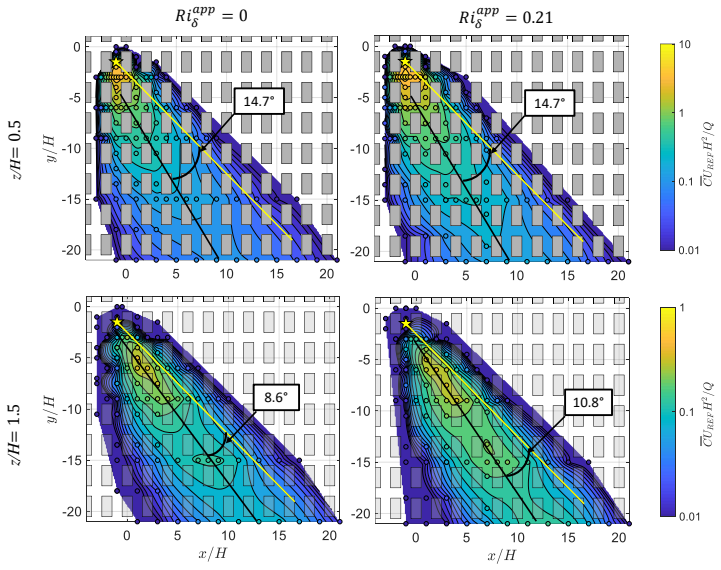
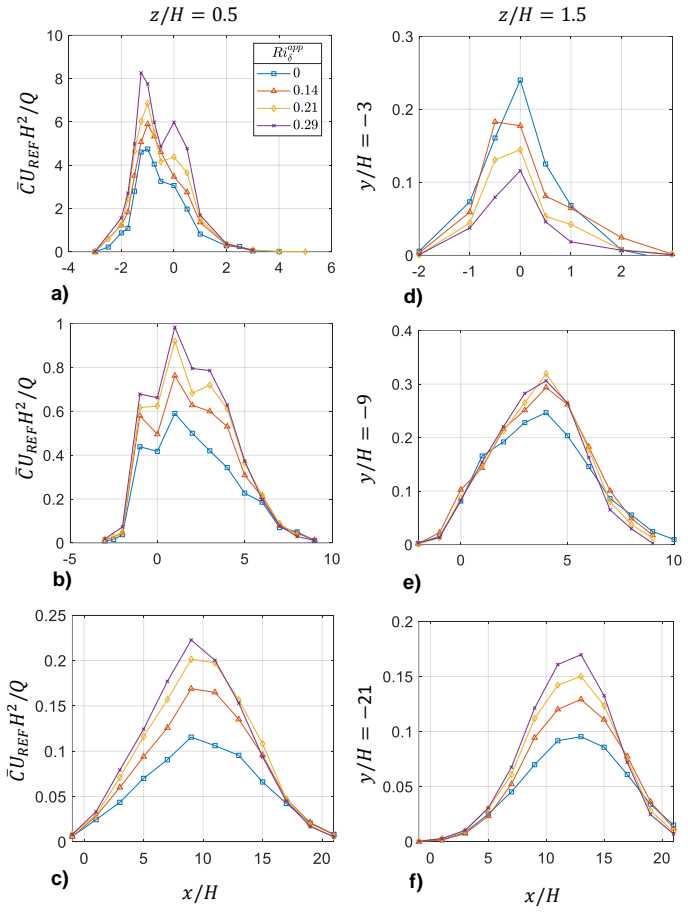
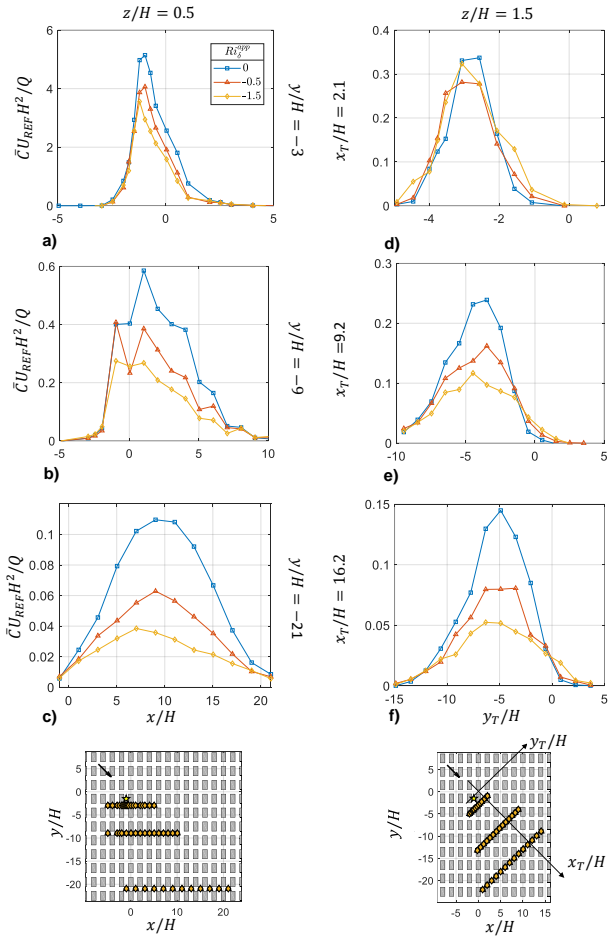
On the paper's own terms, the central claim is that “the stratification (either stable or unstable) effect on the plume width is significantly lower than the effect on the vertical profiles.” Stable stratification doubled the mean concentrations measured inside the canopy (up to two times the neutral values, increasing with Richardson number) while leaving the plume's central axis unchanged — the axis stayed channelled by the street geometry at about 14.7° — and convective stratification cut canopy concentrations by up to a factor of three while deflecting the in-canopy plume axis by about 20% more than neutral flow. Above the canopy both types of stratification increased the plume deflection angle slightly (8.6° to 10.8° for the stable case). The fitted plume depth $\sigma_z$ was reduced by up to 30% under stable layers and markedly deepened under convective ones, whereas the fitted width $\sigma_h$ changed only marginally, reproducing the pattern of earlier field experiments. Finally, the vertical turbulent pollutant flux scaled with the vertical mean-concentration gradient, confirming K-theory ($K_z\,\partial\bar{C}/\partial z = -\overline{w'c'}$) under stratification, with fitted mean eddy diffusivities $K_z(\delta/L) = 0.0202\,(\delta/L)^2 - 0.0425\,(\delta/L) + 0.0306$ and $K_z(\mathrm{Ri}_\delta) = -0.0064\,\mathrm{Ri}_\delta^2 - 0.0839\,\mathrm{Ri}_\delta + 0.0294$.
Load-bearing premise
Everything quantitative in the study — plume angles, widths, depths, and the vertical gradients used to confirm K-theory — is read off Gaussian curves fitted to the measured concentration profiles, and the paper reports no goodness-of-fit statistics, so if those profiles are not genuinely Gaussian (especially inside street canyons one building height from the source) the comparisons lose their quantitative footing.
Editorial extensions
If this is right
- Urban dispersion models that neglect stratification will mis-predict in-canopy pollutant levels by factors of two to three in the tested range, because the vertical concentration response is large while the lateral plume width stays almost neutral-like.
- Neutral-case lateral dispersion parametrisations can probably be kept in stratified urban modelling, with stratification corrections applied to vertical spread and to in-canopy concentration, since $\sigma_h$ changed only slightly in all five stratified cases.
- Models that use K-theory closures can carry the same flux–gradient proportionality into stratified conditions, with eddy diffusivity reduced under stable layers and increased under convective ones according to the fitted quadratic forms.
- Scaled to full size, the tested stratification range corresponds to roughly the conditions observed about 75% of the time over London ($-1 < z'/L < 1$), so the results bear on common urban conditions rather than only extreme ones.
- The reported profiles of mean concentration, variance, and total and turbulent vertical fluxes form a benchmark for validating large-eddy simulations and fast dispersion models under non-neutral stratification.
Reading between the lines
- The mean $K_z$ values in the parametrisations hide a factor-of-three spread across the three measurement locations (0.009–0.14), which suggests that a single scalar eddy diffusivity may be too crude for street-scale models and that location-dependent or turbulence-based $K_z$ formulations would be needed to exploit the confirmed K-theory.
- The in-canopy axis deflection under convection is quantified for only the strongest unstable case ($\mathrm{Ri}^{\mathrm{app}}_\delta = -1.5$); testing whether the axis shift scales with the convective velocity ratio $w_*/U_{\mathrm{REF}}$ across several instability levels would show whether it is a general convective-canopy feature.
- Because the array is regular and aligned at 45°, the width-insensitivity result is tied to this geometry; the natural generalisation — which the authors themselves gesture at with tall buildings — is to re-test whether lateral spread stays neutral-like in staggered or heterogeneous urban layouts before treating it as a universal stratification result.
Signed reviews
Editorial analysis
A structured set of objections, weighed in public.
Referee Report
Summary. This paper reports wind-tunnel experiments on passive scalar dispersion from a ground-level point source in a regular array of rectangular buildings, under three stable, two convective, and two neutral reference boundary layers (bulk Richardson numbers from about -1.5 to 0.29). The central observational claims are that stratification affects the vertical spread of the plume much more than its lateral width, that stable stratification increases in-canopy mean concentrations by up to roughly a factor of two while convective stratification lowers them by up to roughly a factor of three, that the plume axis inside the canopy is unaffected by stable stratification but deviates under the strongest convective case, and that the vertical turbulent pollutant flux is proportional to the vertical mean concentration gradient, with fitted eddy-diffusivity parameterizations given in Eqs. (5) and (6). The paper also emphasizes the value of the dataset for validating numerical models and developing parameterizations for non-neutral urban dispersion.
Significance. If the quantitative conclusions are accepted, this is a valuable contribution to a sparse experimental literature: there are very few laboratory datasets on stratified flow and dispersion over urban-like arrays, and the authors provide concentration means, variances, and fluxes with reported standard errors and a public data repository. The qualitative result that vertical spread is more sensitive to stratification than lateral spread is physically plausible and supported by the raw profiles, and the contrast with Kanda and Yamao (2016) is worth documenting. The K-theory confirmation and the parameterizations in Eqs. (5)-(6), however, are not yet supported to the quantitative level claimed, because the analysis depends on Gaussian fits whose quality and uncertainty are not reported and because the polynomial fits use seven mean values with three free parameters. The paper would be a strong experimental contribution after the quantitative claims are either properly qualified or backed with fit diagnostics and uncertainty estimates.
major comments (4)
- [§5, Fig. 16, Table 2] The claim that K-theory is 'confirmed' in the stratified cases is not quantitatively supported as presented. In Fig. 16 the vertical concentration gradient is obtained by differentiating a Gaussian fit rather than from measured differences, yet no residuals, goodness-of-fit measures, confidence intervals, or propagation of fitting uncertainty are reported. Table 2 lists Kz values from three locations with no standard errors or ranges, and the values vary by roughly a factor of three across locations (e.g., from 0.02 to 0.035 in the neutral SBL case). Without such uncertainty information, the visual proportionality in Fig. 16 cannot be distinguished from an artifact of a smooth fitted profile, especially inside the canopy where Section 4.1 and Fig. 4 indicate the mean concentration is approximately constant with height.
- [§5, Eqs. (5)-(6), Fig. 17] The polynomial parameterizations Kz(δ/L) and Kz(Riδ) are descriptive fits to seven mean values (two neutral, three stable, two convective) with three free coefficients each, and no uncertainties are reported for the coefficients or the fitted curve. This is too few points for a second-order polynomial to be presented as a predictive parameterization, and there is no independent validation or cross-validation. The paper should either present these as purely illustrative fits with explicit caveats, or add uncertainty bounds, a validation subset, or a physically motivated functional form with fewer free parameters.
- [§4.1, Eq. (3) and similar vertical fits] All quantitative plume width and depth statistics (σh, σz), the plume-axis angles, and the vertical concentration gradient used in the K-theory test are derived from Gaussian fits, but the manuscript provides no fit diagnostics. Section 4.1 states the fit was 'remarkably satisfactory' without showing residuals or goodness-of-fit statistics. Given that Fig. 4 shows near-constant concentration with height inside the canopy, the vertical Gaussian assumption is not self-evident. The qualitative width-versus-depth conclusion is supported by the raw profiles and is likely robust, but the quantitative σ values and the fitted gradient should be reported with uncertainty estimates or replaced by direct estimates from the measured profiles.
- [§4.2, Fig. 9] The abstract and conclusions state that in the unstable case the plume central axis 'appeared to deviate' from the neutral direction inside the canopy, but this rests on a single quantified case (Riapp = -1.5). The text notes that the weaker convective case (Riapp = -0.5) gives a plume direction inside the urban model 'close to the neutral reference case' and that figure is not shown. This is a thin empirical basis for a headline claim, and the statement should be softened to report the one-case observation or supplemented with the weaker-case data.
minor comments (5)
- [Abstract] The sentence 'while in convective conditions they were to three times smaller' should read 'they were up to three times smaller'.
- [§2] In the paragraph describing the model, 'Al the experiments' is a typo and should be 'All the experiments'.
- [§3] The phrase 'BL detpthδ' contains a typo; it should be 'BL depth δ'. Also, the row in Table 1 for u*/UREF appears to merge two values ('0.0590.081') without a separator.
- [Figs. 6, 7, 12, 13] The σh and σz plots have no error bars or uncertainty intervals even though the manuscript reports standard errors for the underlying concentration statistics; adding them would help the reader judge whether the small differences between stratification cases are meaningful.
- [References] The citation 'Dezs˝o-Weidinger, G.' should be rendered with the correct diacritic, e.g., 'Dezső-Weidinger'.
Circularity Check
No significant circularity: the K-theory comparison uses independently measured fluxes and fitted mean-concentration gradients, and the Kz parametrisations are explicitly fitted curves rather than predictions.
full rationale
The derivation chain is self-contained and non-circular. The plume-width/depth claims rest on direct mean-concentration measurements and on Gaussian-fit parameters (Eq. 3), which are descriptions of measured profiles, not definitions of the quantities being explained. The K-theory test (Eq. 4) compares directly measured vertical turbulent pollutant fluxes, w'c', with the vertical gradient of mean concentration obtained from a Gaussian fit of the measured concentration profiles; these are independent observables, and no equation or definition forces the proportionality to hold, so the confirmation is a substantive empirical check. The Kz values in Table 2 are derived from that comparison, and Eqs. (5)–(6) are explicitly described as polynomial fits to those mean Kz values ('A parametrisation is attempted by means of a polynomial fitting'), not as predictions validated on independent data; curve fitting is not circular when it is presented as curve fitting. Self-citations (Marucci et al. 2018; Marucci and Carpentieri 2019a,b; Carpentieri et al. 2012) support the experimental methodology, boundary-layer characterization, and neutral-case background, but the stratified-case dispersion results and the stratified K-theory test are new and are not derived from those citations. The paper contains no uniqueness theorem, no ansatz smuggled through citation, and no renamed known result. There is therefore no step in which a claimed result reduces by construction to its own input.
Assumptions & free parameters
free parameters (3)
- Polynomial coefficients for Kz as a function of δ/L (Eq. 5) =
0.0202, -0.0425, 0.0306
- Polynomial coefficients for Kz as a function of Riδ (Eq. 6) =
-0.0064, -0.0839, 0.0294
- Thermal displacement height dh (fitted) =
51.4, 47.3, 37.4, 52.3, 44.5 mm
assumptions (5)
- domain assumption Gaussian shape of lateral and vertical mean concentration profiles (Eq. 3).
- domain assumption Flux-gradient proportionality Kz ∂C/∂z = -w'c' (Eq. 4).
- domain assumption Passive tracer release: propane mixture at 0.03 UREF exit velocity and ≤1.8% propane.
- domain assumption Wind tunnel to full-scale similarity via 1/200 geometric scaling and Monin-Obukhov length scaling.
- domain assumption Synchronised resampling of LDA (100 Hz), cold-wire, and FID (1000 Hz) signals for flux computation.
Cite this review
Pith. "Pith review of Dispersion in an array of buildings in stable and convective atmospheric conditions." pith.science (2026). https://pith.science/paper/VGK26ZRF
@misc{pith2026190806027,
  author       = {Pith},
  title        = {Pith review of: Dispersion in an array of buildings in stable and convective atmospheric conditions},
  year         = {2026},
  howpublished = {\url{https://pith.science/paper/VGK26ZRF}},
  note         = {Machine review of arXiv:1908.06027}
}
abstract
Wind tunnel experiments were conducted to study the impact of atmospheric stratification on flow and dispersion within and over a regular array of rectangular buildings. Three stable and two convective incoming boundary layers were tested with a Richardson number ranging from $-$1.5 to 0.29. Dispersion measurements were carried using a fast response flame ionisation detector. The results show that the stratification effect on the plume width is significantly lower than the effect on the vertical profiles. Stable stratification did not affect the plume central axis inside the canopy, but in the unstable case the axis appeared to deviate from the neutral case direction. Above the canopy both stratification types caused an increase in the plume deflection angle compared to the neutral case. Measured concentrations in stable stratification were up to two times larger in the canopy compared to the neutral case, while in convective conditions they were to three times smaller.The proportionality between the vertical turbulent fluxes and the vertical mean concentration gradient was also confirmed in the stratified cases. The high-quality experimental data produced during this work may help developing new mathematical models and parametrisation for non-neutral stratified conditions, as well as validating existing and future numerical simulations.
Figures

Figures from the paper (14 more)




Forward citations
Cited by 1 Pith paper
-
Stable and convective boundary-layer flows in an urban array
A wind tunnel study of stable and convective boundary layers over a regular urban array quantifies how stratification alters friction velocity, roughness length, displacement height, and the Monin-Obukhov stability length.
Reference graph
Works this paper leans on
-
[1]
write newline
" write newline "" before.all 'output.state := FUNCTION n.dashify 't := "" t empty not t #1 #1 substring "-" = t #1 #2 substring "--" = not "--" * t #2 global.max substring 't := t #1 #1 substring "-" = "-" * t #2 global.max substring 't := while if t #1 #1 substring * t #2 global.max substring 't := if while FUNCTION word.in bbl.in ":" * " " * FUNCTION f...
-
[2]
author Aristodemou, E. , author Boganegra, L.M. , author Mottet, L. , author Pavlidis, D. , author Constantinou, A. , author Pain, C. , author Robins, A. , author ApSimon, H. , year 2018 . title How tall buildings affect turbulent air flows and dispersion of pollution within a neighbourhood . journal Environmental Pollution volume 233 , pages 782--796 . h...
-
[3]
author Boppana, V.B.L. , author Xie, Z.T. , author Castro, I.P. , year 2014 . title Thermal Stratification Effects on Flow Over a Generic Urban Canopy . journal Boundary-Layer Meteorology volume 153 , pages 141--162 . :10.1007/s10546-014-9935-1
-
[4]
author Briggs, G.A. , year 1973 . title Diffusion Estimation for Small Emissions. type Technical Report . Atmospheric Turbulence and Diffusion Laboratory. NOAA/ATDL ATDL-106. http://www.iaea.org/inis/collection/NCLCollectionStore/ \_ Public/06/189/6189881.pdf
work page 1973
-
[5]
author Britter, R.E. , author Hanna, S.R. , year 2003 . title Flow and dispersion in urban reas . journal Annual Review of Fluid Mechanics volume 35 , pages 469--496 . http://www.annualreviews.org/doi/10.1146/annurev.fluid.35.101101.161147, :10.1146/annurev.fluid.35.101101.161147
-
[6]
author Carpentieri, M. , author Hayden, P. , author Robins, A.G. , year 2012 . title Wind tunnel measurements of pollutant turbulent fluxes in urban intersections . journal Atmospheric Environment volume 46 , pages 669--674 . http://dx.doi.org/10.1016/j.atmosenv.2011.09.083, :10.1016/j.atmosenv.2011.09.083
-
[7]
author Castro, I.P. , author Xie, Z.T. , author Fuka, V. , author Robins, A.G. , author Carpentieri, M. , author Hayden, P. , author Hertwig, D. , author Coceal, O. , year 2017 . title Measurements and Computations of Flow in an Urban Street System . journal Boundary-Layer Meteorology volume 162 , pages 207--230 . :10.1007/s10546-016-0200-7
-
[8]
author Cheng, W. , author Liu, C.H. , year 2011 . title Large-eddy simulation of turbulent transports in urban street canyons in different thermal stabilities . journal Journal of Wind Engineering and Industrial Aerodynamics volume 99 , pages 434--442 . http://dx.doi.org/10.1016/j.jweia.2010.12.009, :10.1016/j.jweia.2010.12.009
Show all 29 references
-
[9]
, author Stitou, A
author Dezs o -Weidinger, G. , author Stitou, A. , author van Beeck, J. , author Riethmuller, M.L. , year 2003 . title Measurement of the turbulent mass flux with PTV in a street canyon . journal Journal of Wind Engineering and Industrial Aerodynamics :10.1016/S0167-6105(03)00054-0
2003 doi
-
[10]
, author Xie, Z.T
author Fuka, V. , author Xie, Z.T. , author Castro, I.P. , author Hayden, P. , author Carpentieri, M. , author Robins, A.G. , year 2018 . title Scalar fluxes near a tall building in an aligned array of rectangular buildings . journal Boundary-Layer Meteorology volume 167 , pag...
2018 doi
-
[11]
, author Gough, H.L
author Hertwig, D. , author Gough, H.L. , author Grimmond, S. , author Barlow, J.F. , author Kent, C.W. , author Lin, W.E. , author Robins, A.G. , author Hayden, P. , year 2019 . title Wake characteristics of tall buildings in a realistic urban canopy . journal Boundary-Layer ...
2019 doi
-
[12]
, author Soulhac, L
author Hertwig, D. , author Soulhac, L. , author Fuka, V. , author Auerswald, T. , author Carpentieri, M. , author Hayden, P. , author Robins, A. , author Xie, Z.T. , author Coceal, O. , year 2018 . title Evaluation of fast atmospheric dispersion models in a regular street net...
2018 doi
-
[13]
, author Castillo, M.C.L
author Inagaki, A. , author Castillo, M.C.L. , author Yamashita, Y. , author Kanda, M. , author Takimoto, H. , year 2012 . title Large-Eddy Simulation of Coherent Flow Structures within a Cubical Canopy . journal Boundary-Layer Meteorology volume 142 , pages 207--222 . :10.100...
2012 doi
-
[14]
, year 1981
author Irwin, H.P.A.H. , year 1981 . title The design of spires for wind simulation . journal Journal of Wind Engineering and Industrial Aerodynamics volume 7 , pages 361--366 . :10.1016/0167-6105(81)90058-1
1981 doi
-
[15]
, author Yoshie, R
author Jiang, G. , author Yoshie, R. , year 2018 . title Large-eddy simulation of flow and pollutant dispersion in a 3D urban street model located in an unstable boundary layer . journal Building and Environment volume 142 , pages 47--57 . https://doi.org/10.1016/j.buildenv.20...
2018 doi
-
[16]
, author Finnigan, J.J
author Kaimal, J.C. , author Finnigan, J.J. , year 1994 . title Atmospheric boundary layer flows: their structure and measurement . volume volume 72 . publisher Oxford University Press . :10.1016/0021-9169(95)90002-0
1994 doi
-
[17]
, author Yamao, Y
author Kanda, I. , author Yamao, Y. , year 2016 . title Passive scalar diffusion in and above urban-like roughness under weakly stable and unstable thermal stratification conditions . journal Journal of Wind Engineering and Industrial Aerodynamics volume 148 , pages 18--33 . h...
2016 doi
-
[18]
, author Carpentieri, M
author Marucci, D. , author Carpentieri, M. , year 2019 a. title Effect of local and upwind stratification on flow and dispersion inside and above a bi-dimensional street canyon . journal Building and Environment volume 156 , pages 74--88 . http://arxiv.org/abs/1812.00512, :10...
2019 arXiv
-
[19]
, author Carpentieri, M
author Marucci, D. , author Carpentieri, M. , year 2019 b. title Stable and convective boundary-layer flows in an urban array . journal Journal of Wind Engineering and Industrial Aerodynamics volume (submitted) . http://arxiv.org/abs/1908.05463
2019 arXiv
-
[20]
, author Carpentieri, M
author Marucci, D. , author Carpentieri, M. , author Hayden, P. , year 2018 . title On the simulation of thick non-neutral boundary layers for urban studies in a wind tunnel . journal International Journal of Heat and Fluid Flow volume 72 , pages 37--51 . :10.1016/j.ijheatflui...
2018 doi
-
[21]
, author Baik, J.J
author Park, S.B. , author Baik, J.J. , year 2013 . title A Large-Eddy Simulation Study of Thermal Effects on Turbulence Coherent Structures in and above a Building Array . journal Journal of applied meteorology and climatology volume 52 , pages 1348--1365 . :10.1175/JAMC-D-12-0162.1
2013 doi
-
[22]
, author Xie, Z
author Sessa, V. , author Xie, Z. , author Herring, S. , year 2018 . title Stable stratification effects in a spatially-developing urban boundary layer , in: booktitle 10th International Conference on Urban Climate , address New York (USA)
2018
-
[23]
, author Xie, Z
author Sessa, V. , author Xie, Z. , author Herring, S. , year 2019 . title Thermal stratification effects on turbulence and dispersion in internal and external boundary layers . journal Boundary-Layer Meteorology (submitted)
2019
-
[24]
, author Cui, G
author Shen, Z. , author Cui, G. , author Zhang, Z. , year 2017 . title Turbulent dispersion of pollutants in urban-type canopies under stable stratification conditions . journal Atmospheric Environment volume 156 , pages 1--14 . http://dx.doi.org/10.1016/j.atmosenv.2017.02.01...
2017 doi
-
[25]
, author Salizzoni, P
author Soulhac, L. , author Salizzoni, P. , author Cierco, F.X. , author Perkins, R. , year 2011 . title The model SIRANE for atmospheric urban pollutant dispersion; part I, presentation of the model . journal Atmospheric Environment volume 45 , pages 7379--7395 . http://dx.do...
2011 doi
-
[26]
, author Pourquie, M.J.B.M
author Tomas, J.M. , author Pourquie, M.J.B.M. , author Jonker, H.J.J. , year 2016 . title Stable stratification effects on flow and pollutant dispersion in boundary layers entering a generic urban environement . journal Boundary-Layer Meteorology volume 159 , pages 221--239
2016
-
[27]
, author Murakami, S
author Uehara, K. , author Murakami, S. , author Oikawa, S. , author Wakamatsu, S. , year 2000 . title Wind tunnel experiments on how thermal stratification affects flow in and above urban street canyons . journal Atmospheric Environment volume 34 , pages 1553--1562 . :10.1016...
2000 doi
-
[28]
, author Lacser, A
author Wood, C.R. , author Lacser, A. , author Barlow, J.F. , author Padhra, A. , author Belcher, S.E. , author Nemitz, E. , author Helfter, C. , author Famulari, D. , author Grimmond, C.S.B. , year 2010 . title Turbulent Flow at 190 m Height Above London During 2006-2008: A C...
2010 doi
-
[29]
, author Hayden, P
author Xie, Z.T. , author Hayden, P. , author Wood, C.R. , year 2013 . title Large-eddy simulation of approaching-flow stratification on dispersion over arrays of buildings . journal Atmospheric Environment volume 71 , pages 64--74 . http://dx.doi.org/10.1016/j.atmosenv.2013.0...
2013 doi
Reviewed August 14, 2026 · model on record in the stance chip above.
Discussion (0). Continue with ORCID to comment.