Sparse Fluid Antenna Arrays: Continuous Position Design Beyond Classical DOF Limits
Pith reviewed 2026-05-20 02:55 UTC · model grok-4.3
The pith
Fluid antenna systems with continuous repositioning achieve degrees of freedom that scale linearly with aperture size for direction-of-arrival estimation.
A machine-rendered reading of the paper's core claim, the machinery that carries it, and where it could break.
Core claim
By allowing continuous repositioning within [0, D], fluid antenna systems unlock a universal dual DOF bound that grows linearly with D/λ. The Cramér-Rao bound for L sources therefore scales as O(1/D^{2L}), delivering a (D/(N² d0))^{2L} improvement over the best grid-constrained array. D-optimal positions admit closed-form solutions for a single source and are found efficiently by the Frank-Wolfe algorithm for multiple sources. The proposed two-stage FAS-MUSIC method combines coarray disambiguation with full-aperture maximum-likelihood refinement to track the bound, yielding 17.5 times lower RMSE than uniform linear array MUSIC in simulations while remaining robust to minimum spacing and mild
What carries the argument
Universal dual DOF bound together with continuous position optimization via the Frank-Wolfe algorithm to minimize the Cramér-Rao bound for multiple sources.
If this is right
- Degrees of freedom grow linearly with normalized aperture D/λ instead of saturating at O(N²).
- Cramér-Rao bound scales as O(1/D^{2L}), producing a (D/(N² d0))^{2L} improvement over grid designs.
- FAS with four antennas can outperform a minimum-redundancy array with eight antennas.
- Two-stage FAS-MUSIC reaches performance close to the theoretical bound while resolving grating-lobe ambiguities.
Where Pith is reading between the lines
- The same continuous-position principle could be applied to time-varying channels by dynamically adjusting locations during operation.
- The linear DOF scaling may extend to related tasks such as source localization or spatial multiplexing in large-aperture systems.
- Practical deployments would need to verify whether real mutual coupling at very small spacings ultimately caps the predicted gains.
Load-bearing premise
The underlying signal model and performance bounds continue to hold when antenna positions can be moved continuously, even after minimum-spacing and mutual-coupling effects are included.
What would settle it
Measure root-mean-square error versus aperture size D for L=2 sources using continuously optimized positions and check whether the error follows the predicted 1/D^4 scaling once D exceeds several tens of wavelengths.
Figures


read the original abstract
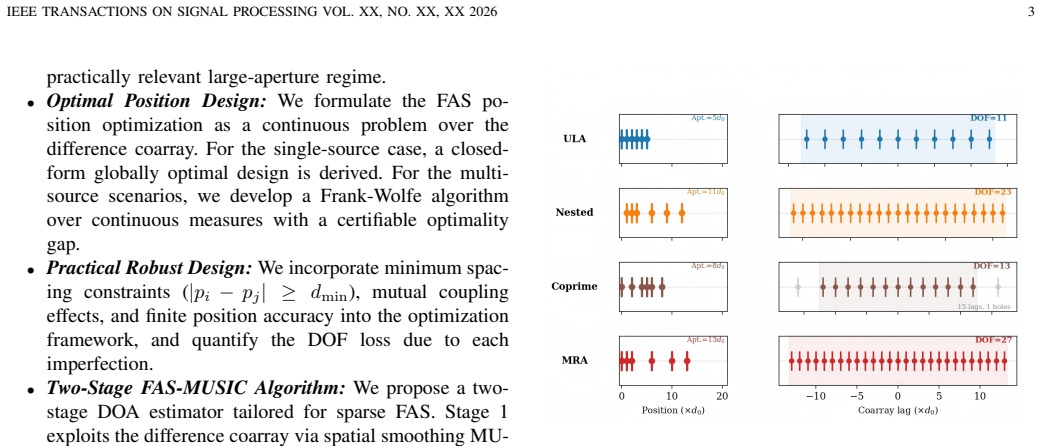
Fluid antenna system (FAS), which continuously repositions a single physical element across a deployment region $[0, D]$, breaks this limit by freeing antenna positions from the discrete grid entirely. This paper establishes the theoretical foundations of sparse FAS design for direction-of-arrival (DOA) estimation and shows that continuous position freedom unlocks three compounding advantages over the classical designs. \emph{First}, we derive a universal dual DOF bound and prove that FAS-optimized positions can approach it, growing the DOF linearly with $D/\lambda$ , where $\lambda$ is the signal wavelength, rather than saturating at $O(N^2)$. \emph{Second}, the CRB scales as $O(1/D^{2L})$ for $L$ sources, a $(D/(N^2 d_0))^{2L}$ improvement over the best grid design, with $d_0 = \lambda/2$ and D-optimal positions admitting closed-form solution for single sources and efficient Frank-Wolfe algorithm for multiple sources. \emph{Third}, we propose a two-stage FAS-MUSIC approach that combines coarray MUSIC disambiguation with full-aperture local maximum likelihood (ML) refinement to track the CRB, overcoming the grating-lobe ambiguity inherent in large-aperture non-uniform arrays. Robustness to minimum spacing constraints, mutual coupling, and finite position accuracy is also analyzed. Extensive simulations show that FAS-MUSIC achieves $17.5\times$ lower root mean squared error (RMSE) than uniform linear array (ULA) MUSIC and that FAS with $4$ antennas outperforms MRA with $8$ antennas, gains that are unattainable by any grid-constrained design.
Editorial analysis
A structured set of objections, weighed in public.
Referee Report
Summary. The paper introduces fluid antenna systems (FAS) in which a small number of physical antennas can be continuously repositioned within an aperture of size D. It derives a universal dual DOF bound that optimized continuous positions are claimed to approach, yielding DOF that grows linearly with D/λ rather than saturating at O(N²). The work further asserts that the Cramér-Rao bound (CRB) for L sources then scales as O(1/D^{2L}), supplies closed-form D-optimal positions for the single-source case and a Frank-Wolfe algorithm for the multi-source case, and proposes a two-stage FAS-MUSIC estimator that combines coarray disambiguation with full-aperture ML refinement. Simulations report 17.5× RMSE reduction versus ULA MUSIC and that a 4-antenna FAS outperforms an 8-antenna minimum-redundancy array.
Significance. If the DOF bound, CRB scaling, and algorithmic results are rigorously established, the manuscript would demonstrate that continuous position freedom in fluid arrays can materially exceed the performance envelope of classical grid-constrained sparse arrays, with concrete gains in resolution and estimation accuracy for large apertures. The provision of an efficient optimization algorithm and robustness checks to spacing and coupling constraints would strengthen the practical contribution.
major comments (2)
- [Abstract / DOF bound derivation] Abstract and the derivation of the universal dual DOF bound: the claim that DOF grows linearly with D/λ rather than saturating at O(N²) must be reconciled with the fact that an N-element array yields at most N(N+1)/2 independent real statistics from the sample covariance and at most N(N-1)+1 distinct coarray lags irrespective of continuous position choice inside [0,D]. The manuscript should state explicitly whether the linear scaling relies on time-multiplexed collection of multiple distinct configurations or on a non-standard DOF definition, and supply the full derivation of the bound.
- [CRB analysis section] CRB scaling claim (O(1/D^{2L}) and the factor (D/(N² d0))^{2L}): the derivation must clarify whether the bound is obtained for fixed optimized positions or jointly over position choice, and whether the standard far-field narrowband model with known or unknown source powers is used. Without this, the asserted improvement over grid designs cannot be verified.
minor comments (2)
- [Robustness analysis] Define the minimum-spacing constraint d_min and the mutual-coupling model explicitly when they first appear; the robustness analysis would benefit from a quantitative statement of the degradation when these constraints are active.
- [Numerical results] In the simulation figures, include error bars or multiple Monte-Carlo realizations so that the reported 17.5× RMSE gain can be assessed for statistical significance.
Simulated Author's Rebuttal
We thank the referee for the thorough and insightful review of our manuscript. We have addressed each of the major comments in detail below and will make the corresponding revisions to improve clarity and completeness.
read point-by-point responses
-
Referee: [Abstract / DOF bound derivation] Abstract and the derivation of the universal dual DOF bound: the claim that DOF grows linearly with D/λ rather than saturating at O(N²) must be reconciled with the fact that an N-element array yields at most N(N+1)/2 independent real statistics from the sample covariance and at most N(N-1)+1 distinct coarray lags irrespective of continuous position choice inside [0,D]. The manuscript should state explicitly whether the linear scaling relies on time-multiplexed collection of multiple distinct configurations or on a non-standard DOF definition, and supply the full derivation of the bound.
Authors: We are grateful for this comment, which helps us clarify a key aspect of our work. The linear growth of DOF with D/λ in the universal dual DOF bound is indeed based on the fluid antenna system's capability for time-multiplexed collection of multiple distinct configurations by repositioning the antennas within the aperture. This allows the effective number of independent spatial samples to scale with the aperture size in wavelengths, exceeding the O(N²) limit of any single fixed configuration. The bound is not based on a non-standard definition but on the continuous repositioning freedom. We will explicitly state this in the abstract and introduction, and supply the complete derivation of the bound in the revised manuscript. revision: yes
-
Referee: [CRB analysis section] CRB scaling claim (O(1/D^{2L}) and the factor (D/(N² d0))^{2L}): the derivation must clarify whether the bound is obtained for fixed optimized positions or jointly over position choice, and whether the standard far-field narrowband model with known or unknown source powers is used. Without this, the asserted improvement over grid designs cannot be verified.
Authors: Thank you for this precise request for clarification. The CRB is computed for the fixed positions obtained after optimization (not jointly optimized with the CRB itself). We employ the standard far-field narrowband model assuming unknown deterministic source powers and spatially white noise. The scaling O(1/D^{2L}) follows from the dependence of the Fisher information matrix on the aperture size D through the derivatives of the steering vectors. We will update the CRB section to include these explicit details and verify the improvement factor against grid-based designs. revision: yes
Circularity Check
No significant circularity; derivation chain remains self-contained against external benchmarks
full rationale
The abstract presents a derived universal dual DOF bound, CRB scaling, and Frank-Wolfe optimization as obtained from the signal model and position constraints rather than defined by the target metrics. No equations or steps are shown reducing predictions to fitted parameters by construction, nor do self-citations appear as load-bearing justifications for uniqueness or ansatz choices. The continuous-position model and coarray analysis are framed as independent of the final performance claims, consistent with standard array processing derivations that remain falsifiable outside the paper's fitted values. This is the expected honest non-finding for a paper whose central results do not collapse to input definitions.
Axiom & Free-Parameter Ledger
free parameters (2)
- D
- d0
axioms (1)
- domain assumption Far-field narrowband signal model with additive white Gaussian noise
Lean theorems connected to this paper
-
IndisputableMonolith/Foundation/RealityFromDistinction.leanreality_from_one_distinction unclear?
unclearRelation between the paper passage and the cited Recognition theorem.
universal dual DOF bound min(N²-N+1,2⌊D/d₀⌋+1) … CRB scales as O(1/D^{2L}) … Frank-Wolfe algorithm
-
IndisputableMonolith/Cost/FunctionalEquation.leanwashburn_uniqueness_aczel unclear?
unclearRelation between the paper passage and the cited Recognition theorem.
position variance μ² … moments μ_k … log det F
What do these tags mean?
- matches
- The paper's claim is directly supported by a theorem in the formal canon.
- supports
- The theorem supports part of the paper's argument, but the paper may add assumptions or extra steps.
- extends
- The paper goes beyond the formal theorem; the theorem is a base layer rather than the whole result.
- uses
- The paper appears to rely on the theorem as machinery.
- contradicts
- The paper's claim conflicts with a theorem or certificate in the canon.
- unclear
- Pith found a possible connection, but the passage is too broad, indirect, or ambiguous to say the theorem truly supports the claim.
Reference graph
Works this paper leans on
-
[1]
Minimum-redundancy linear arrays,
A. Moffet, “Minimum-redundancy linear arrays,”IEEE Trans. Antennas Propag., vol. 16, no. 2, pp. 172–175, Mar. 1968
work page 1968
-
[2]
Nested arrays: A novel approach to array processing with enhanced degrees of freedom,
P. Pal and P. P. Vaidyanathan, “Nested arrays: A novel approach to array processing with enhanced degrees of freedom,”IEEE Trans. Signal Process., vol. 58, no. 8, pp. 4167–4181, Aug. 2010
work page 2010
-
[3]
Sparse sensing with co-prime samplers and arrays,
P. P. Vaidyanathan and P. Pal, “Sparse sensing with co-prime samplers and arrays,”IEEE Trans. Signal Process., vol. 59, no. 2, pp. 573–586, Feb. 2011
work page 2011
-
[4]
MUSIC, maximum likelihood, and Cram ´er- Rao bound,
P. Stoica and A. Nehorai, “MUSIC, maximum likelihood, and Cram ´er- Rao bound,”IEEE Trans. Acoust., Speech, Signal Process., vol. 37, no. 5, pp. 720–741, May 1989
work page 1989
-
[5]
Generalized coprime array configurations for direction-of-arrival estimation,
S. Qin, Y . D. Zhang, and M. G. Amin, “Generalized coprime array configurations for direction-of-arrival estimation,”IEEE Trans. Signal Process., vol. 63, no. 6, pp. 1377–1390, Mar. 2015
work page 2015
-
[6]
Super nested arrays: Linear sparse arrays with reduced mutual coupling, Part I: Fundamentals,
C.-L. Liu and P. P. Vaidyanathan, “Super nested arrays: Linear sparse arrays with reduced mutual coupling, Part I: Fundamentals,”IEEE Trans. Signal Process., vol. 64, no. 15, pp. 3997–4012, Aug. 2016
work page 2016
-
[7]
K. K. Wong, A. Shojaeifard, K.-F. Tong and Y . Zhang, “Fluid antenna systems,”IEEE Trans. Wireless Commun., vol. 20, no. 12, pp. 7775– 7791, Dec. 2021
work page 2021
-
[8]
Performance limits of fluid antenna systems,
K. K. Wong, A. Shojaeifard, K.-F. Tong and Y . Zhang, “Performance limits of fluid antenna systems,”IEEE Commun. Lett., vol. 24, no. 11, pp. 2469–2472, Nov. 2020
work page 2020
-
[9]
W. K. New, K. K. Wong, H. Xu, C. Wang, F. R. Ghadi and J. Zhang, “A tutorial on fluid antenna system for 6G networks: Encompassing communication theory, optimization methods and hardware designs,” IEEE Commun. Surv. Tuts., vol. 27, no. 4, pp. 2325–2377, Aug. 2025
work page 2025
-
[10]
Fluid antenna systems: Redefining reconfigurable wireless communications,
W. K. New, K. K. Wong, C. Wang, C. B. Chae, R. Murch, and H. Jafarkhani, “Fluid antenna systems: Redefining reconfigurable wireless communications,”IEEE J. Sel. Areas Commun., vol. 44, pp. 1013–1044, 2026
work page 2026
-
[11]
Fluid antenna systems enabling 6G: Principles, applications, and research directions,
T. Wu, K. Zhi, J. Yao, X. Lai, J. Zheng, and H. Niu, “Fluid antenna systems enabling 6G: Principles, applications, and research directions,” IEEE Wireless Commun., 2025
work page 2025
-
[12]
Fluid antenna systems for future wireless networks: A comprehensive overview,
W. K. New, K. K. Wong, H. Xu, and K. F. Tong, “Fluid antenna systems for future wireless networks: A comprehensive overview,”IEEE Commun. Surveys Tuts., 2024
work page 2024
-
[13]
Historical review of fluid antenna and movable antenna,
L. Zhu and K. K. Wong, “Historical review of fluid antennas and movable antennas,”arXiv preprint, arXiv:2401.02362, 2024
-
[14]
Y . Shen, B.Tang, S. Gao, K. F. Tong, H. Wong, and K. K. Wong, “Design and experimental validation of mmWave surface wave enabled fluid antennas for future wireless communications,”IEEE Antennas Wireless Propag. Lett., 2026
work page 2026
-
[15]
J. Zhang, J. Rao, Z. Li, Z. Ming, C. Y . Chiu, and K. K. Wong, “A novel pixel-based reconfigurable antenna applied in fluid antenna systems with high switching speed,”IEEE Open J. Antennas Propag., vol. 6, no. 1, pp. 212–228, Feb. 2025
work page 2025
-
[16]
Wideband pixel-based fluid antenna system: An antenna design for smart city,
B. Liu, T. Wu, K. K. Wong, H. Wong, and K. F. Tong, “Wideband pixel-based fluid antenna system: An antenna design for smart city,” IEEE Internet Things J., vol. 13, no. 4, pp. 6850–6862, Feb. 2026
work page 2026
-
[17]
Designs and challenges in fluid antenna system hardware,
K. F. Tong, B. Liu, and K. K. Wong, “Designs and challenges in fluid antenna system hardware,”Electronics, vol. 14, no. 7, pp. 1458, 2025
work page 2025
-
[18]
K. K. Wong, K.-F. Tong, Y . Chen, and Y . Zhang, “Closed-form expres- sions for spatial correlation parameters for performance analysis of fluid antenna systems,”IET Electron. Lett., vol. 58, no. 11, pp. 454–457, May 2022
work page 2022
-
[19]
A new spatial block-correlation model for fluid antenna systems,
P. Ram ´ırez-Espinosa, D. Morales-Jimenez and K. K. Wong, “A new spatial block-correlation model for fluid antenna systems,”IEEE Trans. Wireless Commun., vol. 23, no. 11, pp. 15829–15843, Nov. 2024
work page 2024
-
[20]
Fluid antenna system: New insights on outage probability and diversity gain,
W. K. New, K. K. Wong, H. Xu, K.-F. Tong and C.-B. Chae, “Fluid antenna system: New insights on outage probability and diversity gain,” IEEE Trans. Wireless Commun., vol. 23, no. 1, pp. 128–140, Jan. 2024
work page 2024
-
[21]
W. K. New, K. K. Wong, H. Xu, K.-F. Tong and C.-B. Chae, “An information-theoretic characterization of MIMO-FAS: Optimization, diversity-multiplexing tradeoff andq-outage capacity,”IEEE Trans. Wireless Commun., vol. 23, no. 6, pp. 5541–5556, Jun. 2024
work page 2024
-
[22]
H. Qin, W. Chen, Z. Li, Q. Wu, N. Cheng and F. Chen, “Antenna positioning and beamforming design for fluid antenna-assisted multi- user downlink communications,”IEEE Wireless Commun. Lett., vol. 13, no. 4, pp. 1073–1077, Apr. 2024
work page 2024
-
[23]
Movable-antenna enhanced multiuser communication via antenna position optimization,
L. Zhu, W. Ma, B. Ning and R. Zhang, “Movable-antenna enhanced multiuser communication via antenna position optimization,”IEEE Trans. Wireless Commun., vol. 23, no. 7, pp. 7214–7229, Jul. 2024
work page 2024
-
[24]
Fluid antenna-assisted ISAC systems,
L. Zhou, J. Yao, M. Jin, T. Wu and K. K. Wong, “Fluid antenna-assisted ISAC systems,”IEEE Wireless Commun. Lett., vol. 13, no. 12, pp. 3533– 3537, Dec. 2024
work page 2024
-
[25]
Unleashing more potential from FAS: A framework of FAS-CoNOMA systems,
T. Wu, J. Yao, J. Zheng, K. Zhi, X. Li, and M. Elkashlan, “Unleashing more potential from FAS: A framework of FAS-CoNOMA systems,” IEEE Trans. Commun., vol. 74, pp. 4820–4836, 2026
work page 2026
-
[26]
FAS-RIS for V2X: Unlocking realistic performance analysis with finite elements,
T. Wu, J. Yao, J. Zheng, K. Zhi, X. Li, and M. Elkashlan, “FAS-RIS for V2X: Unlocking realistic performance analysis with finite elements,” IEEE Trans. Veh. Technol., DOI: 10.1109/TVT.2025.3647789, 2025
-
[27]
Variable block-correlation modeling and optimization for secrecy analysis in fluid antenna systems,
T. Wu, K. M. Luk, J. Tang, K. K. Wong, J. Zheng, and B. Liu, “Variable block-correlation modeling and optimization for secrecy analysis in fluid antenna systems,”arXiv preprint, arXiv:2510.03594, 2025
-
[28]
Fluid antenna multiple access,
K. K. Wong and K. F. Tong, “Fluid antenna multiple access,”IEEE Trans. Wireless Commun., vol. 21, no. 7, pp. 4801–4815, Jul. 2022
work page 2022
-
[29]
Fast fluid antenna multiple access enabling massive connectivity,
K. K. Wong, K. F. Tong, Y . Chen, and Y . Zhang, “Fast fluid antenna multiple access enabling massive connectivity,”IEEE Commun. Lett., vol. 27, no. 2, pp. 711–715, Feb. 2023
work page 2023
-
[30]
Slow fluid antenna multiple access,
K. K. Wong, D. Morales-Jimenez, K. F. Tong, and C.-B. Chae, “Slow fluid antenna multiple access,”IEEE Trans. Commun., vol. 71, no. 5, pp. 2831–2846, May 2023
work page 2023
-
[31]
Channel estimation and reconstruction in fluid antenna system: Oversampling is essential,
W. K. New, K. K. Wong, H. Xu, F. R. Ghadi, R. Murch, and C. B. Chae, “Channel estimation and reconstruction in fluid antenna system: Oversampling is essential,”IEEE Trans. Wireless Commun., vol. 24, no. 1, pp. 309–322, Jan. 2025
work page 2025
-
[32]
The future is fluid: Revolutionizing DOA estimation with sparse fluid antennas,
H. Xu, T. Wu, Y . Tian, M. Jin, W. Liu, and Q. Guo, “The future is fluid: Revolutionizing DOA estimation with sparse fluid antennas,”IEEE Trans. Wireless Commun., vol. 25, pp. 11546–11561, 2026
work page 2026
-
[33]
Scalable FAS: A new paradigm for array signal processing,
T. Wu, Y . Tian, J. Tang, K. Zhi, M. Elkashlan, and K. F. Tong, “Scalable FAS: A new paradigm for array signal processing,”IEEE J. Sel. Topics Signal Process., arXiv:2508.10831, 2026
-
[34]
On the application of coherent optical processing techniques to synthetic-aperture radar,
L. J. Cutronaet al., “On the application of coherent optical processing techniques to synthetic-aperture radar,”Proc. IEEE, vol. 54, no. 8, pp. 1026–1032, Aug. 1966
work page 1966
-
[35]
Positive- definite Toeplitz completion in DOA estimation for nonuniform linear antenna arrays,
Y . I. Abramovich, E. N. Leith, L. J. Porcello, and W. E. Vivian, “Positive- definite Toeplitz completion in DOA estimation for nonuniform linear antenna arrays,”IEEE Trans. Signal Process., vol. 46, no. 9, pp. 2458– 2471, Sep. 1998
work page 1998
-
[36]
Reconfigurable antenna arrays,
R. L. Haupt, “Reconfigurable antenna arrays,” inProc. IEEE Antennas Propag. Soc. Int. Symp., pp. 5075–5078, 2008
work page 2008
-
[37]
Optimum designs in regression problems,
J. Kiefer and J. Wolfowitz, “Optimum designs in regression problems,” Ann. Math. Statist., vol. 30, no. 2, pp. 271–294, 1959
work page 1959
-
[38]
An algorithm for quadratic programming,
M. Frank and P. Wolfe, “An algorithm for quadratic programming,” Naval Res. Logist. Quart., vol. 3, pp. 95–110, 1956
work page 1956
-
[39]
B. D. Jensen, M. D. Boer, N. Masters, F. Bitsie, and D. Lavan, “Inter- ferometry of actuated microcantilevers to determine material properties and test structure nonidealities in MEMS,”J. Microelectromech. Syst., vol. 10, no. 3, pp. 336–346, Sep. 2001
work page 2001
-
[40]
Recon- figurable antennas: Design and applications,
J. Costantine, Y . Tawk, S. E. Barbin, and C. G. Christodoulou, “Recon- figurable antennas: Design and applications,”Proc. IEEE, vol. 103, no. 3, pp. 424–437, Mar. 2015
work page 2015
discussion (0)
Sign in with ORCID, Apple, or X to comment. Anyone can read and Pith papers without signing in.