REVIEW 3 major objections 5 minor 62 references
Magnetic field of a ring-like shape molecular cloud
T0 review · 3 major / 5 minor · reviewed 2026-08-15 · deepseek-v4-flash
Pith's one-line read G111's ring-shaped cloud carries a coherent magnetic field that curves along its dense ridges, indicating shock compression from stellar feedback rather than pure gravitational contraction.
desk verdict First field map of G111, with careful foreground subtraction, but the shock-compression conclusion leans on VGT in the dense ridges where the paper's own caveat says VGT may not apply. read the letter →
The pith
A machine-rendered reading of the paper's core claim, the machinery that carries it, and where it could break.
The reading
What carries the argument
The load-bearing instrument is the Velocity Gradients Technique (VGT), which derives the plane-of-sky magnetic field direction from spectroscopic data by computing velocity gradients in CO channel maps and rotating them by 90°, justified by magnetohydrodynamic turbulence anisotropy: turbulent eddies are elongated along field lines, so gradients are statistically perpendicular to the local field. The paper also uses the alignment measure, $AM = 2(\cos^2\theta - 1/2)$, to quantify agreement between orientations from Planck polarization, starlight polarimetry, and VGT, with $AM=1$ meaning parallel and $AM=-1$ perpendicular. VGT supplies the dense-region field map, foreground-subtracted starlight polarization supplies cloud-specific orientations, and Planck supplies the large-scale context; the three are consistent in the southern and western ridges, while the northern clump shows local deviations interpreted as gravitational collapse.
What would settle it
A high-resolution dust-polarization map of the dense ridges that showed the field crossing the ridges nearly perpendicularly, together with the absence of SiO shock-tracer emission along the curved arc, would falsify the shock-compression interpretation by removing its main observational support.
Extended reading notes
Core claim
On the paper's own terms, the central discovery is that G111's plane-of-sky magnetic field is spatially coherent yet follows the cloud's elliptical ring geometry: it runs along the dense ridges traced by submillimetre dust emission and the 12 µm warm-dust structure, most clearly in the southern and eastern parts. Because the field is aligned with the compressed dense structures rather than perpendicular to them, the authors conclude that shock compression—likely driven by stellar winds or a supernova remnant—shaped the cloud, with the magnetic field acting to maintain its integrity and guide gas flows. Foreground subtraction is essential to this result: the large-scale Planck polarization toward the southwestern part of G111 is dominated by foreground dust aligned with the Galactic magnetic field, and only after removing that component do the cloud's own orientations emerge consistently across tracers.
Load-bearing premise
The whole chain rests on the assumption that the CO velocity gradients trace magnetohydrodynamic turbulence whose eddies are elongated along the magnetic field, so rotating the gradients by 90° recovers the true plane-of-sky field direction; if gravitational collapse or non-turbulent dynamics dominate in the probed dense gas, the curved field, and with it the shock-compression conclusion, is not reliable.
Editorial extensions
If this is right
- If the central claim is correct, G111's elliptical ring is the product of turbulent shock-driven compression from external feedback, not primarily self-gravitational contraction.
- The cloud's magnetic field is dynamically important: it stays coherent from the outer CO envelope to the dense C18O gas, guiding flows and resisting dispersal.
- Planck polarization toward G111 includes a substantial foreground component aligned with the Galactic magnetic field, so foreground subtraction is a mandatory step before interpreting large-scale polarization in this region.
- The northern clump is a candidate site of local gravitational collapse, where the VGT-derived field rotates away from the ring geometry and the two CO tracers disagree.
Reading between the lines
- Editorial inference: if the shock-compression reading is right, the curvature of the field should track independent signs of external pressure; a quantitative test would compare the local field-curvature angle with the intensity of shock tracers such as SiO along the ring.
- Editorial inference: the foreground-subtraction prescription assumes all stars nearer than 2500 pc sample only foreground dust; if some foreground material is clumpy or closer than expected, the interpolated foreground map could imprint artificial coherence onto the cloud map, so repeating the analysis with foreground masks of varying depth would test the robustness of the field geometry.
- Editorial inference: the VGT's 90-degree rotation is only valid where turbulence dominates; restricting the VGT analysis to the same velocity intervals as the shock-compressed gas, and excluding the collapsed-core channels, would separate the turbulent and gravitational signals and make the shock-compression conclusion less assumption-dependent.
Signed reviews
Editorial analysis
A structured set of objections, weighed in public.
Referee Report
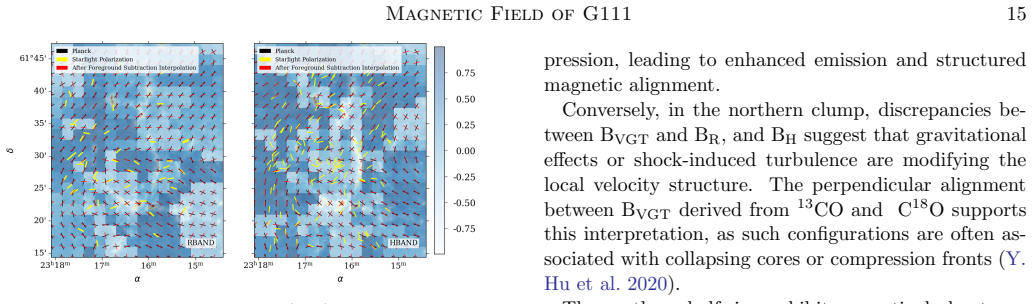
Summary. The manuscript presents a multi-tracer study of the plane-of-sky magnetic field in G111, a ~10 pc ring-like molecular cloud in the NGC 7538 region. The analysis combines Planck 353 GHz polarized dust emission, new Kanata/HONIR starlight polarization in the R and H bands with Gaia-based distances and foreground subtraction (d_fg = 2500 pc), and the velocity gradient technique (VGT) applied to 12CO (TRAO 14m), 13CO, and C18O (IRAM 30m) data. The authors report a coherent but spatially varying magnetic field, with VGT-derived orientations following the dense ridges, agreement between foreground-subtracted starlight polarization and Planck orientations in parts of the map, and a curved magnetic field along the dense ridges that they interpret as evidence of shock compression by stellar winds or supernova remnants. They conclude that turbulent shock-driven compression, rather than simple gravitational contraction, played a central role in shaping G111.
Significance. If correct, the paper provides one of the few multi-tracer magnetic field maps of a >10 pc ring-like molecular cloud, combining three independent probes (Planck polarization, starlight polarimetry, and VGT). The foreground-subtraction strategy is motivated by identified Gaia extinction steps, and the multi-tracer comparison is internally consistent. The VGT-derived maps are compared with independent starlight and Planck orientations rather than being fit to themselves, which partially mitigates concerns about circularity. The new Kanata starlight polarization catalog and the IRAM 30m CO maps are potentially useful community data products. However, the central shock-compression conclusion rests on the validity of VGT in the dense ridges, where the paper itself identifies a breakdown mode, and the quantitative support is limited by the absence of propagated uncertainties and statistical tests. The paper is a solid observational contribution whose interpretation needs to be either strengthened or substantially softened.
major comments (3)
- [§2.7, §4.2–4.3, §5] The central claim that the curved B_VGT along the dense southern and eastern ridges indicates shock compression rests on the assumption that the CO velocity gradients trace the magnetic field in those ridges. However, §2.7 states that the 90° rotation is valid only for turbulence-supported gas, and §4.3 invokes gravitational collapse in the northern clump to explain a VGT discrepancy there, demonstrating that this failure mode is active within the same data set. The external validation offered is qualitative agreement with sparse starlight polarization (B_R, B_H), which probes lower-extinction material and is not co-spatial with the dense ridges; the SiO/CS shock tracers that would directly test compression are explicitly deferred to future work. The conclusion that shock compression 'played a central role in shaping G111' is therefore not supported by an independent check that the dense ridges are turbulence-dominated at the probed scales. Please either add a validation of VGT in the ridges (e.g., a matched-resolution comparison with Planck or JCMT polarization where available, or a quantitative turbulence-versus-gravity assessment from the line data) or weaken the conclusion to a tentative interpretation.
- [§2.6, §3.2.1, §4.1] The foreground distance cutoff d_fg = 2500 pc is adopted with no sensitivity test, even though the cloud distance is 2700 ± 100 pc and the Gaia photogeometric distances carry non-negligible uncertainties. Stars with true distances near 2500–2700 pc that scatter below the cutoff in the distance posterior could contaminate the foreground template, and the interpolation-based subtraction in Eqs. (9)–(10) could therefore bias B_R and B_H and the AM maps in Figures 11–13. Please test the stability of the foreground-subtracted angles and AM maps for a range of d_fg (e.g., 2300, 2400, 2500, and 2600 pc) and report the resulting changes in the derived morphologies.
- [§2.8, Figs. 11–13] Equations (1)–(2) provide per-star uncertainties σ_p and σ_ψ, but no uncertainties are propagated into the interpolated foreground maps, the foreground-subtracted polarization angles, the VGT orientations, or the AM maps. The AM maps are shown without error bars or a null-hypothesis test, so statements such as 'significant correlation' (§4.5) and 'strong agreement' (§4.3) are not quantitatively supported. Please add a Monte Carlo or analytic propagation of the angle uncertainties and report the significance of the alignments, for example by comparing the observed AM distribution with that expected for random relative orientations.
minor comments (5)
- [Abstract] The abstract refers to the 'IRAP 30m telescope', while the body correctly uses IRAM 30m; please correct the typo.
- [§2.3.1] The text states that the pixel scale of 0.3″/pixel is 'substantially less than the typical seeing of 2.5′'; the seeing should presumably be 2.5″, not 2.5′.
- [Fig. 2 caption] The caption contains the garbled symbol 'σP si< 20°'; this should be σψ < 20° as in Eq. (5).
- [Fig. 13 caption] The caption misspells 'parallel' as 'paraller'.
- [§3.5] The sentence 'As already mentioned previously in Section 4.4' refers to a section that appears later in the paper; the cross-reference should be corrected.
Circularity Check
No significant circularity: the central inference rests on comparison of independent tracers, not on a fitted input; VGT self-citations are present but not load-bearing.
full rationale
Walking the derivation chain, each magnetic-field map is an explicit transformation of independent data: Planck polarization angles rotated by 90 deg, Kanata starlight polarization after Gaia-distance-based foreground subtraction, and velocity gradients rotated by 90 deg. No parameter is fitted to the shock-compression conclusion and then read back out as a prediction. The curved-field geometry and the shock-compression interpretation in Sect. 5 are an interpretive classification against the theoretical taxonomy of Sect. 1, not an equation-level derivation, so they do not reduce to the inputs by construction. The paper's own Sect. 2.7 caveat, that VGT may fail where gravity or non-turbulent dynamics dominate, is a validity limitation that lowers confidence in the dense-ridge field tracing, but it is not a circular step. Likewise, the VGT methodology is justified by citations to co-authors (Lazarian, Hu, Yuen), which is self-citation, but the technique has been validated in prior observational and simulation studies outside this particular dataset, so the citations carry independent content rather than forming a closed self-citation chain. The foreground-subtraction and multi-tracer comparisons (Planck, starlight, WISE, CO) provide external cross-checks. No specific equation is equivalent to another by construction, and no fitted quantity is renamed as a prediction. Score 2 reflects the presence of minor self-citations while the central claim retains independent observational support.
Assumptions & free parameters
free parameters (4)
- Foreground distance cutoff d_fg =
2500 pc
- VGT sub-block size =
20 x 20 pixels (final ~5')
- Starlight polarization quality thresholds =
sigma_psi < 20 deg and sigma_p < 0.6%
- Velocity channel ranges for VGT maps =
e.g., [-53.6;-53], [-52.5;-50], [-48.4;-46.5] km/s for 12CO; four ranges for 13CO and C18O
assumptions (4)
- domain assumption Dust grain alignment with the magnetic field, so that polarization traces the POS B-field orientation.
- domain assumption Velocity gradients in MHD turbulence are statistically perpendicular to the local magnetic field, so 90-degree rotated gradients trace B.
- domain assumption The foreground toward G111 is fully sampled by stars with Gaia distances < 2500 pc, and the cloud distance is 2700 pc.
- standard math The POS magnetic field from optically thin dust emission or extinction is the line-of-sight integrated field, so the cloud field is a projection through the cloud depth.
Cite this review
Pith. "Pith review of Magnetic field of a ring-like shape molecular cloud." pith.science (2026). https://pith.science/paper/VGYGMVOC
@misc{pith2026250719281,
  author       = {Pith},
  title        = {Pith review of: Magnetic field of a ring-like shape molecular cloud},
  year         = {2026},
  howpublished = {\url{https://pith.science/paper/VGYGMVOC}},
  note         = {Machine review of arXiv:2507.19281}
}
read the original abstract
We present a detailed study of the magnetic field structure in the G111 molecular cloud, a ring-like filamentary cloud within the NGC 7538 region. We utilized interstellar dust polarization from the Planck telescope to trace large-scale field orientations, starlight extinction polarization from the Kanata telescope to probe the cloud's magnetic field after foreground subtraction, and velocity gradients derived from CO isotopologues, observed with the IRAP 30m telescope, to examine dense regions. Our results reveal a coherent yet spatially varying magnetic field within G111. We correct the significant foreground dust contamination through careful subtraction. We observe a global alignment of the magnetic field with density structures suggesting that the field is dynamically important in shaping the cloud. The curved magnetic field along the dense regions, coinciding with mid-infrared emission in WISE data, indicates shock compression, likely driven by stellar feedback or supernova remnants. Our findings support a scenario where G111's morphology results from turbulent shock-driven compression. The interplay between magnetic fields and external forces is crucial in shaping and maintaining the structure of the molecular cloud. Future high-resolution observations will be essential to further constrain the magnetic field's role in cloud evolution.
Figures


Figures from the paper (9 more)



Reference graph
Works this paper leans on
-
[1]
2021, ApJ, 916, 83, doi: 10.3847/1538-4357/ac07a1
Abe, D., Inoue, T., Inutsuka, S.-i., & Matsumoto, T. 2021, ApJ, 916, 83, doi: 10.3847/1538-4357/ac07a1
-
[2]
2014, in Society of Photo-Optical Instrumentation Engineers (SPIE) Conference Series, Vol
Akitaya, H., Moritani, Y., Ui, T., et al. 2014, in Society of Photo-Optical Instrumentation Engineers (SPIE) Conference Series, Vol. 9147, Ground-based and Airborne Instrumentation for Astronomy V, ed. S. K. Ramsay, I. S. McLean, & H. Takami, 91474O, doi: 10.1117/12.2054577
-
[3]
2019, MNRAS, 485, 2825, doi: 10.1093/mnras/stz508
Alina, D., Ristorcelli, I., Montier, L., et al. 2019, MNRAS, 485, 2825, doi: 10.1093/mnras/stz508
-
[4]
2022, A&A, 658, A90, doi: 10.1051/0004-6361/202039065 Astropy Collaboration, Robitaille, T
Alina, D., Montillaud, J., Hu, Y., et al. 2022, A&A, 658, A90, doi: 10.1051/0004-6361/202039065 Astropy Collaboration, Robitaille, T. P., Tollerud, E. J., et al. 2013, A&A, 558, A33, doi: 10.1051/0004-6361/201322068 Astropy Collaboration, Price-Whelan, A. M., Sip˝ ocz, B. M., et al. 2018, AJ, 156, 123, doi: 10.3847/1538-3881/aabc4f Astropy Collaboration, ...
-
[5]
2021, AJ, 161, 147, doi: 10.3847/1538-3881/abd806
Demleitner, M., & Andrae, R. 2021, AJ, 161, 147, doi: 10.3847/1538-3881/abd806
-
[6]
Balfour, S. K., Whitworth, A. P., Hubber, D. A., & Jaffa, S. E. 2015, MNRAS, 453, 2471, doi: 10.1093/mnras/stv1772
-
[7]
Barreto-Mota, L., de Gouveia Dal Pino, E. M., Burkhart, B., et al. 2021, MNRAS, 503, 5425, doi: 10.1093/mnras/stab798
-
[8]
2023, Experimental Astronomy, 56, 197, doi: 10.1007/s10686-022-09882-5
Bernard, J.-P., Bernard, A., Roussel, H., et al. 2023, Experimental Astronomy, 56, 197, doi: 10.1007/s10686-022-09882-5
Show all 62 references
-
[9]
1993, A&A, 275, 67
Brand, J., & Blitz, L. 1993, A&A, 275, 67
1993
-
[10]
M., Kerton, C
Brunt, C. M., Kerton, C. R., & Pomerleau, C. 2003, ApJS, 144, 47, doi: 10.1086/344245
2003 doi
-
[11]
O., Guerra, J
Butterfield, N. O., Guerra, J. A., Chuss, D. T., et al. 2024, ApJ, 968, 63, doi: 10.3847/1538-4357/ad402c
2024 doi
-
[12]
G., Schwarz, H
Clarke, D., Stewart, B. G., Schwarz, H. E., & Brooks, A. 1983, A&A, 126, 260
1983
-
[13]
1972, Astrophysics and Space Science, 18, 337, doi: 10.1007/BF00645399
Dolginov, A. 1972, Astrophysics and Space Science, 18, 337, doi: 10.1007/BF00645399
1972 doi
-
[14]
2013, The Astrophysical Journal, 765, 159
Draine, B., & Hansley, B. 2013, The Astrophysical Journal, 765, 159
2013
-
[15]
Evans, II, N. J. 1999, ARA&A, 37, 311, doi: 10.1146/annurev.astro.37.1.311
1999 doi
-
[16]
A., Di Francesco, J., et al
Fallscheer, C., Reid, M. A., Di Francesco, J., et al. 2013, ApJ, 773, 102, doi: 10.1088/0004-637X/773/2/102
2013 doi
-
[17]
2016, MNRAS, 457, 375, doi: 10.1093/mnras/stv2880
Federrath, C. 2016, MNRAS, 457, 375, doi: 10.1093/mnras/stv2880
2016 doi
-
[18]
Fenske, J., Arakawa, J., Fallscheer, C., & Francesco, J. D. 2021, AJ, 161, 156, doi: 10.3847/1538-3881/abded2 Fern´ andez-L´ opez, M., Sanhueza, P., Zapata, L. A., et al. 2021, ApJ, 913, 29, doi: 10.3847/1538-4357/abf2b6
2021 doi
-
[19]
Frieswijk, W. W. F., Spaans, M., Shipman, R. F., Teyssier, D., & Hily-Blant, P. 2007, A&A, 475, 263, doi: 10.1051/0004-6361:20077148 Gildas Team. 2013, GILDAS: Grenoble Image and Line Data Analysis Software,, Astrophysics Source Code Library, record ascl:1305.010
2007 doi
-
[20]
1995, ApJ, 438, 763, doi: 10.1086/175121 Gonz´ alez-Casanova, D
Goldreich, P., & Sridhar, S. 1995, ApJ, 438, 763, doi: 10.1086/175121 Gonz´ alez-Casanova, D. F., & Lazarian, A. 2017, ApJ, 835, 41
1995 doi
-
[21]
2013, ApJ, 769, 115, doi: 10.1088/0004-637X/769/2/115
Heitsch, F. 2013, ApJ, 769, 115, doi: 10.1088/0004-637X/769/2/115
2013 doi
-
[22]
2013, A&A, 556, A153, doi: 10.1051/0004-6361/201321292
Hennebelle, P. 2013, A&A, 556, A153, doi: 10.1051/0004-6361/201321292
2013 doi
-
[23]
1949, The Astrophysical Journal, 109, 471, doi: 10.1086/145151
Hiltner, W. 1949, The Astrophysical Journal, 109, 471, doi: 10.1086/145151
1949 doi
-
[24]
2018, ApJ, 852, 129, doi: 10.3847/1538-4357/aa9edc
Hoang, T., Cho, J., & Lazarian, A. 2018, ApJ, 852, 129, doi: 10.3847/1538-4357/aa9edc
2018 doi
-
[25]
2019, ApJ, 873, 16, doi: 10.3847/1538-4357/ab0376
Hsieh, C.-h., Hu, Y., Lai, S.-P., et al. 2019, ApJ, 873, 16, doi: 10.3847/1538-4357/ab0376
2019 doi
-
[26]
Hu, Y., Lazarian, A., & Yuen, K. H. 2020, arXiv e-prints, arXiv:2002.06754. https://arxiv.org/abs/2002.06754
2020 arXiv
-
[28]
H., & Lazarian, A
Hu, Y., Yuen, K. H., & Lazarian, A. 2018b, MNRAS, 480, 1333, doi: 10.1093/mnras/sty1807
-
[29]
H., Lazarian, V., et al
Hu, Y., Yuen, K. H., Lazarian, V., et al. 2019, Nature Astronomy, 3, 776, doi: 10.1038/s41550-019-0769-0
2019 doi
-
[30]
2013, ApJL, 774, L31, doi: 10.1088/2041-8205/774/2/L31
Inoue, T., & Fukui, Y. 2013, ApJL, 774, L31, doi: 10.1088/2041-8205/774/2/L31
2013 doi
-
[31]
2018, PASJ, 70, S53, doi: 10.1093/pasj/psx089
Inoue, T., Hennebelle, P., Fukui, Y., et al. 2018, PASJ, 70, S53, doi: 10.1093/pasj/psx089
2018 doi
-
[32]
2012, ApJ, 759, 35, doi: 10.1088/0004-637X/759/1/35
Inoue, T., & Inutsuka, S.-i. 2012, ApJ, 759, 35, doi: 10.1088/0004-637X/759/1/35
2012 doi
-
[33]
2016, ApJ, 833, 10, doi: 10.3847/0004-637X/833/1/10 Magnetic Field of G111 19
Inoue, T., & Inutsuka, S.-i. 2016, ApJ, 833, 10, doi: 10.3847/0004-637X/833/1/10 Magnetic Field of G111 19
2016 doi
-
[34]
S., Okazaki, A., Akitaya, H., et al
Kawabata, K. S., Okazaki, A., Akitaya, H., et al. 1999, PASP, 111, 898, doi: 10.1086/316387 K¨ onyves, V., Ward-Thompson, D., Pattle, K., et al. 2021, ApJ, 913, 57, doi: 10.3847/1538-4357/abf3ca
1999 doi
-
[35]
Koo, B.-C., & McKee, C. F. 1992, ApJ, 388, 93, doi: 10.1086/171132
1992 doi
-
[36]
1981, in Origin of Cosmic Rays, ed
Lachieze-Rey, M. 1981, in Origin of Cosmic Rays, ed. G. Setti, G. Spada, & A. W. Wolfendale, Vol. 94, 253
1981
-
[37]
2007, The Astrophysical Journal, 669, L77
Lazarian, A., & Hoang, T. 2007, The Astrophysical Journal, 669, L77
2007
-
[38]
2000, ApJ, 537, 720, doi: 10.1086/309040
Lazarian, A., & Pogosyan, D. 2000, ApJ, 537, 720, doi: 10.1086/309040
2000 doi
-
[39]
Lazarian, A., & Vishniac, E. T. 1999, ApJ, 517, 700, doi: 10.1086/307233
1999 doi
-
[41]
Lazarian, A., & Yuen, K. H. 2018b, ApJ, 853, 96, doi: 10.3847/1538-4357/aaa241
-
[42]
K., et al
Li, H.-B., Goodman, A., Sridharan, T. K., et al. 2014, Protostars and Planets VI, 101, doi: 10.2458/azu uapress 9780816531240-ch005
2014 doi
-
[43]
2018, ApJS, 234, 28, doi: 10.3847/1538-4365/aaa3dd
Liu, T., Kim, K.-T., Juvela, M., et al. 2018, ApJS, 234, 28, doi: 10.3847/1538-4365/aaa3dd
2018 doi
-
[44]
2023, MNRAS, 521, 3830, doi: 10.1093/mnras/stad733
Mazzei, R., Li, Z.-Y., Chen, C.-Y., et al. 2023, MNRAS, 521, 3830, doi: 10.1093/mnras/stad733
2023 doi
-
[45]
J., Menten, K
Moscadelli, L., Reid, M. J., Menten, K. M., et al. 2009, ApJ, 693, 406, doi: 10.1088/0004-637X/693/1/406
2009 doi
-
[46]
Nagai, T., Inutsuka, S.-i., & Miyama, S. M. 1998, ApJ, 506, 306, doi: 10.1086/306249
1998 doi
-
[47]
1993, A&A, 274, 968
Naghizadeh-Khouei, J., & Clarke, D. 1993, A&A, 274, 968
1993
-
[48]
2008, ApJ, 687, 354
Nakamura, F., & Li, Z.-Y. 2008, ApJ, 687, 354
2008
-
[49]
A., & Nordlund, A
Padoan, P., Juvela, M., Goodman, A. A., & Nordlund, A. 2001, ApJ, 553, 227
2001
-
[50]
2023, in Astronomical Society of the Pacific Conference
Pattle, K., Fissel, L., Tahani, M., Liu, T., & Ntormousi, E. 2023, in Astronomical Society of the Pacific Conference
2023
-
[51]
534, Protostars and Planets VII, ed
Series, Vol. 534, Protostars and Planets VII, ed. S. Inutsuka, Y. Aikawa, T. Muto, K. Tomida, & M. Tamura, 193, doi: 10.48550/arXiv.2203.11179 Planck Collaboration, Ade, P. A. R., Aghanim, N., et al. 2016, A&A, 586, A138, doi: 10.1051/0004-6361/201525896 Planck Collaboration I...
-
[52]
1979, The Astrophysical Journal, 231, 404, doi: 10.1086/157204
Purcell, E. 1979, The Astrophysical Journal, 231, 404, doi: 10.1086/157204
1979 doi
-
[53]
D., Elston, R., & Lupie, O
Schmidt, G. D., Elston, R., & Lupie, O. L. 1992, AJ, 104, 1563, doi: 10.1086/116341
1992 doi
-
[54]
1958, Acta Astronomica, 8, 135, doi: 10.1086/145465
Serkowski, K. 1958, Acta Astronomica, 8, 135, doi: 10.1086/145465
1958 doi
-
[55]
M., Ostriker, E., & Gammie, C
Stone, J. M., Ostriker, E., & Gammie, C. 1998, ApJ, 508, L99
1998
-
[56]
M., & Zweibel, E
Stone, J. M., & Zweibel, E. G. 2009, ApJ, 696, 233, doi: 10.1088/0004-637X/696/1/233
2009 doi
-
[57]
2023, ApJ, 944, 139, doi: 10.3847/1538-4357/acac38
Tahani, M., & et al. 2023, ApJ, 944, 139, doi: 10.3847/1538-4357/acac38
2023 doi
-
[58]
2015, PASJ, 67, 109, doi: 10.1093/pasj/psv076
Tsuboi, M., Miyazaki, A., & Uehara, K. 2015, PASJ, 67, 109, doi: 10.1093/pasj/psv076
2015 doi
-
[59]
2007, EAS publication series, 23, 147
Vaillancourt, J. 2007, EAS publication series, 23, 147
2007
-
[60]
Vishniac, E. T. 1994, ApJ, 428, 186, doi: 10.1086/174231
1994 doi
-
[61]
1974, ApJ, 194, 249
Wardle, J., & Kronberg, P. 1974, ApJ, 194, 249
1974
-
[62]
L., Eisenhardt, P
Wright, E. L., Eisenhardt, P. R. M., Mainzer, A. K., et al. 2010, AJ, 140, 1868, doi: 10.1088/0004-6256/140/6/1868
2010 doi
-
[63]
2019, ApJ, 878, 157, doi: 10.3847/1538-4357/ab21be
Xu, S., Ji, S., & Lazarian, A. 2019, ApJ, 878, 157, doi: 10.3847/1538-4357/ab21be
2019 doi
-
[64]
H., & Lazarian, A
Yuen, K. H., & Lazarian, A. 2017, ApJL, 837, L24, doi: 10.3847/2041-8213/aa6255
2017 doi
Reviewed August 15, 2026 · model on record in the stance chip above.
Discussion (0). Continue with ORCID to comment.