Cm-wavelength Studies of Molecular Gas and Star Formation at High Redshift with the SKA
Pith reviewed 2026-06-26 04:54 UTC · model grok-4.3
The pith
SKA observations of redshifted low-J molecular lines above 15 GHz will reveal the cold molecular gas in high-redshift galaxies.
A machine-rendered reading of the paper's core claim, the machinery that carries it, and where it could break.
Core claim
Observations with the SKA of redshifted low-J molecular lines at frequencies beyond 15 GHz will provide insight into the kinematics and mass budget of the cold, dense star-forming gas in high-redshift galaxies, which is crucial for exploring the cold molecular gas content in young galaxy populations in the early universe and investigating regions of active star formation.
What carries the argument
Redshifted emission from low-J transitions of CO, HCN, HCO+ and HNC at cm wavelengths, which directly traces the total cold molecular gas mass and its kinematics.
If this is right
- The total molecular gas mass becomes measurable rather than only the excited fraction seen in high-J lines.
- Dense gas tracers can be observed directly in active star-forming regions at early epochs.
- Kinematic data on the cold gas can be combined with continuum measurements to map star formation efficiency.
- Statistical samples of cold gas properties become feasible across the range of galaxy populations identified at high redshift.
Where Pith is reading between the lines
- Such observations could test whether gas excitation conditions change systematically with redshift or galaxy type.
- Combined datasets might clarify why some high-redshift systems appear gas-rich yet show limited star formation.
- The approach could be extended to other dense-gas species to map chemical conditions in the same galaxies.
Load-bearing premise
The low-J lines from high-redshift galaxies will be bright enough and common enough for SKA to detect and study them in enough systems to yield new information.
What would settle it
A large SKA survey at these frequencies that finds no low-J line detections in galaxies already shown by other means to contain substantial molecular gas and active star formation.
Figures
read the original abstract
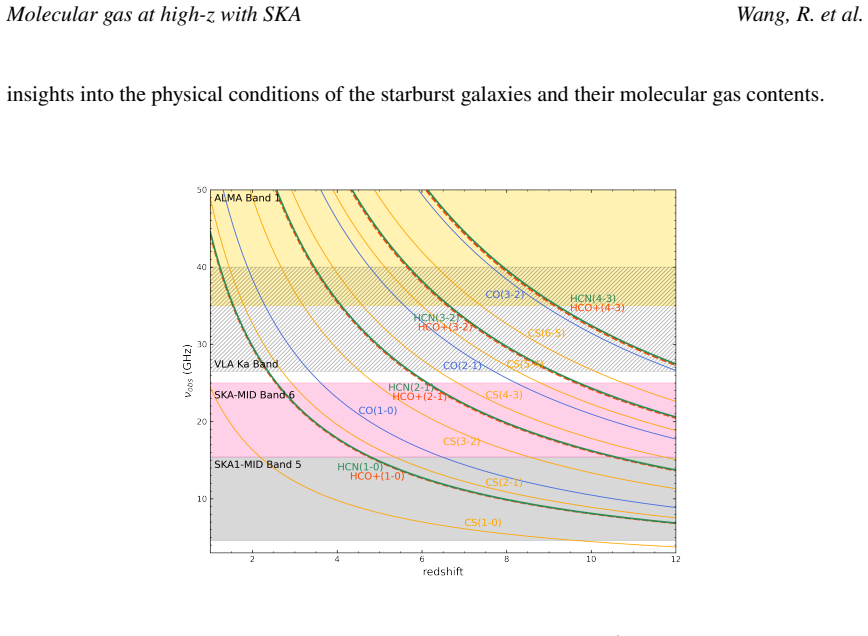
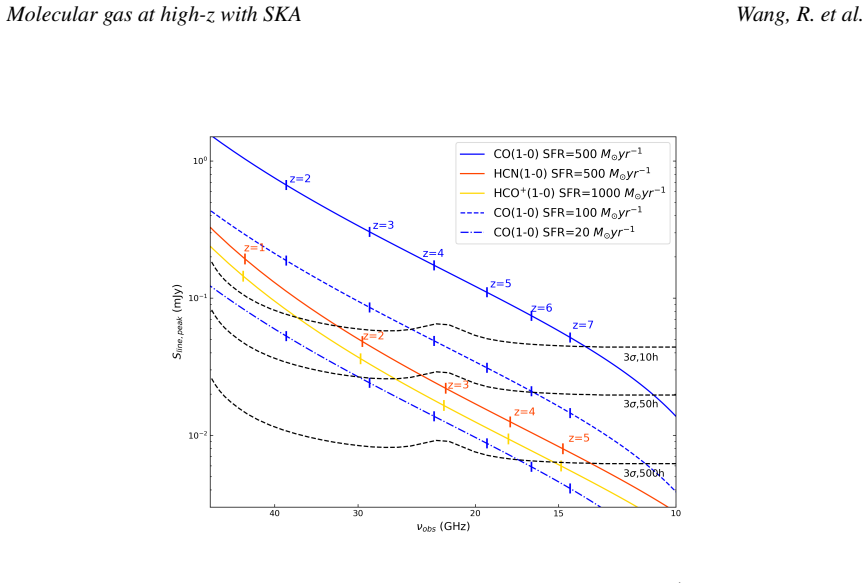
The Square Kilometre Array will be a revolutionary instrument for the study of gas in the distant Universe. At frequencies below ~50 GHz, observations of redshifted emission from low-J transitions of CO, HCN, HCO+, and HNC, etc. provide insight into the kinematics and mass budget of the cold, dense star-forming gas in galaxies. Over the past decade, sensitive imaging using ALMA has detected and resolved the redshifted high-J molecular CO line emission and far-infrared fine structure lines in samples of galaxies over a wide redshift range, shedding light on active star-formation processes at the early epoch of galaxy evolution. In recent years, increasing numbers of young galaxies at high redshift are discovered by JWST, which significantly improved our knowledge of different galaxy populations across cosmic time. In this updated chapter of the SKA science book, we would like to highlight the importance of studies of the low-J molecular lines in high-z galaxies using SKA toward high frequencies, discussing the request of frequency coverage beyond 15 GHz and emphasizing its crucial role in exploring the cold molecular gas content in the young galaxy populations in the early universe and investigating the regions of active-star formation using molecular CO and various dense gas tracers.
Editorial analysis
A structured set of objections, weighed in public.
Referee Report
Summary. The manuscript is an updated chapter for the SKA science book that advocates extending SKA frequency coverage beyond 15 GHz to observe redshifted low-J transitions of CO, HCN, HCO+, and HNC in high-redshift galaxies, thereby probing cold molecular gas kinematics and mass budgets in young galaxy populations and complementing existing ALMA high-J line and JWST continuum data.
Significance. Adoption of the recommended frequency coverage would enable unique access to the cold, dense gas phase in early galaxies that is not directly probed by current facilities; the chapter correctly identifies this scientific opportunity but supplies no new quantitative support such as sensitivity estimates or predicted detection rates.
major comments (1)
- [Abstract] Abstract and main text: the central recommendation for SKA coverage above 15 GHz rests entirely on qualitative discussion of line redshifting and prior ALMA/JWST results, without any sensitivity calculations, expected line fluxes, or detection-rate estimates that would be required to substantiate the claim that such observations are 'crucial' for new insights.
minor comments (1)
- The text would benefit from explicit citation of the most recent JWST high-z galaxy samples and any existing ALMA low-J upper limits at comparable redshifts.
Simulated Author's Rebuttal
We thank the referee for their review of this SKA Science Book chapter and for the recommendation of minor revision. We address the single major comment below.
read point-by-point responses
-
Referee: [Abstract] Abstract and main text: the central recommendation for SKA coverage above 15 GHz rests entirely on qualitative discussion of line redshifting and prior ALMA/JWST results, without any sensitivity calculations, expected line fluxes, or detection-rate estimates that would be required to substantiate the claim that such observations are 'crucial' for new insights.
Authors: This is a chapter in the SKA Science Book whose purpose is to provide high-level scientific advocacy for extending frequency coverage, based on the established complementarity between low-J molecular lines and existing ALMA high-J observations plus JWST continuum data. The manuscript deliberately focuses on the qualitative case for accessing the cold, dense gas phase at high redshift rather than performing new sensitivity modeling or detection-rate forecasts. Such quantitative work would require detailed assumptions about final SKA performance parameters and source populations that lie outside the scope of an advocacy chapter; we therefore do not believe additional calculations are necessary to support the recommendation in this specific document. revision: no
Circularity Check
No significant circularity identified
full rationale
The paper is an updated science-book chapter functioning as strategic advocacy for SKA frequency coverage above 15 GHz to access redshifted low-J CO and dense-gas lines. It presents no derivations, equations, fitted parameters, quantitative predictions, or models. The central claim is a recommendation grounded in prior ALMA and JWST results, without any load-bearing steps that reduce by construction to the paper's own inputs or self-citations. This is a normal, self-contained non-finding for perspective pieces.
Axiom & Free-Parameter Ledger
Reference graph
Works this paper leans on
-
[1]
doi: 10.3847/1538-4357/833/1/71. M. Archipley, J. Vieira, T. Crawford, and SPT-3G. InAmerican Astronomical Society Meeting Abstracts #243, volume 243 ofAmerican Astronomical Society Meeting Abstracts,
-
[2]
doi: 10.1093/mnras/stad1259. E. Bertola et al.A&A, 691:A178,
-
[3]
10 Molecular gas at high-z with SKA Wang, R
doi: 10.1051/0004-6361/202450420. 10 Molecular gas at high-z with SKA Wang, R. et al. M. Béthermin et al.A&A, 573:A113,
-
[4]
doi: 10.1051/0004-6361/201425031. J. E. Birkin et al.MNRAS, 501(3):3926–3950,
-
[5]
doi: 10.1093/mnras/staa3862. M. Bischetti et al.A&A, 645:A33,
-
[6]
doi: 10.1051/0004-6361/202039057. M. Bischetti et al.ApJ, 970(1):9, July
-
[7]
doi: 10.3847/1538-4357/ad4a77. M. Bischetti et al.ApJL, 990(2):L31,
-
[8]
doi: 10.3847/2041-8213/ade6ff. S. Bodansky et al.arXiv e-prints,
-
[9]
doi: 10.3847/1538-4357/abb82f. R. J. Bouwens et al.ApJ, 931(2):160,
-
[10]
doi: 10.3847/1538-4357/ac5a4a. M. Brusa et al.A&A, 612:A29,
-
[11]
doi: 10.1051/0004-6361/201731641. C. L. Carilli and F. Walter.ARA&A, 51(1),
-
[12]
doi: 10.1146/annurev-astro-082812-140953. C. L. Carilli et al.ApJ, 618(2),
-
[13]
doi: 10.1086/426014. G. Chabrier.PASP, 115(809):763–795,
-
[14]
doi: 10.1086/376392. C. J. Conselice et al.ApJ, 983(1):30,
work page internal anchor Pith review doi:10.1086/376392
-
[15]
doi: 10.3847/1538-4357/ada608. E. da Cunha et al.ApJ, 766(1):13,
-
[16]
doi: 10.1088/0004-637X/766/1/13. R. Decarli et al.ApJ, 833(1):70,
-
[17]
doi: 10.3847/1538-4357/833/1/70. R. Decarli et al.ApJ, 854(2):97,
-
[18]
doi: 10.3847/1538-4357/aaa5aa. R. Decarli et al.A&A, 662:A60,
-
[19]
doi: 10.1051/0004-6361/202142871. B. H. C. Emonts et al.Science, 354(6316):1128–1130,
-
[20]
doi: 10.1126/science.aag0512. B. H. C. Emonts et al.ApJ, 887(1):86,
-
[21]
doi: 10.3847/1538-4357/ab45f4. W. B. Everett et al.ApJ, 900(1):55,
-
[22]
doi: 10.3847/1538-4357/ab9df7. L. Ferreira et al.ApJ, 955(2):94,
-
[23]
doi: 10.3847/1538-4357/acec76. S. Fujimoto et al.ApJ, 887(2):107,
-
[24]
doi: 10.3847/1538-4357/ab480f. S. Fujimoto et al.ApJ, 964(2):146,
-
[25]
doi: 10.3847/1538-4357/ad235c. S. Gallerani et al.MNRAS, 473(2):1909–1917,
-
[26]
doi: 10.1093/mnras/stx2458. Y. Gao and P. M. Solomon.ApJ, 606(1),
-
[27]
doi: 10.1086/382999. S. García-Burillo et al.A&A, 539:A8,
-
[28]
doi: 10.1051/0004-6361/201117838. M. Ginolfi et al.A&A, 633:A90,
-
[29]
doi: 10.1051/0004-6361/201936872. C. Gruppioni, M. Béthermin, F. Loiacono, et al.A&A, 643:A8,
-
[30]
doi: 10.1051/0004-6361/ 202038487. M. Hagimoto et al.ApJ, 990(1):29, Sept
-
[31]
doi: 10.3847/1538-4357/ade87e. T. Hashimoto et al.ApJ, 952(1):48,
-
[32]
doi: 10.3847/1538-4357/acdd5c. R. Herrera-Camus et al.A&A, 649:A31,
-
[33]
doi: 10.1051/0004-6361/202039704. R. Herrera-Camus et al.A&A, 699:A80,
-
[34]
J.A.HodgeandE.daCunha.RoyalSocietyOpenScience,7(12):200556,2020
doi: 10.1051/0004-6361/202553896. J.A.HodgeandE.daCunha.RoyalSocietyOpenScience,7(12):200556,2020. doi: 10.1098/rsos. 200556. J. A. Hodge et al.ApJ, 978(2):165,
-
[35]
doi: 10.3847/1538-4357/ad9a52. A. P. S. Hygate et al.MNRAS, 524(2),
-
[36]
doi: 10.1093/mnras/stad1212. S. Jarugula, J. D. Vieira, A. Weiss, et al.ApJ, 921(1):97,
-
[37]
G.C.Jones,R.Maiolino,P.Caselli,andS.Carniani.A&A,632:L7,2019
doi: 10.3847/1538-4357/ac21db. G.C.Jones,R.Maiolino,P.Caselli,andS.Carniani.A&A,632:L7,2019. doi: 10.1051/0004-6361/ 201936989. G. C. Jones et al.MNRAS, 507(3),
-
[38]
doi: 10.1093/mnras/stab2226. M. Kaasinen et al.A&A, 684:A33,
-
[39]
11 Molecular gas at high-z with SKA Wang, R
doi: 10.1051/0004-6361/202348463. 11 Molecular gas at high-z with SKA Wang, R. et al. J. Kamenetzky et al.ApJ, 829(2):93,
-
[40]
doi: 10.3847/0004-637X/829/2/93. F. Lelli et al.Science, 371(6530),
-
[41]
doi: 10.1126/science.abc1893. J. Li et al.ApJL, 922(2):L29,
-
[42]
doi: 10.3847/2041-8213/ac390d. J. Li et al.ApJ, 962(2):119,
-
[43]
doi: 10.3847/1538-4357/ad1754. R. Maiolino et al.MNRAS, 452(1),
-
[44]
doi: 10.1093/mnras/stv1194. D. Marsden et al.MNRAS, 439(2):1556–1574,
-
[45]
doi: 10.1093/mnras/stu001. M. Martorano et al.A&A, 694:A76,
-
[46]
R.Meijerink, M.Spaans, andF.P.Israel.A&A,461(3),
doi: 10.1051/0004-6361/202452919. R.Meijerink, M.Spaans, andF.P.Israel.A&A,461(3),
-
[47]
doi: 10.1051/0004-6361:20066130. R. Meijerink et al.ApJL, 762(2):L16,
-
[48]
doi: 10.1088/2041-8205/762/2/L16. S. Naess et al.JCAP, 2025(11):061,
-
[49]
doi: 10.1088/1475-7516/2025/11/061. M. Neeleman et al.ApJ, 911(2):141,
-
[50]
doi: 10.3847/1538-4357/abe70f. L. Neumann et al.A&A, 693:L13,
-
[51]
doi: 10.1051/0004-6361/202453208. J. Nianias, J. Lim, and M. Yeung.ApJ, 963(1):19,
-
[52]
doi: 10.3847/1538-4357/ad188a. Y. Ono et al.ApJ, 941(1):74,
-
[53]
doi: 10.3847/1538-4357/ac9ea6. K. Ormerod et al.MNRAS, 527(3),
-
[54]
doi: 10.1093/mnras/stad3597. R. Pavesi et al.ApJ, 864(1):49,
-
[55]
A.Pellegrini,J.Flygare,I.P.Theron,etal.IEEEJournalofMicrowaves,1(1):428–437,2021
doi: 10.3847/1538-4357/aacb79. A.Pellegrini,J.Flygare,I.P.Theron,etal.IEEEJournalofMicrowaves,1(1):428–437,2021. doi: 10.1109/JMW.2020.3034029. A. Pensabene et al.A&A, 637:A84,
-
[56]
doi: 10.1051/0004-6361/201936634. M. W. Pound and M. G. Wolfire. In R. W. Argyle, P. S. Bunclark, and J. R. Lewis, editors, Astronomical Data Analysis Software and Systems XVII, volume 394 ofAstronomical Society of the Pacific Conference Series, page 654, Aug
-
[57]
doi: 10.3847/1538-3881/ac9b1f. C. Reuter et al.ApJ, 902(1):78,
-
[58]
doi: 10.3847/1538-4357/abb599. D. A. Riechers et al.Nature, 496(7445),
-
[59]
doi: 10.1038/nature12050. D. A. Riechers et al.ApJ, 872(1):7, Feb
-
[60]
doi: 10.3847/1538-4357/aafc27. M. Rybak et al.A&A, 667:A70,
-
[61]
doi: 10.1051/0004-6361/202243894. M. Rybak et al.A&A, 706:A69, Jan
-
[62]
doi: 10.1051/0004-6361/202556845. D. Salak et al.ApJ, 962(1):1,
-
[63]
doi: 10.3847/1538-4357/ad0df5. C. Schreiber et al.A&A, 599:A134,
-
[64]
doi: 10.1051/0004-6361/201629155. R. Smit et al.Nature, 553(7687),
-
[65]
doi: 10.1038/nature24631. P. M. Solomon and P. A. Vanden Bout.ARA&A, 43(1),
-
[66]
A generator approach to stochastic monotonicity and propagation of order
doi: 10.1146/annurev.astro.43. 051804.102221. J. S. Spilker et al.Science, 361(6406):1016–1019,
work page internal anchor Pith review Pith/arXiv arXiv doi:10.1146/annurev.astro.43
-
[67]
doi: 10.1126/science.aap8900. J. S. Spilker et al.ApJ, 982(2):72,
-
[68]
doi: 10.3847/1538-4357/adb750. V. Springel et al.Nature, 435(7042):629–636,
-
[69]
doi: 10.1038/nature03597. M. L. Strandet et al.ApJL, 842(2):L15,
-
[70]
doi: 10.3847/2041-8213/aa74b0. L. J. Tacconi, R. Genzel, and A. Sternberg.ARA&A, 58:157–203,
-
[71]
doi: 10.1093/mnras/stac150. B. D. Uzgil et al.ApJ, 912(1):67,
-
[72]
doi: 10.3847/1538-4357/abe86b. S. Veilleux, R. Maiolino, A. D. Bolatto, and S. Aalto.A&ARv, 28(1):2,
-
[73]
doi: 10.1088/2041-8205/751/2/L24. J. Wagg, N. Kanekar, and C. L. Carilli.ApJL, 697(1):L33–L37,
-
[74]
doi: 10.1088/0004-637X/ 697/1/L33. J. Wagg et al. InAdvancing Astrophysics with the Square Kilometre Array (AASKA14), page 161, Apr
-
[75]
doi: 10.22323/1.215.0161. F. Walter et al.ApJ, 833(1):67,
-
[76]
doi: 10.3847/1538-4357/833/1/67. F. Walter et al.ApJ, 927(1):21,
-
[77]
doi: 10.3847/1538-4357/ac49e8. F. Wang et al.ApJ, 968(1):9,
-
[78]
doi: 10.3847/1538-4357/ad3fb4. J. Wu, N. J. Evans, II, Y. L. Shirley, and C. Knez.ApJSS, 188(2):313–357,
-
[79]
doi: 10.1051/0004-6361/201731391. J. A. Zavala et al.ApJ, 933(2):242,
-
[80]
doi: 10.3847/1538-4357/ac7560. Z.-Y. Zhang et al.ApJL, 784(2):L31,
discussion (0)
Sign in with ORCID, Apple, or X to comment. Anyone can read and Pith papers without signing in.