REVIEW 3 major objections 5 minor 62 references
Tip of the red giant branch distance to the nearby dwarf galaxy [TT2009] 25 in the NGC 891 group
T0 review · 3 major / 5 minor · reviewed 2026-08-14 · deepseek-v4-flash
Pith's one-line read This paper measures a tip-of-the-red-giant-branch distance of $10.28^{+1.17}_{-1.73}$ Mpc for [TT2009] 25, confirming it as a satellite of NGC 891.
desk verdict A routine but solid TRGB distance to one new dwarf; the differential offset between the two Subaru fields is under-tested and the membership claim is over-confident, but the distance and structural parameters are still useful for the NGC 891 census. read the letter →
The pith
A machine-rendered reading of the paper's core claim, the machinery that carries it, and where it could break.
The reading
What carries the argument
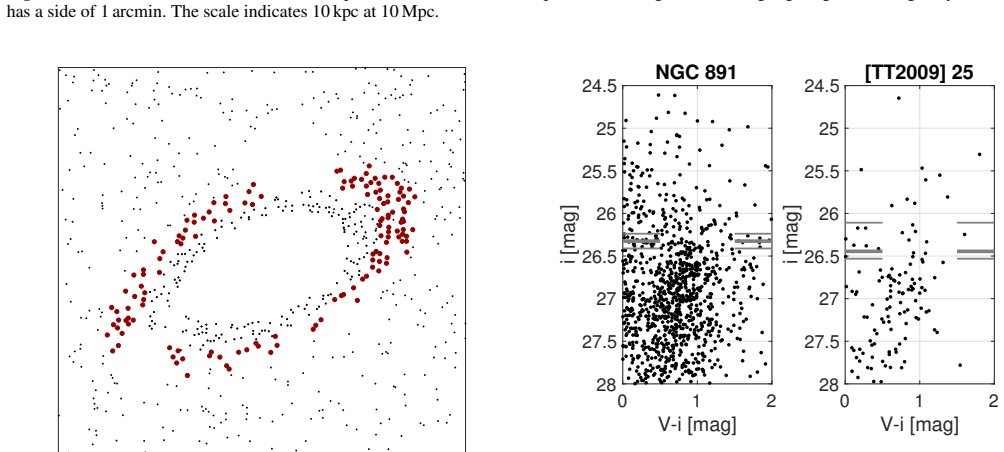
The central mechanism is the tip of the red giant branch (TRGB), the sharp cutoff in the brightness of old low-mass stars at the end of their red-giant evolution, which serves as a standard candle. The paper locates this cutoff in the $i$-band luminosity function with a Bayesian Markov Chain Monte Carlo fitting routine that models the RGB as a power law and uses a large reference field to subtract foreground and background contamination. The distance is computed differentially: the TRGB of [TT2009] 25 is measured against the TRGB of NGC 891's outer halo in the same Subaru field, a difference of 0.12 mag, and the result is anchored to the Hubble Space Telescope distance of NGC 891 ($D = 9.73$ Mpc). This anchoring is what transfers the superior space-based calibration onto the ground-based measurement.
What would settle it
Deep space-based photometry that resolves the crowded central region of [TT2009] 25 and measures its tip of the red giant branch directly would settle the distance: if that tip is not at $i \approx 26.45$ mag, the value from the ground-based outskirts sample, the 0.12 mag offset between dwarf and host is biased and the 10.28 Mpc distance would need revision.
Extended reading notes
Core claim
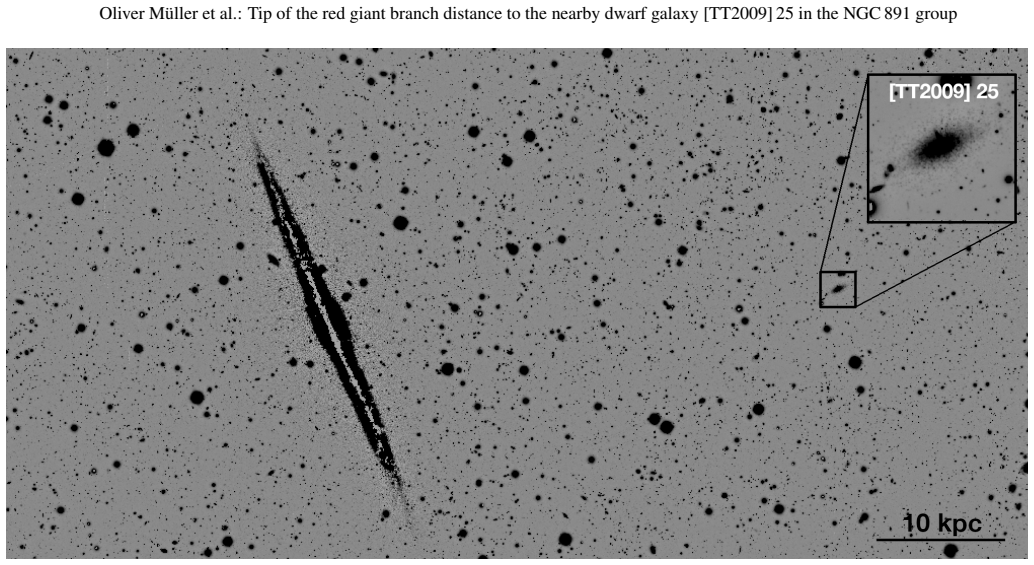
The central discovery is that [TT2009] 25 lies at $10.28^{+1.17}_{-1.73}$ Mpc, with distance modulus $(m-M)_0 = 30.06^{+0.23}_{-0.40}$ mag, consistent with the HST-anchored distance of NGC 891 and confirming the dwarf as a member of that galaxy's system. With the distance fixed, the paper derives structural parameters from archival CFHT data: absolute magnitude $M_r = -13.18^{+0.24}_{-0.40}$ mag, effective radius $649^{+76}_{-111}$ pc, S\'ersic index $n = 1.01$, and ellipticity $0.52$. These place it on the scaling relations defined by Local Group dwarfs, with a morphology reminiscent of Fornax but with FUV emission that makes it a transition-type dwarf rather than a purely quiescent spheroidal. The star map shows a sharp cutoff in the dwarf's stellar profile, so no extended stellar halo is detected around it. In the roughly 100 kpc field surveyed, only this one bright dwarf and the giant stream are resolved, a census the authors compare with the bright-satellite population within 50 kpc of the Milky Way.
Load-bearing premise
The distance estimate assumes that the two stellar-brightness measurements being compared, one from the clean outer parts of NGC 891 and one from the crowded vicinity of [TT2009] 25, carry no systematic offset from crowding or background contamination; if the 0.12 magnitude difference between them is biased, the final distance shifts even though it is anchored to the Hubble Space Telescope distance of NGC 891.
Editorial extensions
If this is right
- [TT2009] 25 is physically associated with NGC 891 at roughly 10 Mpc, giving an extragalactic satellite system around a Milky Way analog outside the Local Group.
- With the distance fixed, the dwarf's absolute magnitude, effective radius, and S\'ersic index can be compared with Local Group scaling relations, and it falls where a Fornax-like transition-type dwarf should.
- The lack of a detected extended stellar halo implies that any such envelope around [TT2009] 25 is either absent or fainter than the foreground contamination from NGC 891 allows these data to see.
- The survey's 100 kpc field contains only one resolved bright dwarf and a giant stream, so a wider, deeper survey around NGC 891 is needed before the dwarf abundance can be compared with the Milky Way's satellite population.
Reading between the lines
- If this result holds, the NGC 891 field currently has an incomplete faint-satellite census: the Milky Way hosts at least ten dwarfs fainter than its classical bright satellites within similar radii, so a comparable survey around NGC 891 would need to be much wider and deeper to see them.
- The Fornax-like structural parameters plus FUV-detected star formation make [TT2009] 25 a plausible host of globular clusters; resolving them would allow dark-matter cusp-versus-core tests in a dwarf outside the Local Group.
- A future space-based observation resolving the dwarf's crowded center and measuring its own tip of the red giant branch would test whether the 0.12 magnitude offset is real or an artifact of crowding, and hence whether the 10.28 Mpc distance is robust.
- Matching the survey's one 100 kpc field to the Milky Way's satellites within 50 kpc is not a like-for-like census, since projected line-of-sight satellites of NGC 891 also appear in the field; a fair abundance comparison needs a radius- and luminosity-matched sample around both hosts.
Signed reviews
Editorial analysis
A structured set of objections, weighed in public.
Referee Report
Summary. This Letter presents a tip of the red giant branch (TRGB) distance measurement for the dwarf galaxy [TT2009] 25, located in the field of the Milky Way analog NGC 891. Using deep Subaru Suprime Cam V and i photometry, the authors measure the TRGB in the outskirts of NGC 891 and in the dwarf galaxy in the same field. They obtain a differential distance modulus offset of 0.12 mag, anchor the offset to the Hubble Space Telescope (HST) distance of NGC 891 (D = 9.73 Mpc), and derive a final distance of D = 10.28^{+1.17}_{-1.73} Mpc for [TT2009] 25, which they interpret as confirmation of its physical association with NGC 891. The paper also derives structural parameters of the dwarf from archival CFHT/MegaCam data and discusses the dwarf satellite abundance in the surveyed field.
Significance. If correct, the measurement places [TT2009] 25 as a confirmed satellite of NGC 891 at approximately 10 Mpc, adding a valuable data point for studies of dwarf galaxy scaling relations and satellite abundances around a Milky Way analog. The manuscript uses deep, well-calibrated ground-based photometry and a standard Bayesian MCMC TRGB approach, and the differential anchoring to an HST distance is a sensible way to reduce external zero-point errors. The structural parameter analysis and the comparative discussion with the Milky Way satellite population are useful contributions. However, the central distance relies on the robustness of a 0.12 mag differential offset measured under different crowding and contamination conditions, and the paper's own ground-based TRGB distance to NGC 891 differs from the adopted HST anchor by 0.18 mag. These internal consistency concerns are not adequately addressed, and the claim that membership is confirmed beyond doubt overstates the strength of the evidence.
major comments (3)
- [Sec. 3 (TRGB distance measurement)] The differential offset of 0.12 mag between the TRGB of NGC 891 and that of [TT2009] 25 is the load-bearing quantity for the final distance, but its robustness is not tested. The authors note that the inner regions of the dwarf suffer blending and brightening of order 0.4 mag and exclude those regions, while the NGC 891 measurement uses an outer annulus; yet no artificial star tests, no variation of the annulus or reference field geometry, and no test of the contamination-model sensitivity are presented. Since any field-dependent bias in the offset propagates directly into the anchored distance, this is a critical gap for the paper's central claim.
- [Sec. 3 (internal consistency)] The text reports i_TRGB = 26.32 for NGC 891, corresponding to D = 8.97 Mpc using the Bellazzini calibration, and yet adopts the HST distance D = 9.73 Mpc as the anchor. The 0.18 mag discrepancy is comparable to the measured dwarf-host offset (0.12 mag) and to the quoted uncertainties. The paper dismisses this as slightly different, but it is actually a significant internal inconsistency. The authors should either identify and quantify the source of this discrepancy (for example, photometric zero-point offsets between Pan-STARRS-calibrated Subaru photometry and HST photometry, or crowding bias in the NGC 891 annulus) or add it as a systematic uncertainty in the final distance. Without this, the differential measurement may be comparing two quantities that are not on the same system.
- [Sec. 4.1] The statement that the distance estimation confirms beyond doubt that [TT2009] 25 is a dwarf galaxy associated with NGC 891 is stronger than the evidence supports. The quoted distance uncertainty is large (10.28^{+1.17}_{-1.73} Mpc), and the 0.18 mag internal inconsistency between the ground-based and HST TRGB measurements shows that systematic errors of that magnitude are plausible. The membership conclusion is likely robust to these shifts, but beyond doubt is not justified. A more measured claim, such as strongly supports membership, would be appropriate.
minor comments (5)
- [Abstract] The phrase 'where one bright dwarfs reside' is grammatically incorrect; it should be 'where one bright dwarf resides.'
- [Sec. 4.1] The word 'seperated' is misspelled; it should be 'separated.'
- [Fig. 2 caption] The sentence 'One side is 100 arcsec' is ambiguous; it would be clearer as 'Each side is 100 arcsec.'
- [Sec. 3] The quoted TRGB uncertainty for [TT2009] 25 is asymmetric (+0.12/-0.35 mag), but the source of this asymmetry is not explained. A brief note on whether it arises from contamination, low star counts, or the MCMC posterior shape would be helpful.
- [Sec. 3] The final distance uncertainty is described as coming from the Subaru TRGB errors and the HST TRGB detection uncertainty (plus or minus 0.2 mag), but the 0.1 mag calibration uncertainty of the TRGB absolute magnitude (Bellazzini 2008) is not mentioned. If the HST anchor makes this term irrelevant, the authors should state so explicitly.
Circularity Check
No circularity: the dwarf distance is a differential TRGB offset measured from the data, anchored to an independent HST distance of NGC 891.
full rationale
The central measurement chain is self-contained. The TRGB magnitudes of NGC 891 and [TT2009] 25 are fit independently from the same Subaru data using the Conn et al. MCMC scheme, the differential offset of 0.12 mag is measured rather than imposed, and the final distance is obtained by adding that offset to the independent HST distance of NGC 891 from Mouhcine et al. (2007) and Rejkuba et al. (2009). Nothing in the derivation defines the dwarf distance as the NGC 891 distance: a substantially larger offset would have failed the consistency test. The self-citations to the authors' earlier data, HST distance, and method descriptions are independent evidence, not fit parameters renamed as predictions; the HST distance is an external measurement, and the MCMC method originates in Conn et al. (2011, 2012). The noted 0.18 mag discrepancy between the ground-based and HST TRGB zero points is a systematic-error concern, not a circular step, because the final result does not require the ground-based absolute tip to equal the HST zero point. No equation reduces to its own input, and no fitted input is relabeled as a prediction.
Assumptions & free parameters
free parameters (2)
- TRGB magnitude of [TT2009] 25 =
i_TRGB = 26.45^{+0.09}_{-0.34} mag
- TRGB magnitude of NGC 891 in the same field =
i_TRGB = 26.32^{+0.09}_{-0.09} mag
assumptions (4)
- domain assumption The Bellazzini (2008) TRGB calibration, M_I = -3.44 +/- 0.1 mag, transformed to AB, is valid for the stellar populations of both galaxies.
- domain assumption The adopted HST distance to NGC 891, D = 9.73^{+0.94}_{-0.86} Mpc, is correct and is used as the zero point for the final distance.
- domain assumption The MCMC reference field accurately represents the foreground and background contamination toward [TT2009] 25.
- domain assumption Stars in the selected elliptical annulus are representative of the dwarf's RGB population after excluding the crowded center.
Cite this review
Pith. "Pith review of Tip of the red giant branch distance to the nearby dwarf galaxy [TT2009] 25 in the NGC 891 group." pith.science (2026). https://pith.science/paper/VHGXAEL2
@misc{pith2026190803073,
  author       = {Pith},
  title        = {Pith review of: Tip of the red giant branch distance to the nearby dwarf galaxy [TT2009] 25 in the NGC 891 group},
  year         = {2026},
  howpublished = {\url{https://pith.science/paper/VHGXAEL2}},
  note         = {Machine review of arXiv:1908.03073}
}
abstract
Dwarf galaxies are key objects for small-scale cosmological tests like the abundance problems or the planes-of-satellites problem. It is therefore a crucial task to get accurate information for as many nearby dwarf galaxies as possible. Using extremely deep, ground-based $V$ and $i$-band Subaru Suprime Cam photometry with a completeness of $i=27$ mag, we measure the tip of the red giant branch distance for the dwarf galaxy [TT2009] 25. This dwarf resides in the field around the Milky Way-analog NGC 891. By using a Bayesian approach, we measure a distance of $10.28^{+1.17}_{-1.73}$ Mpc, which is consistent with the distance of NGC 891, thus we confirm it as a member of NGC 891. The dwarf galaxy follows the scaling relations defined by the Local Group dwarfs. We do not find an extended stellar halo around [TT2009] 25. In the small field of view of 100 kpc covered by the survey, only one bright dwarf galaxy and the giant stream are apparent. This is comparable to the Milky Way, where one bright dwarfs reside in the same volume, as well as the Sagittarius stream - excluding satellites which are farther away but would be projected in the line-of-sight. It is thus imperative to survey for additional dwarf galaxies in a larger area around NGC 891 to test the abundance of dwarf galaxies and compare it to the number of satellites around the Milky Way.
Figures
Reference graph
Works this paper leans on
-
[1]
Peculiar Velocities of Galaxies Just Beyond the Local Group
Anand, G. S., Tully, R. B., Rizzi, L., Shaya, E. J., & Karachentsev, I. D. 2019, arXiv e-prints, arXiv:1905.11416
work page Pith review arXiv 2019
- [2]
- [3]
-
[4]
The M101 Satellite Luminosity Function and the Halo to Halo Scatter Among Local Volume Hosts
Bennet, P., Sand, D. J., Crnojevi ´c, D., et al. 2019, arXiv e-prints, arXiv:1906.03230
work page Pith review arXiv 2019
- [5]
-
[6]
Boylan-Kolchin, M., Bullock, J. S., & Kaplinghat, M. 2011, MNRAS, 415, L40
work page 2011
-
[7]
Chambers, K. C., Magnier, E. A., Metcalfe, N., et al. 2016, arXiv e-prints, arXiv:1612.05560
arXiv 2016
-
[8]
Cohen, Y ., van Dokkum, P., Danieli, S., et al. 2018, ApJ, 868, 96
work page 2018
Show all 62 references
-
[9]
R., Dehnen, W., Read, J
Cole, D. R., Dehnen, W., Read, J. I., & Wilkinson, M. I. 2012, MNRAS, 426, 601
2012
-
[10]
R., Ibata, R
Conn, A. R., Ibata, R. A., Lewis, G. F., et al. 2012, ApJ, 758, 11
2012
-
[11]
R., Lewis, G
Conn, A. R., Lewis, G. F., Ibata, R. A., et al. 2011, ApJ, 740, 69 Da Costa, G. S. & Armandroff, T. E. 1990, AJ, 100, 162 de Blok, W. J. G. 2010, Advances in Astronomy, 2010, 789293
2011
-
[12]
Frenk, C. S. & White, S. D. M. 2012, Annalen der Physik, 524, 507
2012
-
[13]
B., Hardy, E., Pont, F., & Zinn, R
Gallart, C., Stetson, P. B., Hardy, E., Pont, F., & Zinn, R. 2004, ApJ, 614, L109
2004
-
[14]
H., Mao, Y .-Y ., et al
Geha, M., Wechsler, R. H., Mao, Y .-Y ., et al. 2017, ApJ, 847, 4
2017
-
[15]
2018, ApJ, 861, 81
Greggio, L., Falomo, R., & Scarpa, R. 2018, ApJ, 861, 81
2018
-
[16]
2019, MNRAS, 487, 2441
Haghi, H., Kroupa, P., Banik, I., et al. 2019, MNRAS, 487, 2441
2019
-
[17]
L., Aparicio, A., Martínez-Delgado, D., & Gallart, C
Hidalgo, S. L., Aparicio, A., Martínez-Delgado, D., & Gallart, C. 2009, ApJ, 705, 704
2009
-
[18]
G., Ibata, R
Ibata, N. G., Ibata, R. A., Famaey, B., & Lewis, G. F. 2014, Nature, 511, 563
2014
-
[19]
2009, MNRAS, 395, 126
Ibata, R., Mouhcine, M., & Rejkuba, M. 2009, MNRAS, 395, 126
2009
-
[20]
& Hatzidimitriou, D
Irwin, M. & Hatzidimitriou, D. 1995, MNRAS, 277, 1354
1995
-
[21]
2016, A&A, 588, A89
Javanmardi, B., Martinez-Delgado, D., Kroupa, P., et al. 2016, A&A, 588, A89
2016
-
[22]
G., et al
Javanmardi, B., Raouf, M., Khosroshahi, H. G., et al. 2019, ApJ, 870, 50
2019
-
[23]
D., Karachentseva, V
Karachentsev, I. D., Karachentseva, V . E., Huchtmeier, W. K., & Makarov, D. I. 2004, AJ, 127, 2031
2004
-
[24]
D., Makarov, D
Karachentsev, I. D., Makarov, D. I., & Kaisina, E. I. 2013, AJ, 145, 101
2013
-
[25]
2018, Nature Astronomy, 2, 925
Kroupa, P., Banik, I., Haghi, H., et al. 2018, Nature Astronomy, 2, 925
2018
-
[26]
S., et al
Kroupa, P., Famaey, B., de Boer, K. S., et al. 2010, A&A, 523, A32
2010
-
[27]
2018, Nature, 561, E4
Kroupa, P., Haghi, H., Javanmardi, B., et al. 2018, Nature, 561, E4
2018
-
[28]
G., Freedman, W
Lee, M. G., Freedman, W. L., & Madore, B. F. 1993, ApJ, 417, 553
1993
-
[29]
I., Hoffman, Y ., Tully, R
Libeskind, N. I., Hoffman, Y ., Tully, R. B., et al. 2015, MNRAS, 452, 1052 López-Corredoira, M. & Kroupa, P. 2016, ApJ, 817, 75
2015
-
[30]
2005, Transformations between SDSS magnitudes and other systems https://www.sdss3.org/dr10/algorithms/sdssUBVRITransform.php/
Lupton, R. 2005, Transformations between SDSS magnitudes and other systems https://www.sdss3.org/dr10/algorithms/sdssUBVRITransform.php/
2005
-
[31]
A., Schlafly, E
Magnier, E. A., Schlafly, E. F., Finkbeiner, D. P., et al. 2016, arXiv e-prints [arXiv:1612.05242]
2016 arXiv
-
[32]
C., Fanson, J., Schiminovich, D., et al
Martin, D. C., Fanson, J., Schiminovich, D., et al. 2005, ApJ, 619, L1
2005
-
[33]
F., de Jong, J
Martin, N. F., de Jong, J. T. A., & Rix, H.-W. 2008, ApJ, 684, 1075
2008
-
[34]
McConnachie, A. W. 2012, AJ, 144, 4
2012
-
[35]
2003, Science, 301, 1508
Minniti, D., Borissova, J., Rejkuba, M., et al. 2003, Science, 301, 1508
2003
-
[36]
& Zijlstra, A
Minniti, D. & Zijlstra, A. A. 1996, ApJ, 467, L13
1996
-
[37]
2002, PASJ, 54, 833
Miyazaki, S., Komiyama, Y ., Sekiguchi, M., et al. 2002, PASJ, 54, 833
2002
- [38]
-
[39]
1999, ApJ, 524, L19
Moore, B., Ghigna, S., Governato, F., et al. 1999, ApJ, 524, L19
1999
-
[40]
2010, ApJ, 714, L12
Mouhcine, M., Ibata, R., & Rejkuba, M. 2010, ApJ, 714, L12
2010
-
[41]
2007, MNRAS, 381, 873 Müller, O., Famaey, B., & Zhao, H
Mouhcine, M., Rejkuba, M., & Ibata, R. 2007, MNRAS, 381, 873 Müller, O., Famaey, B., & Zhao, H. 2019a, A&A, 623, A36 Müller, O., Jerjen, H., & Binggeli, B. 2017, A&A, 597, A7 Müller, O., Jerjen, H., & Binggeli, B. 2018a, A&A, 615, A105 Müller, O., Pawlowski, M. S., Jerjen, H.,...
2007 arXiv
-
[42]
2007, AJ, 134, 1019
Oosterloo, T., Fraternali, F., & Sancisi, R. 2007, AJ, 134, 1019
2007
-
[43]
Orkney, M. D. A., Read, J. I., Petts, J. A., & Gieles, M. 2019, MNRAS, 1624
2019
-
[44]
Pawlowski, M. S. 2018, Modern Physics Letters A, 33, 1830004
2018
-
[45]
S., Famaey, B., Merritt, D., & Kroupa, P
Pawlowski, M. S., Famaey, B., Merritt, D., & Kroupa, P. 2015, ApJ, 815, 19
2015
-
[46]
S., Kroupa, P., & Jerjen, H
Pawlowski, M. S., Kroupa, P., & Jerjen, H. 2013, MNRAS, 435, 1928
2013
-
[47]
Y ., Ho, L
Peng, C. Y ., Ho, L. C., Impey, C. D., & Rix, H.-W. 2002, AJ, 124, 266
2002
-
[48]
I., Walker, M
Read, J. I., Walker, M. G., & Steger, P. 2018, MNRAS, 481, 860
2018
-
[49]
I., Walker, M
Read, J. I., Walker, M. G., & Steger, P. 2019, MNRAS, 484, 1401
2019
-
[50]
D., et al
Rejkuba, M., Minniti, D., Gregg, M. D., et al. 2000, AJ, 120, 801
2000
-
[51]
2009, MNRAS, 396, 1231
Rejkuba, M., Mouhcine, M., & Ibata, R. 2009, MNRAS, 396, 1231
2009
-
[52]
S., Fattahi, A., et al
Sawala, T., Frenk, C. S., Fattahi, A., et al. 2016, MNRAS, 457, 1931
2016
-
[53]
2017, A&A, 606, A33
Serenelli, A., Weiss, A., Cassisi, S., Salaris, M., & Pietrinferni, A. 2017, A&A, 606, A33
2017
-
[54]
Sersic, J. L. 1968, Atlas de galaxias australes
1968
-
[55]
Simon, J. D. & Geha, M. 2007, ApJ, 670, 313
2007
-
[56]
S., Willman, B., & Aguirre, J
Spekkens, K., Urbancic, N., Mason, B. S., Willman, B., & Aguirre, J. E. 2014, ApJ, 795, L5
2014
-
[57]
& Davies, R
Staveley-Smith, L. & Davies, R. D. 1987, MNRAS, 224, 953
1987
-
[58]
Stetson, P. B. 1987, PASP, 99, 191
1987
-
[59]
& Tully, R
Trentham, N. & Tully, R. B. 2009, MNRAS, 398, 722
2009
-
[60]
A., Borlaff, A., et al
Trujillo, I., Beasley, M. A., Borlaff, A., et al. 2019, MNRAS, 486, 1192
2019
-
[61]
B., Libeskind, N
Tully, R. B., Libeskind, N. I., Karachentsev, I. D., et al. 2015, ApJ, 802, L25 van Dokkum, P., Danieli, S., Cohen, Y ., et al. 2018, Nature, 555, 629
2015
-
[62]
2017, A&A, 608, A142 Article number, page 5 of 5
Venhola, A., Peletier, R., Laurikainen, E., et al. 2017, A&A, 608, A142 Article number, page 5 of 5
2017
Reviewed August 14, 2026 · model on record in the stance chip above.
Discussion (0). Continue with ORCID to comment.