REVIEW 5 minor 11 references
Optimal Morphs of Planar Orthogonal Drawings II
T0 review · 0 major / 5 minor · reviewed 2026-08-14 · deepseek-v4-flash
Pith's one-line read This paper proves that equivalent planar orthogonal drawings of a disconnected graph morph into each other with at most $s+1$ linear morphs, where $s$ is the spirality of the starting drawing and $s = O(n)$.
desk verdict A solid, genuinely new result that closes the disconnected orthogonal morphing problem at the asymptotically optimal O(n) bound, though it leans heavily on the authors' prior framework. read the letter →
The pith
A machine-rendered reading of the paper's core claim, the machinery that carries it, and where it could break.
The reading
What carries the argument
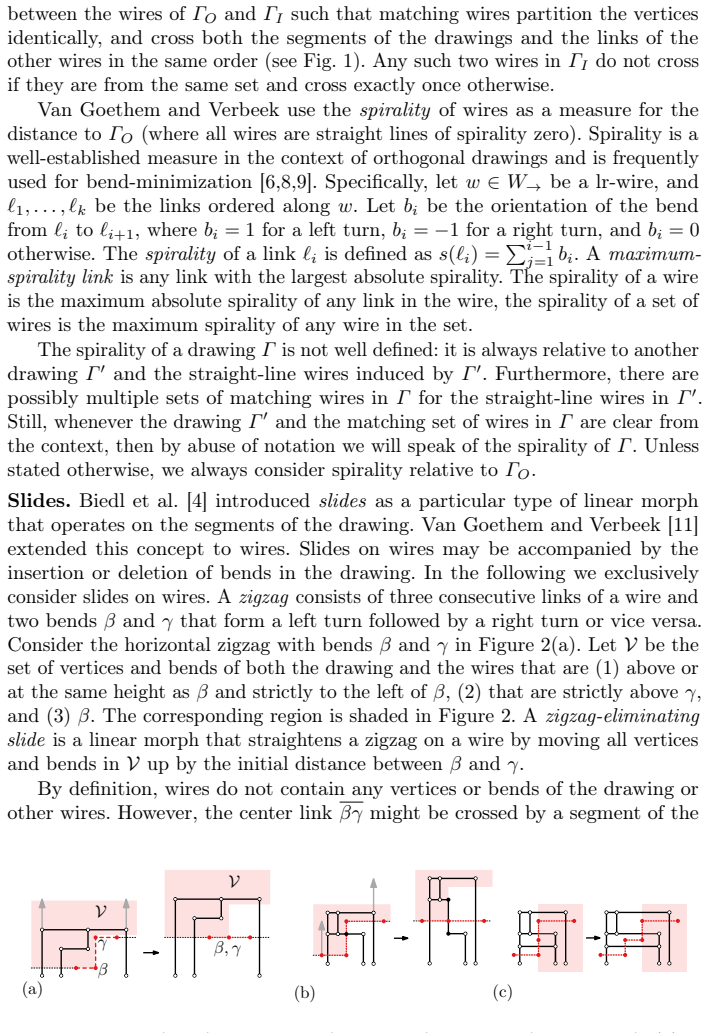
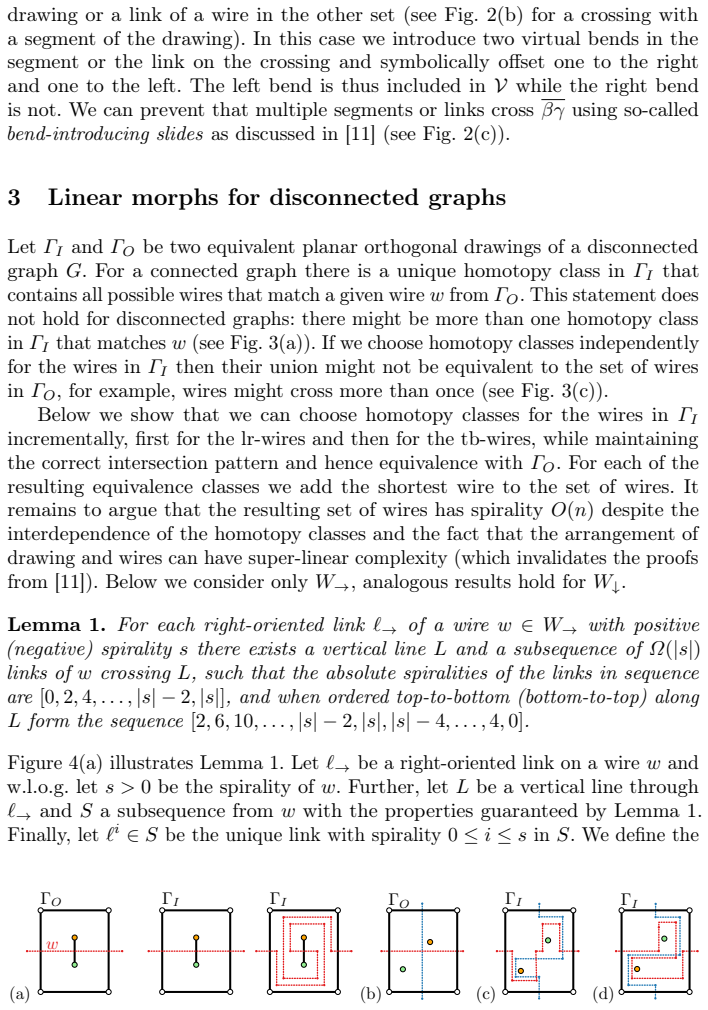
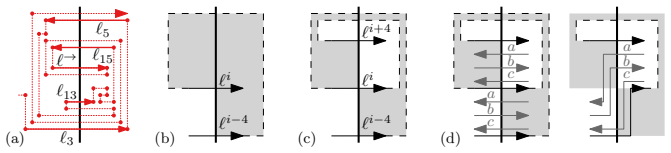
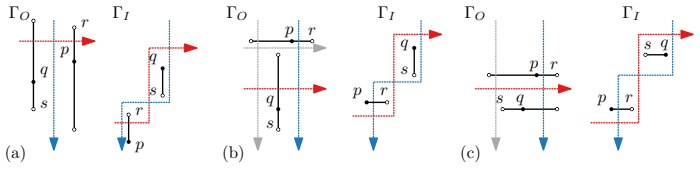
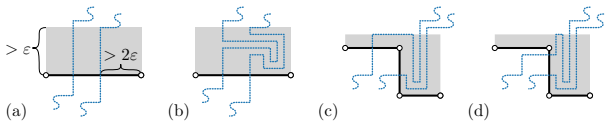
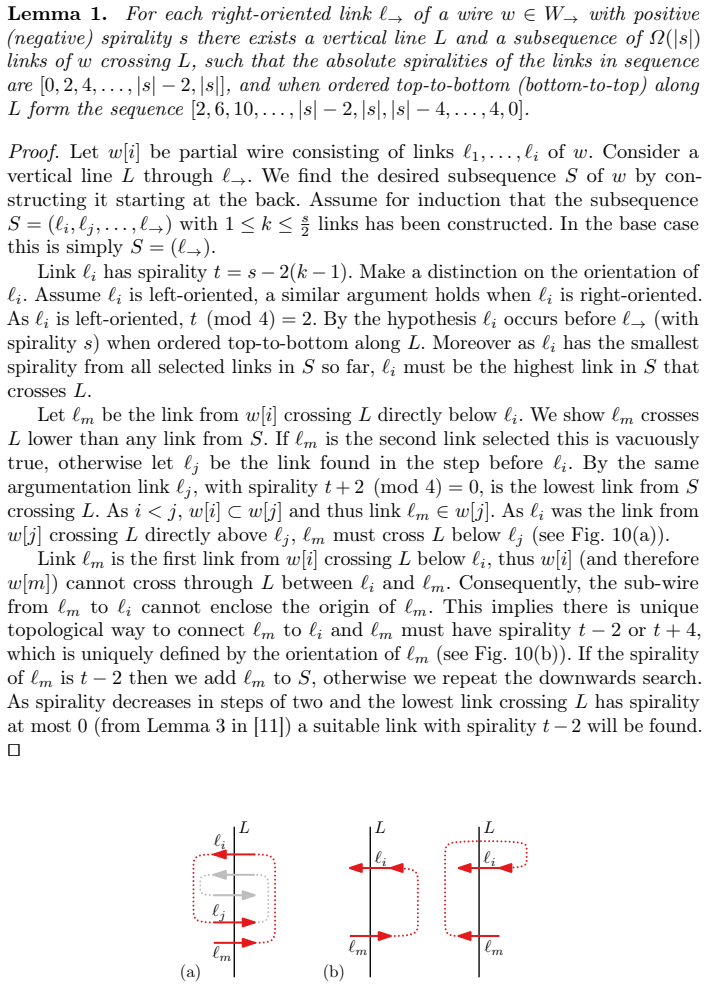
The central object is a wire, an orthogonal polyline that separates the drawing into left/right or top/bottom parts and records the order in which vertices, edges, and other wires are crossed; a set of matched left-to-right and top-to-bottom wires encodes the structural difference between the two drawings. Spirality of a wire is the maximum absolute number of left turns minus right turns accumulated along any of its links, and it serves as the distance measure being driven down to zero. The argument is carried by three mechanisms: shortest-compatible wire insertion, which pins spirality to $O(n)$; staircases, which are chains of maximum-spirality links that isolate the pairs of vertices whose order changes, enabling each unit of spirality to be removed by one linear morph; and windmill rerouting with redraw steps, which keep the number of bends added per iteration linear so the final drawing has linear complexity.
What would settle it
A concrete disproof would be an explicit pair of equivalent planar orthogonal drawings of a disconnected graph with $n$ vertices for which every equivalent set of wires has spirality growing faster than linearly in $n$; such an example would refute the $O(n)$ morph theorem immediately. A narrower test is to search for a single wire whose spiral contains a layer empty of both vertices and edges but full of previously selected shortest wires; if shortcutting that layer yields a wire that is not equivalent to $\Gamma_O$, then the proof of Lemma 3 fails at that point.
Extended reading notes
Core claim
The central claim is that two equivalent planar orthogonal drawings $\Gamma_I$ and $\Gamma_O$ of a possibly disconnected graph $G$ admit a morph into each other using $s+1$ linear morphs, where $s$ is the spirality of $\Gamma_I$ relative to $\Gamma_O$, and every intermediate drawing stays planar, orthogonal, and of linear complexity. Because Lemma 3 guarantees an equivalent set of wires with spirality $O(n)$, this gives an optimal $O(n)$ bound, matching the straight-line lower bound. The construction is connectivity-agnostic: the graph may fall into any number of components, and the wire set still has linear spirality because each wire is chosen as the shortest one compatible with its predecessors, so any overly spiral layer must contain a vertex or an edge and there can be only $O(n)$ such layers. The remaining work shows that all intermediate morphs that reduce spirality by one can be executed together in a single linear morph, and that rerouting and simplification can be adapted to this batching so intermediate complexity never grows beyond linear.
Load-bearing premise
The whole construction hangs on Lemma 3's claim that one can always choose an equivalent set of wires whose spirality is linear in the size of the drawing; that claim relies on being able to shortcut any spiral layer that contains no vertex or edge, because a layer containing only other wires would mean the chosen wire was not already the shortest compatible one. If shortcutting an empty layer ever produces a wire that is no longer equivalent to the target drawing, the linear spirality bound, and the $O(n)$ morph bound along with it, breaks.
Editorial extensions
If this is right
- The $O(n)$ upper bound now holds for all planar orthogonal drawings, connected or not, and therefore matches the straight-line lower bound of $\Omega(n)$, so the worst-case number of linear morphs is optimal.
- Without the rerouting-and-simplification refinement, exactly $s$ linear morphs suffice while preserving planarity and orthogonality, at the cost of $O(n^3)$ intermediate complexity; with the refinement, $s+1$ morphs keep intermediate complexity linear.
- The wire construction and batching arguments do not depend on the graph being connected, so the same algorithm covers arbitrary numbers of components without any preprocessing that inflates the drawing.
- Every intermediate drawing during the morph is planar, orthogonal, and of linear complexity, which means the morph can be used in interactive settings where the mental map of the drawing must be preserved.
- Because spirality can be computed and the morph sequence is explicit, the result yields a constructive algorithm that runs from any two equivalent orthogonal drawings to a sequence of linear morphs.
Reading between the lines
- If the shortest-wire argument is as robust as it appears, the same selection principle might yield low-complexity morphs for other equivalence notions—for example, orthogonal drawings with prescribed edge routes or drawings on surfaces—where separators can be described by homotopy classes rather than straight lines.
- The paper leaves open whether the final morph count can be lowered from $s+1$ to exactly $s$ while still keeping all intermediate drawings of linear complexity; the tradeoff between one extra morph and quadratic-or-worse intermediate complexity is an artifact of the construction, not a proven barrier.
- The windmill-rerouting technique, which bundles all wires crossing an edge into a spiral structure, may be independently useful for reducing bend complexity in other orthogonal drawing algorithms that update drawings locally.
Signed reviews
Editorial analysis
A structured set of objections, weighed in public.
Referee Report
Summary. This paper studies morphing between two equivalent planar orthogonal drawings ΓI and ΓO of a possibly disconnected graph G, while maintaining planarity, orthogonality, and linear complexity of intermediate drawings. Building on the connected-graph result of Van Goethem and Verbeek [11], which uses O(n) linear morphs via the spirality s of ΓI relative to ΓO, the paper proves that s+1 linear morphs always suffice, even for disconnected graphs, and since s=O(n) this is asymptotically optimal. The proof proceeds in three stages: (1) constructing an equivalent set of lr- and tb-wires with spirality O(n) for disconnected graphs (Section 3, Lemmas 1-3), (2) showing that each unit of spirality reduction can be batched into a single linear morph (Section 4, Theorem 2 and Lemmas 4-9), and (3) adapting the rerouting and simplification operations of [11] so that the batched morphs maintain linear complexity of the intermediate drawings (Section 5, Theorem 3). The paper is a full version with appendix proofs, and includes an implementation video.
Significance. If correct, this result settles the optimal linear bound for morphing planar orthogonal drawings of disconnected graphs, improving the previous O(n^1.5) bound for the disconnected case and matching the Ω(n) lower bound of Alamdari et al. for straight-line morphs. The main technical novelties are the wire-construction lemma for disconnected graphs (Lemma 3), which handles multiple homotopy classes per wire, and the batching argument (Section 4) that compresses an entire spirality unit into one linear morph. The paper is parameter-free in the sense that the construction uses no fitted constants, the lower bound is cited from external work, and the central proof chain from wires to batching to complexity control is internally consistent. The main text is explicit that several arguments are sketches, with fuller (though in places still terse) versions in the appendix.
minor comments (5)
- [Appendix, Lemma 9] The proof of Lemma 9 in the appendix gives a detailed argument only for the case where p and q both lie on vertical segments; the two remaining cases (p on a horizontal and q on a vertical segment, and both on horizontal segments) are only set up and dismissed as analogous. Since the contradiction in the first case relies on vertical segments pr and qs, the analogous arguments for the other cases are not immediate and should be spelled out.
- [Appendix, Lemma 2] The shortcut argument in the proof of Lemma 2 is the least formal step of the wire construction: the sentence 'Disconnect all lr-wires at the gates of R... All wires crossing R have been shortened by this' asserts both that the reconnection preserves the equivalence pattern and that every affected wire is strictly shortened. Please expand this step to justify explicitly that reconnecting along L cannot change the crossing order with edges or wires and that the replacement strictly shortens w and all other affected wires.
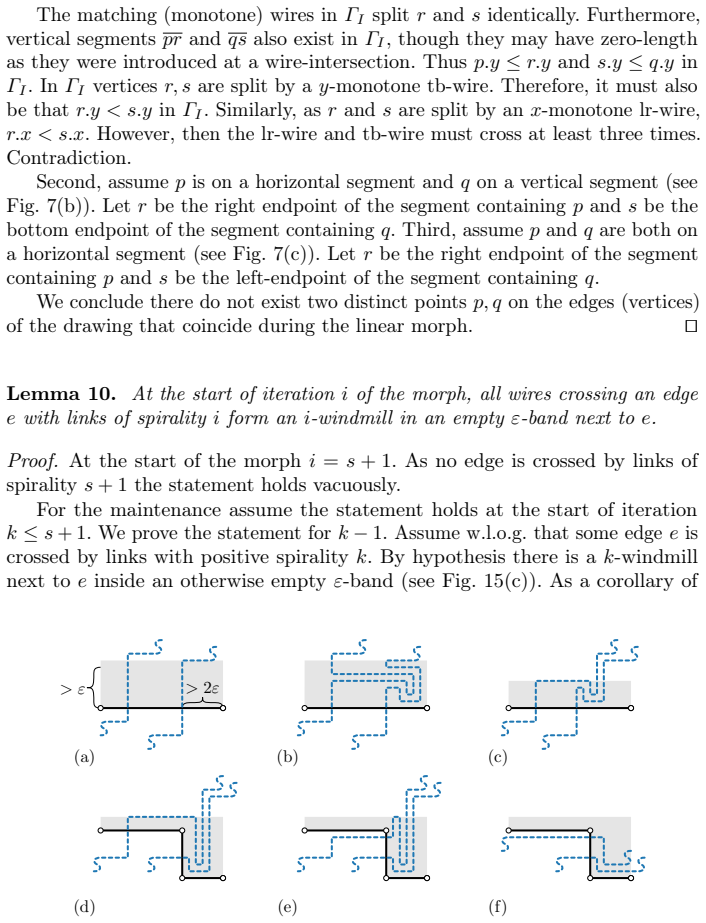
- [Section 5.1, Lemma 10] The statement 'As a corollary of Lemma 4, any slides along links of the wires outside of the ε-band do not affect the k-windmill next to e' is not immediate, because Lemma 4 concerns inversions of vertices, not the geometry of windmills. The connection should be explained.
- [Section 3, Lemma 3] The proof of Lemma 3 invokes 'Lemma 2 from [11]' for the fact that intersecting links have the same spirality. Since this fact is load-bearing for the transfer from lr-wires to tb-wires, please state the lemma explicitly or give the precise reference.
- [Section 2, Notation] The notation Γi−−▶Γj and Γi =▶Γj is unusual and slightly hard to parse; consider defining it more prominently or using a more standard arrow notation.
Circularity Check
No significant circularity: the O(n)-wire construction and batching lemmas are proved from wire combinatorics; the cited morph machinery in [11] is prior published work used as a black box, not a fitted or definitional input.
full rationale
The paper's central new claims—existence of equivalent wire sets with spirality O(n) for disconnected graphs (Lemma 2 and Lemma 3) and batching of iterations into s+1 linear morphs with linear complexity (Sections 4-5)—are argued from the geometry of wires, spirality, and slides rather than assumed as inputs. Lemma 2 proves the O(n) spirality bound by induction and a minimality/shortcut argument on layers; the proof does not presuppose the theorem it is establishing. Lemma 8 and Lemma 9 show that one spirality unit can be removed with a single linear morph by constructing a monotone wire grid and interpolating cell-wise; these are not defined in terms of the number of morphs. The paper does rely heavily on [11] (Theorem 8 and several lemmas) for the underlying morph algorithm, and those references are self-citations by overlapping authors. However, they are prior peer-reviewed, parameter-free statements with fixed assumptions; they are not fitted to the data of this paper and do not include the target disconnected-graph O(n) bound as an assumption. Under the reviewing rules, such citations are real evidence and do not by themselves make the derivation circular. No equation in the paper reduces to another by construction, and no fitted parameter is renamed as a prediction. The few abbreviated arguments in the main text (notably the Lemma 2 layer-shortcut) are terse but are expanded in the appendix and do not amount to assumption of the conclusion.
Assumptions & free parameters
assumptions (5)
- domain assumption Equivalence of ΓI and ΓO implies an equivalent set of wires exists in ΓI with matching crossing order.
- domain assumption Bends and edge subdivisions are unified into straight-line orthogonal drawings on n vertices before morphing.
- domain assumption Prior results from van Goethem and Verbeek [11], especially the O(s) morph for connected drawings and Lemma 9 and Lemma 12 on wire slides, are correct.
- domain assumption Generic position: small epsilon-bands around edges contain no vertices or bends, so windmill rerouting can be performed without creating crossings.
- standard math Jordan curve theorem and planarity of drawing and wires justify the region and crossing-count contradictions used in the proofs.
Cite this review
Pith. "Pith review of Optimal Morphs of Planar Orthogonal Drawings II." pith.science (2026). https://pith.science/paper/VHQBYQWL
@misc{pith2026190808365,
  author       = {Pith},
  title        = {Pith review of: Optimal Morphs of Planar Orthogonal Drawings II},
  year         = {2026},
  howpublished = {\url{https://pith.science/paper/VHQBYQWL}},
  note         = {Machine review of arXiv:1908.08365}
}
abstract
Van Goethem and Verbeek recently showed how to morph between two planar orthogonal drawings $\Gamma_I$ and $\Gamma_O$ of a connected graph $G$ while preserving planarity, orthogonality, and the complexity of the drawing during the morph. Necessarily drawings $\Gamma_I$ and $\Gamma_O$ must be equivalent, that is, there exists a homeomorphism of the plane that transforms $\Gamma_I$ into $\Gamma_O$. Van Goethem and Verbeek use $O(n)$ linear morphs, where $n$ is the maximum complexity of the input drawings. However, if the graph is disconnected their method requires $O(n^{1.5})$ linear morphs. In this paper we present a refined version of their approach that allows us to also morph between two planar orthogonal drawings of a disconnected graph with $O(n)$ linear morphs while preserving planarity, orthogonality, and linear complexity of the intermediate drawings. Van Goethem and Verbeek measure the structural difference between the two drawings in terms of the so-called spirality $s = O(n)$ of $\Gamma_I$ relative to $\Gamma_O$ and describe a morph from $\Gamma_I$ to $\Gamma_O$ using $O(s)$ linear morphs. We prove that $s+1$ linear morphs are always sufficient to morph between two planar orthogonal drawings, even for disconnected graphs. The resulting morphs are quite natural and visually pleasing.
Figures

Figures from the paper (12 more)





Reference graph
Works this paper leans on
-
[11]
Optimal morphs of planar orthogonal drawings
Arthur van Goethem and Kevin Verbeek. Optimal morphs of planar orthogonal drawings. In Proceedings of the 34th International Symposium on Computational Geometry (SoCG 2018) , pages 42:1–42:14, 2018. 13 A Omitted proofs Theorem 2. Let ΓI and ΓO be two unified planar orthogonal drawings of a (disconnected) graphG, whereΓI has spiralitys. We can morphΓI into ...
work page 2018
-
[1]
How to morph planar graph drawings.SIAM Journal on Computing , 46(2):824–852, 2017
Soroush Alamdari, Patrizio Angelini, Fidel Barrera-Cruz, Timothy Chan, Gior- dano Da Lozzo, Giuseppe Di Battista, Fabrizio Frati, Penny Haxell, Anna Lubiw, Maurizio Patrignani, Vincenzo Roselli, Sahil Singla, and Bryan Wilkinson. How to morph planar graph drawings.SIAM Journal on Computing , 46(2):824–852, 2017
work page 2017
-
[2]
Greg Aloupis, Luis Barba, Paz Carmi, Vida Dujmović, Fabrizio Frati, and Pat Morin. Compatible connectivity augmentation of planar disconnected graphs.Discrete & Computational Geometry, 54(2):459–480, 2015
work page 2015
-
[3]
Mor- phing planar graph drawings efficiently
Patrizio Angelini, Fabrizio Frati, Maurizio Patrignani, and Vincenzo Roselli. Mor- phing planar graph drawings efficiently. InProc. 21st International Symposium on Graph Drawing, pages 49–60, 2013
work page 2013
-
[4]
Morphing orthog- onal planar graph drawings.ACM Transactions on Algorithms , 9(4):29:1–29:24, 2013
Therese Biedl, Anna Lubiw, Mark Petrick, and Michael Spriggs. Morphing orthog- onal planar graph drawings.ACM Transactions on Algorithms , 9(4):29:1–29:24, 2013
work page 2013
-
[5]
Morphing planar graphs while preserving edge directions
Therese Biedl, Anna Lubiw, and Michael Spriggs. Morphing planar graphs while preserving edge directions. In Proc. 13th International Symposium on Graph Drawing, pages 13–24, 2006
work page 2006
-
[6]
Orthogonal graph drawing with inflexible edges.Computational Geometry, 55:26–40, 2016
Thomas Bläsius, Sebastian Lehmann, and Ignaz Rutter. Orthogonal graph drawing with inflexible edges.Computational Geometry, 55:26–40, 2016
work page 2016
-
[7]
Deformations of plane rectilinear complexes
Stewart Cairns. Deformations of plane rectilinear complexes. The American Mathematical Monthly, 51(5):247–252, 1944
work page 1944
Show all 11 references
-
[8]
Spirality and optimal orthogonal drawings
Giuseppe Di Battista, Giuseppe Liotta, and Francesco Vargiu. Spirality and optimal orthogonal drawings. SIAM Journal on Computing , 27(6):1764–1811, 1998
1998
-
[9]
Upward spirality and upward planarity testing.SIAM Journal on Discrete Mathematics , 23(4):1842–1899, 2009
Walter Didimo, Francesco Giordano, and Giuseppe Liotta. Upward spirality and upward planarity testing.SIAM Journal on Discrete Mathematics , 23(4):1842–1899, 2009
2009
-
[10]
Deformations of plane graphs
Carsten Thomassen. Deformations of plane graphs. Journal of Combinatorial Theory, Series B , 34(3):244–257, 1983
1983
Reviewed August 14, 2026 · model on record in the stance chip above.
Discussion (0). Continue with ORCID to comment.