REVIEW 4 major objections 5 minor 29 references
A Neural-Operator Surrogate for Platelet Deformation Across Capillary Numbers
T0 review · 4 major / 5 minor · reviewed 2026-08-06 · deepseek-v4-flash
Pith's one-line read A DeepONet trained on platelet simulations spanning capillary numbers 0.07–0.77 yields full 3D deformation trajectories with sub-percent median error, worst cases under 4%, and a 10,000–100,000x speed-up.
desk verdict A real extension of the prior DeepONet platelet work, but the central accuracy metric is undefined and the Ca* sweep is only a stiffness sweep at one shear stress. read the letter →
The pith
A machine-rendered reading of the paper's core claim, the machinery that carries it, and where it could break.
The reading
What carries the argument
The load-bearing object is the DeepONet operator: a branch fully connected network (two hidden layers, 32 and 16 nodes) that encodes the scalar inputs $(\sigma, K)$, and a trunk fully connected network (three hidden layers, 32, 32, and 16 nodes) that encodes $(x_0, t)$, joined by an inner product that outputs the particle's absolute position $x(t)$. The training data come from LAMMPS simulations in which dissipative particle dynamics drives a hollow ellipsoidal platelet built from roughly 18,000–20,000 particles linked by harmonic bonds of stiffness $K$; the capillary number $\mathrm{Ca}^* = \mu\dot{\gamma}a/G_s$ is varied by sweeping $K$ while the wall shear stress stays at 50 Pa. What carries the argument is the per-capillary-number error audit: the network is trained on a random 90% of state tuples, so every stiffness appears in training, but it is validated on complete trajectories that include time instants and particle indices never seen. The paper reports the median, 90th-percentile, and maximum relative displacement error for each of the ten stiffnesses, and repeats the protocol with the two extreme cases held out entirely to support the extrapolation claim.
What would settle it
Recompute the relative displacement error after subtracting the platelet's center-of-mass trajectory from both the LAMMPS ground truth and the DeepONet output: if the residual is materially above the reported sub-percent median, the headline metric conflates bulk motion with deformation. A complementary test is to hold the stiffness fixed and vary the imposed shear rate or stress instead, since the training data never move $\sigma$ off 50 Pa; if accuracy degrades there, the claim of fidelity 'across capillary numbers' does not transfer to other flow conditions.
Extended reading notes
Core claim
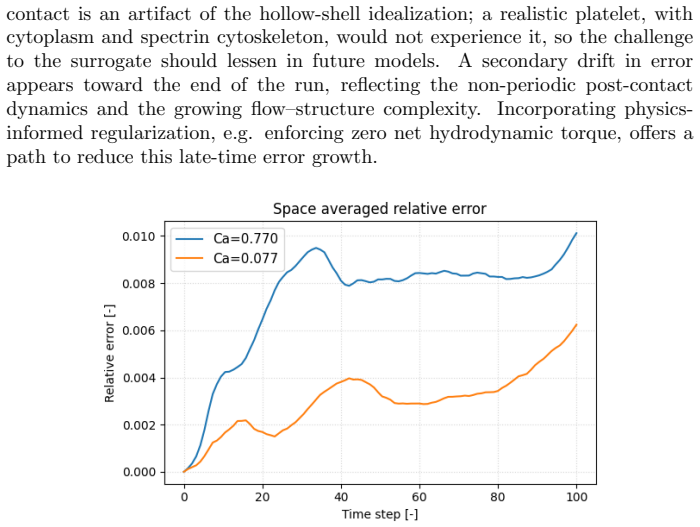
The central claim is that the operator $G: (x_0, t; \sigma, K) \mapsto x(t)$ — the map from a membrane particle's initial position, the elapsed time, the wall shear stress, and the membrane bond stiffness to that particle's current coordinates — is learnable to high fidelity by a fully connected DeepONet with a branch network for $(\sigma, K)$ and a trunk network for $(x_0, t)$. Trained on roughly $10^6$ particle states per trajectory over ten capillary numbers ($0.07 \le \mathrm{Ca}^* \le 0.77$), the network keeps the median relative displacement error under 1%, the 90th percentile under 3%, and the maximum under 4% across the calibrated range, while accelerating the particle simulation by four to five orders of magnitude. With the two extreme stiffnesses left out of training, the median error stays below 3% and the maximum near 8%, which the authors read as graceful extrapolation. Error analysis places the largest deviations at membrane self-contact events and in high-curvature regions; the authors attribute these to the kinematic discontinuity of the hollow-membrane idealization and propose graph-neural trunks and physics-informed torque regularization as remedies. The larger claim is that a surrogate in this accuracy class is fit for coupling with continuum CFD in platelet-resolved thrombosis simulations.
Load-bearing premise
The reported accuracy presumes that varying the membrane's spring stiffness at a fixed wall shear stress of 50 Pa exposes the same deformation regimes as varying the flow itself, and that the paper's 'relative displacement error' measures membrane shape change rather than the platelet's bulk translation.
Editorial extensions
If this is right
- One DeepONet evaluation replaces an individual LAMMPS micro-simulation in a multiscale loop, cutting the micro-solver cost by four to five orders of magnitude.
- Within the calibrated capillary-number range the surrogate stays under 4% worst-case error, which the paper classifies as high-fidelity enough to couple with continuum CFD for platelet-resolved hemodynamics.
- The leave-extremes-out retraining keeps sub-3% median error on the stiffest and most compliant platelets, so the usable envelope extends beyond the ten trained stiffnesses.
- The error audit identifies membrane self-contact and high-curvature patches as the dominant failure modes, directing future work toward graph-neural trunks and physics-informed torque regularization.
- Because the surrogate resolves full time histories (101 instants per trajectory) rather than end states, it can feed time-resolved deformation data into shear-driven models of platelet transport, margination, and adhesion.
Reading between the lines
- The capillary-number sweep is realized only through bond stiffness at one fixed shear stress of 50 Pa, even though $\sigma$ is a network input; a natural stress test the paper does not run is varying the shear rate or stress with stiffness fixed, since real vessels expose platelets to a broad stress range.
- The headline metric deserves a bulk-motion check: recomputing the error after subtracting the platelet's center-of-mass translation from both prediction and ground truth would show whether the sub-percent figure describes shape change or mainly advection.
- The self-contact error peaks are artefacts of the hollow-shell idealization; a filled or cytoskeleton-bearing platelet model would remove them, so the surrogate's stated worst-case errors may largely shrink in more realistic geometries.
- The speed-up claim refers to a single micro-solver evaluation; the net gain inside a coupled CFD loop also depends on how many surrogate calls per cell per time step the coupling requires, which the paper does not quantify.
Editorial analysis
A structured set of objections, weighed in public.
Referee Report
Summary. The manuscript trains a DeepONet surrogate to map (x0, t; sigma, K) to the absolute particle coordinates x(t) of a coarse-grained platelet membrane in a DPD Couette flow, with the capillary number varied by changing bond stiffness K at fixed wall shear stress. It reports median relative displacement errors below 1%, a 90th percentile below 3%, and a worst case below 4% across ten stiffness values, plus a leave-extremes-out extrapolation test with median error below 3% and maximum below 8%, and claims a four-to-five order-of-magnitude speed-up over LAMMPS. The paper concludes that the surrogate is suitable for coupling with continuum CFD in thrombosis simulations.
Significance. If the accuracy claims could be substantiated, the result would be a useful demonstration of operator learning for platelet mechanics and a concrete speed-up for multiscale blood-flow frameworks. The extrapolation design, which holds out the two extreme stiffnesses, is a genuine external check, and the per-capillary-number error table is internally consistent with the stated experiments. However, the central error metric is never defined, the per-capillary-number validation mixes training and held-out data, and the parameter sweep covers only one wall shear stress; until these are resolved, the headline numbers cannot be interpreted independently. The paper would benefit from code and data release and from a rigid-body baseline to separate bulk translation from membrane shape change.
major comments (4)
- [Sec. 3, Fig. 4, Table 3] The paper never defines the relative displacement error used in every headline result. The only normalization attempt appears in the Fig. 2 caption, ||u(t)|| / max_p ||u_p(0)||, but u_p(0) = 0 for all particles, so the denominator is zero. Because the network outputs absolute positions, a predictor that returns the correct rigid-body translation while leaving the membrane shape unchanged could score very differently depending on the chosen denominator. Please state the exact formula, including numerator, denominator, norm used, and whether center-of-mass or rigid rotation is subtracted, report shape-only errors separately from bulk translation errors, and include a rigid-body baseline for comparison.
- [Sec. 4, Table 3] The per-capillary-number validation is not an independent test. The text says the network was trained on a random 90% subset of (x0, t, sigma, K) tuples, so 90% of the tuples at every K are in the training set, yet Table 3 is described as evaluating complete platelet trajectories, including those training points. Errors on memorized training data do not support the claim of a strict interpolation benchmark. Please report metrics only on the held-out 10% of tuples per K, or perform leave-one-K-out retraining; if full trajectories are used, separate train and test errors must be shown.
- [Sec. 2.1, Table 2; Sec. 3, Eq. (4)] All data are generated at a single wall shear stress sigma = 50 Pa, with capillary number varied only by changing the bond constant K. Equation (4) nevertheless lists sigma as an input and the conclusions are framed as applying across physiologically relevant hemodynamic conditions. Varying K at fixed sigma changes the elastic response, but it is not shown to be equivalent to varying the flow-induced stress or shear rate. Please either add experiments at multiple sigma values, for example 50-250 Pa as in the prior work cited, or explicitly restrict the claims to the calibrated one-stress setting.
- [Sec. 2, Eq. (1), Table 2] The calibration from bond constant to capillary number is not specified. Equation (1) contains the in-plane shear modulus G_s, but the text only says G_s is linked to K without giving the conversion; Table 2 lists K ranges and resulting Ca* values without a formula or fitting procedure. Without this relationship, the reported Ca* values are not reproducible and the numerical values in Table 3 cannot be verified. Please provide the G_s(K) relation and any constants used.
minor comments (5)
- [Sec. 2.2, Sec. 4] The dataset size is stated inconsistently: Sec. 2.2 says roughly 18,000 particles and 101 time instants, giving about 1.8 x 10^6 states per trajectory, while Sec. 4 says a leave-one-K-out retraining would involve data sets exceeding 10^8 samples. Please reconcile these numbers.
- [Sec. 5] The speed-up claim of four to five orders of magnitude is not supported by any timing measurement or code; please add wall-clock benchmarks for both LAMMPS and the DeepONet inference.
- [Fig. 6 caption] Typo: 'most complaint platelet' should be 'most compliant platelet'.
- [Sec. 2.1] The phrase 'dimensional capillary number' is misleading because Eq. (1) is dimensionless; consider removing 'dimensional'.
- [General] No data or code availability statement is included; providing the LAMMPS input scripts, trained weights, and evaluation script would substantially strengthen reproducibility.
Circularity Check
No circular derivation: the central accuracy claims are supported by held-out LAMMPS validation and leave-extremes-out retraining, not by fitted inputs or self-citations.
full rationale
This is a supervised operator-learning benchmark rather than a first-principles derivation, and no claimed result is equivalent to its input by construction. The surrogate is trained on a random 90% subset of (x0,t,sigma,K) tuples and evaluated on the held-out 10% (Sec. 3), and the per-capillary-number study evaluates complete trajectories containing time instants and particle indices never seen during training (Sec. 4); the extrapolation study additionally removes the two extreme stiffness trajectories from training (Sec. 4.1). These comparisons are genuinely independent of the fitted weights, so the reported sub-percent median, sub-4% worst-case, and sub-8% extrapolation errors are not statistically forced. The self-citations [3,4] only describe how the LAMMPS workflow was developed in earlier work and are not used as evidence for the present accuracy numbers, so they are not load-bearing. The undefined 'relative displacement error' and the fact that the capillary-number sweep is realized by varying K at fixed sigma are verifiability and scope limitations, not circularity, since neither makes a prediction equal its input by definition. The paper also discloses the main scope limitation: leave-one-K cross-validation is explicitly stated to be beyond scope, so the interpolation benchmark is presented transparently rather than disguised as extrapolation.
Assumptions & free parameters
free parameters (3)
- DeepONet network weights =
not reported; branch 32-16, trunk 32-32-16, latent 32
- Training hyperparameters and data split =
100 epochs, Adam, initial LR 1e-3 to 1e-7 on plateau, 90/10 random split
- K-to-Ca* calibration =
Ca* is approximately 2.31e-4 / K, inferred from Table 3
assumptions (5)
- standard math DeepONet can approximate the deformation operator (universal approximation theorem for operators)
- domain assumption The DPD and spring-network platelet model is an adequate representation of platelet mechanics
- domain assumption Varying K at fixed shear stress sigma = 50 Pa spans the physiologically relevant capillary-number range
- ad hoc to paper The reported "relative displacement error" is a meaningful measure of deformation accuracy
- domain assumption Membrane self-contact is an artifact of the hollow-shell model and will not occur in realistic platelets
Cite this review
Pith. "Pith review of A Neural-Operator Surrogate for Platelet Deformation Across Capillary Numbers." pith.science (2026). https://pith.science/paper/VJQKTAYF
@misc{pith2026250620341,
  author       = {Pith},
  title        = {Pith review of: A Neural-Operator Surrogate for Platelet Deformation Across Capillary Numbers},
  year         = {2026},
  howpublished = {\url{https://pith.science/paper/VJQKTAYF}},
  note         = {Machine review of arXiv:2506.20341}
}
read the original abstract
Reliable multiscale models of thrombosis require platelet-scale fidelity at organ-scale cost, a gap that scientific machine learning has the potential to narrow. We train a DeepONet surrogate on platelet dynamics generated with LAMMPS for platelets spanning ten elastic moduli and capillary numbers (0.07 - 0.77). The network takes in input the wall shear stress, bond stiffness, time, and initial particle coordinates and returns the full three-dimensional deformation of the membrane. Mean-squared-error minimization with Adam and adaptive learning-rate decay yields a median displacement error below 1%, a 90th percentile below 3%, and a worst case below 4% over the entire calibrated range while accelerating computation by four to five orders of magnitude. Leave-extremes-out retraining shows graceful extrapolation: the held-out stiffest and most compliant platelets retain sub-3% median error and an 8% maximum. Error peaks coincide with transient membrane self-contact, suggesting improvements via graph neural trunks and physics-informed torque regularization. These results classify the surrogate as high-fidelity and position it for seamless coupling with continuum CFD, enabling platelet-resolved hemodynamic simulations in patient-specific geometries and opening new avenues for predictive thrombosis modeling.
Figures


Figures from the paper (5 more)




Reference graph
Works this paper leans on
-
[1]
Physics-informed machine learning.Nature Reviews Physics, 3(6):422–440, 2021
George Em Karniadakis, Ioannis G Kevrekidis, Lu Lu, Paris Perdikaris, Sifan Wang, and Liu Yang. Physics-informed machine learning.Nature Reviews Physics, 3(6):422–440, 2021. 11
work page 2021
-
[2]
Lu Lu, Pengzhan Jin, Guofei Pang, Zhongqiang Zhang, and George Em Karniadakis. Learning nonlinear operators via deeponet based on the uni- versal approximation theorem of operators.Nature machine intelligence, 3(3):218–229, 2021
work page 2021
-
[3]
High-Fidelity Description of Platelet Deformation Using a Neural Operator
Marco Laudato, Luca Manzari, and Khemraj Shukla. High-fidelity de- scription of platelet deformation using a neural operator.arXiv preprint arXiv:2412.00747, 2024
work page Pith review arXiv 2024
-
[4]
Neural Operator Modeling of Platelet Geometry and Stress in Shear Flow
Marco Laudato, Luca Manzari, and Khemraj Shukla. Neural operator modeling of platelet geometry and stress in shear flow.arXiv preprint arXiv:2503.12074, 2025
work page Pith review arXiv 2025
-
[5]
Michael MacRaild, Ali Sarrami-Foroushani, Toni Lassila, and Alejandro F Frangi. Accelerated simulation methodologies for computational vascular flow modelling.Journal of the Royal Society Interface, 21(211):20230565, 2024
work page 2024
-
[6]
Zhiliang Xu, Nan Chen, Malgorzata M Kamocka, Elliot D Rosen, and Mark Alber. A multiscale model of thrombus development.Journal of the Royal Society Interface, 5(24):705–722, 2008
work page 2008
-
[7]
Maurizio Tomaiuolo, Lawrence F Brass, and Timothy J Stalker. Regulation of platelet activation and coagulation and its role in vascular injury and arterial thrombosis.Interventional cardiology clinics, 6(1):1, 2017
work page 2017
-
[8]
Jian-ning Zhang, Angela L Bergeron, Qinghua Yu, Carol Sun, Larry V McIntire, Jos´ e A L´ opez, and Jing-fei Dong. Platelet aggregation and acti- vation under complex patterns of shear stress.Thrombosis and haemostasis, 88(11):817–821, 2002
work page 2002
Show all 29 references
-
[9]
Multi-scale modeling of the cardiovascular system: disease development, progression, and clinical intervention.Annals of biomedical engineering, 44:2642–2660, 2016
Yanhang Zhang, Victor H Barocas, Scott A Berceli, Colleen E Clancy, David M Eckmann, Marc Garbey, Ghassan S Kassab, Donna R Lochner, Andrew D McCulloch, Roger Tran-Son-Tay, et al. Multi-scale modeling of the cardiovascular system: disease development, progression, and clinical...
2016
-
[10]
Buckling critical pressures in collapsible tubes relevant for biomedical flows.Scientific Re- ports, 13(1):9298, 2023
Marco Laudato, Roberto Mosca, and Mihai Mihaescu. Buckling critical pressures in collapsible tubes relevant for biomedical flows.Scientific Re- ports, 13(1):9298, 2023
2023
-
[11]
Analysis of the contact critical pres- sure of collapsible tubes for biomedical applications.Continuum Mechanics and Thermodynamics, 36(1):217–228, 2024
Marco Laudato and Mihai Mihaescu. Analysis of the contact critical pres- sure of collapsible tubes for biomedical applications.Continuum Mechanics and Thermodynamics, 36(1):217–228, 2024
2024
-
[12]
Sound generation mechanisms in a collapsible tube.The Journal of the Acoustical Society of America, 155(5):3345–3356, 2024
Marco Laudato, Elias Zea, Elias Sundstr¨ om, Susann Boij, and Mihai Mi- haescu. Sound generation mechanisms in a collapsible tube.The Journal of the Acoustical Society of America, 155(5):3345–3356, 2024. 12
2024
-
[13]
Decod- ing thrombosis through code: a review of computational models.Journal of Thrombosis and Haemostasis, 22(1):35–47, 2024
Noelia Grande Guti´ errez, Debanjan Mukherjee, and David Bark Jr. Decod- ing thrombosis through code: a review of computational models.Journal of Thrombosis and Haemostasis, 22(1):35–47, 2024
2024
-
[14]
Christof Karmonik, Jean X Bismuth, Mark G Davies, and Alan B Lumsden. Computational hemodynamics in the human aorta: a computational fluid dynamics study of three cases with patient-specific geometries and inflow rates.Technology and Health Care, 16(5):343–354, 2008
2008
-
[15]
Machine learning-based segmentation of the thoracic aorta with congenital valve disease using mri.Bioengineer- ing, 10(10):1216, 2023
Elias Sundstr¨ om and Marco Laudato. Machine learning-based segmentation of the thoracic aorta with congenital valve disease using mri.Bioengineer- ing, 10(10):1216, 2023
2023
-
[16]
Karoline-Marie Bornemann, Silje Ekroll Jahren, and Dominik Obrist. The relation between aortic morphology and transcatheter aortic heart valve thrombosis: Particle tracing and platelet activation in larger aor- tic roots with and without neo-sinus.Computers in biology and medi...
2024
-
[17]
A predictive multiscale model for simulat- ing flow-induced platelet activation: Correlating in silico results with in vitro results.Journal of biomechanics, 117:110275, 2021
Peng Zhang, Jawaad Sheriff, Shmuel Einav, Marvin J Slepian, Yuefan Deng, and Danny Bluestein. A predictive multiscale model for simulat- ing flow-induced platelet activation: Correlating in silico results with in vitro results.Journal of biomechanics, 117:110275, 2021
2021
-
[18]
A multiscale model for shear-mediated platelet adhesion dy- namics: correlating in silico with in vitro results.Annals of Biomedical Engineering, 51(5):1094–1105, 2023
Peineng Wang, Jawaad Sheriff, Peng Zhang, Yuefan Deng, and Danny Bluestein. A multiscale model for shear-mediated platelet adhesion dy- namics: correlating in silico with in vitro results.Annals of Biomedical Engineering, 51(5):1094–1105, 2023
2023
-
[19]
A multiscale model for multiple platelet aggregation in shear flow
Prachi Gupta, Peng Zhang, Jawaad Sheriff, Danny Bluestein, and Yuefan Deng. A multiscale model for multiple platelet aggregation in shear flow. Biomechanics and modeling in mechanobiology, 20:1013–1030, 2021
2021
-
[20]
Effect of tube diameter and capillary number on platelet margination and near-wall dynamics.Rheologica Acta, 55:511–526, 2016
Timm Kr¨ uger. Effect of tube diameter and capillary number on platelet margination and near-wall dynamics.Rheologica Acta, 55:511–526, 2016
2016
-
[21]
waltz- ing
Chih-Tang Liao, An-Jun Liu, and Yeng-Long Chen. Flow-induced “waltz- ing” red blood cells: microstructural reorganization and the corresponding rheological response.Science Advances, 8(47):eabq5248, 2022
2022
-
[22]
A microfluidic method to investi- gate platelet mechanotransduction under extensional strain.Research and Practice in Thrombosis and Haemostasis, 7(1):100037, 2023
Nurul A Zainal Abidin, Mariia Timofeeva, Crispin Szydzik, Farzan Akbari- doust, Chitrarth Lav, Ivan Marusic, Arnan Mitchell, Justin R Hamilton, Andrew SH Ooi, and Warwick S Nesbitt. A microfluidic method to investi- gate platelet mechanotransduction under extensional strain.Re...
2023
-
[23]
Shear-induced gradient diffusivity of a red blood cell suspension: effects of cell dynamics from tumbling to tank-treading.Soft Matter, 17(37):8523–8535, 2021
Abhilash Reddy Malipeddi and Kausik Sarkar. Shear-induced gradient diffusivity of a red blood cell suspension: effects of cell dynamics from tumbling to tank-treading.Soft Matter, 17(37):8523–8535, 2021. 13
2021
-
[24]
Koohyar Vahidkhah, Scott L Diamond, and Prosenjit Bagchi. Hydrody- namic interaction between a platelet and an erythrocyte: effect of erythro- cyte deformability, dynamics, and wall proximity.Journal of biomechanical engineering, 135(5):051002, 2013
2013
-
[25]
Platelet margination dynamics in blood flow: The role of lift forces and red blood cells aggregation.Physical Review Fluids, 9(8):083603, 2024
Mariam Dynar, Hamid Ez-Zahraouy, Chaouqi Misbah, and Mehdi Abbasi. Platelet margination dynamics in blood flow: The role of lift forces and red blood cells aggregation.Physical Review Fluids, 9(8):083603, 2024
2024
-
[26]
Platelet biorheology and mechanobiology in thrombosis and hemostasis: Perspectives from multiscale computation.International Jour- nal of Molecular Sciences, 25(9):4800, 2024
Rukiye Tuna, Wenjuan Yi, Esmeralda Crespo Cruz, JP Romero, Yi Ren, Jingjiao Guan, Yan Li, Yuefan Deng, Danny Bluestein, Zixiang Leonardo Liu, et al. Platelet biorheology and mechanobiology in thrombosis and hemostasis: Perspectives from multiscale computation.International Jou...
2024
-
[27]
Lammps-a flexible simulation tool for particle-based materials modeling at the atomic, meso, and continuum scales.Computer physics communications, 271:108171, 2022
Aidan P Thompson, H Metin Aktulga, Richard Berger, Dan S Bolintineanu, W Michael Brown, Paul S Crozier, Pieter J In’t Veld, Axel Kohlmeyer, Stan G Moore, Trung Dac Nguyen, et al. Lammps-a flexible simulation tool for particle-based materials modeling at the atomic, meso, and c...
2022
-
[28]
Dissipative particle dynamics: Bridging the gap between atomistic and mesoscopic simulation.The Jour- nal of chemical physics, 107(11):4423–4435, 1997
Robert D Groot and Patrick B Warren. Dissipative particle dynamics: Bridging the gap between atomistic and mesoscopic simulation.The Jour- nal of chemical physics, 107(11):4423–4435, 1997
1997
-
[29]
Peng Zhang, Chao Gao, Na Zhang, Marvin J Slepian, Yuefan Deng, and Danny Bluestein. Multiscale particle-based modeling of flowing platelets in blood plasma using dissipative particle dynamics and coarse grained molec- ular dynamics.Cellular and molecular bioengineering, 7:552–...
2014
Reviewed August 6, 2026 · model on record in the stance chip above.
Discussion (0). Continue with ORCID to comment.