REVIEW 4 major objections 7 minor 1 cited by
Enhancing Cloud Task Scheduling Using a Hybrid Particle Swarm and Grey Wolf Optimization Approach
T0 review · 4 major / 7 minor · reviewed 2026-08-07 · deepseek-v4-flash
Pith's one-line read A hybrid of Particle Swarm Optimization and Grey Wolf Optimizer cuts cloud scheduling makespan by up to 15% and raises throughput by up to 10%, while balancing load across VMs more evenly than five existing schedulers.
desk verdict Routine PSO-GWO hybrid with a useful VM-aware mapper, but the reported gains are confounded by a missing ablation and the algorithm spec is internally inconsistent; worth a serious referee only if the authors fix those. read the letter →
The pith
A machine-rendered reading of the paper's core claim, the machinery that carries it, and where it could break.
The reading
What carries the argument
The engine is the position-update rule $X_i(t+1) = \lambda(t)\cdot X_{\mathrm{GWO}} + [1-\lambda(t)]\cdot (X_i(t)+V_i(t+1))$, where $X_{\mathrm{GWO}}$ is the average of the three GWO leadership-guided positions, $V_i$ is the PSO velocity, and $\lambda(t)$ decreases linearly from 0.9 to 0.4 over the run. Two stabilizers surround this rule: a diversity monitor that computes mean pairwise distance and applies Gaussian mutation when diversity falls below a threshold, and a VM-aware mapper that replaces a capacity-violating assignment with the least-loaded VM. The fitness function is makespan plus $\beta(1-\mathrm{BOI})$, with $\mathrm{BOI} = 1/(1+\mathrm{CV})$, so a balanced load is rewarded directly during the search. The solution encoding maps continuous positions to VM indices via $\lfloor |x_i| \rfloor \bmod m$.
What would settle it
Rerun the 800-task, 4-VM CloudSim Plus benchmark with each baseline using its original published parameter settings, and also run a version of HybridPSOGWO with the VM-aware mapper disabled; the central claim is falsified if the 15% makespan advantage over EGWO disappears or fails a paired t-test, or if the mapper-only version matches the full hybrid's performance.
Extended reading notes
Core claim
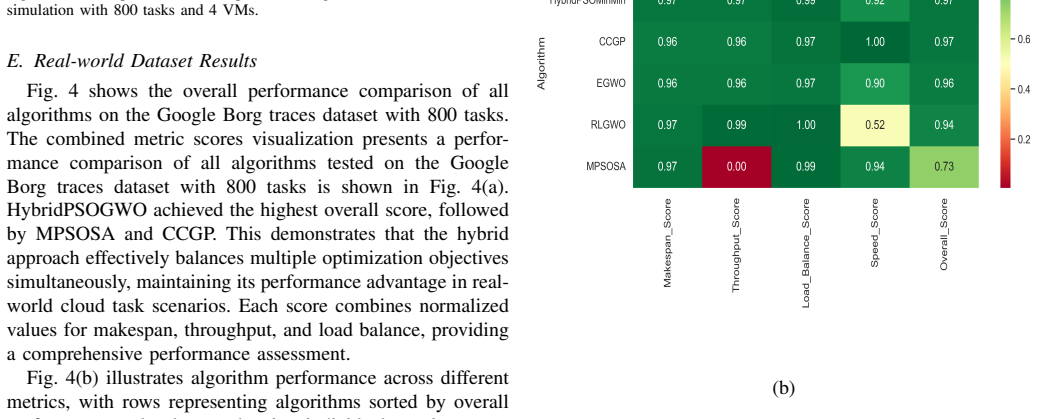
The central claim is that one population of solutions can act simultaneously as PSO particles and GWO wolves, and that an iteration-decreasing blending weight lets GWO dominate early exploration while PSO dominates later refinement, producing schedules with shorter makespan and better load balance than either algorithm alone or than the five compared hybrids. The two supporting mechanisms are a diversity monitor that injects Gaussian mutation when the population clusters too tightly, and a VM-aware task mapper that re-assigns a task to the least-loaded machine when the modulo-based assignment would exceed a machine's capacity threshold. The fitness function combines makespan with a load-balancing penalty derived from the coefficient of variation, so the search explicitly trades completion time against balance. On the CloudSim Plus 800-task, 4-VM benchmark the paper reports a makespan improvement of about 15% over EGWO and 6% over HybridPSOMinMin; on Google Borg traces it reports the highest combined score and roughly 12% lower makespan than RL-GWO at 800 tasks.
Load-bearing premise
The comparison assumes the five baseline schedulers were implemented and tuned as carefully as HybridPSOGWO under the same 50-iteration budget, and that the unspecified VM-capacity threshold and the fitness weight balancing makespan against load do not secretly favor the hybrid.
Editorial extensions
If this is right
- Cloud providers can adopt HybridPSOGWO as a drop-in scheduler that reduces average job completion time without infrastructure changes, since it needs only task execution times, VM capacities, and a fitness function.
- The VM-aware mapping lets the algorithm respect hard capacity limits, a practical requirement in cloud deployments where overloading causes service violations.
- The algorithm converges within 50 iterations on the tested workloads, so it can be rerun periodically as workloads change rather than being a one-time static placement.
- Lower makespan with more even load implies higher resource utilization, so fewer VMs may be needed for the same workload in a production setting.
Reading between the lines
- The paper does not ablate the VM-aware mapper from the PSO-GWO blend, so part or all of the makespan and load-balancing gains could come from the mapper alone; an ablation would separate the two contributions.
- All simulations use four identical 1000-MIPS VMs and independent tasks, so the 15% figure may not extend to heterogeneous machines, dependent workflows, or dynamic arrivals, which the paper itself lists as future work.
- Because baseline parameter settings are not reported, the comparison's fairness rests on an unstated assumption that each baseline was tuned comparably; reproducing the experiments with published defaults is the test.
- The adaptive weight and Gaussian-mutation safeguard are generic mechanisms that could be lifted into other discrete optimization settings beyond cloud scheduling.
Editorial analysis
A structured set of objections, weighed in public.
Referee Report
Summary. The paper proposes HybridPSOGWO, a hybrid of Particle Swarm Optimization and Grey Wolf Optimizer for cloud task scheduling, augmented with an adaptive blending weight, a diversity-preserving Gaussian mutation, and a VM-aware task mapping repair step. The authors evaluate the method in CloudSim Plus and on Google Borg traces against five baselines (EGWO, CCGP, HybridPSOMinMin, MPSOSA, RL-GWO), reporting up to 15% makespan improvement, 10% throughput improvement, and more balanced VM loads. The central claim is that the hybrid search mechanism itself yields these gains.
Significance. If the reported gains are causal and reproducible, the paper would make a useful applied contribution to metaheuristic cloud scheduling, and the use of both simulation and real-world traces is a strength. However, the manuscript as written does not make that case: the update rule is internally inconsistent, several algorithm parameters are missing, the VM-aware mapper confounds the comparison, and the statistical support is stated but not shown. These are load-bearing issues rather than presentation defects.
major comments (4)
- [III-C2, Eq. (15) vs. Eq. (6) and Algorithm 2] The position update rule is specified inconsistently. Eq. (6) and Algorithm 2 line 11 give Xi <- alpha(t)*X_GWO + (1-alpha(t))*(Xi+Vi), with alpha decreasing from 0.9 to 0.4; this matches the prose that early iterations favor GWO exploration and later iterations favor PSO exploitation. Eq. (15) instead gives Xi <- lambda*(Xi+Vi) + (1-lambda)*X_GWO with the same decreasing lambda, which produces the opposite schedule: early PSO weight is high and later GWO weight is high. Since a reader cannot tell which rule was implemented, the method is not reproducible as written.
- [III-C and IV-C, parameter specification] Several parameters that directly affect the algorithm are never given values: PSO inertia weight w, acceleration coefficients c1 and c2, the load-balance weight beta in Eq. (10), the diversity thresholds Dmin and Dmax, the Gaussian mutation variance sigma^2, and the VM capacity threshold used in Algorithm 1. Table I reports only the number of VMs, task counts, population size, and iteration budget. Without these values, the 30-run experiments cannot be reproduced, and the sensitivity of the claims to these choices is unknown.
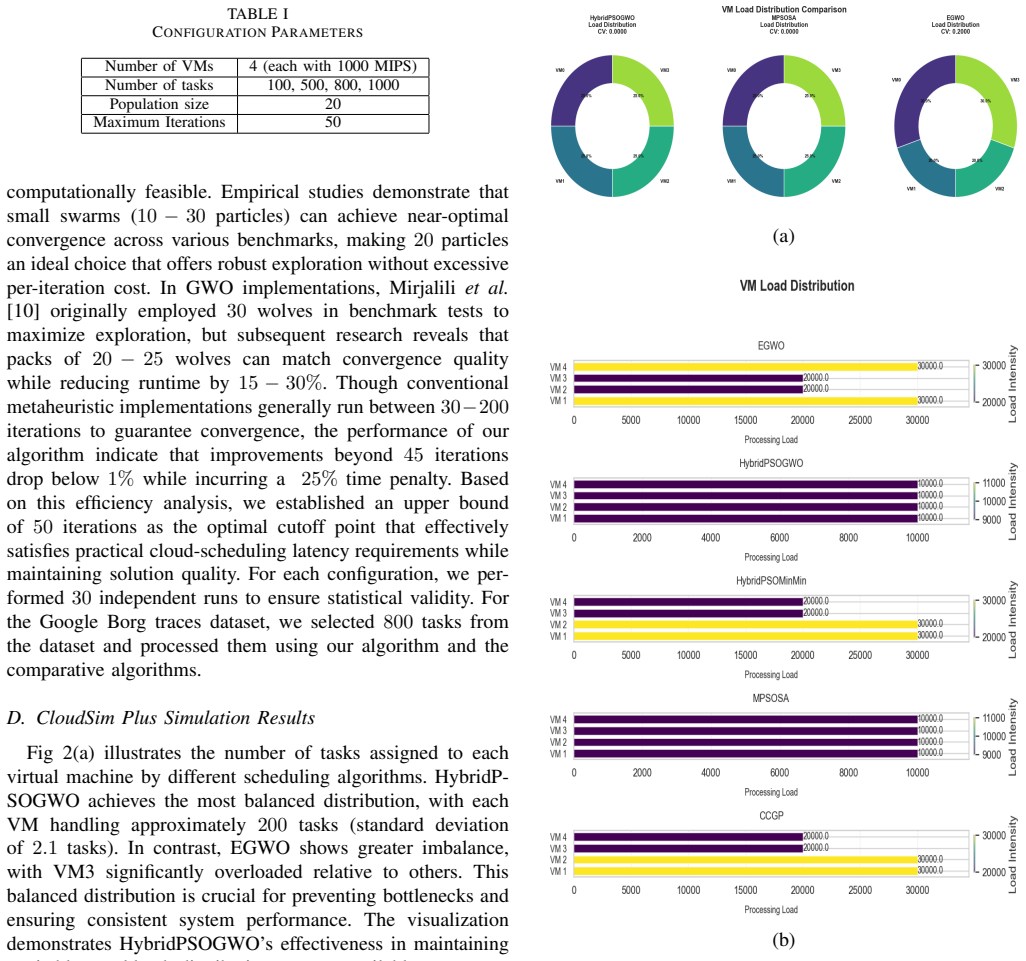
- [IV-D and Algorithm 1, confounded comparison] The VM-Aware Task Mapper (Algorithm 1) is applied only to HybridPSOGWO; the five baselines are not described as having any analogous capacity-constrained repair step. Because this greedy reassignment could by itself reduce makespan and improve load balance, the reported 6% and 15% improvements over HybridPSOMinMin and EGWO may be entirely due to this post-processing rather than to the PSO-GWO hybridization. An ablation that removes the VM-aware mapper from HybridPSOGWO, or applies the same mapper to the baselines, is needed to attribute the gains to the hybrid search mechanism.
- [IV-F, statistical analysis] The paper states in Section IV-F that a paired t-test confirmed p < 0.05 for makespan, throughput, and load balance, but it gives no test statistics, degrees of freedom, effect sizes, or per-configuration results. None of the figures include error bars or variance information, so the reader cannot assess the variability over the claimed 30 runs. The abstract's quantitative claims ('up to 15% improvement in makespan and 10% better throughput') are therefore not supported by the reported evidence.
minor comments (7)
- [III-C, Algorithm 2 line 3 vs. Eq. (7)] The diversity formula in Algorithm 2 line 3 omits the factor 2 that appears in Eq. (7): it uses 1/(N(N-1)) instead of 2/(N(N-1)). The two formulas should be consistent.
- [III-C, notation] The adaptive blending weight is called lambda(t) in Eqs. (5) and (6), but Algorithm 2 and Section III-A call it alpha(t). This notational inconsistency makes the update-rule contradiction harder to spot and should be fixed.
- [IV-B and Eq. (1)] Equation (1) defines completion time CT_i,j but the notation in Eq. (2) and the surrounding text is typographically inconsistent (e.g., 'M akespan', 'T hrouhput'). These typos should be corrected.
- [IV-E, quantitative consistency] The abstract says 'up to 15% improvement in makespan'; Section IV-D says 'approximately 6% over HybridPSOMinMin and 15% over EGWO'; Section IV-E says 'approximately 12% lower makespan than RL-GWO and 8% lower than MPSOSA'. The relationship among these numbers across configurations should be stated explicitly.
- [III-B, Eq. (4) and Algorithm 1] The estimated execution time ETC(t_i, vm_j) used in Algorithm 1 is never defined, and the modulo mapping in Eq. (4) is not connected to the continuous score values produced by the hybrid search. Please define these quantities.
- [II-A, reference [30]] Reference [30] is cited as the Google Borg dataset, but it points to a Kaggle sample rather than to the original Google Borg trace paper. Please cite the original dataset publication or an official source.
- [IV-A, real-world implementation] The real-world experiments use 800 tasks selected from the Borg dataset, but the selection procedure and preprocessing are not described. This matters for reproducibility.
Circularity Check
No circularity: the paper's claims rest on an empirical benchmark comparison and its own optimization objective, not on a self-citation chain or fitted-input-as-prediction.
full rationale
The paper derives no analytic prediction from its inputs; its central claim is an empirical comparison of HybridPSOGWO against five baselines on CloudSim Plus and Google Borg traces. Reporting makespan, throughput, and load-balance improvements is ordinary optimization evaluation because those are the objective functions being optimized, which is not circular reasoning. There is no self-citation: the reference list contains no prior work by the present authors, and no load-bearing argument is justified by a citation to the authors' own results. There is no fitted parameter that is then renamed as a prediction; the adaptive weights and thresholds are stated configuration choices, and the paper does not claim to predict measured data from a fitted model. The VM-Aware Task Mapper is a potential confound for ablating the source of improvement, and Eq. (15) contradicts Algorithm 2's position update, but both are correctness/reproducibility concerns rather than circularity. No step in the derivation chain reduces, by the paper's own equations or by self-citation, to its inputs. Therefore, the appropriate circularity score is 0.
Assumptions & free parameters
free parameters (7)
- lambda_max / lambda_min =
0.9 / 0.4
- beta (load-balance fitness weight) =
unspecified
- PSO coefficients w, c1, c2 =
unspecified
- Diversity thresholds Dmin, Dmax and mutation sigma =
unspecified
- VM capacity threshold =
unspecified
- Iteration budget =
50
- Population size =
20
assumptions (4)
- domain assumption CloudSim Plus simulations accurately represent cloud task execution behavior.
- domain assumption The Google Borg trace sample used is representative of real cloud workloads.
- domain assumption Paired t-test assumptions hold across the 30 independent runs.
- domain assumption The objective functions in Eqs. 1-3 capture the relevant service goals.
Cite this review
Pith. "Pith review of Enhancing Cloud Task Scheduling Using a Hybrid Particle Swarm and Grey Wolf Optimization Approach." pith.science (2026). https://pith.science/paper/VJZX3RFV
@misc{pith2026250515171,
  author       = {Pith},
  title        = {Pith review of: Enhancing Cloud Task Scheduling Using a Hybrid Particle Swarm and Grey Wolf Optimization Approach},
  year         = {2026},
  howpublished = {\url{https://pith.science/paper/VJZX3RFV}},
  note         = {Machine review of arXiv:2505.15171}
}
read the original abstract
Assigning tasks efficiently in cloud computing is a challenging problem and is considered an NP-hard problem. Many researchers have used metaheuristic algorithms to solve it, but these often struggle to handle dynamic workloads and explore all possible options effectively. Therefore, this paper presents a new hybrid method that combines two popular algorithms, Grey Wolf Optimizer (GWO) and Particle Swarm Optimization (PSO). GWO offers strong global search capabilities (exploration), while PSO enhances local refinement (exploitation). The hybrid approach, called HybridPSOGWO, is compared with other existing methods like MPSOSA, RL-GWO, CCGP, and HybridPSOMinMin, using key performance indicators such as makespan, throughput, and load balancing. We tested our approach using both a simulation tool (CloudSim Plus) and real-world data. The results show that HybridPSOGWO outperforms other methods, with up to 15\% improvement in makespan and 10\% better throughput, while also distributing tasks more evenly across virtual machines. Our implementation achieves consistent convergence within a few iterations, highlighting its potential for efficient and adaptive cloud scheduling.
Figures


Figures from the paper (2 more)

Forward citations
Cited by 1 Pith paper
-
Adaptive, Efficient and Fair Resource Allocation in Cloud Datacenters leveraging Weighted A3C Deep Reinforcement Learning
WA3C extends A3C with a priority-weighted softmax and a five-term reward, and the paper reports simulated gains in latency, energy, and fairness over six baselines.
Reference graph
Works this paper leans on
-
[1]
Bellman, Mathematical optimization techniques
R. Bellman, Mathematical optimization techniques. Univ of California Press, 1963
work page 1963
-
[2]
Simulated annealing algorithms: An overview,
R. A. Rutenbar, “Simulated annealing algorithms: An overview,” IEEE Circuits and Devices magazine , vol. 5, no. 1, pp. 19–26, 1989
work page 1989
-
[3]
A review of population-based meta-heuristic algorithms,
Z. Beheshti and S. M. H. Shamsuddin, “A review of population-based meta-heuristic algorithms,” Int. j. adv. soft comput. appl , vol. 5, no. 1, pp. 1–35, 2013
work page 2013
-
[4]
Evolu- tionary algorithms,
T. Bartz-Beielstein, J. Branke, J. Mehnen, and O. Mersmann, “Evolu- tionary algorithms,” Wiley Interdisciplinary Reviews: Data Mining and Knowledge Discovery, vol. 4, no. 3, pp. 178–195, 2014
2014
-
[5]
Gsa: a gravitational search algorithm,
E. Rashedi, H. Nezamabadi-Pour, and S. Saryazdi, “Gsa: a gravitational search algorithm,” Information sciences , vol. 179, no. 13, pp. 2232– 2248, 2009
work page 2009
-
[6]
Swarm intelligence: A review of algorithms,
A. Chakraborty and A. K. Kar, “Swarm intelligence: A review of algorithms,” Nature-inspired computing and optimization: Theory and applications, pp. 475–494, 2017
work page 2017
-
[7]
Task scheduling in cloud computing: A priority-based heuristic approach,
S. Lipsa, R. K. Dash, N. Ivkovi ´c, and K. Cengiz, “Task scheduling in cloud computing: A priority-based heuristic approach,” IEEE access , vol. 11, pp. 27 111–27 126, 2023
work page 2023
-
[8]
A systematic literature review for load balancing and task scheduling techniques in cloud computing,
N. Devi, S. Dalal, K. Solanki, S. Dalal, U. K. Lilhore, S. Simaiya, and N. Nuristani, “A systematic literature review for load balancing and task scheduling techniques in cloud computing,” Artificial Intelligence Review, vol. 57, no. 10, p. 276, 2024
work page 2024
Show all 30 references
-
[9]
Task scheduling in cloud computing based on grey wolf optimization with a new encoding mechanism,
X. Huang, M. Xie, D. An, S. Su, and Z. Zhang, “Task scheduling in cloud computing based on grey wolf optimization with a new encoding mechanism,” Parallel Computing, vol. 122, p. 103111, 2024
2024
-
[10]
Grey wolf optimizer,
S. Mirjalili, S. M. Mirjalili, and A. Lewis, “Grey wolf optimizer,” Advances in engineering software , vol. 69, pp. 46–61, 2014
2014
-
[11]
Improved workflow scheduling using grey wolf optimization in cloud environment,
N. Gupta and S. P. Garg, “Improved workflow scheduling using grey wolf optimization in cloud environment,” Int. Journal of Applied Engi- neering Research, vol. 12, pp. 8643–8650, 2017
2017
-
[12]
Particle swarm optimization,
J. Kennedy and R. Eberhart, “Particle swarm optimization,” in Proceed- ings of ICNN’95-international conference on neural networks , vol. 4. ieee, 1995, pp. 1942–1948
1995
-
[13]
Task scheduling in cloud computing using particle swarm optimization with time varying inertia weight strategies,
X. Huang, C. Li, H. Chen, and D. An, “Task scheduling in cloud computing using particle swarm optimization with time varying inertia weight strategies,” Cluster Computing , vol. 23, no. 2, pp. 1137–1147, 2020
2020
-
[14]
An effective cloud workflow scheduling approach combining pso and idle time slot-aware rules,
Y . Wang and X. Zuo, “An effective cloud workflow scheduling approach combining pso and idle time slot-aware rules,” IEEE/CAA journal of automatica sinica, vol. 8, no. 5, pp. 1079–1094, 2021
2021
-
[15]
A cooperative co- evolution hyper-heuristic framework for workflow scheduling problem,
Q.-z. Xiao, J. Zhong, L. Feng, L. Luo, and J. Lv, “A cooperative co- evolution hyper-heuristic framework for workflow scheduling problem,” IEEE Transactions on Services Computing , vol. PP, pp. 1–1, 06 2019
2019
-
[16]
A scheduling scheme in the cloud computing environment using deep q-learning,
Z. Tong, H. Chen, X. Deng, K. Li, and K. Li, “A scheduling scheme in the cloud computing environment using deep q-learning,” Information Sciences, vol. 512, pp. 1170–1191, 2020
2020
-
[17]
Multi-objective hybrid genetic algorithm for task scheduling problem in cloud computing,
P. Pirozmand, A. A. R. Hosseinabadi, M. Farrokhzad, M. Sadeghilalimi, S. Mirkamali, and A. Slowik, “Multi-objective hybrid genetic algorithm for task scheduling problem in cloud computing,” Neural computing and applications, vol. 33, pp. 13 075–13 088, 2021
2021
-
[18]
An efficient task offloading and auto-scaling approach for iot applications in edge computing environment,
M. Ghahari-Bidgoli, M. Ghobaei-Arani, and A. Sharif, “An efficient task offloading and auto-scaling approach for iot applications in edge computing environment,” Computing, vol. 107, no. 5, pp. 1–44, 2025
2025
-
[19]
Novel load balancing mechanism for cloud networks using dilated and attention-based federated learning with coati optimization,
A. B. Kathole, V . K. Singh, A. Goyal, S. Kant, A. S. Savyanavar, S. A. Ubale, P. Jain, and M. T. Islam, “Novel load balancing mechanism for cloud networks using dilated and attention-based federated learning with coati optimization,” Scientific Reports, vol. 15, no. 1, p. 15268, 2025
2025
-
[20]
An improved particle swarm optimization algorithm for task scheduling in cloud computing,
P. Pirozmand, H. Jalalinejad, A. A. R. Hosseinabadi, S. Mirkamali, and Y . Li, “An improved particle swarm optimization algorithm for task scheduling in cloud computing,” Journal of Ambient Intelligence and Humanized Computing, vol. 14, no. 4, pp. 4313–4327, 2023
2023
-
[21]
Task scheduling in cloud computing using hybrid optimization algorithm,
M. S. A. Khan and R. Santhosh, “Task scheduling in cloud computing using hybrid optimization algorithm,” Soft computing , vol. 26, no. 23, pp. 13 069–13 079, 2022
2022
-
[22]
Hybrid task scheduling strategy for cloud computing by modified particle swarm optimization and fuzzy theory,
N. Mansouri, B. M. H. Zade, and M. M. Javidi, “Hybrid task scheduling strategy for cloud computing by modified particle swarm optimization and fuzzy theory,” Computers & Industrial Engineering , vol. 130, pp. 597–633, 2019
2019
-
[23]
An improved pso algorithm for cloud computing systems,
M. Agarwal and G. M. S. Srivastava, “An improved pso algorithm for cloud computing systems,” International Journal of Emerging Technolo- gies in Engineering Research , vol. 6, no. 3, pp. 14–18, 2018
2018
-
[24]
Task scheduling of cloud computing based on hybrid particle swarm algorithm and genetic algorithm,
X. Fu, Y . Sun, H. Wang, and H. Li, “Task scheduling of cloud computing based on hybrid particle swarm algorithm and genetic algorithm,” Cluster Computing, vol. 26, no. 5, pp. 2479–2488, 2023
2023
-
[25]
Hgwo-multiqos: A hybrid grey wolf optimization approach for qos-constrained workflow scheduling in iaas clouds,
D. Ramesh, S. S. Kolla, D. Naik, and R. Narvaneni, “Hgwo-multiqos: A hybrid grey wolf optimization approach for qos-constrained workflow scheduling in iaas clouds,” Simulation Modelling Practice and Theory , p. 103127, 2025
2025
-
[26]
An enhanced grey wolf optimization algorithm for efficient task scheduling in mobile edge computing,
J. Aminu, S. Kamarudin, R. Latip, B. U. Kangiwa, Z. M. Hanafi, and A. Liman, “An enhanced grey wolf optimization algorithm for efficient task scheduling in mobile edge computing,” International Journal of Computer Applications, vol. 186, no. 56, pp. 39–44, 2024
2024
-
[27]
Cloud computing environment: Review on task scheduling algorithms,
B. Sowjanya and P. Srinivas, “Cloud computing environment: Review on task scheduling algorithms,” International Journal of Engineering Science and Advanced Technology (IJESAT), vol. 18, no. 10, pp. 93–98, 2018
2018
-
[28]
Construction of cloud computing task scheduling model based on simulated annealing hybrid algorithm,
K. Lv and T. Huang, “Construction of cloud computing task scheduling model based on simulated annealing hybrid algorithm,” International Journal of Advanced Computer Science and Applications (IJACSA) , vol. 15, no. 5, pp. 75–82, 2024
2024
-
[29]
Reinforcement learning-based comprehensive learning grey wolf optimizer for feature selection,
Y . Zhang, Z. Wei, J. Zhang, Z. Zhang, and Y . Shi, “Reinforcement learning-based comprehensive learning grey wolf optimizer for feature selection,” Applied Soft Computing , vol. 147, p. 110028, 2024
2024
-
[30]
Google 2019 Cluster sample,
D. Mwiti and E. Gitonga, “Google 2019 Cluster sample,” https: //www.kaggle.com/datasets/derrickmwiti/google-2019-cluster-sample, 2019, [Online; accessed 19-May-2025]
2019
Reviewed August 7, 2026 · model on record in the stance chip above.
Discussion (0). Continue with ORCID to comment.