REVIEW 4 major objections 6 minor 21 references
Miniaturised control of acidity in multiplexed microreactors
T0 review · 4 major / 6 minor · reviewed 2026-08-14 · deepseek-v4-flash
Pith's one-line read A miniaturised multiplexed chip controls acidity independently in ~2.5 nL microreactors from pH 3 to 7, with ~0.4 pH accuracy and stable over 100 cycles.
desk verdict A genuine multiplexed pH-control chip with real quantitative steps, but the advertised pH 3 lower bound is an unvalidated charge-to-pH extrapolation, not a measurement. read the letter →
The pith
A machine-rendered reading of the paper's core claim, the machinery that carries it, and where it could break.
The reading
What carries the argument
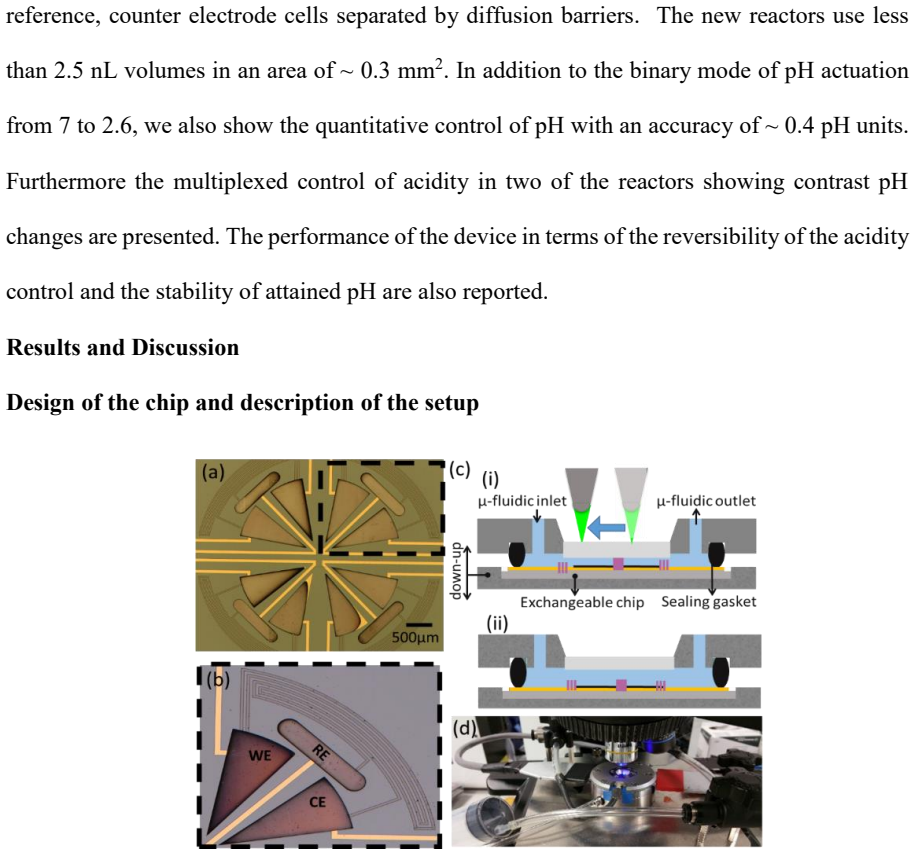
The load-bearing mechanism is the reversible redox proton exchange of a polymerised 4-aminothiolphenol (4ATP) film on platinised electrodes, paired with diffusion barriers that confine the protons. During oxidation the film releases protons into the 2.5 nL working-electrode cell; during reduction it takes them back, returning the pH toward neutral. The barriers are long thin channels sized with the one-dimensional diffusion time $\tau = L^2/(\pi^2 D)$, giving a calculated ~11-minute confinement that matches the observed ~10-minute retention. For pH values below the SNARF dye's detection limit, the paper uses the charge-balance identity $\mathrm{pH} = -\log(Q/(F\,V_{\mathrm{cell}}))$ to estimate the minimum pH, which is the step that carries the claimed low end of the range. The combination of functionalised electrodes, barrier geometry, and fluorescent pH readout is what lets four cells on one chip be addressed independently.
What would settle it
Run the same oxidation in a working-electrode cell whose volume is independently measured and whose proton concentration is read by a pH indicator sensitive below pH 5; if the indicator shows a higher pH than Eq. (1) predicts from the integrated charge, the claimed lower part of the range is not real.
Extended reading notes
Core claim
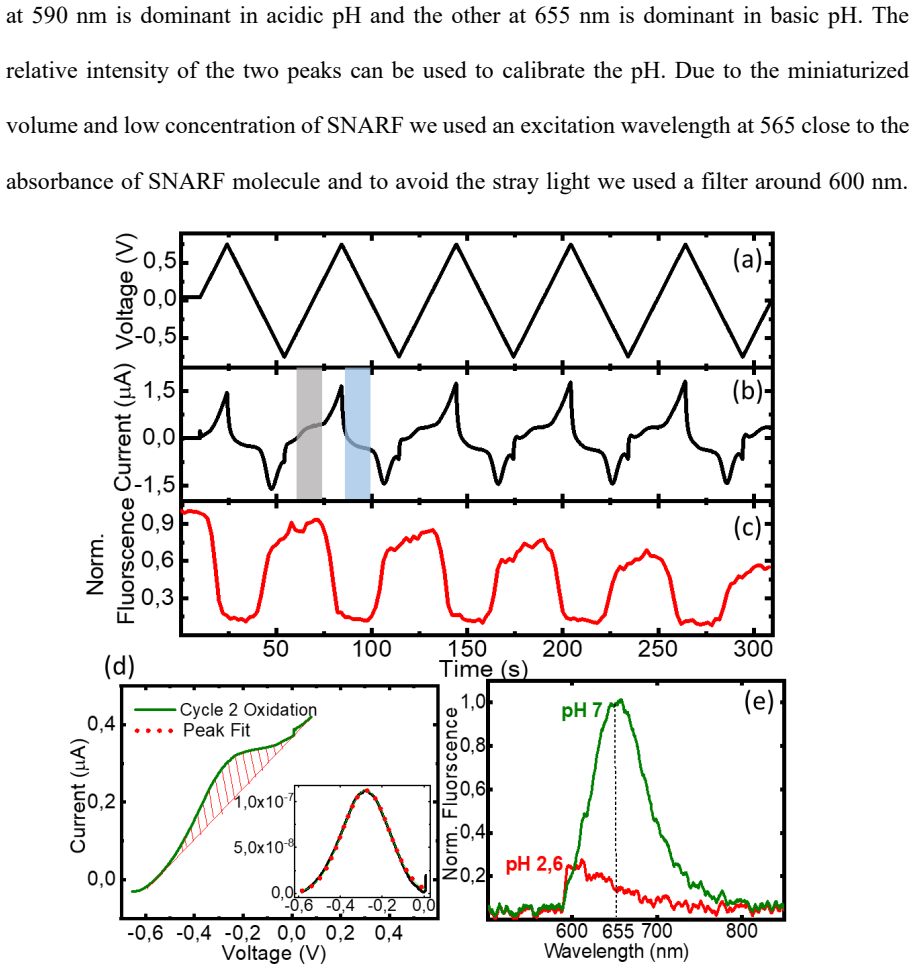
The central claim is that acidity can be controlled electrochemically and independently in cells miniaturised to the hundred-micron scale without losing range, retention, or reversibility. Using 4-aminothiolphenol (4ATP) functionalised on platinised gold electrodes, the authors oxidise the film to release protons and reduce it to recover them, while long narrow channels between the working, counter, and reference electrode cells slow proton escape. A carboxy-SNARF fluorescent dye tracks pH in the visible range; below its detection limit near pH 5, the pH is estimated by equating the integrated oxidation charge to protons in the 2.5 nL cell volume via $\mathrm{pH} = -\log(Q/(F\,V_{\mathrm{cell}}))$. The paper demonstrates binary actuation from pH 7 to 2.6, stepped control with about 0.4 pH-unit accuracy, retention of the acidic state for about 10 minutes against a calculated 11-minute diffusion time, reversibility over 100 cycles, and out-of-phase operation of two cells on the same chip without crosstalk. The authors conclude that this is, to their knowledge, the largest electrochemical acidity range and retention time reported for cells miniaturised in the hundred-micron range.
Load-bearing premise
The low end of the claimed pH range (about pH 2.6) rests on assuming that every electron passed through the electrode produces one proton, that no protons escape through the diffusion barriers during the measurement, and that the cell volume is exactly 2.5 nL.
Editorial extensions
If this is right
- Independent pH control in several cells means a single chip can run several pH-specific reactions in parallel, with each cell held at a different acidity.
- A stable acidic pH for about ten minutes in a 2.5 nL volume is long enough for reactions such as deprotection steps in solid-phase biopolymer synthesis, which the authors target.
- The roughly 0.4 pH-unit resolution from varying pulse amplitude implies that reactions with narrow pH tolerances can be addressed by choosing the applied voltage, without changing the chip or reagents.
- Reversibility over more than 100 cycles, with recovery after flushing fresh electrolyte, implies a single chip can be reused for many assay cycles rather than being a single-use device.
- Because the pH control is independent of the reactor footprint, the same design should shrink further while keeping the range and retention, an outlook the authors state explicitly.
Reading between the lines
- A direct next step implied by the paper is to verify the pH 2.6 lower bound with a pH reporter that works below 5; if confirmed, the device would cover the acidity range used for some standard peptide deprotection conditions, which the authors note correspond to about pH 5.9 at 50% trifluoroacetic acid.
- The paper mentions unpublished data that 4ATP proton exchange also occurs in organic solvents; if that holds, the same chip could control pH-driven reactions in non-aqueous media, extending it beyond water-based combinatorial chemistry.
- Because the multiplexing demonstration uses two potentiostat channels and a single movable spectrometer, a straightforward extension would be to program all four reactors independently and check whether diagonal neighbours show crosstalk that the two-cell test did not probe.
- An unstated improvement would be closed-loop pH control: use the fluorescence signal as feedback to adjust the pulse amplitude in real time, which could tighten accuracy beyond the demonstrated 0.4 pH units.
Signed reviews
Editorial analysis
A structured set of objections, weighed in public.
Referee Report
Summary. The paper presents a miniaturized microfluidic device containing four electrochemical microreactors, each with a working electrode volume of about 2.5 nL and a footprint of roughly 0.3 mm2. Acidity is controlled by the reversible redox proton exchange of a 4-aminothiolphenol polymer functionalized on platinized gold electrodes, with long diffusion barriers separating working, counter, and reference electrode cells. The authors demonstrate cyclic voltammetry-driven pH switching measured by the fluorescence of cSNARF, pulse-voltammetry quantitative pH steps with reported ΔpH of about 0.4 units, a retention time of the acidic state claimed as about 10 minutes, reversibility over 100 cycles, and multiplexed out-of-phase pH control in two cells of the same chip. The headline claims are a large acidity range from pH 3 to 7 with an accuracy of at least 0.4 pH units, and, in the conclusion, the largest acidity range and retention time reported for electrochemical pH control in hundred-micron-scale cells.
Significance. If the full pH range claim is supported, the device would be a notable step toward multiplexed, reversible pH control in nanoliter volumes, relevant for combinatorial chemistry and biopolymer synthesis. The diffusion-barrier design that confines protons and the demonstration of out-of-phase control in two independent cells are valuable and credible contributions. The paper also provides a fairly detailed fabrication and measurement protocol. However, the range below pH 5, including the stated minimum pH of 2.6, is not directly measured but inferred from Eq. (1) under assumptions of 100% Faradaic efficiency, no proton loss, and a known cell volume. This inferential step is the main load-bearing assumption for the headline pH 3-7 range, and the retention-time claim is weaker than stated because measurable drift appears after 5 minutes.
major comments (4)
- [Control of acidity in one microreactor, Eq. (1) and Figure 2(e)] The minimum pH of 2.6 is calculated from the integrated oxidation charge using pH = -log(Q/(F*Vcell)), which assumes that every electron passed produces one retained proton, that no protons are lost through the diffusion barriers or consumed by side reactions, and that the effective cell volume is exactly the geometric value of ~2.5 nL. The text explicitly states that the cSNARF marker quenches below pH 5, so no fluorescence measurement exists in the pH 3-5 interval. The abstract's claim of a 'large acidity range ... from pH 3 to 7' therefore rests on an unverified model inference rather than a measured value. Please provide an independent measurement of pH below 5 (e.g., a different indicator or a micro pH sensor), or clearly rephrase the abstract and conclusions to state that the pH 3-5 portion is an estimate from the charge balance, not a measured datum.
- [Quantitative control and Retention time of the acidity, Figure 3(c) and abstract] The retention-time experiment shows no noticeable change in fluorescence intensity for the first 300 seconds (5 minutes), followed by a slight increase between 5 and 10 minutes, with the pH still below 5 at 600 seconds. This is an observable drift, yet the abstract states the attained pH was 'kept constant for long retention times (~10 minutes)' and the conclusion says the microreactor 'retains a stable pH in the electrode cell for 10 minutes'. The data provided support a stable retention time of about 5 minutes, not 10 minutes. Please revise the retention-time claim to 5 minutes or provide quantitative evidence that the pH change between 5 and 10 minutes is within the stated accuracy of 0.4 pH units.
- [Reversibility tested over 100 cycles, Figure 4(b)] Figure 4(b) shows that both the maximum and minimum normalized fluorescence intensities increase after cycle 25, indicating a progressive net loss of acidity in the closed cell. The text attributes this to proton leakage or defects in the functionalization and reports that flushing with fresh electrolyte is needed to recover the initial intensities. The statement that the system 'has good control over the reversibility' over 100 cycles is therefore only partially supported: the pH contrast is maintained, but the absolute pH drifts over the course of the experiment. Please quantify the drift (in pH units per cycle) and either temper the reversibility claim or explain why this drift is acceptable for the intended applications, given that the abstract emphasizes cyclical stability over more than 100 cycles.
- [Quantitative control and accuracy claims, Figure 3(a,b) and abstract] The abstract claims 'an accuracy of at least 0.4 pH units', but the manuscript does not report an error analysis or calibration statistics. The pulse-voltammetry experiments show stepwise changes in fluorescence intensity that are converted to pH values, and the text reports a ΔpH of about 0.4 units between steps. Accuracy is a statement about agreement with a true value, which requires calibration uncertainties to be propagated. Please state how accuracy was assessed, include error bars or confidence intervals on the pH values, and clarify whether 'accuracy' here means step resolution or agreement with an independent pH measurement.
minor comments (6)
- [Figure 2] The panels of Figure 2 are discussed out of order in the text: panel (e) is referenced before panel (d). Please reorder the citations to match a logical reading sequence.
- [Experimental Section] The multiplexing experiment description states the CV range as '-0.3 V to -0.65 V', which appears to be a typographical error; the Results section reports a range of '-0.3 V to 0.7 V'. Please correct the sign of the upper voltage.
- [Multiplexed control section] The text says 'simultaneous CV measurement that are out of phase', but the fluorescence signal was measured alternately in the two cells, not simultaneously; the dotted projections assume the previous cycles are representative. Please word this as alternating measurement of two independently actuated cells.
- [Figure 3(c)] The fluorescence spectra in the retention-time panel are of poor resolution and difficult to interpret from the printed figure. A higher-quality image or a separate plot of intensity versus time would improve readability.
- [Conclusions] The sentence 'The minimum pH corresponding to the 100th cycle was still under <5' contains a redundancy ('under <5'). More importantly, this is not the same value as the initial minimum pH of 2.6, so the statement that the full range is maintained over 100 cycles is not established by the data shown.
- [References] References 15 and 16 have incomplete citation information: the author lists are truncated and some journal names or page numbers are missing. Please complete these entries.
Circularity Check
No circularity: the pH<5 estimate is an openly stated charge-to-pH conversion, not a concealed reduction.
full rationale
The paper's central claims about reversible pH actuation, quantitative control, retention, and multiplexing are supported by direct fluorescence measurements with cSNARF, calibrated independently as described in the supporting information. The only potentially concerning step is the pH<5 value, obtained from Eq. (1), pH = -log(Q/(F Vcell)), which assumes that all oxidation charge produces retained protons in a known 2.5 nL volume. This is a transparent modeling assumption, not a circular reduction: Q is a measured integrated current, F and Vcell are fixed physical constants, and the paper explicitly discloses that the SNARF marker quenches below pH 5 and that the minimum pH 'could be estimated calculating the total charge exchanged by the electrons in the cell (Q) and attributing that charge exchange to redox reactions producing only protons.' Because the attribution is stated as an assumption rather than hidden as a prediction, and because the fluorescence-calibrated measurements independently establish the core actuation and multiplexing behavior, no equation reduces to its own input by construction. The self-citations to the authors' prior work are methodological references to device design, fabrication, and setup, not load-bearing uniqueness theorems or ansatz smuggling. The paper would be stronger with independent verification of Faradaic efficiency and proton retention for the pH<5 range, but that is a correctness consideration, not circularity.
Assumptions & free parameters
free parameters (2)
- Vcell (working electrode cell volume) =
2.5 nL
- Faradaic efficiency for proton release =
1 (assumed)
assumptions (4)
- domain assumption All oxidation charge passed during a CV cycle produces protons in the working electrode cell.
- domain assumption Protons are confined within the working electrode cell during the measurement because the diffusion time through the barriers (about 11 min) is much longer than the measurement time.
- domain assumption The fluorescence intensity of cSNARF at 655 nm is a monotonic calibration of pH in the range 5-7.4, as given by the supporting information calibration plot.
- domain assumption The redox reaction of polymerized 4ATP reversibly exchanges protons with the electrolyte.
Cite this review
Pith. "Pith review of Miniaturised control of acidity in multiplexed microreactors." pith.science (2026). https://pith.science/paper/VKRAWO3Y
@misc{pith2026190802465,
  author       = {Pith},
  title        = {Pith review of: Miniaturised control of acidity in multiplexed microreactors},
  year         = {2026},
  howpublished = {\url{https://pith.science/paper/VKRAWO3Y}},
  note         = {Machine review of arXiv:1908.02465}
}
read the original abstract
The control of acidity influences the structural assembly of biopolymers that are essential for a wide range of applications. Its miniaturization can increase the speed and the possibilities of combinatorial throughput for their manipulation, similarly to the way that the miniaturization of transistors allows the high throughput of logical operations in microelectronics. Here we present a device containing multiplexed micro-reactors, each one enabling independent electrochemical control of the acidity in ~ 2.5 nL volumes, with a large acidity range in aqueous solutions from pH 3 to 7 and an accuracy of at least 0.4 pH units. The attained pH within each microreactor (with footprints of ~ 0.3 mm2 for each spot) was kept constant for long retention times (~10 minutes) and over repeated cycles >100. The acidity is driven by redox proton exchange reactions, which can be driven at different rates that influence the efficiency of the device in order to achieve more charge exchange (larger acidity range) or better reversibility. By the performance in the acidity control the miniaturisation and the possibility to multiplex paves the way for the control of combinatorial chemistry through pH and acidity controlled reactions.
Figures
Reference graph
Works this paper leans on
-
[1]
In situ synthesis of oligonucleotide microarr ays, Biopolymers, 2004, doi: 10.1002/bip.20005
Xiaolian, G, Erdogan, G, Xiaochuan, Z. In situ synthesis of oligonucleotide microarr ays, Biopolymers, 2004, doi: 10.1002/bip.20005
-
[2]
Liu, D. S , Balasubramanian, S. A proton fuelled DNA nanomachine, Angew. Chem., Int. Ed. 2003, 42, 5734-5736
work page 2003
-
[3]
Liedl, T., Simmel, F. C. Switching the conformation of a DNA molecule with a chemical oscillator, Nano Lett. 2005, 5, 1894-1898
work page 2005
-
[4]
Liu, D. S. , Bruckbauer, A., Abell, C., Balasubramanian, S., Kang, D. J., Klenerman, D., Zhou, D. A Reversible pH -Driven DNA Nanoswitch Array , J. Am. Chem. Soc. 2006, 128, 2067–2071
work page 2006
- [5]
-
[6]
Macromolecules, 1995, 28, 7770-7774
Niwa, M.; Mori, T.; Higashi, N. Macromolecules, 1995, 28, 7770-7774
work page 1995
-
[7]
Merrifield R. B. Solid Phase Peptide Synthesis. I. The Synthesis of a Tetrapeptide. J. Am. Chem. Soc. 1962, 85 (14), 2149-2154
work page 1962
-
[8]
pH-Controlled Assembly of DNA Tiles
Amodio A, Adedeji AF, Castronovo M, Franco E, Ricci F. pH-Controlled Assembly of DNA Tiles. J Am Chem Soc. 2016, 138(39):12735–12738. doi:10.1021/jacs.6b07676
Show all 21 references
-
[9]
Sears, P., Wong, C.,Toward Automated Synthesis of Oligosaccharides and Glycoproteins, Science, 2001, 2344-2350
2001
-
[10]
J Immunol Methods, 2002, 20021: 13-26
Frank R., The SPOT-synthesis technique Synthetic peptide arrays on membrane supports- -principles and applications. J Immunol Methods, 2002, 20021: 13-26
2002
-
[11]
V., On silico peptide microarrays for high-resolution mapping of antibody epitopes and diverse protein-protein interactions
Price, J. V., On silico peptide microarrays for high-resolution mapping of antibody epitopes and diverse protein-protein interactions. Nature Med. 2012, 18, 1434-1440
2012
-
[12]
32, 2004, 18 5409-17, doi:10.1093/nar/gkh879
Zhou, X et al., Microfluidic PicoArray synthesis of oligodeoxynucleotides and simultaneous assembling of multiple DNA sequences.” Nucleic acids research vol. 32, 2004, 18 5409-17, doi:10.1093/nar/gkh879
2004 doi
-
[13]
F, & Remacle
Elbaz, J, Wang. F, & Remacle. F. Willner, I. , pH-Programmable DNA Logic Arrays Powered by Modular DNAzyme Libraries. Nano letters. 2012, 12. 10.1021/nl300051g
2012 doi
-
[14]
D, Southern, E
Egeland, R. D, Southern, E. M. Electrochemically directed synthesis of oligonucleotides for DNA microarray fabrication. Nucleic Acids Res. 2005, 33, 125
2005
-
[15]
The Removal of the t -BOC Group by Electrochemically Generated Acid and Use of an Addressable Electrode Array for Peptide Synthesis
Karl, M., Andy , M., Michael, S., Kilian, D. The Removal of the t -BOC Group by Electrochemically Generated Acid and Use of an Addressable Electrode Array for Peptide Synthesis. J Comb Chem. 2005, 7(5), 637-640
2005
-
[16]
Electrochemically Generated Acid and Its Containment to 100 Micron Reaction Areas for the Production of DNA Microarrays
Maurer, K. Electrochemically Generated Acid and Its Containment to 100 Micron Reaction Areas for the Production of DNA Microarrays. PLOS one, e34, 2006, 3903-3908
2006
-
[17]
Electrochemical control of pH in nano -litre volumes
Balakrishnan, D., Lamblin, G., Thomann, J.S., van den Berg, A., Olthuis, W., Pascual Garcia, C. Electrochemical control of pH in nano -litre volumes. Nano Lett. 2018, DOI: 10.1021/acs.nanolett.7b05054
2018 doi
-
[18]
Hayes, W. A. & Shannon, C. Electrochemistry of surface confined mixed monolayers of 4-Aminothiolphenol and thiolphenol on Au. Langmuir 12, 3688–3694 (1996)
1996
-
[19]
F.; Guerin, D.; Fujiwara, A.; Vuillaume, D
Clément, N.; Nishiguchi, K.; Dufreche, J. F.; Guerin, D.; Fujiwara, A.; Vuillaume, D. Nano Lett. 2013, 13, 3903−3908
2013
-
[20]
Redox active polymer a a pH actuator on a Re -sealable microfluidic platform
Balakrishnan, D., Gerard, M., Girod, S., Frari, D.D., Olthuis, W., Pascual Garcia, C. Redox active polymer a a pH actuator on a Re -sealable microfluidic platform. J.Materials Sci.Eng. 2018, DOI: 10.4172/2169-0022.1000456
2018
-
[21]
Balakrishnan, D., Lamblin, G., Thomann, J. S., Guillot, J., Duday, D.; van den Berg, A., Olthuis, W., Pascual-Garcia, C., Influence of polymerisation on the reversibility of low-energy proton exchange reactions by Para-Aminothiolphenol, Sci. Rep., 2017, 7, 15401
2017
Reviewed August 14, 2026 · model on record in the stance chip above.
Discussion (0). Continue with ORCID to comment.