REVIEW 3 major objections 6 minor 37 references
Multi-Timescale Dynamics Model Bayesian Optimization for Plasma Stabilization in Tokamaks
T0 review · 3 major / 6 minor · reviewed 2026-08-07 · deepseek-v4-flash
Pith's one-line read Two-timescale Bayesian optimization picks electron cyclotron heating profiles that avoid tearing instabilities, succeeding in four of eight live tokamak shots.
desk verdict Live result is not statistically supported, but the method and offline work are solid enough to deserve a careful referee. read the letter →
The pith
A machine-rendered reading of the paper's core claim, the machinery that carries it, and where it could break.
The reading
What carries the argument
The machinery is a two-timescale decomposition of the control problem. On the fast scale, an RPNN with a GRU cell (a gated recurrent memory unit) predicts the next plasma state as a multivariate normal distribution; a random-forest tearing-mode predictor then estimates the probability of a 2/1 tearing mode, a magnetic-island instability. Marginalizing those rollouts yields a prior estimate of the time to tearing, $\hat t_{TM}(\bar\beta_N, a_q)$, which serves as the GP's prior mean. On the slow scale, a Gaussian process with a squared-exponential kernel models the difference between the RPNN prior and observed outcomes, with inputs $(\bar\beta_N, a_q)$ and output $t_{TM}$; the posterior mean and variance feed a UCB acquisition function that picks the next ECH profile. The action space is deliberately low-dimensional: the ECH profile is approximated by a stationary Gaussian curve with three parameters (center, width, amplitude), which is projected onto whatever gyrotrons are available. This decomposition is what lets the method update its belief after each shot without retraining the neural network.
What would settle it
Run a sequence of tokamak shots in which only the ECH profile is varied while all other actuators are held fixed and measure the achieved $\bar\beta_N$: if $\bar\beta_N$ moves systematically with $a_q$, the independence assumption fails, whereas if it stays flat, the context/action split is sound.
Extended reading notes
Core claim
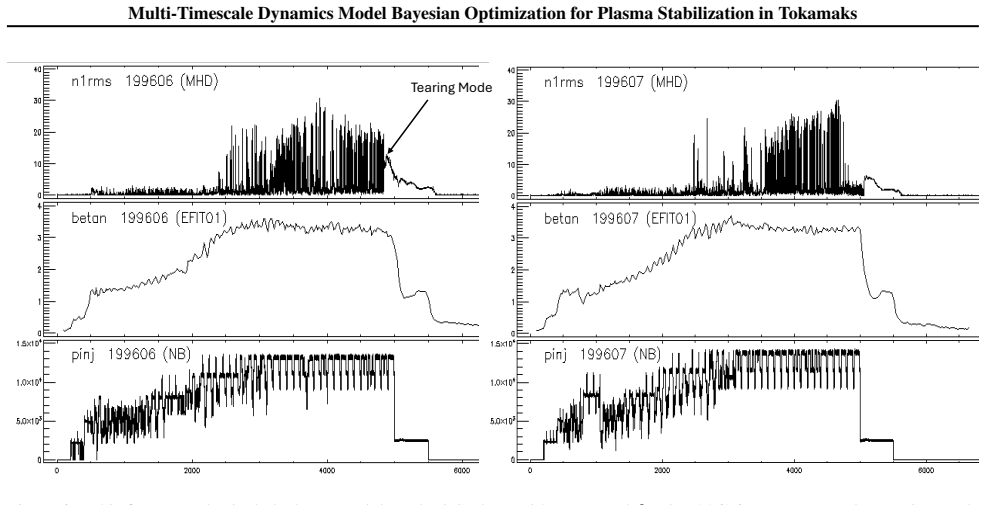
On the paper's own terms, the central discovery is that the reliability of a data-driven plasma dynamics model and the data efficiency of a Gaussian process can be combined across two time scales to make live control decisions. A recurrent probabilistic neural network (RPNN) models high-frequency tokamak state transitions; a tearing-mode classifier converts rollouts into a predicted time to tearing, i.e., how long the plasma stays stable, and those predictions become the prior mean of a GP whose inputs are the target normalized plasma pressure $\bar\beta_N$ and a Gaussian-parameterized ECH profile $a_q$. The GP is updated after every shot with the measured ECH profile and measured $\bar\beta_N$, effectively treating the actuation as noisy, and the next action is selected by upper-confidence-bound acquisition. The paper reports that this pipeline avoided tearing instabilities in four of eight live high-performance shots, compared with a 77% historical tearing rate in similar shots, and increased the average stable time by 914 ms (from 2424 ms to 3339 ms).
Load-bearing premise
The load-bearing premise is that the achieved normalized plasma pressure $\bar\beta_N$ is independent of the ECH profile $a_q$; if ECH also changes $\beta_N$ (the appendix notes ECH can reduce density), the context is not exogenous and the GP's input separation breaks down.
Editorial extensions
If this is right
- If the central claim is right, a small number of Bayesian optimization iterations can raise the chance of stabilizing a high-performance plasma from a historical success rate of about 23% to 50% in the same configuration.
- Because the GP updates with measured (noisy) inputs, the method can keep working when hardware changes, gyrotrons fail, or actuator noise shifts the delivered ECH profile.
- Because the search happens in Gaussian-parameterized ECH space rather than per-gyrotron angle space, the same optimization procedure stays valid as the number of available gyrotrons changes.
- Offline, the RPNN-prior GP has lower cumulative regret than RPNN-only and vanilla GP baselines across RBF and Matérn kernels, except for a clearly misspecified linear kernel.
Reading between the lines
- An unstated consequence is that any high-cost physical plant with abundant historical logs and a tiny live experiment budget could use the same prior-plus-GP structure; the paper's own suggestion of applying it to ramp-up design is one example.
- The load-bearing independence assumption suggests a natural extension: if measured $\beta_N$ shifts systematically with the ECH profile in new shots, the GP should be re-conditioned on predicted rather than assumed $\beta_N$, or the context should be treated as an outcome of the action.
- With eight live shots, the 4/8 success rate carries wide uncertainty; a future campaign that repeats recommended profiles and records failures would reveal whether the real improvement is close to the reported 117% figure.
- Incorporating a physics-based island-evolution model into the neural prior could improve extrapolation outside the historical data; the paper lists this as future work, and the two-timescale structure would accommodate it without changing the GP update.
Editorial analysis
A structured set of objections, weighed in public.
Referee Report
Summary. Sonker et al. present DynaBO, a Bayesian optimization framework for selecting feedforward electron cyclotron heating (ECH) profiles to avoid tearing instabilities in tokamaks. The method couples a recurrent probabilistic neural network (RPNN), trained on historical DIII-D data, with a Gaussian process that models the time-to-tearing as a function of the target normalized plasma pressure and a Gaussian-parameterized ECH profile. The RPNN provides the GP prior mean, and the GP is updated after each experimental shot; actions are chosen by contextual upper-confidence-bound optimization. The paper reports offline experiments on 281 historical high-qmin DIII-D shots, where DynaBO outperforms RPNN-only and vanilla GP baselines, and live DIII-D experiments with eight shots, in which tearing instabilities were avoided in four shots. The authors interpret these results as a 117% improvement over a historical 23% success rate, while also acknowledging in Section 4.2 that the number of live shots is too small to be statistically significant.
Significance. If the claims were fully supported, the work would be a valuable demonstration of data-efficient, model-based control in a real tokamak: it combines a learned high-frequency dynamics model with a low-frequency GP, and it reports genuine live experiments at DIII-D, which are rare and costly. The offline study includes multiple kernels, ablations, and acquisition functions, and the design choices around ECH profile parameterization and conversion to gyrotron angles are practical and clearly motivated. However, the central quantitative claim in the Abstract and Introduction is not supported by the presented evidence: the live comparison has very low power and is confounded by an unmatched historical baseline, and the offline evaluation has a temporal-overlap problem between RPNN training data and the evaluation set. These issues affect the main validation of the method and need to be addressed before the headline claims can be accepted.
major comments (3)
- [Abstract, Introduction, Section 4.2, Table 1] The headline claim of a 117% improvement is not statistically supported, and the paper itself concedes this. From Table 1, DynaBO avoided tearing in 4 of 8 live shots, versus 14 of 61 historical shots with similar settings (the 77% instability rate quoted in Section 4.2 corresponds to a 23% historical success rate). A Fisher exact test on these counts gives a two-sided p-value of approximately 0.19, and even the one-sided test is approximately 0.12; the observed 4/8 rate is therefore entirely consistent with the historical rate. The text in Section 4.2 states that 'this number of shots is too low to be statistically significant,' yet the Abstract and Introduction still present the 117% improvement as a headline result. The comparison is also not apples-to-apples: the historical baseline is described as 'very similar settings' rather than the same setting, Table 1 shows target beta_N varying from 3.14 to 3.45, and the Introduction acknowledges changes to other actuators. In addition, the mean stability-time comparison (3339 ms versus 2424 ms) is misleading if the historical 2424 ms is an average time-to-tearing for shots that developed tearing, while the DynaBO mean includes shots that never tore and lasted 4-5 s. The authors should remove or substantially soften the quantitative improvement claim, or provide a matched comparison with appropriate uncertainty quantification.
- [Section 4, Section 4.1, Appendix A.2.2] The offline evaluation in Section 4.1 likely leaks information from the RPNN training set. The RPNN is trained on DIII-D data collected between 2010 and 2019 (Section 4), while the 281-shot offline evaluation set is drawn from experiments between 2012 and 2023 (Appendix A.2.2). The paper does not report a temporal split or any exclusion of training shots from the evaluation set. Because the RPNN supplies the GP prior mean in Eq. (6), the offline results in Figure 2 can reward a prior that has already seen the test outcomes, inflating DynaBO's performance relative to the RPNN-only baseline and the vanilla GP baselines. The authors should quantify the overlap between the RPNN training data and the 281-shot evaluation set, and ideally rerun the offline comparison on a temporally disjoint test set (for example, shots executed after 2019) or otherwise demonstrate that the prior mean is not fitted to the evaluated outcomes.
- [Section 3.2, Appendix A.1] The assumption that the achieved normalized plasma pressure beta_N is independent of the ECH profile a_q is load-bearing but unexamined. The paper justifies this by saying that beta_N is largely determined by neutral beams through feedback control, but Appendix A.1 itself notes that ECH can reduce electron density via density pump-out, which can in turn affect beta_N. In the GP training data, beta_bar_N is the achieved average pressure and a_q is the achieved ECH profile; if ECH perturbs beta_bar_N, the context and action are correlated, the GP in Eqs. (6)-(7) is fitting a confounded mapping, and the contextual BO separation in Eq. (8) is no longer well-defined. The authors should test this assumption directly, for example by regressing achieved beta_bar_N on a_q within the 281-shot historical set and within the eight live shots, and should discuss the sensitivity of their conclusions to violations of this exogeneity assumption.
minor comments (6)
- [Appendix A.1] The citation '(Wang et al., 2017)' for density pump-out does not appear in the reference list; please add the reference or remove the citation.
- [Section 3.2, Eqs. (6)-(7)] The noise variance is introduced as sigma^2_no, but Eq. (7) writes sigma_no without the square, creating a notation inconsistency.
- [Section 4.2] The paper should define how time-to-tearing is computed for shots in which no tearing occurs; if stable shots are assigned the full shot length or capped at 4-5 s, this should be stated explicitly, because it affects the reported mean stability time and the offline regret in Eq. (9).
- [Figure 2] The main cumulative-regret comparison is shown without error bars or a statement of the number of random seeds; given the stochastic elements in the offline emulation, the variance across runs should be reported, as is done in Appendix A.4 for the acquisition-function comparison.
- [Section 4.2, Introduction] The Introduction says the method found stabilizing values 'despite changes to other actuators,' while Section 4.2 says the remaining settings were kept identical; this apparent contradiction should be clarified.
- [Section 3.2] The definition of the RPNN prior mean \(\hat{t}_{TM}\) has a formatting/notation issue: the expectation is not over an explicitly defined probability measure, and the condition \(T_t \ge 0.5\) is a deterministic threshold on a Bernoulli probability rather than an event; please clarify the stochastic rollout procedure.
Circularity Check
Offline validation is partially circular via overlapping RPNN/classifier training data; live DIII-D claim is not circular.
-
fitted input called prediction
[Section 4.1 (Offline Data Analysis); Appendix A.2.1-A.2.2]
"We use a fixed RPNN in all experiments, trained using 15,000 one-step state transition observations collected between 2010 and 2019 at the DIII-D tokamak. ... we employ data from 281 past experiments carried out at the DIII-D tokamak between 2012 and 2023. ... After selecting an ECH profile, we treat the historical data point corresponding to that particular ECH profile as a new observation, which we use to update our GP model."
The RPNN and the random-forest tearing classifier h are fit on 2010-2019 DIII-D observations (A.2.1: 'We add tearing mode labels to this dataset and train a random forest classifier'), while the offline emulator's ground-truth t_TM comes from 281 shots spanning 2012-2023, with no stated exclusion of overlapping shots. For overlapping shots, the prior mean t_hat is produced by models already trained on those trajectories' state transitions and tearing labels, and the same historical point's t_TM is then entered as the GP 'new observation'.
full rationale
The live DIII-D comparison is not circular: the GP is conditioned on 125 historical shots, then updated with eight genuinely new online measurements, and the 61-shot historical baseline is an external reference. The 117% figure is arithmetic (4/8 vs. 14/61 avoidance), and the paper itself concedes in Sec. 4.2 that 'this number of shots is too low to be statistically significant'—a statistical weakness, not a circular loop. The Sec. 3.2 assumption that achieved beta_N is independent of a_q is a model-misspecification risk (contradicted in part by the density pump-out noted in A.1), not a definitional circle. The one real circular element is the offline evaluation: the RPNN and the tearing classifier are fit on 2010-2019 DIII-D data, the 281-shot offline emulator spans 2012-2023 with no stated exclusion of the training shots, and the same historical point is then used as the 'new observation' to update the GP. For overlapping shots, DynaBO's prior mean is an in-sample fit and the reported offline advantage over baselines is inflated by construction. This makes the offline claim partially circular while leaving the live claim independently grounded.
Assumptions & free parameters
free parameters (6)
- GP kernel length scale =
Multiple values tested (0.01, 0.1, 1 for RBF; Matern nu 0.5, 2.5)
- GP noise variance σ_no =
Not reported
- UCB exploration weight α =
Not reported
- Tearing probability threshold 0.5 =
0.5
- ECH Gaussian parameterization (center, width, amplitude) =
Optimized variables
- Bin margin ε for β̄N =
0.04
assumptions (7)
- domain assumption Tokamak dynamics follow the discrete-time stochastic system s_{t+1} ~ Π(s_t, a_t) (Eq 1)
- domain assumption Tearing mode occurrence follows a Bernoulli distribution T_t ~ Bernoulli(p(s_t, a_t)) (Eq 2)
- domain assumption Achieved normalized plasma pressure βN is independent of the ECH profile a_q (Sec 3.2)
- domain assumption Feedforward and feedback actions are uniquely specified by the target β̄N (Sec 3.2)
- domain assumption ECH profiles can be approximated by a stationary Gaussian curve a_q ≈ a_ech_t (Sec 3.1)
- domain assumption Time-to-tearing t_TM is a valid proxy for the probability of a tearing mode (Sec 3.2)
- standard math Squared-exponential kernel is appropriate for the GP (Sec 3.2)
Cite this review
Pith. "Pith review of Multi-Timescale Dynamics Model Bayesian Optimization for Plasma Stabilization in Tokamaks." pith.science (2026). https://pith.science/paper/VL3EP3BJ
@misc{pith2026250610287,
  author       = {Pith},
  title        = {Pith review of: Multi-Timescale Dynamics Model Bayesian Optimization for Plasma Stabilization in Tokamaks},
  year         = {2026},
  howpublished = {\url{https://pith.science/paper/VL3EP3BJ}},
  note         = {Machine review of arXiv:2506.10287}
}
read the original abstract
Machine learning algorithms often struggle to control complex real-world systems. In the case of nuclear fusion, these challenges are exacerbated, as the dynamics are notoriously complex, data is poor, hardware is subject to failures, and experiments often affect dynamics beyond the experiment's duration. Existing tools like reinforcement learning, supervised learning, and Bayesian optimization address some of these challenges but fail to provide a comprehensive solution. To overcome these limitations, we present a multi-scale Bayesian optimization approach that integrates a high-frequency data-driven dynamics model with a low-frequency Gaussian process. By updating the Gaussian process between experiments, the method rapidly adapts to new data, refining the predictions of the less reliable dynamical model. We validate our approach by controlling tearing instabilities in the DIII-D nuclear fusion plant. Offline testing on historical data shows that our method significantly outperforms several baselines. Results on live experiments on the DIII-D tokamak, conducted under high-performance plasma scenarios prone to instabilities, shows a 50% success rate, marking a 117% improvement over historical outcomes.
Figures


Figures from the paper (3 more)


Reference graph
Works this paper leans on
-
[1]
write newline
" write newline "" before.all 'output.state := FUNCTION n.dashify 't := "" t empty not t #1 #1 substring "-" = t #1 #2 substring "--" = not "--" * t #2 global.max substring 't := t #1 #1 substring "-" = "-" * t #2 global.max substring 't := while if t #1 #1 substring * t #2 global.max substring 't := if while FUNCTION format.date year duplicate empty "emp...
-
[2]
write newline
" write newline "" before.all 'output.state := FUNCTION n.dashify 't := "" t empty not t #1 #1 substring "-" = t #1 #2 substring "--" = not "--" * t #2 global.max substring 't := t #1 #1 substring "-" = "-" * t #2 global.max substring 't := while if t #1 #1 substring * t #2 global.max substring 't := if while FUNCTION format.date year duplicate empty "emp...
-
[3]
Data-driven profile prediction for diii-d
Abbate, J., Conlin, R., and Kolemen, E. Data-driven profile prediction for diii-d. Nuclear Fusion, 61 0 (4): 0 046027, 2021
work page 2021
-
[4]
Bard \'o czi, L., La Haye, R., Strait, E., Logan, N., Smith, S., Richner, N., and Callen, J. Direct preemptive stabilization of neoclassical tearing modes by electron cyclotron current drive in the diii-d low-torque iter baseline scenario. Nuclear Fusion, 63 0 (9): 0 096021, 2023
work page 2023
-
[5]
Boyer, M., Wai, J., Clement, M., Kolemen, E., Char, I., Chung, Y., Neiswanger, W., and Schneider, J. Machine learning for tokamak scenario optimization: combining accelerating physics models and empirical models. In APS Division of Plasma Physics Meeting Abstracts, volume 2021, pp.\ PP11--164, 2021
work page 2021
-
[6]
O., Boyer, M., Kolemen, E., and Schneider, J
Char, I., Chung, Y., Neiswanger, W., Kandasamy, K., Nelson, A. O., Boyer, M., Kolemen, E., and Schneider, J. Offline contextual bayesian optimization. In Wallach, H., Larochelle, H., Beygelzimer, A., d Alch\' e -Buc, F., Fox, E., and Garnett, R. (eds.), Advances in Neural Information Processing Systems, volume 32. Curran Associates, Inc., 2019
work page 2019
-
[7]
Offline model-based reinforcement learning for tokamak control
Char, I., Abbate, J., Bard \'o czi, L., Boyer, M., Chung, Y., Conlin, R., Erickson, K., Mehta, V., Richner, N., Kolemen, E., et al. Offline model-based reinforcement learning for tokamak control. In Learning for Dynamics and Control Conference, pp.\ 1357--1372. PMLR, 2023 a
work page 2023
-
[8]
Full shot predictions for the diii-d tokamak via deep recurrent networks
Char, I., Chung, Y., Abbate, J., Kolemen, E., and Schneider, J. Full shot predictions for the diii-d tokamak via deep recurrent networks. In APS Division of Plasma Physics Meeting Abstracts, volume 2023, pp.\ UP11--096, 2023 b
work page 2023
Show all 37 references
-
[9]
Deep reinforcement learning in a handful of trials using probabilistic dynamics models
Chua, K., Calandra, R., McAllister, R., and Levine, S. Deep reinforcement learning in a handful of trials using probabilistic dynamics models. Advances in neural information processing systems, 31, 2018
2018
-
[10]
Magnetic control of tokamak plasmas through deep reinforcement learning
Degrave, J., Felici, F., Buchli, J., Neunert, M., Tracey, B., Carpanese, F., Ewalds, T., Hafner, R., Abdolmaleki, A., de Las Casas, D., et al. Magnetic control of tokamak plasmas through deep reinforcement learning. Nature, 602 0 (7897): 0 414--419, 2022
2022
-
[11]
and Rasmussen, C
Deisenroth, M. and Rasmussen, C. E. Pilco: A model-based and data-efficient approach to policy search. In Proceedings of the 28th International Conference on machine learning (ICML-11), pp.\ 465--472, 2011
2011
-
[12]
D., Eidietis, N., Barbour, N., Izacard, O., and Kolemen, E
Fu, Y., Eldon, D., Erickson, K., Kleijwegt, K., Lupin-Jimenez, L., Boyer, M. D., Eidietis, N., Barbour, N., Izacard, O., and Kolemen, E. Machine learning control for disruption and tearing mode avoidance. Physics of Plasmas, 27 0 (2), 2020
2020
-
[13]
Off-policy deep reinforcement learning without exploration
Fujimoto, S., Meger, D., and Precup, D. Off-policy deep reinforcement learning without exploration. In International conference on machine learning, pp.\ 2052--2062. PMLR, 2019
2019
-
[14]
U., et al
Gantenbein, G., Zohm, H., Giruzzi, G., G \"u nter, S., Leuterer, F., Maraschek, M., Meskat, J., Yu, Q., Team, A. U., et al. Complete suppression of neoclassical tearing modes with current drive at the electron-cyclotron-resonance frequency in asdex upgrade tokamak. Physical Re...
2000
-
[15]
Bayesian optimization
Garnett, R. Bayesian optimization. Cambridge University Press, 2023
2023
-
[16]
Agile but safe: Learning collision-free high-speed legged locomotion
He, T., Zhang, C., Xiao, W., He, G., Liu, C., and Shi, G. Agile but safe: Learning collision-free high-speed legged locomotion. arXiv preprint arXiv:2401.17583, 2024
2024 arXiv
-
[17]
V., Okabayashi, M., Lasnier, C., Hanson, J., Politzter, P., In, Y., Hyatt, A., Haye, R
Holcomb, C., Ferron, J., Luce, T., Petrie, T., Park, J., Turco, F., Zeeland, M. V., Okabayashi, M., Lasnier, C., Hanson, J., Politzter, P., In, Y., Hyatt, A., Haye, R. L., and Lanctot, M. Steady state scenario development with elevated minimum safety factor on diii-d. Nuclear ...
2014 doi
-
[18]
M., Logan, N
Hu, Q. M., Logan, N. C., Yu, Q., and Bortolon, A. Effects of edge-localized electron cyclotron current drive on edge-localized mode suppression by resonant magnetic perturbations in diii-d. Nuclear Fusion, 64 0 (4): 0 046027, 2024
2024
-
[19]
State-of-the-art neoclassical tearing mode control in diii-d using real-time steerable electron cyclotron current drive launchers
Kolemen, E., Welander, A., La Haye, R., Eidietis, N., Humphreys, D., Lohr, J., Noraky, V., Penaflor, B., Prater, R., and Turco, F. State-of-the-art neoclassical tearing mode control in diii-d using real-time steerable electron cyclotron current drive launchers. Nuclear Fusion,...
2014
-
[20]
Rma: Rapid motor adaptation for legged robots
Kumar, A., Fu, Z., Pathak, D., and Malik, J. Rma: Rapid motor adaptation for legged robots. Robotics: Science and Systems XVII, 2021
2021
-
[21]
Learning quadrupedal locomotion over challenging terrain
Lee, J., Hwangbo, J., Wellhausen, L., Koltun, V., and Hutter, M. Learning quadrupedal locomotion over challenging terrain. Science robotics, 5 0 (47): 0 eabc5986, 2020
2020
-
[22]
Disruptions in iter and strategies for their control and mitigation
Lehnen, M., Aleynikova, K., Aleynikov, P., Campbell, D., Drewelow, P., Eidietis, N., Gasparyan, Y., Granetz, R., Gribov, Y., Hartmann, N., et al. Disruptions in iter and strategies for their control and mitigation. Journal of Nuclear materials, 463: 0 39--48, 2015
2015
-
[23]
Offline reinforcement learning: Tutorial, review
Levine, S., Kumar, A., Tucker, G., and Fu, J. Offline reinforcement learning: Tutorial, review. and Perspectives on Open Problems, 5, 2020
2020
-
[24]
D., Char, I., Neiswanger, W., Kolemen, E., and Schneider, J
Mehta, V., Barr, J., Abbate, J., Boyer, M. D., Char, I., Neiswanger, W., Kolemen, E., and Schneider, J. Automated experimental design of safe rampdowns via probabilistic machine learning. Nuclear Fusion, 64 0 (4): 0 046014, 2024
2024
-
[25]
Integrated modeling applications for tokamak experiments with omfit
Meneghini, O., Smith, S., Lao, L., Izacard, O., Ren, Q., Park, J., Candy, J., Wang, Z., Luna, C., Izzo, V., Grierson, B., Snyder, P., Holland, C., Penna, J., Lu, G., Raum, P., McCubbin, A., Orlov, D., Belli, E., Ferraro, N., Prater, R., Osborne, T., Turnbull, A., and Staebler,...
2015
-
[26]
D., Tengku Hassan, T
Mohamed, M., Zakuan, N. D., Tengku Hassan, T. N. A., Lock, S. S. M., and Mohd Shariff, A. Global development and readiness of nuclear fusion technology as the alternative source for clean energy supply. Sustainability, 16 0 (10): 0 4089, 2024
2024
-
[27]
W., Bertelli, N., Shiraiwa, S., Delgado-Aparicio, L., Menard, J
Ono, M., Berkery, J. W., Bertelli, N., Shiraiwa, S., Delgado-Aparicio, L., Menard, J. E., S \'a nchez-Villar, \'A ., Shah, K., Shevchenko, V. F., Idei, H., et al. Efficient eccd non-inductive plasma current start-up, ramp-up, and sustainment for an st fusion reactor. Nuclear F...
2024
-
[28]
M., Babaeizadeh, M., Kozakowski, P., Milos, P., et al
Osinski, B., Finn, C., Erhan, D., Tucker, G., Michalewski, H., Czechowski, K., Kaiser, L. M., Babaeizadeh, M., Kozakowski, P., Milos, P., et al. Model-based reinforcement learning for atari. ICLR, 1: 0 2, 2020
2020
-
[29]
Disruptions in tokamaks
Schuller, F. Disruptions in tokamaks. Plasma Physics and Controlled Fusion, 37 0 (11A): 0 A135, 1995
1995
-
[30]
Avoiding fusion plasma tearing instability with deep reinforcement learning
Seo, J., Kim, S., Jalalvand, A., Conlin, R., Rothstein, A., Abbate, J., Erickson, K., Wai, J., Shousha, R., and Kolemen, E. Avoiding fusion plasma tearing instability with deep reinforcement learning. Nature, 626 0 (8000): 0 746--751, 2024
2024
-
[31]
Automation and control of laser wakefield accelerators using bayesian optimization
Shalloo, R., Dann, S., Gruse, J.-N., Underwood, C., Antoine, A., Arran, C., Backhouse, M., Baird, C., Balcazar, M., Bourgeois, N., et al. Automation and control of laser wakefield accelerators using bayesian optimization. Nature communications, 11 0 (1): 0 6355, 2020
2020
-
[32]
J., Stevens, J., Li, J., Parasram, M., Damani, F., Alvarado, J
Shields, B. J., Stevens, J., Li, J., Parasram, M., Damani, F., Alvarado, J. I. M., Janey, J. M., Adams, R. P., and Doyle, A. G. Bayesian reaction optimization as a tool for chemical synthesis. Nature, 590 0 (7844): 0 89--96, 2021
2021
-
[33]
Overview and summary
Shimada, M., Campbell, D., Mukhovatov, V., Fujiwara, M., Kirneva, N., Lackner, K., Nagami, M., Pustovitov, V., Uckan, N., Wesley, J., et al. Overview and summary. Nuclear Fusion, 47 0 (6): 0 S1, 2007
2007
-
[34]
Simultaneous control of safety factor profile and normalized beta for jt-60sa using reinforcement learning
Wakatsuki, T., Yoshida, M., Narita, E., Suzuki, T., and Hayashi, N. Simultaneous control of safety factor profile and normalized beta for jt-60sa using reinforcement learning. Nuclear Fusion, 63 0 (7): 0 076017, 2023
2023
-
[35]
@esa (Ref
\@ifxundefined[1] #1\@undefined \@firstoftwo \@secondoftwo \@ifnum[1] #1 \@firstoftwo \@secondoftwo \@ifx[1] #1 \@firstoftwo \@secondoftwo [2] @ #1 \@temptokena #2 #1 @ \@temptokena \@ifclassloaded agu2001 natbib The agu2001 class already includes natbib coding, so you should ...
-
[36]
\@lbibitem[] @bibitem@first@sw\@secondoftwo \@lbibitem[#1]#2 \@extra@b@citeb \@ifundefined br@#2\@extra@b@citeb \@namedef br@#2 \@nameuse br@#2\@extra@b@citeb \@ifundefined b@#2\@extra@b@citeb @num @parse #2 @tmp #1 NAT@b@open@#2 NAT@b@shut@#2 \@ifnum @merge>\@ne @bibitem@firs...
-
[37]
2| h_ § 1 ܺ6B gBoٖn F<h ?|v@u>=+|E@x& ݝbm) 㙸 B/[ in<-Jai=<T 9 6/ϱŹ UYvDlTx +]lK 9 MhsH= ̿ NюR+ g
@open @close @open @close and [1] URL: #1 \@ifundefined chapter * \@mkboth \@ifxundefined @sectionbib * \@mkboth * \@mkboth\@gobbletwo \@ifclassloaded amsart * \@ifclassloaded amsbook * \@ifxundefined @heading @heading NAT@ctr thebibliography [1] @ \@biblabel @NAT@ctr \@bibset...
Reviewed August 7, 2026 · model on record in the stance chip above.
Discussion (0). Sign in to comment.