REVIEW 3 major objections 5 minor 75 references
The HST-Gaia Near-Infrared Astrometric Reference Frame near the Milky Way Galactic Center
T0 review · 3 major / 5 minor · reviewed 2026-08-15 · deepseek-v4-flash
Pith's one-line read Fourteen epochs of HST imaging, anchored by 40 Gaia-DR3 stars, define the first near-infrared ICRS-tied reference frame at the Galactic center, with a systematic tie to Gaia-CRF3 of $0.025$ mas yr$^{-1}$ in proper motion and $0.044$ mas…
desk verdict A solid, carefully-built ICRS-tied reference frame for the Galactic center; the headline Gaia-consistency number is partly self-referential, but the independent maser check and the GP proper-motion method make this a serious referee-worthy paper. read the letter →
The pith
A machine-rendered reading of the paper's core claim, the machinery that carries it, and where it could break.
The reading
What carries the argument
Three components carry the argument. First, a second-order polynomial transformation fits HST pixel coordinates to Gaia-CRF3 sky coordinates using 40 carefully selected primary reference stars, with bootstrap estimates of the transformation error at each epoch. Second, each star's motion is modeled as a first-order polynomial plus one of several Gaussian-process correlation kernels (squared-exponential, step, confusion, or additive error), selected by leave-one-out cross-validation and an expected-log-probability criterion; this is what absorbs a magnitude- and position-angle-dependent systematic shift of up to $\sim2$ mas that would otherwise distort proper motions. Third, the frame is converted into SgrA*-at-Rest coordinates by subtracting the adopted ICRS position and proper motion of Sgr A* itself, so the catalog can be used directly for orbital dynamics. The paper identifies the position-angle systematic but leaves its physical origin open.
What would settle it
Recompute the HST-to-Gaia-CRF3 transformation after re-adding the ten rejected Gaia-DR3 stars with conservative weights and compare the resulting proper-motion bias; a shift larger than $0.025$ mas yr$^{-1}$ would show the outlier rejection biases the frame. Independently, fit the 40 primary stars from the two position-angle epochs separately: if the PA-dependent systematic is real, the two half-frame proper-motion ties should differ by more than their formal errors.
Extended reading notes
Core claim
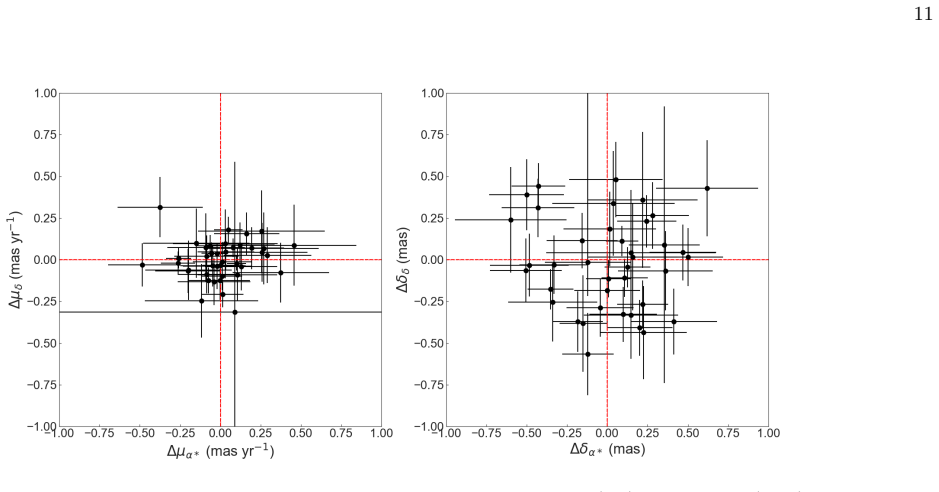
The central claim is that the HST-Gaia frame inherits the ICRS orientation through Gaia-CRF3 with no measurable bias: the error-weighted differences between HST-Gaia and Gaia-DR3 for the 40 primary stars are $-0.015\pm0.020$ mas yr$^{-1}$ in $\mu_{\alpha*}$ and $0.002\pm0.015$ mas yr$^{-1}$ in $\mu_\delta$, with a combined proper-motion precision of $0.025$ mas yr$^{-1}$, and position consistency of $0.044$ mas. The brightest catalog stars reach median errors of $0.03$ mas yr$^{-1}$ in proper motion and $0.11$ mas in position, roughly a factor of $20$ better than previous ICRS proper motions in this field. The paper further claims that a comparison of 13 stellar masers with the radio-based reference frame (D23) shows consistency within $0.041$ mas yr$^{-1}$ and $0.54$ mas at $99.7\%$ confidence, while flagging a possible $\sim2.5\sigma$ offset in the $\alpha_*$ direction that requires further observations to attribute.
Load-bearing premise
The frame tie rests on the assumption that the 40 Gaia-DR3 stars retained as primary references are an unbiased realization of the ICRS in a crowded, high-extinction field; if the ten rejected candidates carry real astrometric signal, or if the retained 40 have correlated errors, the quoted $0.025$ mas yr$^{-1}$ consistency with Gaia-CRF3 would not hold.
Editorial extensions
If this is right
- Galactic-center stellar orbits can now be tied to an inertial ICRS frame rather than only to a radio-maser frame, so dynamical fits gain an independent constraint on the reference frame itself.
- With the reported $0.025$ mas yr$^{-1}$ proper-motion consistency, the frame should detect an extended mass of roughly $3000\,M_\odot$ inside S0-2's orbit, dropping to roughly $1000\,M_\odot$ once Gaia-DR4 improves the tie.
- The 2,823 secondary reference stars inside the ground-based AO field allow existing AO datasets to be re-registered to the ICRS without new observations.
- The 13-maser cross-check gives the first independent near-infrared confirmation of the radio-maser frame at the $0.041$ mas yr$^{-1}$ level, with the paper leaving open whether the $\sim2.5\sigma$ $\alpha_*$ offset is real.
Reading between the lines
- If the frame tie is as stable as reported, the same Gaussian-process modeling should create ICRS-tied reference frames in other crowded, reddened fields where Gaia stars are sparse but multi-epoch HST imaging exists.
- A direct stress test of the central assumption is to repeat the transformation after re-adding the ten rejected Gaia candidates with conservative weights; a shift in the proper-motion bias above $0.025$ mas yr$^{-1}$ would implicate the outlier-rejection step.
- The paper's own Table 6 suggests that the position part of the SgrA*-at-Rest comparison is limited by the adopted ICRS position of Sgr A* rather than by HST-Gaia; improving that VLBI anchor would tighten the maser comparison more than extra HST epochs would.
- If the position-angle-dependent shift is really intra-exposure pointing drift, it should also appear in other long-exposure WFC3-IR programs with two roll angles, and confirming that would permit a physical correction instead of absorbing the effect into the GP kernel.
Signed reviews
Editorial analysis
A structured set of objections, weighed in public.
Referee Report
Summary. The paper presents a new near-infrared astrometric reference frame near the Galactic center, constructed by transforming 14 epochs of HST WFC3-IR astrometry into the Gaia-CRF3 frame using 40 Gaia-DR3 stars that overlap the HST field. The authors introduce a Gaussian-process framework for modeling stellar proper motions that simultaneously handles time-correlated systematics (e.g., a position-angle-dependent shift of up to ~2 mas for faint stars) and spatially correlated confusion. The resulting catalog contains 2,876 sources within ~25" of SgrA*, with the brightest stars achieving median proper-motion and position errors of ~0.03 mas/yr and ~0.11 mas, respectively. The central claim is that the HST-Gaia frame is consistent with Gaia-CRF3 to 0.025 mas/yr in proper motion and 0.044 mas in position, and that it is the first ICRS-based frame precise enough to probe the extended mass distribution near SgrA*. The authors also compare the frame to the radio maser-based frame of Darling et al. (2023), finding consistency within 0.041 mas/yr and 0.54 mas at 99.7% confidence, while noting a possible ~2.5-sigma offset in the alpha* direction.
Significance. If the frame-accuracy claim is correct, this is a valuable contribution: it is the first ICRS-tied NIR reference frame in the central parsec that is independent of radio masers, and the catalog (with ~2,900 sources, including 40 Gaia primary stars and 13 masers) will be a useful resource for GC dynamics. The Gaussian-process methodology for modeling systematic errors is a genuine methodological advance, and the paper provides a detailed pipeline description with machine-readable tables. The validation is reasonably thorough: the GP models are tested against leave-one-out cross-validation and the g-chi-squared_LOO distributions, and the radio maser comparison is an independent external check. However, the headline consistency with Gaia-CRF3 is not an independent validation, since it is measured on the same 40 stars that define the transformation; the only fully external test, the radio comparison, shows a possible ~2.5-sigma offset in alpha*. The significance of the extended-mass claim therefore rests on a precision estimate that is partly self-referential, and this needs to be addressed before the central claim can be accepted.
major comments (3)
- [§3.3, Eq. (10)] The quoted 0.025 mas/yr proper-motion and 0.044 mas position consistency with Gaia-CRF3 is computed as the error-weighted mean residual of the 40 primary reference stars that are the same stars used to fit the second-order polynomial transformation. For a least-squares fit, the residuals on the fitting sample are minimized by construction, so these numbers quantify the internal scatter of the transformation residuals (i.e., its precision relative to the same data), not an independent measure of the accuracy of the frame tie to the ICRS. The authors should either add a leave-one-out or split-sample cross-validation (fit the transformation on a subset of primary stars and test on the remaining stars) or explicitly relabel the §3.3 result as an internal consistency check. This is load-bearing because the abstract and §5.3 use the 0.025 mas/yr value to argue that the frame is precise enough to probe the extended mass distribution near SgrA*.
- [§4.2.3] The only fully independent external validation, the 13-maser comparison, shows a possible tension in the alpha* direction: the average proper-motion offset is -0.076 ± 0.030 mas/yr and the position offset is -0.536 ± 0.230 mas (after adding systematics). The paper acknowledges a ~2.5-sigma tension, but the abstract and conclusions state consistency 'to within 0.041 mas/yr and 0.54 mas at 99.7% confidence,' which is misleading because the observed offset is larger than the quoted 1-sigma uncertainty and the 99.7% confidence interval includes non-zero values. The authors should report the offset and its significance explicitly in the abstract and conclusions, and discuss what a real offset of this magnitude would imply for the frame accuracy claim. If the offset is real, it would be comparable to the claimed 0.025 mas/yr precision and would weaken the extended-mass claim.
- [§3.1] The iterative 5-sigma outlier rejection removed 10 of the 50 Gaia reference stars (20%) from the sample that defines the transformation. The rejection is based on the differences between HST-Gaia proper motions and Gaia-DR3 proper motions, but the HST-Gaia proper motions are computed using the transformation that is fit to the same stars, introducing a circularity into the outlier selection. The paper notes that many removed stars had truncated PSFs or close neighbors, but the possibility that the retained 40-star sample is biased toward zero residual (and thus that the transformation errors are underestimated) should be addressed quantitatively. The authors should report the astrometric properties of the rejected stars and/or demonstrate that the outlier rejection does not alter the conclusions by repeating the analysis with a leave-one-out or a more robust fitting procedure.
minor comments (5)
- [Abstract / §4.2.3] The phrase 'consistent with zero to within 0.041 mas/yr at 99.7% confidence' is imprecise; the observed offset is -0.076 mas/yr with a 1-sigma uncertainty of 0.041 mas/yr. Please state the offset and its uncertainty, and phrase the consistency statement in terms of the confidence interval for the true offset.
- [§3.1] The abbreviation 'D23' is used in §4.1 and §4.2 without being defined at first use in the text; please spell out Darling et al. (2023) when the radio maser frame is first mentioned.
- [Table 3 note] The table note lists 'σ_α*, σ_δ, σ_μδ, σ_μδ'; the last two entries should be σ_{μα*} and σ_{μδ}. Also, several table captions contain the typo 'T able'.
- [§3.2] The ELPD model-selection threshold of ≥6 is stated as corresponding to ~3-sigma preference, but the mapping between the ELPD difference and a significance level is not derived; please provide a reference or a brief justification for this threshold.
- [§5.2] The predicted Gaia-DR4 improvement relies on the empirical constant α_obs ≈ 2.4 in Eq. (19), but the derivation of this constant is not described; please state how it is obtained from the current transformations and discuss its uncertainty.
Circularity Check
The 0.025 mas/yr Gaia-CRF3 consistency claim is computed as the weighted mean residual on the same 40 primary stars used to define the transformation, so it is a fit diagnostic rather than an independent external validation.
-
self definitional
[Section 3.3, Equations 10-11, Figure 5; abstract]
"We define the bias between the HST-Gaia and Gaia-CRF3 reference frames as the error-weighted mean difference between the positions and proper motion values for the primary reference stars: ... For the proper motions, we derive the bias to be ∆µα∗ = -0.015 ±0.020 mas yr−1 and ∆µδ = 0.002±0.015 mas yr−1. This indicates that there is no evidence for a bias between the HST-Gaia and Gaia-CRF3 proper motions to a total precision of σ∆pm = 0.025 mas yr−1."
The primary reference stars in Equation 10 are the same 40 stars onto which the per-epoch second-order polynomial (Equations 1-2) is fit by linear least squares in Section 3.1. Because that fit includes a free constant term at every epoch, and linear and quadratic spatial terms, any coherent HST-versus-Gaia offset in position or proper motion is absorbable by the transformation; the error-weighted mean residual of the fit stars is therefore minimized by construction. Reporting this residual as consistency with Gaia-CRF3 to 0.025 mas/yr states the fitting residual as an external validation.
-
fitted input called prediction
[Section 3.1, primary reference star selection; Section 3.3]
"Reference stars with either position or proper motion differences larger than 5σ (where σ is the quadratic sum of the HST-Gaia and Gaia-DR3 errors) are considered outliers. ... These iterations continue until no outliers are found to exist, which was achieved after 10 Gaia stars are eliminated from the primary reference star sample."
The 40 stars that survive this iterative 5σ trim are then used both to transform HST astrometry into Gaia-CRF3 and to define the no-bias statistic in Equation 10. Outlier rejection is applied to exactly the quantity being tested, removing the stars with the largest HST-versus-Gaia differences, so the subsequent claim of 0.025 mas/yr consistency is computed on a sample selected for HST-Gaia agreement. The paper plausibly explains the rejected stars as edge or confusion cases, but that does not make the surviving-sample consistency test independent of the fit; the test is blind to the stars that disagreed most strongly.
full rationale
The main derivation pipeline is not circular: HST astrometry is transformed into Gaia-CRF3 using 40 primary stars, proper motions are modeled with Gaussian Processes whose kernel choice is validated by leave-one-out cross-validation, and the catalog is internally self-consistent. No load-bearing self-citation chain or imported uniqueness theorem was found. The circularity is confined to the headline claim of consistency with Gaia-CRF3. Equation 10 defines the bias as the error-weighted mean difference on the primary reference stars, which are exactly the stars used in the least-squares polynomial fit of Section 3.1 and which have been iteratively trimmed to remove disagreements larger than 5σ with Gaia. A per-epoch polynomial with free constant and spatial terms can absorb global position and proper-motion offsets, so a near-zero residual mean is expected by construction; the quoted 0.025 mas/yr therefore measures the fit residual, not an independent check against an external ICRS realization. The radio-maser comparison in Section 4.2.3 is genuinely independent, using 13 masers not used in the transformation, and provides some external support; however, it is made in the SgrA*-at-rest frame, depends on the adopted SgrA* ICRS position, and shows a possible ~2.5σ tension in α* for both position and proper motion. Overall, the central frame-consistency claim partially reduces by construction to its own fitting residuals, warranting a score of 6.
Assumptions & free parameters
free parameters (5)
- GP kernel hyperparameters (sigma_0, tau) per star =
fitted per star
- Confusion kernel length scale (ell) =
fitted per star
- Additive error inflation =
fitted per star
- Empirical scaling constant alpha_obs =
approximately 2.4
- Second-order polynomial transformation coefficients (6 per epoch) =
fitted per epoch
assumptions (6)
- domain assumption Gaia-DR3 astrometry is a valid realization of the ICRS toward the Galactic center, with no unmodeled large-scale systematics beyond those quoted in Gaia-CRF3 papers.
- ad hoc to paper The position-angle-dependent systematic offset is constant in time and amplitude across the dataset, so a single GP kernel can absorb it without biasing proper motions.
- domain assumption Iterative 5-sigma outlier rejection on the primary reference stars and on 5.5% of astrometric measurements removes only corrupted measurements and does not bias the sample.
- ad hoc to paper The second-order polynomial transformation fully captures the geometric distortion and reference-frame rotation across the 2'x2' HST field.
- standard math Standard Gaussian Process machinery (Rasmussen and Williams 2006) with the stated kernels and LOO-CV is applicable to sparsely sampled astrometric time series.
- domain assumption The ICRS position and proper motion of SgrA* from Xu et al. (2022) are accurate; alternative measurements differ mainly in position.
Cite this review
Pith. "Pith review of The HST-Gaia Near-Infrared Astrometric Reference Frame near the Milky Way Galactic Center." pith.science (2026). https://pith.science/paper/VLB6LPQE
@misc{pith2026250619933,
  author       = {Pith},
  title        = {Pith review of: The HST-Gaia Near-Infrared Astrometric Reference Frame near the Milky Way Galactic Center},
  year         = {2026},
  howpublished = {\url{https://pith.science/paper/VLB6LPQE}},
  note         = {Machine review of arXiv:2506.19933}
}
abstract
We present the first high-precision proper motion catalog, tied to the International Celestial Reference System (ICRS), of infrared astrometric reference stars within R $\leq$ 25" (1 pc) of the central supermassive black hole at the Galactic center (GC). This catalog contains $\sim$2,900 sources in a highly extinguished region that is inaccessible via Gaia. New astrometric measurements are extracted from HST observations (14 epochs, 2010 - 2023) and transformed into the ICRS using 40 stars in common with Gaia-DR3. We implement a new method for modeling proper motions via Gaussian Processes that accounts for systematic errors, greatly improving measurement accuracy. Proper motion and position measurements reach precisions of $\sim$0.03 mas/yr and $\sim$0.11 mas, respectively, representing a factor of $\sim$20x improvement over previous ICRS proper motion catalogs in the region. These measurements define a novel HST-Gaia reference frame that is consistent with Gaia-CRF3 to within 0.025 mas/yr in proper motion and 0.044 mas in position, making it the first ICRS-based reference frame precise enough to probe the distribution of extended mass within the orbits of stars near SgrA*. In addition, HST-Gaia provides an independent test of the radio measurements of stellar masers that form the basis of current GC reference frames. We find that the HST-Gaia and radio measurements are consistent to within 0.041 mas/yr in proper motion and 0.54 mas in position at 99.7% confidence. Gaia-DR4 is expected to reduce the HST-Gaia reference frame uncertainties by another factor of $\sim$2x, further improving the reference frame for dynamical studies.
Figures


Figures from the paper (9 more)



Reference graph
Works this paper leans on
-
[1]
, " * write output.state after.block = add.period write newline
ENTRY address archivePrefix author booktitle chapter doi edition editor eprint howpublished institution journal key month note number organization pages publisher school series title misctitle type volume year version url label extra.label sort.label short.list INTEGERS output.state before.all mid.sentence after.sentence after.block FUNCTION init.state.co...
-
[2]
write newline
" write newline "" before.all 'output.state := FUNCTION format.doi doi empty "" "doi:" doi * if FUNCTION format.url url empty "" new.block "" url * "" * if FUNCTION format.eprint eprint empty "" archivePrefix empty "" archivePrefix ":" * if eprint field.or.null * if FUNCTION format.pid eprint empty format.doi format.eprint if FUNCTION n.dashify 't := "" t...
-
[3]
thebibliography [1] 20pt to REFERENCES 6pt =0pt 10pt plus 3pt =0pt =0pt =1pt plus 1pt =0pt =0pt -12pt =13pt plus 1pt =20pt =13pt plus 1pt \@M =10000 =-1.0em =0pt =0pt 0pt =0pt =1.0em @enumiv\@empty 10000 10000 `\.\@m \@noitemerr \@latex@warning Empty `thebibliography' environment \@ifnextchar \@reference \@latexerr Missing key on reference command Each re...
arXiv 2019
- [4]
- [5]
-
[6]
2022, One-Pass HST Photometry with hst1pass , Instrument Science Report WFC3 2022-5, 55 pages, ,
Anderson , J. 2022, One-Pass HST Photometry with hst1pass , Instrument Science Report WFC3 2022-5, 55 pages, ,
work page 2022
- [7]
-
[8]
2012, , 750, 111
Antonini , F., Capuzzo-Dolcetta , R., Mastrobuono-Battisti , A., & Merritt , D. 2012, , 750, 111
2012
Show all 75 references
-
[9]
2020, , 901, L29
Arca Sedda , M., Gualandris , A., Do , T., et al. 2020, , 901, L29
2020
-
[10]
2018, , 616, A17
Arenou , F., et al. 2018, , 616, A17
2018
-
[11]
F., Charlot , P., Feissel , M., & Lestrade , J
Arias , E. F., Charlot , P., Feissel , M., & Lestrade , J. F. 1995, , 303, 604
1995
-
[12]
2013, , 558, A33
Astropy Collaboration , Robitaille , et al. 2013, , 558, A33
2013
-
[13]
N., & Wolf , R
Bahcall , J. N., & Wolf , R. A. 1977, , 216, 883
1977
-
[14]
2018, , 609, A28
Baumgardt , H., Amaro-Seoane , P., & Sch \"o del , R. 2018, , 609, A28
2018
-
[15]
R., et al
Bellini , A., Anderson , J., Bedin , L. R., et al. 2017, , 842, 6
2017
-
[16]
2018, , 853, 86
Bellini , A., et al. 2018, , 853, 86
2018
-
[17]
2020, , 644, A159
Charlot , P., et al. 2020, , 644, A159
2020
-
[18]
K., Gerhard , O., et al
Chatzopoulos , S., Fritz , T. K., Gerhard , O., et al. 2015, , 447, 948
2015
-
[19]
J., et al
Darling , J., Paine , J., Reid , M. J., et al. 2023, , 955, 117
2023
-
[20]
2020, , 901, L28
Do , T., David Martinez , G., Kerzendorf , W., et al. 2020, , 901, L28
2020
-
[21]
2019, Science, 365, 664
Do , T., et al. 2019, Science, 365, 664
2019
-
[22]
2011, , 728, 37
Dodds-Eden , K., et al. 2011, , 728, 37
2011
-
[23]
2021, , 649, A5
Fabricius , C., et al. 2021, , 649, A5
2021
-
[24]
2014, , 570, A2
Feldmeier , A., et al. 2014, , 570, A2
2014
-
[25]
2022a, , 667, A148
Gaia Collaboration , Klioner , et al. 2022a, , 667, A148
-
[26]
2022b, arXiv e-prints, arXiv:2208.00211
Gaia Collaboration , Vallenari , et al. 2022b, arXiv e-prints, arXiv:2208.00211
-
[27]
2013, Understanding predictive information criteria for Bayesian models, , , arXiv:1307.5928
Gelman, A., Hwang, J., & Vehtari, A. 2013, Understanding predictive information criteria for Bayesian models, , , arXiv:1307.5928. https://arxiv.org/abs/1307.5928
2013 arXiv
-
[28]
M., et al
Ghez , A. M., et al. 2003, , 586, L127
2003
-
[29]
M., et al
Ghez , A. M., et al. 2008, , 689, 1044
2008
-
[30]
2009, , 692, 1075
Gillessen , S., Eisenhauer , F., Trippe , S., et al. 2009, , 692, 1075
2009
-
[31]
J., & Kemball , A
Gonidakis , I., Diamond , P. J., & Kemball , A. J. 2010, , 406, 395
2010
-
[32]
Gordon , D., de Witt , A., & Jacobs , C. S. 2023, , 165, 49
2023
-
[33]
2018, ArXiv e-prints, arXiv:1807.09409
GRAVITY Collaboration , Abuter , et al. 2018, ArXiv e-prints, arXiv:1807.09409
2018 arXiv
- [34]
-
[35]
2022, , 657, L12
GRAVITY Collaboration , Abuter , et al. 2022, , 657, L12
2022
-
[36]
2024, arXiv e-prints, arXiv:2403.12219
Griggio , M., Libralato , M., Bellini , A., et al. 2024, arXiv e-prints, arXiv:2403.12219
2024
-
[37]
D., Ghez , A
Hornstein , S. D., Ghez , A. M., Tanner , A., et al. 2002, , 577, L9
2002
-
[38]
W., Do , T., Lu , J
Hosek , M. W., Do , T., Lu , J. R., et al. 2022, , 939, 68
2022
-
[39]
W., Lu , J
Hosek , Jr., M. W., Lu , J. R., Anderson , J., et al. 2015, , 813, 27
2015
-
[40]
2018, , 855, 13
---. 2018, , 855, 13
2018
-
[41]
Hunter, J. D. 2007, Computing in Science & Engineering, 9, 90
2007
-
[42]
2019, , 873, 9
Jia , S., et al. 2019, , 873, 9
2019
-
[43]
2023, arXiv e-prints, arXiv:2302.02040
Jia , S., et al. 2023, arXiv e-prints, arXiv:2302.02040
2023 arXiv
-
[44]
Y., & Hoang , B.-M
Jurado , C., Naoz , S., Lam , C. Y., & Hoang , B.-M. 2024, , 971, 95
2024
-
[45]
Kemball , A. J. 2007, in Astrophysical Masers and their Environments, ed. J. M. Chapman & W. A. Baan , Vol. 242, 236--245
2007
-
[46]
2021, , 649, A2
Lindegren , L., et al. 2021, , 649, A2
2021
-
[47]
2022, , 940, 101
Linial , I., & Sari , R. 2022, , 940, 101
2022
-
[48]
R., Ghez , A
Lu , J. R., Ghez , A. M., Hornstein , S. D., et al. 2009, , 690, 1463
2009
-
[49]
M., Reid , M
Menten , K. M., Reid , M. J., Eckart , A., & Genzel , R. 1997, , 475, L111
1997
-
[50]
2020, , 28, 4
Neumayer , N., Seth , A., & B \"o ker , T. 2020, , 28, 4
2020
-
[51]
2022, arXiv e-prints, arXiv:2208.13218
Nogueras-Lara , F. 2022, arXiv e-prints, arXiv:2208.13218
2022 arXiv
-
[52]
2023, , 671, L10
Nogueras-Lara , F., Schultheis , M., Najarro , F., et al. 2023, , 671, L10
2023
-
[53]
Oliphant, T. E. 2006, A guide to NumPy, Vol. 1 (Trelgol Publishing USA)
2006
-
[54]
2024, , 977, 228
Paugnat , H., et al. 2024, , 977, 228
2024
-
[55]
2006, , 643, 1011
Paumard , T., et al. 2006, , 643, 1011
2006
-
[56]
M., et al
Plewa , P. M., et al. 2015, , 453, 3234
2015
-
[57]
E., & Williams , C
Rasmussen , C. E., & Williams , C. K. I. 2006, Gaussian Processes for Machine Learning
2006
-
[58]
J., & Brunthaler , A
Reid , M. J., & Brunthaler , A. 2004, , 616, 872
2004
-
[59]
2020, , 892, 39
---. 2020, , 892, 39
2020
-
[60]
J., Menten , K
Reid , M. J., Menten , K. M., Genzel , R., et al. 2003, , 587, 208
2003
-
[61]
J., Menten , K
Reid , M. J., Menten , K. M., Trippe , S., Ott , T., & Genzel , R. 2007, , 659, 378
2007
-
[62]
C., & MacLeod , M
Rose , S. C., & MacLeod , M. 2024, , 963, L17
2024
-
[63]
2019, , 873, 65
Sakai , S., et al. 2019, , 873, 65
2019
-
[64]
2009, , 502, 91
Sch \"o del , R., Merritt , D., & Eckart , A. 2009, , 502, 91
2009
-
[65]
2010, , 511, A18
Sch \"o del , R., Najarro , F., Muzic , K., & Eckart , A. 2010, , 511, A18
2010
-
[66]
2002, , 419, 694
Sch \"o del , R., et al. 2002, , 419, 694
2002
-
[67]
2024, arXiv e-prints, arXiv:2409.12261
The GRAVITY Collaboration , El Dayem , et al. 2024, arXiv e-prints, arXiv:2409.12261
2024 arXiv
-
[68]
2015, arXiv e-prints, arXiv:1507.04544
Vehtari , A., Gelman , A., & Gabry , J. 2015, arXiv e-prints, arXiv:1507.04544
2015 arXiv
-
[69]
2016, Statistics and Computing, 27, 1413–1432
Vehtari, A., Gelman, A., & Gabry, J. 2016, Statistics and Computing, 27, 1413–1432. http://dx.doi.org/10.1007/s11222-016-9696-4
2016 doi
-
[70]
2020, Nature Methods, 17, 261
Virtanen , P., et al. 2020, Nature Methods, 17, 261
2020
-
[71]
D., et al
von Fellenberg , S. D., et al. 2022, , 932, L6
2022
-
[72]
C., et al
Weldon , G. C., et al. 2023, , 954, L33
2023
-
[73]
J., et al
Xu , S., Zhang , B., Reid , M. J., et al. 2022, arXiv e-prints, arXiv:2210.03390
2022 arXiv
-
[74]
R., Ghez , A
Yelda , S., Lu , J. R., Ghez , A. M., et al. 2010, , 725, 331
2010
-
[75]
2024, , 961, 232
Zhang , F., & Amaro Seoane , P. 2024, , 961, 232
2024
Reviewed August 15, 2026 · model on record in the stance chip above.
Discussion (0). Continue with ORCID to comment.