REVIEW 4 major objections 6 minor 43 references
YNiSn$_2$: A candidate Dirac semimetal
T0 review · 4 major / 6 minor · reviewed 2026-08-06 · deepseek-v4-flash
Pith's one-line read YNiSn2 is a promising quasi-2D Dirac semimetal candidate, with a tiny Fermi surface pocket and carriers of mass 0.08 m0.
desk verdict Solid first single-crystal dHvA characterization of YNiSn2, but the quasi-2D and Dirac claims rest on an unresolved SdH harmonic ambiguity that should be fixed before publication. read the letter →
The pith
A machine-rendered reading of the paper's core claim, the machinery that carries it, and where it could break.
The reading
What carries the argument
The argument runs on quantum oscillations analyzed with the Lifshitz-Kosevich formalism. The formula $\Delta M \propto B^{1/2} R_T R_D \cos[2\pi(F/B + \gamma - \delta)]$ converts the temperature and field decay of oscillation amplitudes into a cyclotron mass ($m^*$) and Dingle temperature; the Onsager relation $F = (\Phi_0/2\pi^2) A_F$ turns each frequency into an extremal Fermi-surface area. The quasi-2D claim is carried by the $1/\cos\theta$ dependence of the SdH frequency on tilt angle, and the magnetoresistance interpretation leans on a theoretical square-root dependence for quasi-two-dimensional layered metals.
What would settle it
Grow YNiSn2 crystals without using tin flux and repeat the dHvA and SdH measurements, alongside a pure-tin reference sample; if the 43.5 and 60.8 T dHvA peaks or the 133 T SdH peak disappear, shift, or match the tin oscillation frequencies, or fail to follow a single $1/\cos\theta$ scaling, the inferred quasi-2D Dirac pocket is not intrinsic.
Extended reading notes
Core claim
The paper reports the synthesis of single-crystal YNiSn2 in the orthorhombic Cmcm structure and characterizes it as a semimetal. Its central discovery is a dominant quasi-two-dimensional Fermi surface, inferred from de Haas-van Alphen oscillations with frequencies $F_1 = 43.5$ T and $F_2 = 60.8$ T, an extremely light cyclotron mass $m^* \approx 0.08\,m_0$, and a Fermi-surface cross-section of about 1% of the basal Brillouin-zone area. Shubnikov-de Haas oscillations add a frequency near 133 T whose angle dependence follows $F(\theta) \propto 1/\cos\theta$, the expected scaling for a quasi-2D cylindrical pocket. Together with a giant positive magnetoresistance of roughly 1200% at 16 T and a linear-to-square-root crossover in field dependence, the paper interprets these features as evidence that YNiSn2 is a promising Dirac semimetal candidate.
Load-bearing premise
The quantum oscillations assigned to YNiSn2 come from the intrinsic Fermi surface of YNiSn2, not from residual tin left by the flux growth.
Editorial extensions
If this is right
- If the assignment holds, YNiSn2 becomes a concrete quasi-2D platform for studying Dirac-like carriers in a semimetallic 3D crystal.
- The tiny pocket and $m^* = 0.08\,m_0$ imply high mobility, so field-induced resistivity upturns and enhanced quantum oscillations should be reproducible across crystals.
- The observed linear-to-square-root magnetoresistance crossover would be an experimental realization of the quasi-2D layered-metal prediction, extending the graphene analogue to a bulk material.
- Resolving whether the 133 T SdH peak is a harmonic of the 43.5 T dHvA fundamental determines whether the claimed 2D Fermi surface is fully consistent between transport and thermodynamic probes.
Reading between the lines
- Editorial inference: the 133 T SdH peak sits near $3\times 43.5$ T, so the 2D-scaling curve built on that peak remains subject to a harmonic-or-intrinsic ambiguity even if the material is clean.
- Editorial inference: because the crystals are grown in tin flux and residual Sn superconducts at 3.7 K, any quantum-oscillation component overlapping tin's 105–170 T range should be checked against a pure-Sn control before the Dirac assignment is taken as settled.
- Editorial inference: if YNiSn2 is a Dirac semimetal, hydrostatic pressure or chemical substitution should continuously shift the tiny pocket's oscillation frequency, offering a way to map the band structure near the Fermi level.
Editorial analysis
A structured set of objections, weighed in public.
Referee Report
Summary. The manuscript reports the synthesis, crystal structure, and thermodynamic and transport properties of YNiSn2. It claims that the compound is a semimetal with a dominant quasi-2D Fermi surface consisting of a tiny pocket with cyclotron effective mass 0.08 m0, supported by dHvA oscillations (F1 = 43.5 T, F2 = 60.8 T) and SdH oscillations (peak at 133–138 T) with angular dependence F(θ) ∝ 1/cosθ, and large magnetoresistance ~1200% at 16 T. The central conclusion positions YNiSn2 as a candidate Dirac semimetal.
Significance. If the interpretation is correct, YNiSn2 would be a new orthorhombic semimetal with a very light, quasi-2D pocket, adding to the family of materials where small effective masses and anisotropic transport are associated with Dirac-like physics. The paper has concrete strengths: single-crystal growth and structural characterization, EDS composition analysis, specific-heat measurements, and careful Lifshitz–Kosevich fits to dHvA data that yield masses and Dingle temperatures. The high-field susceptibility and MR analysis are also consistent with semimetallic behavior. The main weakness is that the SdH peak that anchors the quasi-2D claim is not shown to be an intrinsic fundamental frequency of YNiSn2.
major comments (4)
- [Section III.D, Fig. 6c] The 133-T SdH peak is not established as an intrinsic fundamental frequency of YNiSn2. The text itself notes that 133 T is close to 3 × 43.5 T and that harmonic contributions cannot be excluded. If the peak is the third harmonic of the dHvA fundamental F1, then the angular scaling F(θ) ∝ 1/cosθ shown in Fig. 6h is expected for a harmonic of a quasi-2D fundamental and does not independently confirm two-dimensionality. The authors should resolve this by presenting a harmonic analysis of the dHvA signal, extending the SdH field range, or comparing with a band-structure calculation of the expected quantum-oscillation spectrum.
- [Section II, Fig. 2b inset] Residual Sn is present in the sample, as shown by the superconducting transition at 3.7 K. Pure Sn exhibits quantum oscillations in the 105–170 T range, and the observed SdH peak at 133–138 T lies inside this range. The paper argues that the dHvA frequencies (43.5 and 60.8 T) are below the Sn range, but the SdH peak in question is not. To support the assignment of the 133-T peak to YNiSn2, the authors should rule out Sn contamination, for instance by measuring a reference Sn sample under identical conditions or by performing element-specific or orientation-dependent checks that distinguish Sn pockets.
- [Section III.D, Fig. 6h] The SdH frequency obtained from the angular fit is F0 = 138(2) T, whereas the dHvA analysis yields fundamental frequencies of 43.5 and 60.8 T for B ∥ b. The paper attributes the discrepancy to different field windows and to transport versus thermodynamic weighting, but this is not quantitatively supported; a factor of ~2–3 difference in frequency between SdH and dHvA for the same pocket is unusual. The authors should either reconcile the two measurements with a consistent assignment or present evidence that the SdH peak corresponds to a different, previously unresolved pocket.
- [Section III.D, Fig. 6c inset] The effective mass fitted to the 137-T SdH peak is m* = 0.20(2) m0, which is close to three times the dHvA mass of 0.08 m0. This is quantitatively consistent with the third-harmonic interpretation. The manuscript does not address this coincidence; it should be explicitly discussed and excluded by a higher-harmonic analysis or by measurements at higher fields.
minor comments (6)
- [Section III.A, Fig. 2a] In the text, 'cp' should be written as 'c_p' (or defined as the specific heat at constant pressure) to avoid confusion with the heat capacity notation.
- [Section III.D, Fig. 6a caption] The word 'diferent' in the caption should be corrected to 'different'.
- [Section III.D, text] The expression 'wc ∗τ≥1' appears garbled; it should presumably be 'ω_c τ ≥ 1' (with omega_c the cyclotron frequency).
- [Throughout] The manuscript uses both 'B' and 'μ0H' for magnetic field; choose a single notation and define it consistently in the experimental section.
- [Abstract and Section III.D] The magnetoresistance value is given as 'approaching 1200%' in the abstract and 'nearly 1100%' in the main text; reconcile these numbers or clarify the measurement conditions (e.g., different samples or temperatures).
- [Reference [14]] The reference title 'Nodal-line semimetals and their variance' should be checked; the word 'variance' is likely a typo for 'variants' or 'various'.
Circularity Check
No significant circularity: all load-bearing quantities are direct fits to measured quantum oscillations and transport data, not quantities defined by the claim.
full rationale
The paper's central claim—that YNiSn2 hosts a dominant quasi-two-dimensional Fermi surface with a light cyclotron mass—is derived from direct measurements: dHvA frequencies F1 = 43.5 T and F2 = 60.8 T are obtained from FFTs of the oscillatory magnetization, the effective mass m* = 0.08 m0 is extracted from the Lifshitz–Kosevich thermal damping factor, and the SdH angular dependence is fitted to F(theta) = F0/cos(theta - theta0). None of these quantities is defined in terms of the Dirac-semimetal conclusion; rather, the Dirac candidate status is an inference from the observed small mass, small Fermi-surface cross-section, and anisotropic scaling. The 1/cos(theta) fit is a standard Onsager-relation description of a cylindrical Fermi surface, not a self-referential definition. The paper explicitly acknowledges the harmonic ambiguity of the 133-T SdH peak, noting it is 'close to three times 43.5 T' and that the SdH signal may be a higher harmonic; this is a stated limitation and an artifact/correctness risk rather than a circular step, because the fits do not assume the conclusion they support. There are no load-bearing self-citations: the references to Lifshitz–Kosevich theory, Sn flux superconductivity, and comparable semimetals are external standard results. The derivation chain is therefore self-contained with respect to circularity, and any concerns about residual Sn or harmonic contamination belong to experimental validity, not circular reasoning.
Assumptions & free parameters
free parameters (6)
- dHvA cyclotron effective mass =
m* = 0.080(1) m0 and m* = 0.079(5) m0
- SdH cyclotron effective mass =
m* = 0.20(2) m0
- Dingle temperatures =
T_D = 4.7 K and 3.8 K
- SdH oscillation frequency at B parallel to b =
F0 = 138(2) T
- Magnetoresistance exponent =
n = 0.72(3)
- SdH background polynomial =
second-order polynomial in field over 10 to 16 T
assumptions (4)
- standard math Lifshitz-Kosevich formula describes the amplitude of dHvA and SdH oscillations
- standard math Onsager relation connects oscillation frequency F to extremal Fermi-surface cross-section area
- domain assumption The observed quantum oscillations originate from YNiSn2 and not from residual Sn flux or from harmonics of another frequency
- standard math Free-electron Sommerfeld model relates the gamma coefficient to the density of states
Cite this review
Pith. "Pith review of YNiSn$_2$: A candidate Dirac semimetal." pith.science (2026). https://pith.science/paper/VLD25OHM
@misc{pith2026250705500,
  author       = {Pith},
  title        = {Pith review of: YNiSn$_2$: A candidate Dirac semimetal},
  year         = {2026},
  howpublished = {\url{https://pith.science/paper/VLD25OHM}},
  note         = {Machine review of arXiv:2507.05500}
}
abstract
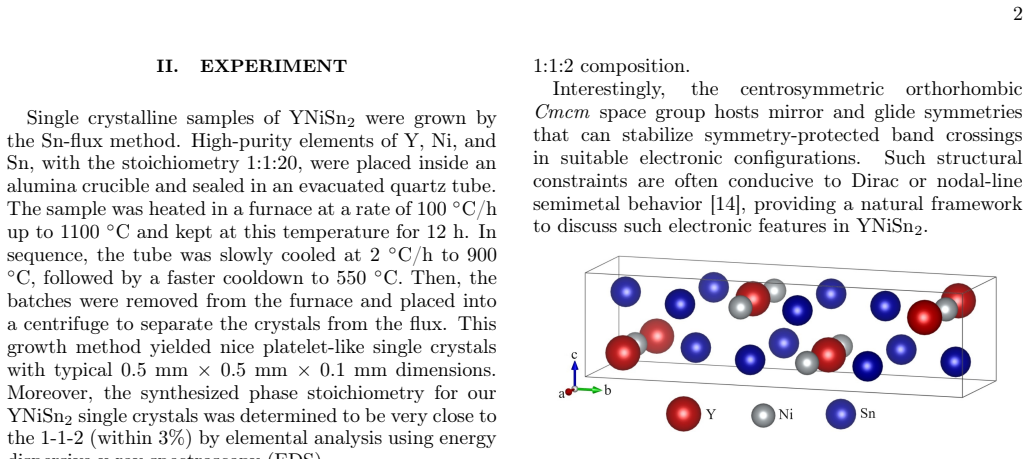
We report the synthesis and physical properties of the new compound YNiSn$_2$, which crystallizes in the orthorhombic \textit{Cmcm} structure. The material exhibits semimetallic behavior and develops a giant positive magnetoresistance approaching 1200\% at $B = 16$ T. Pronounced de Haas-van Alphen and Shubnikov-de Haas oscillations reveal a dominant quasi-two-dimensional Fermi surface with an exceptionally small cyclotron effective mass of $m^{*} = 0.08 m{0}$, indicating light carriers and a tiny Fermi surface pocket. The strong anisotropy revealed by Shubnikov-de Haas quantum oscillation measurements highlights the low-dimensional electronic character of YNiSn$_2$, positioning it as a promising Dirac semimetal candidate.
Figures


Figures from the paper (3 more)


Reference graph
Works this paper leans on
-
[1]
B. A. Bernevig, T. L. Hughes, and S.-C. Zhang, Quan- tum Spin Hall Effect and Topological Phase Transition in HgTe Quantum Wells, Science314, 1757 (2006)
work page 2006
- [2]
- [3]
-
[4]
M. Z. Hasan and C. L. Kane,Colloquium: Topological insulators, Reviews of Modern Physics82, 3045 (2010)
work page 2010
-
[5]
Yan and C
B. Yan and C. Felser, Topological Materials: Weyl Semimetals, Annual Review of Condensed Matter Physics8, 337 (2017)
2017
-
[6]
C. Zhang, H.-Z. Lu, S.-Q. Shen, Y. P. Chen, and F. Xiu, Towards the manipulation of topological states of matter: a perspective from electron transport, Science Bulletin 63, 580 (2018)
work page 2018
-
[7]
N.P.Armitage, E.J.Mele,andA.Vishwanath,Weyland Dirac semimetals in three-dimensional solids, Reviews of Modern Physics90, 015001 (2018)
work page 2018
- [8]
Show all 43 references
-
[9]
Kohn, Excitonic phases, Physical Review Letters19, 439 (1967), publisher: APS
W. Kohn, Excitonic phases, Physical Review Letters19, 439 (1967), publisher: APS
1967
-
[10]
J. M. Blatt, K. Böer, and W. Brandt, Bose-Einstein con- densation of excitons, Physical Review126, 1691 (1962), publisher: APS
1962
-
[11]
V. N. Kotov, B. Uchoa, V. M. Pereira, F. Guinea, and A. Castro Neto, Electron-electron interactions in graphene: Current status and perspectives, Reviews of modern physics84, 1067 (2012), publisher: APS
2012
-
[12]
Kuneš, Excitonic condensation in systems of strongly correlated electrons, Journal of Physics: Condensed Mat- ter27, 333201 (2015), publisher: IOP Publishing
J. Kuneš, Excitonic condensation in systems of strongly correlated electrons, Journal of Physics: Condensed Mat- ter27, 333201 (2015), publisher: IOP Publishing
2015
-
[13]
Y. Jia, P. Wang, C.-L. Chiu, Z. Song, G. Yu, B. Jäck, S. Lei, S. Klemenz, F. A. Cevallos, M. Onyszczak, N. Fishchenko, X. Liu, G. Farahi, F. Xie, Y. Xu, K. Watanabe, T. Taniguchi, B. A. Bernevig, R. J. Cava, L. M. Schoop, A. Yazdani, and S. Wu, Evidence for a monolayer exciton...
2022
-
[14]
Chang, Nodal-line semimetals and their variance, Materials Today Quantum8, 100057 (2025)
P.-Y. Chang, Nodal-line semimetals and their variance, Materials Today Quantum8, 100057 (2025)
2025
-
[15]
Wang and R
Y. Wang and R. M. Nandkishore, Interplay between short-range correlated disorder and Coulomb interaction in nodal-line semimetals, Physical Review B96, 115130
-
[16]
Romaka, Y
L. Romaka, Y. Dovgalyuk, V. V. Romaka, I. Lotot- ska, and Y. Stadnyk, Interaction of the components in Y–Ni–Sn ternary system at 770 K and 670 K, Inter- metallics29, 116 (2012)
2012
-
[17]
C. P. Sebastian and R. Pöttgen, The Stannides YNixSn2 (x = 0, 0.14, 0.21, 1) – Syntheses, Structure, and 119Sn Mössbauer Spectroscopy, Monatshefte für Chemie - Chemical Monthly5, 381 (2007)
2007
-
[18]
Komarovskaya, L
L. Komarovskaya, L. Aksel’rud, and R. Skolozdra, Crys- tal Structure of the Compound LuNiSn2 and Its Analogs, Kristallografiya28, 1201 (1983)
1983
-
[19]
Skolozdra, L
R. Skolozdra, L. Komarovskaya, and L. Aksel’rud, Mag- netic susceptibility of RNiSn2 and RNi3Sn2 compounds (R-rare earths), Izvestiya Akademii Nauk SSSR, Neor- ganicheskie Materialy24, 1490 (1988)
1988
-
[20]
Skolozdra, S
R. Skolozdra, S. Sadykov, L. Komarovskaya, and O. Ku- vandikov, Magnetic susceptibility and crystal structure of RNi1-xSn2-y (R-La, Ce, Pr, Nd, Sm), Fiz. Met. Met- alloved.;(USSR)65(1988)
1988
-
[21]
Pecharsky, K
V. Pecharsky, K. Gschneidner Jr, and L. Miller, Low- temperatureheatcapacityandmagneticpropertiesofthe RNiX2 compounds (R= La, Ce; X= Si, Ge, Sn), Physical Review B43, 10906 (1991)
1991
-
[22]
Kittel,Introduction to solid state physics, 8th ed
C. Kittel,Introduction to solid state physics, 8th ed. (John Wiley \& sons, inc, Hoboken, NJ, 2005)
2005
-
[23]
Eisenstein, Superconducting Elements, Reviews of Modern Physics26, 277 (1954)
J. Eisenstein, Superconducting Elements, Reviews of Modern Physics26, 277 (1954)
1954
-
[24]
I. A. Leahy, Y.-P. Lin, P. E. Siegfried, A. C. Treglia, J. C. W. Song, R. M. Nandkishore, and M. Lee, Non- saturating large magnetoresistance in semimetals, Pro- ceedings of the National Academy of Sciences115, 10570 (2018)
2018
-
[25]
W. A. Roger, J. A. Rowlands, and S. B. Woods, The Fermi surface of white tin using ultrasonic quantum os- cillations, Journal of Physics F: Metal Physics6, 315 (1976)
1976
-
[26]
M. M. Finkelstein, Fermi surface deformation parameters and cyclotron effective masses in white tin, Journal of Low Temperature Physics14, 287 (1974). 8
1974
-
[27]
Sankar, G
R. Sankar, G. Peramaiyan, I. P. Muthuselvam, S. Xu, M. Z. Hasan, and F. C. Chou, Crystal growth and transport properties of Weyl semimetal TaAs, Journal of Physics: Condensed Matter30, 015803 (2018)
2018
-
[28]
Shoenberg,Magnetic Oscillations in Metals(Cam- bridge University Press, 1984)
D. Shoenberg,Magnetic Oscillations in Metals(Cam- bridge University Press, 1984)
1984
-
[29]
J. Hu, Z. Tang, J. Liu, Y. Zhu, J. Wei, and Z. Mao, Nearly massless Dirac fermions and strong Zeeman split- ting in the nodal-line semimetal ZrSiS probed by de Haas–van Alphen quantum oscillations, Physical Review B96, 045127 (2017)
2017
-
[30]
Singha, A
R. Singha, A. K. Pariari, B. Satpati, and P. Mandal, Large nonsaturating magnetoresistance and signature of nondegenerate Dirac nodes in ZrSiS, Proceedings of the National Academy of Sciences114, 2468 (2017)
2017
-
[31]
L. Li, K. Wang, D. Graf, L. Wang, A. Wang, and C. Petrovic, Electron-hole asymmetry, Dirac fermions, and quantum magnetoresistance in BaMnBi2, Physical Review B93, 115141 (2016)
2016
-
[32]
Le Mardelé, J
F. Le Mardelé, J. Wyzula, I. Mohelsky, S. Nasrallah, M. Loh, S. Ben David, O. Toledano, D. Tolj, M. Novak, G. Eguchi, S. Paschen, N. Barišić, J. Chen, A. Kimura, M. Orlita, Z. Rukelj, A. Akrap, and D. Santos-Cottin, Evidence for three-dimensional Dirac conical bands in TlBiSSe...
2023
-
[33]
A. B. Pippard,Magnetoresistance in Metals(Cambridge University Press, 1989)
1989
-
[34]
M. N. Ali, J. Xiong, S. Flynn, J. Tao, Q. D. Gib- son, L. M. Schoop, T. Liang, N. Haldolaarachchige, M. Hirschberger, N. P. Ong, and R. J. Cava, Large, non- saturating magnetoresistance in WTe2, Nature514, 205 (2014)
2014
-
[35]
F. F. Tafti, Q. D. Gibson, S. K. Kushwaha, N. Hal- dolaarachchige, and R. J. Cava, Resistivity plateau and extreme magnetoresistance in LaSb, Nature Physics12, 272 (2016)
2016
-
[36]
S. Sun, Q. Wang, P.-J. Guo, K. Liu, and H. Lei, Large magnetoresistance in LaBi: origin of field-induced resis- tivity upturn and plateau in compensated semimetals, New Journal of Physics18, 082002 (2016)
2016
-
[37]
Liang, Q
T. Liang, Q. Gibson, M. N. Ali, M. Liu, R. J. Cava, and N. P. Ong, Ultrahigh mobility and giant magnetoresis- tance in the Dirac semimetal Cd3As2, Nature Materials 14, 280 (2015)
2015
-
[38]
Peramaiyan, R
G. Peramaiyan, R. Sankar, I. P. Muthuselvam, and W.-L. Lee, Anisotropic magnetotransport and extremely large magnetoresistanceinNbAs2singlecrystals,ScientificRe- ports8, 6414 (2018)
2018
-
[39]
Y. Wang, L. Thoutam, Z. Xiao, J. Hu, S. Das, Z. Mao, J. Wei, R. Divan, A. Luican-Mayer, G. Crabtree, and others, Origin of the turn-on temperature behavior in WTe2, Physical Review B92, 180402 (2015)
2015
-
[40]
P. D. Grigoriev, Longitudinal interlayer magnetoresis- tance in strongly anisotropic quasi-two-dimensional met- als, Physical Review B88, 054415 (2013)
2013
-
[41]
A. A. Sinchenko, P. D. Grigoriev, P. Lejay, and P. Mon- ceau, Linear magnetoresistance in the charge density wave state of quasi-two-dimensional rare-earth tritel- lurides, Physical Review B96, 245129 (2017)
2017
-
[42]
P. S. Alekseev, A. P. Dmitriev, I. V. Gornyi, and V. Y. Kachorovskii, Strong magnetoresistance of disordered graphene, Physical Review B87, 165432 (2013)
2013
-
[43]
Vasileva, P
G. Vasileva, P. Alekseev, Y. Vasilyev, A. Dmitriev, V. Kachorovskii, D. Smirnov, H. Schmidt, and R. Haug, Magnetoresistance of Monolayer Graphene With Short- Range Disorder, physica status solidi (b)256, 1800525 (2019)
2019
Reviewed August 6, 2026 · model on record in the stance chip above.
Discussion (0). Continue with ORCID to comment.