Programmable dipolar interaction geometry selects stripe-family order in a molecular lattice quantum simulator
Pith reviewed 2026-06-29 23:56 UTC · model grok-4.3
The pith
Sign-changing dipolar interactions in a molecular lattice select a family of stripe solids whose ordering wavevector shifts with filling.
A machine-rendered reading of the paper's core claim, the machinery that carries it, and where it could break.
Core claim
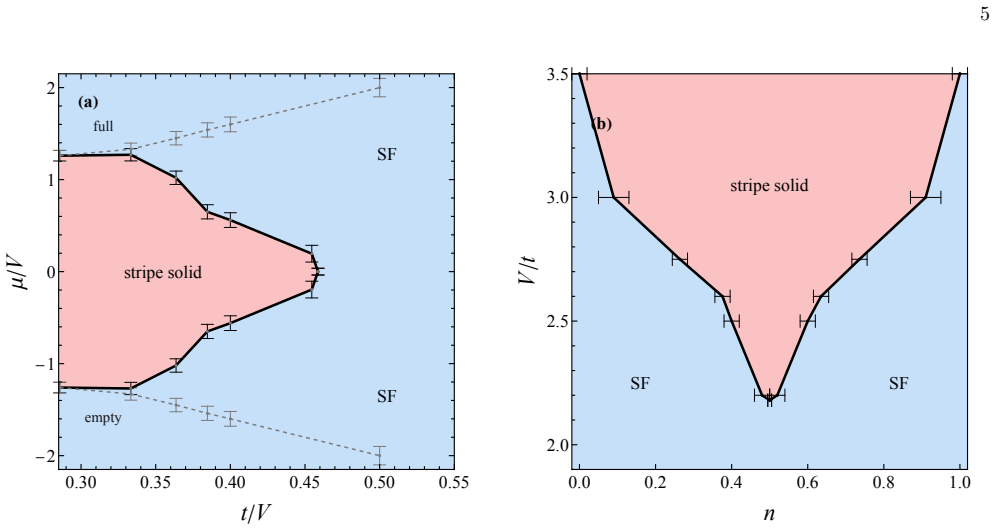
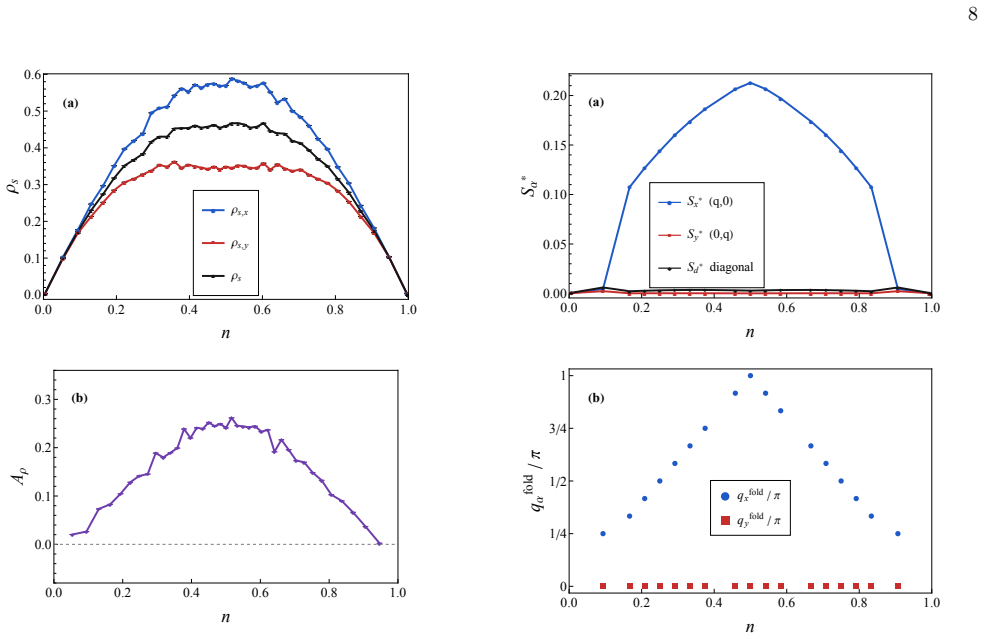
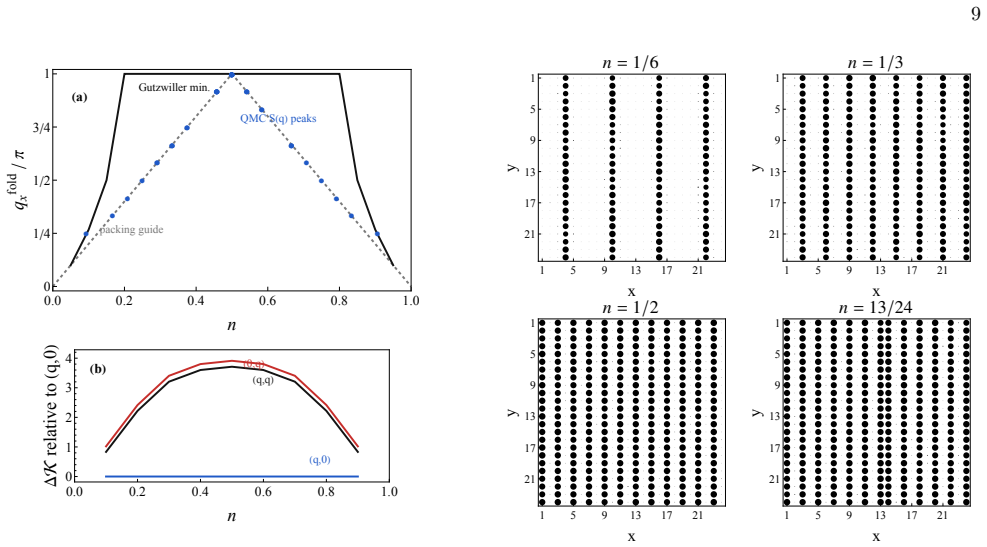
In the minimal hard-core Bose-Hubbard model with interaction V(r) proportional to (x squared minus y squared) over (x squared plus y squared) to the 5/2, the low-t/V regime forms a stripe solid whose leading wavevector stays inside the (q,0) axial family but continuously reorganizes with filling; this establishes the stripe family itself, not any single commensurate peak, as the robust ordered object.
What carries the argument
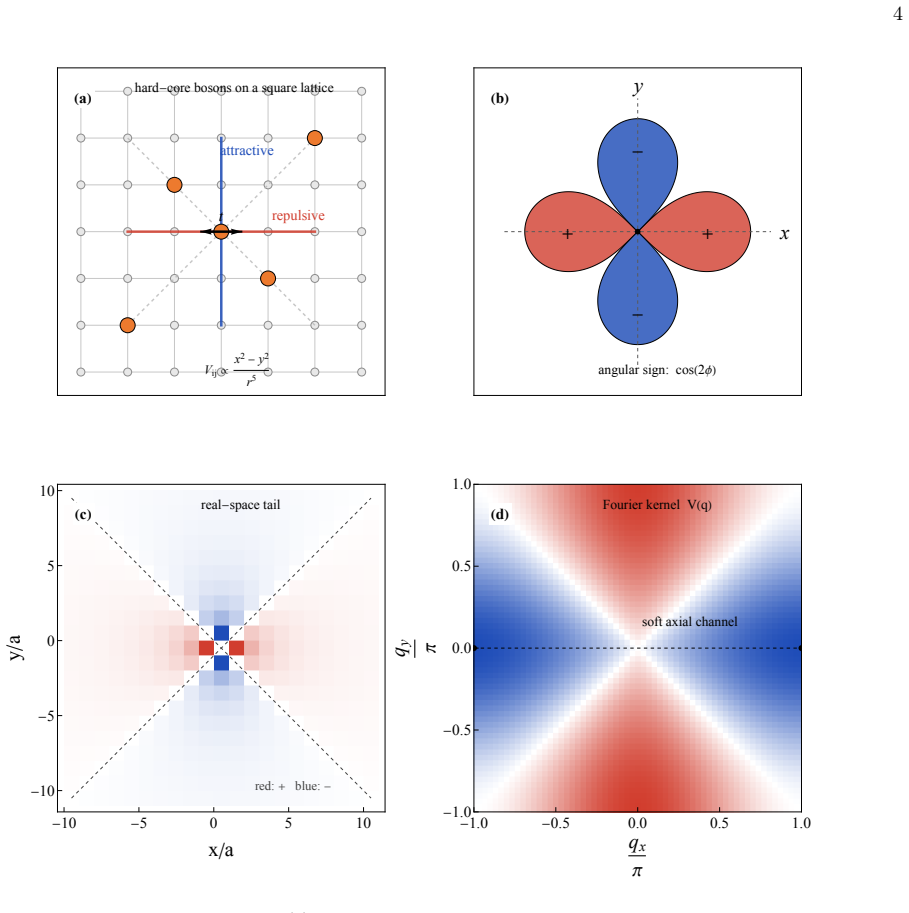
The sign-changing non-axisymmetric dipolar tail V(r) that is repulsive along one lattice axis and attractive along the perpendicular axis, which breaks rotational symmetry and selects the axial stripe family.
If this is right
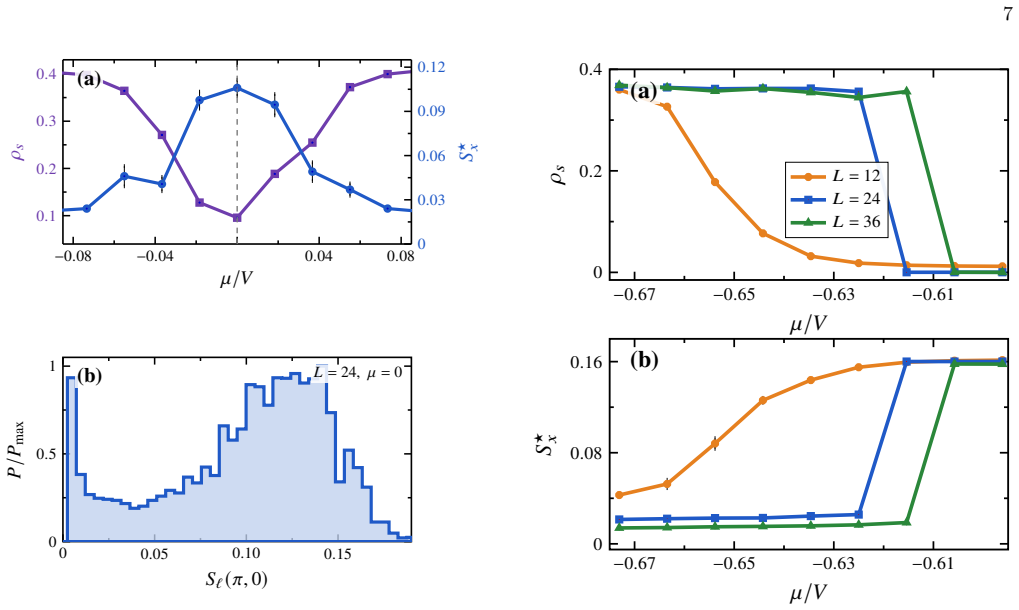
- The stripe lobe terminates via first-order switching between superfluid and solid sectors, visible in measurement-resolved structure-factor histograms rather than averaged observables.
- Near lobe closure, averaged signals can appear supersolid-like while the underlying state switches between phases.
- NaCs molecules with modest effective dipole moments reach the t/V window where the stripe family is stable.
Where Pith is reading between the lines
- The same geometry-engineering principle could be applied to other lattice symmetries or interaction forms to stabilize different families of ordered states.
- Direct measurement of the filling-dependent shift in the leading wavevector would provide a clear experimental signature of the family character.
- The observed superfluid anisotropy suggests a route to directionally controlled transport without explicit lattice anisotropy.
Load-bearing premise
The low-energy physics of the dressed molecules is faithfully captured by the hard-core Bose lattice model with the given dipolar tail.
What would settle it
If the ordering wavevector remains fixed at a single commensurate value independent of filling, or if the superfluid phase shows no directional stiffness anisotropy, the central claim would be falsified.
Figures
read the original abstract
Microwave-dressed polar molecules offer a route to lattice quantum simulators in which the angular form of long-range dipolar interactions, not only their overall strength, can be engineered. We study this setting in a minimal hard-core Bose lattice model on a square optical lattice, with particles interacting through a sign-changing non-axisymmetric dipolar tail \mathcal V(\mathbf r)\propto (x^2-y^2)/(x^2+y^2)^{5/2} that is repulsive along one lattice axis and attractive along the other. Using worm-algorithm path-integral quantum Monte Carlo simulations, supported by a hard-core spin mapping and a Gutzwiller soft-mode diagnostic, we find two regimes controlled by t/V: at larger t/V the system remains superfluid but develops a pronounced directional stiffness anisotropy, while at smaller t/V it forms a stripe solid selected in the (q,0) axial family, corresponding to real-space stripes parallel to y. The leading ordering wave vector remains in this axial family but reorganizes with filling, showing that the robust ordered object is a family of stripe states rather than one fixed commensurate Bragg peak. Near the closure of the stripe lobe, averaged observables can mimic a narrow supersolid signal; measurement-resolved stripe structure-factor histograms instead reveal first-order switching between superfluid and stripe-solid sectors. NaCs lattice estimates place the relevant V/t window within reach of modest effective dressed dipole moments, linking the predicted stripe-family order and its experimental diagnostics to accessible molecular quantum-simulation scales.
Editorial analysis
A structured set of objections, weighed in public.
Referee Report
Summary. The manuscript examines a minimal hard-core Bose-Hubbard model on the square lattice with a sign-changing, non-axisymmetric dipolar interaction V(r) ∝ (x² - y²)/(r²)^{5/2}. Worm-algorithm path-integral QMC simulations, supplemented by a hard-core spin mapping and Gutzwiller soft-mode analysis, identify a superfluid regime with pronounced stiffness anisotropy at larger t/V and, at smaller t/V, a stripe-solid phase belonging to the axial (q,0) family. The leading ordering wave-vector reorganizes with filling, establishing that the robust ordered object is a family of stripe states rather than a single fixed commensurate Bragg peak. Structure-factor histograms reveal first-order switching near the lobe closure, and NaCs estimates indicate the relevant V/t window is experimentally accessible.
Significance. If the central mapping and numerical diagnostics hold, the work shows that angular engineering of dipolar tails can select a reorganizing family of stripe solids rather than a unique wave-vector, providing a concrete, programmable route to stripe order in molecular quantum simulators. The histogram-based distinction between true supersolid signals and first-order switching between sectors is a useful methodological advance. The parameter-free character of the interaction geometry (controlled solely by t/V) and the direct link to accessible dressed-dipole strengths strengthen the result's relevance to ongoing experiments.
major comments (2)
- [§4 (QMC results and diagnostics)] The central claim that the ordered state is a reorganizing axial-stripe family (rather than a fixed Bragg peak) rests on the structure-factor histograms and wave-vector evolution with filling. However, the manuscript must specify the lattice sizes, interaction cutoffs, and finite-size scaling procedure used to construct S(q) and the histograms; without these, it is impossible to confirm that the reorganization is not a finite-size artifact or that the first-order switching is robustly resolved.
- [§2 (model definition) and §6 (experimental estimates)] The effective Hamiltonian is taken to be exactly the hard-core bosons with the stated V(r). The experimental relevance section therefore requires an explicit discussion of possible corrections arising from finite dressed-dipole moments, off-resonant couplings, or lattice-induced terms; any such term that modifies the anisotropy balance would alter the stripe-family selection and could pin the ordering vector, directly affecting the claim that the minimal model captures the low-energy physics.
minor comments (2)
- [Abstract] The abstract states that 'averaged observables can mimic a narrow supersolid signal'; a brief clarification of which observables are averaged and how the mimicry is quantified would improve readability.
- [§2] Notation for the dipolar tail is given in the abstract but would benefit from an explicit equation label and a real-space plot of the sign-changing lobes when first introduced.
Simulated Author's Rebuttal
We thank the referee for the positive assessment of the work and for the constructive comments. We address each major point below, providing the requested technical details and expanding the experimental discussion. Revisions have been made to incorporate these clarifications.
read point-by-point responses
-
Referee: The central claim that the ordered state is a reorganizing axial-stripe family (rather than a fixed Bragg peak) rests on the structure-factor histograms and wave-vector evolution with filling. However, the manuscript must specify the lattice sizes, interaction cutoffs, and finite-size scaling procedure used to construct S(q) and the histograms; without these, it is impossible to confirm that the reorganization is not a finite-size artifact or that the first-order switching is robustly resolved.
Authors: We agree that these numerical details are essential for validating the claims. In the revised manuscript, §4 now includes an explicit subsection on simulation parameters and diagnostics. We used square lattices with linear sizes L=8,12,16,20,24 under periodic boundaries. The dipolar tail was truncated at a cutoff of 5 lattice spacings (verified to yield identical ordering for a 7-spacing cutoff). Finite-size scaling of the structure-factor peak height was performed via extrapolation of S(q_max)/L² versus 1/L, confirming that the leading wave vector remains within the axial family in the thermodynamic limit. Histograms were accumulated from >10⁵ independent samples per density point; the bimodal character signaling first-order switching persists across all L studied and is not an artifact of small systems. revision: yes
-
Referee: The effective Hamiltonian is taken to be exactly the hard-core bosons with the stated V(r). The experimental relevance section therefore requires an explicit discussion of possible corrections arising from finite dressed-dipole moments, off-resonant couplings, or lattice-induced terms; any such term that modifies the anisotropy balance would alter the stripe-family selection and could pin the ordering vector, directly affecting the claim that the minimal model captures the low-energy physics.
Authors: We concur that potential corrections must be quantified. The revised §6 now contains a dedicated paragraph estimating these effects for NaCs parameters. Finite dressed-dipole moments introduce small axisymmetric corrections whose relative strength is <5% of the leading (x²-y²) anisotropy at the modest dressing strengths (V/t≈5–10) considered; off-resonant couplings and higher-band lattice terms are estimated to be even smaller and do not shift the ordering vector outside the axial family. We explicitly note that stronger dressing would require inclusion of these terms, but within the experimentally accessible window the minimal model remains a faithful description of the low-energy physics. revision: yes
Circularity Check
No circularity: direct numerical simulation of explicit Hamiltonian
full rationale
The paper reports worm-algorithm QMC simulations of a minimal hard-core Bose lattice model with the stated sign-changing dipolar interaction V(r) on the square lattice, using t/V as an explicit control parameter. Phases and ordering vectors are diagnosed via standard structure-factor histograms and Gutzwiller soft-mode analysis. No parameter is fitted to a data subset and then relabeled as a prediction, no load-bearing premise reduces to a self-citation, and no ansatz or uniqueness claim is imported from prior author work. The derivation chain consists of direct computation of observables from the model Hamiltonian; results are therefore independent of the inputs by construction.
Axiom & Free-Parameter Ledger
free parameters (1)
- t/V
axioms (2)
- domain assumption The low-energy physics of microwave-dressed polar molecules on a square optical lattice is captured by the hard-core Bose lattice model with interaction V(r) proportional to (x^2 - y^2)/(x^2 + y^2)^{5/2}
- domain assumption Worm-algorithm path-integral quantum Monte Carlo and the Gutzwiller soft-mode diagnostic correctly identify superfluid, stripe-solid, and first-order switching regimes
Reference graph
Works this paper leans on
-
[1]
The numerical scale used below is tied to the concrete dressing parameters re- ported in the NaCs droplet experiment of Ref
+C 3,2 sin2 θcos 2ϕ] +· · ·, which maps in thexyplane toD 0 =−C 3,0 andD 2 =C 3,2. The numerical scale used below is tied to the concrete dressing parameters re- ported in the NaCs droplet experiment of Ref. [12]. That experiment used two microwave components: a linearly polarizedπfield alongz, coupling mainly to the|1,0⟩ rotational state, and an elliptic...
-
[2]
Micheli, G
A. Micheli, G. K. Brennen, and P. Zoller, A toolbox for lattice-spin models with polar molecules, Nat. Phys.2, 341 (2006)
2006
-
[3]
A.V.Gorshkov, P.Rabl, G.Pupillo, A.Micheli, P.Zoller, M. D. Lukin, and H. P. Büchler, Suppression of inelastic collisions between polar molecules with a repulsive shield, Phys. Rev. Lett.101, 073201 (2008)
2008
-
[4]
Karman and J
T. Karman and J. M. Hutson, Microwave shielding of ultracold polar molecules, Phys. Rev. Lett.121, 163401 (2018)
2018
-
[5]
Anderegg, S
L. Anderegg, S. Burchesky, Y. Bao, S. S. Yu, T. Karman, E. Chae, K.-K. Ni, W. Ketterle, and J. M. Doyle, Ob- servation of microwave shielding of ultracold molecules, Science373, 779 (2021)
2021
-
[6]
Schindewolf, R
A. Schindewolf, R. Bause, X.-Y. Chen, M. Duda, T. Kar- man, I. Bloch, and X.-Y. Luo, Evaporation of microwave- shielded polar molecules to quantum degeneracy, Nature 607, 677 (2022)
2022
-
[7]
J. Lin, G. Chen, M. Jin, Z. Shi, F. Deng, W. Zhang, G. Quéméner, T. Shi, S. Yi, and D. Wang, Microwave shielding of bosonic NaRb molecules, Phys. Rev. X13, 031032 (2023)
2023
-
[8]
Bigagli, C
N. Bigagli, C. Warner, W. Yuan, S. Zhang, I. Steven- son, T. Karman, and S. Will, Collisionally stable gas of bosonic dipolar ground-state molecules, Nat. Phys.19, 1579 (2023)
2023
-
[9]
Bigagli, W
N. Bigagli, W. Yuan, S. Zhang, B. Bulatovic, T. Kar- man, I. Stevenson, and S. Will, Observation of bose– einstein condensation of dipolar molecules, Nature631, 289 (2024)
2024
-
[10]
Karman, N
T. Karman, N. Bigagli, W. Yuan, S. Zhang, I. Stevenson, and S. Will, Double microwave shielding, PRX Quantum 6, 020358 (2025)
2025
-
[11]
Zhang, K
W. Zhang, K. Chen, S. Yi, and T. Shi, Quantum phases for finite-temperature gases of bosonic polar molecules shielded by dual microwaves, PRX Quantum6, 040307 (2025)
2025
-
[12]
W.-J. Jin, F. Deng, S. Yi, and T. Shi, Bose–einstein condensatesofmicrowave-shieldedpolarmolecules,Phys. Rev. Lett.134, 233003 (2025)
2025
-
[13]
Zhang, W
S. Zhang, W. Yuan, N. Bigagli, H. Kwak, T. Karman, I. Stevenson, and S. Will, Observation of self-bound 13 droplets of ultracold dipolar molecules, Nature651, 601 (2026)
2026
-
[14]
Bloch, J
I. Bloch, J. Dalibard, and W. Zwerger, Many-body physics with ultracold gases, Rev. Mod. Phys.80, 885 (2008)
2008
-
[15]
M. A. Baranov, Theoretical progress in many-body physics with ultracold dipolar gases, Phys. Rep.464, 71 (2008)
2008
-
[16]
Lahaye, C
T. Lahaye, C. Menotti, L. Santos, M. Lewenstein, and T. Pfau, The physics of dipolar bosonic quantum gases, Rep. Prog. Phys.72, 126401 (2009)
2009
-
[17]
K.Góral, L.Santos,andM.Lewenstein,Quantumphases of dipolar bosons in optical lattices, Phys. Rev. Lett.88, 170406 (2002)
2002
-
[18]
Capogrosso-Sansone, C
B. Capogrosso-Sansone, C. Trefzger, M. Lewenstein, P. Zoller, and G. Pupillo, Quantum phases of cold polar molecules in 2D optical lattices, Phys. Rev. Lett.104, 125301 (2010)
2010
-
[19]
Pollet, J
L. Pollet, J. D. Picon, H. P. Büchler, and M. Troyer, Su- persolid phase with cold polar molecules on a triangular lattice, Phys. Rev. Lett.104, 125302 (2010)
2010
-
[20]
Trefzger, C
C. Trefzger, C. Menotti, B. Capogrosso-Sansone, and M. Lewenstein, Ultracold dipolar gases in optical lattices, J. Phys. B: At. Mol. Opt. Phys.44, 193001 (2011)
2011
-
[21]
Zhang, A
C. Zhang, A. Safavi-Naini, A. M. Rey, and B. Capogrosso-Sansone, Equilibrium phases of tilted dipolar lattice bosons, New J. Phys.17, 123014 (2015)
2015
-
[22]
Menotti, C
C. Menotti, C. Trefzger, and M. Lewenstein, Metastable states of a gas of dipolar bosons in a 2D optical lattice, Phys. Rev. Lett.98, 235301 (2007)
2007
-
[23]
H. P. Büchler, E. Demler, M. Lukin, A. Micheli, N. Prokof’ev, G. Pupillo, and P. Zoller, Strongly cor- related 2D quantum phases with cold polar molecules: Controlling the shape of the interaction potential, Phys. Rev. Lett.98, 060404 (2007)
2007
-
[24]
Danshita and C
I. Danshita and C. A. R. Sá de Melo, Stability of super- fluid and supersolid phases of dipolar bosons in optical lattices, Phys. Rev. Lett.103, 225301 (2009)
2009
-
[25]
Bandyopadhyay, R
S. Bandyopadhyay, R. Bai, S. Pal, K. Suthar, R. Nath, andD.Angom,Quantumphasesofcanteddipolarbosons in a two-dimensional square optical lattice, Phys. Rev. A 100, 053623 (2019)
2019
-
[26]
Micheli, G
A. Micheli, G. Pupillo, H. P. Büchler, and P. Zoller, Cold polar molecules in two-dimensional traps: Tailoring in- teractions with external fields for novel quantum phases, Phys. Rev. A76, 043604 (2007)
2007
-
[27]
Zhang and B
C. Zhang and B. Capogrosso-Sansone, Quantum monte carlo study of the long-range site-diluted XXZ model as realized by polar molecules, Phys. Rev. A98, 013621 (2018)
2018
-
[28]
A. N. Aleksandrova, I. L. Kurbakov, A. K. Fedorov, and Y. E. Lozovik, Density-wave-type supersolid of two- dimensional tilted dipolar bosons, Phys. Rev. A109, 063326 (2024)
2024
-
[29]
C.Zhang, J.Zhang, J.Yang,andB.Capogrosso-Sansone, Ground states of two-dimensional tilted dipolar bosons with density-induced hopping, Phys. Rev. A103, 043333 (2021)
2021
-
[30]
Macia, J
A. Macia, J. Boronat, and F. Mazzanti, Phase diagram of dipolar bosons in two dimensions with tilted polarization, Phys. Rev. A90, 061601 (2014)
2014
-
[31]
J.Zhang, C.Zhang, J.Yang,andB.Capogrosso-Sansone, Supersolid phases of lattice dipoles tilted in three dimen- sions, Phys. Rev. A105, 063302 (2022)
2022
-
[32]
Zhang, A
C. Zhang, A. Safavi-Naini, and B. Capogrosso-Sansone, Equilibrium phases of dipolar lattice bosons in the pres- ence of random diagonal disorder, Phys. Rev. A97, 013615 (2018)
2018
-
[33]
F. Deng, X. Hu, W.-J. Jin, S. Yi, and T. Shi, Two- and many-bodyphysicsofultracoldmoleculesdressedbydual microwave fields, Nat. Commun.16, 11219 (2025)
2025
-
[34]
Quéméner, and J
K.Matsuda, L.DeMarco, J.-R.Li, W.G.Tobias, G.Val- tolina, G. Quéméner, and J. Ye, Resonant collisional shielding of reactive molecules using electric fields, Sci- ence370, 1324 (2020)
2020
-
[35]
Mukherjee and J
B. Mukherjee and J. M. Hutson, Controlling collisional loss and scattering lengths of ultracold dipolar molecules with static electric fields, Phys. Rev. Research6, 013145 (2024)
2024
-
[36]
Dutta, B
J. Dutta, B. Mukherjee, and J. M. Hutson, Universality in the microwave shielding of ultracold polar molecules, Phys. Rev. Research7, 023164 (2025)
2025
-
[37]
Stevenson, A
I. Stevenson, A. Z. Lam, N. Bigagli, C. Warner, W. Yuan, S. Zhang, and S. Will, Ultracold gas of dipolar NaCs ground state molecules, Phys. Rev. Lett.130, 113002 (2023)
2023
-
[38]
Zhang, W
S. Zhang, W. Yuan, N. Bigagli, C. Warner, I. Stevenson, and S. Will, Dressed-state spectroscopy and magic trap- ping of microwave-shielded NaCs molecules, Phys. Rev. Lett.133, 263401 (2024)
2024
-
[39]
Stevenson, S
I. Stevenson, S. Singh, A. Elkamshishy, N. Bigagli, W. Yuan, S. Zhang, C. H. Greene, and S. Will, Three- body recombination of ultracold microwave-shielded po- lar molecules, Phys. Rev. Lett.133, 263402 (2024)
2024
-
[40]
X.-Y. Chen, A. Schindewolf, S. Eppelt, R. Bause, M. Duda, S. Biswas, T. Karman, T. A. Hilker, I. Bloch, and X.-Y. Luo, Field-linked resonances of polar molecules, Nature614, 59 (2023)
2023
-
[41]
X.-Y. Chen, S. Biswas, S. Eppelt, A. Schindewolf, F. Deng, T. Shi, S. Yi, T. A. Hilker, I. Bloch, and X.-Y. Luo, Ultracold field-linked tetratomic molecules, Nature 626, 283 (2024)
2024
-
[42]
Macia, D
A. Macia, D. Hufnagl, F. Mazzanti, J. Boronat, and R. E. Zillich, Excitations and stripe phase formation in a 2D dipolar bose gas with tilted polarization, Phys. Rev. Lett. 109, 235307 (2012)
2012
-
[43]
Z.-K.Lu, Y.Li, D.S.Petrov,andG.V.Shlyapnikov,Sta- ble dilute supersolid of two-dimensional dipolar bosons, Phys. Rev. Lett.115, 075303 (2015)
2015
-
[44]
Bombin, J
R. Bombin, J. Boronat, and F. Mazzanti, Dipolar bose supersolid stripes, Phys. Rev. Lett.119, 250402 (2017)
2017
-
[45]
M. A. Norcia, C. Politi, L. Klaus, E. Poli, M. Sohmen, M. J. Mark, R. N. Bisset, L. Santos, and F. Ferlaino, Two-dimensional supersolidity in a dipolar quantum gas, Nature596, 357 (2021)
2021
-
[46]
Bland, E
T. Bland, E. Poli, C. Politi, L. Klaus, M. A. Norcia, F. Ferlaino, L. Santos, and R. N. Bisset, Two-dimensional supersolid formation in dipolar condensates, Phys. Rev. Lett.128, 195302 (2022)
2022
-
[47]
Klaus, T
L. Klaus, T. Bland, E. Poli, C. Politi, G. Lamporesi, E. Casotti, R. N. Bisset, M. J. Mark, and F. Ferlaino, Observation of vortices and vortex stripes in a dipolar condensate, Nat. Phys.18, 1453 (2022)
2022
-
[48]
Recati and S
A. Recati and S. Stringari, Supersolidity in ultracold dipolar gases, Nat. Rev. Phys.5, 735 (2023)
2023
-
[49]
Casotti, E
E. Casotti, E. Poli, L. Klaus, A. Litvinov, C. Ulm, C. Politi, M. J. Mark, T. Bland, and F. Ferlaino, Ob- servation of vortices in a dipolar supersolid, Nature635, 14 327 (2024)
2024
-
[50]
Schmidt, L
M. Schmidt, L. Lassablière, G. Quéméner, and T. Lan- gen, Self-bound dipolar droplets and supersolids in molecular bose–einstein condensates, Phys. Rev. Re- search4, 013235 (2022)
2022
-
[51]
Langen, J
T. Langen, J. Boronat, J. Sánchez-Baena, R. Bom- bín, T. Karman, and F. Mazzanti, Dipolar droplets of strongly interacting molecules, Phys. Rev. Lett.134, 053001 (2025)
2025
-
[52]
Ciardi, K
M. Ciardi, K. R. Pedersen, T. Langen, and T. Pohl, Self- bound superfluid membranes and monolayer crystals of ultracold polar molecules, Phys. Rev. Lett.135, 153401 (2025)
2025
-
[53]
Hebib, C
Y. Hebib, C. Zhang, J. Yang, and B. Capogrosso- Sansone, Quantum phases of lattice dipolar bosons cou- pled to a high-finesse cavity, Phys. Rev. A107, 043318 (2023)
2023
-
[54]
Hebib, C
Y. Hebib, C. Zhang, M. Boninsegni, and B. Capogrosso- Sansone, Thermocrystallization of lattice dipolar bosons coupled to a high-finesse cavity, Phys. Rev. B109, 174515 (2024)
2024
-
[55]
N. V. Prokof’ev, B. V. Svistunov, and I. S. Tupitsyn, “worm” algorithm in quantum monte carlo simulations, Phys. Lett. A238, 253 (1998)
1998
-
[56]
N. V. Prokof’ev, B. V. Svistunov, and I. S. Tupitsyn, Exact, complete, and universal continuous-time world- line monte carlo approach to the statistics of discrete quantum systems, J. Exp. Theor. Phys.87, 310 (1998)
1998
- [57]
-
[58]
E. L. Pollock and D. M. Ceperley, Path-integral com- putation of superfluid densities, Phys. Rev. B36, 8343 (1987)
1987
-
[59]
L. Su, A. Douglas, M. Szurek, R. Groth, S. F. Ozturk, A. Krahn, A. H. Hébert, G. A. Phelps, S. Ebadi, S. Dick- erson, F. Ferlaino, O. Marković, and M. Greiner, Dipolar quantum solids emerging in a hubbard quantum simula- tor, Nature622, 724 (2023)
2023
-
[60]
Greiner, O
M. Greiner, O. Mandel, T. Esslinger, T. W. Hänsch, and I. Bloch, Quantum phase transition from a superfluid to a mott insulator in a gas of ultracold atoms, Nature415, 39 (2002)
2002
-
[61]
Santra, C
B. Santra, C. Baals, R. Labouvie, A. B. Bhattacherjee, A. Pelster, and H. Ott, Measuring finite-range phase co- herence in an optical lattice using talbot interferometry, Nat. Commun.8, 15601 (2017)
2017
-
[62]
J. Tao, M. Zhao, and I. B. Spielman, Observation of anisotropic superfluid density in an artificial crystal, Phys. Rev. Lett.131, 163401 (2023)
2023
discussion (0)
Sign in with ORCID, Apple, or X to comment. Anyone can read and Pith papers without signing in.