REVIEW 3 major objections 5 minor 9 references
Entropy-Based Dynamic Programming for Efficient Vehicle Parking
T0 review · 3 major / 5 minor · reviewed 2026-08-12 · deepseek-v4-flash
Pith's one-line read A single fitted temperature predicts how parking spots are distributed through a garage, and a dynamic-programming policy using that prediction cuts expected parking time.
desk verdict A fresh single-parameter parking model that unfortunately rests on an invalid probability formula and a circular simulation, so the central claim doesn't hold as written. read the letter →
The pith
A machine-rendered reading of the paper's core claim, the machinery that carries it, and where it could break.
The reading
What carries the argument
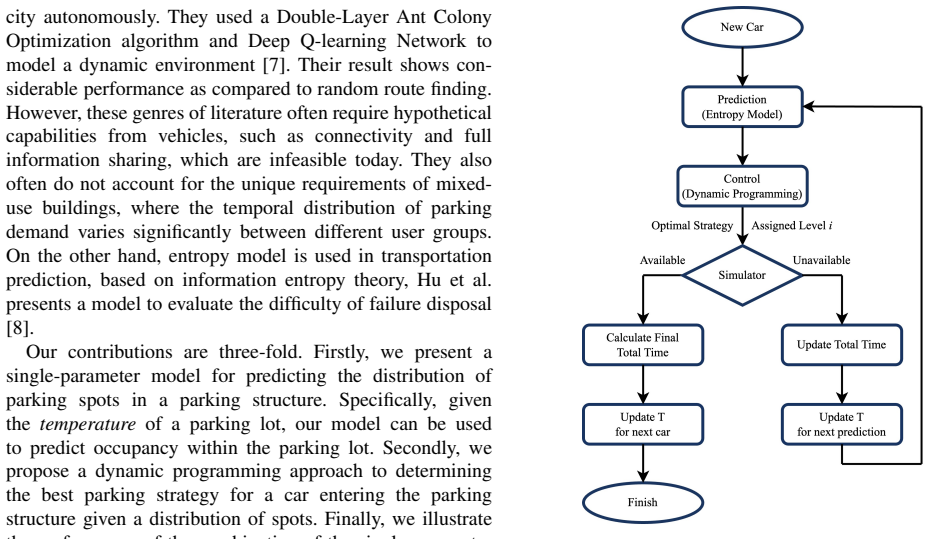
The key object is the single-parameter entropy model, in which each spot's energy is proportional to the square of its normalized distance to the point of interest and the temperature $T$ encodes how busy the garage is; the occupancy probability formula from the canonical ensemble turns that energy and temperature into a predicted fill rate for every spot. The second piece is the dynamic-programming recursion for $f(i)$ and the resulting floor-selection rule $u(i)$, which converts the predicted distribution into an explicit parking decision for a car at floor $i$. Together they let a system update its temperature estimate from a small sample of observed spots, re-run the recursion, and direct each car to the floor that minimizes expected time to park and return to the entrance.
What would settle it
Record the occupied or empty status of every spot in a real multi-story garage along with each spot's distance to the main entrance, then fit the single-temperature entropy curve to a time window that includes a rush-hour surge; if the best-fit curve has error far above the 0.173 MSE reported here, or if the fitted temperature changes so quickly that one value cannot describe the garage at that moment, the central claim is contradicted.
Extended reading notes
Core claim
The central claim is that a parking garage behaves like a canonical ensemble: the probability that spot $i$ is occupied is $p(i) = \frac{2e^{E(i)/k_B T}}{1+e^{E(i)/k_B T}}$, with $E(i)$ taken as the squared normalized distance from the spot to the single point of interest and with temperature $T$ as the only fitted parameter. Fitting $T$ by minimizing mean squared error on ten real parking lots gives an aggregate MSE of $0.173$, and about ten observations from a 105-spot lot already produce a good estimate of the whole distribution. The paper then treats floor choice as a Markov decision process, defines $f(i)$ as the minimum expected total time starting from floor $i$, and computes $f(i)=p_i(t_1+it_2)+(1-p_i)(t_1+\min_{j>i}((j-i)t_3+f(j)))$, with control $u(i)=\operatorname{arg\,min}_{j>i}[(j-i)t_3+f(j)]$. Feeding the entropy-model probabilities into this recursion yields TIPP, which in simulation outperforms Benchmark and Inverse policies at medium and high occupancy.
Load-bearing premise
The load-bearing premise is that a parking garage is in thermal equilibrium, meaning the average inflow of cars equals the average outflow, so that a single temperature can determine the entire occupancy distribution; if real garages spend long periods in rush-hour imbalance, this premise fails and the entropy model loses its foundation.
Editorial extensions
If this is right
- A garage operator could predict the full occupancy distribution from as few as ten observed spots, with the fitted temperature carrying all the information.
- Because the model needs only distance-to-entrance and a small sample, it offers a low-cost alternative to sensor-heavy full-information parking systems and avoids sharing vehicle-level data.
- Under TIPP, the recommended floor shifts as the chosen floor fills up; the paper interprets the resulting fluctuations as the policy correcting its own temperature estimate.
- At low occupancy the simple Benchmark policy is competitive, but TIPP's advantage grows as the garage becomes congested, exactly when parking decisions matter most.
Reading between the lines
- If the equilibrium assumption is the fragile link, a natural stress test is to apply the model to a garage with known rush-hour surges; one would expect the single-temperature fit to degrade exactly when inflow exceeds outflow, suggesting a two-temperature or time-varying extension.
- The dynamic-programming layer is agnostic to how the $p_i$ are obtained, so any better occupancy predictor could be swapped in without changing the control recursion.
- The sample-efficiency result suggests an active-sampling rule: instead of observing fixed spots, choose the few spots whose occupancy is most informative about $T$; the model makes that question well-posed.
- With multiple entrances or points of interest, the paper's proposed additive energy extension is directly testable in the same simulation framework.
Editorial analysis
A structured set of objections, weighed in public.
Referee Report
Summary. The manuscript proposes a single-parameter 'temperature' model for the occupancy distribution of spots in a multi-story parking garage, with the occupancy probability of a spot of energy E claimed to be given by Eq. (1). Based on these probabilities, it formulates a dynamic-programming policy (TIPP) that chooses which lower floor to visit next, and compares TIPP with Benchmark, Inverse, and Optimal policies in a simulated 10-level garage with 30 spots per level at temperature 0.5. The paper also reports an in-sample MSE of 0.173 for the entropy-model fit on ten real parking lots, and concludes that the model is accurate, sample-efficient, and suitable for real-time parking assignment.
Significance. The dynamic-programming component is a genuine and clearly stated contribution: given reliable occupancy probabilities, the recursion in Eqs. (5)-(6) defines a sensible, implementable policy, and the simulation protocol is transparent. The paper also has the virtue of explicitly acknowledging that TIPP does not beat the optimal policy on average. However, the central model equation is mathematically invalid as printed, the reported fit is in-sample and of poor quality, and the simulation validates the policy only under the same model that generated the data. These issues are load-bearing for the paper's main claims, so the manuscript cannot be accepted in its current form.
major comments (3)
- [Section III, Eq. (1)] Equation (1) is not a valid probability for any positive energy E(i). Since E(i)>0 throughout the paper (E is proportional to squared distance in Section III and E(i)=(i/N)^2 in Section V), the argument x=exp(E/k_B T) exceeds 1, and p(i)=2x/(1+x) lies strictly between 1 and 2, approaching 2 as T approaches 0. This contradicts the text's claim that 'at low temperatures, states will have a low probability of being occupied.' Because Eq. (1) is the only source of the probabilities p_i used in the dynamic-programming recursion Eq. (5), the policy's inputs are not well-defined. A corrected Boltzmann factor of the form p ∝ exp(-E/k_B T) would restore probabilities in [0,1], but then all fits, figures, and simulation temperatures would need to be redone.
- [Section III, Figure 2] The validation reported for the entropy model is not predictive. The temperature for each lot is obtained by minimizing the MSE of the same entropy model on that lot using gradient descent, and the energy-distance relation E ∝ d^2 was itself selected as the best fit on the same data. Reporting the pooled in-sample MSE of 0.173 as 'excellent' is unsupported: on 0-1 fill-rate data, this corresponds to a root-mean-square error of roughly 0.42. No held-out data, cross-validation, or uncertainty estimates are provided, so the claim that the model is an accurate representation of parking-spot occupancy is not established.
- [Section V, simulation setup] The simulation cannot validate the entropy-based prediction. The garage occupancy is generated from Eq. (1) at a temperature of 0.5, and TIPP's prediction component uses exactly the same model with a fitted temperature. Thus the experiments show only that, conditional on the entropy model being correct, the dynamic-programming policy is useful; they provide no evidence that Eq. (1) predicts real parking occupancy. This circularity, combined with the invalid Eq. (1), means the central claim that a single temperature parameter can predict parking-lot occupancy is unsupported.
minor comments (5)
- [Section V] The time parameters t1, t2, and t3 are introduced in Section II but no numerical values or units are given in Section V; the y-axis of Figure 5 is therefore in unspecified units, and the simulation is not reproducible as described.
- [Sections II and IV] The symbol T is used for both temperature and total parking time (Eq. (2)), and the state space is written as S = {i, T}, which conflates a parameter with a state variable.
- [Section III] The model is called an 'entropy model,' but Eq. (1) is a canonical-ensemble occupation probability; no entropy is computed or modeled, so the terminology is misleading.
- [Section III, Figure 3] The sample-efficiency result is presented as a single curve without error bars or multiple lots, so the claim that 'very few observations are necessary' is not statistically supported.
- [References] Reference [4] is malformed, and several references lack complete bibliographic details, which should be corrected.
Circularity Check
In-sample fit is presented as prediction, and the simulation is generated by the very entropy model TIPP uses, making the central validation loop circular.
-
fitted input called prediction
[Section III, 'Prediction - Entropy Model'; temperature-fitting paragraph and Figure 2]
"The temperature of the parking lot was then determined by minimizing the mean squared error (MSE) of the Entropy Model using gradient descent. ... We observe that the Entropy Model has an excellent fit to the data. Indeed, the calculated MSE over the entire dataset is 0.173."
The only model parameter, temperature, is chosen per parking lot by minimizing the same MSE that is then quoted as evidence of an 'excellent fit.' The 'predicted' fill-rate curve in Figure 2 is the fitted curve, so the reported accuracy is the training loss of the fit rather than an out-of-sample prediction. This is a textbook fitted-input-called-prediction pattern: a parameter fitted to data is renamed a prediction and then used to justify the model. The paper's sample-efficiency experiment (fitting on a subset and evaluating on the full lot) provides a partially independent check, but the central 'excellent fit' claim is in-sample.
-
self definitional
[Section V, 'Experiments'; simulation setup and TIPP update rule]
"We simulate a parking lot environment at a fixed temperature of 0.5, which determines the occupancy of each level based on the probabilities derived from Eq. 1. ... At each floor visit, we update the values of the probabilities pi using the method described in section III, run the dynamic program described in equations 5 and 6."
The simulated garage's occupancy is generated from Eq. 1 with T = 0.5, and TIPP's probability estimates are obtained by fitting the same entropy model to observations drawn from that simulation. The data generator and the predictor are therefore the same equation, so the policy comparison is conducted entirely inside the model's own world. TIPP's superiority over the heuristic policies is the expected consequence of solving an exact DP on the MDP defined by that same generator, rather than an external test of the entropy model or of TIPP's real-world predictive value. The experiment cannot falsify the model and provides no independent evidence for the central claim.
full rationale
Two concrete reductions make the paper's validation loop circular. First, in Section III the temperature is fitted by gradient descent on each lot, and the resulting in-sample MSE (0.173) is presented as the model's 'excellent fit' and as evidence that the entropy model is an accurate representation. This is a fitted parameter renamed as a prediction; the reported accuracy is the objective function used to fit the model. Second, in Section V the simulated garage is generated from Eq. 1 at T=0.5, while TIPP obtains its occupancy probabilities from the same entropy model fit to observations of that simulation. The predictor and the environment generator coincide by construction, so the policy comparison is a closed-loop demonstration inside the model's assumptions. The DP recursion itself is standard and not circular, and the sample-efficiency experiment in Section III offers a limited out-of-sample check, so the paper is not completely circular. Nevertheless, the central predictive claim and the simulated policy superiority both reduce, in part, to the paper's own construction rather than to independent evidence, warranting a score of 6.
Assumptions & free parameters
free parameters (4)
- Temperature T =
not reported
- Energy-distance exponent =
2
- Time costs t1, t2, t3 =
not reported
- Simulation temperatures =
0.1, 0.5, 1.0
assumptions (6)
- domain assumption The parking lot is in thermal equilibrium with a heat bath, meaning average inflow equals average outflow.
- domain assumption The desirability of each parking spot can be described by a scalar quantity analogous to energy.
- ad hoc to paper The energy of a spot is proportional to the square of its normalized distance to a single point of interest.
- domain assumption Vehicles can only move downward between adjacent floors, and passengers walk upward on foot.
- domain assumption Floor occupancies are independent Bernoulli trials with probabilities p_i.
- ad hoc to paper The canonical ensemble occupancy formula, Eq. 1, is valid for parking spots.
Cite this review
Pith. "Pith review of Entropy-Based Dynamic Programming for Efficient Vehicle Parking." pith.science (2026). https://pith.science/paper/VMPMF2ZG
@misc{pith2026241117014,
  author       = {Pith},
  title        = {Pith review of: Entropy-Based Dynamic Programming for Efficient Vehicle Parking},
  year         = {2026},
  howpublished = {\url{https://pith.science/paper/VMPMF2ZG}},
  note         = {Machine review of arXiv:2411.17014}
}
read the original abstract
In urban environments, parking has proven to be a significant source of congestion and inefficiency. In this study, we propose a methodology that offers a systematic solution to minimize the time spent by drivers in finding parking spaces. Drawing inspiration from statistical mechanics, we utilize an entropy model to predict the distribution of available parking spots across different levels of a multi-story parking garage, encoded by a single parameter: temperature. Building on this model, we develop a dynamic programming framework that guides vehicles to the optimal floor based on the predicted occupancy distribution. This approach culminates in our Temperature-Informed Parking Policy (TIPP), which not only predicts parking spot availability but also dynamically adjusts parking assignments in real-time to optimize vehicle placement and reduce search times. We compare TIPP with simpler policies and the theoretical optimal solution to demonstrate its effectiveness and gauge how closely it approaches the ideal parking strategy. The results highlight the potential of integrating TIPP in real-world applications, paving the way for smarter, more efficient urban landscapes.
Figures


Figures from the paper (2 more)


Reference graph
Works this paper leans on
-
[1]
The impact of parking pain in the us, uk and germany car,
G. Cookson and B. Pishue, “The impact of parking pain in the us, uk and germany car,” Tech. Rep., 2017
work page 2017
-
[2]
Parking slot assignment games,
D. Ayala, O. Wolfson, B. Xu, B. Dasgupta, and J. Lin, “Parking slot assignment games,” in Proceedings of the 19th ACM SIGSPATIAL International Conference on Advances in Geographic Information Systems, ser. GIS ’11. New York, NY , USA: Association for Computing Machinery, 2011, p. 299–308. [Online]. Available: https://doi.org/10.1145/2093973.2094014
arXiv 2011
-
[3]
A new heuristic for solving the parking assignment problem,
S. Abidi, S. Krichen, E. Alba, and J. M. Molina, “A new heuristic for solving the parking assignment problem,” Procedia Computer Science, vol. 60, pp. 312–321, 2015, knowledge-Based and Intelligent Information and Engineering Systems 19th Annual Conference, KES- 2015, Singapore, September 2015 Proceedings. [Online]. Available: https://www.sciencedirect.co...
work page 2015
-
[4]
Development of fuzzy logic forecast models for location-based parking finding services,
I. Chen Zhirong, Xia Jianhong (Cecilia) and Buntoro, “Development of fuzzy logic forecast models for location-based parking finding services,” Mathematical Problems in Engineering , 2013
work page 2013
-
[5]
Y . Han, J. Shan, M. Wang, and G. Yang, “Optimization design and evaluation of parking route based on automatic assignment mechanism of parking lot,” Advances in Mechanical Engineering , vol. 9, no. 7, p. 1687814017712416, 2017. [Online]. Available: https://doi.org/10.1177/1687814017712416
-
[6]
F. L. Xinyuan Zhang, Cong Zhao, X. Li, and Y . Du, “Online parking assignment in an environment of partially connected vehicles: A multi- agent deep reinforcement learning approach,” Transportation Research Part C, 2022
work page 2022
-
[7]
Deep reinforcement learning-based long-range autonomous valet park- ing for smart cities,
L. W. Muhammad Khalid, K. Wang, N. Aslam, C. Pan, and Y . Cao, “Deep reinforcement learning-based long-range autonomous valet park- ing for smart cities,” Sustainable Cities and Society , 2022
work page 2022
-
[8]
Research on entropy based corrective maintenance difficulty estimation of metro signaling,
X. Hu, R. Niu, and T. Tao, “Research on entropy based corrective maintenance difficulty estimation of metro signaling,” in 2019 IEEE Intelligent Transportation Systems Conference (ITSC) . IEEE, 2019, pp. 79–85
work page 2019
Show all 9 references
-
[9]
Huang, Statistical Mechanics
K. Huang, Statistical Mechanics . Wiley, 1987
1987
Reviewed August 12, 2026 · model on record in the stance chip above.
Discussion (0). Continue with ORCID to comment.