REVIEW 4 major objections 6 minor 42 references
Periodic orbit tracking in cislunar space: A finite-horizon approach
T0 review · 4 major / 6 minor · reviewed 2026-08-06 · deepseek-v4-flash
Pith's one-line read A finite-horizon controller that tracks an entire orbit family, not a fixed orbit, cuts fuel use in cislunar stationkeeping simulations.
desk verdict The core idea—optimizing the reference orbit within a fitted orbit family—is new and worth discussing, but the headline fuel-savings claim is partly built into the formulation and the baseline comparison needs rework. read the letter →
The pith
A machine-rendered reading of the paper's core claim, the machinery that carries it, and where it could break.
The reading
What carries the argument
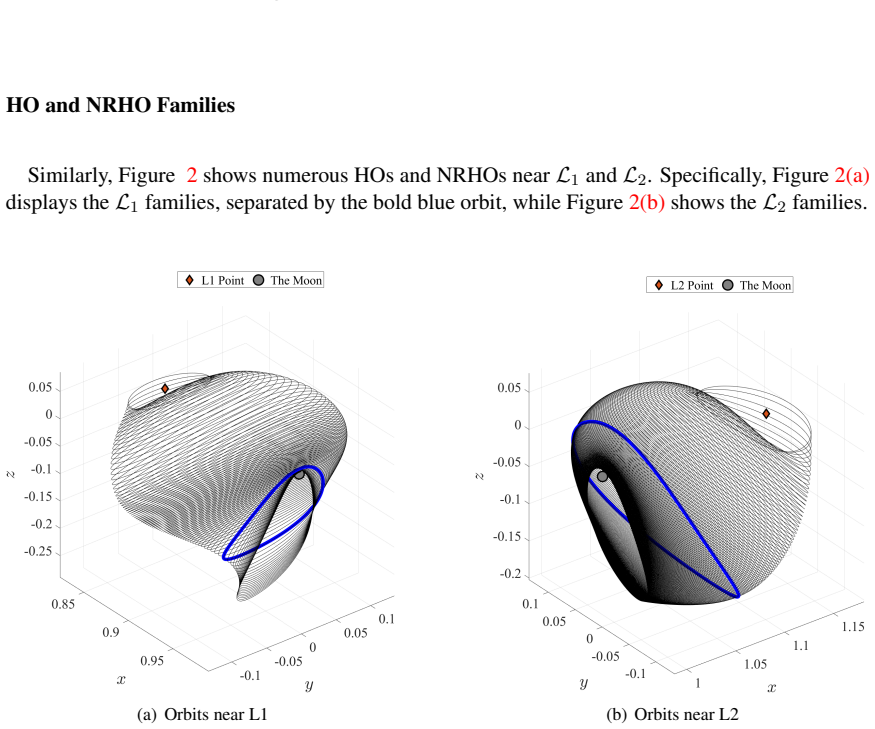
The load-bearing object is the multivariate polynomial regression model of Eq. (2), which represents the state $\hat X_i$ of any orbit-family member as a polynomial in $\chi$ (which orbit in the family) and $\nu$ (where along the orbit), with cosine and sine terms in $\nu$ to handle periodicity. The model is fitted separately on sub-manifolds chosen so that the map is continuous and one-to-one over the region $R$. This compact two-parameter model is what lets the NMPC treat the reference as an implicit variable: the cost function in Eq. (3) is written against $P(\chi_k,\nu_{k+i})$, so the optimizer can move $\chi_k$ within bounds to pick a cheaper nearby member of the same family. The paper also proposes a fixed-$\chi$ variant, in which one family member is selected for the whole horizon, as the computationally efficient middle ground between full flexibility and rigid tracking.
What would settle it
Hold out a second set of continuation-generated orbit members, refit Eq. (2) without them, and compute the maximum state-prediction error on the held-out set; if that error is comparable to the tracking-error weights in the cost function, the nominal reference is unreliable. A closed-loop test that starts the spacecraft on an orbit member outside the trained sub-manifold and checks whether it remains in the family would settle the claim directly.
Extended reading notes
Core claim
The central claim is that the reference trajectory for periodic-orbit tracking in the circular restricted three-body problem should be a decision variable, not a fixed input. The controller minimizes a finite-horizon cost that compares the propagated state with the regression model $P(\chi_k,\nu_{k+i})$ over the prediction and control horizons, subject to bounds on the family parameter $\chi$, the along-orbit angle $\nu$, and the velocity impulses. Because $\chi$ can vary within the starting sub-manifold, the optimizer selects the orbit that is easiest to track while still keeping the spacecraft in the family. The paper reports that this formulation reduces fuel consumption compared with tracking a predefined reference orbit, across Lyapunov, halo, and near-rectilinear halo families near L1 and L2, including when an extended Kalman filter feeds estimated states to the controller.
Load-bearing premise
The entire fuel-saving result rests on the fitted polynomial model of each orbit family being accurate and one-to-one; if that fit is poor or the two parameters do not label every point cleanly, the controller is chasing wrong reference states and the reported savings do not carry over.
Editorial extensions
If this is right
- A spacecraft can stay inside a chosen cislunar orbit family even when its initial state is poorly known and a biased disturbance acts on the dynamics.
- The fixed-$\chi$ family-tracking controller uses less control effort than tracking a single predefined orbit and roughly matches a fully variable reference at lower computational cost.
- The same construction works for Lyapunov, halo, and near-rectilinear halo families near both L1 and L2, with prediction and control horizons tuned per family.
- Coupling the NMPC with an extended Kalman filter keeps the estimated spacecraft within the orbit family, with the estimation error fluctuating around a stable mean.
Reading between the lines
- Beyond the paper, the same reference-as-decision idea can be carried to quasi-periodic orbit families and tori, where a two-parameter regression becomes a three- or four-parameter model and the fuel savings would quantify how much flexibility the controller actually needs.
- A natural extension is to hold out some continuation-generated orbit members from the regression training and measure the prediction error of Eq. (2) on them; that would show how much of the reported fuel saving depends on the fidelity of the fit.
- If the savings persist under higher-fidelity dynamics such as ephemeris or four-body models, family tracking could become an operational stationkeeping strategy, with orbit-keeping tolerances replacing a single reference orbit.
Signed reviews
Editorial analysis
A structured set of objections, weighed in public.
Referee Report
Summary. The paper proposes a Nonlinear Model Predictive Control (NMPC) scheme for keeping a spacecraft within a family of periodic orbits in the cislunar CR3BP, rather than tracking one predefined orbit. The authors use pseudo-arclength continuation to generate orbit families, parameterize each family member by two variables (χ, ν), and fit the resulting states with a multivariate polynomial regression (MPR) model. The NMPC then optimizes over the velocity impulses and the orbit parameter χ at each step, and the controller is integrated with an Extended Kalman Filter. Simulations for Lyapunov, halo, and near-rectilinear halo orbits near L1 and L2 are presented, and the paper claims a significant fuel reduction compared to conventional fixed-orbit tracking.
Significance. If rigorously supported, the idea of tracking an entire orbit family instead of a single reference orbit is a useful contribution to cislunar station-keeping, potentially reducing fuel by allowing the spacecraft to exploit the natural manifold structure. The paper makes a clear effort to build a practical pipeline: PAC for family generation, MPR for a compact reference model, an NMPC solver with CasADi, and an EKF-based GNC loop. However, the current evidence for the central quantitative claim is not convincing: the baseline comparison is structurally biased, the MPR model is unvalidated, the disturbance description is inconsistent, and the headline results are single deterministic runs without statistical support. The conceptual contribution is defensible, but the quantitative claims need substantial additional evidence.
major comments (4)
- [V, Eqs. (3)-(4)] The optimization over χ_k in Eqs. (3)-(4) makes the proposed problem a relaxation of any fixed-χ baseline: every feasible control sequence for the baseline (with χ_k ≡ χ0) is feasible for the proposed problem, so the proposed optimal cost is by construction no larger. The fuel reductions in Figures 13 and 17 therefore partly reflect the added degree of freedom rather than a demonstrated advantage of family tracking. To support the headline claim, please compare against the same NMPC with χ_k constrained to a fixed orbit that is selected by a principled rule (e.g., the family member closest to the initial state or a minimum-fuel fixed orbit), and report the achieved distance from the orbit family for both methods.
- [IV, Eq. (2)] The MPR model generates the reference states P(χ,ν) that appear in the NMPC cost, but no fitting error, validation set, or model-order selection is reported. The paper also asserts without proof that the (χ,ν) parameterization is unique and continuous over the region R. Since the controller tracks these regressed states, regression error directly affects the effective reference and can influence the measured fuel consumption. Please report per-sub-manifold fit errors (RMS and maximum position error) and, if possible, a closed-loop sensitivity analysis to the regression error.
- [VI] The disturbance model is internally inconsistent: the text introduces an 'unexpected biased disturbance' to simulate 'an unrealistic strong solar wind', but the next sentence states the disturbance is 'Gaussian with a zero mean and σ_q = 10^{-3}'. It is also not specified how the disturbance enters the propagation in Eqs. (5)-(6) (e.g., process noise on states, unmodeled acceleration, or measurement error). The robustness claims depend on this model, so please clarify and make the description consistent.
- [VI, Figures 13 and 17] The headline fuel-savings claim is based on single deterministic simulation runs without error bars or statistical comparison. The Monte Carlo study in Figure 14 is only for the proposed method, not for the baseline. Please report total ΔV statistics (mean, standard deviation, and histograms if feasible) for both the proposed method and the fixed-orbit baseline over the same set of initial states and disturbance realizations, so the claimed reduction can be assessed as a distribution rather than a single trajectory.
minor comments (6)
- [Introduction] The internal section references are inconsistent: the results appear in Section 6 (Numerical Simulations) and Section 7 (NMPC-EKF), not 'Section 7 presents and discusses the results' as stated in the introduction.
- [II] In the paragraph after Eq. (1), 'receptively' should be 'respectively', and 'in the CR3BP mode' should probably be 'in the CR3BP model'.
- [VI, Figure 16 caption] The caption reads 'the tow control strategies'; 'tow' should be 'two'.
- [V] In the paragraph discussing the variable-χ approach, the phrase 'it significantly increases computational complexity' is repeated; the duplicate should be removed.
- [IV, Eq. (2)] The summation condition 'nχ+ncν+nsν ≤ N' should state explicitly that nχ, ncν, nsν are nonnegative integers, and the ranges of χ and ν should be given.
- [V, Eq. (4)] The line 'X_k = X_0' is written as a constraint, but it is an initial condition; please rewrite it as 'given initial state X_0'.
Circularity Check
Fuel-savings claim is guaranteed by the extra optimization variable χ; the fixed-orbit baseline comparison is unmatched.
-
other
[Section 5, Eq. (4); Section 6, Figs. 13 and 17; Abstract.]
"Section 5: "the optimization involves only a single parameter, χk, that determines the optimal target orbit along the prediction horizon" and "χmin ≤ χk ≤ χmax" (Eq. 4). Section 6: "In the third case, the reference orbit is fixed, and the spacecraft is constrained to track only that orbit." Abstract: "The results demonstrate a significant reduction in fuel consumption compared to conventional tracking methods.""
Because χk is a decision variable in the proposed NMPC while the conventional baseline fixes the reference orbit, every feasible baseline trajectory is feasible for the proposed problem by setting χk to the baseline's orbit parameter. Hence the proposed optimal cost is always no larger than the baseline cost; the fuel-reduction headline is entailed by construction (relaxing the tracking constraint), not by an empirically demonstrated dynamical property. The reported magnitude also depends on the arbitrarily chosen fixed baseline orbit, so Figures 13 and 17 do not test the proposed method against a matched task. The qualitative result is the value of adding one degree of freedom to the optimizer.
full rationale
The orbit-family construction (PAC, MPR, and NMPC with χ as an optimization variable) is internally consistent and not circular by itself: the MPR is an empirical fit, and the NMPC minimizes a well-defined cost. The circularity is confined to the headline comparison against conventional tracking. In Eq. (4), χk is minimized along with the impulses, while the baseline fixes the reference orbit; hence the proposed feasible set contains the baseline's, so the optimal cost—and therefore fuel use—is less than or equal to the baseline's by construction. Figures 13 and 17 therefore demonstrate a guaranteed inequality rather than an empirical advantage. The size of the saving is scenario-dependent and could be inflated by choosing a poorly matched baseline orbit. Other weaknesses noted in the manuscript, such as the absence of MPR fitting-error analysis, lack of a validation set, and the assumed rather than proved uniqueness of the (χ, ν) parameterization, are correctness and robustness risks rather than circularity. No load-bearing self-citation was found: the cited prior work provides standard continuation and propagation tools, not the paper's comparative fuel-saving claim.
Assumptions & free parameters
free parameters (6)
- MPR polynomial coefficients =
not reported
- NMPC weights Q, Qt, R =
Q=Qt=diag(1,1,1,0,0,0), R=diag(1e-2,1e-2,1e-2)
- Prediction and control horizons Np, Nc =
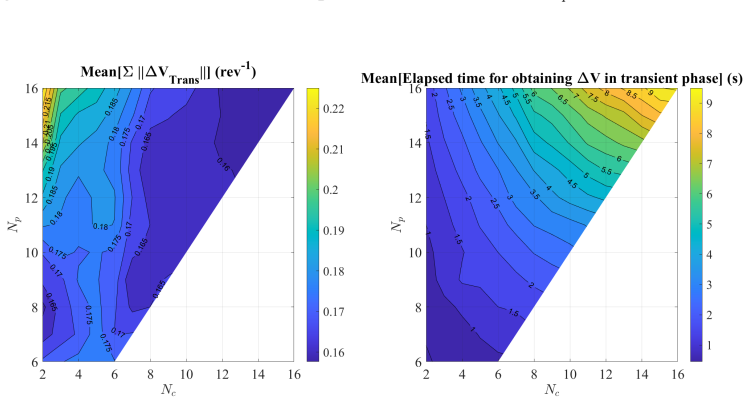
selected per family, not explicitly stated
- Sub-manifold divisions =
not quantified
- Disturbance standard deviation sigma_q =
1e-3
- Sampling times Ts, bTs, and NT =
not reported
assumptions (6)
- domain assumption The CR3BP is an adequate model for cislunar spacecraft dynamics.
- domain assumption Periodic orbit families exist and are computable via PAC.
- ad hoc to paper The orbit family is a 2D manifold parameterizable uniquely by (chi, nu).
- ad hoc to paper The MPR model in Eq. (2) approximates the manifold well enough for control.
- standard math The NMPC optimizer finds adequate minima of the non-convex problem.
- domain assumption The EKF linearization is valid for the noise level.
Cite this review
Pith. "Pith review of Periodic orbit tracking in cislunar space: A finite-horizon approach." pith.science (2026). https://pith.science/paper/VN2GF4MH
@misc{pith2026250719928,
  author       = {Pith},
  title        = {Pith review of: Periodic orbit tracking in cislunar space: A finite-horizon approach},
  year         = {2026},
  howpublished = {\url{https://pith.science/paper/VN2GF4MH}},
  note         = {Machine review of arXiv:2507.19928}
}
read the original abstract
This paper presents a Nonlinear Model Predictive Control (NMPC) scheme for maintaining a spacecraft within a specified family of periodic orbits near the libration points in cislunar space. Unlike traditional approaches that track a predefined reference orbit, the proposed method designs an optimal trajectory that keeps the spacecraft within the orbit family, regardless of the initial reference. The Circular Restricted Three-Body Problem (CR3BP) is used to model the system dynamics. First, the Pseudo-Arclength Continuation (PAC) method is employed to compute the members of each orbit family. Then, the state of each member is parameterized by two variables: one defining the orbit and the other specifying the location along it. These computed states are then fit to a Multivariate Polynomial Regression (MPR) model. An NMPC framework is developed to generate the optimal reference trajectory and compute the corresponding velocity impulses for trajectory tracking. The control system is integrated with a Extended Kalman Filter (EKF) observer that estimates the spacecraft's relative state. Numerical simulations are conducted for Lyapunov, halo, and near-rectilinear halo orbits near L1 and L2. The results demonstrate a significant reduction in fuel consumption compared to conventional tracking methods.
Figures


Figures from the paper (18 more)




Reference graph
Works this paper leans on
-
[1]
Dynamical systems, the three-body problem and space mission design,
W. S. Koon, M. W. Lo, J. E. Marsden, and S. D. Ross, “Dynamical systems, the three-body problem and space mission design,” in Equadiff 99: (In 2 V olumes), pp. 1167–1181, World Scientific, 2000
work page 2000
-
[2]
A. P. Wilmer, R. A. Bettinger, L. M. Shockley, and M. J. Holzinger, “Preliminary investigation and pro- posal of periodic orbits and their utilization for logistics in the cislunar regime,”Space Policy, p. 101635,
-
[3]
Artemis: the first mission to the lunar libration orbits,
M. Woodard, D. Folta, and D. Woodfork, “Artemis: the first mission to the lunar libration orbits,” in 21st International Symposium on Space Flight Dynamics, Toulouse, France , 2009
work page 2009
-
[4]
Lunar orbiter platform-gateway: a clear use case for ccsds mo services,
M. Merri and M. Sarkarati, “Lunar orbiter platform-gateway: a clear use case for ccsds mo services,” in 2018 AIAA SPACE and Astronautics F orum and Exposition , p. 5337, 2018. https://doi.org/10.2514/6.2018-5337
-
[5]
Aeronautics, NASA’s journey to Mars: pioneering next steps in space exploration
N. Aeronautics, NASA’s journey to Mars: pioneering next steps in space exploration . Government Printing Office, 2016
work page 2016
-
[6]
A comprehensive review on cislunar expansion and space domain awareness,
B. Baker-McEvilly, S. Bhadauria, D. Canales, and C. Frueh, “A comprehensive review on cislunar expansion and space domain awareness,” Progress in Aerospace Sciences , vol. 147, p. 101019, 2024. https://doi.org/10.1016/j.paerosci.2024.10101. 17
arXiv 2024
-
[7]
Options for staging orbits in cislunar space,
R. Whitley and R. Martinez, “Options for staging orbits in cislunar space,” in 2016 IEEE Aerospace Conference, pp. 1–9, IEEE, 2016. https://doi.org/10.1109/AERO.2016.7500635
-
[8]
Analytic construction of periodic orbits about the collinear points,
D. L. Richardson, “Analytic construction of periodic orbits about the collinear points,” Celestial me- chanics, vol. 22, no. 3, pp. 241–253, 1980. https://doi.org/10.1007/BF01229511
Show all 42 references
-
[9]
Impulsive and low-thrust transfer design between stable and nearly-stable periodic orbits in the restricted problem,
R. E. Pritchett, E. Zimovan, and K. Howell, “Impulsive and low-thrust transfer design between stable and nearly-stable periodic orbits in the restricted problem,” in 2018 Space Flight Mechanics Meeting , p. 1690, 2018. https://doi.org/10.2514/6.2018-1690
2018 doi
-
[10]
Low-thrust earth-moon transfers via man- ifolds of a halo orbit in the cis-lunar space,
S. K. Singh, B. D. Anderson, E. Taheri, and J. L. Junkins, “Low-thrust earth-moon transfers via man- ifolds of a halo orbit in the cis-lunar space,” in 43rd Annual AAS Guidance, Navigation and Control Conference, 2020
2020
-
[11]
Stationkeeping and transfer trajectory design for spacecraft in cislunar space,
D. C. Davis, S. M. Phillips, K. C. Howell, S. Vutukuri, and B. P. McCarthy, “Stationkeeping and transfer trajectory design for spacecraft in cislunar space,” in AAS/AIAA Astrodynamics Specialist Conference , vol. 8, Springer Nature London, 2017
2017
-
[12]
Tadpole orbits in the l4/l5 region: Construction and links to other families of periodic orbits,
A. G. Van Anderlecht, “Tadpole orbits in the l4/l5 region: Construction and links to other families of periodic orbits,” Master’s thesis, Purdue University, 2016
2016
-
[13]
Wilmer, R
A. Wilmer, R. A. Bettinger, and B. Little, Cislunar Periodic Orbit Constellation Assessment for Space Domain Awareness of L1 and L2 Halo Orbits , p. 4191. 2021. https://doi.org/10.2514/6.2021-4191
2021 doi
-
[14]
Investigation of near-rectilinear halo orbit search and rescue using staging l1/l2 lyapunov and distant retrograde orbit families,
T. J. Fay, A. P. Wilmer, and R. A. Bettinger, “Investigation of near-rectilinear halo orbit search and rescue using staging l1/l2 lyapunov and distant retrograde orbit families,” Journal of Space Safety En- gineering, 2024. https://doi.org/10.1016/j.jsse.2024.04.009
2024 doi
-
[15]
Generalizing the bicircular restricted four-body problem,
R. B. Negri and A. F. Prado, “Generalizing the bicircular restricted four-body problem,” Journal of Guidance, Control, and Dynamics , vol. 43, no. 6, pp. 1173–1179, 2020. https://doi.org/10.2514/1.G004848
2020 doi
-
[16]
Multiple families of synodic resonant periodic orbits in the bicircular restricted four–body problem,
K. Oshima, “Multiple families of synodic resonant periodic orbits in the bicircular restricted four–body problem,” Advances in Space Research , vol. 70, no. 5, pp. 1325–1335, 2022. https://doi.org/10.1016/j.asr.2022.06.009
2022 doi
-
[17]
Lagrangian derivation and stability analysis of multi-body gravi- tational dynamical models with application to cislunar periodic orbit propagation,
A. P. Wilmer and R. A. Bettinger, “Lagrangian derivation and stability analysis of multi-body gravi- tational dynamical models with application to cislunar periodic orbit propagation,” in Astrodyn. Spec. Conf, 2021
2021
-
[18]
Design of a model predictive controller for formation flight on quasi-halo orbits,
F. P. Salzo, G. Bucchioni, R. Vazquez, et al. , “Design of a model predictive controller for formation flight on quasi-halo orbits,” 2023
2023
-
[19]
Chance-constrained model predictive control for near recti- linear halo orbit spacecraft rendezvous,
J. C. Sanchez, F. Gavilan, and R. Vazquez, “Chance-constrained model predictive control for near recti- linear halo orbit spacecraft rendezvous,”Aerospace Science and Technology, vol. 100, p. 105827, 2020. https://doi.org/10.1016/j.ast.2020.105827
2020
-
[20]
Model predictive control for formation recon- figuration exploiting quasi-periodic tori in the cislunar environment,
A. Capannolo, G. Zanotti, M. Lavagna, and G. Cataldo, “Model predictive control for formation recon- figuration exploiting quasi-periodic tori in the cislunar environment,” Nonlinear Dynamics , vol. 111, no. 8, pp. 6941–6959, 2023. https://doi.org/10.1007/s11071-022-08214-8
2023 doi
-
[21]
Periodic model predictive control for tracking halo orbits in the elliptic restricted three-body problem,
R. Quartullo, A. Garulli, and I. Kolmanovsky, “Periodic model predictive control for tracking halo orbits in the elliptic restricted three-body problem,”IEEE Transactions on Control Systems Technology, vol. 31, no. 5, pp. 1971–1981, 2023. https://doi.org/10.1109/TCST.2023.3291548
1971
-
[22]
Suboptimal nonlinear model predictive control strategies for tracking near rectilinear halo orbits,
A. W. Berning Jr, D. Liao-McPherson, A. Girard, and I. Kolmanovsky, “Suboptimal nonlinear model predictive control strategies for tracking near rectilinear halo orbits,” arXiv preprint arXiv:2008.09240,
2008 arXiv
- [23]
-
[24]
Dynamics near the three-body libration points via koopman operator theory,
S. Servadio, D. Arnas, and R. Linares, “Dynamics near the three-body libration points via koopman operator theory,” Journal of Guidance, Control, and Dynamics , vol. 45, no. 10, pp. 1800–1814, 2022. https://doi.org/10.2514/1.G006519
2022 doi
-
[25]
Numerical exploration of the restricted problem, v,
M. H ´enon, “Numerical exploration of the restricted problem, v,”Astronomy and Astrophysics, vol. 1, p. 223-238 (1969)., vol. 1, pp. 223–238, 1969
1969
-
[26]
The ‘halo’family of 3-dimensional periodic orbits in the earth-moon restricted 3-body problem,
J. V . Breakwell and J. V . Brown, “The ‘halo’family of 3-dimensional periodic orbits in the earth-moon restricted 3-body problem,” Celestial mechanics , vol. 20, no. 4, pp. 389–404, 1979. https://doi.org/10.1007/BF01230405
1979 doi
- [27]
-
[28]
Casadi: a software framework for nonlinear optimization and optimal control,
J. A. Andersson, J. Gillis, G. Horn, J. B. Rawlings, and M. Diehl, “Casadi: a software framework for nonlinear optimization and optimal control,” Mathematical Programming Computation, vol. 11, pp. 1– 36, 2019. https://doi.org/10.1007/s12532-018-0139-4. 18
2019 doi
-
[29]
Non- linear model predictive control using casadi package for trajectory tracking of quadrotor,
M. Elhesasy, T. N. Dief, M. Atallah, M. Okasha, M. M. Kamra, S. Yoshida, and M. A. Rushdi, “Non- linear model predictive control using casadi package for trajectory tracking of quadrotor,” Energies, vol. 16, no. 5, p. 2143, 2023. https://doi.org/10.3390/en16052143
2023 doi
-
[30]
Analytic optimal control for multi-satellite assembly using linearized twistor-based model,
M. Atallah, M. Okasha, and O. Abdelkhalik, “Analytic optimal control for multi-satellite assembly using linearized twistor-based model,” Advances in Space Research , vol. 74, no. 10, pp. 5142–5155,
-
[31]
Development of guidance, navigation, and control systems for multi-spacecraft assem- bly in proximity operations,
M. A. Atallah, “Development of guidance, navigation, and control systems for multi-spacecraft assem- bly in proximity operations,” 2023
2023
-
[32]
Uncertainty propagation and filtering via the koopman op- erator in astrodynamics,
S. Servadio, W. Parker, and R. Linares, “Uncertainty propagation and filtering via the koopman op- erator in astrodynamics,” Journal of Spacecraft and Rockets , vol. 60, no. 5, pp. 1639–1655, 2023. https://doi.org/10.2514/1.A35688
2023 doi
-
[33]
https://doi.org/10.1016/j.asr.2024.08.072
2024 doi
-
[34]
Recursive polynomial minimum mean-square error estimation with applica- tions to orbit determination,
S. Servadio and R. Zanetti, “Recursive polynomial minimum mean-square error estimation with applica- tions to orbit determination,” Journal of Guidance, Control, and Dynamics, vol. 43, no. 5, pp. 939–954,
-
[35]
Differential algebra-based multiple gaussian particle filter for orbit de- termination,
S. Servadio and R. Zanetti, “Differential algebra-based multiple gaussian particle filter for orbit de- termination,” Journal of Optimization Theory and Applications , vol. 191, no. 2, pp. 459–485, 2021. https://doi.org/10.1007/s10957-021-01934-8
2021 doi
-
[36]
Nonlinear filtering with a polynomial series of gaussian random variables,
S. Servadio, R. Zanetti, and B. A. Jones, “Nonlinear filtering with a polynomial series of gaussian random variables,” IEEE Transactions on Aerospace and Electronic Systems , vol. 57, no. 1, pp. 647– 658, 2020. https://doi.org/10.1109/TAES.2020.3028487
2020
-
[37]
Nonlinear prediction in marker-based spacecraft pose estimation with polynomial transition maps,
S. Servadio, F. Cavenago, P. Di Lizia, and M. Massari, “Nonlinear prediction in marker-based spacecraft pose estimation with polynomial transition maps,” Journal of Spacecraft and Rockets , vol. 59, no. 2, pp. 511–523, 2022. https://doi.org/10.2514/1.A35068
2022 doi
-
[38]
https://doi.org/10.2514/1.G004544
-
[40]
Maximum a posteriori estimation of hamiltonian systems with high order taylor polynomials,
S. Servadio, R. Zanetti, and R. Armellin, “Maximum a posteriori estimation of hamiltonian systems with high order taylor polynomials,” The Journal of the Astronautical Sciences , vol. 69, no. 2, pp. 511– 536, 2022. https://doi.org/10.1007/s40295-022-00304-4
2022 doi
-
[42]
Likelihood scouting via map inversion for a posterior-sampled particle filter,
S. Servadio, “Likelihood scouting via map inversion for a posterior-sampled particle filter,”IEEE Trans- actions on Aerospace and Electronic Systems , 2024. https://doi.org/10.1109/TAES.2024.3446757. 19
2024
- [2020]
-
[2024]
https://doi.org/10.1016/j.spacepol.2024.10163
2024
Reviewed August 6, 2026 · model on record in the stance chip above.
Discussion (0). Continue with ORCID to comment.