A thick-shell formalism for pulsar wind nebulae based on energy conservation
Pith reviewed 2026-06-26 19:59 UTC · model grok-4.3
The pith
Thick-shell energy conservation model matches Crab nebula structure and spectrum while resolving filament-bubble age mismatch.
A machine-rendered reading of the paper's core claim, the machinery that carries it, and where it could break.
Core claim
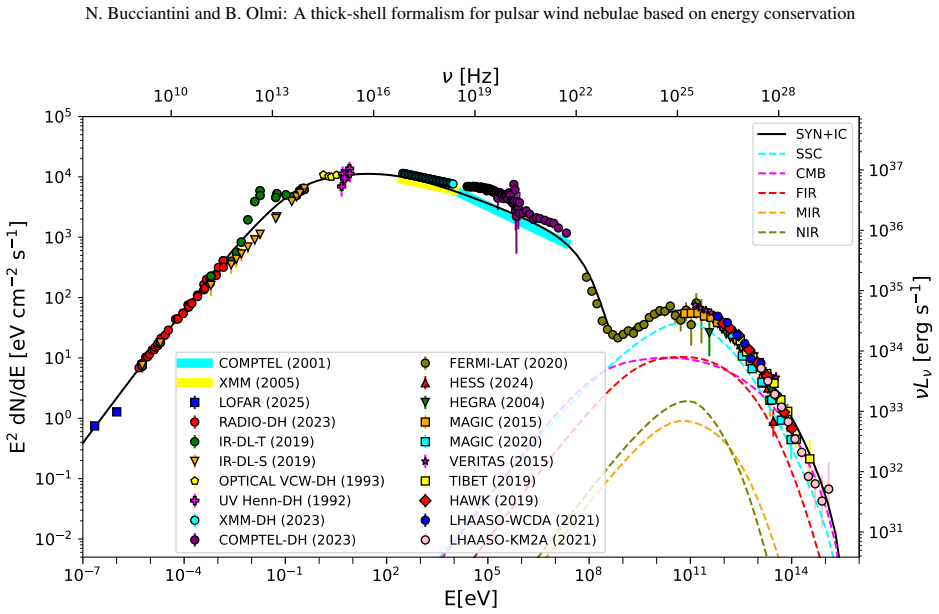
The thick-shell formalism based on energy conservation reproduces the Crab nebula structural properties and spectrum, accounting for the difference in convergence age between the optical filaments and the radio bubble, thereby removing the inconsistencies of previous one-zone thin-shell models.
What carries the argument
The thick-shell description based on global energy conservation, which models the wind bubble as a finite-thickness region containing mixed material and decoupled from the surrounding medium.
If this is right
- The formalism supplies a more realistic evolutionary description that includes radiation losses and geometrical effects such as the thick mixed layer.
- It can be used for fitting individual objects and for population synthesis of pulsar wind nebulae with improved structural accuracy.
- The high-order upwind-implicit scheme guarantees accurate energy conservation during particle-spectrum evolution.
- The algebraic-vectorizable method computes synchrotron self-Compton emission across the full Klein-Nishina regime without numerical integrations or interpolations.
Where Pith is reading between the lines
- The same thick-shell treatment could resolve similar structural-spectral tensions reported for other young pulsar wind nebulae.
- Incorporating a variable mixing efficiency might allow the model to span both tightly coupled and fully decoupled evolutionary tracks.
- Multi-epoch imaging that maps the radial extent of the mixed layer would provide a direct test of the assumed thickness.
- The reduced computational cost relative to full hydrodynamics suggests the formalism could serve as a fast prior for initializing three-dimensional simulations.
Load-bearing premise
A thick-shell description based on global energy conservation together with simplified mixing and weak coupling to the outer medium is enough to capture the essential dynamics without full hydrodynamic simulations.
What would settle it
A high-resolution observation or hydrodynamic simulation that shows the optical filaments and radio bubble share the same convergence age, or that the observed Crab spectrum cannot be reproduced once a thick mixed layer and decoupling are imposed.
Figures
read the original abstract
One of the most powerful approaches to model the structural and spectral evolution of wind bubbles, and pulsar wind nebulae in particular, is based on the one-zone thin-shell formalism. By solving a set of simple equations, one can relate the spectral properties of these systems to the physical properties of the pulsar and supernova remnant. Due to its predictive power, this approach has been widely used both to fit existing objects and in population synthesis. However, there are inconsistencies when applied to the Crab nebula that have never been fully accounted for, casting doubts on its reliability. We introduce a new and more flexible formalism based on energy conservation that reconciles the observed structural and spectral properties of the Crab nebula, solving the inconsistencies, and provides a more realistic description of wind-bubble evolution. The equations of the formalism are presented and discussed, together with simplified solutions and more complex ones including radiation losses. Implications for the modeling of wind bubbles and pulsar wind nebulae are illustrated. We also introduce a new high-order upwind-implicit scheme for particle-spectrum evolution that ensures high accuracy in energy conservation, and an algebraic-vectorizable approach for synchrotron self-Compton emission in the full Klein-Nishina regime that avoids costly interpolations and integrations. We reproduce the Crab nebula structural properties and spectrum, accounting for the difference in convergence age between the optical filaments and the radio bubble, thereby removing the inconsistencies. The spectral accuracy of this approach is comparable to that of the standard one, but it is superior in reproducing structural properties and accounting for geometrical effects such as a thick layer of mixed material and the lack of efficient coupling between the wind bubble and the surrounding medium.
Editorial analysis
A structured set of objections, weighed in public.
Referee Report
Summary. The paper introduces a thick-shell formalism for pulsar wind nebulae based on global energy conservation, intended to resolve inconsistencies in the standard one-zone thin-shell model when applied to the Crab nebula. It claims to reproduce both the observed structural properties (including the difference in convergence ages between the optical filaments and the radio bubble) and the broadband spectrum by incorporating a thick layer of mixed material and the lack of efficient coupling to the surrounding SNR shell. The work also presents a high-order upwind-implicit numerical scheme for particle-spectrum evolution that preserves energy conservation and an algebraic method for synchrotron self-Compton emission in the full Klein-Nishina regime.
Significance. If the central results hold, the formalism offers a computationally efficient yet more geometrically realistic alternative to thin-shell models and full hydrodynamical simulations for PWN evolution. This could improve the reliability of fits to individual objects and population-synthesis studies. The numerical innovations for spectrum evolution and SSC calculations are independently useful contributions that enhance accuracy without costly integrations.
major comments (1)
- [Crab nebula application section] The reproduction of Crab structural properties (different convergence ages for filaments vs. radio bubble) is the central claim that removes prior inconsistencies. The thick-shell description relies on global energy conservation plus simplified mixing and no efficient coupling to the SNR; without a quantitative argument or comparison (e.g., to hydro simulations) demonstrating that local effects such as Rayleigh-Taylor instabilities at the contact discontinuity do not dominate the observed thickness and velocity field, the structural match risks being coincidental rather than robust. This assumption is load-bearing and should be addressed explicitly in the section presenting the Crab application.
minor comments (2)
- The abstract states that equations are 'presented and discussed, together with simplified solutions and more complex ones including radiation losses'; a table or explicit comparison of these solution classes would improve clarity for readers.
- Notation for the thick-shell thickness parameter and mixing efficiency should be defined consistently the first time it appears to avoid ambiguity in later equations.
Simulated Author's Rebuttal
We thank the referee for the careful and constructive review. We address the single major comment below and indicate the revision made to the manuscript.
read point-by-point responses
-
Referee: The reproduction of Crab structural properties (different convergence ages for filaments vs. radio bubble) is the central claim that removes prior inconsistencies. The thick-shell description relies on global energy conservation plus simplified mixing and no efficient coupling to the SNR; without a quantitative argument or comparison (e.g., to hydro simulations) demonstrating that local effects such as Rayleigh-Taylor instabilities at the contact discontinuity do not dominate the observed thickness and velocity field, the structural match risks being coincidental rather than robust. This assumption is load-bearing and should be addressed explicitly in the section presenting the Crab application.
Authors: We agree that the load-bearing nature of the mixing and coupling assumptions requires explicit discussion to support the central claim. The formalism is constructed around global energy conservation precisely to describe the averaged dynamical evolution without resolving local hydrodynamics, which is its intended advantage over full simulations. In the revised manuscript we have added a new paragraph in the Crab nebula application section that directly addresses Rayleigh-Taylor instabilities at the contact discontinuity. The added text explains that, while such instabilities contribute to local mixing, the observed shell thickness and the differential convergence ages between filaments and radio bubble remain governed by the global energy balance; the model reproduces both structural and spectral observables simultaneously under the stated assumptions. We acknowledge that a quantitative comparison against hydrodynamical simulations would provide further validation but lies outside the scope of the present work, which focuses on the analytic thick-shell formalism itself. revision: yes
Circularity Check
No circularity: derivation from energy conservation is self-contained
full rationale
The paper presents a thick-shell formalism explicitly derived from global energy conservation, with new numerical schemes for spectrum evolution and SSC emission. The Crab reproduction is framed as validation that resolves prior inconsistencies via the new geometry and mixing treatment, not as a tautological fit. No quoted equations or steps reduce a prediction to its own inputs by construction, and no self-citation load-bearing or ansatz smuggling is evident in the provided text. The central claim retains independent content from the conservation principle and thick-shell assumptions.
Axiom & Free-Parameter Ledger
axioms (1)
- domain assumption Energy conservation governs the structural and spectral evolution of the wind bubble
Reference graph
Works this paper leans on
-
[1]
2020, , 247, 33
Abdollahi , S., Acero , F., Ackermann , M., et al. 2020, , 247, 33
2020
-
[2]
U., Albert , A., Alfaro , R., et al
Abeysekara , A. U., Albert , A., Alfaro , R., et al. 2019, , 881, 134
2019
-
[3]
2024, , 686, A308
Aharonian , F., Ait Benkhali , F., Aschersleben , J., et al. 2024, , 686, A308
2024
-
[4]
2004, , 614, 897
Aharonian , F., Akhperjanian , A., Beilicke , M., et al. 2004, , 614, 897
2004
-
[5]
Aharonian , F. A. & Atoyan , A. M. 1981, , 79, 321
1981
-
[6]
A., et al
Aleksi \'c , J., Ansoldi , S., Antonelli , L. A., et al. 2015, Journal of High Energy Astrophysics, 5, 30
2015
-
[7]
W., Bi , X
Amenomori , M., Bao , Y. W., Bi , X. J., et al. 2019, , 123, 051101
2019
-
[8]
J., & Bassa , C
Arias , M., Timmerman , R., Sweijen , F., van Weeren , R. J., & Bassa , C. G. 2025, , 699, A319
2025
-
[9]
Bandiera , R., Bucciantini , N., Mart \' n , J., Olmi , B., & Torres , D. F. 2020, , 499, 2051
2020
-
[10]
Bandiera , R., Bucciantini , N., Mart \' n , J., Olmi , B., & Torres , D. F. 2021, , 508, 3194
2021
-
[11]
Bandiera , R., Bucciantini , N., Mart \' n , J., Olmi , B., & Torres , D. F. 2023 a , , 520, 2451
2023
-
[12]
Bandiera , R., Bucciantini , N., Olmi , B., & Torres , D. F. 2023 b , , 525, 2839
2023
-
[13]
Bietenholz , M. F. & Nugent , R. L. 2015, , 454, 2416
2015
-
[14]
& Rezzolla , L
Breu , C. & Rezzolla , L. 2016, , 459, 646
2016
-
[15]
M., & Del Zanna , L
Bucciantini , N., Amato , E., Bandiera , R., Blondin , J. M., & Del Zanna , L. 2004, , 423, 253
2004
-
[16]
2011, , 410, 381
Bucciantini , N., Arons , J., & Amato , E. 2011, , 410, 381
2011
-
[17]
M., Del Zanna , L., & Amato , E
Bucciantini , N., Blondin , J. M., Del Zanna , L., & Amato , E. 2003, , 405, 617
2003
-
[18]
D., & Thompson , T
Bucciantini , N., Quataert , E., Arons , J., Metzger , B. D., & Thompson , T. A. 2007, , 380, 1541
2007
-
[19]
P., Grandmont , F., & Binette , L
Charlebois , M., Drissen , L., Bernier , A. P., Grandmont , F., & Binette , L. 2010, , 139, 2083
2010
-
[20]
& Fesen , R
Davidson , K. & Fesen , R. A. 1985, , 23, 119
1985
-
[21]
J., Bandiera , R., et al
De Looze , I., Barlow , M. J., Bandiera , R., et al. 2019, , 488, 164
2019
-
[22]
F., Olmi , B., Bucciantini , N., & Meyer , D
De Sarkar , A., Torres , D. F., Olmi , B., Bucciantini , N., & Meyer , D. M.-A. 2026, In Preparation
2026
-
[23]
& Horns , D
Dirson , L. & Horns , D. 2023, , 671, A67
2023
-
[24]
2008, , 174, 379
Fesen , R., Rudie , G., Hurford , A., & Soto , A. 2008, , 174, 379
2008
-
[25]
A., Shull , J
Fesen , R. A., Shull , J. M., & Hurford , A. P. 1997, , 113, 354
1997
-
[26]
2022, , 511, 1439
Fiori , M., Olmi , B., Amato , E., et al. 2022, , 511, 1439
2022
-
[27]
D., Slane , P
Gelfand , J. D., Slane , P. O., & Zhang , W. 2009, , 703, 2051
2009
-
[28]
Giuliani , Jr., J. L. 1982, , 256, 624
1982
-
[29]
S., O'Connell , R
Hennessy , G. S., O'Connell , R. W., Cheng , K. P., et al. 1992, , 395, L13
1992
-
[30]
Henry , R. B. C. & MacAlpine , G. M. 1982, , 258, 11
1982
-
[31]
J., Stone , J
Hester , J. J., Stone , J. M., Scowen , P. A., et al. 1996, , 456, 225
1996
-
[32]
\'I \ n iguez-Pascual , D., Vigan \`o , D., & Torres , D. F. 2025, , 704, L14
2025
-
[33]
1998, , 499, 282
Jun , B.-I. 1998, , 499, 282
1998
-
[34]
A., & Kelner , S
Khangulyan , D., Aharonian , F. A., & Kelner , S. R. 2014, , 783, 100
2014
-
[35]
G., Briel , U
Kirsch , M. G., Briel , U. G., Burrows , D., et al. 2005, in Society of Photo-Optical Instrumentation Engineers (SPIE) Conference Series, Vol. 5898, UV, X-Ray, and Gamma-Ray Space Instrumentation for Astronomy XIV, ed. O. H. W. Siegmund , 22--33
2005
-
[36]
2001, , 378, 918
Kuiper , L., Hermsen , W., Cusumano , G., et al. 2001, , 378, 918
2001
-
[37]
2021, Science, 373, 425
Lhaaso Collaboration , Cao , Z., Aharonian , F., et al. 2021, Science, 373, 425
2021
-
[38]
M., Desch , S
Loll , A. M., Desch , S. J., Scowen , P. A., & Foy , J. P. 2013, , 765, 152
2013
-
[39]
& Tziamtzis , A
Lundqvist , P. & Tziamtzis , A. 2012, , 423, 1571
2012
-
[40]
G., Jordan , C
Lyne , A. G., Jordan , C. A., Graham-Smith , F., et al. 2015, , 446, 857
2015
-
[41]
K., Ng , C.-Y., Bucciantini , N., et al
Ma , Y. K., Ng , C.-Y., Bucciantini , N., et al. 2016, , 820, 100
2016
-
[42]
MacAlpine , G. M. & Satterfield , T. J. 2008, , 136, 2152
2008
-
[43]
A., Ansoldi , S., et al
MAGIC Collaboration , Acciari , V. A., Ansoldi , S., et al. 2020, , 635, A158
2020
-
[44]
F., & Rea , N
Mart \' n , J., Torres , D. F., & Rea , N. 2012, , 427, 415
2012
-
[45]
2021, , 502, 1864
Martin , T., Milisavljevic , D., & Drissen , L. 2021, , 502, 1864
2021
-
[46]
2025, arXiv e-prints, arXiv:2502.19632
Martin , T., Milisavljevic , D., Temim , T., et al. 2025, arXiv e-prints, arXiv:2502.19632
arXiv 2025
-
[47]
Matzner , C. D. & McKee , C. F. 1999, , 510, 379
1999
-
[48]
& VERITAS Collaboration
Meagher , K. & VERITAS Collaboration . 2015, in International Cosmic Ray Conference, Vol. 34, 34th International Cosmic Ray Conference (ICRC2015), 792
2015
-
[49]
M.-A., Meliani , Z., & Torres , D
Meyer , D. M.-A., Meliani , Z., & Torres , D. F. 2024, , 692, A207
2024
-
[50]
Meyer , D. M.-A. & Torres , D. F. 2025, , 537, 186
2025
-
[51]
Ostriker , J. P. & Gunn , J. E. 1971, , 164, L95
1971
-
[52]
Owen , P. J. & Barlow , M. J. 2015, , 801, 141
2015
-
[53]
& Salvati , M
Pacini , F. & Salvati , M. 1973, , 186, 249
1973
-
[54]
A., J \'o hannesson , G., & Moskalenko , I
Porter , T. A., J \'o hannesson , G., & Moskalenko , I. V. 2017, , 846, 67
2017
-
[55]
H., Flannery , B
Press , W. H., Flannery , B. P., & Teukolsky , S. A. 1986, Numerical recipes. The art of scientific computing
1986
-
[56]
Reynolds , S. P. & Chevalier , R. A. 1984, , 278, 630
1984
-
[57]
& Hester , J
Sankrit , R. & Hester , J. J. 1997, , 491, 796
1997
-
[58]
2013, , 434, 102
Smith , N. 2013, , 434, 102
2013
-
[59]
Stone , J. M. & Gardiner , T. 2007, , 671, 1726
2007
-
[60]
E., Brown , J
Sukhbold , T., Ertl , T., Woosley , S. E., Brown , J. M., & Janka , H.-T. 2016, , 821, 38
2016
-
[61]
M., Kavanagh , P
Temim , T., Laming , J. M., Kavanagh , P. J., et al. 2024, , 968, L18
2024
-
[62]
Truelove , J. K. & McKee , C. F. 1999, , 120, 299
1999
-
[63]
2009, , 497, 167
Tziamtzis , A., Schirmer , M., Lundqvist , P., & Sollerman , J. 2009, , 497, 167
2009
-
[64]
Veron-Cetty , M. P. & Woltjer , L. 1993, , 270, 370
1993
-
[65]
& Chevalier , R
Yang , H. & Chevalier , R. A. 2015, , 806, 153
2015
-
[66]
2015, in International Cosmic Ray Conference, Vol
Zabalza , V. 2015, in International Cosmic Ray Conference, Vol. 34, 34th International Cosmic Ray Conference (ICRC2015), 922
2015
discussion (0)
Sign in with ORCID, Apple, or X to comment. Anyone can read and Pith papers without signing in.