REVIEW 4 major objections 4 minor 29 references
Fresnel drag in space-time modulated metamaterials
T0 review · 4 major / 4 minor · reviewed 2026-08-14 · deepseek-v4-flash
Pith's one-line read Stationary material drags light like a moving one
desk verdict Solid dispersion result and bianisotropic mapping, but the moving-medium equivalence in Eq. (28) is algebraically wrong and unphysical for subluminal modulations. read the letter →
The pith
A machine-rendered reading of the paper's core claim, the machinery that carries it, and where it could break.
The reading
What carries the argument
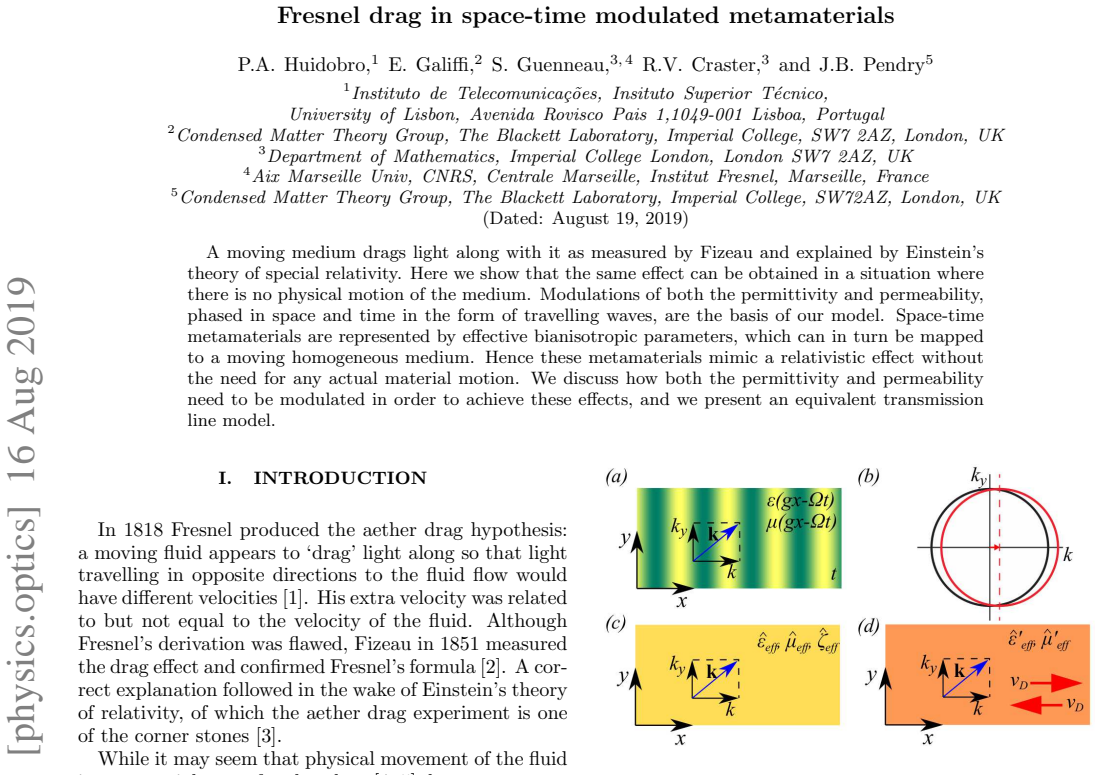
The load-bearing object is the travelling-wave modulation of both constitutive parameters, $\epsilon(x,t) = \epsilon_m[1 + 2\alpha_e\cos(gx - \Omega t)]$ and $\mu(x,t) = \mu_m[1 + 2\alpha_m\cos(gx - \Omega t)]$, combined with a Bloch-Floquet treatment of Maxwell's equations and a three-mode truncation valid for long wavelengths. This yields the displaced-circle dispersion relation of Eq. (12), whose center shift $\delta\omega$ is the Fresnel drag. The same dispersion is then matched to a uniaxial bianisotropic medium, and ultimately to a moving uniaxial medium through Lorentz transformations; the magnetoelectric coupling $\xi$ carries the drag effect in the static effective description.
What would settle it
Measure the isofrequency contours of a transmission line or metamaterial with equal electric and magnetic travelling-wave modulations at low frequency: if the centers of the contours remain at $k = 0$ rather than shifting by $\delta = \alpha_e\alpha_m\, 2g\Omega/(c_m^2g^2 - \Omega^2)$, the Fresnel-drag claim is falsified. A simpler numerical check is to solve the full Bloch-Floquet eigenvalue equation and compare the exact contour centres with Eq. (12).
Extended reading notes
Core claim
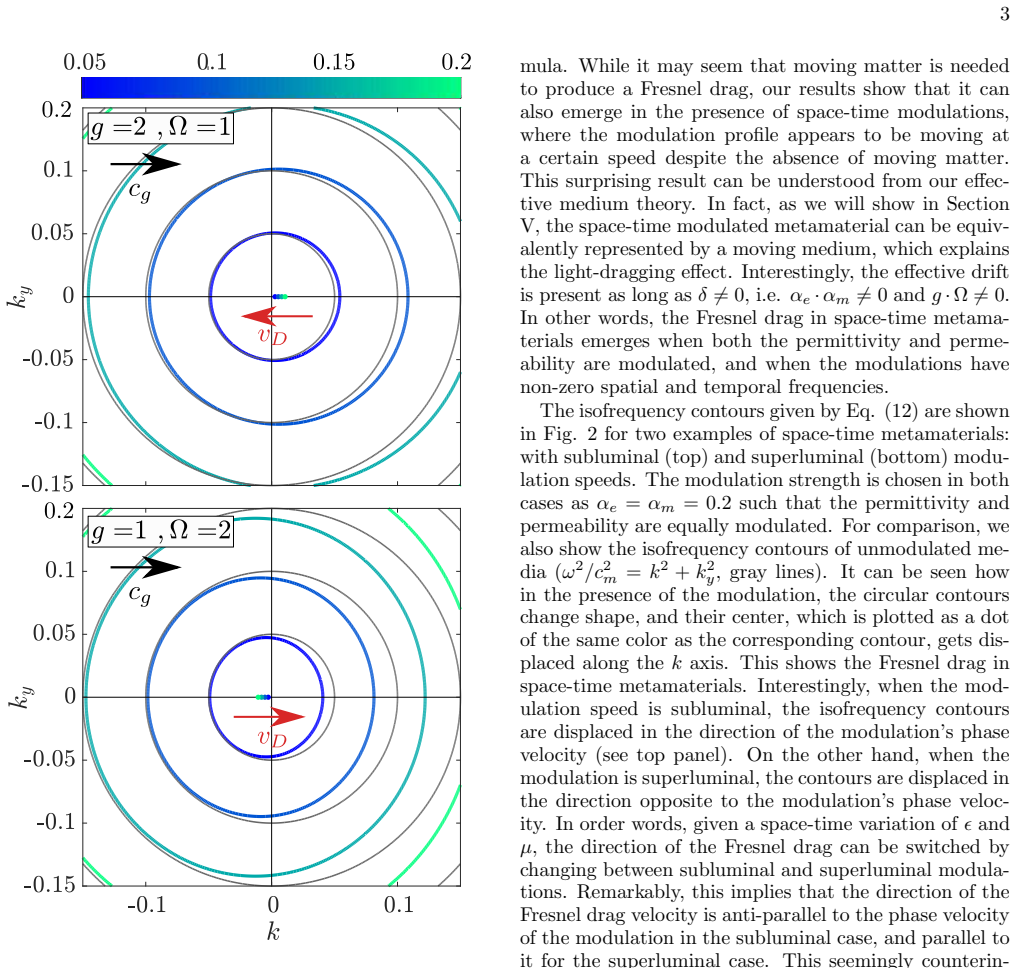
On the paper's own terms, the central discovery is that space-time modulation of both $\epsilon$ and $\mu$ produces a genuine Fresnel drag in the absence of mechanical motion. Working from a Bloch-Floquet solution of Maxwell's equations, and keeping only three neighbouring modes to obtain the long-wavelength limit, the authors obtain $\beta^2\omega^2 = \kappa^2 k_y^2 + (k - \delta\omega)^2$, with $\delta = \alpha_e\alpha_m\, 2g\Omega/(c_m^2g^2 - \Omega^2)$. The isofrequency contours are therefore circles displaced along the modulation axis, which is exactly the dispersion signature of a moving medium. The displacement is nonzero only when both material parameters are modulated with nonzero spatial and temporal frequencies; the drag direction reverses between subluminal and superluminal modulation. The paper further shows that the medium is equivalent to a bianisotropic medium with magnetoelectric coupling $\xi = \delta$, and that for $\alpha_e = \alpha_m$ the effective parameters match those of a uniaxial medium moving with velocity $v_D \approx -\alpha^2\, 2c_m^2 g\Omega/(c_m^2g^2 - \Omega^2)$.
Load-bearing premise
The whole drag interpretation rests on the long-wavelength limit in which three neighbouring Bloch-Floquet modes give the displaced-circle dispersion of Eq. (12); if the Lorentz-transformation step connecting those effective parameters to a moving medium is only approximate in $v_D$, the claimed magnitude of the drag velocity would change.
Editorial extensions
If this is right
- If the dispersion relation $\beta^2\omega^2 = \kappa^2 k_y^2 + (k - \delta\omega)^2$ is correct, low-frequency light in a space-time modulated medium should show a phase-velocity splitting $\Delta = 2\delta$ between forward and backward waves whenever both $\epsilon$ and $\mu$ are modulated.
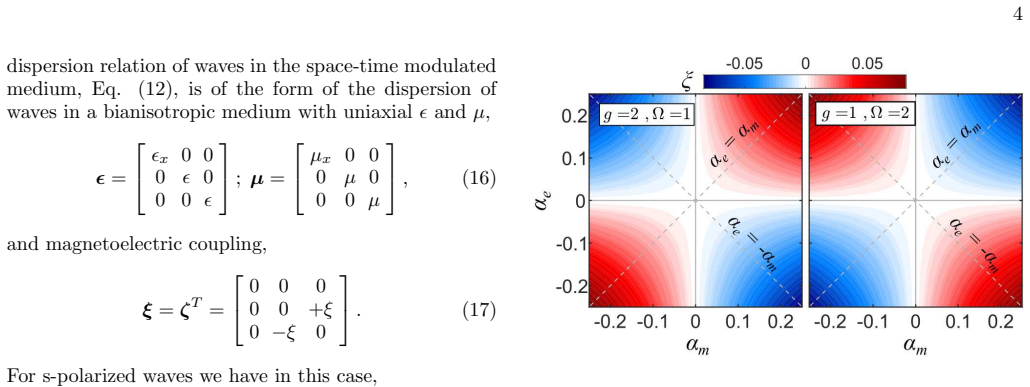
- The effective magnetoelectric coupling $\xi = \delta$ should be measurable as non-reciprocal propagation, with the strongest effect when $\alpha_e = \alpha_m$ for fixed total modulation strength.
- Switching the modulation from subluminal to superluminal should reverse both $\xi$ and the drag velocity, turning a fast forward mode into a slow one without changing the physical layout.
- The proposed transmission line, with modulated varactors and ferrite-core inductors, should exhibit the dragged dispersion at radio frequencies near a few megahertz.
- Because a single-parameter modulation gives $\delta = 0$, the same analysis predicts no long-wavelength Fresnel drag if only $\epsilon$ or only $\mu$ is modulated.
Reading between the lines
- A natural extension the authors do not develop is to use the subluminal/superluminal sign switch as a switchable non-reciprocal component; because the effect is set by the pump amplitude and phase, it could be toggled faster than mechanically moving media.
- The equivalence to a moving medium suggests that other relativistic kinematics, such as apparent time dilation or wavelength shifts, could be tested in a laboratory frame using classical waves under travelling-wave modulation.
- The acoustic analogue noted in the paper could be tested with modulated density and bulk modulus; a positive result would extend the drag concept to sound waves.
Signed reviews
Editorial analysis
A structured set of objections, weighed in public.
Referee Report
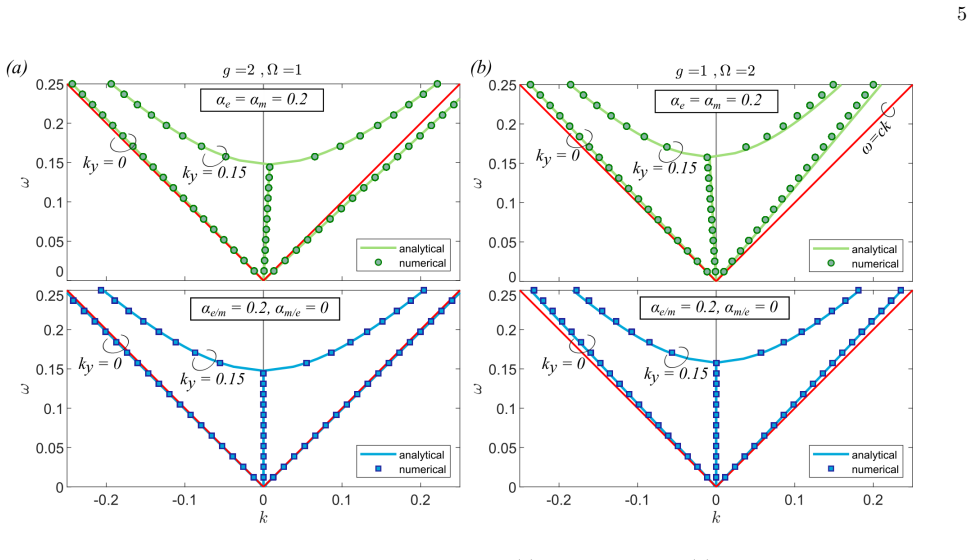
Summary. This paper studies a medium whose permittivity and permeability are modulated by a traveling wave in space and time. Using a Bloch-Floquet ansatz and a low-frequency, long-wavelength approximation, the authors derive the dispersion relation in Eq. (12), in which the isofrequency contours are displaced by δω along the modulation direction. They interpret this displacement as a Fresnel drag effect that arises without physical motion, identify effective bianisotropic parameters in Eqs. (19)-(22), attempt to map these parameters to a moving uniaxial medium in Section V, and propose a transmission-line implementation in Section VII. The analytical dispersion relation is compared with numerical Bloch-Floquet solutions in Fig. 4.
Significance. If the central dispersion result holds, the paper offers a clean demonstration that space-time modulation of both ε and μ produces a shifted dispersion surface and effective magnetoelectric coupling, with numerical validation of Eq. (12) in Fig. 4 being a genuine strength. The bianisotropic parameter identification is transparent and falsifiable. However, the moving-medium mapping in Section V contains a dimensional inconsistency and an algebraic error that invalidate Eq. (28), so the abstract's claim that the metamaterial 'can in turn be mapped to a moving homogeneous medium' is not supported as written. The core shifted-dispersion and bianisotropic results appear independent of this mapping, so the central physics is likely salvageable, but the equivalence claim needs correction or removal.
major comments (4)
- [Section V, Eqs. (27)-(28)] The key result vD≈−ξc_m²ε'μ' does not follow from the preceding formulas. Equation (27) defines a dimensionless magnetoelectric coupling, (v/c_m)(ε'μ'−1)/(ε'μ'−v²/c_m²), whereas the effective ξ in Eq. (22) has units of s/m, so equating the two requires an unstated factor of c_m. Inverting Eq. (27) to first order in the coupling gives v≈ξc_mε'μ'/(ε'μ'−1), not Eq. (28). Since Eq. (29) yields ε'−1=O(α²), the two expressions differ by a factor of order 1/α². The quantitative drag velocity and the subsequent sign and magnitude claims based on Eq. (28) are therefore unsupported.
- [Section V, moving-medium parameter range] The proposed moving-medium equivalence fails for a substantial parameter range. For α_e=α_m, the effective parameters (19)-(22) require a dimensionless magnetoelectric-to-permittivity ratio ξc_m/(ε−1)=c_m/c_g. In a moving uniaxial medium with ε'=μ' and |v|<c_m, a short calculation from Eqs. (24)-(27) shows this ratio cannot exceed values of order unity and in fact remains below 2, while c_m/c_g can be arbitrarily large for subluminal modulations with c_g→0. Thus for sufficiently subluminal modulation no real moving medium with the assumed properties exists. The abstract's equivalence claim is therefore not supported unless the mapping is reformulated or restricted.
- [Section VI, after Eqs. (30)-(31)] The verbal description of the drag direction contradicts both Section V and the inequalities that immediately follow. For subluminal c_g<c_m, Eqs. (30)-(31) give v_+<c_m and |v_-|>c_m, meaning forward waves slow down and backward waves speed up. The text in Section VI states the opposite ('forward waves ... speed up and backward waves slow down'), while Section V correctly states the forward-slow/backward-fast behavior. This internal inconsistency affects the physical interpretation of the drag direction and must be corrected.
- [Section VII, Appendix B] The transmission-line model is claimed to reproduce Fresnel drag, but the proof is omitted; the sentence 'it can be proven that our transmission line model reproduces the Fresnel drag' is not a derivation. Since the experimental proposal in Section VII rests on this model, the supporting calculation should either be shown explicitly or the claim should be stated as a conjecture.
minor comments (4)
- [General notation] The dimensionless velocities c_g=Ω/g and c_m=1/√(ε_mμ_m) should be defined explicitly at first use; Fig. 2 uses 'subluminal (g>Ω)' and 'superluminal (Ω>g)' without stating the relation to c_g and c_m.
- [Section II, Eq. (12)] The paper states that Eq. (12) is obtained by considering three neighboring modes and approximating ω≪Ω, k≪g, but the detailed reduction is not shown. The numerical agreement in Fig. 4 is reassuring, but a brief outline of the truncation and the order of neglected terms would improve reproducibility.
- [Section III, paragraph 3] There is a typo: 'In order words' should be 'In other words'.
- [Section V, Eq. (29)] Equation (29) is stated as an approximation without specifying the order of the neglected terms; given the issue with Eq. (28), the approximation should be re-derived and stated explicitly.
Circularity Check
No circularity: the dispersion and effective-medium results are derived from Maxwell's equations, with the moving-medium mapping presented as an interpretive equivalence rather than as a fitted prediction.
full rationale
The paper's load-bearing result, Eq. (12), is obtained analytically from Maxwell's equations in the space-time modulated medium using a Bloch-Floquet expansion and a long-wavelength three-mode truncation. The effective bianisotropic parameters in Eqs. (19)-(22) are then identified by direct comparison of Eq. (12) with Eq. (18), which is the dispersion relation of a known bianisotropic medium; this is an exact algebraic identification, not a fit to data and not an input hidden inside the derivation of Eq. (12). The Fresnel drag statement in Section III is read off from the displaced isofrequency circles, which follow from the derived dispersion relation, so the claimed effect is not assumed in advance. Section V's mapping to a moving medium is explicitly presented as an interpretation supported by previously established formulas for moving uniaxial media (cited from Kong and from prior moving-media literature); no self-citation is used as the unique or load-bearing justification, and the paper does not invoke any uniqueness theorem to forbid alternative descriptions. The transmission-line model is proposed as an independent realization, not used to infer the effective parameters. Consequently, no step reduces by construction to its own inputs or renames a fitted parameter as a prediction. A possible algebraic issue in the inversion from Eq. (27) to Eq. (28) would concern correctness of the moving-medium parameters, but it is not a circularity: the moving-medium velocity is not fitted to the drag effect, and the main dispersion result does not depend on that mapping.
Assumptions & free parameters
free parameters (2)
- α_e (electric modulation strength) =
0.2 in examples (variable)
- α_m (magnetic modulation strength) =
0.2 in examples (variable)
assumptions (4)
- domain assumption Bloch-Floquet expansion truncated to three neighbouring modes with ω≪Ω and k≪g
- domain assumption Background parameters ε_m and μ_m greater than 1, and a dispersionless approximation
- domain assumption s-polarized waves treated without loss of generality
- standard math Lorentz-transformation formulas (24)-(27) for a moving uniaxial medium
Cite this review
Pith. "Pith review of Fresnel drag in space-time modulated metamaterials." pith.science (2026). https://pith.science/paper/VPLKFYWU
@misc{pith2026190805883,
  author       = {Pith},
  title        = {Pith review of: Fresnel drag in space-time modulated metamaterials},
  year         = {2026},
  howpublished = {\url{https://pith.science/paper/VPLKFYWU}},
  note         = {Machine review of arXiv:1908.05883}
}
read the original abstract
A moving medium drags light along with it as measured by Fizeau and explained by Einstein's theory of special relativity. Here we show that the same effect can be obtained in a situation where there is no physical motion of the medium. Modulations of both the permittivity and permeability, phased in space and time in the form of travelling waves, are the basis of our model. Space-time metamaterials are represented by effective bianisotropic parameters, which can in turn be mapped to a moving homogeneous medium. Hence these metamaterials mimic a relativistic effect without the need for any actual material motion. We discuss how both the permittivity and permeability need to be modulated in order to achieve these effects, and we present an equivalent transmission line model.
Figures
Figures from the paper (2 more)

Reference graph
Works this paper leans on
-
[1]
A. Fresnel. Lettre d’augustin fresnel ` a fran¸ cois arago sur l’influence du mouvement terrestre dans quelques ph´ enom` enes d’optique. Annales de Chimie et de Physique, 9:57–67, 1818
-
[2]
H. Fizeau. Sur les hypoth` eses relatives ` a l’´ ether lumineux. Comptes Rendus de l’Acad´ emie des Sciences, 33:349–355, 1851
- [3]
-
[4]
Electromagnetic nonreciprocity
Christophe Caloz, Andrea Al` u, Sergei Tretyakov, Dim- itrios Sounas, Karim Achouri, and Zo´ e-Lise Deck-L´ eger. Electromagnetic nonreciprocity. Phys. Rev. Applied , 10:047001, Oct 2018
work page 2018
-
[5]
Christophe Caloz and Zo´ e-Lise Deck-L´ eger. Spacetime metamaterials. arXiv preprint arXiv:1905.00560 , 2019
work page Pith review arXiv 1905
-
[6]
Joshua N. Winn, Shanhui Fan, John D. Joannopoulos, and Erich P. Ippen. Interband transitions in photonic crystals. Physical Review B, 59:1551–1554, Jan 1999
work page 1999
-
[7]
Electrically driven nonreciprocity induced by interband photonic transition on a silicon chip
Hugo Lira, Zongfu Yu, Shanhui Fan, and Michal Lipson. Electrically driven nonreciprocity induced by interband photonic transition on a silicon chip. Physical review letters, 109(3):033901, 2012
work page 2012
-
[8]
Dispersion relations in time- space periodic media: Part i—stable interactions
ES Cassedy and AA Oliner. Dispersion relations in time- space periodic media: Part i—stable interactions. Pro- ceedings of the IEEE , 51(10):1342–1359, 1963
work page 1963
Show all 29 references
-
[9]
Dispersion relations in time-space periodic media part ii—unstable interactions
ES Cassedy. Dispersion relations in time-space periodic media part ii—unstable interactions. Proceedings of the IEEE, 55(7):1154–1168, 1967
1967
-
[10]
Uskov, and Eoin P
Fabio Biancalana, Andreas Amann, Alexander V. Uskov, and Eoin P. O’Reilly. Dynamics of light propagation in spatiotemporal dielectric structures. Phys. Rev. E , 75:046607, Apr 2007
2007
-
[11]
Non-reciprocal photonics based on time modulation
Dimitrios L Sounas and Andrea Al` u. Non-reciprocal photonics based on time modulation. Nature Photonics, 11(12):774, 2017
2017
-
[12]
Negative landau damping in bilayer graphene
Tiago A Morgado and M´ ario G Silveirinha. Negative landau damping in bilayer graphene. Physical Review Letters, 119(13):133901, 2017
2017
-
[13]
Parametric amplification and bidirectional in- visibility in pt-symmetric time-floquet systems
Theodoros T Koutserimpas, Andrea Al` u, and Romain Fleury. Parametric amplification and bidirectional in- visibility in pt-symmetric time-floquet systems. Physical Review A, 97(1):013839, 2018
2018
-
[14]
Galiffi, P
E. Galiffi, P. A. Arroyo, and J. B. Pendry. Broadband nonreciprocal THz amplification in luminal graphene metasurfaces. arXiv:1907.08421
1907 arXiv
-
[15]
Non- reciprocal gain in non-hermitian time-floquet systems
Theodoros T Koutserimpas and Romain Fleury. Non- reciprocal gain in non-hermitian time-floquet systems. Physical Review Letters, 120(8):087401, 2018
2018
-
[16]
Parity–time synthetic photonic lattices
Alois Regensburger, Christoph Bersch, Mohammad-Ali Miri, Georgy Onishchukov, Demetrios N Christodoulides, and Ulf Peschel. Parity–time synthetic photonic lattices. Nature, 488(7410):167, 2012
2012
-
[17]
Pho- tonic weyl point in a two-dimensional resonator lattice with a synthetic frequency dimension
Qian Lin, Meng Xiao, Luqi Yuan, and Shanhui Fan. Pho- tonic weyl point in a two-dimensional resonator lattice with a synthetic frequency dimension. Nature Commu- nications, 7:13731, 2016
2016
-
[18]
Floquet topological insulators for sound
Romain Fleury, Alexander B Khanikaev, and Andrea Alu. Floquet topological insulators for sound. Nature Communications, 7:11744, 2016
2016
-
[19]
Floquet chern insulators of light
Li He, Zachariah Addison, Jicheng Jin, Eugene J Mele, Steven G Johnson, and Bo Zhen. Floquet chern insulators of light. arXiv preprint arXiv:1902.08560 , 2019
1902 arXiv
-
[20]
Complete optical isolation created by indirect interband photonic transitions
Zongfu Yu and Shanhui Fan. Complete optical isolation created by indirect interband photonic transitions. Na- ture Photonics, 3(2):91, 2009
2009
-
[21]
Giant non-reciprocity at the subwavelength scale using angular momentum-biased metamaterials
Dimitrios L Sounas, Christophe Caloz, and Andrea Alu. Giant non-reciprocity at the subwavelength scale using angular momentum-biased metamaterials. Nature Com- munications, 4:2407, 2013
2013
-
[22]
Magnetic-free non-reciprocity and isolation based on parametrically modulated coupled-resonator loops
Nicholas A Estep, Dimitrios L Sounas, Jason Soric, and Andrea Al` u. Magnetic-free non-reciprocity and isolation based on parametrically modulated coupled-resonator loops. Nature Physics, 10(12):923, 2014
2014
-
[23]
Giant linear nonreciprocity, zero re- flection, and zero band gap in equilibrated space-time- varying media
Sajjad Taravati. Giant linear nonreciprocity, zero re- flection, and zero band gap in equilibrated space-time- varying media. Phys. Rev. Applied, 9:064012, Jun 2018
2018
-
[24]
Electromagnetic Wave Theory
Jin Au Kong. Electromagnetic Wave Theory . Wiley- Interscience, New York, US, 1986
1986
-
[25]
Trans- mission lines emulating moving media
Joni Vehmas, Silvio Hrabar, and Sergei Tretyakov. Trans- mission lines emulating moving media. New Journal of Physics, 16(9):093065, 2014
2014
-
[26]
Silveirinha
M´ ario G. Silveirinha. Spontaneous parity-time-symmetry breaking in moving media. Phys. Rev. A , 90:013842, Jul 2014
2014
-
[27]
Realizing effec- tive magnetic field for photons by controlling the phase of dynamic modulation
Kejie Fang, Zongfu Yu, and Shanhui Fan. Realizing effec- tive magnetic field for photons by controlling the phase of dynamic modulation. Nature Photonics, 6(11):782, 2012
2012
-
[28]
Sound isolation and giant linear nonreciprocity in a compact acoustic cir- culator
Romain Fleury, Dimitrios L Sounas, Caleb F Sieck, Michael R Haberman, and Andrea Al` u. Sound isolation and giant linear nonreciprocity in a compact acoustic cir- culator. Science, 343(6170):516–519, 2014
2014
-
[29]
Modulated phononic crystals: Non-reciprocal wave propagation and willis materials
H Nassar, XC Xu, AN Norris, and GL Huang. Modulated phononic crystals: Non-reciprocal wave propagation and willis materials. Journal of the Mechanics and Physics of Solids, 101:10–29, 2017
2017
Reviewed August 14, 2026 · model on record in the stance chip above.
Discussion (0). Continue with ORCID to comment.