REVIEW 3 major objections 5 minor 42 references
Variable-preconditioned transformed primal-dual method for generalized Wasserstein Gradient Flows
T0 review · 3 major / 5 minor · reviewed 2026-08-04 · deepseek-v4-flash
Pith's one-line read A variable-preconditioned transformed primal-dual method solves generalized Wasserstein gradient flows up to 20 times faster than existing methods while preserving structure.
desk verdict Useful numerical extension of TPD to nonsmooth JKO, with a real internal inconsistency in the adaptive step-size table that needs fixing before the speedups are reproducible. read the letter →
The pith
A machine-rendered reading of the paper's core claim, the machinery that carries it, and where it could break.
The reading
What carries the argument
The central mechanism is the variable-preconditioned transformed primal-dual flow, with the specific preconditioners I_u = diag(∇²F̂_h(u^k)) (the diagonal of the Hessian of a regularized objective at the previous JKO solution) and I_p = B I_u^{-1} B^T (the Schur complement). This transformation makes the saddle-point system nearly upper triangular and diagonally dominant, almost decoupling primal and dual updates; the nonsmooth transport cost is handled through a separable proximal operator, and each component-wise subproblem is solved by a bound-preserving Newton iteration.
What would settle it
Run Algorithm 4.1 on the 1D saturation test with λ0 set 100 times above the paper's value (λ0=5 instead of 0.05). If iteration counts still drop by 99% and energy remains monotone, the hidden step-size bound is not load-bearing; if the iteration count or energy error blows up, the adaptive rule is genuinely fixing an otherwise unstable regime.
Extended reading notes
Core claim
Each step of the dynamic JKO scheme for generalized Wasserstein gradient flows is a nonsmooth, linearly constrained minimization. The paper shows it can be solved efficiently by a transformed primal-dual (TPD) method extended with proximal splitting. The method uses variable-dependent diagonal preconditioners—I_u from the Hessian of a regularized objective, I_p its Schur complement—that nearly decouple the primal and dual updates. The paper proves the component-wise proximal subproblem has a unique bounded solution for concave mobilities and a convergent, bound-preserving Newton solver. Numerical tests in 1D–3D report up to 99.8% fewer iterations and a 20x CPU speedup, while preserving energ
Load-bearing premise
The outer iteration's convergence and the reported speedups depend on the heuristic adaptive step-size rule staying within a stability bound for λ and σ that the paper does not estimate rigorously; if for some energy or mobility that hidden bound is violated, the iteration counts and CPU improvements do not transfer.
Editorial extensions
If this is right
- The reported speedups imply that for the tested problems, the computational bottleneck shifts from iteration count to per-iteration matrix inversion, where the paper notes that parallel and high-performance computing techniques could yield further gains.
- The proved existence, uniqueness, and bound-preserving Newton solver for the proximal subproblem makes the method applicable to a broad class of concave mobilities, including degenerate cases M(ρ)=ρ and M(ρ)=1−ρ².
- The semi-implicit-explicit splitting provides a template for extending transformed primal-dual methods to other nonsmooth optimization problems that combine a smooth energy with a separable convex nonsmooth term under linear constraints.
- The adaptive step-size rule demonstrates a practical way to maintain acceleration when the smooth part's Lipschitz constant is not explicitly known, and the paper's numerical results show it further improves efficiency beyond the constant-step version.
Reading between the lines
- We infer that the diagonal-Hessian preconditioning idea could transfer to other saddle-point problems where the objective is a sum of a smooth term and a separable nonsmooth term, such as optimal transport-based inverse problems or imaging.
- A rigorous convergence analysis of the outer iteration would likely require a sharp bound on λ and σ in terms of the Lipschitz constant of ∇J_h under the I_u metric and the condition number of B I_u^{-1}B^T; such a bound is absent from the paper.
- A testable extension is to replace the heuristic adaptive rule with a backtracking line search on a Lyapunov functional; if convergence can be certified, the method would gain a verifiable guarantee without losing its speed.
- The success of the component-wise proximal Newton solver suggests that the same bound-preserving strategy could accelerate other primal-dual schemes that currently rely on expensive exact proximal evaluations.
Editorial analysis
A structured set of objections, weighed in public.
Referee Report
Summary. The paper proposes VPTPD, a variable-preconditioned transformed primal-dual method for the fully discrete dynamic JKO scheme (2.3) of generalized Wasserstein gradient flows. The method combines proximal-gradient splitting of the nonsmooth transport action with explicit treatment of the smooth energy, variable-dependent diagonal preconditioners based on the Hessian of a regularized objective, a component-wise proximal-operator Newton solver, and an adaptive step-size rule. Numerical experiments in 1D, 2D, and 3D report large reductions in iteration counts and CPU time relative to PDJKO and PrePDJKO, including speedups up to about 20x, while preserving energy dissipation, mass conservation, and density bounds.
Significance. If the algorithmic claims hold, the paper is a useful contribution to structure-preserving computation of Wasserstein-type gradient flows, with potential practical impact on large-scale simulation. The paper gives the algorithm in detail, specifies default parameters and stopping criteria, and reports thorough benchmark comparisons against existing methods rather than deriving the central efficiency claim from those methods; the comparative claims are therefore not circular. The inner proximal subproblem is treated seriously: Theorem 4.2 addresses existence, uniqueness, bounds, and Newton convergence for two families of concave mobilities. The main weaknesses are the lack of a convergence theory for the outer iteration and an internal inconsistency in the adaptive step-size parameters used in the headline speedup table.
major comments (3)
- [§4.3, Eq. (4.11) and Table 2] The adaptive rule is internally inconsistent with the reported parameters. Section 4.3 defines γ−∈(0,1) as a decrement factor and requires γ+·γ−<1, but the caption of Table 2 sets γ−=16 (with γ+=10), so γ+·γ−=160. Under (4.11), the 'decrease' branch would multiply λ by 16 whenever a convergence monitor worsens, which is the opposite of the stated decrement mechanism. Since the VPTPD(s) speedups in Tables 2–4 rely on this adaptive rule, the reported results are not reproducible from the text. Please correct the table or the rule and re-run the affected experiments; this is not a typographical nit, as it changes the algorithm actually executed.
- [§4.1 / §4.3] The outer iteration (4.1) has no convergence proof. Theorem 4.2 concerns only the component-wise proximal subproblem (4.6), and Section 4.3 explicitly states that no rigorous upper bound on λ and σ is currently available. The paper's central numerical claim—that VPTPD converges in far fewer iterations than PrePDJKO—therefore rests on an unproved algorithmic step. In a numerical analysis journal this needs to be addressed: either provide a convergence/stability theorem for (4.1) under stated assumptions, or clearly state that the outer iteration is heuristic and temper the corresponding claims in the abstract and introduction.
- [§4.2, Theorem 4.2] The proof of Theorem 4.2 is sketched rather than complete. After deriving L(ρ) in (4.8), the proof states that L'(ρ)>0 is 'easy to check' and then refers to Table 1 for root intervals, signs of L'', initial Newton values, and endpoint solutions. No derivation is given for the interval classification or for the Newton convergence conclusion, even though this theorem is one of the four main contributions claimed in the abstract. Please supply a complete argument, or a reference to a prior result that contains it, for each case in Table 1.
minor comments (5)
- [Throughout] There are several typos and grammatical slips: 'trasport' (p.2), 'contuity' (p.4), 'taclking' (p.6), 'inditates' (p.11), 'ojec-tive' (p.8), and 'conditioner number' should be 'condition number' (p.9).
- [Algorithm 4.1] The control flow is confusing: the algorithm uses an outer 'while' and inner 'repeat' with the stopping criteria placed at line 9. The nesting should be clarified, and the algorithm should specify how the outer JKO iterations and inner fixed-point iterations terminate.
- [§4.1, near Eq. (4.1)] The notation '∇F_h = ∇J_h(u^n) + 1/(2τ)∂Φ_h(u^{n+1})' is dimensionally/notationally imprecise: since F_h=Φ_h/(2τ)+J_h, the subgradient term should be written as (1/(2τ))∂Φ_h(u^{n+1}) with an explicit understanding of where it is evaluated. Please rewrite to avoid confusion.
- [§2] The text says the full discrete scheme is 'elaborated elsewhere' and 'we refer the readers to the supplementary document,' but no supplementary document is included in the arXiv listing. If the derivation is not repeated, a complete reference to the prior publication is needed.
- [References] Reference [11] is listed with volume '0 (0)' and pages 'S386–S413'; the publication details should be completed or marked as accepted/in press.
Circularity Check
No significant circularity: the headline speedups are benchmark-verified against PDJKO/PrePDJKO; cited TPD/JKO works are building blocks with independent support, not the target result.
full rationale
The paper's central efficiency claim is that Algorithm 4.1 with variable preconditioners I_u = diag(∇²F̂_h(u^k)) and I_p = B(I_u)^{-1}B^T accelerates the fully discrete dynamic JKO solve (2.3). This is established by direct numerical comparisons in Tables 2–4 against PDJKO and PrePDJKO, i.e., it is externally falsifiable and not an output reconstructed from the inputs. The TPD transformation (3.4)–(3.6) and the JKO preconditioning framework are adopted from the authors' prior papers ([11,13] and [10]), but these are published methods with independent derivations and benchmarks; the present paper adds a proximal-splitting extension, a diagonal Hessian-based preconditioner, a Newton solver, and an adaptive step heuristic. Theorem 4.2's existence/uniqueness statement is backed by a strong-convexity argument (with Table 1 supplied), so it is not merely imported. Flagged non-circular limitations: Section 4.3 states "we currently do not have a rigorous estimate" for the λ,σ stability bound, so outer-iteration convergence of (4.1) is heuristic; and Table 2 lists "γ− = 16" while Section 4.3 requires "γ− ∈ (0,1)" and "γ+·γ− < 1" (with γ+ = 10), an internal inconsistency that threatens reproducibility of the adaptive speedups. These are correctness/robustness concerns, not circular reductions, and leave the circularity score at 0.
Assumptions & free parameters
free parameters (5)
- regularization parameter r in bphi =
1e-5
- extrapolation coefficients kappa1, kappa2 =
0.3, 0.8
- initial step sizes lambda0, sigma0 =
varies by experiment (0.556/0.667, 0.05, 1/0.3)
- adaptive step parameters lambda_max, lambda_min, gamma_+, gamma_-, theta_max =
3*lambda0, lambda0, 1.2, 0.8, 0.99
- stopping tolerances tol, TOL =
1e-5
assumptions (6)
- domain assumption The energy J has the form (1.2) and the admissible set is {rho: M(rho) >= 0, mass constant}.
- domain assumption Mobility M is concave and of the form rho^xi or (rho-alpha)^xi(beta-rho)^xi, xi in (0,1].
- domain assumption The regularized objective bF_h in (4.3) is twice differentiable and strictly convex for suitable tau when M(rho) >= 0.
- ad hoc to paper Successive JKO solutions u^k and u^{k+1} are close enough that a preconditioner built from u^k suffices.
- ad hoc to paper A sufficiently small lambda and sigma exists for the outer iteration (4.1) to converge, and the adaptive rule can find it.
- standard math Standard convex analysis and monotonicity properties used in the Newton solver proof.
Cite this review
Pith. "Pith review of Variable-preconditioned transformed primal-dual method for generalized Wasserstein Gradient Flows." pith.science (2026). https://pith.science/paper/VQ62ISH5
@misc{pith2026250915385,
  author       = {Pith},
  title        = {Pith review of: Variable-preconditioned transformed primal-dual method for generalized Wasserstein Gradient Flows},
  year         = {2026},
  howpublished = {\url{https://pith.science/paper/VQ62ISH5}},
  note         = {Machine review of arXiv:2509.15385}
}
abstract
We propose a Variable-Preconditioned Transformed Primal-Dual (VPTPD) method for solving generalized Wasserstein gradient flows based on the structure-preserving JKO scheme. This is a nontrivial extension of the TPD method [Chen et al. (2025) SIAM J. Sci. Comput.] incorporating proximal splitting techniques to address the challenges arising from the nonsmoothness of the objective function. Our key contributions include: (i) a semi-implicit-explicit iterative scheme that combines proximal gradient steps with explicit gradient steps to treat the nonsmooth and smooth terms respectively; (ii) variable-dependent preconditioners constructed from the Hessian of a regularized objective to balance iteration count and per-iteration cost; (iii) a proof of existence and uniqueness of bounded solutions for the generalized proximal operator with the chosen preconditioner, along with a convergent and bound-preserving Newton solver; and (iv) an adaptive step-size strategy to improve robustness and accelerate convergence under poor Lipschitz conditions of the energy derivative. Comprehensive numerical experiments spanning from 1D to 3D settings demonstrate that our method achieves superior computational efficiency--achieving up to a 20$\times$ speedup over existing methods-thereby highlighting its broad applicability through several challenging simulations.
Figures


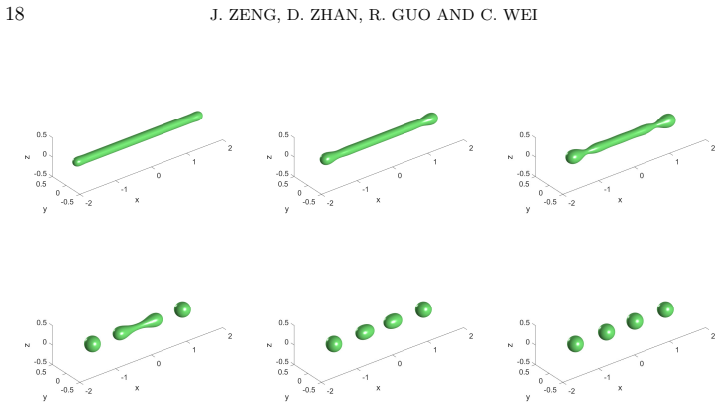
Figures from the paper (7 more)



Reference graph
Works this paper leans on
-
[1]
Ambrosio, N
L. Ambrosio, N. Gigli, and G. Savare , Gradient flows in metric spaces and in the space of probability measures , Springer, (2005)
2005
-
[2]
Bailo, J
R. Bailo, J. A. Carrillo, and J. Hu , Bound-preserving finite-volume schemes for systems of continuity equations with saturation , SIAM Journal on Applied Mathematics, 83 (2023), pp. 1315--1339
2023
-
[3]
Baskaran, J
A. Baskaran, J. S. Lowengrub, C. Wang, and S. M. Wise , Convergence analysis of a second order convex splitting scheme for the modified phase field crystal equation , SIAM Journal on Numerical Analysis, 51 (2013), pp. 2851--2873
2013
-
[4]
Benamou and Y
J.-D. Benamou and Y. Brenier , A computational fluid mechanics solution to the monge-kantorovich mass transfer problem , Numerische Mathematik, 84 (2000), pp. 375--393
2000
-
[5]
Benamou, G
J.-D. Benamou, G. Carlier, and M. Laborde , An augmented lagrangian approach to wasserstein gradient flows and applications , ESAIM: Proceedings and surveys, 54 (2016), pp. 1--17
2016
-
[6]
J. A. Carrillo, A. Chertock, and Y. Huang , A finite-volume method for nonlinear nonlocal equations with a gradient flow structure , Communications in Computational Physics, 17 (2015), pp. 233--258
2015
-
[7]
J. A. Carrillo, K. Craig, L. Wang, and C. Wei , Primal dual methods for wasserstein gradient flows , Foundations of Computational Mathematics, 22 (2022), pp. 389--443
2022
-
[8]
J. A. CARRILLO, Y. HUANG, and S. MARTIN , Explicit flock solutions for quasi-morse potentials , European Journal of Applied Mathematics, 25 (2014), p. 553–578, https://doi.org/10.1017/S0956792514000126
Show all 42 references
-
[9]
J. A. Carrillo, S. Lisini, G. Savar \'e , and D. Slep c ev , Nonlinear mobility continuity equations and generalized displacement convexity , Journal of Functional Analysis, 258 (2010), pp. 1273--1309
2010
-
[10]
J. A. Carrillo, L. Wang, and C. Wei , Structure preserving primal dual methods for gradient flows with nonlinear mobility transport distances , 2024
2024
-
[11]
L. Chen, R. Guo, and J. Wei , Transformed primal-dual methods with variable-preconditioners , arXiv preprint arXiv:2312.12355, (2023)
2023 arXiv
-
[12]
Chen and J
L. Chen and J. Wei , Transformed primal--dual methods for nonlinear saddle point systems , Journal of Numerical Mathematics, 31 (2023), pp. 281--311
2023
-
[13]
Y. Chen, T. A. Davis, W. W. Hager, and S. Rajamanickam , Algorithm 887: Cholmod, supernodal sparse cholesky factorization and update/downdate , ACM Transactions on Mathematical Software (TOMS), 35 (2008), pp. 1--14
2008
-
[14]
Cheng, Q
Q. Cheng, Q. Liu, W. Chen, and J. Shen , A new flow dynamic approach for wasserstein gradient flows , Journal of Computational Physics, 524 (2025), p. 113696, https://doi.org/https://doi.org/10.1016/j.jcp.2024.113696
2025
-
[15]
Cheng and J
Q. Cheng and J. Shen , A new lagrange multiplier approach for constructing structure preserving schemes, i. positivity preserving , Computer Methods in Applied Mechanics and Engineering, 391 (2022), p. 114585
2022
-
[16]
Cheng and J
Q. Cheng and J. Shen , A new lagrange multiplier approach for constructing structure preserving schemes, ii. bound preserving , SIAM Journal on Numerical Analysis, 60 (2022), pp. 970--998
2022
-
[17]
De Giorgi , New problems on minimizing movements , Ennio de Giorgi: selected papers, (1993), pp
E. De Giorgi , New problems on minimizing movements , Ennio de Giorgi: selected papers, (1993), pp. 699--713
1993
-
[18]
Y. Deng, L. Wang, and C. Wei , Efficient primal-dual forward-backward splitting method for wasserstein-like gradient flows with general nonlinear mobilities , 2025, https://arxiv.org/abs/2504.12713
2025 arXiv
-
[19]
Dolbeault, B
J. Dolbeault, B. Nazaret, and G. Savaré , A new class of transport distances between measures , Calculus of Variations and Partial Differential Equations, 34 (2009), pp. 193--231
2009
-
[20]
C. M. Elliott and H. Garcke , On the cahn–hilliard equation with degenerate mobility , SIAM Journal on Mathematical Analysis, 27 (1996), pp. 404--423
1996
-
[21]
D. J. Eyre , Unconditionally gradient stable time marching the cahn-hilliard equation , MRS online proceedings library (OPL), 529 (1998), p. 39
1998
-
[22]
Frank, A
F. Frank, A. Rupp, and D. Kuzmin , Bound-preserving flux limiting schemes for dg discretizations of conservation laws with applications to the cahn--hilliard equation , Computer Methods in Applied Mechanics and Engineering, 359 (2020), p. 112665
2020
-
[23]
D. Hou, L. Ju, and Z. Qiao , Energy-dissipative spectral renormalization exponential integrator method for gradient flow problems , SIAM Journal on Scientific Computing, 46 (2024), pp. A3477--A3502
2024
-
[24]
Huang and J
F. Huang and J. Shen , Bound/positivity preserving and energy stable sav schemes for dissipative systems: applications to keller-segel and poisson-nernst-planck equations , Siam J. Sci. Comput, 43 (2021)
2021
-
[25]
Huang, Z
Q. Huang, Z. Qiao, C. Wang, and H. Yang , Maximum bound principle and bound preserving etd schemes for a phase-field model of tumor growth with extracellular matrix degradation , arXiv preprint arXiv:2503.18699, (2025)
2025 arXiv
-
[26]
Q. A. Huang, W. Jiang, and J. Yang , An efficient and unconditionally energy stable scheme for simulating solid-state dewetting of thin films with isotropic surface energy , Communications in Computational Physics, 26 (2019), pp. 1444--1470
2019
-
[27]
Huang, W
Q.-A. Huang, W. Jiang, J. Z. Yang, and C. Yuan , A structure-preserving, upwind-sav scheme for the degenerate cahn--hilliard equation with applications to simulating surface diffusion , Journal of Scientific Computing, 97 (2023), p. 64
2023
-
[28]
Jacobs, F
M. Jacobs, F. L\' e ger, W. Li, and S. Osher , Solving large-scale optimization problems with a convergence rate independent of grid size , SIAM Journal on Numerical Analysis, 57 (2019), pp. 1100--1123
2019
-
[29]
Jordan, D
R. Jordan, D. Kinderlehrer, and F. Otto , The variational formulation of the fokker--planck equation , SIAM journal on mathematical analysis, 29 (1998), pp. 1--17
1998
-
[30]
L. Ju, J. Zhang, and Q. Du , Fast and accurate algorithms for simulating coarsening dynamics of cahn--hilliard equations , Computational Materials Science, 108 (2015), pp. 272--282
2015
-
[31]
A. A. Lee., A. Münch, and E. Süli , Degenerate mobilities in phase field models are insufficient to capture surface diffusion , Applied Physics Letters, 107 (2015), p. 081603
2015
-
[32]
H. G. Lee and J. Kim , Accurate contact angle boundary conditions for the cahn--hilliard equations , Computers & fluids, 44 (2011), pp. 178--186
2011
-
[33]
W. Li, J. Lu, and L. Wang , Fisher information regularization schemes for wasserstein gradient flows , Journal of Computational Physics, 416 (2020), p. 109449
2020
-
[34]
Lisini, D
S. Lisini, D. Matthes, and G. Savar \'e , Cahn--hilliard and thin film equations with nonlinear mobility as gradient flows in weighted-wasserstein metrics , Journal of differential equations, 253 (2012), pp. 814--850
2012
-
[35]
Y. Liu, Y. Xu, and W. Yin , Acceleration of primal--dual methods by preconditioning and simple subproblem procedures , Journal of Scientific Computing, 86 (2021), p. 21
2021
-
[36]
Papadakis, G
N. Papadakis, G. Peyr \'e , and E. Oudet , Optimal transport with proximal splitting , SIAM Journal on Imaging Sciences, 7 (2014), pp. 212--238
2014
-
[37]
J. Shen, J. Xu, and J. Yang , The scalar auxiliary variable (sav) approach for gradient flows , Journal of Computational Physics, 353 (2018), pp. 407--416
2018
-
[38]
Xu and T
C. Xu and T. Tang , Stability analysis of large time-stepping methods for epitaxial growth models , SIAM Journal on Numerical Analysis, 44 (2006), pp. 1759--1779
2006
-
[39]
Yan , A new primal–dual algorithm for minimizing the sum of three functions with a linear operator , Journal of Scientific Computing, 76 (2018), pp
M. Yan , A new primal–dual algorithm for minimizing the sum of three functions with a linear operator , Journal of Scientific Computing, 76 (2018), pp. 1698--1717
2018
-
[40]
Yang and G
X. Yang and G. Zhang , Convergence analysis for the invariant energy quadratization (ieq) schemes for solving the cahn–hilliard and allen–cahn equations with general nonlinear potential , Journal of Scientific Computing, 82 (2020), p. 28
2020
-
[41]
Z. Zhou, W. Jiang, T. Qian, and Z. Zhang , A new phase-field model for anisotropic surface diffusion: Anisotropic cahn-hilliard equation with improved conservation (ach-ic) , (2025), https://arxiv.org/abs/2507.18048, https://arxiv.org/abs/2507.18048
2025 arXiv
-
[42]
write newline
" write newline "" before.all 'output.state := FUNCTION fin.entry add.period write newline FUNCTION new.block output.state before.all = 'skip after.block 'output.state := if FUNCTION not #0 #1 if FUNCTION and 'skip pop #0 if FUNCTION or pop #1 'skip if FUNCTION new.block.check...
Reviewed August 4, 2026 · model on record in the stance chip above.
Discussion (0). Continue with ORCID to comment.