REVIEW 2 minor 2 cited by
Vortex NOON states for rotation sensing
T0 review · 0 major / 2 minor · reviewed 2026-06-30 · grok-4.3
Pith's one-line read Vortex NOON states of bosonic atoms detect external rotations at the Heisenberg limit.
desk verdict This paper gives a concrete, workable proposal for making vortex NOON states on usable timescales and turning them into a rotation sensor at the Heisenberg limit. read the letter →
The pith
A machine-rendered reading of the paper's core claim, the machinery that carries it, and where it could break.
The reading
What carries the argument
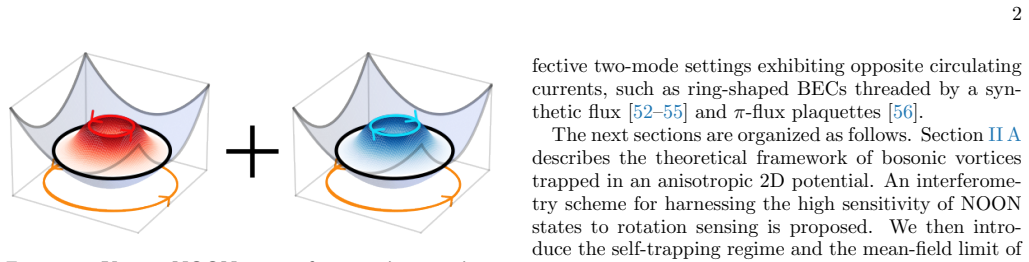
Effective two-mode Bose-Hubbard model defined by vortex modes (p_x ± i p_y) carrying opposite circulation in the p orbitals of the trap.
What would settle it
An experiment that fails to produce a spectrally isolated NOON manifold or that measures rotation sensitivity no better than the standard quantum limit would falsify the central claim.
Extended reading notes
Core claim
Vortex NOON states of few-body bosonic vortices can be generated in a weakly anisotropic two-dimensional harmonic trap where single-particle p orbitals define an effective two-mode Bose-Hubbard model with modes (p_x ± i p_y) carrying opposite circulation. In the self-trapping regime the NOON manifold is spectrally isolated and collective tunneling produces highly entangled vortex NOON states; geodesic counterdiabatic driving and resonance-chaos-assisted tunneling accelerate their creation on relevant timescales with near-unit fidelity. An interferometric protocol that exploits the states' intrinsic sensitivity to rotation then detects infinitesimal external rotations at the Heisenberg limit.
Load-bearing premise
The single-particle p orbitals in the weakly anisotropic trap define an effective two-mode Bose-Hubbard model whose vortex modes carry opposite circulation.
Editorial extensions
If this is right
- The NOON manifold becomes spectrally isolated in the self-trapping regime.
- Geodesic counterdiabatic driving produces the states for small particle numbers on short timescales.
- Resonance- and chaos-assisted tunneling produces the states for larger particle numbers.
- The interferometric protocol reaches Heisenberg-limited rotation detection.
Reading between the lines
- The same vortex-orbital construction could be attempted in other trap anisotropies or with higher angular-momentum orbitals.
- Combining the two acceleration strategies might further shorten preparation times beyond what either achieves alone.
- The metrological protocol may generalize to other many-body systems that host circulating modes.
Editorial analysis
A structured set of objections, weighed in public.
Referee Report
Summary. The paper introduces a scheme to generate NOON states of few-body bosonic vortices in a weakly anisotropic 2D harmonic trap, where single-particle p orbitals define an effective two-mode Bose-Hubbard model with vortex modes (p_x ± i p_y) carrying opposite circulation. In the self-trapping regime the NOON manifold is spectrally isolated; collective tunneling produces highly entangled vortex NOON states, but on long timescales. Two acceleration protocols (geodesic counterdiabatic driving for small N and resonance/chaos-assisted tunneling for larger N) are developed to reach near-unit fidelity on usable timescales. An interferometric protocol is then presented that maps the ±2N angular-momentum difference onto a rotation-induced phase, recovering Heisenberg-limited rotation sensing.
Significance. If the effective two-mode modeling and fidelity claims hold, the work supplies a concrete, experimentally relevant route to rotation metrology with entangled vortex states in cold atoms. The use of standard Josephson-junction constructions together with explicit parameter regimes, fidelity benchmarks, and a closed interferometric sequence is a strength; the absence of ad-hoc free parameters in the core derivation further supports the proposal.
minor comments (2)
- The abstract states that the NOON manifold 'becomes spectrally isolated' in the self-trapping regime; a brief quantitative statement of the gap size relative to other manifolds (e.g., in terms of the interaction strength U/J) would help readers assess robustness without consulting the figures.
- The two acceleration protocols are presented as complementary; a short table or paragraph comparing the accessible particle-number ranges, required control precision, and residual fidelity loss for each method would improve clarity.
Simulated Author's Rebuttal
We thank the referee for the detailed and positive summary of our manuscript on vortex NOON states for rotation sensing. The recommendation for minor revision is noted. No specific major comments were provided in the report, so we have no point-by-point responses at this time. We are happy to incorporate any minor changes or clarifications if the editor or referee identifies them.
Circularity Check
No significant circularity detected
full rationale
The paper's derivation begins from the standard effective two-mode Bose-Hubbard model for p_x ± i p_y vortex orbitals in a weakly anisotropic trap, a well-established approximation in the literature. Spectral isolation of the NOON manifold, collective tunneling, acceleration protocols (geodesic counterdiabatic driving and resonance/chaos-assisted tunneling), and the interferometric protocol mapping ±2N angular momentum to rotation phase are all constructed using conventional quantum mechanics, Josephson-junction techniques, and metrology methods without any reduction to fitted parameters defined by the target claim, self-definitional loops, or load-bearing self-citations. The Heisenberg-limit sensitivity follows directly from the intrinsic properties of the NOON states within the model, rendering the chain self-contained against external benchmarks.
Assumptions & free parameters
assumptions (1)
- domain assumption The single-particle p orbitals define an effective two-mode Bose-Hubbard model with vortex modes carrying opposite circulation.
Cite this review
Pith. "Pith review of Vortex NOON states for rotation sensing." pith.science (2026). https://pith.science/paper/VQCNIPG7
@misc{pith2026260629509,
  author       = {Pith},
  title        = {Pith review of: Vortex NOON states for rotation sensing},
  year         = {2026},
  howpublished = {\url{https://pith.science/paper/VQCNIPG7}},
  note         = {Machine review of arXiv:2606.29509}
}
abstract
We introduce a scheme to generate NOON states of few-body bosonic vortices and demonstrate their application as high-precision rotation sensors. Our approach is based on cold atoms in a weakly anisotropic two-dimensional harmonic trap, where the single-particle p orbitals define an effective two-mode Bose-Hubbard model with vortex modes $(\mathrm{p}_x\pm\mathrm{i}\mathrm{p}_y)$ carrying opposite circulation. In the self-trapping regime, we show that the NOON manifold becomes spectrally isolated, and collective tunneling processes give rise to highly entangled vortex NOON states. However, these states emerge on prohibitively long timescales. To overcome this limitation, we develop two complementary acceleration strategies: geodesic counterdiabatic driving for small particle numbers, and resonance- and chaos-assisted tunneling in the semiclassical regime at larger particle numbers. Both approaches enable the generation of NOON states on experimentally relevant timescales while preserving near-unit fidelities. Finally, we quantify the metrological advantage of vortex NOON states by introducing an interferometric protocol that exploits their intrinsic sensitivity to rotation, enabling the detection of infinitesimal external rotations at the Heisenberg limit. Our work opens the door to rotation sensors based on atomic NOON states, generically realizable in bosonic Josephson junctions with vortex-type orbitals.
Figures


Figures from the paper (6 more)


Forward citations
Cited by 2 Pith papers
-
Quantum Many-Body Metrology of Rotation Sensing with Strong Interactions
For a few bosons in a ring with two weak links, strong interactions make the many-body quantum Fisher information at zero rotation nonzero and large, improving slow-rotation sensing beyond the Bose-Hubbard prediction.
-
Time-independent counterdiabatic driving for emergent two-level subspaces in many-body systems
Geodesic parameter trajectories make the counterdiabatic Hamiltonian time-independent for effective two-level systems, reducing shortcuts to adiabaticity to fixed-amplitude controls.
Reference graph
Works this paper leans on
-
[1]
Shortcut to adiabaticity The possibility of adiabatically generating a NOON state is opened by the separation of the energy lev- els corresponding to the states of interest. The adia- batic theorem states that when the Hamiltonian varies slowly compared to the intrinsic timescale set by the level splitting between the energy eigenstates, the system re- ma...
-
[2]
However, impor- tant connections have been established between geodesic and counterdiabatic driving [50, 51, 100, 101]
Geodesic counterdiabatic driving A priori, the CDH is defined independently of the choice of the driving function Ω. However, impor- tant connections have been established between geodesic and counterdiabatic driving [50, 51, 100, 101]. The combination of these two driving strategies, known as geodesic counterdiabatic driving (GCD), makes it possi- ble to...
-
[3]
Floquet-Magnus emulation of the complex coupling The need to introduce a complex coupling ∆ eff may, however, pose practical difficulties. A viable solution to implement ∆eff is through Floquet engineering, by adding an oscillating term to the Bose-Hubbard Hamiltonian, emulating the additional complex phase [98, 99, 104, 105]. We show that such an alterna...
-
[4]
By analogy with Bloch’s theorem in space, time-periodic Hamiltonians are conveniently treated within the Floquet formalism [110]
Driven two-mode system Assuming, as before, control over the energy difference between the vortex modes±, we consider the following periodic drive of the Hamiltonian (22): ˆH(t) =− U 3 ˆb†2 + ˆb2 + + ˆb†2 − ˆb2 − − ∆ 2 ˆb† +ˆb− + ˆb† −ˆb+ −ℏΩ cos(ωt)(ˆn+ −ˆn−),(40) withℏΩ andωthe amplitude and angular frequency of the modulation. By analogy with Bloch’s t...
-
[5]
Quantizing Eq
Resonance- and chaos-assisted tunneling In the vicinity of a nonlinearr:s-resonance chain inside the regular island ( ˜I < ˜Ic), the driven Hamiltonian (43) admits the effective description [45, 46] ˜H(r:s) eff (˜I, ˜θ) = (˜I− ˜Ir:s)2 2 ˜mr:s + 2˜Vr:scos(r˜θ),(48) parametrized by the resonance action ˜Ir:s, the effec- tive mass ˜m r:s and the resonance co...
-
[6]
As established in Sec
NOON state preparation from RAT and CAT Figure 9 summarizes the phenomenology of the RAT- CAT acceleration as the modulation angular frequencyω is varied, at a fixed amplitude of modulationℏΩ = 3.8 ∆. As established in Sec. III B 1, this amplitude sets the de- gree of non-integrability: it must be large enough to de- velop the connected chaotic sea and th...
-
[7]
Pro- jecting ˆH1b (2) onto this manifold directly yields Eq. (6), with (E 10 +E 01)/2 = 2ℏ¯ω,E10 −E 01 =−∆, ˆnx −ˆny = ˆb† +ˆb− + ˆb† −ˆb+ and ˆLz = iRℏ(ˆb† yˆbx − ˆb† xˆby) =Rℏ(ˆn+ −ˆn−).(B5) The interaction Hamiltonian (7) is derived from the two-mode bosonic field (B2) as ˆHint = g2D 2 ZZ ∞ −∞ dxdy ˆψ†2(x, y) ˆψ2(x, y).(B6) Expanding the fields in the ...
-
[8]
C. L. Degen, F. Reinhard, and P. Cappellaro, Quantum sensing, Rev. Mod. Phys.89, 035002 (2017)
2017
Show all 139 references
-
[9]
Pezz` e, A
L. Pezz` e, A. Smerzi, M. K. Oberthaler, R. Schmied, and P. Treutlein, Quantum metrology with nonclassical states of atomic ensembles, Rev. Mod. Phys.90, 035005 (2018)
2018
-
[10]
Pezz` e and A
L. Pezz` e and A. Smerzi, Heisenberg-Limited Noisy Atomic Clock Using a Hybrid Coherent and Squeezed State Protocol, Phys. Rev. Lett.125, 210503 (2020)
2020
-
[11]
H. Kwon, K. C. Tan, T. Volkoff, and H. Jeong, Nonclas- sicality as a Quantifiable Resource for Quantum Metrol- ogy, Phys. Rev. Lett.122, 040503 (2019)
2019
-
[12]
Ye and P
J. Ye and P. Zoller, Essay: Quantum Sensing with Atomic, Molecular, and Optical Platforms for Funda- mental Physics, Phys. Rev. Lett.132, 190001 (2024)
2024
-
[13]
Panda, M
C. Panda, M. Tao, M. Ceja, J. Khoury, G. Tino, and H. M¨ uller, Measuring gravitational attraction with a lat- tice atom interferometer, Nature631, 1 (2024)
2024
-
[14]
Pezz´ e and A
L. Pezz´ e and A. Smerzi, Mach-Zehnder Interferometry at the Heisenberg Limit with Coherent and Squeezed- Vacuum Light, Phys. Rev. Lett.100, 073601 (2008)
2008
-
[15]
J. A. Jones, S. D. Karlen, J. Fitzsimons, A. Ardavan, 18 S. C. Benjamin, G. A. D. Briggs, and J. J. L. Mor- ton, Magnetic field sensing beyond the standard quan- tum limit using 10-spin noon states, Science324, 1166 (2009)
2009
-
[16]
D. W. Hallwood, A. Stokes, J. J. Cooper, and J. Dun- ningham, Measuring atomic NOON-states and using them to make precision measurements, New Journal of Physics11, 103040 (2009)
2009
-
[17]
P. C. Humphreys, M. Barbieri, A. Datta, and I. A. Walmsley, Quantum enhanced multiple phase estima- tion, Phys. Rev. Lett.111, 070403 (2013)
2013
-
[18]
Enrico Fermi
L. Pezz´ e and A. Smerzi,Atom Interferometry, Pro- ceedings of the International School of Physics “Enrico Fermi”, Vol. 188 (IOS Press, 2014) pp. 691–741
2014
-
[19]
Zhang, M
J. Zhang, M. Um, D. Lv, J.-N. Zhang, L.-M. Duan, and K. Kim, NOON States of Nine Quantized Vibrations in Two Radial Modes of a Trapped Ion, Phys. Rev. Lett. 121, 160502 (2018)
2018
-
[20]
Canuel, F
B. Canuel, F. Leduc, D. Holleville, A. Gauguet, J. Fils, A. Virdis, A. Clairon, N. Dimarcq, C. J. Bord´ e, A. Lan- dragin, and P. Bouyer, Six-Axis Inertial Sensor Using Cold-Atom Interferometry, Phys. Rev. Lett.97, 010402 (2006)
2006
-
[21]
Kumar, T
P. Kumar, T. Biswas, K. Feliz, R. Kanamoto, M.-S. Chang, A. K. Jha, and M. Bhattacharya, Cavity op- tomechanical sensing and manipulation of an atomic persistent current, Phys. Rev. Lett.127, 113601 (2021)
2021
-
[22]
Roy and O
R. Roy and O. E. Alon, Inferring rotations using a bosonic josephson junction (2026), arXiv:2601.13344 [cond-mat.quant-gas]
2026
-
[23]
Y. Li, Y. Castin, and A. Sinatra, Optimum spin squeez- ing in bose-einstein condensates with particle losses, Phys. Rev. Lett.100, 210401 (2008)
2008
-
[24]
I. Afek, O. Ambar, and Y. Silberberg, High-NOON States by Mixing Quantum and Classical Light, Science 328, 879 (2010)
2010
-
[25]
C. Song, K. Xu, W. Liu, C.-P. Yang, S.-B. Zheng, H. Deng, Q. Xie, K. Huang, Q. Guo, L. Zhang, P. Zhang, D. Xu, D. Zheng, X. Zhu, H. Wang, Y.-A. Chen, C.-Y. Lu, S. Han, and J.-W. Pan, 10-Qubit Entanglement and Parallel Logic Operations with a Superconducting Cir- cuit, Phys. Re...
2017
-
[26]
J. I. Cirac, M. Lewenstein, K. Mølmer, and P. Zoller, Quantum superposition states of Bose-Einstein conden- sates, Phys. Rev. A57, 1208 (1998)
1998
-
[27]
Gordon and C
D. Gordon and C. M. Savage, Creating macroscopic quantum superpositions with Bose-Einstein conden- sates, Phys. Rev. A59, 4623 (1999)
1999
-
[28]
Sørensen, L.-M
A. Sørensen, L.-M. Duan, J. I. Cirac, and P. Zoller, Many-particle entanglement with Bose–Einstein con- densates, Nature409, 63–66 (2001)
2001
-
[29]
K. W. Mahmud, H. Perry, and W. P. Reinhardt, Phase engineering of controlled entangled number states in a single component Bose–Einstein condensate in a double well, J. Phys. B: At. Mol. Opt. Phys36, L265 (2003)
2003
-
[30]
Schenke, A
C. Schenke, A. Minguzzi, and F. W. J. Hekking, Nona- diabatic creation of macroscopic superpositions with strongly correlated one-dimensional bosons in a ring trap, Phys. Rev. A84, 053636 (2011)
2011
-
[31]
Photonic
U. R. Fischer and M.-K. Kang, “Photonic” Cat States from Strongly Interacting Matter Waves, Phys. Rev. Lett.115, 260404 (2015)
2015
-
[32]
A. A. Bychek, D. N. Maksimov, and A. R. Kolovsky, NOON state of Bose atoms in the double-well potential via an excited-state quantum phase transition, Phys. Rev. A97, 063624 (2018)
2018
-
[33]
Pezz` e, M
L. Pezz` e, M. Gessner, P. Feldmann, C. Klempt, L. San- tos, and A. Smerzi, Heralded Generation of Macroscopic Superposition States in a Spinor Bose-Einstein Conden- sate, Phys. Rev. Lett.123, 260403 (2019)
2019
-
[34]
L. D. Carr, D. R. Dounas-Frazer, and M. A. Garcia- March, Dynamical realization of macroscopic superpo- sition states of cold bosons in a tilted double well, EPL 90, 10005 (2010)
2010
-
[35]
Schneider Gr¨ un, K
D. Schneider Gr¨ un, K. Wittmann Wilsmann, L. Ymai, J. Links, and A. Foerster, Protocol designs for NOON states, Commun Phys5(2022)
2022
-
[36]
Beringer, M
L. Beringer, M. Steinhuber, J. Diego Urbina, K. Richter, and S. Tomsovic, Controlling many-body quantum chaos: Bose-Hubbard systems, New Journal of Physics 26, 073002 (2024)
2024
-
[37]
Smerzi, S
A. Smerzi, S. Fantoni, S. Giovanazzi, and S. R. Shenoy, Quantum Coherent Atomic Tunneling between Two Trapped Bose-Einstein Condensates, Phys. Rev. Lett. 79, 4950 (1997)
1997
-
[38]
G. J. Milburn, J. Corney, E. M. Wright, and D. F. Walls, Quantum dynamics of an atomic Bose-Einstein conden- sate in a double-well potential, Phys. Rev. A55, 4318 (1997)
1997
-
[39]
Albiez, R
M. Albiez, R. Gati, J. F¨ olling, S. Hunsmann, M. Cris- tiani, and M. K. Oberthaler, Direct Observation of Tun- neling and Nonlinear Self-Trapping in a Single Bosonic Josephson Junction, Phys. Rev. Lett.95, 010402 (2005)
2005
-
[40]
Zhang, Y
H. Zhang, Y. K. Wang, Y. Zheng,et al., Scalable gen- eration of massive Schr¨ odinger cat states via quantum tunnelling, Nature Physics 10.1038/s41567-026-03281-9 (2026)
2026 doi
-
[41]
Lapert, G
M. Lapert, G. Ferrini, and D. Sugny, Optimal control of quantum superpositions in a bosonic Josephson junc- tion, Phys. Rev. A85, 023611 (2012)
2012
-
[42]
C. P. Koch, U. Boscain, T. Calarco, G. Dirr, S. Fil- ipp, S. J. Glaser, R. Kosloff, S. Montangero, T. Schulte- Herbr¨ uggen, D. Sugny, and F. K. Wilhelm, Quan- tum optimal control in quantum technologies. Strate- gic report on current status, visions and goals for research in ...
2022 doi
-
[43]
X. Chen, A. Ruschhaupt, S. Schmidt, A. del Campo, D. Gu´ ery-Odelin, and J. G. Muga, Fast Optimal Fric- tionless Atom Cooling in Harmonic Traps: Shortcut to Adiabaticity, Phys. Rev. Lett.104, 063002 (2010)
2010
-
[44]
X. Chen, I. Lizuain, A. Ruschhaupt, D. Gu´ ery-Odelin, and J. G. Muga, Shortcut to Adiabatic Passage in Two- and Three-Level Atoms, Phys. Rev. Lett.105, 123003 (2010)
2010
-
[45]
del Campo, Shortcuts to Adiabaticity by Counter- diabatic Driving, Phys
A. del Campo, Shortcuts to Adiabaticity by Counter- diabatic Driving, Phys. Rev. Lett.111, 100502 (2013)
2013
-
[46]
Deffner, C
S. Deffner, C. Jarzynski, and A. del Campo, Classi- cal and Quantum Shortcuts to Adiabaticity for Scale- Invariant Driving, Phys. Rev. X4, 021013 (2014)
2014
-
[47]
del Campo and K
A. del Campo and K. Kim, Focus on Shortcuts to Adi- abaticity, New J. Phys.21, 050201 (2019)
2019
-
[48]
Gu´ ery-Odelin, A
D. Gu´ ery-Odelin, A. Ruschhaupt, A. Kiely, E. Tor- rontegui, S. Mart´ ınez-Garaot, and J. G. Muga, Short- cuts to adiabaticity: Concepts, methods, and applica- tions, Rev. Mod. Phys.91, 045001 (2019)
2019
-
[49]
ˇCepait˙ e, A
I. ˇCepait˙ e, A. Polkovnikov, A. J. Daley, and C. W. Dun- can, Counterdiabatic Optimized Local Driving, PRX 19 Quantum4, 010312 (2023)
2023
-
[50]
Tomsovic and D
S. Tomsovic and D. Ullmo, Chaos-assisted tunneling, Phys. Rev. E50, 145 (1994)
1994
-
[51]
Brodier, P
O. Brodier, P. Schlagheck, and D. Ullmo, Resonance- Assisted Tunneling in Near-Integrable Systems, Phys. Rev. Lett.87, 064101 (2001)
2001
-
[52]
Eltschka and P
C. Eltschka and P. Schlagheck, Resonance- and Chaos- Assisted Tunneling in Mixed Regular-Chaotic Systems, Phys. Rev. Lett.94, 014101 (2005)
2005
-
[53]
Schlagheck, A
P. Schlagheck, A. Mouchet, and D. Ullmo, Resonance- assisted tunneling in mixed regular-chaotic systems, in Dynamical Tunneling: Theory and Experiment, edited by S. Keshavamurthy and P. Schlagheck (CRC Press, 2011)
2011
-
[54]
Li and W
X. Li and W. V. Liu, Physics of higher orbital bands in optical lattices: a review, Reports on Progress in Physics79, 116401 (2016)
2016
-
[55]
Vanhaele and P
G. Vanhaele and P. Schlagheck, Noon states with ultra- cold bosonic atoms via resonance- and chaos-assisted tunneling, Phys. Rev. A103, 013315 (2021)
2021
-
[56]
Vanhaele, A
G. Vanhaele, A. B¨ acker, R. Ketzmerick, and P. Schlagheck, Creating triple-NOON states with ultra- cold atoms via chaos-assisted tunneling, Phys. Rev. A 106, L011301 (2022)
2022
-
[57]
Dengis, S
S. Dengis, S. Wimberger, and P. Schlagheck, Acceler- ated creation of NOON states with ultracold atoms via counterdiabatic driving, Phys. Rev. A111, L031301 (2025)
2025
-
[58]
Dengis, S
S. Dengis, S. Wimberger, and P. Schlagheck, Multi- mode NOON-state generation with ultracold atoms via geodesic counterdiabatic driving, Phys. Rev. A112, 042610 (2025)
2025
-
[59]
Aghamalyan, M
D. Aghamalyan, M. Cominotti, M. Rizzi, D. Rossini, F. Hekking, A. Minguzzi, L.-C. Kwek, and L. Amico, Coherent superposition of current flows in an atom- tronic quantum interference device, New journal of Physics17, 045023 (2015)
2015
-
[60]
Nicolau, J
E. Nicolau, J. Mompart, B. Juli´ a-D´ ıaz, and V. Ahufin- ger, Orbital angular momentum dynamics of bose- einstein condensates trapped in two stacked rings, Phys. Rev. A102, 023331 (2020)
2020
-
[61]
Pradhan, P
N. Pradhan, P. Kumar, R. Kanamoto, T. N. Dey, M. Bhattacharya, and P. K. Mishra, Cavity optome- chanical detection of persistent currents and solitons in a bosonic ring condensate, Phys. Rev. Res.6, 013104 (2024)
2024
-
[62]
Carmona-L´ opez, A
S. Carmona-L´ opez, A. Matos-Abiague, F. Isaule, and L. Morales-Molina, Enhancing supercurrent-based in- ertial sensing via interactions in atomtronic angu- lar accelerometers (2026), arXiv:2605.02048 [cond- mat.quant-gas]
2026 arXiv
-
[63]
Di Liberto and N
M. Di Liberto and N. Goldman, Chiral orbital order of interacting bosons without higher bands, Phys. Rev. Res.5, 023064 (2023)
2023
-
[64]
Cr´ epel, R
V. Cr´ epel, R. Yao, B. Mukherjee, R. Fletcher, and M. Zwierlein, Geometric squeezing of rotating quantum gases into the lowest Landau level, Comptes Rendus. Physique24, 241 (2023)
2023
-
[65]
Upright p are used to distinguish the p x and py orbitals from thep x andp y momenta alongxandy
-
[66]
Isacsson and S
A. Isacsson and S. M. Girvin, Multiflavor bosonic Hub- bard models in the first excited Bloch band of an optical lattice, Phys. Rev. A72, 053604 (2005)
2005
-
[67]
W. V. Liu and C. Wu, Atomic matter of nonzero- momentum Bose-Einstein condensation and orbital cur- rent order, Phys. Rev. A74, 013607 (2006)
2006
-
[68]
M¨ uller, S
T. M¨ uller, S. F¨ olling, A. Widera, and I. Bloch, State Preparation and Dynamics of Ultracold Atoms in Higher Lattice Orbitals, Phys. Rev. Lett.99, 200405 (2007)
2007
-
[69]
Wirth, M
G. Wirth, M. ¨Olschl¨ ager, and A. Hemmerich, Evidence for orbital superfluidity in the P-band of a bipartite op- tical square lattice, Nature Physics7, 147–153 (2010)
2010
-
[70]
Wang, G.-Q
X.-Q. Wang, G.-Q. Luo, J.-Y. Liu, W. V. Liu, A. Hem- merich, and Z.-F. Xu, Evidence for an atomic chiral su- perfluid with topological excitations, Nature596, 227 (2021)
2021
-
[71]
Dalfovo, S
F. Dalfovo, S. Giorgini, L. P. Pitaevskii, and S. Stringari, Theory of Bose-Einstein condensation in trapped gases, Rev. Mod. Phys.71, 463 (1999)
1999
-
[72]
Goldman, O
N. Goldman, O. Diessel, L. Barbiero, M. Pr¨ ufer, M. Di Liberto, and L. Peralta Gavensky, Floquet- Engineered Nonlinearities and Controllable Pair- Hopping Processes: From Optical Kerr Cavities to Cor- related Quantum Matter, PRX Quantum4, 040327 (2023)
2023
-
[73]
Raghavan, A
S. Raghavan, A. Smerzi, S. Fantoni, and S. R. Shenoy, Coherent oscillations between two weakly coupled Bose- Einstein condensates: Josephson effects,πoscillations, and macroscopic quantum self-trapping, Phys. Rev. A 59, 620 (1999)
1999
-
[74]
A. N. Salgueiro, A. de Toledo Piza, G. B. Lemos, R. Drumond, M. C. Nemes, and M. Weidem¨ uller, Quan- tum dynamics of bosons in a double-well potential: Josephson oscillations, self-trapping and ultralong tun- neling times, Eur. Phys. J. D44, 537 (2007)
2007
-
[75]
C. W. Helstrom,Quantum Detection and Estimation Theory, Mathematics in Science and Engineering, Vol. 123 (Academic Press, New York, 1976)
1976
-
[76]
S. L. Braunstein and C. M. Caves, Statistical distance and the geometry of quantum states, Phys. Rev. Lett. 72, 3439 (1994)
1994
-
[77]
C. R. Rao, Information and the Accuracy Attainable in the Estimation of Statistical Parameters, Bulletin of the Calcutta Mathematical Society37, 81 (1945)
1945
-
[78]
Cram´ er,Mathematical Methods of Statistics(Prince- ton University Press, Princeton, 1946)
H. Cram´ er,Mathematical Methods of Statistics(Prince- ton University Press, Princeton, 1946)
1946
-
[79]
M. F. Andersen, C. Ryu, P. Clad´ e, V. Natarajan, A. Vaziri, K. Helmerson, and W. D. Phillips, Quantized Rotation of Atoms from Photons with Orbital Angular Momentum, Phys. Rev. Lett.97, 170406 (2006)
2006
-
[80]
Anker, M
T. Anker, M. Albiez, R. Gati, S. Hunsmann, B. Eier- mann, A. Trombettoni, and M. K. Oberthaler, Nonlin- ear Self-Trapping of Matter Waves in Periodic Poten- tials, Phys. Rev. Lett.94, 020403 (2005)
2005
-
[81]
Zibold, E
T. Zibold, E. Nicklas, C. Gross, and M. K. Oberthaler, Classical Bifurcation at the Transition from Rabi to Josephson Dynamics, Phys. Rev. Lett.105, 204101 (2010)
2010
-
[82]
Jaksch, C
D. Jaksch, C. Bruder, J. I. Cirac, C. W. Gardiner, and P. Zoller, Cold Bosonic Atoms in Optical Lattices, Phys. Rev. Lett.81, 3108 (1998)
1998
-
[83]
T. D. K¨ uhner and H. Monien, Phases of the one- dimensional Bose-Hubbard model, Phys. Rev. B58, R14741(R) (1998)
1998
-
[84]
Greiner, O
M. Greiner, O. Mandel, T. Esslinger, T. W. H¨ ansch, and I. Bloch, Quantum phase transition from a superfluid 20 to a Mott insulator in a gas of ultracold atoms, Nature 415, 39 (2002)
2002
-
[85]
Bloch, J
I. Bloch, J. Dalibard, and W. Zwerger, Many-body physics with ultracold gases, Rev. Mod. Phys.80, 885 (2008)
2008
-
[86]
Dupont, A
N. Dupont, A. Vashisht, and N. Goldman, Extreme frag- mentation of a Bose gas (2024), arXiv:2404.18827 [cond- mat.quant-gas]
2024
-
[87]
In Fig. 4 (b), we plot (E n −E 0)/Uversus Λ =N U/∆ rather than using ∆ as the energy unit (as elsewhere in this work), because this choice makes the self-trapping regime immediately apparent. As Λ→ ∞, the eigen- states of ˆH(9) approach the Fock states|n +, n−⟩, i.e. the eigen...
-
[88]
Husimi, Some Formal Properties of the Density Ma- trix, Proceedings of the Physico-Mathematical Society of Japan
K. Husimi, Some Formal Properties of the Density Ma- trix, Proceedings of the Physico-Mathematical Society of Japan. 3rd Series22, 264 (1940)
1940
-
[89]
G. S. Agarwal, Relation between atomic coherent-state representation, state multipoles, and generalized phase- space distributions, Phys. Rev. A24, 2889 (1981)
1981
-
[90]
Throughout this work we adoptℏ eff= 2/N[130, 131] arising from the scaling to dimensionless units above. An alternative definitionℏ eff= 2/(N+ 1), based on state counting [84, 132], is used in some semiclassical analyses of bosonic systems [48]; the two differ at order 1/Nand ...
-
[91]
E. H. Lieb, The classical limit of quantum spin sys- tems, Communications in Mathematical Physics31, 327 (1973)
1973
-
[92]
For the Earth’s rotation and the preparation times reached here (τNOON ∼10 2 to 103 ℏ/∆), 2NΩ ⊕τNOON ∼ (10−5 −10 −3)≪π/2 (forNranging from 3 to 10)
-
[93]
(10) the phase produced by the protocol
Withφin Eq. (10) the phase produced by the protocol
-
[94]
Landau, Zur theorie der energieubertragung
L. Landau, Zur theorie der energieubertragung. II, Physikalische Zeitschrift der Sowjetunion2, 46 (1932)
1932
-
[95]
Zener, Non-adiabatic crossing of energy levels, Proc
C. Zener, Non-adiabatic crossing of energy levels, Proc. R. Soc. Lond. A137, 696 (1932)
1932
-
[96]
Majorana, Atomi orientati in campo magnetico vari- abile, Il Nuovo Cimento (1924-1942)9, 43 (1932)
E. Majorana, Atomi orientati in campo magnetico vari- abile, Il Nuovo Cimento (1924-1942)9, 43 (1932)
1924
-
[97]
St¨ uckelberg, Theorie der unelastischen St¨ osse zwis- chen Atomen, Helv
E. St¨ uckelberg, Theorie der unelastischen St¨ osse zwis- chen Atomen, Helv. Phys. Acta5, 369 (1932)
1932
-
[98]
Tomka, T
M. Tomka, T. Souza, S. Rosenberg, and A. Polkovnikov, Geodesic paths for quantum many-body systems (2016), arXiv:1606.05890 [cond-mat.quant-gas]
2016 arXiv
-
[99]
Carlini, A
A. Carlini, A. Hosoya, T. Koike, and Y. Okudaira, Time-Optimal Quantum Evolution, Phys. Rev. Lett. 96, 060503 (2006)
2006
-
[100]
J. K. Nauth and V. M. Stojanovi´ c, Quantum- brachistochrone approach to the conversion fromWto Greenberger-Horne-Zeilinger states for Rydberg-atom qubits, Phys. Rev. A106, 032605 (2022)
2022
-
[101]
J. P. Provost and G. Vallee, Riemannian structure on manifolds of quantum states, Commun. Math. Phys.76, 289 (1980)
1980
-
[102]
C. W. Misner, K. S. Thorne, and J. A. Wheeler,Grav- itation(W. H. Freeman and Company, San Francisco, 1973)
1973
-
[103]
(19), the sum (25) reduces to a single term
For the two-level reduced system of Eq. (19), the sum (25) reduces to a single term
-
[104]
M. V. Berry, Transitionless quantum driving, J. Phys. A: Math. Theor.42, 365303 (2009)
2009
-
[105]
P. W. Claeys, M. Pandey, D. Sels, and A. Polkovnikov, Floquet-Engineering Counterdiabatic Protocols in Quantum Many-Body Systems, Phys. Rev. Lett.123, 090602 (2019)
2019
-
[106]
Petiziol, B
F. Petiziol, B. Dive, F. Mintert, and S. Wimberger, Fast adiabatic evolution by oscillating initial Hamiltonians, Phys. Rev. A98, 043436 (2018)
2018
-
[107]
del Campo, M
A. del Campo, M. M. Rams, and W. H. Zurek, Assisted Finite-Rate Adiabatic Passage Across a Quantum Criti- cal Point: Exact Solution for the Quantum Ising Model, Phys. Rev. Lett.109, 115703 (2012)
2012
-
[108]
Kolodrubetz, V
M. Kolodrubetz, V. Gritsev, and A. Polkovnikov, Clas- sifying and measuring geometry of a quantum ground state manifold, Phys. Rev. B88, 064304 (2013)
2013
-
[109]
Mandelstam and I
L. Mandelstam and I. Tamm, The Uncertainty Relation Between Energy and Time in Non-Relativistic Quantum Mechanics, J. Phys (USSR)9, 249 (1945)
1945
-
[110]
Kolodrubetz, D
M. Kolodrubetz, D. Sels, P. Mehta, and A. Polkovnikov, Geometry and non-adiabatic response in quantum and classical systems, Physics Reports697, 1 (2017)
2017
-
[111]
Goldman and J
N. Goldman and J. Dalibard, Periodically Driven Quan- tum Systems: Effective Hamiltonians and Engineered Gauge Fields, Phys. Rev. X4, 031027 (2014)
2014
-
[112]
Petiziol, F
F. Petiziol, F. Mintert, and S. Wimberger, Quantum control by effective counterdiabatic driving, EPL145, 15001 (2024)
2024
-
[113]
Magnus, On the exponential solution of differen- tial equations for a linear operator, Communications on Pure and Applied Mathematics7, 649 (1954)
W. Magnus, On the exponential solution of differen- tial equations for a linear operator, Communications on Pure and Applied Mathematics7, 649 (1954)
1954
-
[114]
Rahav, I
S. Rahav, I. Gilary, and S. Fishman, Effective hamilto- nians for periodically driven systems, Phys. Rev. A68, 013820 (2003)
2003
-
[115]
These are close to the energies of the Fock states, but are slightly modified by the anisotropy ∆ (see Appendix D)
-
[116]
Bohigas, S
O. Bohigas, S. Tomsovic, and D. Ullmo, Manifestations of classical phase space structures in quantum mechan- ics, Physics Reports223, 43 (1993)
1993
-
[117]
Eckardt, Colloquium: Atomic quantum gases in pe- riodically driven optical lattices, Rev
A. Eckardt, Colloquium: Atomic quantum gases in pe- riodically driven optical lattices, Rev. Mod. Phys.89, 011004 (2017)
2017
-
[118]
Grifoni and P
M. Grifoni and P. H¨ anggi, Driven quantum tunneling, Physics Reports304, 229 (1998)
1998
-
[119]
M. J. Davis and E. J. Heller, Quantum dynamical tun- neling in bound states, The Journal of Chemical Physics 75, 246 (1981)
1981
-
[120]
W. K. Hensinger, H. H¨ affner, A. Browaeys, N. R. Heckenberg, K. Helmerson, C. McKenzie, G. J. Mil- burn, W. D. Phillips, S. L. Rolston, H. Rubinsztein- Dunlop, and B. Upcroft, Dynamical tunnelling of ultra- cold atoms, Nature412, 52 (2001)
2001
-
[121]
The dimensionless action ˜Irelates to the physical action IthroughI/ℏ= ˜I/ℏeff, withℏ eff= 2/N[83, 132]
-
[122]
Wimberger,Nonlinear Dynamics and Quantum Chaos, Graduate Texts in Physics (Springer Cham, 2014)
S. Wimberger,Nonlinear Dynamics and Quantum Chaos, Graduate Texts in Physics (Springer Cham, 2014)
2014
-
[123]
When driving the system, the centers of the self- trapping islands are generally slightly displaced from the minima (z=±1) of ˜H0. When evaluating the semiclas- sical RAT coupling from the center of an island to the surrounding chaotic sea, the (φ, z) phase space (Bloch 21 sph...
-
[124]
V. I. Arnol’d, Proof of a theorem of A. N. Kolmogorov on the preservation of conditionally periodic motions under a small perturbation of the Hamiltonian, Russian Mathematical Surveys18, 9 (1963)
1963
-
[125]
B. V. Chirikov, A universal instability of many- dimensional oscillator systems, Physics Reports52, 263 (1979)
1979
-
[126]
˜Ir:s, ˜mr:s and ˜Vr:s express the corresponding physical quantitiesI r:s,m r:s andV r:s in units ofℏ/ℏ eff=Nℏ/2, Nℏ2/(2∆) andN∆/2 respectively
-
[127]
4 (a)), then-th EBK quasimode of one island corresponds to the (2n)-th eigenstate of ˆH0.E kr in Eq
Because ˆH0 exhibits quasi-degenerate doublets in the self-trapping regime (see Fig. 4 (a)), then-th EBK quasimode of one island corresponds to the (2n)-th eigenstate of ˆH0.E kr in Eq. (50) is therefore the (2kr)- th eigenvalue of ˆH0
-
[128]
Arnal, G
M. Arnal, G. Chatelain, M. Martinez, N. Dupont, O. Gi- raud, D. Ullmo, B. Georgeot, G. Lemari´ e, J. Billy, and D. Gu´ ery-Odelin, Chaos-assisted tunneling resonances in a synthetic Floquet superlattice, Science Advances 6, eabc4886 (2020)
2020
-
[129]
Martinez, O
M. Martinez, O. Giraud, D. Ullmo, J. Billy, D. Gu´ ery- Odelin, B. Georgeot, and G. Lemari´ e, Chaos-Assisted Long-Range Tunneling for Quantum Simulation, Phys. Rev. Lett.126, 174102 (2021)
2021
-
[130]
Dupont, F
N. Dupont, F. Arrouas, L. Gabardos, N. Ombredane, J. Billy, B. Peaudecerf, D. Sugny, and D. Gu´ ery-Odelin, Phase-space distributions of Bose–Einstein condensates in an optical lattice: optimal shaping and reconstruc- tion, New Journal of Physics25, 013012 (2023)
2023
-
[131]
Dupont, L
N. Dupont, L. Gabardos, F. Arrouas, N. Ombredane, J. Billy, B. Peaudecerf, and D. Gu´ ery-Odelin, Hamil- tonian Ratchet for Matter-Wave Transport, Phys. Rev. Lett.131, 133401 (2023)
2023
-
[132]
Ansel, E
Q. Ansel, E. Dionis, F. Arrouas, B. Peaudecerf, S. Gu´ erin, D. Gu´ ery-Odelin, and D. Sugny, Introduction to theoretical and experimental aspects of quantum op- timal control, Journal of Physics B: Atomic, Molecular and Optical Physics57, 133001 (2024)
2024
-
[133]
Dupont, G
N. Dupont, G. Chatelain, L. Gabardos, M. Arnal, J. Billy, B. Peaudecerf, D. Sugny, and D. Gu´ ery-Odelin, Quantum State Control of a Bose-Einstein Condensate in an Optical Lattice, PRX Quantum2, 040303 (2021)
2021
-
[134]
Stolzenberg, C
K. Stolzenberg, C. Struckmann, S. Bode, R. Li, A. Herbst, V. Vollenkemper, D. Thomas, A. Ra- jagopalan, E. M. Rasel, N. Gaaloul, and D. Schlippert, Multi-Axis Inertial Sensing with 2D Matter-Wave Ar- rays, Phys. Rev. Lett.134, 143601 (2025)
2025
-
[135]
Hadzibabic, P
Z. Hadzibabic, P. Kr¨ uger, M. Cheneau, B. Battelier, and J. Dalibard, Berezinskii-Kosterlitz-Thouless crossover in a trapped atomic gas, Nature441, 1118 (2006)
2006
-
[136]
R. Tao, M. Ammenwerth, F. Gyger, I. Bloch, and J. Zei- her, High-Fidelity Detection of Large-Scale Atom Ar- rays in an Optical Lattice, Phys. Rev. Lett.133, 013401 (2024)
2024
-
[137]
Lerose and S
A. Lerose and S. Pappalardi, Bridging entanglement dy- namics and chaos in semiclassical systems, Phys. Rev. A102, 032404 (2020)
2020
-
[138]
Dupont, B
N. Dupont, B. Peaudecerf, D. Gu´ ery-Odelin, G. Lemari´ e, B. Georgeot, C. Miniatura, and N. Gold- man, Many-body dynamical localization in Fock space (2026), arXiv:2604.09224 [cond-mat.quant-gas]
2026 arXiv
-
[139]
F. A. Berezin, General concept of quantization, Com- munications in Mathematical Physics40, 153 (1975)
1975
Reviewed June 30, 2026 · model on record in the stance chip above.
Discussion (0). Continue with ORCID to comment.