Definability of Functional Properties in the Basic Modal-Temporal Language over Ordered Frames
Pith reviewed 2026-07-02 03:55 UTC · model grok-4.3
The pith
Restricting to minimal functional frames makes many functional properties definable in the basic modal-temporal language, with the strict reading enabling definitions such as injectivity even in reflexive orders.
A machine-rendered reading of the paper's core claim, the machinery that carries it, and where it could break.
Core claim
When the semantics are restricted to the O² family of minimal functional frames, many of the nine functional properties become definable and the strict reading can define properties such as injectivity even in reflexive orders; the identical patterns appear under indexed languages and the Uniform Domain condition on L_{T×W}, showing that the expressive limitations of the multiflow setting stem from uncontrolled functional multiplicity rather than from any weakness of the operators themselves, while lack of connectivity remains a fundamental obstacle in all non-linear orders.
What carries the argument
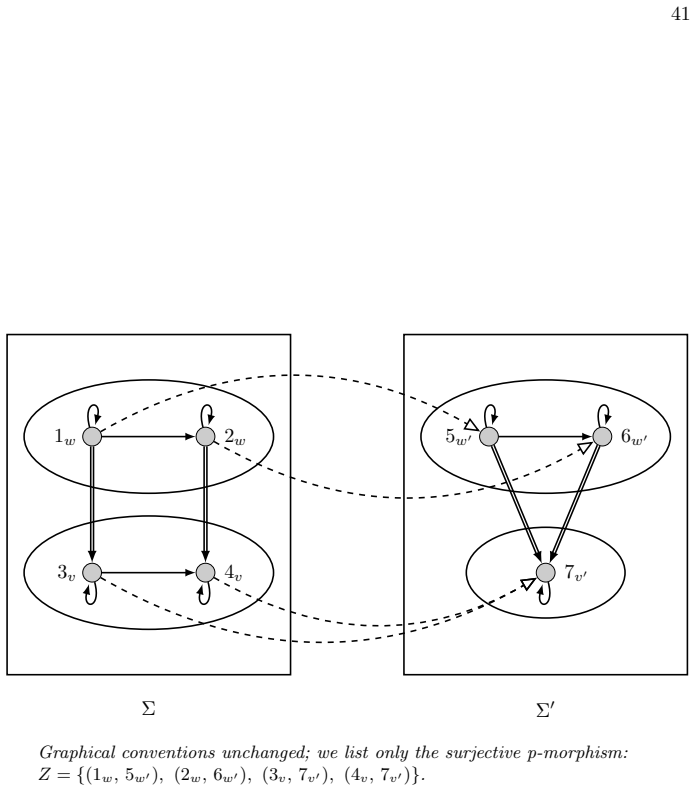
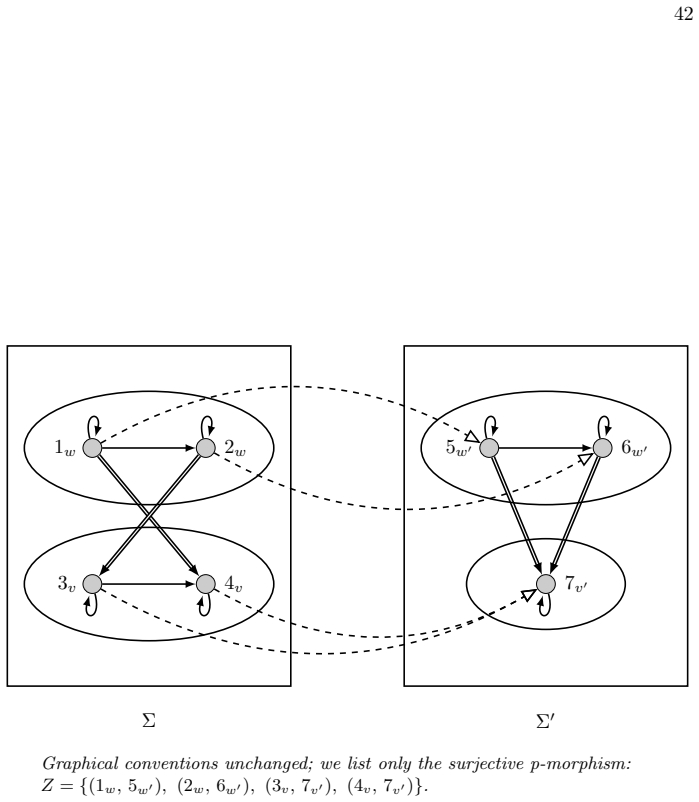
the O² family of minimal functional frames, which restricts functional multiplicity to make properties such as injectivity, surjectivity, and monotonicity definable under the L_{T×W} language.
If this is right
- Many of the nine functional properties become definable once semantics are restricted to the O² family.
- The strict reading of the temporal operators defines injectivity even on reflexive orders.
- Indexed languages and the Uniform Domain condition produce the same definability patterns as the O² restriction.
- A set of properties remains undefinable in all non-linear orders because of lack of connectivity.
Where Pith is reading between the lines
- Similar multiplicity controls could be tested in other combinations of modal and temporal operators to check whether expressivity increases in the same way.
- The results separate multiplicity control from connectivity as two distinct requirements for definability over orders.
- One could add connectivity axioms to non-linear orders and check whether the previously undefinable properties then become expressible.
- The patterns suggest examining whether the same multiplicity controls affect definability results in related bimodal languages.
Load-bearing premise
The analysis assumes that the identical definability patterns across multiflow, minimal functional frames, indexed languages, and uniform domain conditions are caused specifically by the control of functional multiplicity rather than by other unexamined semantic or syntactic factors in the language.
What would settle it
Finding a mismatch in which functional properties are definable under the O² frames versus under the Uniform Domain condition would show that multiplicity control is not the determining factor.
Figures
read the original abstract
We study the expressive power of the simplest modal-temporal language, obtained by adding Prior's temporal operators \(G\) and \(H\) to the basic modal language with \(\Box\). This language is the standard bimodal combination of modal and tense logic; under its functional interpretation it is denoted \(L_{T\times W}\). To analyse its definability across five order types, we consider two semantic readings of the temporal operators: the standard reading (\(G,H\)), which includes the current instant, and the strict reading (\(G^{\ast},H^{\ast}\)), which always excludes it. We examine nine functional properties -- totality, non-totality, injectivity, surjectivity, monotonicity, strict monotonicity, antitonicity, strict antitonicity, and constancy -- over preorders, strict preorders, partial orders, linear orders, and strict linear orders. Our analysis reveals two different levels of expressive power. In the original multiflow setting, the language is quite weak and the two readings coincide. When we restrict the semantics to minimal functional frames (the \(O^{2}\) family), many properties become definable, and the choice of reading becomes crucial: the strict reading can define properties such as injectivity even in reflexive orders. The same definability patterns appear with indexed languages and with the Uniform Domain condition on the semantics of \(L_{T\times W}\). That three such different ways of controlling functional multiplicity lead to identical definability patterns indicates that the expressive limitations of the original framework come from the uncontrolled multiplicity of functions, not from any weakness of the operators. Even after controlling functional multiplicity, a set of properties remains undefinable in all non-linear orders, showing that the lack of connectivity is a fundamental obstacle.
Editorial analysis
A structured set of objections, weighed in public.
Referee Report
Summary. The manuscript examines the expressive power of the basic modal-temporal language obtained by adding Prior's G and H to the basic modal language (denoted L_{T×W} under functional interpretation). It studies definability of nine functional properties (totality, non-totality, injectivity, surjectivity, monotonicity, strict monotonicity, antitonicity, strict antitonicity, constancy) over five order types (preorders, strict preorders, partial orders, linear orders, strict linear orders), comparing the standard reading (G, H, including the current instant) and strict reading (G*, H*, excluding it). The central claim is that the language is weak in the multiflow setting with coinciding readings, but many properties become definable when restricting to minimal functional frames (the O² family), where the choice of reading matters (e.g., strict reading defines injectivity even in reflexive orders); identical patterns hold under indexed languages and the Uniform Domain condition. This coincidence is taken to show that expressive limitations stem from uncontrolled functional multiplicity rather than operator weakness, while lack of connectivity remains an obstacle in non-linear orders.
Significance. If the definability results and the isolation of multiplicity as the key factor hold, the work would clarify how semantic restrictions interact with modal-temporal operators to determine expressive power, distinguishing operator limitations from frame multiplicity issues. The observation that connectivity is a persistent barrier even after multiplicity control, and that strict readings unlock additional definability in reflexive settings, offers concrete guidance for applications in temporal reasoning and verification. The cross-comparison across three distinct controls is a methodological strength when the variable isolation is made explicit.
major comments (2)
- [Abstract] Abstract (final paragraph): the inference that identical definability patterns across multiflow, O² minimal frames, indexed languages, and Uniform Domain 'indicates that the expressive limitations ... come from the uncontrolled multiplicity of functions, not from any weakness of the operators' is load-bearing for the central claim but requires explicit isolation that these controls differ only (or primarily) in multiplicity and share no confounding interactions with the five order types or the standard/strict readings of G/H. The manuscript should supply a side-by-side comparison or counter-model analysis showing that other semantic factors are held constant.
- [Abstract] The abstract states that 'our analysis reveals two different levels of expressive power' and that 'the same definability patterns appear' under the three controls, yet provides no derivation sketches, counter-model constructions, or error analysis for the nine properties. Without these, it is impossible to verify whether the reported patterns for, e.g., injectivity under strict reading in reflexive orders are robust or sensitive to unexamined interactions with order types.
minor comments (2)
- [Abstract] The notation O² family and L_{T×W} are introduced without a brief definitional reminder in the abstract; a one-sentence gloss would aid readers unfamiliar with the multiflow semantics.
- [Abstract] The nine properties and five order types are listed but not cross-referenced to any table or numbered list; adding such a reference would improve traceability when the patterns are discussed.
Simulated Author's Rebuttal
We thank the referee for the careful and constructive report. We respond to each major comment below, agreeing where revisions will strengthen the isolation of the multiplicity factor and improve cross-references to the supporting analyses.
read point-by-point responses
-
Referee: [Abstract] Abstract (final paragraph): the inference that identical definability patterns across multiflow, O² minimal frames, indexed languages, and Uniform Domain 'indicates that the expressive limitations ... come from the uncontrolled multiplicity of functions, not from any weakness of the operators' is load-bearing for the central claim but requires explicit isolation that these controls differ only (or primarily) in multiplicity and share no confounding interactions with the five order types or the standard/strict readings of G/H. The manuscript should supply a side-by-side comparison or counter-model analysis showing that other semantic factors are held constant.
Authors: We agree that an explicit demonstration of isolation would strengthen the central claim. Each control (O² minimal frames, indexed languages, Uniform Domain) is constructed to vary only functional multiplicity while holding the five order types and both readings of G/H fixed. In revision we will insert a side-by-side comparison table (new subsection or appendix) that tabulates the semantic parameters across the three controls, confirming constancy of order types and readings, together with two short counter-model examples illustrating that a property becomes definable precisely when multiplicity is controlled. revision: yes
-
Referee: [Abstract] The abstract states that 'our analysis reveals two different levels of expressive power' and that 'the same definability patterns appear' under the three controls, yet provides no derivation sketches, counter-model constructions, or error analysis for the nine properties. Without these, it is impossible to verify whether the reported patterns for, e.g., injectivity under strict reading in reflexive orders are robust or sensitive to unexamined interactions with order types.
Authors: The abstract summarises results whose full derivations, formulas, counter-models, and error analyses appear in Sections 3–5 of the manuscript. The definability of injectivity under the strict reading on reflexive orders, for instance, is witnessed by an explicit formula verified directly in the O² semantics. To make this linkage immediate from the abstract we will add a single sentence directing readers to the relevant sections for the nine properties; this is a minor textual change that preserves abstract length while improving verifiability. revision: partial
Circularity Check
No circularity; definability claims rest on direct semantic frame restrictions
full rationale
The paper derives definability results by applying the language's semantics (standard vs. strict readings of G/H) to explicitly defined frame classes (multiflow, O² minimal functional frames, indexed languages, Uniform Domain) over five order types and nine properties. No equations reduce a 'prediction' to a fitted input by construction, no self-citations are invoked as load-bearing uniqueness theorems, and no ansatz or renaming of known results occurs. The inference that identical patterns across three controls implicate multiplicity (rather than other factors) is an interpretive claim about causation, not a self-definitional or fitted reduction; the derivation chain remains self-contained against the stated semantic definitions.
Axiom & Free-Parameter Ledger
axioms (1)
- standard math Standard Kripke semantics for the basic modal operator Box and Prior's temporal operators G and H (or their strict variants) over ordered frames.
Reference graph
Works this paper leans on
-
[1]
A Temporal×Modal Approach to the Definability of Properties of Functions,
A. Burrieza and I. P. de Guzm´ an, “A Temporal×Modal Approach to the Definability of Properties of Functions,” in A. Armando (Ed.),Frontiers of Combining Systems, FroCoS 2002, Lecture Notes in Artificial Intelligence, vol. 2309, Springer-Verlag, Berlin Heidelberg, 2002, pp. 239–254
2002
-
[2]
Indexed Flows in Tem- poral×Modal Logic with Functional Semantics,
A. Burrieza, I. P. de Guzm´ an, and E. Mu˜ noz, “Indexed Flows in Tem- poral×Modal Logic with Functional Semantics,”Proceedings of the Ninth International Symposium on Temporal Representation and Reason- ing (TIME 2002), IEEE Computer Society, pp. 141–148, 2002
2002
-
[3]
A functional approach for temporal× modal logics,
A. Burrieza and I. P. de Guzm´ an, “A functional approach for temporal× modal logics,”Acta Informatica, vol. 39, pp. 71–96, 2003
2003
-
[4]
Functional systems in the context of temporal×modal logics with indexed flows,
A. Burrieza, I. P. de Guzm´ an, and E. Mu˜ noz-Velasco, “Functional systems in the context of temporal×modal logics with indexed flows,”Interna- tional Journal of Computer Mathematics, vol. 86, nos. 10–11, pp. 1696– 1706, Oct.–Nov. 2009
2009
-
[5]
Burrieza, A., I
A. Burrieza, A., I. Fortes, and I. P´ erez de Guzm´ an,Completeness of a functional system for surjective functions. Mathematical Logic Quarterly, 63(6), 574–597, 2017
2017
-
[6]
Burrieza, M
A. Burrieza, M. Fortes, and I. P. de Guzm´ an. A temporal logic for mul- tiflows with a double-indexing language.Mathematical Logic Quarterly, 64(1-2):112–135, 2018
2018
-
[7]
Axiomatic classes in propositional modal logic,
R. Goldblatt and S. K. Thomason, “Axiomatic classes in propositional modal logic,” inAlgebra and Logic, J. N. Crossley (ed.), Springer Lecture Notes in Mathematics, Vol. 450, pp. 163–173, Springer, 1974
1974
-
[8]
Using the universal modality: gains and ques- tions,
V. Goranko and S. Passy, “Using the universal modality: gains and ques- tions,”Journal of Logic and Computation, vol. 2, no. 1, pp. 5–30, 1992
1992
-
[9]
G. E. Hughes and M. J. Cresswell.A Companion to Modal Logic. Methuen, London, 1984
1984
-
[10]
Boolean algebras with operators. Part I,
B. J´ onsson and A. Tarski, “Boolean algebras with operators. Part I,”Amer- ican Journal of Mathematics, vol. 73, pp. 891–939, 1951. 31
1951
-
[11]
Manna and A
Z. Manna and A. Pnueli.The Temporal Logic of Reactive and Concurrent Systems: Specification. Springer-Verlag, New York, 1992
1992
-
[12]
de Rijke
M. de Rijke. The modal logic of inequality.Journal of Symbolic Logic, 57(2):566–584, 1992
1992
-
[13]
Tarski and S
A. Tarski and S. Givant.A Formalization of Set Theory Without Variables (Vol. 41, Colloquium Publications). American Mathematical Society
-
[14]
R. H. Thomason. Combinations of tense and modality. In D. Gabbay and F. Guenthner, editors,Handbook of Philosophical Logic, Vol. II: Extensions of Classical Logic, pages 135–165. Reidel, Dordrecht, 1984
1984
-
[15]
Correspondence theory,
J. van Benthem, “Correspondence theory,” in D. Gabbay and F. Guenth- ner (eds.),Handbook of Philosophical Logic, Vol. II, pp. 167–247, Reidel, Dordrecht,1984. 32 Appendix 1 Summary of Defining Formulas Tables 4 and 5 below show that the strict interpretation (G ∗, H∗) yields a more uniform pattern of definability across the minimal order types of theO 2 f...
1984
-
[16]
The label “allO 2” indicates definability across all minimal order types in theO 2 family
-
[17]
No new graphical elements are introduced in this figure
For properties of order preservation, mirror-image formulations usingH andH ∗ are also possible and equivalent over minimal frames to the future- oriented ones listed. 33 2 Formal correspondence between minimal and indexed frames We now establish a precise formal correspondence between the minimal frame familyO 2 and the class of indexed frames of typeO. ...
discussion (0)
Sign in with ORCID, Apple, or X to comment. Anyone can read and Pith papers without signing in.