REVIEW 3 major objections 4 minor 33 references
Bing meets Sobolev
T0 review · 3 major / 4 minor · reviewed 2026-08-14 · deepseek-v4-flash
Pith's one-line read For every $p<2$, there is a wild involution of the 3-sphere in $W^{1,p}$.
desk verdict Main result likely true but Lemma 3.2's construction fails for nontrivial rotations, so the proof needs major repair before the theorem is established. read the letter →
The pith
A machine-rendered reading of the paper's core claim, the machinery that carries it, and where it could break.
The reading
What carries the argument
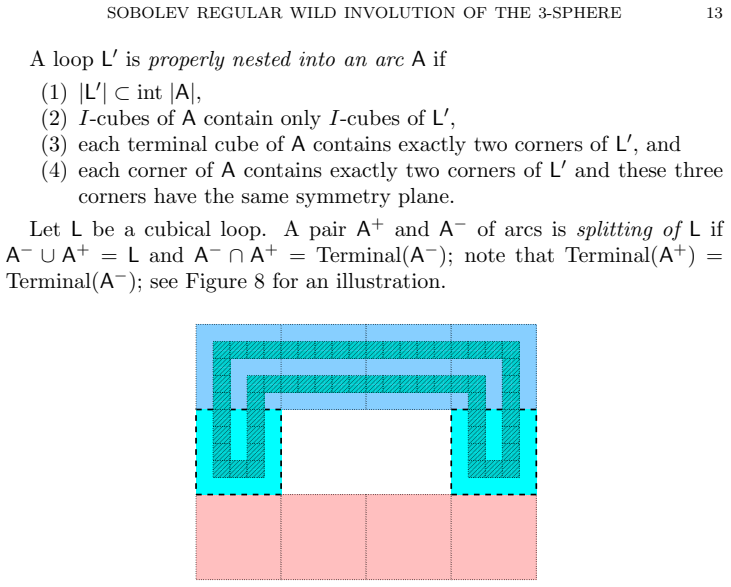
The load-bearing machinery is a cubical version of Bing's defining sequence: a tree of nested cubical loops, meaning solid tori made from dyadic cubes, with a symmetry plane at each corner. Inside each loop, a smaller nested loop is split into two arcs, and two linked loops are properly embedded; a $\rho$-twist map $h_\rho$ on a nested pair is a self-homeomorphism that is the identity on the outer boundary and realizes a rotation of the inner loop. Lemma 3.2 shows that every symmetric uniform nested pair admits such a twist whose conjugate involution $h_\rho R h_\rho^{-1}$ is locally bilipschitz with constant of order $(\sigma(L)/\sigma(L'))\#L$, and Lemma 2.6 straightens cubical arcs bilipschitzly to segments. These estimates feed into a measure count: the corner set at level $k$ has controlled measure, and the non-corner part of $X_k$ has volume at most $2^{k+1}r_k^2$, so the chosen $r_k$ makes $|Df|^p$ summable.
What would settle it
A concrete way to test the claim is to check whether the defining sequence really supports the volume and corner-count bounds: if any symmetric shrinkable sequence forces the Lebesgue measure $|X_k|$ of the $k$-th stage to exceed $C\,2^k r_k^2$ for a constant $C$ independent of $k$, then the integral estimate $\int_{Y_k}|Df|^p \lesssim 2^k r_k^{2-p}$ fails and the $p<2$ range would shrink. Alternatively, computing the actual $L^p$ norm of $|Df|$ for the explicit $r_k$ sequence on a computer model of the first few levels would give a numerical check of the summability.
Extended reading notes
Core claim
The central claim is Theorem 1.1: for each $p\in [1,2)$, the 3-sphere admits an orientation-preserving and an orientation-reversing wild involution $f$ in $W^{1,p}(S^3,S^3)$. The proof constructs $f$ as the quotient of a linear involution by a monotone map $\varphi$ that collapses the Bing double, a Cantor-set decomposition of $\mathbb{R}^3$ whose nondegenerate elements are components of nested solid tori. A carefully chosen defining sequence of cubical tori with side lengths $r_k = \min\{3^{-k^{2/(2-p)}}, 15^{-k}, (10L_{\mathrm{inner}}^p)^{-k}\}$ makes $\varphi$ and $f$ locally bilipschitz with constants whose singularities are integrable at exponent $p$; the contribution from corners is controlled by the $4^k$ count of corners, and the contribution from the remaining volume by the shrink rate. The regularity of $f$ is not an automatic consequence of the regularity of $\varphi$, since $\varphi\circ\iota\circ\varphi^{-1}$ need not lie in $W^{1,1}$; the twist structure supplies the additional cancellation.
Load-bearing premise
The construction assumes that the Bing double has a defining sequence of nested solid tori that is simultaneously symmetric under the given involution, shrinkable in Bing's sense, and satisfies the explicit nesting distances and side-length bounds used in Section 5; this shrinkable defining sequence is taken from Bing's and Montgomery--Zippin's work rather than proved here.
Editorial extensions
If this is right
- The same proof yields a monotone map $\varphi: S^3\to S^3$ collapsing the Bing double in $W^{1,p}(S^3,S^3)$ for every $p<2$.
- Wild fixed point sets, both a wildly embedded 2-sphere and a wildly embedded 1-sphere, are compatible with Sobolev differentiability of the involution for all $p<2$.
- The composition $\varphi\circ\iota\circ\varphi^{-1}$ is not automatically Sobolev from the Sobolev regularity of $\varphi$; the twist cancellation built into the construction is essential.
- The method reaches every $p<2$ but does not settle $p\ge 2$; whether wild involutions exist in $W^{1,2}$ is left open.
Reading between the lines
- A natural testable extension, not claimed in the paper, is that the same corner-count versus volume balance may produce wild $W^{1,p}$ involutions of $S^n$ in higher dimensions with a dimension-dependent threshold below $2$.
- The existence of Sobolev-regular monotone cellular maps of this kind is a step toward a Sobolev version of cellular approximation, which would bear on the Lavrentiev phenomenon in three-dimensional elasticity.
- The heuristic that $p=2$ is the critical balance between solid-torus volume and local bilipschitz rotation constant suggests that $p<2$ may be the sharp range for wildness; checking whether the adjoint integrability formula forces better regularity of $f^{-1}$ could test this.
Signed reviews
Editorial analysis
A structured set of objections, weighed in public.
Referee Report
Summary. The paper claims that for every 1 ≤ p < 2 there exist both an orientation-preserving and an orientation-reversing wild involution of S^3 in the Sobolev space W^{1,p}(S^3,S^3). The strategy is to realize Bing's wild involution as a quotient of a linear involution by a monotone map φ associated with Bing's double, and to choose a defining sequence of solid tori so that the composed map has local Lipschitz constants whose L^p norms can be controlled by selecting side lengths r_k. The technical apparatus consists of cubical loops and arcs, a bilipschitz straightening lemma for cubical arcs, and a lemma on twist maps of nested cubical loops; these feed into a local Lipschitz bound for the approximating involutions, followed by an L^p summability argument in Section 5.
Significance. If the proof can be repaired, the result is significant: it would show that wild topological involutions can have Sobolev regularity for every exponent below 2, complementing classical tameness results for C^1 involutions and the open problem of wild quasiconformal reflections. The constructive cubical approach, with explicit derivative estimates, is well motivated and connects to the Ball–Evans approximation problem via cellular mappings. However, the manuscript currently contains a serious gap in the proof of the central twist-map lemma and a separate incorrect estimate in Section 5, so the main theorem is not yet established by the arguments presented.
major comments (3)
- [§3.2, Lemma 3.2] The prescribed construction of the ρ-twist h_ρ in Lemma 3.2 is invalid for the nontrivial rotations actually used. The lift ι of the identity on ∂|L| must satisfy S(ι(x0)) = ~h'_ρ(S(x0)); in the t-coordinate of the universal cover this forces n#Lσ(L) = k_ρσ(L') + m#L'σ(L'). In the nested pairs of §4.2.2 one has σ(L') = σ(L)/3 and #L' = 3#L, so the congruence reduces to k_ρ = 3#L(n−m). Hence no such lift exists for any rotation with 1 ≤ k_ρ ≤ #L'−1, in particular for the one-cube shift maps used in §4.2.3. Consequently ~h_ρ is not a deck transformation of the covering map g_φ, the map h_ρ does not descend, and the estimate (3.1) feeding into (4.1) is unsupported. The proof as written therefore does not establish Lemma 3.2.
- [§5, L^p estimate for the corner set] The displayed inequality near the end of §5, namely ∫_{x∈X_k\X_{k+1}: η(x)>0} |Df|^p ≤ (L_inner^k)^p (2L_inner^p)^{-k} = 2^{-k}, omits the factor 1/r_k^p coming from the local bound L(x) = L1 L_inner^{η(x)}/r_{ℓ(x)}. With r_k = (10L_inner^p)^{-k}, the missing factor contributes 10^{kp}L_inner^{kp^2}, which destroys the claimed summability. The estimate of the L^p norm on the corner set therefore needs to be redone, and the summability argument in terms of r_k must be corrected.
- [§4.2.2, defining sequence] The quantitative properties of the defining sequence—side-length ratios, nesting distances, symmetry, linking, and the identity #L' = 3#L—are asserted by reference to [5,7,25] rather than proved in the paper. These properties are load-bearing: they are used in the arithmetic of Lemma 3.2 and in the measure and volume estimates of §5. The authors should either provide a self-contained construction of such a defining sequence or give precise references with lemma and page numbers for each required property.
minor comments (4)
- [Abstract] The abstract contains 'orientation-reserving' which should be 'orientation-reversing'.
- [§2.1, Definition 2.4] There is a typo 'collactions' for 'collections'.
- [§4.2.4, Eq. (4.1)] The index ℓ(x) in the local Lipschitz bound Lip f_k ≤ L1 L2^{η(x)}/r_{ℓ(x)} is never defined; it should be specified, e.g., as the level of the defining-sequence cube containing x.
- [§5] The notation for the constant in r_k = min{3^{-m_k}, 15^{-k}, (10L_p^2)^{-k}} is inconsistent with the rest of the paper; the third term should read (10L_inner^p)^{-k} to match the subsequent estimates.
Circularity Check
No significant circularity: the Sobolev construction is derived from explicit estimates and classical external topology, with only a non-load-bearing self-citation.
full rationale
The derivation chain is self-contained for the new analytic content. Lemma 2.6 proves the cubical-arc bilipschitz straightening directly, and Lemma 3.2 constructs the twist maps and proves the local bilipschitz estimate (3.1) from the geometry of nested cubical loops; neither lemma imports the target W^{1,p} conclusion. The L^p integrability in Section 5 follows from explicit choices of cube side lengths r_k, with the integrand bounded by the locally finite composition of twist maps and the corner-counting estimate taken from Bing [7]; no parameter is fitted to the desired Sobolev regularity. The only self-citation is the remark that the bilipschitz model construction is made 'in spirit of [15]'; the needed model is actually established inside the paper, so this citation is inspirational rather than load-bearing. The other self-citations [27,28] are contextual references in the introduction. The skeptic's objection to Lemma 3.2 concerns the existence of a lift with a prescribed alignment condition; if correct, that would be a mathematical gap in the proof, not a circular reduction of the theorem to its assumptions. No step in the paper defines its output in terms of its input, fits a prediction from a subset of the target data, or relies on a self-citation to force the claimed result. Hence no circular step is exhibited.
Assumptions & free parameters
free parameters (1)
- Cube side length sequence r_k =
min{3^{-m_k}, 15^{-k}, (10L_inner^p)^{-k}} with m_k = k^{2/(2-p)}
assumptions (3)
- domain assumption Bing's shrinkability theorem for the Bing double decomposition: there exists a monotone quotient map phi: R^3 -> R^3 collapsing the Bing double to a Cantor set.
- domain assumption The Bing double defining sequence (L_w) can be realized with the required symmetry with respect to the linear involutions R+ and R-, proper nesting, splitting arcs, and linking of loops as specified in Section 4.2.
- standard math Smith's theorem on fixed point sets of involutions of S^3 provides the tame/wild dichotomy referenced in the introduction.
Cite this review
Pith. "Pith review of Bing meets Sobolev." pith.science (2026). https://pith.science/paper/VR5P5Z2X
@misc{pith2026190809193,
  author       = {Pith},
  title        = {Pith review of: Bing meets Sobolev},
  year         = {2026},
  howpublished = {\url{https://pith.science/paper/VR5P5Z2X}},
  note         = {Machine review of arXiv:1908.09193}
}
abstract
We show that, for each $1\le p < 2$, there exists a wild involution $\mathbb S^3\to \mathbb S^3$ in the Sobolev class $W^{1,p}(\mathbb S^3,\mathbb S^3)$.
Figures

Figures from the paper (6 more)



Reference graph
Works this paper leans on
-
[1]
S. S. Antman. Nonlinear problems of elasticity , volume 107 of Applied Mathematical Sciences. Springer, New York, second edition, 2005
work page 2005
-
[2]
S. Armentrout. Concerning cellular decompositions of 3-manifolds that yield 3- manifolds. Trans. Amer. Math. Soc., 133:307–332, 1968
work page 1968
-
[3]
J. M. Ball. Convexity conditions and existence theorems in nonlinear elasticity. Arch. Rational Mech. Anal., 63(4):337–403, 1976/77
work page 1976
-
[4]
J. M. Ball. Singularities and computation of minimizers for variational problems. In Foundations of computational mathematics (Oxford, 1999) , volume 284 of London Math. Soc. Lecture Note Ser. , pages 1–20. Cambridge Univ. Press, Cambridge, 2001
work page 1999
-
[5]
R. H. Bing. A homeomorphism between the 3-sphere and the sum of two solid horned spheres. Ann. of Math. (2) , 56:354–362, 1952
work page 1952
-
[6]
R. H. Bing. Decompositions of E3. In Topology of 3-manifolds and related topics (Proc. The Univ. of Georgia Institute, 1961) , pages 5–21. Prentice-Hall. Englewood Cliffs, N.J., 1962
work page 1961
-
[7]
R. H. Bing. Shrinking without lengthening. Topology, 27(4):487–493, 1988
work page 1988
-
[8]
S. Bochner. Compact groups of differentiable transformations. Ann. of Math. (2) , 46:372–381, 1945
work page 1945
Show all 33 references
-
[9]
L. E. J. Brouwer. ¨Uber die periodischen Transformationen der Kugel. Math. Ann. , 80(1):39–41, 1919
1919
-
[10]
M. Brown. A proof of the generalized Schoenflies theorem. Bull. Amer. Math. Soc. , 66:74–76, 1960
1960
-
[11]
M. Brown. The monotone union of open n-cells is an open n-cell. Proc. Amer. Math. Soc., 12:812–814, 1961
1961
-
[12]
Campbell, S
D. Campbell, S. Hencl, and V. Tengvall. Approximation of W 1,p Sobolev homeomor- phism by diffeomorphisms and the signs of the Jacobian. Adv. Math., 331:748–829, 2018
2018
-
[13]
P. G. Ciarlet. Mathematical elasticity. Vol. I, volume 20 ofStudies in Mathematics and its Applications. North-Holland Publishing Co., Amsterdam, 1988. Three-dimensional elasticity
1988
-
[14]
R. J. Daverman. Decompositions of manifolds, volume 124 of Pure and Applied Math- ematics. Academic Press Inc., Orlando, FL, 1986
1986
-
[15]
Drasin and P
D. Drasin and P. Pankka. Sharpness of Rickman’s Picard theorem in all dimensions. Acta Math., 214(2):209–306, 2015
2015
-
[16]
M. H. Freedman and R. Skora. Strange actions of groups on spheres. J. Differential Geom., 25(1):75–98, 1987
1987
-
[17]
Haj lasz and P
P. Haj lasz and P. Koskela. Sobolev meets Poincar´ e. C. R. Acad. Sci. Paris S´ er. I Math., 320(10):1211–1215, 1995
1995
-
[18]
D. H. Hamilton. QC Riemann mapping theorem in space. In Complex analysis and dynamical systems III , volume 455 of Contemp. Math., pages 131–149. Amer. Math. Soc., Providence, RI, 2008
2008
-
[19]
Heinonen and S
J. Heinonen and S. Semmes. Thirty-three yes or no questions about mappings, mea- sures, and metrics. Conform. Geom. Dyn. , 1:1–12 (electronic), 1997. SOBOLEV REGULAR WILD INVOLUTION OF THE 3-SPHERE 17
1997
-
[20]
Heinonen and J.-M
J. Heinonen and J.-M. Wu. Quasisymmetric nonparametrization and spaces associ- ated with the Whitehead continuum. Geometry & Topology, 14(2):773–798, 2010
2010
-
[21]
Hencl and A
S. Hencl and A. Pratelli. Diffeomorphic approximation of W 1,1 planar Sobolev home- omorphisms. J. Eur. Math. Soc. (JEMS) , 20(3):597–656, 2018
2018
-
[22]
Hencl and B
S. Hencl and B. Vejnar. Sobolev homeomorphism that cannot be approximated by diffeomorphisms in W 1,1. Arch. Ration. Mech. Anal., 219(1):183–202, 2016
2016
-
[23]
Iwaniec, L
T. Iwaniec, L. V. Kovalev, and J. Onninen. Diffeomorphic approximation of Sobolev homeomorphisms. Arch. Ration. Mech. Anal., 201(3):1047–1067, 2011
2011
-
[24]
Iwaniec and J
T. Iwaniec and J. Onninen. Monotone Sobolev mappings of planar domains and surfaces. Arch. Ration. Mech. Anal., 219(1):159–181, 2016
2016
-
[25]
Montgomery and L
D. Montgomery and L. Zippin. Examples of transformation groups. Proc. Amer. Math. Soc., 5:460–465, 1954
1954
-
[26]
J. W. Morgan and H. Bass, editors. The Smith conjecture , volume 112 of Pure and Applied Mathematics. Academic Press, Inc., Orlando, FL, 1984. Papers presented at the symposium held at Columbia University, New York, 1979
1984
-
[27]
Pankka and V
P. Pankka and V. Vellis. Quasiconformal non-parametrizability of almost smooth spheres. Selecta Mathematica, 23(2):1121–1151, 2017
2017
-
[28]
Pankka and J.-M
P. Pankka and J.-M. Wu. Geometry and quasisymmetric parametrization of Semmes spaces. Rev. Mat. Iberoamericana, 30(3):893–960, 2014
2014
-
[29]
S. Semmes. Good metric spaces without good parameterizations. Rev. Mat. Iberoamericana, 12(1):187–275, 1996
1996
-
[30]
L. C. Siebenmann. Approximating cellular maps by homeomorphisms. Topology, 11:271–294, 1972
1972
-
[31]
P. A. Smith. Transformations of finite period. II. Ann. of Math. (2), 40:690–711, 1939
1939
-
[32]
Waldhausen
F. Waldhausen. ¨Uber Involutionen der 3-Sph¨ are.Topology, 8:81–91, 1969
1969
-
[33]
J. W. T. Youngs. Homeomorphic approximations to monotone mappings. Duke Math. J., 15:87–94, 1948. Department of Mathematics, Syracuse University, Syracuse, NY 13244, USA and Department of Mathematics and Statistics, P.O.Box 35 (MaD) FI-40014 University of Jyv ¨askyl¨a, Finland...
1948
Reviewed August 14, 2026 · model on record in the stance chip above.
Discussion (0). Continue with ORCID to comment.