REVIEW 3 minor 118 references
Search for Quasar Pairs with ${\it Gaia}$ Astrometric Data. III. Discovery of 9 dual and projected quasars
T0 review · 0 major / 3 minor · reviewed 2026-07-02 · grok-4.3
Pith's one-line read Spectroscopic observations confirm 6 dual quasars and 3 projected quasars from 11 Gaia-selected candidates.
desk verdict This paper adds spectroscopic confirmations for 6 dual quasars and 3 projected ones from Gaia-selected candidates, extending their own series with modest but direct new objects. read the letter →
The pith
A machine-rendered reading of the paper's core claim, the machinery that carries it, and where it could break.
The reading
What carries the argument
Low-resolution long-slit spectroscopic follow-up on three telescopes to classify Gaia-selected quasar pair candidates as dual, projected, or otherwise.
What would settle it
Higher-resolution spectra or imaging that show any of the six dual quasars to be single objects, stars, or line-of-sight projections at different redshifts would falsify the reported discoveries.
Extended reading notes
Core claim
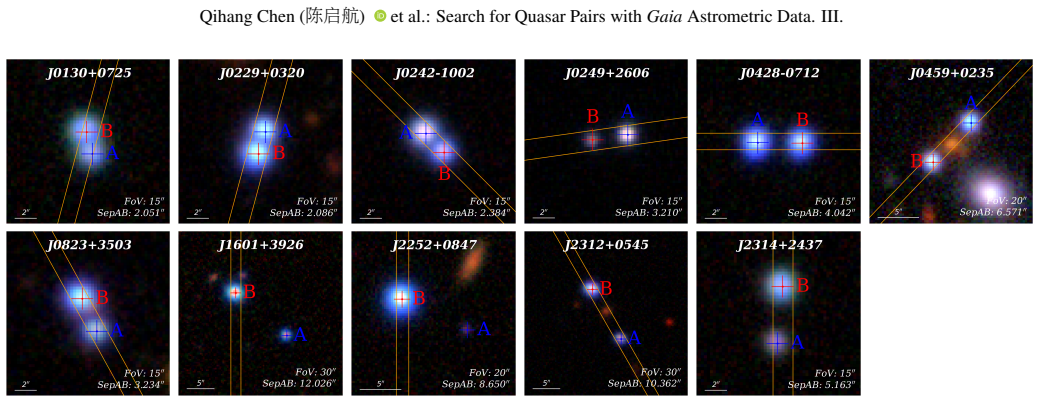
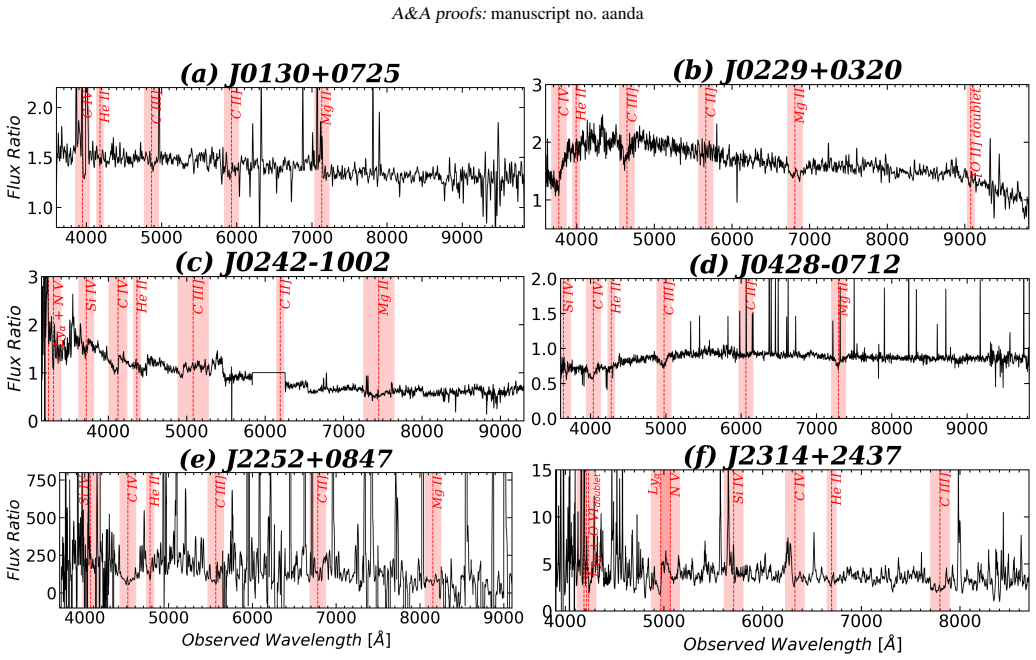
We report the low-resolution long-slit spectroscopic observations and confirmations of 11 quasar pair candidates selected from the MGQPC catalog. The major discoveries include 6 dual quasars and 3 projected quasars. One of the dual quasars has a high redshift of ∼3.1. The LQ hypothesis of 3 dual quasars cannot be completely ruled out. We investigated the reason why previous spectroscopic surveys missed several new quasars and discussed a projected quasar with a wide-separation lensing configuration as well as two quasar-star projections.
Load-bearing premise
The photometric redshifts extracted from Paper-II are sufficiently accurate to prioritize candidates and mitigate contamination from projected quasars and quasar-star projections.
Editorial extensions
If this is right
- Photometric redshifts reduce contamination from projected quasars and quasar-star projections in candidate lists.
- Previous spectroscopic surveys missed several new quasars for reasons that can now be addressed in selection.
- A projected quasar with wide-separation lensing configuration and two quasar-star projections that mimic lensed systems are identified.
- Confirmation strategies for dual and lensed quasar candidates are reviewed and outlined for future large-scale surveys.
Reading between the lines
- Applying the same Gaia-plus-photometric-redshift selection to larger samples could increase the known population of dual quasars at z greater than 3.
- High-resolution imaging follow-up on the three dual candidates whose lensing status remains open would clarify whether any are actually lensed systems.
- The methods used here to handle quasar-star projections offer a template for cleaning candidate lists in other wide-field pair searches.
Signed reviews
Editorial analysis
A structured set of objections, weighed in public.
Referee Report
Summary. The paper reports low-resolution long-slit spectroscopic observations confirming 11 quasar pair candidates selected from the MGQPC catalog (Paper I), using five spectrographs on three telescopes. This yields six dual quasars (one at z ≈ 3.1) and three projected quasars; the LQ hypothesis cannot be fully ruled out for three of the duals. The work examines why prior surveys missed several objects, discusses a wide-separation lensing configuration and two quasar-star projections, illustrates the utility of photometric redshifts from Paper II for reducing contamination, and reviews confirmation strategies for dual/lensed quasars in the context of large surveys.
Significance. If the spectroscopic classifications hold, the addition of six dual quasars (including a high-redshift example) enlarges the sample available for studies of supermassive black hole pairs and merger-driven evolution. The explicit discussion of selection biases, contamination mitigation via photometric redshifts, and future confirmation strategies in the era of large spectroscopic surveys provides practical guidance beyond the specific discoveries.
minor comments (3)
- [Abstract] Abstract: the claim of 'confirmations' would be strengthened by explicit reference to the figures or tables that display the spectra, line identifications, and redshift measurements for the 11 candidates.
- [Spectroscopic observations section] The description of the five spectrographs and three telescopes would benefit from a compact table listing instrument, telescope, resolution, wavelength coverage, and typical exposure times to allow readers to assess data quality at a glance.
- [Discussion of photometric redshifts] The statement that photometric redshifts from Paper II 'illustrate their positive role' is useful, but a short quantitative comparison (e.g., fraction of candidates rejected by photo-z cuts) would make the mitigation claim more concrete.
Simulated Author's Rebuttal
We thank the referee for their positive and constructive report, which recommends minor revision. The assessment accurately captures the scope of our spectroscopic follow-up and the broader context we provide on selection biases and confirmation strategies. No major comments requiring point-by-point rebuttal were raised in the report.
Circularity Check
No significant circularity
full rationale
This is an observational discovery paper whose central claims consist of direct low-resolution long-slit spectroscopic confirmations of 11 candidates, yielding 6 dual quasars and 3 projected quasars. These rest on the new spectra themselves rather than on any derivation, fit, or prediction. Photometric redshifts extracted from Paper II are invoked only illustratively to discuss selection and contamination mitigation; they do not enter the reported redshifts or classifications. No equations, fitted parameters, or self-citation chains reduce the confirmation results to prior inputs by construction. The work is therefore self-contained against external spectroscopic benchmarks.
Assumptions & free parameters
Cite this review
Pith. "Pith review of Search for Quasar Pairs with ${\it Gaia}$ Astrometric Data. III. Discovery of 9 dual and projected quasars." pith.science (2026). https://pith.science/paper/VRDCDTOI
@misc{pith2026260700093,
  author       = {Pith},
  title        = {Pith review of: Search for Quasar Pairs with $\it Gaia$ Astrometric Data. III. Discovery of 9 dual and projected quasars},
  year         = {2026},
  howpublished = {\url{https://pith.science/paper/VRDCDTOI}},
  note         = {Machine review of arXiv:2607.00093}
}
abstract
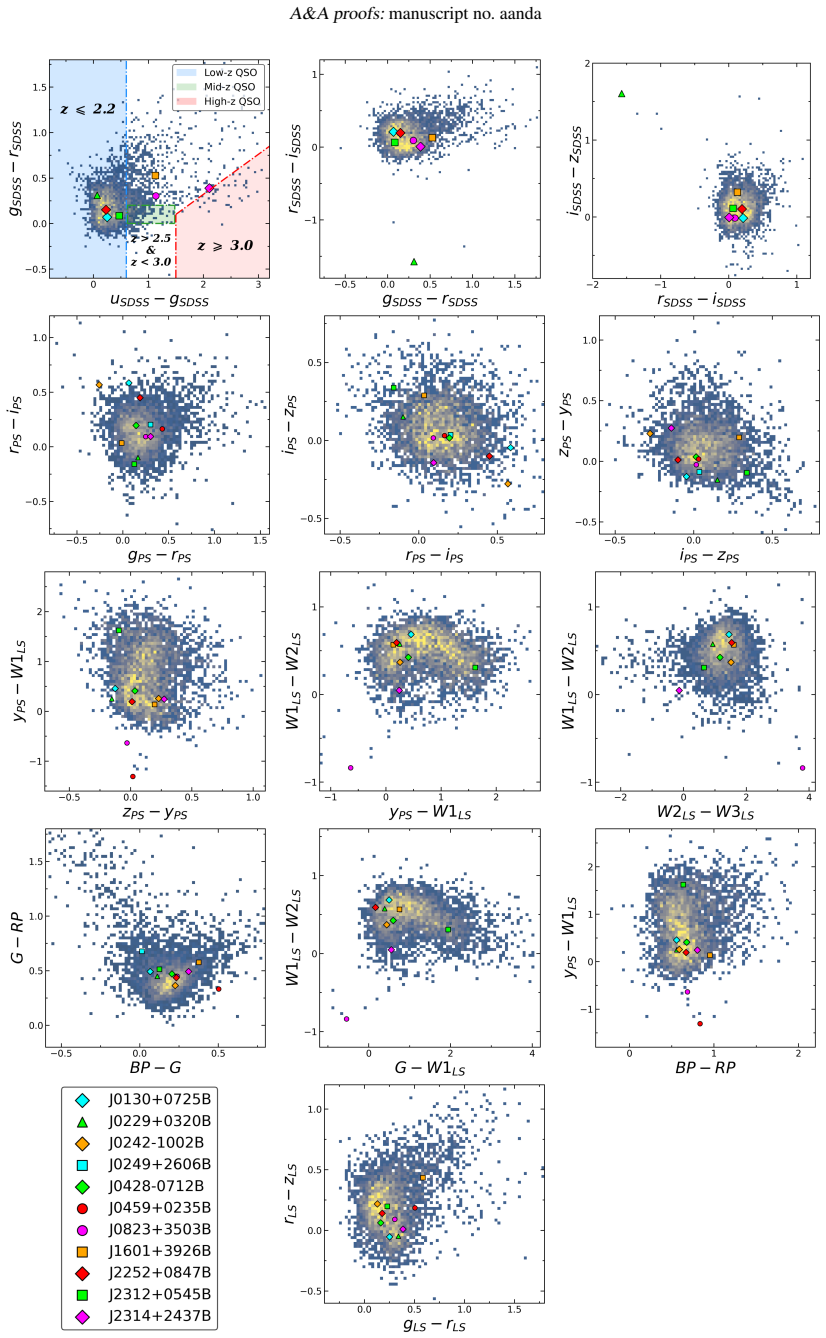
We report the low-resolution long-slit spectroscopic observations and confirmations of 11 quasar pair candidates, which are selected from the MGQPC catalog presented in the first paper of our series work (hereafter, Paper-I) and the early version of this catalog. The spectroscopic follow-up was carried out with 5 spectrographs equipped on 3 telescopes, and the major discoveries include 6 dual quasars and 3 projected quasars. One of the dual quasars has a high redshift of $\sim$ 3.1. The LQ hypothesis of 3 dual quasars cannot be completely ruled out. We investigated the reason why previous spectroscopic surveys missed several new quasars. We discussed a projected quasar with a wide-separation lensing configuration, as well as two quasar-star projections that mimic the configuration of lensed quasars. The photometric redshifts for the 11 observed candidates were extracted from the second paper of our series work (hereafter, Paper-II) to illustrate their positive role in mitigating contamination from projected quasars and quasar-star projections. We also reviewed and discussed the confirmation strategies for dual and lensed quasar candidates, and outlined future confirmation strategies for them in the context of the era dominated by large-scale spectroscopic and imaging surveys.
Figures


Figures from the paper (2 more)
Reference graph
Works this paper leans on
- [1]
- [2]
- [3]
-
[4]
Altamura, E., Brennan, S., Le´sniewska, A., et al. 2020, AJ, 159, 122
work page 2020
-
[5]
T., Jahnke, K., van der Wel, A., et al
Andika, I. T., Jahnke, K., van der Wel, A., et al. 2023, ApJ, 943, 150
work page 2023
-
[6]
Anguita, T., Schechter, P. L., Kuropatkin, N., et al. 2018, MNRAS, 480, 5017
work page 2018
-
[7]
J., Stern, D., Noirot, G., et al
Assef, R. J., Stern, D., Noirot, G., et al. 2018, ApJS, 234, 23 Astropy Collaboration, Price-Whelan, A. M., Lim, P. L., et al. 2022, ApJ, 935, 167 Astropy Collaboration, Price-Whelan, A. M., Sip˝ocz, B. M., et al. 2018, AJ, 156, 123 Astropy Collaboration, Robitaille, T. P., Tollerud, E. J., et al. 2013, A&A, 558, A33
work page 2018
-
[8]
Barone, T. M., G. C., K. V ., Tran, K.-V ., et al. 2026, AJ, 171, 57
work page 2026
Show all 118 references
-
[9]
2025, A&A, 698, A29
Bazzanini, L., Angora, G., Scialpi, M., et al. 2025, A&A, 698, A29
2025
-
[10]
H., Agnello, A., & Hjorth, J
Bruun, S. H., Agnello, A., & Hjorth, J. 2023, A&A, 676, A111
2023
-
[11]
Butler, N. R. & Bloom, J. S. 2011, AJ, 141, 93
2011
-
[12]
2025, Science China Physics, Mechanics, and Astronomy, 68, 280403
Cai, Z., Huang, S., Liu, Y ., Zhao, C., & Huang, L. 2025, Science China Physics, Mechanics, and Astronomy, 68, 280403
2025
-
[13]
C., Magnier, E
Chambers, K. C., Magnier, E. A., Metcalfe, N., et al. 2016, arXiv e-prints, arXiv:1612.05560
2016 arXiv
-
[14]
Chan, J. H. H., Wong, K. C., Ding, X., et al. 2024, MNRAS, 527, 6253
2024
-
[15]
2023, ApJ, 944, 107
Chaussidon, E., Yèche, C., Palanque-Delabrouille, N., et al. 2023, ApJ, 944, 107
2023
-
[16]
2025a, arXiv e-prints, arXiv:2512.16844
Chen, N., Zhou, Y ., Dadiani, E., et al. 2025a, arXiv e-prints, arXiv:2512.16844
-
[17]
2026, A&A, 707, A30
Chen, Q., Jing, L., Zhu, X., et al. 2026, A&A, 707, A30
2026
-
[18]
2020, ApJ, 897, 86
Chen, Y ., Yu, Q., & Lu, Y . 2020, ApJ, 897, 86
2020
-
[19]
2021, arXiv e-prints, arXiv:2109.06881
Chen, Y .-C. 2021, arXiv e-prints, arXiv:2109.06881
2021
-
[20]
2022, ApJ, 925, 162
Chen, Y .-C., Hwang, H.-C., Shen, Y ., et al. 2022, ApJ, 925, 162
2022
-
[21]
2023d, ApJS, 265, 46 CSST Collaboration, Gong, Y ., Miao, H., et al
Chen, Z.-F., Qin, H.-C., Cai, J.-T., et al. 2023d, ApJS, 265, 46 CSST Collaboration, Gong, Y ., Miao, H., et al. 2026, Science China Physics, Mechanics, and Astronomy, 69, 239501
2026
-
[22]
2012, Research in Astronomy and Astrophysics, 12, 1197
Cui, X.-Q., Zhao, Y .-H., Chu, Y .-Q., et al. 2012, Research in Astronomy and Astrophysics, 12, 1197
2012
-
[23]
D., Sharon, K., et al
Dahle, H., Gladders, M. D., Sharon, K., et al. 2013, ApJ, 773, 146
2013
-
[24]
2023, ApJS, 269, 61 de Jong, R
Dawes, C., Storfer, C., Huang, X., et al. 2023, ApJS, 269, 61 de Jong, R. S., Agertz, O., Berbel, A. A., et al. 2019, The Messenger, 175, 3 De Rosa, A., Vignali, C., Bogdanovi´c, T., et al. 2019, New A Rev., 86, 101525 De Rosa, A., Vignali, C., Severgnini, P., et al. 2023, MNR...
2023
-
[25]
2026, ApJS, 283, 70 DESI Collaboration, Karim, M
Deng, Z., Xiang, C., Chen, Q., et al. 2026, ApJS, 283, 70 DESI Collaboration, Karim, M. A., Adame, A. G., et al. 2025, arXiv e-prints, arXiv:2503.14745
2026 arXiv
-
[26]
J., Lang, D., et al
Dey, A., Schlegel, D. J., Lang, D., et al. 2019, AJ, 157, 168
2019
-
[27]
J., Harvey, T., et al
Duan, Q., Conselice, C. J., Harvey, T., et al. 2026, MNRAS, 546, stag008
2026
-
[28]
H., et al
Ducourant, C., Teixeira, R., Vale-Cunha, P. H., et al. 2026, A&A, 707, A345
2026
-
[29]
2025, The Open Journal of Astro- physics, 8, 12
Ellison, S., Ferreira, L., Bickley, R., et al. 2025, The Open Journal of Astro- physics, 8, 12
2025
-
[30]
L., Patton, D
Ellison, S. L., Patton, D. R., & Hickox, R. C. 2015, MNRAS, 451, L35
2015
-
[31]
L., Patton, D
Ellison, S. L., Patton, D. R., Mendel, J. T., & Scudder, J. M. 2011, MNRAS, 418, 2043
2011
-
[32]
2000, ApJ, 545, 63 Euclid Collaboration, Mellier, Y ., Abdurro’uf, et al
Elvis, M. 2000, ApJ, 545, 63 Euclid Collaboration, Mellier, Y ., Abdurro’uf, et al. 2025, A&A, 697, A1
2000
-
[33]
Fan, X., Bañados, E., & Simcoe, R. A. 2023, ARA&A, 61, 373
2023
-
[34]
2016, PASP, 128, 115005
Fan, Z., Wang, H., Jiang, X., et al. 2016, PASP, 128, 115005
2016
-
[35]
P., Falomo, R., Scarpa, R., et al
Farina, E. P., Falomo, R., Scarpa, R., et al. 2014, MNRAS, 441, 886
2014
-
[36]
P., Falomo, R., & Treves, A
Farina, E. P., Falomo, R., & Treves, A. 2011, MNRAS, 415, 3163
2011
-
[37]
2021, A&A, 653, A109
Fian, C., Mediavilla, E., Motta, V ., et al. 2021, A&A, 653, A109
2021
-
[38]
2023, ApJ, 942, 64
Fu, X.-D., Wang, J., Xu, X., & Zhang, Z.-X. 2023, ApJ, 942, 64
2023
-
[39]
C., Chen, Y .-C., Oguri, M., et al
Gross, A. C., Chen, Y .-C., Oguri, M., et al. 2025, ApJ, 989, 112
2025
-
[40]
B., Hewitt, J
Haarsma, D. B., Hewitt, J. N., Lehár, J., & Burke, B. F. 1997, ApJ, 479, 102
1997
-
[41]
R., Millman, K
Harris, C. R., Millman, K. J., van der Walt, S. J., et al. 2020, Nature, 585, 357
2020
-
[42]
Hawkins, M. R. S. 2021, MNRAS, 503, 3848
2021
-
[43]
2023, A&A, 672, A123
He, Z., Li, N., Cao, X., et al. 2023, A&A, 672, A123
2023
-
[44]
E., Fynbo, J
Heintz, K. E., Fynbo, J. P. U., Krogager, J.-K., et al. 2016, AJ, 152, 13
2016
-
[45]
F., Myers, A
Hennawi, J. F., Myers, A. D., Shen, Y ., et al. 2010, ApJ, 719, 1672
2010
-
[46]
Hennawi, J. F. & Prochaska, J. X. 2013, ApJ, 766, 58
2013
-
[47]
Hogg, D. W. 1999, arXiv e-prints, astro
1999
-
[48]
F., Hernquist, L., Cox, T
Hopkins, P. F., Hernquist, L., Cox, T. J., et al. 2005, ApJ, 630, 705
2005
-
[49]
F., Hernquist, L., Cox, T
Hopkins, P. F., Hernquist, L., Cox, T. J., et al. 2006, ApJS, 163, 1
2006
-
[50]
F., Hernquist, L., Cox, T
Hopkins, P. F., Hernquist, L., Cox, T. J., & Kereš, D. 2008, ApJS, 175, 356
2008
-
[51]
2020, ApJ, 900, 79
Hou, M., Li, Z., & Liu, X. 2020, ApJ, 900, 79
2020
-
[52]
Hunter, J. D. 2007, Computing in Science and Engineering, 9, 90 Hutsemékers, D., Sluse, D., Savi´c, Ð., & Richards, G. T. 2023, A&A, 672, A45
2007
-
[53]
2006, ApJ, 653, L97
Inada, N., Oguri, M., Morokuma, T., et al. 2006, ApJ, 653, L97
2006
-
[54]
2003, Nature, 426, 810 Ivezi´c, Ž., Kahn, S
Inada, N., Oguri, M., Pindor, B., et al. 2003, Nature, 426, 810 Ivezi´c, Ž., Kahn, S. M., Tyson, J. A., et al. 2019, ApJ, 873, 111
2003
-
[55]
2018, in Society of Photo-Optical Instrumentation Engineers (SPIE) Conference Series, V ol
Jiang, H., Hu, Z., Xu, M., et al. 2018, in Society of Photo-Optical Instrumentation Engineers (SPIE) Conference Series, V ol. 10702, Ground-based and Airborne Instrumentation for Astronomy VII, ed. C. J. Evans, L. Simard, & H. Takami, 107022L
2018
-
[56]
2026, ApJ, 998, 80 Article number, page 12 Qihang Chen (陈启航) et al.: Search for Quasar Pairs withGaiaAstrometric Data
Jiang, Y ., Shen, Y ., Liu, X., et al. 2026, ApJ, 998, 80 Article number, page 12 Qihang Chen (陈启航) et al.: Search for Quasar Pairs withGaiaAstrometric Data. III
2026
-
[57]
2026, ApJ, 1000, 311
Jing, L., Chen, Q., Zhu, X., et al. 2026, ApJ, 1000, 311
2026
-
[58]
D., Oliphant, T
Jones, E. D., Oliphant, T. E., & Peterson, P. 2001, in SciPy: Open Source Scien- tific Tools for Python
2001
-
[59]
2025, in Astronomical Society of the Pacific Conference Series, V ol
Juneau, S., Jacques, A., Pothier, S., et al. 2025, in Astronomical Society of the Pacific Conference Series, V ol. 541, Astronomical Data Analysis Software and Systems XXXIII, ed. A. Jacques, R. Seaman, N. Gandilo, & T. Linder, 77 JUST Team, Liu, C., Zu, Y ., et al. 2024, Astr...
2025
-
[60]
& Haehnelt, M
Kauffmann, G. & Haehnelt, M. 2000, MNRAS, 311, 576
2000
-
[61]
J., Treister, E., Kakkad, D., et al
Koss, M. J., Treister, E., Kakkad, D., et al. 2023, ApJ, 942, L24
2023
-
[62]
J., D’Onghia, E., et al
Krishnarao, D., Fox, A. J., D’Onghia, E., et al. 2022, Nature, 609, 915
2022
-
[63]
Lau, M. W. 2017, PhD thesis, University of California, Santa Cruz
2017
-
[64]
W., Prochaska, J
Lau, M. W., Prochaska, J. X., & Hennawi, J. F. 2018, ApJ, 857, 126
2018
-
[65]
2019, PhD thesis, University of Cambridge, UK
Lemon, C. 2019, PhD thesis, University of Cambridge, UK
2019
-
[66]
W., et al
Lemon, C., Anguita, T., Auger-Williams, M. W., et al. 2023, MNRAS, 520, 3305
2023
-
[67]
W., McMahon, R., et al
Lemon, C., Auger, M. W., McMahon, R., et al. 2020, MNRAS, 494, 3491
2020
-
[68]
2024, Space Sci
Lemon, C., Courbin, F., More, A., et al. 2024, Space Sci. Rev., 220, 23
2024
-
[69]
A., Auger, M
Lemon, C. A., Auger, M. W., McMahon, R. G., & Ostrovski, F. 2018, MNRAS, 479, 5060
2018
-
[70]
H., Mannerkoski, M., et al
Liao, S., Johansson, P. H., Mannerkoski, M., et al. 2023, MNRAS, 520, 4463
2023
-
[71]
Liu, X., Shen, Y ., & Strauss, M. A. 2012, ApJ, 745, 94
2012
-
[72]
A., & Hao, L
Liu, X., Shen, Y ., Strauss, M. A., & Hao, L. 2011, ApJ, 737, 101
2011
-
[73]
2015, HumVI: Hu- man Viewable Image creation, Astrophysics Source Code Library, record ascl:1511.014
Marshall, P., Sandford, C., More, A., & Buddelmeijerr, H. 2015, HumVI: Hu- man Viewable Image creation, Astrophysics Source Code Library, record ascl:1511.014
2015
-
[74]
J., Verma, A., More, A., et al
Marshall, P. J., Verma, A., More, A., et al. 2016, MNRAS, 455, 1171
2016
-
[75]
N., Napier, K
Martinez, M. N., Napier, K. A., Cloonan, A. P., et al. 2023, ApJ, 946, 63
2023
-
[76]
J., et al
Mateos, S., Alonso-Herrero, A., Carrera, F. J., et al. 2012, MNRAS, 426, 3271
2012
-
[77]
2024, ApJ, 965, L4
Matsuoka, Y ., Izumi, T., Onoue, M., et al. 2024, ApJ, 965, L4
2024
-
[78]
2018, astropy/astroscrappy: v1.0.5 Zenodo Release
McCully, C., Crawford, S., Kovacs, G., et al. 2018, astropy/astroscrappy: v1.0.5 Zenodo Release
2018
-
[79]
H., Martinez-Aldama, M
Naddaf, M. H., Martinez-Aldama, M. L., Marziani, P., et al. 2023, A&A, 675, A43
2023
-
[80]
J., Graham, M
Nakoneczny, S. J., Graham, M. J., Stern, D., et al. 2025, ApJ, 992, 153
2025
-
[81]
D., Sharon, K., et al
Napier, K., Gladders, M. D., Sharon, K., et al. 2023, ApJ, 954, L38
2023
-
[82]
2006, AJ, 132, 999
Oguri, M., Inada, N., Pindor, B., et al. 2006, AJ, 132, 999
2006
-
[83]
2013, MNRAS, 429, 482
Oguri, M., Schrabback, T., Jullo, E., et al. 2013, MNRAS, 429, 482
2013
-
[84]
Oke, J. B. & Gunn, J. E. 1982, PASP, 94, 586
1982
-
[85]
D., et al
Palanque-Delabrouille, N., Yeche, C., Myers, A. D., et al. 2011, A&A, 530, A122 pandas development team, T. 2022, pandas-dev/pandas: Pandas, if you use this software, please cite it as below
2011
-
[86]
W., Weaver, K
Pfeifle, R. W., Weaver, K. A., Secrest, N. J., Rothberg, B., & Patton, D. R. 2025, ApJS, 281, 25
2025
-
[87]
Pierce, J. C. S., Tadhunter, C., Ramos Almeida, C., et al. 2023, MNRAS, 522, 1736
2023
-
[88]
2005, ApJ, 626, 649
Pindor, B. 2005, ApJ, 626, 649
2005
-
[89]
Prochaska, J. X. & Hennawi, J. F. 2009, ApJ, 690, 1558
2009
-
[90]
T., Fan, X., Newberg, H
Richards, G. T., Fan, X., Newberg, H. J., et al. 2002, AJ, 123, 2945
2002
-
[91]
B., Zavala, R
Rodriguez, C., Taylor, G. B., Zavala, R. T., et al. 2006, ApJ, 646, 49
2006
-
[92]
E., Berghea, C
Rusu, C. E., Berghea, C. T., Fassnacht, C. D., et al. 2019, MNRAS, 486, 4987
2019
-
[93]
2026, A&A, 709, A236
Scialpi, M., Mannucci, F., D’Amato, Q., et al. 2026, A&A, 709, A236
2026
-
[94]
B., Dahle, H., et al
Sharon, K., Bayliss, M. B., Dahle, H., et al. 2017, ApJ, 835, 5
2017
-
[95]
A., Chen, Y .-C., et al
Shen, Y ., Casey-Clyde, J. A., Chen, Y .-C., et al. 2023a, arXiv e-prints, arXiv:2306.15527
-
[96]
2021, Nature Astronomy, 5, 569
Shen, Y ., Chen, Y .-C., Hwang, H.-C., et al. 2021, Nature Astronomy, 5, 569
2021
-
[97]
A., Rosario, D
Shields, G. A., Rosario, D. J., Junkkarinen, V ., et al. 2012, ApJ, 744, 151
2012
-
[98]
E., Evans, N
Shu, Y ., Koposov, S. E., Evans, N. W., et al. 2019, MNRAS, 489, 4741
2019
-
[99]
W., & Pérez-Fournon, I
Shu, Y ., Marques-Chaves, R., Evans, N. W., & Pérez-Fournon, I. 2018, MNRAS, 481, L136
2018
-
[100]
D., Tang, S., Lee, K.-G., et al
Silverman, J. D., Tang, S., Lee, K.-G., et al. 2020, ApJ, 899, 154
2020
-
[101]
2012, A&A, 544, A62
Sluse, D., Hutsemékers, D., Courbin, F., Meylan, G., & Wambsganss, J. 2012, A&A, 544, A62
2012
-
[102]
J., Benford, D
Stern, D., Assef, R. J., Benford, D. J., et al. 2012, ApJ, 753, 30
2012
-
[103]
G., Krone-Martins, A., et al
Stern, D., Djorgovski, S. G., Krone-Martins, A., et al. 2021, ApJ, 921, 42
2021
-
[104]
2026, MNRAS, 547, stag411
Tang, S., Silverman, J., Prochaska, X., et al. 2026, MNRAS, 547, stag411
2026
-
[105]
D., Ding, X., et al
Tang, S., Silverman, J. D., Ding, X., et al. 2021, ApJ, 922, 83 Tubín-Arenas, D., Lamer, G., Krumpe, M., et al. 2023, A&A, 672, L9 van der Walt, S., Colbert, S. C., & Varoquaux, G. 2011, Computing in Science and Engineering, 13, 22 van Dokkum, P. G. 2001, PASP, 113, 1420 Van W...
2021
-
[106]
E., et al
Virtanen, P., Gommers, R., Oliphant, T. E., et al. 2020, Nature Methods, 17, 261 V olonteri, M., Pfister, H., Beckmann, R., et al. 2022, MNRAS, 514, 640
2020
-
[107]
L., Jespersen, C
Vujeva, L., Steinhardt, C. L., Jespersen, C. K., et al. 2024, ApJ, 974, 23
2024
-
[108]
2019, Research in Astronomy and As- trophysics, 19, 149
Wang, C.-J., Bai, J.-M., Fan, Y .-F., et al. 2019, Research in Astronomy and As- trophysics, 19, 149
2019
-
[109]
2018, ApJ, 869, L9
Wang, F., Yang, J., Fan, X., et al. 2018, ApJ, 869, L9
2018
-
[110]
2026, ApJ, 997, 269
Wang, Q., Ding, X., Silverman, J., et al. 2026, ApJ, 997, 269
2026
-
[111]
2023, Science China Physics, Mechanics, and Astronomy, 66, 109512 Wes McKinney
Wang, T., Liu, G., Cai, Z., et al. 2023, Science China Physics, Mechanics, and Astronomy, 66, 109512 Wes McKinney. 2010, in Proceedings of the 9th Python in Science Conference, ed. Stéfan van der Walt & Jarrod Millman, 56 – 61
2023
-
[112]
& Timlin, J
Yi, W. & Timlin, J. 2021, ApJS, 255, 12
2021
-
[113]
2026, ApJ, 1002, L28
Yue, M., Fan, X., Eilers, A.-C., et al. 2026, ApJ, 1002, L28
2026
-
[114]
2021, ApJ, 921, L27
Yue, M., Fan, X., Yang, J., & Wang, F. 2021, ApJ, 921, L27
2021
-
[115]
2023, AJ, 165, 191
Yue, M., Fan, X., Yang, J., & Wang, F. 2023, AJ, 165, 191
2023
-
[116]
R., Shen, Y ., et al
Zheng, Z.-Y ., Butler, N. R., Shen, Y ., et al. 2016, ApJ, 827, 56
2016
-
[117]
2026, A&A, 710, A191
Zhu, X., Chen, Q., Jing, L., et al. 2026, A&A, 710, A191
2026
-
[118]
Zhu, Y ., Bakx, T. J. L. C., Ikeda, R., et al. 2024, Research Notes of the American Astronomical Society, 8, 284 Article number, page 13 A&A proofs:manuscript no. aanda Fig. A.1.Similar to Figure 2 but for the two QSPs. The DESI DR1 spec- trum of J0823+3503A observed on MJD 59...
2024
Reviewed July 2, 2026 · model on record in the stance chip above.
Discussion (0). Continue with ORCID to comment.