REVIEW 3 major objections 6 minor 11 references
Telescope Array 10 Year Composition
T0 review · 3 major / 6 minor · reviewed 2026-08-14 · deepseek-v4-flash
Pith's one-line read Telescope Array’s ten-year data point to a light cosmic-ray composition.
desk verdict Useful 10-year TA hybrid Xmax measurement with a robust light-composition conclusion; the quoted fractions are placeholders pending the paper's own deferred bias study. read the letter →
The pith
A machine-rendered reading of the paper's core claim, the machinery that carries it, and where it could break.
The reading
What carries the argument
The load-bearing object is the full $X_{\mathrm{max}}$ distribution per energy bin, rather than only its first two moments. Hybrid events combine surface-detector timing with fluorescence light profiles to give an $X_{\mathrm{max}}$ bias below 1 g/cm$^2$ and a resolution of 17.2 g/cm$^2$. Single-element compatibility is judged by maximum-likelihood fits that allow a uniform systematic shift of the data, while multi-element mixtures are fit with the Barlow\textendash Beeston method for finite Monte Carlo samples, implemented in ROOT's TFractionFitter, using QGSJET II-04 templates for proton, helium, nitrogen, and iron; data and Monte Carlo pass the same quality cuts.
What would settle it
Re-fit the same 3,560 events with identical cuts and fitting procedure but with $X_{\mathrm{max}}$ templates generated by a different hadronic interaction model, such as EPOS-LHC or Sibyll 2.3d, and require no systematic data shift. If the best-fit mixture is no longer predominantly light, or if a shift near or beyond the quoted 17 g/cm$^2$ is needed to obtain any acceptable fit, the light-composition conclusion would be shown to depend on the choice of Monte Carlo model rather than on the data alone.
Extended reading notes
Core claim
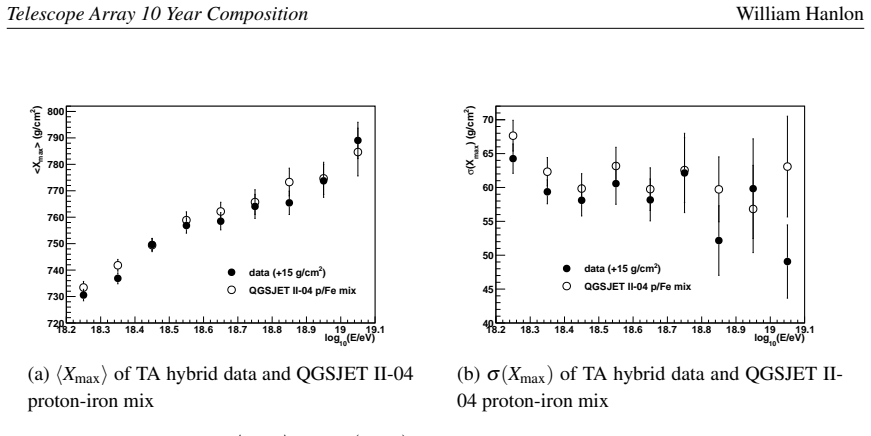
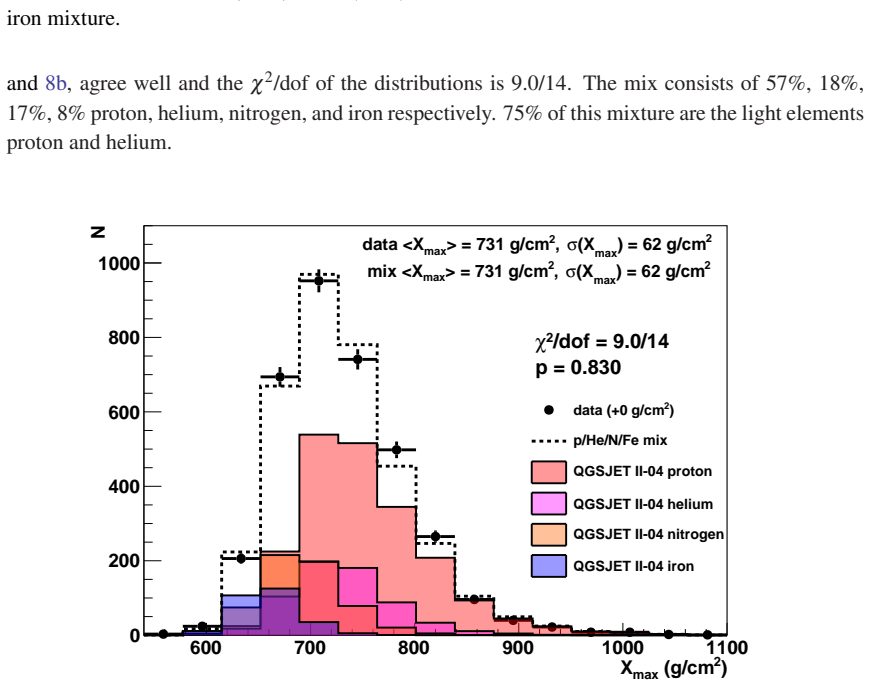
The central discovery is that ten years of Telescope Array hybrid $X_{\mathrm{max}}$ data, collected from 27 May 2008 to 28 November 2017, are compatible with a light composition below $10^{19.1}$ eV. Treating the data as a mixture of QGSJET II-04 proton, helium, nitrogen, and iron and fitting the full $X_{\mathrm{max}}$ distributions yields best-fit fractions of 57% proton, 18% helium, 17% nitrogen, and 8% iron, with no systematic shift of the data required. The fit reproduces both $\langle X_{\mathrm{max}}\rangle$ and $\sigma(X_{\mathrm{max}})$ across the energy range, and the resulting $p$-value of 0.830 indicates that the data and mixture are statistically compatible. The author notes that proton and helium fractions are strongly anti-correlated ($r<-0.9$), so the robust conclusion is stated as roughly 75% 'light' elements (proton and helium combined), with nitrogen and iron as minority components.
Load-bearing premise
The load-bearing premise is that the QGSJET II-04 Monte Carlo templates, processed through the collaboration's detector simulation and reconstruction, correctly predict the $X_{\mathrm{max}}$ distribution for each primary nucleus; the paper does not test other hadronic models, and the procedure that makes pure protons compatible with the data relies on absorbing the 17 g/cm$^2$ systematic as a uniform shift.
Editorial extensions
If this is right
- If the four-component mixture is correct, roughly three quarters of ultra-high-energy cosmic rays between $10^{18.2}$ and $10^{19.1}$ eV are protons or helium nuclei, with nitrogen and iron contributing the remaining quarter.
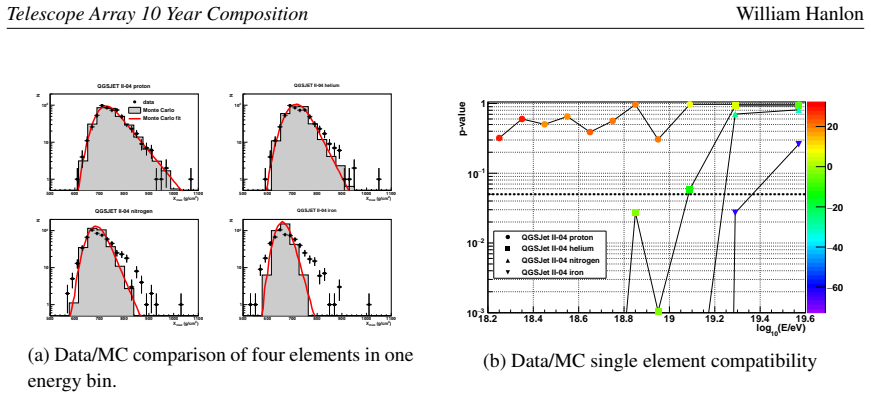
- The single-element tests show that pure QGSJET II-04 protons remain compatible with the data over the whole $10^{18.2}$\textendash$10^{19.9}$ eV range after a shift of about 20 g/cm$^2$, so a proton-dominated interpretation cannot be excluded at the highest energies.
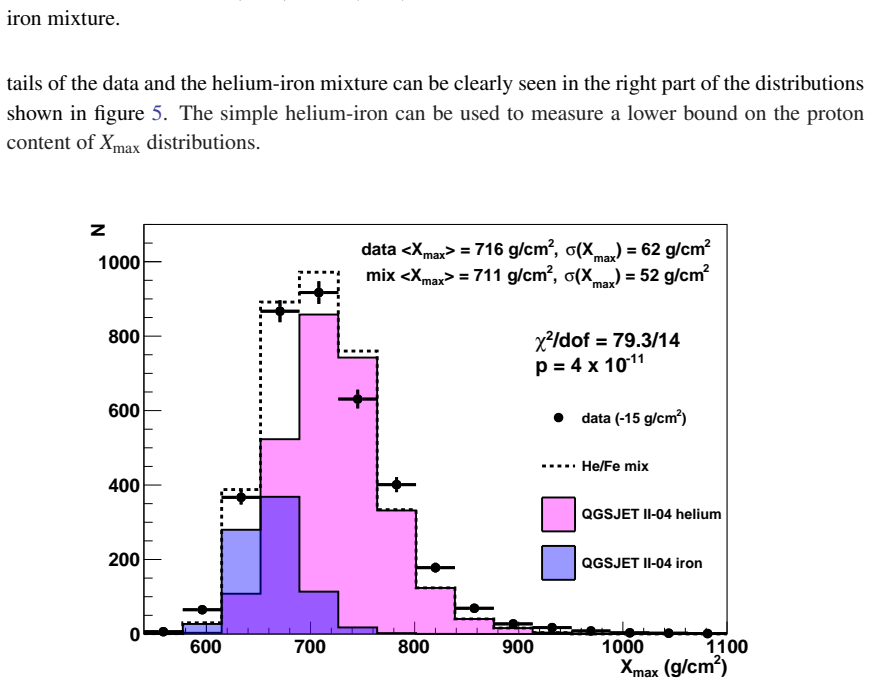
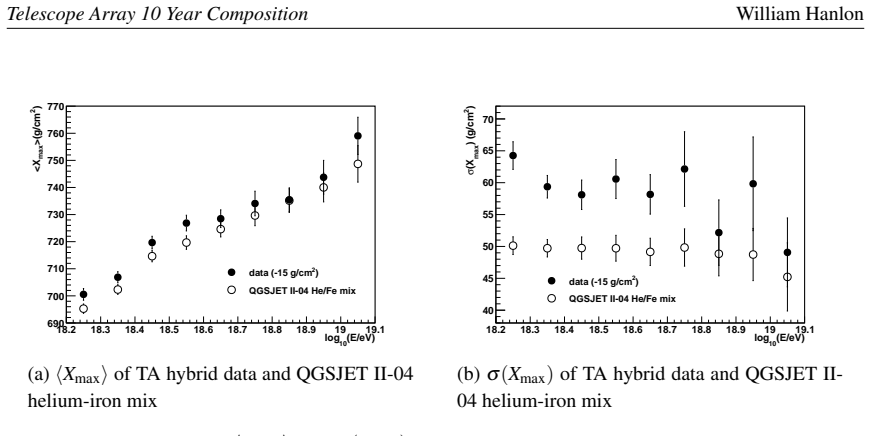
- The helium-iron mixture is rejected with $p = 4\times10^{-11}$ even after an optimal shift, establishing that protons are required to reproduce the exponential tail of the $X_{\mathrm{max}}$ distribution.
- Because proton and helium fractions are strongly anti-correlated in the fit, the paper's robust claim is the lumped light/medium/heavy split of about 75/17/8, not the individual proton and helium percentages.
- Full-distribution likelihood tests can reject wrong single-element models at current statistics; as the dataset grows, the same tests should also discriminate between competing multi-component mixtures.
Reading between the lines
- If the light composition is right at Telescope Array's northern sky, the tension with the heavier composition reported at similar energies by the Pierre Auger Observatory would point to energy-scale differences, sky coverage, or hadronic-model systematics, rather than to incompatible source populations.
- The strong proton-helium anti-correlation means the individual helium fraction of about 18% is not separately identifiable at current resolution; a future detector with better $X_{\mathrm{max}}$ resolution or supplemental muon measurements could break that degeneracy.
- Because the four-component fit needs no systematic shift while the pure-proton test needs about 20 g/cm$^2$, future composition studies could use the size of the required shift as a model-comparison statistic, preferring templates that fit without shifting.
- The same full-distribution fitting machinery can be applied to energy bins above $10^{19.1}$ eV as statistics accumulate, providing a direct test of whether the composition turns heavier at the highest energies.
Signed reviews
Editorial analysis
A structured set of objections, weighed in public.
Referee Report
Summary. The paper presents the Telescope Array collaboration's ten-year hybrid Xmax dataset (3560 events, 27 May 2008 to 28 November 2017) and uses full Xmax distributions, rather than only the mean and sigma, to test composition hypotheses against QGSJET II-04 Monte Carlo templates. Single-element compatibility tests, which allow a systematic shift of the data, find pure protons acceptable over log10(E/eV) = 18.2-19.9, while helium, nitrogen, and iron are rejected below about 10^19 eV; two-component fits find 95% proton + 5% iron (chi^2/dof = 12.8/14, p = 0.546) and a rejected 77% helium + 23% iron mixture; and a four-component p/He/N/Fe fit gives 57/18/17/8 percent fractions (75% light), with chi^2/dof = 9.0/14, p = 0.830 and no systematic shift. The paper concludes that TA data are compatible with a predominantly light composition below 10^19.1 eV.
Significance. If the claims survive scrutiny, this is a useful consolidation of TA composition measurements: it validates a full-distribution fitting approach, provides a comparison with the Auger four-component analysis, and strengthens the earlier conclusion of a light composition near 10^18.2-10^19.1 eV. The paper deserves credit for using the Barlow-Beeston method for finite MC samples, reporting p-values and chi^2/dof rather than only moments, and explicitly pointing out the p-He anti-correlation and the need for a future bias study. The main limitations are that the quoted fractions are conditional on a single hadronic model, carry no uncertainties, and are not yet validated by a closure test; these limitations directly affect the quantitative central claim, although the qualitative light-composition conclusion may survive.
major comments (3)
- [Section 4, Figures 7-9] The quantitative output of the four-component fit is not yet validated. The text reports 57% proton, 18% helium, 17% nitrogen, and 8% iron and summarizes this as 75% light, but no statistical or systematic uncertainties are given for these fractions, and the proton and helium fractions are stated to be strongly anti-correlated (r < -0.9) because their QGSJET II-04 Xmax templates differ by only about 25 g/cm^2 against a reconstruction resolution of about 18 g/cm^2. The paper itself says 'A future Monte Carlo study will investigate the bias introduced into the fraction calculations that are caused by these correlations.' As written, the point estimates cannot support claims at the reported precision, and the p+He sum itself could be biased if the fitter trades light against heavy components. I request a closure test with pseudo-experiments that inject known fractions and recover them, plus quoted uncertainties; until then, the paper should present only the light/medium/heavy sums as indicative, not the individual proton and helium fractions.
- [Section 4, Figure 9] The statistical setup of the four-component fit is ambiguous. The quoted chi^2/dof = 9.0/14 and Figure 7 describe what appears to be a single histogram over the full energy range 10^18.2-10^19.1 eV, whereas Figure 9 presents fractions as a function of energy. If the fractions were fitted per energy bin, the paper should state how the global 57/18/17/8 values were obtained and what uncertainties apply to the per-bin points; if a single global fit was used, the energy dependence in Figure 9 needs to be reconciled with it. Please also specify the histogram binning and the number of events in each energy bin.
- [Section 4, Figures 3-9] All composition inferences in the paper use QGSJET II-04 templates only, while the abstract and summary state a general conclusion of a 'predominantly light composition.' Because Xmax predictions differ between hadronic models by tens of g/cm^2, and the Auger four-component fractions quoted in [10] are model dependent, the reported fractions are conditional on this one model. Please either add a cross-check with at least one other hadronic model (for example EPOS-LHC or Sibyll 2.3c) or explicitly restrict the headline claim to QGSJET II-04; if the latter, the model dependence should be stated in the abstract and summary.
minor comments (6)
- [Abstract and Section 1] The sentence 'the current generation experiments better tests which compare full distributions can be employed' is ungrammatical and should be rewritten.
- [Section 3, Figure 2b] The text should state explicitly that the pure-proton compatibility is obtained after allowing a systematic shift of the data of about 20 g/cm^2, so that the summary does not read as a shift-free compatibility claim.
- [Section 4] The sign convention for the quoted systematic shifts ('data (+15 g/cm^2)', 'data (-15 g/cm^2)') is not defined; please clarify whether positive means data shifted toward larger Xmax and how the shifted data are compared with templates.
- [Section 4, Figures 3 and 7] The number and width of the Xmax histogram bins used in the fits are not given; specify them so that the chi^2/dof values can be checked.
- [Figure 2b caption] The caption uses 'QGSJet II-04' while the rest of the paper uses 'QGSJET II-04'; unify the notation.
- [Section 5] The summary phrase 'predominantly light elements such as QGSJET II-04 proton and helium' is imprecise; protons and helium are the elements, while QGSJET II-04 is the hadronic model used for their templates.
Circularity Check
No circularity: composition fractions are fitted against external QGSJET II-04 Monte Carlo templates, and no prediction is derived from a quantity defined by the result.
full rationale
The paper's central claim is that ten years of TA hybrid Xmax data are compatible with a predominantly light composition. The load-bearing ingredients are the measured Xmax distributions and the QGSJET II-04 Monte Carlo templates for proton, helium, nitrogen, and iron, which are external inputs, not derived from the data or from the fit itself. The four-component fractions (57% proton, 18% helium, 17% nitrogen, 8% iron) are fitted outputs obtained by minimizing chi2 comparing data and template mixtures; they are not pre-imposed on the data. The p/He anti-correlation and the need for a future bias study are statistical limitations of the fitting procedure, not circular reasoning. Self-citations to previous TA papers provide detector performance numbers and systematic uncertainties, but the composition conclusion does not reduce to those citations; it rests on the comparison of data to independent hadronic-interaction-model predictions. No equation defines the data in terms of the fitted fractions, and no fitted parameter is renamed as a prediction. Model dependence on QGSJET II-04 is a correctness or external-validity concern, not a circularity concern. Therefore the analysis is self-contained in the sense required by the circularity test.
Assumptions & free parameters
free parameters (7)
- systematic Xmax shift (p/Fe fit) =
+15 g/cm2
- proton fraction (p/Fe fit) =
95%
- iron fraction (p/Fe fit) =
5%
- systematic Xmax shift (He/Fe fit) =
-15 g/cm2
- helium fraction (He/Fe fit) =
77%
- iron fraction (He/Fe fit) =
23%
- four-component fractions =
p 57%, He 18%, N 17%, Fe 8%
assumptions (4)
- domain assumption QGSJET II-04 accurately predicts Xmax distributions for each primary nucleus after detector simulation.
- domain assumption The hybrid detector simulation and reconstruction chain faithfully model Xmax resolution (17.2 g/cm2), bias (<1 g/cm2), and energy resolution (5.7%).
- domain assumption The systematic uncertainty of 17 g/cm2 on <Xmax> can be represented by a uniform shift of the data distribution.
- standard math Barlow and Beeston finite-MC template fitting is applicable to the Xmax histograms.
Cite this review
Pith. "Pith review of Telescope Array 10 Year Composition." pith.science (2026). https://pith.science/paper/VSELNLBK
@misc{pith2026190801356,
  author       = {Pith},
  title        = {Pith review of: Telescope Array 10 Year Composition},
  year         = {2026},
  howpublished = {\url{https://pith.science/paper/VSELNLBK}},
  note         = {Machine review of arXiv:1908.01356}
}
abstract
Estimates of the composition of ultra high energy cosmic rays (UHECRs) can be inferred by recording the depth of air shower maximum, $X_{\mathrm{max}}$, for many showers and comparing the distributions to those predicted by Monte Carlo simulations. Traditionally, UHECR composition has relied upon comparison of the first and second moments of the $X_{\mathrm{max}}$ distributions to estimate the compatibility between data and simulations, but with the large UHECR datasets being built the current generation experiments better tests which compare full distributions can be employed. Such tests can be used to understand the accuracy with which UHECR composition can actually be understood at the current level of statistics and quantitatively measure the significance of agreement or disagreement with models in order to reject them. In this paper we present the most recent results of 10 years of Telescope Array hybrid $X_{\mathrm{max}}$ measurements which is found to agree with a predominantly light composition. In previously published results we have demonstrated the agreement of Telescope Array hybrid $X_{\mathrm{max}}$ data with single element models using systematic shifting of the data in order to ensure the shapes of the distributions are being compared. Here we present multi-component source models fit to hybrid $X_{\mathrm{max}}$ data and report on the relative fractions of those sources that best fit the data. Below $10^{19.1}$ eV TA hybrid data is found to be compatible with mixtures composed of predominantly light elements such as protons and helium.
Figures


Figures from the paper (6 more)


Reference graph
Works this paper leans on
-
[10]
Pierre Auger collaboration, Depth of maximum of air-shower profiles at the Pierre Auger Observatory. II. Composition implications , https://doi.org/10.1103/PhysRevD.90.122006 Phys. Rev. D90 (2014) 122006 [ https://arxiv.org/abs/1409.5083 1409.5083 ]
arXiv 2014
-
[1]
Telescope Array collaboration, The surface detector array of the Telescope Array experiment , https://doi.org/10.1016/j.nima.2012.05.079 Nucl. Instrum. Meth. A689 (2013) 87 [ https://arxiv.org/abs/1201.4964 1201.4964 ]
arXiv 2013
-
[2]
T. Abu-Zayyad et al., The prototype high-resolution Fly's Eye cosmic ray detector , https://doi.org/10.1016/S0168-9002(00)00307-7 Nucl. Instrum. Meth. A450 (2000) 253
-
[3]
Y. Tameda et al., Trigger electronics of the new fluorescence detectors of the Telescope Array experiment , https://doi.org/10.1016/j.nima.2009.07.093 Nucl. Instrum. Meth. A609 (2009) 227
-
[4]
H. Tokuno et al., New air fluorescence detectors employed in the Telescope Array experiment , https://doi.org/10.1016/j.nima.2012.02.044 Nucl. Instrum. Meth. A676 (2012) 54 [ https://arxiv.org/abs/1201.0002 1201.0002 ]
arXiv 2012
-
[5]
Telescope Array collaboration, Depth of Ultra High Energy Cosmic Ray Induced Air Shower Maxima Measured by the Telescope Array Black Rock and Long Ridge FADC Fluorescence Detectors and Surface Array in Hybrid Mode , https://doi.org/10.3847/1538-4357/aabad7 Astrophys. J. 858 (2018) 76 [ https://arxiv.org/abs/1801.09784 1801.09784 ]
arXiv 2018
-
[6]
Telescope Array collaboration, The Energy Spectrum of Ultra-High-Energy Cosmic Rays Measured by the Telescope Array FADC Fluorescence Detectors in Monocular Mode , https://doi.org/10.1016/j.astropartphys.2013.06.007 Astropart. Phys. 48 (2013) 16 [ https://arxiv.org/abs/1305.6079 1305.6079 ]
work page Pith review arXiv 2013
-
[7]
Telescope Array collaboration, Energy Spectrum of Ultra-High Energy Cosmic Rays Observed with the Telescope Array Using a Hybrid Technique , https://doi.org/10.1016/j.astropartphys.2014.05.002 Astropart. Phys. 61 (2015) 93 [ https://arxiv.org/abs/1305.7273 1305.7273 ]
work page Pith review arXiv 2015
Show all 11 references
-
[8]
R. J. Barlow and C. Beeston, Fitting using finite Monte Carlo samples , https://doi.org/10.1016/0010-4655(93)90005-W Comput. Phys. Commun. 77 (1993) 219
1993 doi
-
[9]
Brun and F
R. Brun and F. Rademakers, ROOT: An object oriented data analysis framework , https://doi.org/10.1016/S0168-9002(97)00048-X Nucl. Instrum. Meth. A389 (1997) 81
1997 doi
-
[11]
write newline
" write newline "" before.all 'output.state := FUNCTION blank.sep after.quote 'output.state := FUNCTION fin.entry output.state after.quoted.block = 'skip 'add.period if write newline FUNCTION new.block output.state before.all = 'skip output.state after.quote = after.quoted.blo...
Reviewed August 14, 2026 · model on record in the stance chip above.
Discussion (0). Continue with ORCID to comment.