Maniplexes as a Foundation for Cross-Linked Databases of Symmetric Objects
Pith reviewed 2026-06-29 03:55 UTC · model grok-4.3
The pith
Maniplexes provide a unifying framework for graphs, maps on surfaces, and abstract polytopes that enables a single interoperable database.
A machine-rendered reading of the paper's core claim, the machinery that carries it, and where it could break.
Core claim
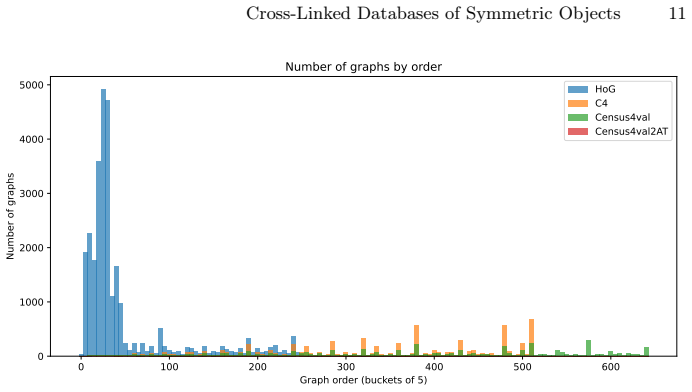
Maniplexes unify graphs, maps on surfaces, and abstract polytopes. The authors present an edge-labeled graph format for storing them that is compact and interoperable, and demonstrate it by linking two existing datasets of regular 4-maniplexes to the House of Graphs and to tetravalent graph censuses through canonical forms of their flag graphs, 1-skeleton graphs, and 1-coskeleton graphs.
What carries the argument
The edge-labeled graph representation of maniplexes, which encodes the combinatorial structure in a way that supports canonical forms and database interoperability.
If this is right
- Existing datasets from different communities can be cross-referenced using canonical representations.
- Results about regular structures in one domain become directly applicable to equivalent objects in another.
- A single database can store and query all these symmetric objects without duplication.
- Researchers gain tools to recognize when a graph, map, or polytope is the same object under different names.
Where Pith is reading between the lines
- Adoption of this format could lead to automated tools that scan multiple databases for isomorphisms.
- This unification might extend naturally to higher-dimensional or irregular cases beyond the regular 4-maniplexes shown.
- Cross-linking could reveal previously unnoticed dualities or symmetries across the fields.
Load-bearing premise
That the edge-labeled graph format will be adopted by the different research communities studying these objects.
What would settle it
If attempts to connect additional datasets using the proposed format fail to produce consistent canonical forms that match known equivalences between structures.
Figures
read the original abstract
Graphs, maps on surfaces, and abstract polytopes are related combinatorial structures that tend to be studied by different communities using their own tools and databases. Maniplexes provide a unifying framework that captures all of them. A single database built around maniplexes would help researchers recognize shared structures and translate results across fields. Here we present a compact, interoperable format for storing maniplexes as edge-labeled graphs, designed with such a database in mind. As a first step, we connect two existing datasets of regular 4-maniplexes to the House of Graphs and to Poto\v{c}nik's tetravalent graph censuses, using canonical forms of their flag graphs, 1-skeleton graphs, and 1-coskeleton graphs.
Editorial analysis
A structured set of objections, weighed in public.
Referee Report
Summary. The manuscript proposes maniplexes as a unifying combinatorial framework that captures graphs, maps on surfaces, and abstract polytopes. It presents a compact, interoperable format for representing maniplexes as edge-labeled graphs, intended to support a single cross-linked database. As a concrete demonstration, the work connects two existing censuses of regular 4-maniplexes to the House of Graphs and to Potočnik's tetravalent graph censuses by means of canonical forms of their flag graphs, 1-skeleton graphs, and 1-coskeleton graphs.
Significance. If the proposed format and linking method prove workable, the paper supplies a practical infrastructure step that could improve interoperability among communities studying symmetric combinatorial objects. The explicit cross-references via canonical flag, 1-skeleton, and 1-coskeleton forms constitute a verifiable strength and illustrate the framework's utility without overclaiming completed translations of results across fields.
minor comments (2)
- Abstract: the string 'Poto\v{c}nik's' appears to contain an unrendered LaTeX command; confirm that the name renders correctly as 'Potočnik's' throughout the manuscript.
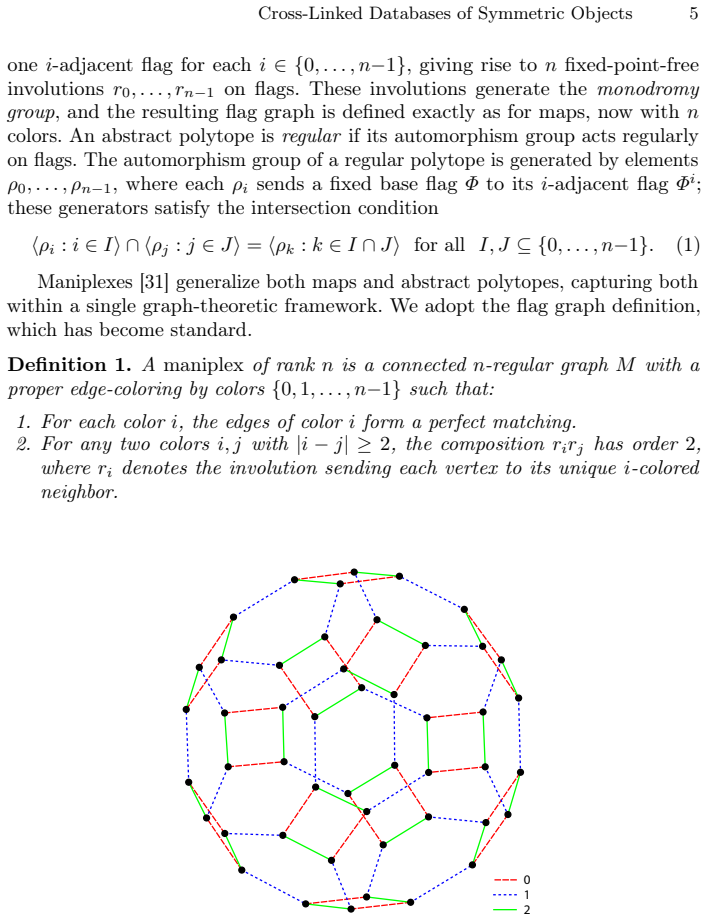
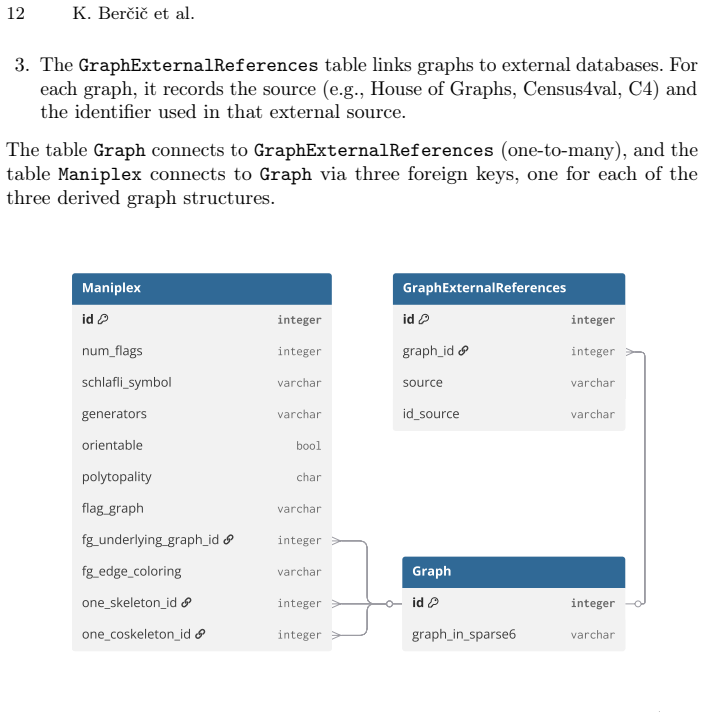
- The description of the edge-labeled graph format would benefit from an explicit small example (e.g., a 3-maniplex or 4-maniplex with its labeled edges) to clarify the encoding conventions for readers outside the immediate community.
Simulated Author's Rebuttal
We thank the referee for the positive summary and significance assessment of our work on maniplexes and the proposed storage format. The recommendation for minor revision is noted; we will incorporate any editorial or minor clarifications in the revised version.
Circularity Check
Framework proposal with no derivation chain or fitted predictions
full rationale
The manuscript proposes an edge-labeled graph format for storing maniplexes and demonstrates concrete cross-references between existing 4-maniplex censuses and graph databases via canonical flag, 1-skeleton, and 1-coskeleton forms. No equations, derivations, predictions of new quantities, or parameter fittings appear. The central claim is that maniplexes unify the structures and the proposed format enables interoperability; this is presented as an infrastructure step rather than a closed mathematical argument. No load-bearing step reduces by construction to its own inputs, and any self-citations are not invoked to justify uniqueness or force a result. The paper is self-contained against external benchmarks as a proposal.
Axiom & Free-Parameter Ledger
Reference graph
Works this paper leans on
-
[1]
https://www.math.mun.ca/distanceregular/, accessed: 2026
Bailey, R.: DistanceRegular.org. https://www.math.mun.ca/distanceregular/, accessed: 2026
2026
-
[2]
http://bridge.imfm.si/projects/symob/ (2026), accessed: 2026
Berčič, K., Cunningham, G., Santamaría-Galvis, A.D.: Cross-linked dataset of symmetric objects. http://bridge.imfm.si/projects/symob/ (2026), accessed: 2026
2026
-
[3]
https://discretezoo.xyz, accessed: 2026
Berčič, K., Vidali, J.: DiscreteZOO: A database of discrete combinatorial objects. https://discretezoo.xyz, accessed: 2026
2026
-
[4]
Berčič, K., Vidali, J.: Labelled graph formats – lsparse6.https://github.com/ DiscreteZOO/Computations/wiki/Labelled-graph-formats#lsparse6, accessed: 2026
2026
-
[5]
Math- ematics in Computer Science14, 559–575 (2020)
Berčič, K., Vidali, J.: DiscreteZOO: A fingerprint database of discrete objects. Math- ematics in Computer Science14, 559–575 (2020). https://doi.org/10.1007/s11786- 020-00453-5
-
[6]
International Journal of Algebra and Computation12(05), 623–644 (2002)
Besche, H.U., Eick, B., O’Brien, E.A.: A millennium project: Constructing small groups. International Journal of Algebra and Computation12(05), 623–644 (2002). https://doi.org/10.1142/S0218196702001115
-
[7]
Discrete Applied Mathematics161(1–2), 311–320 (2013)
Brinkmann, G., Coolsaet, K., De Boeck, J., Goedgebeur, H.: House of Graphs: A database of interesting graphs. Discrete Applied Mathematics161(1–2), 311–320 (2013). https://doi.org/10.1016/j.dam.2012.07.018
-
[8]
https://www.math.auckland.ac.nz/~conder/, ac- cessed: 2026
Conder, M.: Lists of regular maps, hypermaps and polytopes, trivalent symmetric graphs, and surface actions. https://www.math.auckland.ac.nz/~conder/, ac- cessed: 2026
2026
-
[9]
https://doi.org/10.5281/zenodo.8060684
Cunningham, G., Mixer, M., Williams, G.: RAMP, the research assistant for maniplexes and polytopes, Version 0.8.0.https://github.com/SupposeNot/RAMP (2023). https://doi.org/10.5281/zenodo.8060684
-
[10]
Cunningham, G., Mochán, E., Montero, A., Potočnik, P., Toledo, M.: Faithfulness in maniplexes, submitted 2025
2025
-
[11]
https://doi.org/10.5281/zenodo.19323533 Cross-Linked Databases of Symmetric Objects 15
Cunningham, G., Montero, A., Potočnik, P., Toledo, M.: Rotary 4-maniplexes with rotation group of order 3550 or less (2026). https://doi.org/10.5281/zenodo.19323533 Cross-Linked Databases of Symmetric Objects 15
-
[12]
com/chiral/, accessed: 2026
Hartley, M.I.: An atlas of small chiral polytopes.http://www.abstract-polytopes. com/chiral/, accessed: 2026
2026
-
[13]
http://www
Hartley, M.I.: An atlas of small regular polytopes. http://www. abstract-polytopes.com/atlas/, accessed: 2026
2026
-
[14]
http://www
Hartley, M.I.: Polytopes derived from sporadic simple groups. http://www. abstract-polytopes.com/sporpolys/, accessed: 2026
2026
-
[15]
Combinatorica43(2), 385–420 (2023)
Hubard, I., Mochán, E., Montero, A.: Voltage operations on maniplexes, polytopes and maps. Combinatorica43(2), 385–420 (2023). https://doi.org/10.1007/s00493- 023-00018-7
-
[16]
Ars Mathe- matica Contemporanea25(1), Paper No
Leemans, D., Toledo, M.: Faithful and thin non-polytopal maniplexes. Ars Mathe- matica Contemporanea25(1), Paper No. 4, 17 (2025)
2025
-
[17]
cecs.anu.edu.au/~bdm/data/formats.txt(2022), accessed: 2026
McKay, B.: Description of graph6, sparse6 and digraph6 encodings.https://users. cecs.anu.edu.au/~bdm/data/formats.txt(2022), accessed: 2026
2022
-
[18]
Journal of Symbolic Computation60, 94–112 (2014)
McKay, B.D., Piperno, A.: Practical graph isomorphism, II. Journal of Symbolic Computation60, 94–112 (2014). https://doi.org/10.1016/j.jsc.2013.09.003
-
[19]
McMullen, P., Schulte, E.: Abstract Regular Polytopes, Encyclopedia of Math- ematics and its Applications, vol. 92. Cambridge University Press (2002). https://doi.org/10.1017/CBO9780511546686
-
[20]
Nedela, R.: Maps, hypermaps and related topics.https://www.savbb.sk/~nedela/ CMbook.pdf(2007)
2007
-
[21]
Pellicer, D.: Abstract Chiral Polytopes, New Mathematical Monographs, vol. 49. Cambridge University Press (2025)
2025
-
[22]
Pisanski, T., Marušič, D., Potočnik, P., Orbanić, A., Horvat, B., Lukšič, P.: Ency- clopedia of graphs.http://atlas.gregas.eu/, accessed: 2026
2026
-
[23]
Potočnik, P.: A list of 4-valent 2-arc-transitive graphs and finite faithful amalgams of index (4, 2). Eur. J. Comb.30, 1323–1336 (2009)
2009
-
[24]
net(2024), accessed: 2026
Potočnik, P.: Graphsym: Datasets of highly symmetric graphs.https://graphsym. net(2024), accessed: 2026
2024
-
[25]
Potočnik, P., Spiga, P., Verret, G.: Cubic vertex-transitive graphs on up to 1280 vertices. J. Symbolic Comput.50, 465–477 (2013)
2013
-
[26]
Potočnik, P., Spiga, P., Verret, G.: Bounding the order of the vertex-stabiliser in 3-valent vertex-transitive and 4-valent arc-transitive graphs. J. Combin. Theory Ser. B111, 148–180 (2015)
2015
-
[27]
Potočnik, P., Wilson, S.E.: Census of edge-transitive tetravalent graphs.https: //jan.ucc.nau.edu/~swilson/C4FullSite/index.html, accessed: 2026
2026
-
[28]
The Art of Discrete and Applied Mathematics3(1), #P1.08 (2020)
Potočnik, P., Wilson, S.E.: Recipes for edge-transitive tetravalent graphs. The Art of Discrete and Applied Mathematics3(1), #P1.08 (2020). https://doi.org/10.26493/2590-9770.1269.732
-
[29]
https://www.gap-system.org(2022)
The GAP Group: GAP – Groups, Algorithms, and Programming, Version 4.12. https://www.gap-system.org(2022)
2022
-
[30]
Vauthier, L., Leemans, D.: An atlas of abstract regular polytopes for small al- most simple groups.https://www.math.auckland.ac.nz/~dleemans/polytopes/, accessed: 2026
2026
-
[31]
Sym- metry4(2), 265–275 (2012)
Wilson, S.E.: Maniplexes: Part 1: Maps, polytopes, symmetry and operators. Sym- metry4(2), 265–275 (2012). https://doi.org/10.3390/sym4020265
-
[32]
Mathematics Magazine89(4), 267 (2016)
Wood, J.: Proof without words: The automorphism group of the Petersen graph is isomorphic to s5. Mathematics Magazine89(4), 267 (2016). https://doi.org/10.4169/math.mag.89.4.267
discussion (0)
Sign in with ORCID, Apple, or X to comment. Anyone can read and Pith papers without signing in.