REVIEW 2 major objections 6 minor 1 cited by
Free energy minimizers with radial densities: classification and quantitative stability
T0 review · 2 major / 6 minor · reviewed 2026-08-11 · deepseek-v4-flash
Pith's one-line read This paper shows that, for monotone increasing strictly admissible radial weights, centered spheres uniquely minimize the free energy at every volume, and the energy gap controls the squared weighted distance to the ball.
desk verdict Counterexamples genuinely answer Q1 in the negative; the monotone classification is a serious Chambers adaptation; the stability theorem has a repairable but real gap in Proposition 4.2/Remark 4.3. read the letter →
The pith
A machine-rendered reading of the paper's core claim, the machinery that carries it, and where it could break.
The reading
What carries the argument
The classification argument runs through spherical symmetrization, which replaces any competitor by a spherically symmetric set with no larger energy and the same weighted volume. The boundary of the symmetrized minimizer is described by a plane curve $\gamma$ solving the constant weighted mean curvature equation (3.3), and the proof decomposes $\gamma$ into an upper curve, a lower curve, and a curl curve; a comparison argument shows the lower curve bends faster than the upper one, so it cannot cross the symmetry axis, and any curling contradicts the tangent restriction, forcing $\gamma$ to be a centered circle. A separate calibration argument, using a radial vector field with an explicit multiplier, gives large-volume uniqueness under $\kappa$-uniform admissibility. For stability, the key machinery is a second-order expansion on nearly spherical sets, writing $\partial E=\{Rx(1+u(x))\}$, expanding the energy gap to second order, and controlling it from below by $\|u\|^2_{L^2}$; the local estimate is then connected to global sets through almost-minimizers, uniform boundedness, and a compactness argument.
What would settle it
Evaluate condition (4.3) along the radii $r_k$ produced by Lemma 4.14 for a monotone strictly admissible pair; in $n=2$ with $\psi(r)=\arctan r$ the condition reduces to $\psi'(r_k)>r_k$, which fails for all $r_k>1$, so if the contradiction argument reaches such radii the proof of Theorem 1.8 as written cannot invoke Proposition 4.2.
Extended reading notes
Core claim
The central discovery is that the stability condition $\psi''+g'\ge 0$, which characterizes local minimality of centered spheres, is not enough to guarantee global optimality once a potential term $g$ is present. In dimension $n\ge2$, the paper constructs $\kappa$-uniformly admissible weights with $\psi$ minimized at the origin for which non-centered balls beat the centered ball at intermediate volumes, so monotonicity of the two weights is needed. Under monotone increasing strictly admissible hypotheses, Theorem 1.5 establishes that centered spheres uniquely solve the volume-constrained problem for every volume; Corollary 1.6 records the resulting isoperimetric profile identity, and Theorem 1.8 states a sharp quadratic stability bound $E(E)-E(B_R)\ge c|E\triangle B_R|_f^2$ for all sets of the same weighted volume.
Load-bearing premise
The stability proof requires that at every radius $r_k$ selected by the compactness argument the local estimate's condition (4.3) holds, meaning $\psi'(r_k)>-\frac{(n-2)(n-1)}{r_k^2(\psi'(r_k)+g(r_k))}+(n-1)r_k$; this domination is not implied by the monotone strictly admissible hypotheses, and for $n=2$, $\psi(r)=\arctan r$ it fails for every $r>1$.
Editorial extensions
If this is right
- For any monotone increasing strictly admissible pair $(\psi,g)$, the volume-constrained variational problem is fully solved: every minimizer is a centered ball, so further analysis of the free energy can be restricted to balls.
- The explicit isoperimetric profile formula $E'(v)=g(r)+\psi'(r)+(n-1)/r$ with $r=\Phi^{-1}(v)$ makes it possible to detect where the profile is concave or convex and to locate volumes at which centered uniqueness may fail.
- The two counterexamples show that numerical or variational methods that rely only on $\psi''+g'\ge0$ to certify global optimality will fail in dimension $n\ge2$; monotonicity checks must be added.
- The sharp quadratic stability inequality implies quantitative convergence of any minimizing sequence to the centered ball in the $f$-weighted $L^1$ distance, with the exponent 2 optimal since ellipsoidal deformations saturate the bound.
- In the large-volume regime, $\kappa$-uniform admissibility alone guarantees that centered spheres of radius larger than $\sqrt{n+2}/\kappa$ are the unique minimizers.
Reading between the lines
- A natural extension not pursued in the paper is to lower the regularity requirement on the monotone weights; the comparison structure of the curve argument suggests that a density/approximation argument could preserve the classification for merely $C^2$ monotone strictly admissible weights.
- The counterexamples occupy the intermediate-volume regime, which is the natural frontier: small volumes concentrate near minima of $e^\psi$, large volumes are forced to centered balls by calibration, and the failure of global optimality is a genuinely intermediate-volume phenomenon; a one-parameter family of weights could be tested numerically across this transition.
- For the stability theorem, the proof would become unconditional if the local estimate of Proposition 4.2 were stated directly under the weaker condition displayed in Remark 4.3 and that condition were shown to hold at the radii produced by the compactness argument; making this substitution is a concrete open step.
- The sharpness of the quadratic exponent via ellipsoids suggests that the optimal constant in (1.4) is governed by the lowest eigenvalue of the second variation; computing it for a model potential such as a linear field would give an explicit quantitative bound for droplet shapes in a gravitational field.
Editorial analysis
A structured set of objections, weighed in public.
Referee Report
Summary. The paper studies the free-energy isoperimetric problem in R^n with perimeter density f=e^ψ and external potential g, both radial, under a volume constraint with respect to f. After establishing existence, boundedness, and regularity of minimizers, it computes the first and second variations and shows that centered spheres are stationary and stable exactly when ψ''+g'≥0. The main results are: (i) a complete one-dimensional classification; (ii) two counterexamples in n≥2 showing that ψ''+g'>0 plus a minimum of ψ at the origin does not suffice for global optimality of centered spheres; (iii) a global uniqueness theorem for centered spheres when ψ and g are both monotone increasing and strictly admissible (Theorem 1.5); and (iv) a sharp quadratic stability inequality in that monotone class (Theorem 1.8). The proof of (iii) is an adaptation of Chambers' proof of the log-convex density conjecture, and the proof of (iv) follows the Fuglede-type scheme of Fusco–La Manna.
Significance. If the proofs are completed, the paper gives a fairly complete answer to the question of when the stability condition ψ''+g'≥0 is also sufficient for global optimality of centered spheres, and it provides a quantitative rigidity statement in the monotone regime. The two counterexamples are instructive and show that the one-dimensional behavior does not persist in higher dimensions. The main classification is a substantial adaptation of Chambers' argument to the case with a potential, and the quantitative stability result is a natural and useful strengthening. The paper also contributes elementary existence and regularity results for this free-energy functional. The proofs are mostly self-contained and the statements are precise, with the qualification that the quantitative stability half currently contains two repairable gaps, detailed below. The counterexamples and the classification argument are, in my reading, sound.
major comments (2)
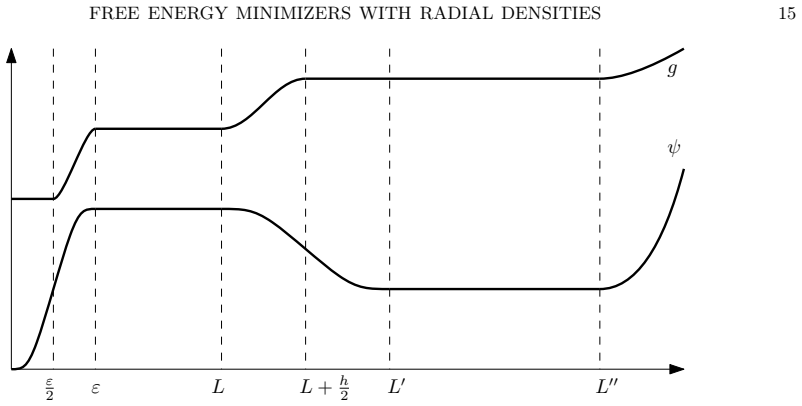
- [Section 4.1 (Proposition 4.2 and Remark 4.3)] Condition (4.3) in Proposition 4.2 is not implied by the hypotheses of Theorem 1.8, and the assertion in Remark 4.3 that (4.3) is automatically satisfied for monotone increasing strictly admissible weights is false. For example, take n=2, ψ(r)=arctan(r), and g(r)=r+C with C>0. Then ψ is increasing, g is increasing, and ψ''(r)+g'(r)=1-2r/(1+r^2)^2>0 for all r>0, so the weights satisfy the assumptions of Theorem 1.8. However, for n=2 the right-hand side of (4.3) reduces to R, while ψ'(R)=1/(1+R^2)<R for all sufficiently large R, so (4.3) fails. Since the proof of Theorem 1.8 in Section 4.2 applies Proposition 4.2 at the radii r_k produced by Lemma 4.14, with r_k converging to the arbitrary radius R>0, the proof of Theorem 1.8 is not justified as written. This is repairable: the proof of Proposition 4.2 only requires the weaker condition stated in Remark 4.3, namely (R^2ψ'(R)+R(n-1))(ψ'(R)+g(R))+R(n-1)ψ'(R)+R^2(ψ''(R)+g'(R))+(n-1)(n-2)>0, which is automatically satisfied when ψ'≥0, g≥0 and ψ''+g'>0. The proposition should be restated with that weaker hypothesis and the remark amended.
- [Section 4.2 (Theorem 1.8 proof, Lemma 4.7)] The proof of Theorem 1.8 uses Lemma 4.7 in the case of large asymmetric difference, but Lemma 4.7 requires the hypothesis ψ(r)>ψ(0). This is not a consequence of the assumptions 'ψ,g monotone increasing strictly admissible' if 'monotone increasing' is understood in the standard non-decreasing sense, which the paper's own usage in Proposition 1.4 and Proposition 2.17 suggests. For instance, ψ≡0 and g(r)=r are monotone increasing and strictly admissible, yet ψ(r)=ψ(0) for every r. The contradiction argument of Lemma 4.7 would still need a separate justification in this degenerate case; as written, the application of Lemma 4.7 in the proof of Theorem 1.8 is not covered by its hypotheses. This is a further gap in the stability theorem, though it is also local and repairable, either by treating the constant-ψ case separately (e.g., via [43] when ψ≡0) or by a limiting argument from strictly increasing perturbations.
minor comments (6)
- [Section 2.1 (Proposition 2.2 and Remark 2.3)] The statement of Proposition 2.2 uses condition (2.2), but Remark 2.3 and the proof refer to 'condition (2.3)' and 'thanks to condition (2.3)'; these references should be to (2.2).
- [Section 2.4 (Proposition 2.16)] The estimate e^{M/n}-e^{M/(2n)} ≥ M/n used near the end of the proof is not correct as written; the correct lower bound is e^{M/n}-e^{M/(2n)} ≥ M/(2n). The conclusion remains valid because the second term on the right-hand side of (2.25) still has a factor ε^{n-1} and can be made small, but the displayed constant in the perimeter estimate should be adjusted.
- [Section 3.1 (Proposition 3.2)] The last display of Proposition 3.2 reads Pf(F⋆ξ) ≤ Pf(Fξ); the right-hand side should be Pf(F), not Pf(Fξ).
- [Section 4.1 (Lemma 4.14)] In the statement of Lemma 4.14, the phrase 'for each i ∈ N' is unused and appears to be a leftover; the graph u_k should be indexed by k, and the regularity statement 'C^{1,α} for all α<1/2' should be stated consistently.
- [Section 2.3 (Theorem 1.3 proof)] In the lower bound for h, the expression ℓ′ + ℓ r + (n-1)/r should read ℓ′ + ℓ(r + (n-1)/r); the factor ℓ is missing in front of (n-1)/r.
- [Section 3.2 (Lemma 3.9(2))] The displayed computation of ˜H''_1(0) contains unreadable OCR artifacts (the strings '/bracehtipupleft/bracehtipdownright/...'); these should be cleaned up in the LaTeX source.
Circularity Check
No significant circularity: the main theorems are derived from symmetrization, calibration, and ODE comparison with external references, not from the authors' own conclusions.
full rationale
I examined the derivation chain for Theorems 1.5 and 1.8. The classification proof in Section 3 proceeds by spherical symmetrization (Proposition 3.2), reduction to a generating curve satisfying the weighted mean curvature ODE (Lemma 3.4), and a geometric upper/lower/curl curve argument adapted from Chambers [15]; the cited geometric lemmas are external, prior work by other authors, and not by the present authors. The counterexamples in Propositions 2.16 and 2.17 are explicit constructions with free parameters (M, epsilon, L, h, delta) chosen through inequalities, not fitted to the conclusion. The stability result in Section 4 uses a self-contained second-order expansion for nearly spherical sets in Proposition 4.2 and the Fusco--La Manna compactness scheme from [33]; the authors' own prior works [64,65] appear only in the introduction as context and are not load-bearing. The weak point noted by the reader -- that hypothesis (4.3) in Proposition 4.2 is not implied by Theorem 1.8's hypotheses -- is a correctness gap in a displayed sufficient condition, not a circularity: the proof only needs the weaker condition recorded in Remark 4.3, and that weaker condition does not assume the theorem's conclusion. No equation is defined in terms of the target result, no fitted parameter is renamed as a prediction, and no load-bearing step reduces to a self-citation. Therefore the derivation is self-contained with respect to circularity.
Assumptions & free parameters
free parameters (6)
- M (plateau height in Prop 2.16) =
arbitrary large M > 0
- epsilon (transition width in Prop 2.16) =
small, satisfying (2.23)
- h = L' - L =
large, satisfying (2.24)
- C (additive constant in g) =
large
- delta (linear perturbation added to g) =
small
- g(0) in Prop 2.17 =
large
assumptions (7)
- domain assumption Radial symmetry of psi and g with respect to the origin.
- domain assumption Admissibility: psi in C^2, g in C^1, psi'(0)=0, and psi''+g' >= 0 for all r >= 0.
- domain assumption Monotone increasing psi and g for Theorems 1.5 and 1.8.
- standard math Standard geometric measure theory: BV compactness, coarea formula, regularity theory for omega-minimizers.
- standard math Kolesnikov-Zhdanov calibration lemma.
- standard math Chambers' log-convex density theorem and the auxiliary geometric lemmas of Boyer-Brown-Chambers-Loving-Tammen.
- ad hoc to paper Condition (4.3) in Proposition 4.2 is available at the radii used in the proof of Theorem 1.8.
Cite this review
Pith. "Pith review of Free energy minimizers with radial densities: classification and quantitative stability." pith.science (2026). https://pith.science/paper/VTDGOGYJ
@misc{pith2026241203997,
  author       = {Pith},
  title        = {Pith review of: Free energy minimizers with radial densities: classification and quantitative stability},
  year         = {2026},
  howpublished = {\url{https://pith.science/paper/VTDGOGYJ}},
  note         = {Machine review of arXiv:2412.03997}
}
abstract
We study the isoperimetric problem with a potential energy $g$ in $\mathbb{R}^n$ weighted by a radial density $f$ and analyze the geometric properties of minimizers. Notably, we construct two counterexamples demonstrating that, in contrast to the classical isoperimetric case $g = 0$, the condition $\ln(f)'' + g' \geq 0$ does not generally guarantee the global optimality of centered spheres. However, we demonstrate that centered spheres are globally optimal when both $f$ and $g$ are monotone. Additionally, we strengthen this result by deriving a sharp quantitative stability inequality.
Figures

Forward citations
Cited by 1 Pith paper
-
The one-dimensional equilibrium shape of a crystal
In one dimension, under g(0)=0, g>=0 and convex sub-level sets, every minimizer of the free energy with prescribed mass is an interval and a minimizer always exists.
Reference graph
Works this paper leans on
-
[11]
Isoperimetric Regions in Rn with Density rp
W. Boyer, B. Brown, G. R. Chambers, A. Loving, and S. Tamm en. “Isoperimetric Regions in Rn with Density rp”. In: Analysis and Geometry in Metric Spaces (2016)
work page 2016
-
[15]
Proof of the log-convex density conjec ture
G. R. Chambers. “Proof of the log-convex density conjec ture”. In: J. Eur. Math. Soc. (JEMS) 21.8 (2019), pp. 2301–2332. issn: 1435-9855,1435-9863
work page 2019
-
[43]
E. Indrei and A. Karakhanyan. Minimizing the free energy. 2023. arXiv: 2304.01866 [math.AP]
arXiv 2023
-
[1]
Ambrosio, N
L. Ambrosio, N. Fusco, and D. Pallara. Functions of bounded variation and free discontinuity problems. Oxford university press, 2000
2000
-
[2]
New spectral Bishop–Gromov and B onnet–Myers theorems and applications to isoperimetry
G. Antonelli and K. Xu. “New spectral Bishop–Gromov and B onnet–Myers theorems and applications to isoperimetry”. In: arXiv preprint arXiv:2405.08918 (2024)
arXiv 2024
-
[3]
Equilibrium shapes of cr ystals in a gravitational field: Crystals on a table
J. A vron, J. Taylor, and R. Zia. “Equilibrium shapes of cr ystals in a gravitational field: Crystals on a table”. In: Journal of statistical physics 33.3 (1983), pp. 493–522
work page 1983
-
[4]
D. Bakry and M. Émery. “Diffusions hypercontractives”. I n: Séminaire de Probabil- ités XIX 1983/84: Proceedings . Springer, 2006, pp. 177–206
work page 1983
-
[5]
Lévy–Gromov’s isoperimetric in equality for an infinite di- mensional diffusion generator
D. Bakry and M. Ledoux. “Lévy–Gromov’s isoperimetric in equality for an infinite di- mensional diffusion generator”. In: Inventiones mathematicae 123.2 (1996), pp. 259– 281
work page 1996
Show all 69 references
-
[6]
Stability of hypersurface s with constant mean curvature
J. L. Barbosa and M. d. Carmo. “Stability of hypersurface s with constant mean curvature”. In: Manfredo P. do Carmo–Selected Papers . Springer, 2012, pp. 221– 235
2012
-
[7]
Propriétés de concavité du profil isopérimétr ique et applications
V. Bayle. “Propriétés de concavité du profil isopérimétr ique et applications”. PhD thesis. Université Joseph-Fourier-Grenoble I, 2003
2003
-
[8]
A quantitative iso perimetric inequality on the sphere
V. Bögelein, F. Duzaar, and N. Fusco. “A quantitative iso perimetric inequality on the sphere”. In: Advances in Calculus of Variations 10.3 (2017), pp. 223–265
2017
-
[9]
A sharp quantita tive isoperimetric in- equality in hyperbolic n-space
V. Bögelein, F. Duzaar, and C. Scheven. “A sharp quantita tive isoperimetric in- equality in hyperbolic n-space”. In: Calculus of Variations and Partial Differential Equations 54 (2015), pp. 3967–4017
2015
-
[10]
Isoperimetry in sur- faces of revolution with density
E. Bongiovanni, A. Diaz, A. Kakkar, and N. Sothanaphan. “Isoperimetry in sur- faces of revolution with density”. In: Missouri journal of mathematical sciences 30.2 (2018), pp. 150–165
2018
-
[12]
Y. D. Burago and V. A. Zalgaller. Geometric inequalities. Vol. 285. Springer Science & Business Media, 2013
2013
-
[13]
Stabilité isopérimétrique
G. Carron. “Stabilité isopérimétrique”. In: Mathematische Annalen 306 (1996), pp. 323– 340
1996
-
[14]
Free boundary stable hypersu rfaces in manifolds with density and rigidity results
K. Castro and C. Rosales. “Free boundary stable hypersu rfaces in manifolds with density and rigidity results”. In: Journal of Geometry and Physics 79 (2014), pp. 14– 28
2014
-
[16]
The Riemann ian quantitative isoperi- metric inequality
O. Chodosh, M. Engelstein, and L. Spolaor. “The Riemann ian quantitative isoperi- metric inequality”. In: Journal of the European Mathematical Society 25.5 (2022), pp. 1711–1741
2022
-
[17]
On the i soperimetric deficit in Gauss space
A. Cianchi, N. Fusco, F. Maggi, and A. Pratelli. “On the i soperimetric deficit in Gauss space”. In: American Journal of Mathematics (2011), pp. 131–186
2011
-
[18]
A selection principle f or the sharp quantitative isoperimetric inequality
M. Cicalese and G. P. Leonardi. “A selection principle f or the sharp quantitative isoperimetric inequality”. In: Archive for Rational Mechanics and Analysis 206.2 (2012), pp. 617–643
2012
-
[19]
Best constants for the i soperimetric inequality in quantitative form
M. Cicalese and G. P. Leonardi. “Best constants for the i soperimetric inequality in quantitative form”. In: Journal of the European Mathematical Society 15.3 (2013), pp. 1101–1129. 38 REFERENCES
2013
-
[20]
Sharp quantitative stability for isoperimetric inequalities with homogeneou s weights
E. Cinti, F. Glaudo, A. Pratelli, X. Ros-Oton, and J. Ser ra. “Sharp quantitative stability for isoperimetric inequalities with homogeneou s weights”. In: Transactions of the American Mathematical Society 375.3 (2022), pp. 1509–1550
2022
-
[21]
Differential geometry of manifolds with den sity
I. Corwin. “Differential geometry of manifolds with den sity”. In: Rose-Hulman Un- dergraduate Mathematics Journal 7.1 (2006), p. 2
2006
-
[22]
A two-point function ap proach to connectedness of drops in convex potentials
G. De Philippis and M. Goldman. “A two-point function ap proach to connectedness of drops in convex potentials”. In: Comm. Anal. Geom. 30.4 (2022), pp. 815–841. issn: 1019-8385,1944-9992
2022
-
[23]
A quantitativ e version of the isoperimetric inequality: the anisotropic case
L. Esposito, N. Fusco, and C. Trombetti. “A quantitativ e version of the isoperimetric inequality: the anisotropic case”. In: Annali della Scuola Normale Superiore di Pisa- Classe di Scienze 4.4 (2005), pp. 619–651
2005
-
[24]
A sharp stability result for t he relative isoperimetric inequality inside convex cones
A. Figalli and E. Indrei. “A sharp stability result for t he relative isoperimetric inequality inside convex cones”. In: Journal of Geometric Analysis 23.2 (2013), pp. 938–969
2013
-
[25]
On the isoperimetric problem f or radial log-convex den- sities
A. Figalli and F. Maggi. “On the isoperimetric problem f or radial log-convex den- sities”. In: Calculus of Variations and Partial Differential Equations 48.3 (2013), pp. 447–489
2013
-
[26]
On the shape of liquid drops and crystals in the small mass regime
A. Figalli and F. Maggi. “On the shape of liquid drops and crystals in the small mass regime”. In: Archive for rational mechanics and analysis 201 (2011), pp. 143–207
2011
-
[27]
A mass transport ation approach to quantita- tive isoperimetric inequalities
A. Figalli, F. Maggi, and A. Pratelli. “A mass transport ation approach to quantita- tive isoperimetric inequalities”. In: Inventiones mathematicae 182.1 (2010), pp. 167– 211
2010
-
[28]
R. Finn. Equilibrium capillary surfaces . Vol. 284. Springer Science & Business Me- dia, 2012
2012
-
[29]
The sessile liquid drop. I. Symmetric case
R. Finn. “The sessile liquid drop. I. Symmetric case”. I n: Pacific Journal of Mathe- matics 88.2 (1980), pp. 541–587
1980
-
[30]
Stability in the isoperimetric problem fo r convex or nearly spherical do- mains in Rn
B. Fuglede. “Stability in the isoperimetric problem fo r convex or nearly spherical do- mains in Rn”. In: Transactions of the American Mathematical Society 314.2 (1989), pp. 619–638
1989
-
[31]
The quantitative isoperimetric inequality and related topics
N. Fusco. “The quantitative isoperimetric inequality and related topics”. In: Bulletin of Mathematical Sciences 5 (2015), pp. 517–607
2015
-
[32]
A strong form of the quantitative isoperimetric inequality
N. Fusco and V. Julin. “A strong form of the quantitative isoperimetric inequality”. In: Calculus of Variations and Partial Differential Equations 50 (2014), pp. 925– 937
2014
-
[33]
Some weighted isoperimetri c inequalities in quan- titative form
N. Fusco and D. A. La Manna. “Some weighted isoperimetri c inequalities in quan- titative form”. In: J. Funct. Anal. 285.2 (2023), Paper No. 109946, 24. issn: 0022- 1236,1096-0783
2023
-
[34]
The sharp quantita tive isoperimetric inequal- ity
N. Fusco, F. Maggi, and A. Pratelli. “The sharp quantita tive isoperimetric inequal- ity”. In: Annals of mathematics (2008), pp. 941–980
2008
-
[35]
Existence and regularity for the problem of a pendent liquid drop
E Gonzalez, U. Massari, and I. Tamanini. “Existence and regularity for the problem of a pendent liquid drop”. In: Pacific Journal of Mathematics 88.2 (1980), pp. 399– 420
1980
-
[36]
Isoperimetric inequalities in Riemannian manifolds
M. Gromov. “Isoperimetric inequalities in Riemannian manifolds”. In: Asymptotic Theory of Finite Dimensional Spaces 1200 (1986), pp. 114–129
1986
-
[37]
A quantitative isoperimetric inequality in n -dimensional space
R. Hall. “A quantitative isoperimetric inequality in n -dimensional space.” In: (1992)
1992
-
[38]
Some theorems on the free energies of cryst al surfaces
C. Herring. “Some theorems on the free energies of cryst al surfaces”. In: Physical review 82.1 (1951), p. 87
1951
-
[39]
The log-convex density conjecture and vertic al surface area in warped products
S. Howe. “The log-convex density conjecture and vertic al surface area in warped products”. In: Advances in Geometry 15.4 (2015), pp. 455–468. REFERENCES 39
2015
-
[40]
A weighted relative isoperimetric inequal ity in convex cones
E. Indrei. “A weighted relative isoperimetric inequal ity in convex cones”. In: Methods and Applications of Analysis 28.01 (2021), pp. 001–014
2021
-
[41]
On the equilibrium shape of a crystal
E. Indrei. “On the equilibrium shape of a crystal”. In: Calculus of Variations and Partial Differential Equations 63.4 (2024), p. 97
2024
-
[42]
The one-dimensional equilibrium shape of a crystal
E. Indrei. “The one-dimensional equilibrium shape of a crystal”. In: arXiv preprint arXiv:2501.07900 (2025)
2025 arXiv
-
[44]
On the isoperimetric nature of a rearrangem ent inequality and its consequences for some variational problems
B. Kawohl. “On the isoperimetric nature of a rearrangem ent inequality and its consequences for some variational problems”. In: Archive for Rational Mechanics and Analysis 94 (1986), pp. 227–243
1986
-
[45]
On isoperimetric se ts of radially symmetric measures
A. V. Kolesnikov and R. I. Zhdanov. “On isoperimetric se ts of radially symmetric measures”. In: Concentration, functional inequalities and isoperimetry 545 (2011), pp. 123–154
2011
-
[46]
A class of weighted isoperimetric inequ alities in hyperbolic space
H. Li and B. Xu. “A class of weighted isoperimetric inequ alities in hyperbolic space”. In: Proceedings of the American Mathematical Society 151.05 (2023), pp. 2155–2168
2023
-
[47]
F. Maggi. Sets of finite perimeter and geometric variational problems . Vol. 135. Cambridge Studies in Advanced Mathematics. An introductio n to geometric mea- sure theory. Cambridge University Press, Cambridge, 2012, pp. xx+454. isbn: 978- 1-107-02103-7
2012
-
[48]
F. Maggi. Sets of finite perimeter and geometric variational problems : an introduc- tion to Geometric Measure Theory . Vol. 135. Cambridge University Press, 2012
2012
-
[49]
Stable minimal hypersurfaces in R6
L. Mazet. “Stable minimal hypersurfaces in R6”. In: arXiv preprint arXiv:2405.14676 (2024)
2024 arXiv
-
[50]
Equilibrium shapes for planar crystals i n an external field
R. J. McCann. “Equilibrium shapes for planar crystals i n an external field”. In: Communications in mathematical physics 195 (1998), pp. 699–723
1998
-
[51]
A weighted isoperimetric inequality o n the hyperbolic plane
I McGillivray. “A weighted isoperimetric inequality o n the hyperbolic plane”. In: arXiv preprint arXiv:1712.07690 (2017)
2017 arXiv
-
[52]
An isoperimetric inequality in the pl ane with a log-convex density
I. McGillivray. “An isoperimetric inequality in the pl ane with a log-convex density”. In: Ricerche di Matematica 67 (2018), pp. 817–874
2018
-
[53]
F. Morgan. Geometric measure theory: a beginner’s guide . Academic press, 2016
2016
-
[54]
Manifolds with density
F. Morgan. “Manifolds with density”. In: Notices of the AMS 52.8 (2005), pp. 853– 858
2005
-
[55]
Regularity of isoperimetric hypersurface s in Riemannian manifolds
F. Morgan. “Regularity of isoperimetric hypersurface s in Riemannian manifolds”. In: Trans. Amer. Math. Soc. 355.12 (2003), pp. 5041–5052. issn: 0002-9947,1088-6850
2003
-
[56]
Steiner and Schwarz s ymmetrization in warped products and fiber bundles with density
F. Morgan, S. Howe, and N. Harman. “Steiner and Schwarz s ymmetrization in warped products and fiber bundles with density”. In: Revista Matemática Iberoamer- icana 27.3 (2011), pp. 909–918
2011
-
[57]
Existence of isoperimetric regions in Rn with density
F. Morgan and A. Pratelli. “Existence of isoperimetric regions in Rn with density”. In: Ann. Global Anal. Geom. 43.4 (2013), pp. 331–365. issn: 0232-704X,1572-9060
2013
-
[58]
A strong form of the quantitative Wulff ine quality
R. Neumayer. “A strong form of the quantitative Wulff ine quality”. In: SIAM Journal on Mathematical Analysis 48.3 (2016), pp. 1727–1772
2016
-
[59]
Stability of the Wulff shape
B. Palmer. “Stability of the Wulff shape”. In: Proceedings of the American Mathe- matical Society 126.12 (1998), pp. 3661–3667
1998
-
[60]
Regularity of free bounda ries in anisotropic capillar- ity problems and the validity of Young’s law
G. D. Philippis and F. Maggi. “Regularity of free bounda ries in anisotropic capillar- ity problems and the validity of Young’s law”. In: Archive for Rational Mechanics and Analysis 216 (2015), pp. 473–568
2015
-
[61]
Stable and isoperimetric regions in some w eighted manifolds with boundary
C. Rosales. “Stable and isoperimetric regions in some w eighted manifolds with boundary”. In: Nonlinear Analysis 205 (2021), p. 112217. 40 REFERENCES
2021
-
[62]
On the is operimetric problem in Euclidean space with density
C. Rosales, A. Canete, V. Bayle, and F. Morgan. “On the is operimetric problem in Euclidean space with density”. In: Calculus of Variations and Partial Differential Equations 31.1 (2008), pp. 27–46
2008
-
[63]
Locally constrained inverse cur vature flows
J. Scheuer and C. Xia. “Locally constrained inverse cur vature flows”. In: Transac- tions of the American Mathematical Society 372.10 (2019), pp. 6771–6803
2019
-
[64]
Approaching the isoperimetric problem in H C m via the hyperbolic log- convex density conjecture
L. Silini. “Approaching the isoperimetric problem in H C m via the hyperbolic log- convex density conjecture”. In: Calculus of Variations and Partial Differential Equa- tions 63.1 (2024), p. 11
2024
-
[65]
Quantitative C 1-stability of spheres in ra nk one symmetric spaces of non-compact type
L. Silini. “Quantitative C 1-stability of spheres in ra nk one symmetric spaces of non-compact type”. In: Advances in Calculus of Variations 0 (2024)
2024
-
[66]
Einfache Beweise der isoperimetrischen H auptsätze
J. Steiner. “Einfache Beweise der isoperimetrischen H auptsätze.” In: Journal für die reine und angewandte Mathematik (Crelles Journal) 1838.18 (1838), pp. 281–296
-
[67]
On the sphericity of liquid droplets
I. Tamanini. “On the sphericity of liquid droplets”. In : Astérisque 118 (1984), pp. 235–241
1984
-
[68]
The spaces BV and quasilinear equation s
A. I. Vol’pert. “The spaces BV and quasilinear equation s”. In: Matematicheskii Sbornik 115.2 (1967), pp. 255–302
1967
-
[69]
The symmetry of sessile and pendent drops
H. Wente. “The symmetry of sessile and pendent drops”. I n: Pacific Journal of Mathematics 88.2 (1980), pp. 387–397
1980
Reviewed August 11, 2026 · model on record in the stance chip above.
Discussion (0). Continue with ORCID to comment.