Logistic Gene Regulatory Networks: A Modelling Framework Beyond Hill Functions
Pith reviewed 2026-06-27 11:19 UTC · model grok-4.3
The pith
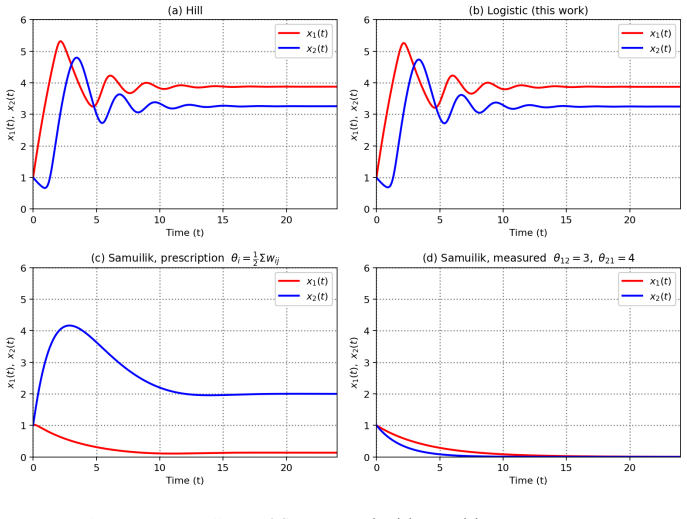
A product-of-logistics translation turns Boolean gene rules into continuous models where every Boolean steady state becomes an exponentially stable equilibrium for steep enough responses.
A machine-rendered reading of the paper's core claim, the machinery that carries it, and where it could break.
Core claim
The central claim is a recovery theorem: every steady state of the Boolean network reappears, for sufficiently steep response, as an exponentially stable equilibrium of the continuous model, so the translation provably refines rather than distorts the Boolean analysis.
What carries the argument
The recursive De Morgan product of increasing and decreasing logistic functions that converts an arbitrary Boolean rule into a continuous regulatory function confined to the unit interval.
If this is right
- The continuous models are globally well-posed and forward-invariant.
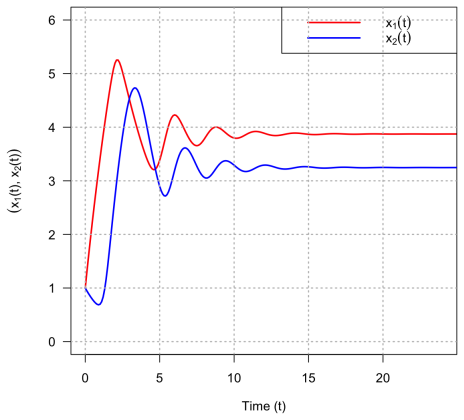
- The negative-feedback two-gene oscillator is globally asymptotically stable.
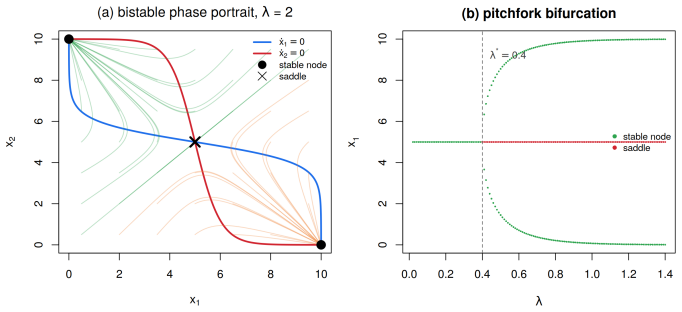
- The toggle switch admits an explicit closed-form bistability threshold expressed in positive concentrations.
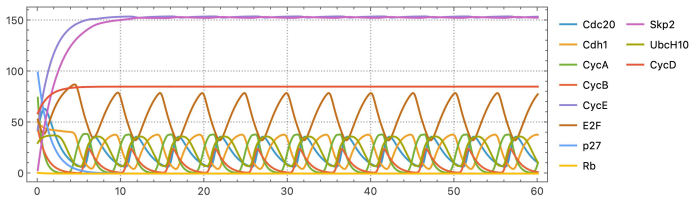
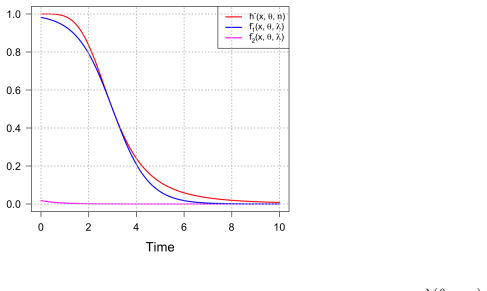
- Automatic translation of the eleven-gene Traynard network produces a sustained limit cycle that matches the Boolean cyclic attractor.
- The translation supports exact feedback linearisation for control of the resulting ODE systems.
Where Pith is reading between the lines
- The same structural translation could be applied to any Boolean model in the literature without rewriting the logical rules.
- Because thresholds remain positive concentrations, parameter fitting to experimental data becomes more direct than in weighted-sum logistic models.
- The recovery property suggests that Boolean attractors can serve as reliable initial guesses for numerical continuation in the continuous system.
Load-bearing premise
Regulatory functions are constructed via a recursive De Morgan product of logistic functions that confines every function to the unit interval while retaining a strictly positive basal rate.
What would settle it
Observe whether, as the steepness parameter of the logistic functions tends to infinity, every Boolean steady state fails to become an equilibrium or loses exponential stability in the resulting ODE system.
Figures

read the original abstract
Boolean networks model gene regulatory networks, but extracting quantitative dynamics requires translating their logical rules into differential equations, and the sigmoidal kernel chosen carries direct biological consequences. The near-universal choice, the Hill function, sets production to exactly zero when an activator is absent, creating a spurious absorbing off-state with no biological counterpart. We develop a product-of-logistics framework in which increasing logistic functions represent activation, decreasing logistic functions represent repression, and a recursive De Morgan product formula translates an arbitrary Boolean rule into a continuous regulatory function. The translation is automatic, confines every regulatory function to the unit interval, and retains a strictly positive basal rate. Our central result is a recovery theorem: every steady state of the Boolean network reappears, for sufficiently steep response, as an exponentially stable equilibrium of the continuous model, so the translation provably refines rather than distorts the Boolean analysis. We establish global well-posedness, forward invariance, and an explicit Lipschitz constant, and prove, for the two canonical two-gene motifs, global asymptotic stability of the negative-feedback oscillator and a closed-form bistability threshold for the toggle switch. Every threshold remains a positive, measurable concentration, unlike weighted-sum logistic formulations that place repressor thresholds at meaningless negative values. The eleven-gene Traynard mammalian cell-cycle network is translated automatically: in the proliferative regime its trajectories settle onto a sustained limit cycle reproducing the Boolean cyclic attractor. Because it is purely structural, the translation applies unchanged to existing Boolean models and supports exact feedback linearisation for control.
Editorial analysis
A structured set of objections, weighed in public.
Referee Report
Summary. The manuscript develops a product-of-logistics framework to translate arbitrary Boolean gene regulatory networks into continuous ODEs. Increasing and decreasing logistic functions are combined via a recursive De Morgan product to produce regulatory functions that map into (0,1] while retaining a strictly positive basal production rate. The central result is a recovery theorem asserting that every Boolean steady state reappears as an exponentially stable equilibrium of the continuous system for sufficiently large steepness. The authors prove global well-posedness, forward invariance of the unit hypercube, and an explicit Lipschitz constant; they derive closed-form results for the negative-feedback oscillator and toggle-switch motifs; and they show that the automatically translated Traynard 11-gene cell-cycle network produces a sustained limit cycle matching the Boolean cyclic attractor. The translation is purely structural and therefore applies directly to existing Boolean models.
Significance. If the recovery theorem and supporting global-existence results hold, the framework supplies a mathematically rigorous, biologically preferable alternative to Hill-function translations that avoids spurious zero-production states and negative thresholds. The explicit Lipschitz constant, closed-form motif analysis, and automatic applicability to existing Boolean models are concrete strengths that facilitate both analysis and control design. The 11-gene example demonstrates scalability. These features position the work as a useful bridge between discrete logical models and quantitative dynamical systems in systems biology.
minor comments (3)
- The abstract refers to the steepness parameter only descriptively ('sufficiently steep response'); the first appearance of its symbol and the precise statement of the recovery theorem should include an explicit lower bound or scaling relation so that readers can immediately locate the quantitative content of the main result.
- In the section presenting the 11-gene Traynard network, the statement that trajectories 'settle onto a sustained limit cycle' appears to rest on numerical integration; the integration scheme, step-size control, and tolerance used to confirm the periodic orbit should be stated explicitly for reproducibility.
- A short illustrative example (e.g., the Boolean rule for a single activator AND repressor) showing the recursive De Morgan construction step-by-step would clarify the automatic translation procedure before the general theorem is stated.
Simulated Author's Rebuttal
We thank the referee for their positive and constructive review of our manuscript. The recommendation for minor revision is appreciated, and we note that no specific major comments were raised in the report.
Circularity Check
No significant circularity identified
full rationale
The paper defines a structural translation from Boolean rules to continuous regulatory functions via recursive De Morgan products of logistic functions, then states and proves a recovery theorem showing Boolean steady states reappear as exponentially stable equilibria for large steepness. This theorem, along with well-posedness, invariance, and explicit results for two-gene motifs, is presented as independently derived content rather than reducing by construction to the input Boolean network or to any fitted parameters. No self-citations, ansatzes smuggled via prior work, or renamings of known results appear as load-bearing steps in the described derivation chain.
Axiom & Free-Parameter Ledger
free parameters (1)
- steepness parameter
axioms (2)
- domain assumption Logistic functions suitably model graded activation and repression while ensuring positive basal expression
- standard math Recursive application of De Morgan laws yields a valid continuous regulatory function for any Boolean rule
Reference graph
Works this paper leans on
-
[1]
P. Traynard, A. Fauré, F. Fages, D. Thieffry, Logical model specification aided by model-checking techniques: application to the mammalian cell cycle regulation., Bioinformatics (Oxford, England) 32 (2016) i772–i780. doi:10.1093/bioinformatics/btw457
-
[2]
C.Biane, F.Delaplace, Causalreasoningonbooleancontrolnetworksbased on abduction: theory andapplication tocancerdrug discovery, IEEE/ACM transactions on computational biology and bioinformatics 16 (2018) 1574– 1585
2018
-
[3]
Sahin, H
Ö. Sahin, H. Fröhlich, C. Löbke, U. Korf, S. Burmester, M. Majety, J. Mat- tern, I. Schupp, C. Chaouiya, D. Thieffry, et al., Modeling erbb receptor- regulated g1/s transition to find novel targets for de novo trastuzumab resistance, BMC systems biology 3 (2009) 1
2009
-
[4]
Verlingue, A
L. Verlingue, A. Dugourd, G. Stoll, E. Barillot, L. Calzone, A. Londoño- Vallejo, A comprehensive approach to the molecular determinants of lifes- pan using a boolean model of geroconversion., Aging cell 15 (2016) 1018–
2016
-
[5]
doi:10.1111/acel.12504
-
[6]
D. P. A. Cohen, L. Martignetti, S. Robine, E. Barillot, A. Zinovyev, L. Cal- zone, Mathematical modelling of molecular pathways enabling tumour cell invasion and migration., PLoS computational biology 11 (2015) e1004571. doi:10.1371/journal.pcbi.1004571. 47
-
[7]
J. Enciso, H. Mayani, L. Mendoza, R. Pelayo, Modeling the pro- inflammatory tumor microenvironment in acute lymphoblastic leukemia predicts a breakdown of hematopoietic-mesenchymal communication net- works., Frontiers in physiology 7 (2016) 349. doi:10.3389/fphys.2016. 00349
-
[8]
Albert, H
R. Albert, H. G. Othmer, The topology of the regulatory interactions predicts the expression pattern of the segment polarity genes in drosophila melanogaster, Journal of theoretical biology 223 (2003) 1–18
2003
-
[9]
I. Belgacem, J.-L. Gouzé, Global stability of full open reversible Michaelis– Menten reactions, in: 8th IFAC Symposium on Advanced Control of Chemical Processes (ADCHEM), Elsevier, 2012, pp. 591–596. doi:10.3182/ 20120710-4-SG-2026.00039
arXiv 2012
-
[10]
I. Belgacem, J.-L. Gouzé, Global stability of enzymatic chain of full re- versible Michaelis–Menten reactions, Acta Biotheoretica 61 (2013) 425–436. doi:10.1007/s10441-013-9195-3
-
[11]
I. Belgacem, J.-L. Gouzé, Mathematical study of the global dynamics of a concave gene expression model, in: 22nd Mediterranean Conference on Control and Automation (MED’14), IEEE, 2014, pp. 1341–1346. doi:10. 1109/MED.2014.6961562
arXiv 2014
-
[12]
I. Belgacem, J.-L. Gouzé, Stability analysis and reduction of gene transcrip- tion models, in: 2013 IEEE 52nd Annual Conference on Decision and Con- trol (CDC), IEEE, 2013, pp. 2691–2696. doi:10.1109/CDC.2013.6760289
-
[13]
I. Belgacem, J.-L. Gouzé, Analysis and reduction of transcription– translation coupled models for gene expression, in: 12th IFAC Sympo- sium on Computer Applications in Biotechnology (CAB), Elsevier, 2013, pp. 42–47. doi:10.3182/20131216-3-IN-2044.00012
-
[14]
Belgacem, E
I. Belgacem, E. Grac, D. Ropers, J.-L. Gouzé, A coupled transcription– translation mathematical model of RNA polymerase, in: 21st International Symposium on Mathematical Theory of Networks and Systems (MTNS 2014), 2014, pp. 1383–1386. ISBN 978-90-367-6321-9
2014
-
[15]
I. Belgacem, E. Grac, D. Ropers, J.-L. Gouzé, Stability analysis of a re- duced transcription–translation model of RNA polymerase, in: 2014 IEEE 53rd Annual Conference on Decision and Control (CDC), IEEE, 2014, pp. 3924–3929. doi:10.1109/CDC.2014.7039999
-
[16]
I. Belgacem, S. Casagranda, E. Grac, D. Ropers, J.-L. Gouzé, Re- duction and stability analysis of a transcription–translation model of RNA polymerase, Bulletin of Mathematical Biology 80 (2018) 294–318. doi:10.1007/s11538-017-0372-4. 48
-
[17]
Gouzé, R.Edwards, Control ofnegative feedback loopsin genetic networks, in: 2020 59th IEEE Conference on Decision and Control (CDC), IEEE, 2020, pp
I.Belgacem, J.-L. Gouzé, R.Edwards, Control ofnegative feedback loopsin genetic networks, in: 2020 59th IEEE Conference on Decision and Control (CDC), IEEE, 2020, pp. 5098–5105
2020
-
[18]
Chambon, I
L. Chambon, I. Belgacem, J.-L. Gouzé, Qualitative control of undesired os- cillations in a genetic negative feedback loop with uncertain measurements, Automatica 112 (2020) 108642
2020
-
[19]
Farcot, S
E. Farcot, S. Best, R. Edwards, I. Belgacem, X. Xu, P. Gill, Chaos in a ring circuit, Chaos: An Interdisciplinary Journal of Nonlinear Science 29 (2019) 043103
2019
-
[20]
I. Belgacem, R. Edwards, E. Farcot, Computer-aided analysis of high- dimensional Glass networks: periodicity, chaos, and bifurcations in a ring circuit, Chaos: An Interdisciplinary Journal of Nonlinear Science (2025). doi:10.1063/5.0243955
-
[21]
Becskei, L
A. Becskei, L. Serrano, Engineering stability in gene networks by autoreg- ulation, Nature 405 (2000) 590–593
2000
-
[22]
Lipshtat, A
A. Lipshtat, A. Loinger, N. Q. Balaban, O. Biham, Genetic toggle switch without cooperative binding, Physical review letters 96 (2006) 188101
2006
-
[23]
M. J. Weickert, S. Adhya, The galactose regulon of escherichia coli, Molec- ular microbiology 10 (1993) 245–251
1993
-
[24]
P. G. Gottschalk, J. R. Dunn, The five-parameter logistic: a characteriza- tion and comparison with the four-parameter logistic, Analytical biochem- istry 343 (2005) 54–65
2005
-
[25]
Reeve, J
R. Reeve, J. R. Turner, Pharmacodynamic models: parameterizing the hill equation, michaelis-menten, the logistic curve, and relationships among these models, Journal of biopharmaceutical statistics 23 (2013) 648–661
2013
-
[26]
Santillán, On the use of the hill functions in mathematical models of gene regulatory networks, Mathematical Modelling of Natural Phenomena 3 (2008) 85–97
M. Santillán, On the use of the hill functions in mathematical models of gene regulatory networks, Mathematical Modelling of Natural Phenomena 3 (2008) 85–97
2008
-
[27]
Samuilik, F
I. Samuilik, F. Sadyrbaev, D. Ogorelova, Mathematical modeling of three- dimensional genetic regulatory networks using logistic and gompertz func- tions, WSEAS Transactions on systems and control 17 (2022) 101107
2022
-
[28]
T. S. Gardner, C. R. Cantor, J. J. Collins, Construction of a genetic toggle switch in escherichia coli, Nature 403 (2000) 339–342
2000
-
[29]
I. Belgacem, Numerical reliability of logistic gene regulatory network mod- els: Preventing expression shutdown and robust integration of boolean- derived ODE systems, Mathematics and Computers in Simulation (sub- mitted) (2026). 49
2026
-
[30]
Bernot, J.-P
G. Bernot, J.-P. Comet, A. Richard, M. Chaves, J.-L. Gouzé, F. Dayan, Modeling and analysis of gene regulatory networks, in: F. Cazals, P. Ko- rnprobst (Eds.), Modeling in Computational Biology and Biomedicine: A Multidisciplinary Endeavor, Springer, Berlin, Heidelberg, 2012, pp. 47–80
2012
-
[31]
Polynikis, S
A. Polynikis, S. Hogan, M. di Bernardo, Comparing different ode modelling approaches for gene regulatory networks, Journal of theoretical biology 261 (2009) 511–530
2009
-
[32]
Bottani, R
S. Bottani, R. A. Veitia, Hill function-based models of transcriptional switches: impact of specific, nonspecific, functional and nonfunctional bind- ing, Biological Reviews 92 (2017) 953–963
2017
-
[33]
H. Kim, E. Gelenbe, Stochastic gene expression modeling with hill function for switch-like gene responses, IEEE/ACM Transactions on Computational Biology and Bioinformatics 9 (2011) 973–979
2011
-
[34]
E. M. Ozbudak, M. Thattai, H. N. Lim, B. I. Shraiman, A. Van Oudenaar- den, Multistability in the lactose utilization network of escherichia coli, Nature 427 (2004) 737–740
2004
-
[35]
Madar, E
D. Madar, E. Dekel, A. Bren, U. Alon, Negative auto-regulation increases the input dynamic-range of the arabinose system of escherichia coli, BMC systems biology 5 (2011) 111
2011
-
[36]
Oehler, M
S. Oehler, M. Amouyal, P. Kolkhof, B. von Wilcken-Bergmann, B. Müller- Hill, Qualityandpositionofthethreelacoperatorsofe.colidefineefficiency of repression., The EMBO journal 13 (1994) 3348–3355
1994
-
[37]
M. B. Elowitz, S. Leibler, A synthetic oscillatory network of transcriptional regulators, Nature 403 (2000) 335
2000
-
[38]
I. Belgacem, Exploring logistic functions as robust alternatives to hill func- tions in genetic network modeling, 2025. URL:https://arxiv.org/abs/ 2512.14325.arXiv:2512.14325
Pith/arXiv arXiv 2025
-
[39]
Abeliovich, An empirical extremum principle for the hill coefficient in ligand-protein interactions showing negative cooperativity, Biophysical journal 89 (2005) 76–79
H. Abeliovich, An empirical extremum principle for the hill coefficient in ligand-protein interactions showing negative cooperativity, Biophysical journal 89 (2005) 76–79
2005
-
[40]
J. E. Marsden, M. McCracken, The Hopf Bifurcation and Its Applications, volume 19 ofApplied Mathematical Sciences, Springer-Verlag, New York,
-
[41]
doi:10.1007/978-1-4612-6374-6
-
[42]
Y. A. Kuznetsov, Elements of Applied Bifurcation Theory, volume 112 of Applied Mathematical Sciences, 3 ed., Springer-Verlag, New York, 2004. doi:10.1007/978-1-4757-3978-7
-
[43]
F. Blanchini, S. Miani, Set-Theoretic Methods in Control, Systems & Control: Foundations & Applications, Birkhäuser, Boston, MA, 2008. doi:10.1007/978-0-8176-4606-6. 50
-
[44]
I. Belgacem, Sustained limit cycles in the logistic two-gene genetic oscil- lator: A delay-driven Hopf bifurcation, 2026. URL:https://arxiv.org/ abs/2605.23722.arXiv:2605.23722
Pith/arXiv arXiv 2026
-
[45]
I. Belgacem, Beyond linear additive and hill functions: A general logistic reformulation of delay-coupled gene regulatory networks with equilibrium analysis, Hopf bifurcation, and Lipschitz stability, 2026. URL:https:// arxiv.org/abs/2604.26810.arXiv:2604.26810
Pith/arXiv arXiv 2026
-
[46]
Feller, An Introduction to Probability Theory and Its Applications, volume 1, 3 ed., Wiley, New York, 1968
W. Feller, An Introduction to Probability Theory and Its Applications, volume 1, 3 ed., Wiley, New York, 1968
1968
-
[47]
D. M. Wittmann, J. Krumsiek, J. Saez-Rodriguez, D. A. Lauffenburger, S. Klamt, F. J. Theis, Transforming boolean models to continuous models: methodology and application to t-cell receptor signaling, BMC systems biology 3 (2009) 98
2009
-
[48]
A. A. Nielsen, B. S. Der, J. Shin, P. Vaidyanathan, V. Paralanov, E. A. Strychalski, D. Ross, D. Densmore, C. A. Voigt, Genetic circuit design automation, Science 352 (2016) aac7341
2016
-
[49]
Hartman, Ordinary Differential Equations, volume 38 ofClassics in Ap- plied Mathematics, 2 ed., Society for Industrial and Applied Mathematics (SIAM), Philadelphia, PA, 2002
P. Hartman, Ordinary Differential Equations, volume 38 ofClassics in Ap- plied Mathematics, 2 ed., Society for Industrial and Applied Mathematics (SIAM), Philadelphia, PA, 2002
2002
-
[50]
Sadyrbaev, I
F. Sadyrbaev, I. Samuilik, V. Sengileyev, On modelling of genetic regula- tory networks, WSEAS Transactions on Electronics 12 (2021) 73
2021
-
[51]
Kozlovska, F
O. Kozlovska, F. Sadyrbaev, In search of chaos in genetic systems, Chaos Theory and Applications 6 (2024) 13–18
2024
-
[52]
Samuilik, F
I. Samuilik, F. Sadyrbaev, Genetic engineering–construction of a network of arbitrary dimension with periodic attractor, Vibroengineering Procedia 46 (2022) 67–72
2022
-
[53]
Sadyrbaev, V
F. Sadyrbaev, V. Sengileyev, A. Silvans, On coexistence of inhibition and activation in genetic regulatory networks, in: International Conference on Numerical Analysis and Applied Mathematics 2021, ICNAAM 2021, AIP PRESS, 2023, p. 160005
2021
-
[54]
S. S. Somathilaka, S. Balasubramaniam, D. P. Martins, X. Li, Revealing gene regulation-based neural network computing in bacteria, Biophysical Reports 3 (2023)
2023
-
[55]
Kozlovska, F
O. Kozlovska, F. Sadyrbaev, Modeling networks of four elements, Compu- tation 13 (2025) 123
2025
-
[56]
Kozlovska, F
O. Kozlovska, F. Sadyrbaev, Models of genetic networks with given prop- erties, WSEAS Transactions on Computer Research 10 (2022) 43–49. 51
2022
-
[57]
Bintu, N
L. Bintu, N. E. Buchler, H. G. Garcia, U. Gerland, T. Hwa, J. Kondev, R. Phillips, Transcriptional regulation by the numbers: models, Current opinion in genetics & development 15 (2005) 116–124
2005
-
[58]
M. Acar, A. Becskei, A. Van Oudenaarden, Enhancement of cellular mem- ory by reducing stochastic transitions, Nature 435 (2005) 228–232
2005
-
[59]
Huang, Z
L. Huang, Z. Yuan, P. Liu, T. Zhou, Effects of promoter leakage on dy- namics of gene expression, BMC systems biology 9 (2015) 16. doi:10.1186/ s12918-015-0157-z
2015
-
[60]
Jacob, J
F. Jacob, J. Monod, Genetic regulatory mechanisms in the synthesis of proteins, Journal of molecular biology 3 (1961) 318–356
1961
-
[61]
G. K. Ackers, A. D. Johnson, M. A. Shea, Quantitative model for gene reg- ulation by lambda phage repressor., Proceedings of the national academy of sciences 79 (1982) 1129–1133
1982
-
[62]
Z. Zuo, G. D. Stormo, High-resolution specificity from dna sequencing highlights alternative modes of lac repressor binding, Genetics 198 (2014) 1329–1343
2014
-
[63]
C. M. Falcon, K. S. Matthews, Operator dna sequence variation enhances high affinity binding by hinge helix mutants of lactose repressor protein, Biochemistry 39 (2000) 11074–11083
2000
-
[64]
Kumar, S
S. Kumar, S. Anastassov, S. K. Aoki, J. Falkenstein, C.-H. Chang, T. Frei, P. Buchmann, P. Argast, M. Khammash, Diya–a universal light illumina- tion platform for multiwell plate cultures, Iscience 26 (2023)
2023
-
[65]
Razo-Mejia, S
M. Razo-Mejia, S. L. Barnes, N. M. Belliveau, G. Chure, T. Einav, M. Lewis, R. Phillips, Tuning transcriptional regulation through signaling: a predictive theory of allosteric induction, Cell systems 6 (2018) 456–469
2018
-
[66]
Sawlekar, F
R. Sawlekar, F. Montefusco, V. Kulkarni, D. G. Bates, Biomolecular imple- mentation of a quasi sliding mode feedback controller based on dna strand displacement reactions, in: 2015 37th Annual International Conference of the IEEE Engineering in Medicine and Biology Society (EMBC), IEEE, 2015, pp. 949–952
2015
-
[67]
Del Vecchio, R
D. Del Vecchio, R. M. Murray, Biomolecular Feedback Systems, Princeton University Press, Princeton, NJ, 2015
2015
-
[68]
Lugagne, C
J.-B. Lugagne, C. M. Blassick, M. J. Dunlop, Deep model predictive control of gene expression in thousands of single cells, Nature Communications 15 (2024) 2148
2024
-
[69]
Faquir, M
H. Faquir, M. Pájaro, I. Otero-Muras, A computational framework for optimalandmodelpredictivecontrolofstochasticgeneregulatorynetworks, IEEE Transactions on Computational Biology and Bioinformatics (2025). 52
2025
-
[70]
S.A.Kauffman, Metabolicstabilityandepigenesisinrandomlyconstructed genetic nets, Journal of theoretical biology 22 (1969) 437–467
1969
-
[71]
B. P. Ingalls, Mathematical Modeling in Systems Biology: An Introduction, MIT Press, Cambridge, MA, 2013. 53
2013
discussion (0)
Sign in with ORCID, Apple, or X to comment. Anyone can read and Pith papers without signing in.