REVIEW 4 minor 274 references
Lecture notes on random matrix theory: the results, the applications, and the analytical tools
T0 review · 0 major / 4 minor · reviewed 2026-07-10 · grok-4.5
Pith's one-line read Classic random-matrix spectral laws can be derived transparently with the cavity method and then applied directly to nuclear spectra, ecosystem stability, PCA, and localisation.
desk verdict Solid, cavity-first lecture notes that re-derive the classic RMT laws and tools cleanly; useful reference, not a research claim. read the letter →
The pith
A machine-rendered reading of the paper's core claim, the machinery that carries it, and where it could break.
The reading
What carries the argument
The cavity (Schur-complement / block-inversion) method applied to the resolvent: deleting one row and column produces self-consistent equations for the diagonal Green functions that become deterministic by concentration of large sums, after which the Stieltjes inversion recovers the eigenvalue density.
What would settle it
For any of the ensembles (GOE, elliptic, Wishart, random-regular adjacency, …) compute the empirical resolvent or eigenvalue histogram at moderate but increasing N and check whether the deviation from the predicted density or outlier location scales as claimed; a systematic O(1) discrepancy that does not vanish would falsify the concentration step.
Extended reading notes
Core claim
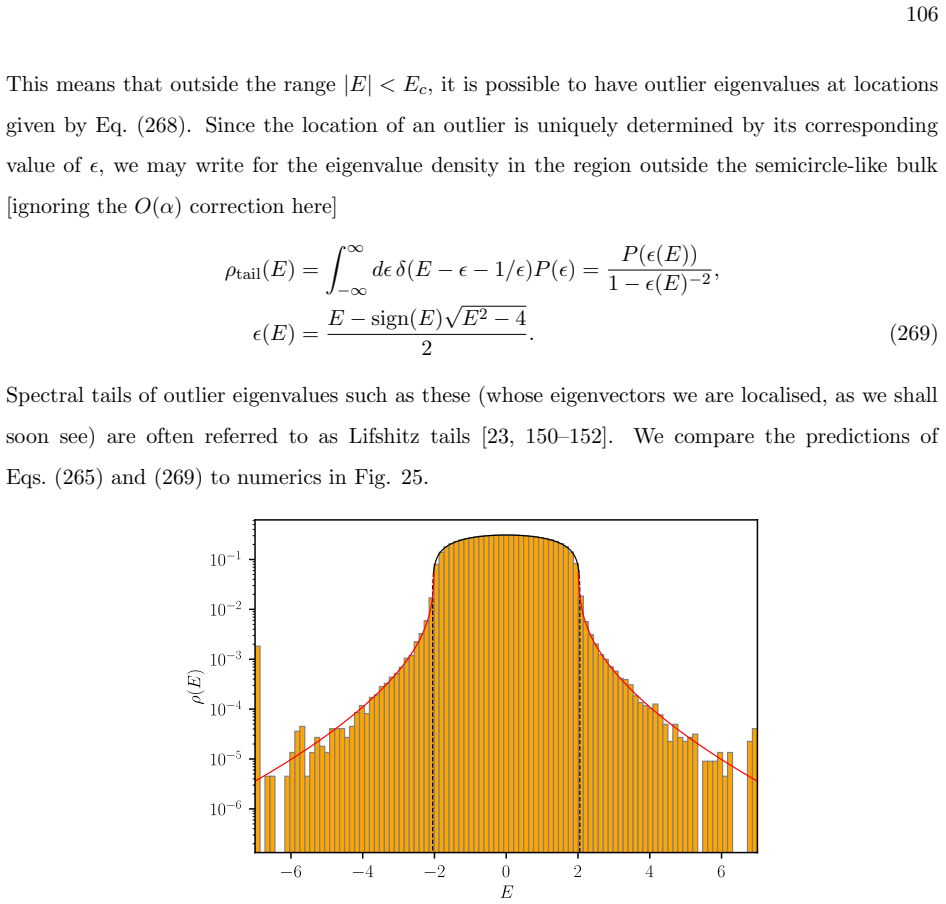
In the large-N limit, under standard moment conditions on the matrix entries, the cavity equations for the resolvent close and concentrate, yielding the classic spectral densities (semicircle, elliptic, Marchenko-Pastur, Kesten-McKay, …) and the associated outlier eigenvalues and spacing statistics; the same densities control the listed applications once the appropriate random matrix is identified.
Load-bearing premise
The large-N concentration arguments (central-limit behaviour of cavity sums, vanishing of off-diagonal resolvent entries, tree-like factorisation on sparse graphs) remain uniformly valid for every ensemble and application treated.
Editorial extensions
If this is right
- Nuclear level-spacing histograms should match the Wigner surmise once the spectrum is unfolded.
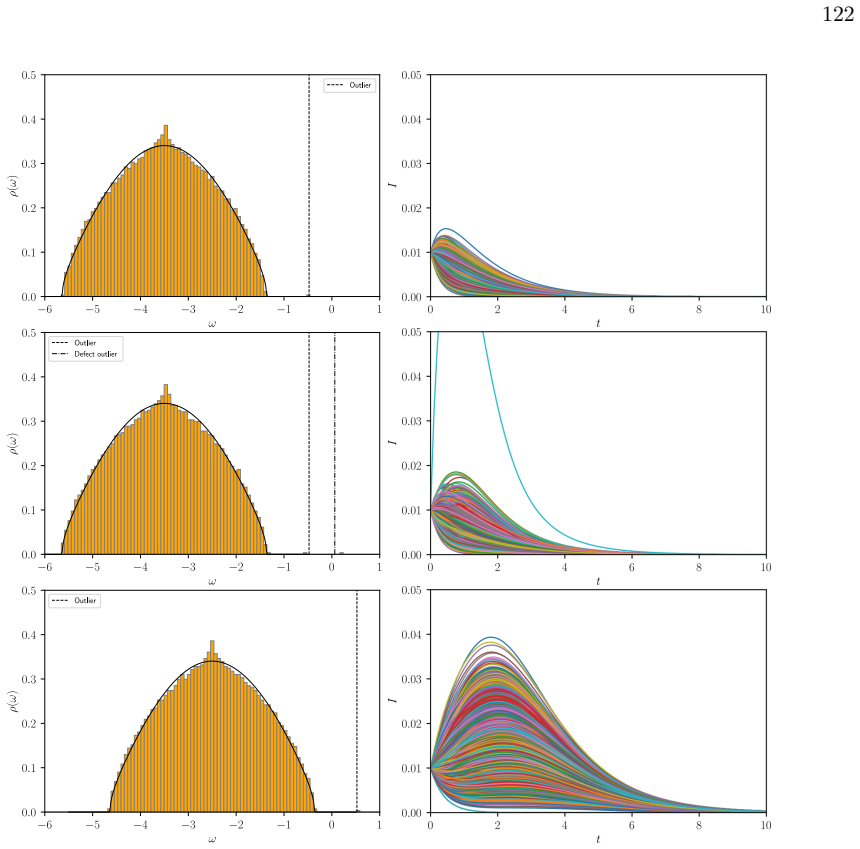
- An ecosystem whose Jacobian has mean and variance exceeding the May thresholds will be unstable, with the nature of the instability (oscillatory versus exponential) fixed by whether the bulk ellipse or the outlier crosses the stability line.
- PCA recovers a population spike only above the BBP threshold; below it the principal-component overlap vanishes and the sample spectrum is pure Marchenko-Pastur noise.
- On a random regular graph the Anderson model exhibits a mobility edge separating extended bulk states from exponentially localised Lifshitz-tail states once the on-site disorder is large enough.
- The same cavity equations supply the spectral edge that sets the epidemic threshold on a configuration-model network and the diffusion instability threshold of its Laplacian.
Reading between the lines
- Because the notes deliberately juxtapose cavity, replica, supersymmetry and free-probability derivations of the same semicircle, a reader can treat them as a controlled comparison of analytic cost versus range of validity for any new disordered model.
- The explicit DMFT treatment of the spherical p-spin and generalised Lotka-Volterra systems suggests that the same cavity-plus-mean-field pipeline can be reused for other high-dimensional non-linear dynamics whose linearised Jacobians are random.
- The population-dynamics algorithm of the final section is presented as a numerical solver for the cavity equations; it therefore offers a practical route to spectral densities of sparse or non-homogeneous ensembles that lack closed-form solutions.
- Finance applications of Marchenko-Pastur cleaning are given only briefly, yet the rotationally-invariant estimator formulae are complete enough that a practitioner could implement optimal shrinkage on real covariance matrices without further derivation.
Signed reviews
Editorial analysis
A structured set of objections, weighed in public.
Referee Report
Summary. These lecture notes derive the classic large-N spectral laws of random matrix theory (Wigner semicircle, Girko elliptic law and outliers, Marchenko-Pastur with BBP transition, Kesten-McKay, sparse-network spectra) primarily via the cavity/block-inversion method, then illustrate each law with a concrete application (nuclear level spacings, May ecosystems and Lotka-Volterra/neural stability, PCA and covariance cleaning, Anderson localisation on RRGs, network Laplacians). Part 2 re-derives the semicircle (and selected extensions) from first principles with diagrammatic, replica, supersymmetric and MSRJD path-integral methods, and adds free probability, population dynamics and Dyson Brownian motion. Exercises close most sections. The central claim is pedagogical: the cavity route is elementary and transparent under standard moment conditions, the same laws control the listed applications, and the advanced formalisms become useful in complementary regimes.
Significance. If the notes are adopted as a graduate reference they fill a genuine gap: a single, self-contained treatment that (i) derives the workhorse spectral laws with the cavity method rather than heavy combinatorics or replicas, (ii) immediately embeds each law in a modern application (ecology, finance, localisation, networks), and (iii) supplies a comparative toolkit of the advanced methods used in the disordered-systems literature. The derivations recover the known closed forms, numerical checks against single large matrices are shown throughout, and the exercises are well-chosen. The absence of free parameters or circular definitions, together with the explicit discussion of when each method is advantageous, makes the manuscript a high-value pedagogical resource for the cond-mat.dis-nn and adjacent communities.
minor comments (4)
- Throughout Part 1 the large-N concentration steps (CLT on cavity sums, vanishing of off-diagonal resolvent entries, tree-like factorisation) are invoked without quantitative error bounds or references to the rigorous literature that supplies them. A short paragraph or footnote in §II.D–F (and analogous places in §§III, V, VII) pointing to the relevant theorems would strengthen the notes without changing their pedagogical character.
- Figure captions and axis labels are occasionally terse (e.g. Figs. 7–11, 17–19). Adding the precise ensemble parameters and the meaning of solid/dashed curves would improve readability for students.
- A few typographical inconsistencies remain (Marčenko vs Marchenko, occasional missing spaces around equations). A light copy-edit pass would remove them.
- The population-dynamics section (XV) is very brief relative to the other advanced tools. A short worked example (e.g. the sparse ER cavity equations of §VIII) would make the method more immediately usable.
Circularity Check
No significant circularity: pedagogical re-derivations of classic RMT laws from block inversion, CLT concentration, and standard transforms, without fitted inputs or self-definitional loops.
full rationale
These are self-contained lecture notes. Part 1 derives the semicircle (II), elliptic law (III), DMFT order parameters (IV), Marchenko-Pastur/BBP (V), Coulomb-gas/DBM joint laws (VI), Kesten-McKay and localisation diagnostics (VII), and sparse-network spectra (VIII) by the cavity/block-inversion method plus large-N concentration of cavity sums and vanishing of off-diagonal resolvent entries. Each step starts from the definition of the resolvent (or Hermitised resolvent), applies the Schur complement, invokes CLT/moment conditions that are stated explicitly, and solves a closed equation for G(z) or C(z,z*); the density is then recovered by the inverse Stieltjes (or 2D) transform. No parameter is fitted to data and then re-presented as a prediction of that same data; numerical checks are comparisons, not calibration. Part 2 re-derives the same laws via diagrams, replicas, SUSY, path integrals, free probability, and population dynamics from first principles, again without circular definitions. Applications (nuclear spacings, May stability, PCA cleaning, Anderson IPR, etc.) use the derived spectra as inputs; they do not define the spectra in terms of the application outcomes. There is no load-bearing self-citation of an author-owned uniqueness theorem, no ansatz smuggled solely via self-citation, and no renaming of an empirical pattern as a new derivation. The concentration arguments lack quantitative error bounds, but that is a completeness/rigour issue, not circularity. Score 0 is therefore appropriate.
Assumptions & free parameters
assumptions (3)
- domain assumption Matrix entries are independent (up to Hermiticity) with vanishing mean, variance O(1/N) and higher moments o(1/N); the empirical spectral measure concentrates.
- domain assumption Off-diagonal resolvent elements are negligible in the large-N limit.
- domain assumption Sparse graphs are locally tree-like so that cavity factorisation holds.
Cite this review
Pith. "Pith review of Lecture notes on random matrix theory: the results, the applications, and the analytical tools." pith.science (2026). https://pith.science/paper/VUHAX35E
@misc{pith2026260707868,
  author       = {Pith},
  title        = {Pith review of: Lecture notes on random matrix theory: the results, the applications, and the analytical tools},
  year         = {2026},
  howpublished = {\url{https://pith.science/paper/VUHAX35E}},
  note         = {Machine review of arXiv:2607.07868}
}
read the original abstract
Random matrix theory has established itself as a theoretical cornerstone of the mathematical sciences over the past century. It has undeniable utility in areas of research as diverse as nuclear physics, finance, ecology and disordered systems. The purpose of these notes is twofold. First, the most famous and widely used classic results are derived in a pedagogical manner, mostly using the comparatively elementary and transparent cavity method. The significance of each result is then demonstrated in the context of a particular application. There are also some select exercises at the end of each section. In the second part of these notes, a reference guide of analytical techniques for the random-matrix/disordered-systems practitioner is provided. Introducing the diagrammatic, replica, path-integral, and supersymmetric formalisms from first principles, we rederive some of the aforementioned classic results, particularly focussing on the simplest one -- the semicircle law. Innovations such as the population dynamics method and the tools of free probability theory are also included. We discuss the merits of each analytical approach, and we highlight the contexts in which each becomes particularly useful.
Figures


Figures from the paper (38 more)








Reference graph
Works this paper leans on
-
[1]
using the Keldysh dynamic formalism [248, 249]). It is also possible to make a perturbative expansion of the response functions in model parameters other than 1/Nusing the diagrammatic approach [56, 187] (see also the exercises). Here, we use the computation of the semicircle law to demonstrate the diagrammatic approach. Needless to say, the diagrammatic ...
-
[2]
Evaluation using Wick’s theorem We begin with Eq. (547). Writing the path integral explicitly, and consulting Eq. (549), we may write the disorder-averaged response functions (in the caseµ= 0 and Γ = 1) as * 1 N X k Rkk(T,0) + = Z D[x,ˆx] − i N X k xk(T)ˆxk(0) ! exp [S0 +S int],(572) where we identify the so-called ‘bare’ action and the interaction term r...
-
[3]
Feynman diagrams as a combinatorial tool Keeping track of the huge variety of ‘Wick pairings’ in the sum in Eq. (574) is a daunting task. A useful strategy is to use Feynman diagrams, which help to identify the terms that are (non- )vanishing in the limitN→ ∞, as well as being a convenient bookkeeping tool. We have already seen that Wick pairings can vani...
-
[4]
The only Wick pairings that we need to consider pair solely hatted and unhatted dynamic variables
-
[5]
The only non-vanishing Wick pairings forN→ ∞correspond to planar diagrams with non-crossing and non-twisted arcs
-
[6]
One therefore sees that the sum in Eq
The number of combinations of Wick pairings that are equivalent up to time ordering always exactly cancels a prefactor, allowing us to discard the labelling of the internal nodes in the Feynman diagrams. One therefore sees that the sum in Eq. (574) can be evaluated in the thermodynamic limit by considering the set of all planar rainbow diagrams. As a fina...
-
[7]
i X i Z dtψixi − σ2 T 2 X i Z dtˆx2 i (t) # ×exp
Resummation of the diagrammatic series We employ one additional diagrammatic convention to simplify the notation when we perform sums over many diagrams. We denote a sum of planar diagrams by an edge with a double arrow, accompanied by a label for identification purposes. For example, let us take the surviving planar diagrams for the second-order term abo...
-
[8]
Initialise a populationG (cav) i with random complex values andi= 1,· · ·, N pop
Show all 274 references
-
[9]
For eachi, draw a value ofk i from the distributionkP k/p
-
[10]
For eachi, select at random a subsetS i of sizek i −1 from the rangej= 1,· · ·, N pop, and calculateG ′ i = 1 ω−iϵ− 1 p P j∈Si G(cav) j
-
[11]
Repeat from Step 2 until the quantityG cav =N −1 pop P i G(cav) i converges
-
[12]
Perform Steps 2 to 4 once more
Once convergence has occurred, we begin the sampling phase. Perform Steps 2 to 4 once more. 213
-
[13]
Select a random subsetS j of sizek j from the rangel= 1,· · ·, N pop
Draw a valuek j from the distributionP k. Select a random subsetS j of sizek j from the rangel= 1,· · ·, N pop. ComputeG j = 1 ω−iη− 1 p P l∈Sj G(cav) l
-
[14]
Compute the quantityG α = N −1 samp PNsamp j=1 Gj
Repeat Step 7 a numberN samp times to obtain a set{G j}. Compute the quantityG α = N −1 samp PNsamp j=1 Gj
-
[15]
ComputeG(ω) = N −1 iter PNiter α=1 Gα
Repeat Steps 6 to 8 a numberN iter times to obtain a set{G α}. ComputeG(ω) = N −1 iter PNiter α=1 Gα. This is our final estimate of the resolvent for a fixed valueω
-
[16]
The eigenvalue density is then obtained via ρ(ω) =π −1ImG(ω)
Repeat Steps 1 to 9 for all desired values ofω. The eigenvalue density is then obtained via ρ(ω) =π −1ImG(ω). The results of performing this procedure are show in Fig. 41. To adapt the method for the Laplacian matrix, we instead use the update ruleG ′ i = 1 ω−iϵ+ 1 p P j∈Si 1 ...
-
[17]
M. L. Mehta,Random matrices, Vol. 142 (Elsevier, 2004)
2004
-
[18]
R. Haq, A. Pandey, and O. Bohigas, Fluctuation properties of nuclear energy levels: Do theory and experiment agree?, Physical Review Letters48, 1086 (1982)
1982
-
[19]
Weidenm¨ uller and G
H. Weidenm¨ uller and G. Mitchell, Random matrices and chaos in nuclear physics: Nuclear structure, Reviews of Modern Physics81, 539 (2009)
2009
-
[20]
R. M. May, Will a large complex system be stable?, Nature238, 413 (1972). 214
1972
-
[21]
Allesina and S
S. Allesina and S. Tang, The stability–complexity relationship at age 40: a random matrix perspective, Population Ecology57, 63 (2015)
2015
-
[22]
J. Baik, G. Ben Arous, and S. P´ ech´ e, Phase transition of the largest eigenvalue for nonnull complex sample covariance matrices, Ann. Probab.33, 1643 (2005)
2005
-
[23]
Laloux, P
L. Laloux, P. Cizeau, M. Potters, and J.-P. Bouchaud, Random matrix theory and financial correla- tions, International Journal of Theoretical and Applied Finance3, 391 (2000)
2000
-
[24]
Potters, J.-P
M. Potters, J.-P. Bouchaud, and L. Laloux, Financial applications of random matrix theory: Old laces and new pieces, arXiv preprint physics/0507111 (2005)
2005 arXiv
-
[25]
M´ ezard, G
M. M´ ezard, G. Parisi, and M. A. Virasoro,Spin glass theory and beyond: An Introduction to the Replica Method and Its Applications, Vol. 9 (World Scientific Publishing Company, 1987)
1987
-
[26]
Evers and A
F. Evers and A. D. Mirlin, Anderson transitions, Reviews of Modern Physics80, 1355 (2008)
2008
-
[27]
Bohigaset al.,Random matrix theories and chaotic dynamics, Tech
O. Bohigaset al.,Random matrix theories and chaotic dynamics, Tech. Rep. (Paris-11 Univ., 91-Orsay (France). Inst. de Physique Nucleaire, 1991)
1991
-
[28]
Bohigas and M.-J
O. Bohigas and M.-J. Giannoni, Chaotic motion and random matrix theories, inMathematical and Computational Methods in Nuclear Physics: Proceedings of the Sixth Granada Workshop Held in Granada, Spain, October 3–8, 1983(Springer, 2005) pp. 1–99
1983
-
[29]
Di Francesco, P
P. Di Francesco, P. Ginsparg, and J. Zinn-Justin, 2d gravity and random matrices, Physics Reports 254, 1 (1995)
1995
-
[30]
J. P. Keating and N. C. Snaith, Random matrix theory andζ(1/2+ it), Communications in Mathe- matical Physics214, 57 (2000)
2000
-
[31]
A. M. Odlyzko, On the distribution of spacings between zeros of the zeta function, Mathematics of Computation48, 273 (1987)
1987
-
[32]
Johansson, Non-intersecting paths, random tilings and random matrices, Probability theory and related fields123, 225 (2002)
K. Johansson, Non-intersecting paths, random tilings and random matrices, Probability theory and related fields123, 225 (2002)
2002
-
[33]
E. P. Wigner, Characteristic vectors of bordered matrices with infinite dimensions, Annals of Mathe- matics62, 548 (1955)
1955
-
[34]
Wigner, Conference on neutron physics by time-of-flight, Oak Ridge National Lab
E. Wigner, Conference on neutron physics by time-of-flight, Oak Ridge National Lab. Report ORNL- 2309 (1957)
1957
-
[35]
E. P. Wigner, On the distribution of the roots of certain symmetric matrices, Annals of Mathematics 67, 325 (1958)
1958
-
[36]
E. P. Wigner, Random matrices in physics, SIAM review9, 1 (1967)
1967
-
[37]
E. P. Wigner, Characteristic vectors of bordered matrices with infinite dimensions i, inThe Collected Works of Eugene Paul Wigner: Part A: The Scientific Papers(Springer, 1993) pp. 524–540
1993
-
[38]
D. V. Widder, The stieltjes transform, Transactions of the American Mathematical Society43, 7 (1938)
1938
-
[39]
K¨ uhn, Spectra of sparse random matrices, Journal of Physics A: Mathematical and Theoretical41, 295002 (2008)
R. K¨ uhn, Spectra of sparse random matrices, Journal of Physics A: Mathematical and Theoretical41, 295002 (2008). 215
2008
-
[40]
Rogers, I
T. Rogers, I. P. Castillo, R. K¨ uhn, and K. Takeda, Cavity approach to the spectral density of sparse symmetric random matrices, Physical Review E—Statistical, Nonlinear, and Soft Matter Physics78, 031116 (2008)
2008
-
[41]
Gaudin, Sur la loi limite de l’espacement des valeurs propres d’une matrice ale´ atoire, Nuclear Physics25, 447 (1961)
M. Gaudin, Sur la loi limite de l’espacement des valeurs propres d’une matrice ale´ atoire, Nuclear Physics25, 447 (1961)
1961
-
[42]
Efetov, Supersymmetry and theory of disordered metals, advances in Physics32, 53 (1983)
K. Efetov, Supersymmetry and theory of disordered metals, advances in Physics32, 53 (1983)
1983
-
[43]
Erd˝ os, Universality of wigner random matrices: a survey of recent results, Russian Mathematical Surveys66, 507 (2011)
L. Erd˝ os, Universality of wigner random matrices: a survey of recent results, Russian Mathematical Surveys66, 507 (2011)
2011
-
[44]
A. D. Mirlin and Y. V. Fyodorov, Universality of level correlation function of sparse random matrices, Journal of Physics A: Mathematical and General24, 2273 (1991)
1991
-
[45]
F. J. Dyson, Statistical theory of the energy levels of complex systems. i, Journal of Mathematical Physics3, 140 (1962)
1962
-
[46]
F. J. Dyson, The threefold way. algebraic structure of symmetry groups and ensembles in quantum mechanics, Journal of Mathematical Physics3, 1199 (1962)
1962
-
[47]
F. J. Dyson, Statistical theory of the energy levels of complex systems. iii, Journal of Mathematical Physics3, 166 (1962)
1962
-
[48]
Bohigas, M.-J
O. Bohigas, M.-J. Giannoni, and C. Schmit, Characterization of chaotic quantum spectra and univer- sality of level fluctuation laws, Physical review letters52, 1 (1984)
1984
-
[49]
H. L. Montgomery, The pair correlation of zeros of the zeta function, inProc. Symp. Pure Math, Vol. 24 (1973) p. 1
1973
-
[50]
Rajan and L
K. Rajan and L. F. Abbott, Eigenvalue spectra of random matrices for neural networks, Physical review letters97, 188104 (2006)
2006
-
[51]
Sompolinsky, A
H. Sompolinsky, A. Crisanti, and H.-J. Sommers, Chaos in random neural networks, Physical review letters61, 259 (1988)
1988
-
[52]
Aljadeff, M
J. Aljadeff, M. Stern, and T. Sharpee, Transition to chaos in random networks with cell-type-specific connectivity, Physical review letters114, 088101 (2015)
2015
-
[53]
Molgedey, J
L. Molgedey, J. Schuchhardt, and H. G. Schuster, Suppressing chaos in neural networks by noise, Physical review letters69, 3717 (1992)
1992
-
[54]
Haake, F
F. Haake, F. Izrailev, N. Lehmann, D. Saher, and H.-J. Sommers, Statistics of complex levels of random matrices for decaying systems, Zeitschrift f¨ ur Physik B Condensed Matter88, 359 (1992)
1992
-
[55]
Feinberg and A
J. Feinberg and A. Zee, Non-hermitian random matrix theory: Method of hermitian reduction, Nuclear Physics B504, 579 (1997)
1997
-
[56]
R. M. May,Stability and complexity in model ecosystems, Vol. 6 (Princeton university press, 2001)
2001
-
[57]
M. A. Nowak and W. Tarnowski, Probing non-orthogonality of eigenvectors in non-hermitian matrix models: diagrammatic approach, Journal of High Energy Physics2018, 1 (2018)
2018
-
[58]
V. L. Girko, Circular law, Theory of Probability & Its Applications29, 694 (1985)
1985
-
[59]
Girko, Elliptic law, Theory of Probability & Its Applications30, 677 (1986)
V. Girko, Elliptic law, Theory of Probability & Its Applications30, 677 (1986). 216
1986
-
[60]
R. A. Janik, M. A. Nowak, G. Papp, and I. Zahed, Non-hermitian random matrix models, Nuclear Physics B501, 603 (1997)
1997
-
[61]
H. J. Sommers, A. Crisanti, H. Sompolinsky, and Y. Stein, Spectrum of large random asymmetric matrices, Physical review letters60, 1895 (1988)
1988
-
[62]
Rogers, Universal sum and product rules for random matrices, Journal of mathematical physics51 (2010)
T. Rogers, Universal sum and product rules for random matrices, Journal of mathematical physics51 (2010)
2010
-
[63]
Benaych-Georges and R
F. Benaych-Georges and R. R. Nadakuditi, The eigenvalues and eigenvectors of finite, low rank per- turbations of large random matrices, Advances in Mathematics227, 494 (2011)
2011
-
[64]
O’Rourke and D
S. O’Rourke and D. Renfrew, Low rank perturbations of large elliptic random matrices, (2014)
2014
-
[65]
J. W. Baron, T. J. Jewell, C. Ryder, and T. Galla, Eigenvalues of random matrices with generalized correlations: A path integral approach, Physical Review Letters128, 120601 (2022)
2022
-
[66]
J. W. Baron, T. J. Jewell, C. Ryder, and T. Galla, Breakdown of random-matrix universality in persistent lotka-volterra communities, Physical Review Letters130, 137401 (2023)
2023
-
[67]
S. F. Edwards and R. C. Jones, The eigenvalue spectrum of a large symmetric random matrix, Journal of Physics A: Mathematical and General9, 1595 (1976)
1976
-
[68]
Ikeda, Bose–einstein-like condensation of deformed random matrix: a replica approach, Journal of Statistical Mechanics: Theory and Experiment2023, 023302 (2023)
H. Ikeda, Bose–einstein-like condensation of deformed random matrix: a replica approach, Journal of Statistical Mechanics: Theory and Experiment2023, 023302 (2023)
2023
-
[69]
J. Hu, D. R. Amor, M. Barbier, G. Bunin, and J. Gore, Emergent phases of ecological diversity and dynamics mapped in microcosms, Science378, 85 (2022)
2022
-
[70]
G. J. Rodgers, K. Austin, B. Kahng, and D. Kim, Eigenvalue spectra of complex networks, Journal of Physics A: Mathematical and General38, 9431 (2005)
2005
-
[71]
J. W. Baron, Eigenvalue spectra and stability of directed complex networks, Physical Review E106, 064302 (2022)
2022
-
[72]
J. W. Baron, Path-integral approach to sparse non-hermitian random matrices, Physical Review E 111, 034217 (2025)
2025
-
[73]
Valigi, J
P. Valigi, J. W. Baron, I. Neri, G. Biroli, and C. Cammarota, Eigenvalue spectral tails and localisation properties of asymmetric networks, Journal of Physics A: Mathematical and Theoretical58, 455002 (2025)
2025
-
[74]
J. W. Baron and T. Galla, Dispersal-induced instability in complex ecosystems, Nature communica- tions11, 6032 (2020)
2020
-
[75]
Allesina, J
S. Allesina, J. Grilli, G. Barab´ as, S. Tang, J. Aljadeff, and A. Maritan, Predicting the stability of large structured food webs, Nature communications6, 7842 (2015)
2015
-
[76]
Poley, T
L. Poley, T. Galla, and J. W. Baron, Eigenvalue spectra of finely structured random matrices, Physical Review E109, 064301 (2024)
2024
-
[77]
Barab´ as, M
G. Barab´ as, M. J. Michalska-Smith, and S. Allesina, Self-regulation and the stability of large ecological networks, Nature ecology & evolution1, 1870 (2017)
2017
-
[78]
Pigani, D
E. Pigani, D. Sgarbossa, S. Suweis, A. Maritan, and S. Azaele, Delay effects on the stability of large 217 ecosystems, Proceedings of the National Academy of Sciences119, e2211449119 (2022)
2022
-
[79]
Gravel, F
D. Gravel, F. Massol, and M. A. Leibold, Stability and complexity in model meta-ecosystems, Nature communications7, 12457 (2016)
2016
-
[80]
Bunin, Interaction patterns and diversity in assembled ecological communities, arXiv preprint arXiv:1607.04734 (2016)
G. Bunin, Interaction patterns and diversity in assembled ecological communities, arXiv preprint arXiv:1607.04734 (2016)
2016 arXiv
-
[81]
Galla, Dynamically evolved community size and stability of random lotka-volterra ecosystems (a), Europhysics Letters123, 48004 (2018)
T. Galla, Dynamically evolved community size and stability of random lotka-volterra ecosystems (a), Europhysics Letters123, 48004 (2018)
2018
-
[82]
Stone, The feasibility and stability of large complex biological networks: a random matrix approach, Scientific reports8, 1 (2018)
L. Stone, The feasibility and stability of large complex biological networks: a random matrix approach, Scientific reports8, 1 (2018)
2018
-
[83]
Biroli, G
G. Biroli, G. Bunin, and C. Cammarota, Marginally stable equilibria in critical ecosystems, New Journal of Physics20, 083051 (2018)
2018
-
[84]
Gardiner,Stochastic methods, Vol
C. Gardiner,Stochastic methods, Vol. 4 (Springer Berlin Heidelberg, 2009)
2009
-
[85]
Bunin, Ecological communities with lotka-volterra dynamics, Physical Review E95, 042414 (2017)
G. Bunin, Ecological communities with lotka-volterra dynamics, Physical Review E95, 042414 (2017)
2017
-
[86]
F. Roy, G. Biroli, G. Bunin, and C. Cammarota, Numerical implementation of dynamical mean field theory for disordered systems: Application to the lotka–volterra model of ecosystems, Journal of Physics A: Mathematical and Theoretical52, 484001 (2019)
2019
-
[87]
Altieri, F
A. Altieri, F. Roy, C. Cammarota, and G. Biroli, Properties of equilibria and glassy phases of the random lotka-volterra model with demographic noise, Physical Review Letters126, 258301 (2021)
2021
-
[88]
Altieri, G
A. Altieri, G. Biroli, and C. Cammarota, Dynamical mean-field theory and aging dynamics, Journal of Physics A: Mathematical and Theoretical53, 375006 (2020)
2020
-
[89]
Crisanti, H
A. Crisanti, H. Horner, and H.-J. Sommers, The spherical p-spin interaction spin-glass model: the dynamics, Zeitschrift f¨ ur Physik B Condensed Matter92, 257 (1993)
1993
-
[90]
D. A. Sakthivadivel, Magnetisation and mean field theory in the ising model, SciPost Physics Lecture Notes , 035 (2022)
2022
-
[91]
Sompolinsky and A
H. Sompolinsky and A. Zippelius, Dynamic theory of the spin-glass phase, Physical Review Letters 47, 359 (1981)
1981
-
[92]
Sompolinsky and A
H. Sompolinsky and A. Zippelius, Relaxational dynamics of the edwards-anderson model and the mean-field theory of spin-glasses, Physical Review B25, 6860 (1982)
1982
-
[93]
De Dominicis, Dynamics as a substitute for replicas in systems with quenched random impurities, Phys
C. De Dominicis, Dynamics as a substitute for replicas in systems with quenched random impurities, Phys. Rev. B18, 4913 (1978)
1978
-
[94]
P. C. Martin, E. D. Siggia, and H. A. Rose, Statistical dynamics of classical systems, Physical Review A8, 423 (1973)
1973
-
[95]
H.-K. Janssen, On a lagrangean for classical field dynamics and renormalization group calculations of dynamical critical properties, Zeitschrift f¨ ur Physik B Condensed Matter23, 377 (1976)
1976
-
[96]
C. d. Dominicis, Techniques de renormalisation de la th´ eorie des champs et dynamique des ph´ enomenes critiques, inJ. Phys., Colloq, Vol. 37 (1976) p. 247
1976
-
[97]
D. J. Thouless, P. W. Anderson, and R. G. Palmer, Solution of’solvable model of a spin glass’, 218 Philosophical Magazine35, 593 (1977)
1977
-
[98]
Onsager, Electric moments of molecules in liquids, Journal of the American Chemical Society58, 1486 (1936)
L. Onsager, Electric moments of molecules in liquids, Journal of the American Chemical Society58, 1486 (1936)
1936
-
[99]
L. F. Cugliandolo and J. Kurchan, Analytical solution of the off-equilibrium dynamics of a long-range spin-glass model, Physical Review Letters71, 173 (1993)
1993
-
[100]
Opper and S
M. Opper and S. Diederich, Phase transition and 1/f noise in a game dynamical model, Physical review letters69, 1616 (1992)
1992
-
[101]
H. D. Young, R. A. Freedman, T. Sandin, and A. L. Ford,University physics, Vol. 9 (Addison-Wesley Reading, MA, 1996)
1996
-
[102]
T. Galla, Intrinsic fluctuations in stochastic delay systems: Theoretical description and application to a simple model of gene regulation, Physical Review E—Statistical, Nonlinear, and Soft Matter Physics 80, 021909 (2009)
2009
-
[103]
Brett and T
T. Brett and T. Galla, Stochastic processes with distributed delays: Chemical langevin equation¡? format?¿ and linear-noise approximation, Physical Review Letters110, 250601 (2013)
2013
-
[104]
D. J. Gross and M. M´ ezard, The simplest spin glass, Nuclear Physics B240, 431 (1984)
1984
-
[105]
Binder and A
K. Binder and A. P. Young, Spin glasses: Experimental facts, theoretical concepts, and open questions, Reviews of Modern physics58, 801 (1986)
1986
-
[106]
T. R. Kirkpatrick and D. Thirumalai, p-spin-interaction spin-glass models: Connections with the structural glass problem, Physical Review B36, 5388 (1987)
1987
-
[107]
Castellani and A
T. Castellani and A. Cavagna, Spin-glass theory for pedestrians, Journal of Statistical Mechanics: Theory and Experiment2005, P05012 (2005)
2005
-
[108]
D. R. Reichman and P. Charbonneau, Mode-coupling theory, Journal of Statistical Mechanics: Theory and Experiment2005, P05013 (2005)
2005
-
[109]
Greenacre, P
M. Greenacre, P. J. Groenen, T. Hastie, A. I. d’Enza, A. Markos, and E. Tuzhilina, Principal compo- nent analysis, Nature Reviews Methods Primers2, 100 (2022)
2022
-
[110]
L. R. Goldberg, The structure of phenotypic personality traits., American psychologist48, 26 (1993)
1993
-
[111]
Frani´ c, D
S. Frani´ c, D. Borsboom, C. V. Dolan, and D. I. Boomsma, The big five personality traits: psychological entities or statistical constructs?, Behavior genetics44, 591 (2014)
2014
-
[112]
Van Der Maaten, E
L. Van Der Maaten, E. O. Postma, H. J. Van Den Herik,et al., Dimensionality reduction: A compar- ative review, Journal of Machine Learning Research10, 1 (2009)
2009
-
[113]
Paul and A
D. Paul and A. Aue, Random matrix theory in statistics: A review, Journal of Statistical Planning and Inference150, 1 (2014)
2014
-
[114]
V. A. Marˇ cenko and L. A. Pastur, Distribution of eigenvalues for some sets of random matrices, Mathematics of the USSR-Sbornik1, 457 (1967)
1967
-
[115]
Bun, J.-P
J. Bun, J.-P. Bouchaud, and M. Potters, Cleaning large correlation matrices: tools from random matrix theory, Physics Reports666, 1 (2017)
2017
-
[116]
Potters and J.-P
M. Potters and J.-P. Bouchaud,A first course in random matrix theory: for physicists, engineers and 219 data scientists(Cambridge University Press, 2020)
2020
-
[117]
Laloux, P
L. Laloux, P. Cizeau, J.-P. Bouchaud, and M. Potters, Noise dressing of financial correlation matrices, Physical review letters83, 1467 (1999)
1999
-
[118]
Markowitz, Modern portfolio theory, Journal of Finance7, 77 (1952)
H. Markowitz, Modern portfolio theory, Journal of Finance7, 77 (1952)
1952
-
[119]
H. M. Markowitz,Portfolio selection: efficient diversification of investments(Yale university press, 2008)
2008
-
[120]
H. M. Markowitz, Portfolio theory: as i still see it, Annu. Rev. Financ. Econ.2, 1 (2010)
2010
-
[121]
J. Bun, R. Allez, J.-P. Bouchaud, and M. Potters, Rotational invariant estimator for general noisy matrices, IEEE Transactions on Information Theory62, 7475 (2016)
2016
-
[122]
Ledoit and M
O. Ledoit and M. Wolf, Spectrum estimation: A unified framework for covariance matrix estimation and pca in large dimensions, Journal of Multivariate Analysis139, 360 (2015)
2015
-
[123]
Ledoit and M
O. Ledoit and M. Wolf, Nonlinear shrinkage estimation of large-dimensional covariance matrices, The Annals of Statistics40, 1024 (2012)
2012
-
[124]
Ledoit and S
O. Ledoit and S. P´ ech´ e, Eigenvectors of some large sample covariance matrix ensembles, Probability Theory and Related Fields151, 233 (2011)
2011
-
[125]
F. J. Dyson, A brownian-motion model for the eigenvalues of a random matrix, Journal of Mathemat- ical Physics3, 1191 (1962)
1962
-
[126]
F. J. Dyson, Statistical theory of the energy levels of complex systems. ii, Journal of Mathematical Physics3, 157 (1962)
1962
-
[127]
F. J. Dyson and M. L. Mehta, Statistical theory of the energy levels of complex systems. iv, Journal of Mathematical Physics4, 701 (1963)
1963
-
[128]
M. L. Mehta and F. J. Dyson, Statistical theory of the energy levels of complex systems. v, Journal of Mathematical Physics4, 713 (1963)
1963
-
[129]
Kawabata, K
K. Kawabata, K. Shiozaki, M. Ueda, and M. Sato, Symmetry and topology in non-hermitian physics, Physical Review X9, 041015 (2019)
2019
-
[130]
R. S. Palais, The classification of real division algebras, The American Mathematical Monthly75, 366 (1968)
1968
-
[131]
Risken, Fokker-planck equation, inThe Fokker-Planck equation: methods of solution and applica- tions(Springer, 1989) pp
H. Risken, Fokker-planck equation, inThe Fokker-Planck equation: methods of solution and applica- tions(Springer, 1989) pp. 63–95
1989
-
[132]
D. J. Griffiths and D. F. Schroeter,Introduction to quantum mechanics(Cambridge university press, 2018)
2018
-
[133]
Dumitriu and A
I. Dumitriu and A. Edelman, Matrix models for beta ensembles, Journal of Mathematical Physics43, 5830 (2002)
2002
-
[134]
Allez, J.-P
R. Allez, J.-P. Bouchaud, and A. Guionnet, Invariant beta ensembles and the gauss-wigner crossover, Physical review letters109, 094102 (2012)
2012
-
[135]
Br´ ezin and A
E. Br´ ezin and A. Zee, Universality of the correlations between eigenvalues of large random matrices, Nuclear Physics B402, 613 (1993). 220
1993
-
[136]
Erd˝ os and H.-T
L. Erd˝ os and H.-T. Yau, Universality of local spectral statistics of random matrices, Bulletin of the American Mathematical Society49, 377 (2012)
2012
-
[137]
Stoffregen, J
U. Stoffregen, J. Stein, H.-J. St¨ ockmann, M. Ku´ s, and F. Haake, Microwave billiards with broken time reversal symmetry, Physical review letters74, 2666 (1995)
1995
-
[138]
Rehemanjiang, M
A. Rehemanjiang, M. Allgaier, C. Joyner, S. M¨ uller, M. Sieber, U. Kuhl, and H.-J. St¨ ockmann, Microwave realization of the gaussian symplectic ensemble, Physical review letters117, 064101 (2016)
2016
-
[139]
P. So, S. M. Anlage, E. Ott, and R. N. Oerter, Wave chaos experiments with and without time reversal symmetry: Gue and goe statistics, Physical review letters74, 2662 (1995)
1995
-
[140]
S. N. Majumdar, C. Nadal, A. Scardicchio, and P. Vivo, Index distribution of gaussian random ma- trices, Physical review letters103, 220603 (2009)
2009
-
[141]
Cavagna, J
A. Cavagna, J. P. Garrahan, and I. Giardina, Index distribution of random matrices with an application to disordered systems, Physical Review B61, 3960 (2000)
2000
-
[142]
S. N. Majumdar and G. Schehr, Top eigenvalue of a random matrix: large deviations and third order phase transition, Journal of Statistical Mechanics: Theory and Experiment2014, P01012 (2014)
2014
-
[143]
C. A. Tracy and H. Widom, Level-spacing distributions and the airy kernel, Communications in Mathematical Physics159, 151 (1994)
1994
-
[144]
Ashcroft, N
N. Ashcroft, N. Mermin,et al., Solid state physics. hrw international editions (1976)
1976
-
[145]
Kittel and P
C. Kittel and P. McEuen,Introduction to solid state physics(John Wiley & Sons, 2018)
2018
-
[146]
N. F. Mott, The basis of the electron theory of metals, with special reference to the transition metals, Proceedings of the Physical Society. Section A62, 416 (1949)
1949
-
[147]
P. W. Andersonet al., Absence of diffusion in certain random lattices, Physical review109, 1492 (1958)
1958
-
[148]
Chulaevsky and Y
V. Chulaevsky and Y. Suhov, A brief history of anderson localization, inMulti-scale Analysis for Random Quantum Systems with Interaction(Springer New York, New York, NY, 2014) pp. 3–26
2014
-
[149]
S. F. Edwards and P. W. Anderson, Theory of spin glasses, Journal of Physics F: Metal Physics5, 965 (1975)
1975
-
[150]
Lagendijk, B
A. Lagendijk, B. v. Tiggelen, and D. S. Wiersma, Fifty years of anderson localization, Physics today 62, 24 (2009)
2009
-
[151]
D. P. Arovas, E. Berg, S. A. Kivelson, and S. Raghu, The hubbard model, Annual review of condensed matter physics13, 239 (2022)
2022
-
[152]
N. C. Wormaldet al., Models of random regular graphs, London mathematical society lecture note series , 239 (1999)
1999
-
[153]
Abou-Chacra, D
R. Abou-Chacra, D. Thouless, and P. Anderson, A selfconsistent theory of localization, Journal of Physics C: Solid State Physics6, 1734 (1973)
1973
-
[154]
M´ ezard and G
M. M´ ezard and G. Parisi, The bethe lattice spin glass revisited, The European Physical Journal B-Condensed Matter and Complex Systems20, 217 (2001)
2001
-
[155]
F. L. Metz, I. Neri, and T. Rogers, Spectral theory of sparse non-hermitian random matrices, Journal 221 of Physics A: Mathematical and Theoretical52, 434003 (2019)
2019
-
[156]
J. S. Yedidia, W. T. Freeman, Y. Weiss,et al., Understanding belief propagation and its generaliza- tions, Exploring artificial intelligence in the new millennium8, 0018 (2003)
2003
-
[157]
V. A. Susca, P. Vivo, and R. K¨ uhn, Cavity and replica methods for the spectral density of sparse symmetric random matrices, SciPost Physics Lecture Notes , 033 (2021)
2021
-
[158]
Kesten,Symmetric random walks on groups(Cornell University, 1958)
H. Kesten,Symmetric random walks on groups(Cornell University, 1958)
1958
-
[159]
B. D. McKay, The expected eigenvalue distribution of a large regular graph, Linear Algebra and its applications40, 203 (1981)
1981
-
[160]
Biroli and R
G. Biroli and R. Monasson, A single defect approximation for localized states on random lattices, Journal of Physics A: Mathematical and General32, L255 (1999)
1999
-
[161]
Pietracaprina, V
F. Pietracaprina, V. Ros, and A. Scardicchio, Forward approximation as a mean-field approximation for the anderson and many-body localization transitions, Physical Review B93, 054201 (2016)
2016
-
[162]
Weibull, A statistical theory of strength of materials, IVB-Handl
W. Weibull, A statistical theory of strength of materials, IVB-Handl. (1939)
1939
-
[163]
Kim and A
Y. Kim and A. B. Harris, Density of states of the random-hopping model on a cayley tree, Physical Review B31, 7393 (1985)
1985
-
[164]
G. J. Rodgers and A. J. Bray, Density of states of a sparse random matrix, Physical Review B37, 3557 (1988)
1988
-
[165]
Semerjian and L
G. Semerjian and L. F. Cugliandolo, Sparse random matrices: the eigenvalue spectrum revisited, Journal of Physics A: Mathematical and General35, 4837 (2002)
2002
-
[166]
Lifshitz, Energy spectrum structure and quantum states of disordered condensed systems, Soviet Physics Uspekhi7, 549 (1965)
I. Lifshitz, Energy spectrum structure and quantum states of disordered condensed systems, Soviet Physics Uspekhi7, 549 (1965)
1965
-
[167]
Khorunzhiy, W
O. Khorunzhiy, W. Kirsch, and P. M¨ uller, Lifshitz tails for spectra of erd˝ os-r´ enyi random graphs, The Annals of Applied Probability , 295 (2006)
2006
-
[168]
Bapst and G
V. Bapst and G. Semerjian, Lifshitz tails on the bethe lattice: a combinatorial approach, Journal of Statistical Physics145, 51 (2011)
2011
-
[169]
Biroli, G
G. Biroli, G. Semerjian, and M. Tarzia, Anderson model on bethe lattices: density of states, localization properties and isolated eigenvalue, Progress of Theoretical Physics Supplement184, 187 (2010)
2010
-
[170]
A. D. Mirlin, Y. V. Fyodorov, F.-M. Dittes, J. Quezada, and T. H. Seligman, Transition from localized to extended eigenstates in the ensemble of power-law random banded matrices, Physical Review E 54, 3221 (1996)
1996
-
[171]
M. R. Zirnbauer, Anderson localization and non-linear sigma model with graded symmetry, Nuclear Physics B265, 375 (1986)
1986
-
[172]
Mirlin and F
A. Mirlin and F. Evers, Multifractality and critical fluctuations at the anderson transition, Physical Review B62, 7920 (2000)
2000
-
[173]
N. F. Mott and W. Twose, The theory of impurity conduction, Advances in physics10, 107 (1961)
1961
-
[174]
Abrahams, P
E. Abrahams, P. W. Anderson, D. C. Licciardello, and T. V. Ramakrishnan, Scaling theory of local- ization: Absence of quantum diffusion in two dimensions, Physical Review Letters42, 673 (1979). 222
1979
-
[175]
Slevin and T
K. Slevin and T. Ohtsuki, Critical exponent for the anderson transition in the three-dimensional orthogonal universality class, New Journal of Physics16, 015012 (2014)
2014
-
[176]
P. P. Poduval and S. Das Sarma, Anderson localization in doped semiconductors, Physical Review B 107, 174204 (2023)
2023
-
[177]
Siegrist, P
T. Siegrist, P. Jost, H. Volker, M. Woda, P. Merkelbach, C. Schlockermann, and M. Wuttig, Disorder- induced localization in crystalline phase-change materials, Nature materials10, 202 (2011)
2011
-
[178]
T. Ying, Y. Gu, X. Chen, X. Wang, S. Jin, L. Zhao, W. Zhang, and X. Chen, Anderson localization of electrons in single crystals: Li x fe7se8, Science advances2, e1501283 (2016)
2016
-
[179]
Bragaglia, F
V. Bragaglia, F. Arciprete, W. Zhang, A. M. Mio, E. Zallo, K. Perumal, A. Giussani, S. Cecchi, J. E. Boschker, H. Riechert,et al., Metal-insulator transition driven by vacancy ordering in gesbte phase change materials, Scientific reports6, 23843 (2016)
2016
-
[180]
Segev, Y
M. Segev, Y. Silberberg, and D. N. Christodoulides, Anderson localization of light, Nature Photonics 7, 197 (2013)
2013
-
[181]
D. H. White, T. A. Haase, D. J. Brown, M. D. Hoogerland, M. S. Najafabadi, J. L. Helm, C. Gies, D. Schumayer, and D. A. Hutchinson, Observation of two-dimensional anderson localisation of ultra- cold atoms, Nature communications11, 4942 (2020)
2020
-
[182]
Roy and D
S. Roy and D. E. Logan, Fock-space correlations and the origins of many-body localization, Physical Review B101, 134202 (2020)
2020
-
[183]
Tarzia, Many-body localization transition in hilbert space, Physical Review B102, 014208 (2020)
M. Tarzia, Many-body localization transition in hilbert space, Physical Review B102, 014208 (2020)
2020
-
[184]
D. M. Basko, I. L. Aleiner, and B. L. Altshuler, Metal–insulator transition in a weakly interacting many-electron system with localized single-particle states, Annals of physics321, 1126 (2006)
2006
-
[185]
B. L. Altshuler, Y. Gefen, A. Kamenev, and L. S. Levitov, Quasiparticle lifetime in a finite system: A nonperturbative approach, Physical review letters78, 2803 (1997)
1997
-
[186]
Parameswaran and R
S. Parameswaran and R. Vasseur, Many-body localization, symmetry and topology, Reports on Progress in Physics81, 082501 (2018)
2018
-
[187]
Smith, A
J. Smith, A. Lee, P. Richerme, B. Neyenhuis, P. W. Hess, P. Hauke, M. Heyl, D. A. Huse, and C. Monroe, Many-body localization in a quantum simulator with programmable random disorder, Nature Physics12, 907 (2016)
2016
-
[188]
J. Z. Imbrie, On many-body localization for quantum spin chains, Journal of Statistical Physics163, 998 (2016)
2016
-
[189]
J. Z. Imbrie, Diagonalization and many-body localization for a disordered quantum spin chain, Physical review letters117, 027201 (2016)
2016
-
[190]
J.-y. Choi, S. Hild, J. Zeiher, P. Schauß, A. Rubio-Abadal, T. Yefsah, V. Khemani, D. A. Huse, I. Bloch, and C. Gross, Exploring the many-body localization transition in two dimensions, Science 352, 1547 (2016)
2016
-
[191]
Bordia, H
P. Bordia, H. P. L¨ uschen, S. S. Hodgman, M. Schreiber, I. Bloch, and U. Schneider, Coupling identical one-dimensional many-body localized systems, Physical review letters116, 140401 (2016). 223
2016
-
[192]
Schreiber, S
M. Schreiber, S. S. Hodgman, P. Bordia, H. P. L¨ uschen, M. H. Fischer, R. Vosk, E. Altman, U. Schnei- der, and I. Bloch, Observation of many-body localization of interacting fermions in a quasirandom optical lattice, Science349, 842 (2015)
2015
-
[193]
Newman,Networks(Oxford university press, 2018)
M. Newman,Networks(Oxford university press, 2018)
2018
-
[194]
Beel, Google scholar’s ranking algorithm: an introductory overview, (2009)
J. Beel, Google scholar’s ranking algorithm: an introductory overview, (2009)
2009
-
[195]
Ediger, K
D. Ediger, K. Jiang, J. Riedy, D. A. Bader, C. Corley, R. Farber, and W. N. Reynolds, Massive social network analysis: Mining twitter for social good, in2010 39th international conference on parallel processing(IEEE, 2010) pp. 583–593
2010
-
[196]
A. J. O’malley and P. V. Marsden, The analysis of social networks, Health services and outcomes research methodology8, 222 (2008)
2008
-
[197]
Pastor-Satorras, C
R. Pastor-Satorras, C. Castellano, P. Van Mieghem, and A. Vespignani, Epidemic processes in complex networks, Reviews of modern physics87, 925 (2015)
2015
-
[198]
Starnini, F
M. Starnini, F. Baumann, T. Galla, D. Garcia, G. I˜ niguez, M. Karsai, J. Lorenz, and K. Sznajd-Weron, Opinion dynamics: Statistical physics and beyond, arXiv preprint arXiv:2507.11521 (2025)
2025 arXiv
-
[199]
Pilosof, M
S. Pilosof, M. A. Porter, M. Pascual, and S. K´ efi, The multilayer nature of ecological networks, Nature ecology & evolution1, 0101 (2017)
2017
-
[200]
Mungan, S
M. Mungan, S. Sastry, K. Dahmen, and I. Regev, Networks and hierarchies: How amorphous materials learn to remember, Physical review letters123, 178002 (2019)
2019
-
[201]
Akara-pipattana and O
P. Akara-pipattana and O. Evnin, Random matrices with row constraints and eigenvalue distributions of graph laplacians, Journal of Physics A: Mathematical and Theoretical56, 295001 (2023)
2023
-
[202]
Bordenave and P
C. Bordenave and P. Caputo, Large deviations of empirical neighborhood distribution in sparse random graphs, Probability Theory and Related Fields163, 149 (2015)
2015
-
[203]
J. W. Baron, Classes of non-gaussian random matrices: Long-range eigenvalue correlations and non- ergodic extended eigenvectors, Europhysics Letters151, 21002 (2025)
2025
-
[204]
L. Tang, Y. Zhou, L. Wang, S. Purkayastha, L. Zhang, J. He, F. Wang, and P. X.-K. Song, A review of multi-compartment infectious disease models, International Statistical Review88, 462 (2020)
2020
-
[205]
D. S. Dean, An approximation scheme for the density of states of the laplacian on random graphs, Journal of Physics A: Mathematical and General35, L153 (2002)
2002
-
[206]
J. W. Baron, Persistent individual bias in a voter model with quenched disorder, Physical Review E 103, 052309 (2021)
2021
-
[207]
Prigogine and R
I. Prigogine and R. Lefever, Symmetry breaking instabilities in dissipative systems. ii, The Journal of Chemical Physics48, 1695 (1968)
1968
-
[208]
A. M. Zhabotinsky, Belousov-zhabotinsky reaction, Scholarpedia2, 1435 (2007)
2007
-
[209]
R. A. Satnoianu, M. Menzinger, and P. K. Maini, Turing instabilities in general systems, Journal of mathematical biology41, 493 (2000)
2000
-
[210]
Turing, The chemical basis of morphogenesis, Phil Trans R Soc B237, 37 (1952)
A. Turing, The chemical basis of morphogenesis, Phil Trans R Soc B237, 37 (1952)
1952
-
[211]
J. D. da Silva, D. Tapias, P. Sollich, and F. Metz, Spectral properties, localization transition and 224 multifractal eigenvectors of the laplacian on heterogeneous networks, SciPost Physics18, 047 (2025)
2025
-
[212]
Br´ ezin, C
E. Br´ ezin, C. Itzykson, G. Parisi, and J.-B. Zuber, Planar diagrams, Communications in Mathematical Physics59, 35 (1978)
1978
-
[213]
J. A. Mingo and R. Speicher,Free probability and random matrices, Vol. 35 (Springer, 2017)
2017
-
[214]
D. Voiculescu, Symmetries of some reduced free product c*-algebras, inOperator Algebras and their Connections with Topology and Ergodic Theory: Proceedings of the OATE Conference held in Bu¸ steni, Romania, Aug. 29–Sept. 9, 1983(Springer, 1983) pp. 556–588
1983
-
[215]
Voiculescu, Limit laws for random matrices and free products, Inventiones mathematicae104, 201 (1991)
D. Voiculescu, Limit laws for random matrices and free products, Inventiones mathematicae104, 201 (1991)
1991
-
[216]
Voiculescu, Addition of certain non-commuting random variables, Journal of functional analysis 66, 323 (1986)
D. Voiculescu, Addition of certain non-commuting random variables, Journal of functional analysis 66, 323 (1986)
1986
-
[217]
Voiculescu, Multiplication of certain non-commuting random variables, Journal of Operator Theory , 223 (1987)
D. Voiculescu, Multiplication of certain non-commuting random variables, Journal of Operator Theory , 223 (1987)
1987
-
[218]
Nica and R
A. Nica and R. Speicher,Lectures on the combinatorics of free probability, Vol. 13 (Cambridge Uni- versity Press, 2006)
2006
-
[219]
Burda and A
Z. Burda and A. Swiech, Quaternionicrtransform and non-hermitian random matrices, Phys. Rev. E92, 052111 (2015)
2015
-
[220]
R. A. Janik, M. A. Nowak, G. Papp, J. Wambach, and I. Zahed, Non-hermitian random matrix models: Free random variable approach, Physical Review E55, 4100 (1997)
1997
-
[221]
Burda, R
Z. Burda, R. Janik, and M. Nowak, Multiplication law and s transform for non-hermitian random matrices, Physical Review E—Statistical, Nonlinear, and Soft Matter Physics84, 061125 (2011)
2011
-
[222]
Kamenev and M
A. Kamenev and M. M´ ezard, Level correlations in disordered metals: The replicaσmodel, Physical Review B60, 3944 (1999)
1999
-
[223]
Sherrington and S
D. Sherrington and S. Kirkpatrick, 50 years of spin glass theory, Nature Reviews Physics , 1 (2025)
2025
-
[224]
Verbaarschot and M
J. Verbaarschot and M. Zirnbauer, Critique of the replica trick, Journal of Physics A: Mathematical and General18, 1093 (1985)
1985
-
[225]
M. R. Zirnbauer, Another critique of the replica trick, arXiv preprint cond-mat/9903338 (1999)
1999 arXiv
-
[226]
Parisi, Infinite number of order parameters for spin-glasses, Physical Review Letters43, 1754 (1979)
G. Parisi, Infinite number of order parameters for spin-glasses, Physical Review Letters43, 1754 (1979)
1979
-
[227]
Parisi, The order parameter for spin glasses: a function on the interval 0-1, Journal of Physics A: Mathematical and General13, 1101 (1980)
G. Parisi, The order parameter for spin glasses: a function on the interval 0-1, Journal of Physics A: Mathematical and General13, 1101 (1980)
1980
-
[228]
Parisi, Order parameter for spin-glasses, Physical Review Letters50, 1946 (1983)
G. Parisi, Order parameter for spin-glasses, Physical Review Letters50, 1946 (1983)
1946
-
[229]
Talagrand, The parisi formula, Annals of mathematics , 221 (2006)
M. Talagrand, The parisi formula, Annals of mathematics , 221 (2006)
2006
-
[230]
Gradenigo, M
G. Gradenigo, M. C. Angelini, L. Leuzzi, and F. Ricci-Tersenghi, Solving the spherical p-spin model with the cavity method: equivalence with the replica results, Journal of Statistical Mechanics: Theory and Experiment2020, 113302 (2020)
2020
-
[231]
Franz and F
S. Franz and F. Tria, A note on the guerra and talagrand theorems for mean field spin glasses: the 225 simple case of spherical models, Journal of statistical physics122, 313 (2006)
2006
-
[232]
J. R. de Almeida and D. J. Thouless, Stability of the sherrington-kirkpatrick solution of a spin glass model, Journal of Physics A: Mathematical and General11, 983 (1978)
1978
-
[233]
Crisanti and H.-J
A. Crisanti and H.-J. Sommers, The spherical p-spin interaction spin glass model: the statics, Zeitschrift f¨ ur Physik B Condensed Matter87, 341 (1992)
1992
-
[234]
Edwards and M
S. Edwards and M. Warner, The effect of disorder on the spectrum of a hermitian matrix, Journal of Physics A: Mathematical and General13, 381 (1980)
1980
-
[235]
C. M. Bender and S. A. Orszag,Advanced mathematical methods for scientists and engineers: Asymp- totic methods and perturbation theory, Vol. 1 (Springer, 1999)
1999
-
[236]
Barrat, The p-spin spherical spin glass model, arXiv preprint cond-mat/9701031 (1997)
A. Barrat, The p-spin spherical spin glass model, arXiv preprint cond-mat/9701031 (1997)
1997 arXiv
-
[237]
Zamponi, Mean field theory of spin glasses, arXiv preprint arXiv:1008.4844 (2010)
F. Zamponi, Mean field theory of spin glasses, arXiv preprint arXiv:1008.4844 (2010)
2010 arXiv
-
[238]
Patil, F
N. Patil, F. Aguirre-Lopez, and J.-P. Bouchaud, The spectral boundary of block structured random matrices, Journal of Physics: Complexity (2024)
2024
-
[239]
Agliari, F
E. Agliari, F. Alemanno, A. Barra, and A. Fachechi, On the marchenko–pastur law in analog bipartite spin-glasses, Journal of Physics A: Mathematical and Theoretical52, 254002 (2019)
2019
-
[240]
Charbonneau, E
P. Charbonneau, E. Marinari, G. Parisi, F. Ricci-tersenghi, G. Sicuro, F. Zamponi, and M. Mezard, Spin glass theory and far beyond: replica symmetry breaking after 40 years(World Scientific, 2023)
2023
-
[241]
Y. V. Fyodorov, B. A. Khoruzhenko, and H.-J. Sommers, Almost-hermitian random matrices: eigen- value density in the complex plane, Physics Letters A226, 46 (1997)
1997
-
[242]
Y. V. Fyodorov, B. A. Khoruzhenko, and H.-J. Sommers, Almost hermitian random matrices: crossover from wigner-dyson to ginibre eigenvalue statistics, Physical review letters79, 557 (1997)
1997
-
[243]
A. D. Mirlin and Y. V. Fyodorov, Distribution of local densities of states, order parameter function, and critical behavior near the anderson transition, Physical review letters72, 526 (1994)
1994
-
[244]
A. D. Mirlin and Y. V. Fyodorov, Statistical properties of one-point green functions in disordered systems and critical behavior near the anderson transition, Journal de Physique I4, 655 (1994)
1994
-
[245]
Verbaarschot, The supersymmetric method in random matrix theory and applications to qcd, in AIP Conference Proceedings, Vol
J. Verbaarschot, The supersymmetric method in random matrix theory and applications to qcd, in AIP Conference Proceedings, Vol. 744 (American Institute of Physics, 2004) pp. 277–362
2004
-
[246]
J. A. Zuk, Introduction to the supersymmetry method for the gaussian random-matrix ensembles, arXiv preprint cond-mat/9412060 (1994)
1994 arXiv
-
[247]
Guhr, Supersymmetry in random matrix theory, arXiv preprint arXiv:1005.0979 (2010)
T. Guhr, Supersymmetry in random matrix theory, arXiv preprint arXiv:1005.0979 (2010)
2010 arXiv
-
[248]
Berazin,The method of second quantization, Vol
F. Berazin,The method of second quantization, Vol. 24 (Elsevier, 2012)
2012
-
[249]
Y. V. Fyodorov and A. D. Mirlin, On the density of states of sparse random matrices, Journal of Physics A: Mathematical and General24, 2219 (1991)
1991
-
[250]
Verbaarschot, H
J. Verbaarschot, H. Weidenm¨ uller, and M. Zirnbauer, Grassmann integration in stochastic quantum physics: The case of compound-nucleus scattering, Physics Reports129, 367 (1985)
1985
-
[251]
T. R. W¨ urfel, M. J. Crumpton, and Y. V. Fyodorov, Mean left-right eigenvector self-overlap in the real ginibre ensemble, Random Matrices: Theory and Applications13, 2450017 (2024). 226
2024
-
[252]
J. T. Chalker and B. Mehlig, Eigenvector statistics in non-hermitian random matrix ensembles, Phys- ical review letters81, 3367 (1998)
1998
-
[253]
R. P. Feynman, The principle of least action in quantum mechanics, inFeynman’s thesis—a new approach to quantum theory(World Scientific, 2005) pp. 1–69
2005
-
[254]
R. P. Feynman, Space-time approach to non-relativistic quantum mechanics, Reviews of modern physics20, 367 (1948)
1948
-
[255]
R. P. Feynman, Space-time approach to quantum electrodynamics, Phys. Rev.76, 769 (1949)
1949
-
[256]
Altland and B
A. Altland and B. D. Simons,Condensed Matter Field Theory(Cambridge University Press, 2010)
2010
-
[257]
Onsager and S
L. Onsager and S. Machlup, Fluctuations and irreversible processes, Physical Review91, 1505 (1953)
1953
-
[258]
Doi, Second quantization representation for classical many-particle system, Journal of Physics A: Mathematical and General9, 1465 (1976)
M. Doi, Second quantization representation for classical many-particle system, Journal of Physics A: Mathematical and General9, 1465 (1976)
1976
-
[259]
Peliti, Path integral approach to birth-death processes on a lattice, Journal de Physique46, 1469 (1985)
L. Peliti, Path integral approach to birth-death processes on a lattice, Journal de Physique46, 1469 (1985)
1985
-
[260]
J. W. Baron and T. Galla, Stochastic fluctuations and quasipattern formation in reaction-diffusion systems with anomalous transport, Physical Review E99, 052124 (2019)
2019
-
[261]
Galla, Generating-functional analysis of random lotka-volterra systems: A step-by-step guide, arXiv preprint arXiv:2405.14289 (2024)
T. Galla, Generating-functional analysis of random lotka-volterra systems: A step-by-step guide, arXiv preprint arXiv:2405.14289 (2024)
2024 arXiv
-
[262]
J. A. Hertz, Y. Roudi, and P. Sollich, Path integral methods for the dynamics of stochastic and disordered systems, Journal of Physics A: Mathematical and Theoretical50, 033001 (2016)
2016
-
[263]
Altland and A
A. Altland and A. Kamenev, Wigner-dyson statistics from the keldyshσ-model, Phys. Rev. Lett.85, 5615 (2000)
2000
-
[264]
Kamenev and A
A. Kamenev and A. Andreev, Electron-electron interactions in disordered metals: Keldysh formalism, Physical Review B60, 2218 (1999)
1999
-
[265]
Kamenev and A
A. Kamenev and A. Levchenko, Keldysh technique and non-linearσ-model: basic principles and applications, Advances in Physics58, 197 (2009)
2009
-
[266]
Kuczala and T
A. Kuczala and T. O. Sharpee, Eigenvalue spectra of large correlated random matrices, Physical Review E94, 050101 (2016)
2016
-
[267]
G. ’t Hooft, A planar diagram theory for strong interactions, inThe Large N Expansion In Quantum Field Theory And Statistical Physics: From Spin Systems to 2-Dimensional Gravity(World Scientific,
-
[268]
Aguirre-L´ opez, Heterogeneous mean-field analysis of the generalized lotka–volterra model on a network, Journal of Physics A: Mathematical and Theoretical57, 345002 (2024)
F. Aguirre-L´ opez, Heterogeneous mean-field analysis of the generalized lotka–volterra model on a network, Journal of Physics A: Mathematical and Theoretical57, 345002 (2024)
2024
-
[269]
J. I. Park, D.-S. Lee, S. H. Lee, and H. J. Park, Incorporating heterogeneous interactions for ecological biodiversity, Physical Review Letters133, 198402 (2024)
2024
-
[270]
Poley, T
L. Poley, T. Galla, and J. W. Baron, Interaction networks in persistent lotka-volterra communities, Physical Review E111, 014318 (2025)
2025
-
[271]
Rogers,New results on the spectral density of random matrices, Ph.D
T. Rogers,New results on the spectral density of random matrices, Ph.D. thesis, King’s College London 227 (2010)
2010
-
[272]
Livan, M
G. Livan, M. Novaes, and P. Vivo, Introduction to random matrices theory and practice, Monograph Award63, 914 (2018)
2018
-
[273]
A. M. Mambuca, C. Cammarota, and I. Neri, Dynamical systems on large networks with predator-prey interactions are stable and exhibit oscillations, Physical Review E105, 014305 (2022)
2022
-
[274]
Rogers, C
T. Rogers, C. P. Vicente, K. Takeda, and I. P. Castillo, Spectral density of random graphs with topological constraints, Journal of Physics A: Mathematical and Theoretical43, 195002 (2010)
2010
Reviewed July 10, 2026 · model on record in the stance chip above.
Discussion (0). Continue with ORCID to comment.