REVIEW 3 major objections 5 minor 19 references
Two-frequency approach to the theory of atmospheric acoustic-gravity waves
T0 review · 3 major / 5 minor · reviewed 2026-08-14 · deepseek-v4-flash
Pith's one-line read Atmospheric acoustic-gravity waves beat at two frequencies at once
desk verdict A clean real-variable derivation of the standard AGW two-branch solution, useful as a tutorial, but the satellite 'explanation' is a qualitative guess that needs a quantitative test. read the letter →
The pith
A machine-rendered reading of the paper's core claim, the machinery that carries it, and where it could break.
The reading
What carries the argument
The machinery is a two-oscillator description of the coupled horizontal and vertical displacement equations. Writing displacements as $\sin(\omega t)$ times plane waves in $x,z$ reduces the dynamics to a $4\times4$ algebraic system in the coefficients $a,b,c,d$; nontrivial solvability gives the dispersion relation (10) with the two eigenfrequencies. Each eigenfrequency yields a polarization relation linking vertical coefficients to horizontal ones, and the general solution is the sum of the two independent eigen-solutions. Initial conditions on perturbed velocity select the amplitudes, producing real, not complex, formulas for $V_x$ and $V_z$ whose interference generates beats.
What would settle it
Take a satellite or lidar time series of an acoustic-gravity wave packet with $k_xH\approx0.5$ and $k_zH\to0$ and fit Eq. (13) allowing only amplitude, phase, and the two frequencies; if the fitted envelope period disagrees with $\omega_{-}=\omega_{0}[(1+2\varepsilon)^{1/2}-(1-2\varepsilon)^{1/2}]/2$ by more than the observational uncertainty, or if the predicted in-phase relation between vertical velocity and density fails, the single-mode two-frequency explanation is ruled out for that event.
Extended reading notes
Core claim
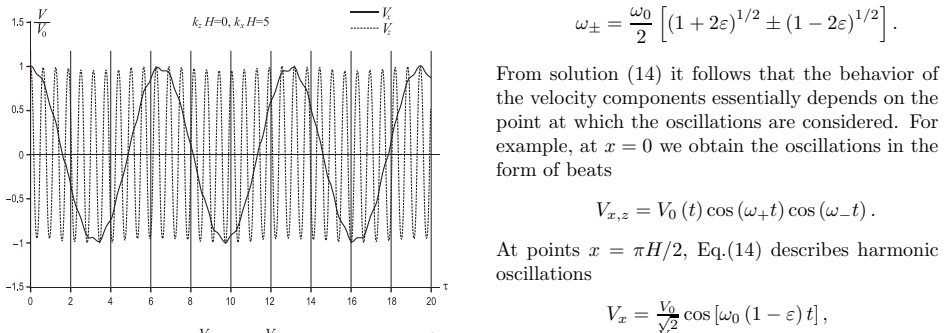
The central claim is that a small-amplitude acoustic-gravity disturbance in an isothermal stratified atmosphere is not a single mode but a superposition of two eigen-oscillations. The frequencies are the roots of Eq. (10), $\omega_{1,2}^{2}=\frac{1}{2}(\omega_{01}^{2}+\omega_{02}^{2}\pm\sqrt{D})$ with $D=(\omega_{01}^{2}-\omega_{02}^{2})^{2}+4(\omega_{03}^{4}+\omega_{04}^{4})$, where $\omega_{01}^{2}=k_{x}^{2}c_{s}^{2}$, $\omega_{02}^{2}=(k_{z}^{2}+1/(4H^{2}))c_{s}^{2}$, $\omega_{03}^{2}=\varepsilon k_{x}c_{s}^{2}/H$, $\omega_{04}^{2}=k_{x}k_{z}c_{s}^{2}$, and $\varepsilon=1/\gamma-1/2$. Starting from the coupled second-order displacement equations, the paper shows that the general real solution is the sum of the two eigen-solutions, with coefficients fixed by initial conditions on velocity, giving closed-form expressions (13) for $V_x$ and $V_z$. For equal initial amplitudes and phases, these factor into $\cos(\omega_{+}t)\cos(\omega_{-}t)$ beats, where $\omega_{\pm}=\omega_{0}[(1+2\varepsilon)^{1/2}\pm(1-2\varepsilon)^{1/2}]/2$. The paper claims these beats match the morphology of satellite-observed acoustic-gravity wave trains, including typical $k_xH\approx0.5$, $k_zH\to0$ scaling, near-in-phase $V_x$ and $V_z$, and in-phase vertical velocity with density.
Load-bearing premise
The comparisons with satellite data assume that an observed wave train is well represented by a single plane-wave component at one fixed wavenumber pair $(k_x,k_z)$ that is a superposition of the two eigenfrequencies, even though real atmospheric acoustic-gravity waves are broadband and affected by winds, dissipation, and temperature variability.
Editorial extensions
If this is right
- If the two-frequency picture is correct, beat-like intensity modulations in satellite observations of acoustic-gravity waves follow from linear theory alone, without invoking nonlinear interactions or external modulation.
- The two-frequency solution contains the standard single-frequency regime as a limit: for $k_zH\approx k_xH\gg1$ the general solution reduces to a high-frequency acoustic oscillation, and at the evanescent point $k_z=0$, $k_x=1/(2H)$ it recovers previously studied evanescent acoustic-gravity modes.
- At horizontal location $x=0$ the velocity components are exactly $\cos(\omega_{+}t)\cos(\omega_{-}t)$, a pure beat, while at $x=\pi H/2$ the same solution gives two harmonic oscillations with slightly different frequencies, so the degree of beating is spatially dependent.
- The real-variable form provides direct predictions for phase relations between $V_x$ and $V_z$ and between $V_z$ and density; the paper claims these can account for observed in-phase behaviour near $k_z\to0$ where classical theory predicts a $\pi/2$ phase shift.
- Because the construction is parameter-free given wavenumbers, scale height, adiabatic index, and initial amplitudes, Eq. (13) can be compared directly with time-series data rather than through dispersion fits alone.
Reading between the lines
- A natural extension beyond the paper is to ask whether the same two-frequency structure survives in slowly varying non-isothermal backgrounds; one testable prediction is that beat envelopes should persist along ray paths with locally defined scale height.
- In the editor's reading, the paper's comparison with satellite data is qualitative; a quantitative test would be to fit Eq. (13) to individual wave-train time series and check whether the envelope period and the in-phase polarization relation hold within observational uncertainty.
- The two-frequency decomposition may also apply to other stratified media, including stellar or solar atmospheric layers, where beat-like velocity signals could be misidentified as separate modes rather than as two eigenfrequencies of a single disturbance.
Signed reviews
Editorial analysis
A structured set of objections, weighed in public.
Referee Report
Summary. The manuscript develops a two-frequency description of acoustic-gravity waves in an isothermal atmosphere. Starting from the linearized hydrodynamic equations, the authors derive coupled second-order equations for the horizontal and vertical displacement components, impose initial conditions of zero displacement and prescribed velocity, and obtain real-time solutions expressed as sums of two eigen-oscillations with the frequencies given by Eq. (10). The paper further presents velocity solutions in Eq. (13), examines special limiting cases, and claims that the two-frequency regime explains beat-like wave trains and phase properties observed by satellites (Section 6).
Significance. The paper's mathematical core is a self-contained, parameter-free derivation. It recovers the standard acoustic-gravity dispersion relation and offers real-variable, physically interpretable solutions that reduce to single-frequency oscillations in appropriate limits. The main weakness is the observational section, which asserts explanatory power without a quantitative comparison. If the observational analysis were made rigorous, the framework could be a useful interpretive tool for AGW data.
major comments (3)
- [Section 4, Eq. (12)] The second spatial term in the expression for ξz is printed as cos(k·r) twice; consistency with Eq. (8) and with the derivation of Eq. (13) requires the second term to be sin(k·r). This should be corrected.
- [Section 6, Eqs. (10) and (13)] The claim that the two-frequency regime explains satellite observations is not supported by a quantitative comparison. The paper cites morphological similarity and the qualitative properties kxH≈0.5, kzH→0, but it does not compute the predicted beat period (ω1−ω2), the modulation envelope, or the phase relationships between Vx and Vz for the observed events, nor does it show that a single-wavenumber superposition is adequate. Without such a test, the statement that these observations 'can be explained' remains an unsubstantiated assertion. I recommend adding a quantitative fit or rephrasing the claim as a qualitative suggestion.
- [Section 5, Eq. (14)] The reduction of Eqs. (13) to the compact beat form (14) is presented without derivation, and the notation is confusing because Vx,z denotes both the velocity component and its amplitude envelope. Please provide the algebra and introduce separate symbols for the envelope and phase.
minor comments (5)
- [Abstract and Section 7] The paper promises spectral characteristics of the perturbed velocity, but no spectra are computed or plotted; either add spectral analysis or remove the claim.
- [Section 6] The cited observed properties come mainly from the authors' previous papers; the manuscript should summarize the measurement procedure and error bars so that the qualitative comparison can be evaluated.
- [Section 5 and Figure captions] In the text, 'the dimensionless velocity components Vx/V0x and Vx/V0x' appears to contain a typo; the second quantity should likely be Vz/V0z.
- [References] Several references are abbreviated or contain inconsistencies (e.g., 'Prist' appears for what is likely Priest); the reference list should be standardized.
- [Section 5, Eq. (14)] At x=0 the expression Vx,z = V0(t) cos(ω+t) cos(ω−t) is ambiguous because Vx(t) in Eq. (14) is nonnegative, whereas cos(ω−t) changes sign; please clarify whether V0(t) is meant to include an absolute value.
Circularity Check
No significant circularity: the two-frequency solutions are derived from the linearized hydrodynamic equations without fitting any output to the observations used for context.
full rationale
The paper's derivation is self-contained. It starts from standard linearized hydrodynamic equations (Eq. 1), rewrites them in displacement variables (Eqs. 3-5), imposes zero initial displacement and a Fourier space dependence with the stratified exponential factor (Eqs. 6-8), and obtains the algebraic system (Eq. 9). The two eigenfrequencies in Eq. (10) follow from the vanishing determinant of that system, not from any observational input. The real velocity solutions (Eq. 13) are linear combinations of the two eigenmodes with coefficients fixed by the stated initial conditions (Eq. 7); no parameter is tuned to data. The comparison with satellite observations in Section 6 is qualitative and explicitly hedged ('may indicate in favor of the two-frequency oscillation regime'); the observed parameters (kxH ≈ 0.5, kzH → 0) are not inserted into the model to force agreement, and no fitted constant is renamed as a prediction. The citation to Cheremnykh et al. (2019) is used only as a special-case consistency check for evanescent modes, not as the foundation of the two-frequency result, so it is not load-bearing self-citation. The fact that Eq. (10) is the standard two-branch AGW dispersion relation is a question of novelty or framing, not circularity: the paper's claimed output, explicit real-variable two-frequency beating solutions with given initial-condition dependence, is not equivalent by construction to its inputs.
Assumptions & free parameters
assumptions (5)
- domain assumption Linearized hydrodynamic equations for a stratified isothermal atmosphere (Eq. 1) are valid for small perturbations.
- domain assumption The background atmosphere is isothermal with constant scale height H = RT/g and an exponential density profile (Eq. 2).
- domain assumption Perturbed quantities and displacements vanish at t=0, so that Eq. (3) integrates velocity to displacement without a constant.
- domain assumption The solution can be written as a finite sum of modes of the form e^{z/2H} sin(ωt) times spatial sines and cosines (Eq. 8).
- standard math Trigonometric functions sin(k·r) and cos(k·r) are linearly independent, allowing Eq. (9) to be separated.
Cite this review
Pith. "Pith review of Two-frequency approach to the theory of atmospheric acoustic-gravity waves." pith.science (2026). https://pith.science/paper/VUNDG6KN
@misc{pith2026190807789,
  author       = {Pith},
  title        = {Pith review of: Two-frequency approach to the theory of atmospheric acoustic-gravity waves},
  year         = {2026},
  howpublished = {\url{https://pith.science/paper/VUNDG6KN}},
  note         = {Machine review of arXiv:1908.07789}
}
read the original abstract
The propagation of acoustic-gravity waves (AGWs) in the stratified isothermal atmosphere is analyzed using methods of the oscillation theory. It is shown that AGW in the atmosphere can be considered as an oscillatory process occurring at two eigenfrequencies. This consideration makes it possible to explain some of the observed properties of AGWs. The solutions for perturbed hydrodynamic velocity versus time and spectral characteristics are obtained in a real, but not complex, variables.
Figures


Reference graph
Works this paper leans on
-
[1]
Mathematical methods of classical mechanics
Arnold V.I., 1989. Mathematical methods of classical mechanics. Springer-Verlag, 1989, New York Inc., 518p
work page 1989
-
[2]
Bateman G. MHD instabilities. Cambridge, Mass., MIT Press, 1978, 270 p
work page 1978
-
[3]
Cheremnykh O.K., Fedorenko A.K., Kryuchkov E.I., Selivanov Y.A. Evanescent acoustic -- gravity modes in the isothermal atmosphere: systematization and applications to the Earth and solar atmospheres. Ann.Geophys.,2019,v.37, p.401-415
work page 2019
-
[4]
Fedorenko A.K. Energy balance of acoustic gravity waves above the polar caps according to the data of satellite measurements, Geomagn. Aeron., 2010, V.50, p. 107--118
work page 2010
-
[5]
Fedorenko, A.K., Kryuchkov, Y.I.: Wind Control of the Propagation of Acoustic Gravity Waves in the Polar Atmosphere, Geomagn. Aeron. (Engl. Transl.) 53, 377-388, 2013
work page 2013
-
[6]
Fedorenko, A.K, Bespalova, A.V, Cheremnykh, O.K, Kryuchkov, E.I.: A dominant acoustic-gravity mode in the polar thermosphere, Ann. Geophys., 33, 101-108, 2015. [doi:10.5194/angeo-33-101-2015]
-
[7]
Hines C.O. Internal atmospheric gravity waves at ionospheric heights //Canadian J.Phys., 1960, V.38, P.1441-1481
work page 1960
-
[8]
A., Shan H.A., Shan M.I., Stenflo L
Kaladze T.D., Pokhotelov O. A., Shan H.A., Shan M.I., Stenflo L. Acoustic-gravity waves in the Earth ionosphere. Jornal Atmospheric and Solar-Terrestrial Physics. - 2008. - V. 70. -- P. 1607-1616
work page 2008
Show all 19 references
-
[9]
Mechanics (Volume 1 of A Course of Theoretical Physics) Pergamon Press, 1969, 170 p
Landau L.D., Lifshitz E.M., I. Mechanics (Volume 1 of A Course of Theoretical Physics) Pergamon Press, 1969, 170 p
1969
-
[10]
Landau L.D., Lifshitz E.M. II. Fluid mechanics (Volume 6 of A Course of Theoretical Physics) Pergamon Press, 1969, 539p
1969
-
[11]
Foundation of radiation hydrodynamics
Mihalas D., Mihalas B.W. Foundation of radiation hydrodynamics. Courier Corp., 2013, 752 p
2013
-
[12]
An Introduction to Atmospheric Gravity Waves
Nappo Carmen J. An Introduction to Atmospheric Gravity Waves. Elsevier, 2002, 279 p
2002
-
[13]
Narayanan A. Satya. An Introduction to Waves and Oscillations in the Sun, Springer, 2013, 231 p
2013
-
[14]
Solar magnetohydrodynamics.- Springer Netherland, 1982, 270p
Prist E.R. Solar magnetohydrodynamics.- Springer Netherland, 1982, 270p
1982
-
[15]
Nonlinear acoustic - gravity waves
Stenflo L., Shukla P.K. Nonlinear acoustic - gravity waves. J. Plasma Physics, 2009, v.75, 6 p.841-847
2009
-
[16]
Internal Gravity Waves
Sutherland B.R. Internal Gravity Waves. Cambridge University Press, 2010, 395 p
2010
-
[17]
Tolstoy I., The Theory of Waves in Stratified Fluids Including the Effect of Gravity and Rotation, Reviews in Modern Physics. - 1963. - V.35, N.23. -- P.207- 230
1963
-
[18]
L., Nicolls, M
Vadas S. L., Nicolls, M. J.: The phases and amplitudes of gravity waves propagating and dissipating in the thermosphere: Theory, J. Geophys. Res., 117, A05322, doi:10.1029/2011JA017426, 2012
2012 doi
-
[19]
Acoustic-Gravity Waves in the Upper Atmosphere
Yeh K.C., Liu C.H. Acoustic-Gravity Waves in the Upper Atmosphere. Reviews in Geophysics and Space Physics. - 1974. - V.12, N.2. -- P.193 -- 216
1974
Reviewed August 14, 2026 · model on record in the stance chip above.
Discussion (0). Continue with ORCID to comment.