REVIEW 3 major objections 5 minor 78 references
SIEVE: Effective Filtered Vector Search with Collection of Indexes
T0 review · 3 major / 5 minor · reviewed 2026-08-06 · deepseek-v4-flash
Pith's one-line read SIEVE claims that a workload-tailored collection of small HNSW subindexes, chosen by an analytical cost model, is the fastest non-Oracle filtered vector search method, with up to 8.06x QPS gains over ACORN-γ at 0.9 recall@10 and bounded…
desk verdict SIEVE is a strong, well-evaluated systems paper: the collection-of-indexes idea is not new, but the cost-model-driven selection and serving are a genuine contribution, and the measured speedups deserve serious peer review despite heuristic constants in the model. read the letter →
The pith
A machine-rendered reading of the paper's core claim, the machinery that carries it, and where it could break.
The reading
What carries the argument
The mechanism is the three-dimensional cost model that ties index size, search time, and recall to one formula. Indexed search cost is modeled as $C(I_h, sef, w, f) = \log(\mathrm{card}(h)) \cdot sef \cdot (\mathrm{card}(h)/\mathrm{card}(f))^{cor}$, where $\mathrm{card}(h)$ is the size of subindex $I_h$, $\mathrm{card}(f)$ the number of points passing filter $f$, and $cor$ a query-correlation exponent fixed at 0.5 in the experiments. Memory is modeled as $S(I_h) = M_\infty \cdot (\log(\mathrm{card}(h))/\log(N)) \cdot \mathrm{card}(h)$, so smaller subindexes are built with proportionally lower construction parameter $M$, and serving-time exploration $sef$ is downscaled by $S_\downarrow(I_h) = \max(k, sef_\infty \cdot \log(\mathrm{card}(h))/\log(N))$. Because the formulas make smaller graphs cheaper to build and search, SIEVE can pack many subindexes into a fixed memory budget and route each query to the cheapest option at a target recall. The optimization is a supermodular minimization with a knapsack memory constraint, solved greedily by unit marginal benefit.
What would settle it
One concrete test: measure, per historical filter on a real dataset, the actual correlation between query similarity and filter passing (average distance from queries to passing versus non-passing points), then run SIEVE once with the paper's constant 0.5 and once with per-filter measured values. If the measured-correlation version chooses different subindexes and improves QPS at 0.9 recall beyond a small margin, the constant-correlation premise is falsified.
Extended reading notes
Core claim
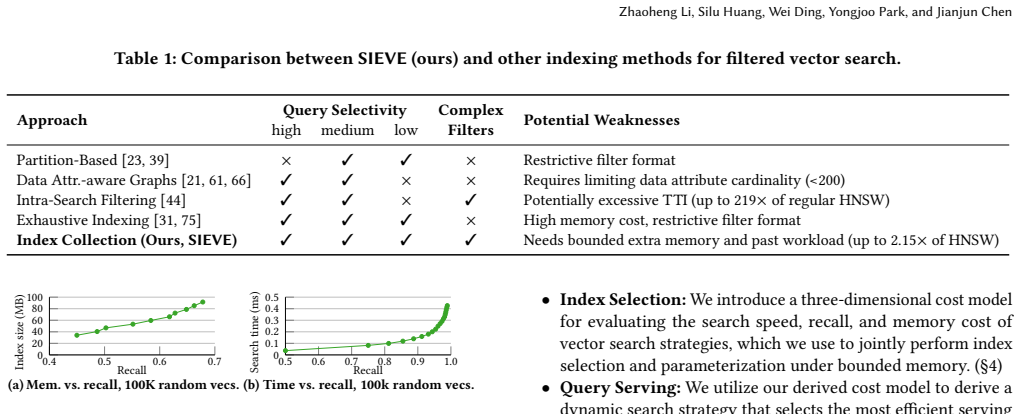
SIEVE claims that the fastest way to answer a filtered vector query is to find the smallest HNSW subindex whose filter subsumes the query filter, because in that subindex the matching points are dense enough to restore the just-a-few-hops property that a large filtered graph loses. To make that possible, SIEVE formalizes index selection as a budget-constrained optimization over a DAG of filters observed in a historical workload, using an analytical cost model that treats recall as a constraint and optimizes speed. The paper reports that the resulting collection is the best-performing non-Oracle method on all six datasets tested, achieving up to 8.06x higher QPS at 0.9 recall@10 than ACORN-γ, with memory never above 2.15x that of a single HNSW index and time-to-index as low as 1% of ACORN-γ's.
Load-bearing premise
The analysis assumes one fixed value (0.5 in the experiments) for how strongly similar vectors line up with filter-passing points in every subindex; if real filters differ in this alignment, the cost model will under- or over-estimate search costs and may select a suboptimal collection.
Editorial extensions
If this is right
- Low-selectivity "unhappy-middle" queries become fast without specialized graph construction: a small subindex makes filter-passing points dense, so HNSW traversal regains the just-a-few-hops property.
- SIEVE supports conjunctions, disjunctions, and range predicates with no restriction on attribute cardinality, because filters only need to be evaluable on attributes.
- The same cost model gives a query-time fallback: when indexed search is estimated slower than brute-force KNN, SIEVE uses brute force, so performance is bounded by the better of the two at every recall.
- On YFCC, the first doubling of the HNSW memory budget cuts serving time by 2.63x at 0.95 recall, while later budget doublings add far less, showing that the optimizer spends memory on the highest-benefit subindexes first.
- SIEVE can cold-start with only the base index and reach 97% of full-workload QPS after three 5K-query slices, and it can be refit after workload shifts without rebuilding the base index.
Reading between the lines
- Editorial inference: if per-filter correlation values were measured instead of fixed at 0.5, SIEVE's cost model would likely favor different subindexes on datasets whose filters systematically anti-correlate with query similarity; estimating this correlation online is a natural extension.
- Editorial inference: the index-collection framing invites continuous maintenance techniques from materialized-view selection, such as benefit-based eviction under a sliding workload window; the paper sketches refitting but does not quantify online adaptation under high-churn workloads.
- Editorial inference: because raw vectors dominate memory, the extra subindexes become nearly free for very high-dimensional embeddings, making the same design more attractive as embedding dimensionality grows.
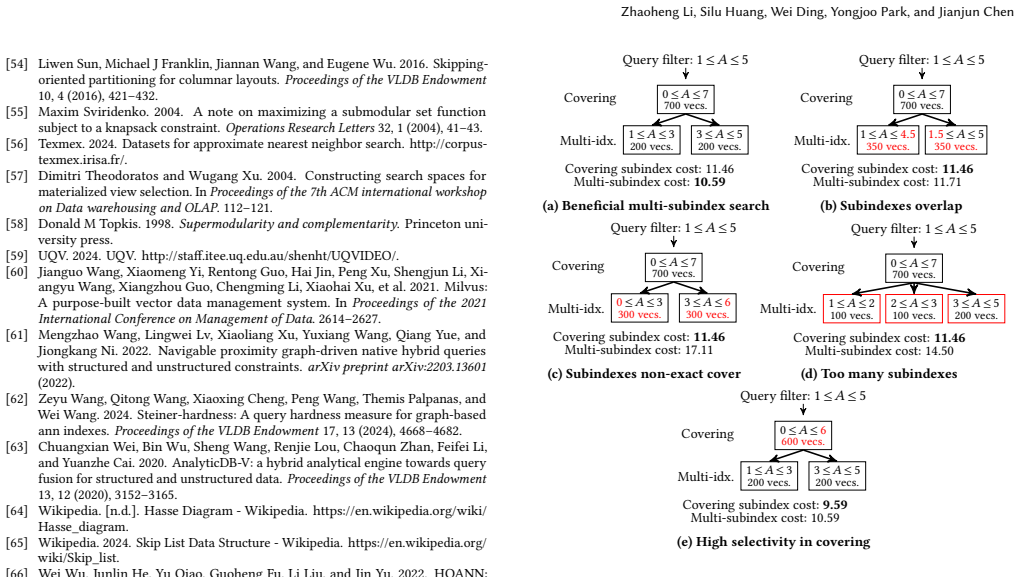
- Editorial inference: the paper's appendix shows multi-subindex search is rarely beneficial, which suggests SIEVE's core value is subindex selection rather than multi-index unions; improving subsumption detection in sparse filter spaces could increase serving opportunities for complex predicates.
Editorial analysis
A structured set of objections, weighed in public.
Referee Report
Summary. The paper proposes SIEVE, a filtered vector search framework that replaces a single filtered graph index with a collection of small HNSW subindexes selected by a workload-aware cost model. The construction phase defines candidate subindexes from historical query filters, estimates each candidate's memory size and search cost via three analytical formulas (M↓, S↓, and an indexed-search cost function with a query-correlation exponent), and applies a greedy, budget-constrained optimization to choose which subindexes to build. The serving phase uses the same cost model to pick the best subindex and its serving parameter, and decides between indexed search and brute-force KNN. Experiments on six datasets with varied predicate forms (conjunctions, disjunctions, range filters) report that SIEVE outperforms all non-Oracle baselines, with up to 8.06× QPS improvement over ACORN-γ at recall@10 = 0.9, memory below 2.15× of a standard HNSW graph, and time-to-index as low as 1% of ACORN-γ. The paper also studies memory-budget trade-offs, workload-knowledge sensitivity, cold starts, and workload shifts.
Significance. If the results hold, SIEVE makes a useful contribution to filtered vector search: it shows that a collection of small subindexes, chosen by a cost model and served with dynamic parameter scaling, can beat graph-traversal-filtering methods on low and medium selectivity predicates while keeping memory and build time bounded. The work is significant because it extends the materialized-view-selection paradigm to approximate, recall-aware vector search, and it ships with a public artifact, measured end-to-end QPS, and systematic ablations (dynamic M/se f, budget scaling, workload shifts, cold starts). The main correctness risk is that the cost model's key constants and scaling laws are asserted rather than validated, and the headline speedup is measured on the same query slice used for workload fitting; both issues are addressable and do not by themselves invalidate the empirical findings.
major comments (3)
- [§4.2, Def. 4.7; §7.1] The query-correlation exponent cor(w,f,h) is a load-bearing constant: it controls the selectivity penalty in the indexed-search cost C(I_h,sef,w,f)=log(card(h))·sef·(card(h)/card(f))^{cor}, and this same cost drives both GreedyRatio subindex selection (§4.3) and the indexed-vs-brute-force serving decision (§5.2). The paper fixes cor=0.5 for all queries, filters, and subindexes (§7.1) without measuring it, without a sensitivity analysis, and without per-dataset calibration. With uncorrelated filters the penalty should be approximately cor≈1, so the assumed 0.5 could materially mis-rank subindexes and mis-route serving choices. The authors should report QPS-recall curves for several cor values (e.g., 0, 0.25, 0.5, 0.75, 1) on at least one low-selectivity and one range-filter dataset, and state whether the Fig. 9 conclusions survive; alternatively, calibrate cor per dataset and report the fitted values.
- [§4.2, Def. 4.6; §5.1, Def. 5.1] The downscaling formulas M↓(I_h)=M∞·log(card(h))/log(N) and S↓(I_h)=max(k, sef∞·log(card(h))/log(N)) are motivated heuristically by the Θ(log N) degree of Delaunay graphs, but the paper provides no derivation and no direct validation that these proportionalities hold for HNSW across datasets and filter cardinalities. More importantly, there is no experiment verifying that a subindex built with M↓ and served with S↓ actually achieves the same recall as the base index at (M∞, sef∞). Without such a check, the QPS-recall curves in Fig. 9 may compare methods at different effective recalls, and the paper's 'higher recall' claims (>0.99 on YFCC/Paper/UQV) could partly reflect subindexes that are over-searched relative to their stated parameterization. Please add per-subindex recall-parity measurements or an explicit validation of the log-scaling assumption.
- [§7.1, 'Index Fitting'] The main evaluation fits the cost model and subindex collection on the first 25% query slice and then serves all queries, including that same fitting slice, to produce the Fig. 9 QPS-recall curves. Consequently, the headline 8.06× speedup contains an in-sample component. The cold-start experiment (§7.7.1) shows good out-of-sample behavior on YFCC after three 5K slices, which mitigates the concern, but the other five datasets have no out-of-sample evaluation. Please report, for all datasets, the QPS-recall curve when serving the remaining 75% (or a held-out slice) of queries, and clearly label which results are in-sample versus out-of-sample.
minor comments (5)
- [§4.2 vs. §7.1] The text states 'for discussion, set c = 1' when presenting the cost model, but §7.1 sets q(w,f,h) = 0.5 for all experiments; the paper should reconcile this discrepancy and clarify which value is used in the reported results.
- [Fig. 9 caption] The caption says 'the next best non-Oracle method (ACORN-γ)', but on Paper and MSONG the non-Oracle baselines also include CAPS and FilteredVamana; please specify the comparison baseline per dataset or adjust the wording to 'the best applicable baseline'.
- [§7.3, Table 5] The statement that SIEVE's memory is 'as low as 1.29× on GIST' would be clearer if the table explicitly listed the ratio column; the current text requires the reader to divide the values manually.
- [Appendix A.1, footnote 13] The claim that single-index search is always optimal when the covering subindex exactly matches the filter is asserted with 'we omit the proof for brevity'; either provide a short argument or mark it as an empirical observation.
- [§4.3] The notation for marginal benefit in the diminishing-returns inequality is slightly confusing because the benefit is defined as a reduction in cost; consider writing the inequality directly in terms of the reduction, e.g., C(I,H)-C(I∪{I_h},H) ≥ C(J,H)-C(J∪{I_h},H), to match the standard submodularity presentation.
Circularity Check
No significant circularity: the paper's headline QPS/recall/TTI claims are measured experimentally, and its cost-model constants are stated assumptions rather than parameters fitted to the reported outcome.
full rationale
SIEVE's claimed contribution is an index-collection construction and serving strategy driven by an analytical cost model, but the paper's central results (up to 8.06x QPS, 1% TTI, memory bounds) are measured latencies and resource usage, not values computed from the cost model. The cost model in Definition 4.7 is used to rank candidate subindexes and to choose between indexed and brute-force search, and its constants (cor = 0.5, gamma calibration) are modeling assumptions; a wrong exponent would make the optimizer choose worse indexes, but it would not by construction produce the reported QPS-recall curves. The 25% workload slice used for fitting and then included in evaluation is an in-sample evaluation concern, not a derivation-circular reduction, and the paper discloses this protocol explicitly. Self-citations are limited to the authors' own technical report and code repository and to prior materialized-view work cited as related context; no load-bearing uniqueness theorem or ansatz is imported from same-author prior work. The unvalidated constant correlation exponent and filter-stability assumption are correctness/robustness risks, not circularity, because the experimental evidence does not reduce to those assumptions by the paper's own equations.
Assumptions & free parameters
free parameters (4)
- γ (brute-force scaling constant) =
chosen so γ·card(f) = C(I_h, f) at card=1000
- q (query correlation factor) =
0.5
- M∞ (base index construction degree) =
swept over {16, 32}
- sef∞ (base index serving exploration factor) =
swept over [10, 110]
assumptions (5)
- domain assumption HNSW search time scales logarithmically with graph size and linearly with sef.
- domain assumption HNSW needs node degree Θ(log N) for small-world navigation, so M and sef can be downscaled proportionally to log(card).
- ad hoc to paper Query correlation factor is constant across all subindexes and filters.
- domain assumption Future workload filter distribution follows the historical workload H.
- domain assumption Index memory size is proportional to M × card(h).
Cite this review
Pith. "Pith review of SIEVE: Effective Filtered Vector Search with Collection of Indexes." pith.science (2026). https://pith.science/paper/VV3SF2MG
@misc{pith2026250711907,
  author       = {Pith},
  title        = {Pith review of: SIEVE: Effective Filtered Vector Search with Collection of Indexes},
  year         = {2026},
  howpublished = {\url{https://pith.science/paper/VV3SF2MG}},
  note         = {Machine review of arXiv:2507.11907}
}
read the original abstract
Many real-world tasks such as recommending videos with the kids tag can be reduced to finding most similar vectors associated with hard predicates. This task, filtered vector search, is challenging as prior state-of-the-art graph-based (unfiltered) similarity search techniques quickly degenerate when hard constraints are considered. That is, effective graph-based filtered similarity search relies on sufficient connectivity for reaching the most similar items within just a few hops. To consider predicates, recent works propose modifying graph traversal to visit only the items that may satisfy predicates. However, they fail to offer the just-a-few-hops property for a wide range of predicates: they must restrict predicates significantly or lose efficiency if only a small fraction of items satisfy predicates. We propose an opposite approach: instead of constraining traversal, we build many indexes each serving different predicate forms. For effective construction, we devise a three-dimensional analytical model capturing relationships among index size, search time, and recall, with which we follow a workload-aware approach to pack as many useful indexes as possible into a collection. At query time, the analytical model is employed yet again to discern the one that offers the fastest search at a given recall. We show superior performance and support on datasets with varying selectivities and forms: our approach achieves up to 8.06x speedup while having as low as 1% build time versus other indexes, with less than 2.15x memory of a standard HNSW graph and modest knowledge of past workloads.
Figures


Figures from the paper (13 more)




Reference graph
Works this paper leans on
-
[1]
Query Rewrite With A Nested Materialized View
[n.d.]. Query Rewrite With A Nested Materialized View. https://patents.google. com/patent/US20090228432A1/en
-
[2]
Sanjay Agrawal, Surajit Chaudhuri, and Vivek R Narasayya. 2000. Automated selection of materialized views and indexes in SQL databases. InVLDB, Vol. 2000. 496–505
work page 2000
-
[3]
Georgios Amanatidis, Federico Fusco, Philip Lazos, Stefano Leonardi, Alberto Marchetti-Spaccamela, and Rebecca Reiffenhäuser. 2021. Submodular maxi- mization subject to a knapsack constraint: Combinatorial algorithms with near- optimal adaptive complexity. In International Conference on Machine Learning . PMLR, 231–242
work page 2021
-
[4]
Luıs A Nunes Amaral, Antonio Scala, Marc Barthelemy, and H Eugene Stanley
-
[5]
Kamel Aouiche, Pierre-Emmanuel Jouve, and Jérôme Darmont. 2006. Clustering- based materialized view selection in data warehouses. InEast European conference on advances in databases and information systems . Springer, 81–95
work page 2006
-
[6]
Antonio Torralba Aude Oliva. [n.d.]. Modeling the shape of the scene: a holistic representation of the spatial envelope. http://people.csail.mit.edu/torralba/code/ spatialenvelope/
-
[7]
Edmon Begoli, Jesús Camacho-Rodríguez, Julian Hyde, Michael J Mior, and Daniel Lemire. 2018. Apache calcite: A foundational framework for optimized query processing over heterogeneous data sources. In Proceedings of the 2018 International Conference on Management of Data . 221–230
work page 2018
-
[8]
big-ann benchmarks. 2024. YFCC10M - Neurips23 BigANN Challenge Filter Track. https://github.com/harsha-simhadri/big-ann-benchmarks/blob/main/ benchmark/datasets.py
work page 2024
Show all 78 references
-
[9]
Samy Chambi, Daniel Lemire, Owen Kaser, and Robert Godin. 2016. Better bitmap performance with roaring bitmaps. Software: practice and experience 46, 5 (2016), 709–719
2016
-
[10]
Chandra Chekuri. [n.d.]. Combinatorial Optimization. https://courses.grainger. illinois.edu/cs586/sp2022/main.pdf
-
[11]
CloudFlare. [n.d.]. Computing Euclidean distance on 144 dimensions. https: //blog.cloudflare.com/computing-euclidean-distance-on-144-dimensions/
-
[12]
cmuparlay. 2024. Benchmarking nearest neighbors
2024
-
[13]
DiskANN. [n.d.]. DiskAnnPy - API. https://microsoft.github.io/DiskANN/docs/ python/latest/diskannpy.html
-
[14]
David P Dobkin, Steven J Friedman, and Kenneth J Supowit. 1990. Delaunay graphs are almost as good as complete graphs. Discrete & Computational Geome- try 5 (1990), 399–407
1990
-
[15]
Matthijs Douze, Alexandr Guzhva, Chengqi Deng, Jeff Johnson, Gergely Szilvasy, Pierre-Emmanuel Mazaré, Maria Lomeli, Lucas Hosseini, and Hervé Jégou. 2024. The faiss library. arXiv preprint arXiv:2401.08281 (2024)
2024 arXiv
-
[16]
Joshua Engels, Ben Landrum, Shangdi Yu, Laxman Dhulipala, and Julian Shun. [n.d.]. Approximate Nearest Neighbor Search with Window Filters. In Forty-first International Conference on Machine Learning
-
[17]
Cong Fu, Chao Xiang, Changxu Wang, and Deng Cai. 2017. Fast approximate nearest neighbor search with the navigating spreading-out graph. arXiv preprint arXiv:1707.00143 (2017)
2017 arXiv
-
[18]
Jianyang Gao and Cheng Long. 2023. High-dimensional approximate nearest neighbor search: with reliable and efficient distance comparison operations. Proceedings of the ACM on Management of Data 1, 2 (2023), 1–27
2023
-
[19]
Parke Godfrey, Jarek Gryz, Andrzej Hoppe, Wenbin Ma, and Calisto Zuzarte
-
[20]
Jonathan Goldstein and Per-Åke Larson. 2001. Optimizing queries using ma- terialized views: a practical, scalable solution. SIGMOD Rec. 30, 2 (May 2001), 331–342. https://doi.org/10.1145/376284.375706
2001
-
[21]
Siddharth Gollapudi, Neel Karia, Varun Sivashankar, Ravishankar Krishnaswamy, Nikit Begwani, Swapnil Raz, Yiyong Lin, Yin Zhang, Neelam Mahapatro, Premku- mar Srinivasan, et al. 2023. Filtered-diskann: Graph algorithms for approximate nearest neighbor search with filters. In P...
2023
-
[22]
Georg Gottlob. 1987. Subsumption and implication. Inform. Process. Lett. 24, 2 (1987), 109–111
1987
-
[23]
Gaurav Gupta, Jonah Yi, Benjamin Coleman, Chen Luo, Vihan Lakshman, and Anshumali Shrivastava. 2023. CAPS: A Practical Partition Index for Filtered Similarity Search. arXiv preprint arXiv:2308.15014 (2023)
2023 arXiv
-
[24]
harsha simhadri. 2024. Big ANN Benchmarks. https://github.com/harsha- simhadri/big-ann-benchmarks
2024
-
[25]
Stratos Idreos, Martin L Kersten, Stefan Manegold, et al. 2007. Database Cracking.. In CIDR, Vol. 7. 68–78
2007
-
[26]
Milena G Ivanova, Martin L Kersten, Niels J Nes, and Romulo AP Gonçalves. 2010. An architecture for recycling intermediates in a column-store. ACM Transactions on Database Systems (TODS) 35, 4 (2010), 1–43
2010
-
[27]
Suhas Jayaram Subramanya, Fnu Devvrit, Harsha Vardhan Simhadri, Ravishankar Krishnawamy, and Rohan Kadekodi. 2019. Diskann: Fast accurate billion-point nearest neighbor search on a single node. Advances in Neural Information Processing Systems 32 (2019)
2019
-
[28]
Alekh Jindal, Konstantinos Karanasos, Sriram Rao, and Hiren Patel. 2018. Select- ing subexpressions to materialize at datacenter scale. Proceedings of the VLDB Endowment 11, 7 (2018), 800–812
2018
-
[29]
G Kashyap and G Ambika. 2019. Link deletion in directed complex networks. Physica A: Statistical Mechanics and its Applications 514 (2019), 631–643
2019
-
[30]
Asterios Katsifodimos, Ioana Manolescu, and Vasilis Vassalos. 2012. Materialized view selection for XQuery workloads. In Proceedings of the 2012 ACM SIGMOD International Conference on Management of Data (Scottsdale, Arizona, USA) (SIG- MOD ’12). Association for Computing Machi...
2012
-
[31]
Ben Landrum, Magdalen Dobson Manohar, Mazin Karjikar, and Laxman Dhuli- pala. 2025. IVF2 Index: Fusing Classic and Spatial Inverted Indices for Fast Filtered ANNS. In The 1st Workshop on Vector Databases . https://openreview. net/forum?id=kXw8E3xT7O
2025
-
[32]
Zhaoheng Li, Xinyu Pi, and Yongjoo Park. 2023. S/C: Speeding up Data Materi- alization with Bounded Memory. In 2023 IEEE 39th international conference on data engineering (ICDE). IEEE, 1981–1994
2023
-
[33]
Yu A Malkov and Dmitry A Yashunin. 2018. Efficient and robust approximate nearest neighbor search using hierarchical navigable small world graphs. IEEE transactions on pattern analysis and machine intelligence 42, 4 (2018), 824–836
2018
-
[34]
Information Management and Preservation. 2024. Million Song Dataset Bench- marks. https://www.ifs.tuwien.ac.at/mir/msd/
2024
-
[35]
Meta. [n.d.]. Llama Models. https://www.llama.com/
-
[36]
Microsoft. [n.d.]. Introducing Phi-3: Redefining what’s possible with SLMs. https://azure.microsoft.com/en-us/blog/introducing-phi-3-redefining- whats-possible-with-slms/
-
[37]
Baharan Mirzasoleiman, Ashwinkumar Badanidiyuru, and Amin Karbasi. 2016. Fast constrained submodular maximization: Personalized data summarization. In International Conference on Machine Learning . PMLR, 1358–1367
2016
-
[38]
Sudarshan, and Krithi Ramamritham
Hoshi Mistry, Prasan Roy, S. Sudarshan, and Krithi Ramamritham. 2001. Ma- terialized view selection and maintenance using multi-query optimization. In Proceedings of the 2001 ACM SIGMOD International Conference on Management of Data (Santa Barbara, California, USA) (SIGMOD ’01...
2001
-
[39]
Jason Mohoney, Anil Pacaci, Shihabur Rahman Chowdhury, Ali Mousavi, Ihab F Ilyas, Umar Farooq Minhas, Jeffrey Pound, and Theodoros Rekatsinas. 2023. High-throughput vector similarity search in knowledge graphs. Proceedings of the ACM on Management of Data 1, 2 (2023), 1–25
2023
-
[40]
Bilegsaikhan Naidan, Leonid Boytsov, Yury Malkov, and David Novak. 2015. Non-metric space library manual. arXiv preprint arXiv:1508.05470 (2015)
2015 arXiv
-
[41]
Mark EJ Newman, Cristopher Moore, and Duncan J Watts. 2000. Mean-field solution of the small-world network model. Physical Review Letters 84, 14 (2000), 3201
2000
-
[42]
nmslib. 2024. Hnswlib - fast approximate nearest neighbor search. https://github. com/nmslib/hnswlib
2024
-
[43]
OpenAI. [n.d.]. OpenAI. https://openai.com/
-
[44]
Liana Patel, Peter Kraft, Carlos Guestrin, and Matei Zaharia. 2024. ACORN: Performant and Predicate-Agnostic Search Over Vector Embeddings and Struc- tured Data. Proc. ACM Manag. Data 2, 3, Article 120 (May 2024), 27 pages. https://doi.org/10.1145/3654923
2024 doi
-
[45]
Pinecone. [n.d.]. Hierarchical Navigable Small Worlds (HNSW). https://www. pinecone.io/learn/series/faiss/hnsw/
-
[46]
Karthikeyan Ramasamy, Prasad M Deshpande, Jeffrey F Naughton, and David Maier. 1998. Set-Valued Attributes in O/R DBMS: Implementation Options and Performance Implications. R DBMS: Implementation options and performance implications, Madison: University of Wisconsin (1998)
1998
-
[47]
Abhishek Roy, Alekh Jindal, Hiren Patel, Ashit Gosalia, Subru Krishnan, and Carlo Curino. 2019. Sparkcruise: Handsfree computation reuse in spark. Proceedings of the VLDB Endowment 12, 12 (2019), 1850–1853
2019
-
[48]
Viktor Sanca and Anastasia Ailamaki. 2024. Efficient Data Access Paths for Mixed Vector-Relational Search. In Proceedings of the 20th International Workshop on Data Management on New Hardware . 1–9
2024
-
[49]
Aneesh Sharma, Jerry Jiang, Praveen Bommannavar, Brian Larson, and Jimmy Lin. 2016. GraphJet: Real-time content recommendations at Twitter. Proceedings of the VLDB Endowment 9, 13 (2016), 1281–1292
2016
-
[50]
Amit Shukla, Prasad Deshpande, Jeffrey F Naughton, et al. 1998. Materialized view selection for multidimensional datasets. In VLDB, Vol. 98. 488–499
1998
-
[51]
Harsha Vardhan Simhadri, Martin Aumüller, Amir Ingber, Matthijs Douze, George Williams, Magdalen Dobson Manohar, Dmitry Baranchuk, Edo Liberty, Frank Liu, Ben Landrum, et al. 2024. Results of the Big ANN: NeurIPS’23 compe- tition. arXiv preprint arXiv:2409.17424 (2024)
2024 arXiv
-
[52]
Justin JongSu Song, Wookey Lee, and Jafar Afshar. 2019. An effective high recall retrieval method. Data & Knowledge Engineering 123 (2019), 101603
2019
-
[53]
Liwen Sun, Michael J Franklin, Sanjay Krishnan, and Reynold S Xin. 2014. Fine- grained partitioning for aggressive data skipping. In Proceedings of the 2014 ACM SIGMOD international conference on Management of data . 1115–1126. Zhaoheng Li, Silu Huang, Wei Ding, Yongjoo Park, ...
2014
-
[54]
Liwen Sun, Michael J Franklin, Jiannan Wang, and Eugene Wu. 2016. Skipping- oriented partitioning for columnar layouts. Proceedings of the VLDB Endowment 10, 4 (2016), 421–432
2016
-
[55]
Maxim Sviridenko. 2004. A note on maximizing a submodular set function subject to a knapsack constraint. Operations Research Letters 32, 1 (2004), 41–43
2004
-
[56]
Texmex. 2024. Datasets for approximate nearest neighbor search. http://corpus- texmex.irisa.fr/
2024
-
[57]
Dimitri Theodoratos and Wugang Xu. 2004. Constructing search spaces for materialized view selection. In Proceedings of the 7th ACM international workshop on Data warehousing and OLAP . 112–121
2004
-
[58]
Donald M Topkis. 1998. Supermodularity and complementarity. Princeton uni- versity press
1998
-
[59]
UQV. 2024. UQV. http://staff.itee.uq.edu.au/shenht/UQVIDEO/
2024
-
[60]
Jianguo Wang, Xiaomeng Yi, Rentong Guo, Hai Jin, Peng Xu, Shengjun Li, Xi- angyu Wang, Xiangzhou Guo, Chengming Li, Xiaohai Xu, et al. 2021. Milvus: A purpose-built vector data management system. In Proceedings of the 2021 International Conference on Management of Data . 2614–2627
2021
-
[61]
Mengzhao Wang, Lingwei Lv, Xiaoliang Xu, Yuxiang Wang, Qiang Yue, and Jiongkang Ni. 2022. Navigable proximity graph-driven native hybrid queries with structured and unstructured constraints. arXiv preprint arXiv:2203.13601 (2022)
2022 arXiv
-
[62]
Zeyu Wang, Qitong Wang, Xiaoxing Cheng, Peng Wang, Themis Palpanas, and Wei Wang. 2024. Steiner-hardness: A query hardness measure for graph-based ann indexes. Proceedings of the VLDB Endowment 17, 13 (2024), 4668–4682
2024
-
[63]
Chuangxian Wei, Bin Wu, Sheng Wang, Renjie Lou, Chaoqun Zhan, Feifei Li, and Yuanzhe Cai. 2020. AnalyticDB-V: a hybrid analytical engine towards query fusion for structured and unstructured data. Proceedings of the VLDB Endowment 13, 12 (2020), 3152–3165
2020
-
[64]
Wikipedia. [n.d.]. Hasse Diagram - Wikipedia. https://en.wikipedia.org/wiki/ Hasse_diagram
-
[65]
Wikipedia. 2024. Skip List Data Structure - Wikipedia. https://en.wikipedia.org/ wiki/Skip_list
2024
-
[66]
Wei Wu, Junlin He, Yu Qiao, Guoheng Fu, Li Liu, and Jin Yu. 2022. HQANN: Efficient and robust similarity search for hybrid queries with structured and unstructured constraints. In Proceedings of the 31st ACM International Conference on Information & Knowledge Management . 4580–4584
2022
-
[67]
Wentao Xiao, Yueyang Zhan, Rui Xi, Mengshu Hou, and Jianming Liao. 2024. Enhancing HNSW Index for Real-Time Updates: Addressing Unreachable Points and Performance Degradation. arXiv preprint arXiv:2407.07871 (2024)
2024 arXiv
-
[68]
Zongheng Yang, Badrish Chandramouli, Chi Wang, Johannes Gehrke, Yinan Li, Umar Farooq Minhas, Per-Åke Larson, Donald Kossmann, and Rajeev Acharya
-
[69]
Zhengyu Yang, Danlin Jia, Stratis Ioannidis, Ningfang Mi, and Bo Sheng. 2018. Intermediate data caching optimization for multi-stage and parallel big data frameworks. In 2018 IEEE 11th International Conference on Cloud Computing (CLOUD). IEEE, 277–284
2018
-
[70]
Neal E Young. 2008. Greedy set-cover algorithms (1974-1979, chvátal, johnson, lovász, stein). Encyclopedia of algorithms (2008), 379–381
2008
-
[71]
Chuan Zhang, Xin Yao, and Jian Yang. 2001. An evolutionary approach to materialized views selection in a data warehouse environment.IEEE Transactions on Systems, Man, and Cybernetics, Part C (Applications and Reviews) 31, 3 (2001), 282–294
2001
-
[72]
Li Zhaoheng, Huang Silu, Ding Wei, Park Yongjoo, and Chen Jianjun. [n.d.]. SIEVE Technical Report. https://billyzhaohengli.github.io/assets/pdf/SIEVE_ tech_report.pdf
-
[73]
Li Zhaoheng, Huang Silu, Ding Wei, Park Yongjoo, and Chen Jianjun. 2025. SIEVE - Github. https://github.com/BillyZhaohengLi/SIEVE-vldb25/
2025
-
[74]
Zilliz. 2024. Faiss vs. HNSWlib: Choosing the Right Vector Search Tool for Your Application
2024
-
[75]
Chaoji Zuo, Miao Qiao, Wenchao Zhou, Feifei Li, and Dong Deng. 2024. SeRF: Segment Graph for Range-Filtering Approximate Nearest Neighbor Search. Pro- ceedings of the ACM on Management of Data 2, 1 (2024), 1–26. A APPENDIX A.1 Multi-index Search This section studies the feasib...
2024
-
[2000]
Proceedings of the national academy of sciences 97, 21 (2000), 11149–11152
Classes of small-world networks. Proceedings of the national academy of sciences 97, 21 (2000), 11149–11152
2000
-
[2009]
In 2009 IEEE 25th International Conference on Data Engineering
Query rewrites with views for XML in DB2. In 2009 IEEE 25th International Conference on Data Engineering . IEEE, 1339–1350
2009
-
[2020]
InProceedings of the 2020 ACM SIGMOD International Conference on Management of Data (Portland, OR, USA) (SIGMOD ’20)
Qd-tree: Learning Data Layouts for Big Data Analytics. InProceedings of the 2020 ACM SIGMOD International Conference on Management of Data (Portland, OR, USA) (SIGMOD ’20). Association for Computing Machinery, New York, NY, USA, 193–208. https://doi.org/10.1145/3318464.3389770
2020
Reviewed August 6, 2026 · model on record in the stance chip above.
Discussion (0). Continue with ORCID to comment.