REVIEW 4 major objections 5 minor 33 references
Escape of \alpha-particle in inertial confinement fusion
T0 review · 4 major / 5 minor · reviewed 2026-08-14 · deepseek-v4-flash
Pith's one-line read Alpha particles escape DT fuel more than earlier models predict, lowering fusion gain estimates.
desk verdict A genuinely useful upgrade of the alpha-escape model, but the numerical fit leans on an unjustified slow-electron-only approximation, so the ±0.02 accuracy claim should be treated with caution. read the letter →
The pith
A machine-rendered reading of the paper's core claim, the machinery that carries it, and where it could break.
The reading
What carries the argument
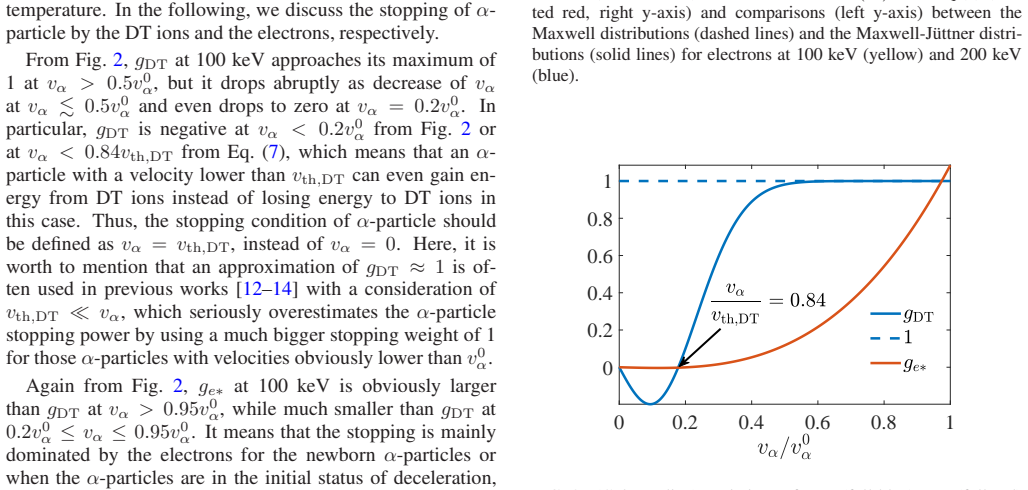
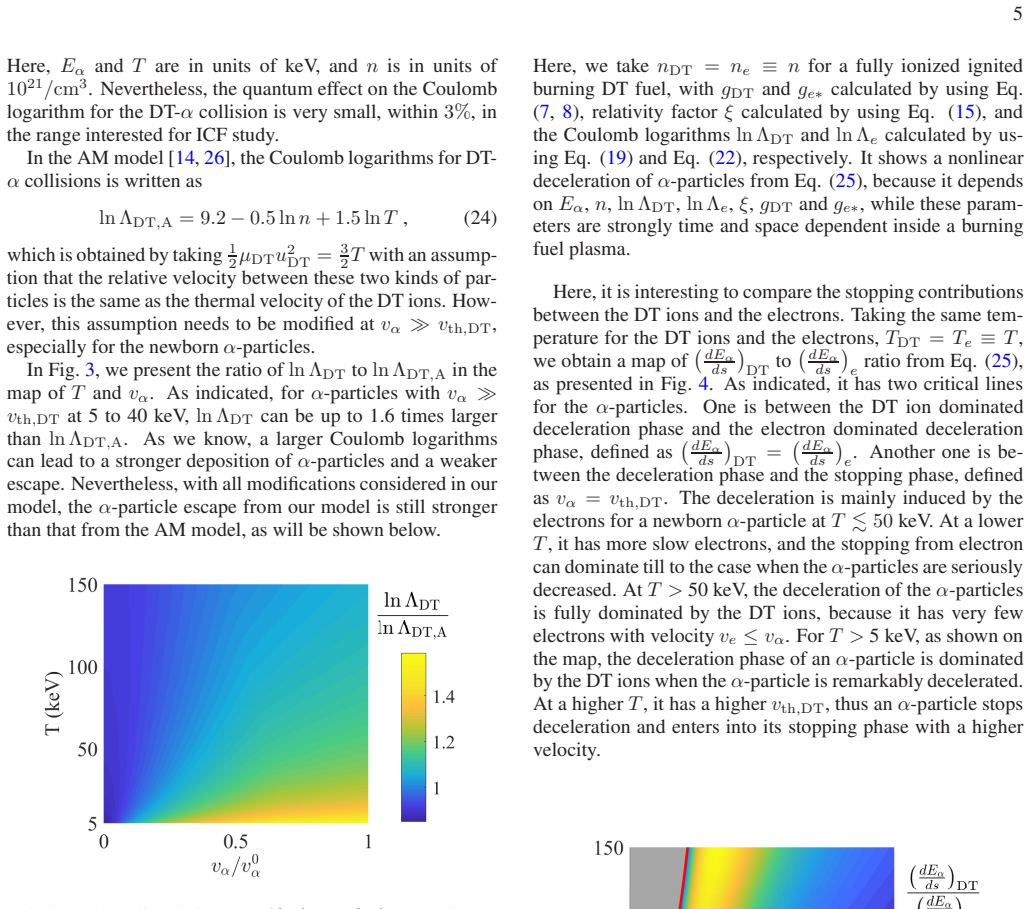
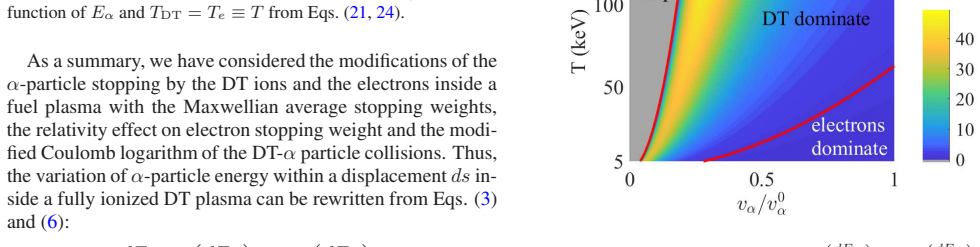
The carrying object is the modified stopping power assembled in Eq. (25), with three pieces. First, Maxwellian-averaged stopping weights $g_j(x)=\mathrm{erf}(x)-(1+m_j/m_\alpha)x\,\mathrm{d}\,\mathrm{erf}(x)/\mathrm{d}x$ replace the common approximation $g_{DT}\approx1$; this matters because below the ion thermal speed a slowed $\alpha$ particle can gain energy from DT ions. Second, the relativity factor $\xi=8/(8+15\gamma)$, derived from the Maxwell-Jüttner electron distribution, reduces the electron stopping weight at high temperature, by about 27% at 100 keV. Third, a Coulomb logarithm for DT-$\alpha$ collisions based on the Maxwell-averaged relative velocity, with a classical-versus-quantum critical energy, can exceed the AM value by a factor of 1.6. These ingredients feed the geometric integral Eq. (28), and the outcome is compressed into the fitted escape factor Eq. (32).
What would settle it
Numerically integrate Eq. (11) directly from the stated Maxwell-Jüttner distribution at $T_e=100$ keV without the small-$\gamma$ series and compare $\xi$ with Eq. (15)'s value of 0.73; a mismatch would require refitting Eq. (32). A second check is a Monte Carlo $\alpha$-transport run using Eq. (25) as the stopping model, comparing $\eta_E$ from Eq. (28) with Eq. (32) across $T=1$--150 keV and $\rho R=0.04$--3 g/cm$^2$.
Extended reading notes
Core claim
The central claim is that with the modified stopping treatment, the $\alpha$-particle escape factor $\eta_E$ of a DT fuel is noticeably stronger than the AM model's $\eta_A$ and than the ZH model's fitted escape factor above 10 keV. The paper constructs the stopping power from Maxwellian-averaged weights $g_{DT}$ and $g_e$, multiplies electron stopping by the relativity factor $\xi=8/(8+15\gamma)$, and uses Coulomb logarithms $\ln\Lambda_{DT}$ and $\ln\Lambda_e$ that include the relative-velocity and quantum corrections. Integrating Eq. (28) over isotropic straight-line trajectories gives $\eta_E$, and Eq. (32) fits the result over $T=1$--150 keV and $\rho R=0.04$--3 g/cm$^2$ to within $\pm0.02$. Applied to a hot-spot model, these escape factors give lower temperature, pressure, and fusion gain than the AM model, and a near-ignition case that ignites with the AM factor fails with Eq. (32).
Load-bearing premise
The fitted escape formula inherits a specific relativity correction for the electron speed distribution; if that correction is slightly wrong, the numbers in Eq. (32) change, even though the overall conclusion of stronger escape probably remains.
Editorial extensions
If this is right
- Self-heating is weaker than AM-model estimates because a larger share of the 3.5 MeV alpha energy leaves the fuel.
- Ignition margins shrink: the paper's example hot spot gives fusion gain about 1.2 with the AM escape factor and about 0.6 with Eq. (32).
- The ZH escape-factor expression is a good comparison only below about 10 keV; above that it deviates from the modified model.
- For fuels hotter than about 64 keV, alpha escape can increase gain by cooling and compressing the fuel into a higher-reactivity state.
Reading between the lines
- A reader recomputing $\xi$ by numerical integration of Eq. (11) can check whether Eq. (15) is exact within its stated range; if not, the fitted coefficients in Eq. (32) would need recalibration, though the direction of the effect would survive.
- The stopping model can be embedded in radiation-hydrodynamics or kinetic alpha-transport codes for non-uniform, time-dependent hot spots, replacing the uniform-fuel fit; the paper notes Eq. (28) is the integration route for that use.
- The high-temperature result that escape can raise gain suggests partially escaping alphas could act as a temperature regulator in vigorous burns, a design consequence the paper does not explore.
Signed reviews
Editorial analysis
A structured set of objections, weighed in public.
Referee Report
Summary. The paper develops a modified model for the escape of 3.54 MeV alpha particles from a uniform, spherical DT fuel, incorporating Maxwellian-averaged stopping weights for both DT ions and electrons, a relativistic correction to the electron distribution, and updated Coulomb logarithms for DT-alpha collisions. The authors integrate the stopping-power equation along straight-line trajectories to compute an escape factor and compare it with the Krokhin-Rozanov/AM and Zylstra-Hurricane models. They find that their model gives systematically larger escape fractions, propose a fitted expression (Eq. 32) claimed to be accurate to within ±0.02 over T = 1-150 keV and ρR = 0.04-3 g/cm^2, and illustrate the consequences for hot-spot dynamics and fusion gain, including a case where ignition fails under the new escape factor but would occur with the AM model.
Significance. If the central claims are correct, the paper provides a useful correction to alpha-particle self-heating estimates in ICF, with direct implications for ignition thresholds and target design. The model is based on first-principles Coulomb collision theory rather than an ad hoc fit, and the comparison with established AM and ZH models is a valuable service to the community. The fitted escape-factor expression, if properly validated, would be a convenient engineering formula. However, the paper currently contains unverified display equations and an unsupported accuracy claim, so the quantitative conclusions cannot yet be taken at face value.
major comments (4)
- [Section II, Eq. (10)] The Maxwell-Jüttner speed distribution as printed is not correctly normalized. The standard form is f_J(v_e) = v_e^2 λ^5 / (γ c^3 K_2(1/γ)) exp(-λ/γ), where λ = (1 - v_e^2/c^2)^(-1/2); the printed version has λ^5 in the denominator instead of the numerator. This is a genuine error in a displayed physical distribution. Because the derivation of Eq. (14) uses only the v_e → 0 limit, Eq. (15) is not invalidated by this typo alone, but the manuscript should correct Eq. (10) and should not invite evaluation of Eq. (11) with the printed form.
- [Section II, Eqs. (26)-(27)] The prefactors in Eqs. (26) and (27) appear inconsistent with Eq. (6). With q_α = 2e and q_j = ±e, Eq. (6) contains q_α^2 q_j^2 = 4e^4, but Eqs. (26)-(27) display only e^4. If the numerical calculation used the displayed prefactor, the stopping power is underestimated by a factor of four, which would strongly alter the escape factors and the fitted expression Eq. (32). If this is only a typographical omission in the displayed equations, it must be corrected; otherwise the manuscript should explain the apparent discrepancy.
- [Section III, Eq. (32)] The claimed ±0.02 accuracy of the fitted expression is not supported by any residual analysis. Figure 6 shows only three areal densities and temperatures up to 100 keV, while the fit is claimed valid up to 150 keV and down to 0.04 g/cm^2. The manuscript should provide a residual map or an error table comparing Eq. (32) with the direct integration of Eq. (28) over the full claimed parameter range.
- [Section II, Eqs. (11)-(15)] The step from the full-integral definition of ξ in Eq. (11) to the low-velocity expansion in Eqs. (14)-(15) assumes that the v_e > v_α branch of h_e can be neglected. The text asserts that the stopping is dominated by slow electrons, but it does not quantify the error from dropping the acceleration branch. Because the Jüttner high-velocity tail differs from the Maxwell tail, the manuscript should include a quantitative estimate showing that this approximation changes ξ by a negligible amount relative to the claimed ±0.02 escape-factor accuracy.
minor comments (5)
- [Section IV heading] The section heading "ECAPE-EFFECT" contains a typo and should read "ESCAPE-EFFECT."
- [Section IV, text after Fig. 7] The phrase "/greaterorsimilar64 keV" is a leftover LaTeX command and should be replaced by the proper symbol or word.
- [Section II, Eq. (20)] The critical energy E_c is introduced as a fitted expression, but no fitting data, error estimates, or derivation are given; the authors should specify the basis for this fit.
- [Fig. 1 caption] The caption should state explicitly whether the plotted Maxwell-Jüttner curves use the normalized distribution or the erroneous printed form of Eq. (10), since the visual comparison should be based on the correct distribution.
- [Section V, summary] The summary states a 28% decrease at 100 keV, while Eq. (15) gives 1 - 8/(8 + 15×0.196) ≈ 0.273; the numbers should be made consistent.
Circularity Check
No significant circularity: the escape factor is computed from an independent Coulomb-stopping model, and the fitted expression Eq. (32) is an interpolation of the authors' own numerical results, not a constructional reuse of the target comparisons.
full rationale
The derivation chain is self-contained. The alpha escape factor follows from the two-body Coulomb collision stopping model in Eq. (4), the Maxwellian and Maxwell-Juttner distribution weightings in Sec. II, and the geometric escape integral Eq. (28). No target quantity is reused as an input. Equation (32) is a parameterization of the authors' own numerical solutions of Eq. (28), not a fit to an external benchmark or to the AM/ZH escape factors being compared, so it is interpolation of a computed result rather than a predicted quantity forced by construction. The comparison with AM and ZH models uses published external models, and the few self-citations in the introduction concern ICF implosion context rather than the stopping or escape derivation. The only notable issue visible in the text is a possible normalization typo in the printed Maxwell-Juttner distribution, Eq. (10), where the printed v^2/(gamma c^3 K2 lambda^5) differs from the standard v^2 lambda^5/(gamma c^3 K2) form; however, this affects numerical accuracy of the relativity correction, not the logical dependence of the derivation on its inputs, and does not make any result equivalent to its inputs by construction. No step in the paper reduces to a self-citation or to a fitted input renamed as a prediction.
Assumptions & free parameters
free parameters (2)
- Critical energy Ec(T) =
(1663 - 6.9T)/(1+0.001T) keV
- Escape factor fit coefficients =
0.00593, 1.174, 1.556, 0.00385, 0.600, 1.316, 0.00547, 1.180, 1.574
assumptions (5)
- domain assumption Classical two-body Coulomb collision model with Debye shielding truncation
- domain assumption Fuel is a fully ionized, pure equimolar DT plasma with Te = TDT and spatially uniform density and temperature for the escape factor calculation
- domain assumption Alpha particles travel in straight lines and do not change direction during slowing
- domain assumption Electron velocity distribution is Maxwell-Juttner with the form in Eq. (10)
- domain assumption Stopping condition is vα = vth,DT, implemented as Eα ≤ TDT in Eq. (29)
Cite this review
Pith. "Pith review of Escape of \alpha-particle in inertial confinement fusion." pith.science (2026). https://pith.science/paper/VWKOSGJM
@misc{pith2026190807130,
  author       = {Pith},
  title        = {Pith review of: Escape of \alpha-particle in inertial confinement fusion},
  year         = {2026},
  howpublished = {\url{https://pith.science/paper/VWKOSGJM}},
  note         = {Machine review of arXiv:1908.07130}
}
abstract
Escape of $\alpha$-particles from a burning or an ignited burning deuterium-tritium (DT) fuel with temperature up to more than tens keV is very important in inertial confinement fusion, which can significantly influence not only the hot spot dynamics and the energy gain but also the shielding design in fusion devices. In this paper, we study the $\alpha $-particle escape from a burning or an ignited burning DT fuel by considering the modifications including the $\alpha $-particle stopping by both DT ions and electrons with their Maxwellian average stopping weights, the relativity effect on electron distribution, and the modified Coulomb logarithm of the DT-$\alpha $ particle collisions. As a result of our studies, the escape-effect from our modified model is obviously stronger than those from the traditional models. A fitted expression is presented to calculate the escape factor in a DT fuel, which can be applied to a burning fuel with temperatures of 1 to 150 keV and areal densities of 0.04 to 3 g/cm$^2$ with an accuracy within $\pm0.02$. Finally, we discuss the $\alpha $-particle escape-effect on the hot-spot dynamics and the thermonuclear energy gain by comparing the results with escape factors from different models.
Figures

Figures from the paper (4 more)


Reference graph
Works this paper leans on
-
[1]
to calculate the α -particle escape factor in AM model, which involves the α -particle stopping induced only by electrons. Thus, it needs a consistent expre s- sion for the α -particle escape factor, which considers the stop- ping contributions not only from electrons but also from the DT ions. In addition, the Coulomb logarithms for the DT- α collisions ...
-
[2]
2v0 α ≤ vα ≤ 0. 95v0 α . It means that the stopping is mainly dominated by the electrons for the newborn α -particles or when the α -particles are in the initial status of deceleration, while dominated by the DT ions after the α -particle is sig- nificantly decelerated. Thus, calculation of ge is especially important for a newborn α -particle. In addition,...
-
[3]
J. D. Lindl, R. L. McCrory, and E. M. Campbell, Phys. Today 45, 32 (1992)
work page 1992
-
[4]
E. Campbell, V . Goncharov, T. Sangster, S. Regan, P . Radh a, R. Betti, J. Myatt, D. Froula, M. Rosenberg, I. Igumenshchev , W. Seka, A. Solodov, A. Maximov, J. Marozas, T. Collins, D. Turnbull, F. Marshall, A. Shvydky, J. Knauer, R. McCrory, A. Sefkow, M. Hohenberger, P . Michel, T. Chapman, L. Masse, C. Goyon, S. Ross, J. Bates, M. Karasik, J. Oh, J. W...
work page 2017
-
[5]
The gain of the hot-spot can be defined as GH = (∆ N 4 Efus ) / (3 2 T0N0 )
13) , (36) where ⟨σv ⟩ is in unit of m3/ s and T is in unit of keV . The gain of the hot-spot can be defined as GH = (∆ N 4 Efus ) / (3 2 T0N0 ) . (37) Here, T0 and N0 are temperature and particle number of the hot spot at its stagnation phase, respectively, ∆ N = N0 − N is the particle number difference of the hot spot during its e x- pansion phase. On th...
-
[6]
K. Lan, J. Liu, D. Lai, W. Zheng, and X.-T. He, Phys. Plasmas 21, 010704 (2014) ; K. Lan, X.-T. He, J. Liu, W. Zheng, and D. Lai, Phys. Plasmas 21, 052704 (2014); K. Lan and W. Zheng, Phys. Plasmas 21, 090704 (2014)
work page 2014
-
[7]
Nuckolls, L
J. Nuckolls, L. Wood, A. Thiessen, and G. Zimmerman, Nature 239, 139 (1972)
1972
-
[8]
K. A. Brueckner and S. Jorna, Rev. Mod. Phys. 46, 325 (1974)
work page 1974
Show all 33 references
-
[9]
W. M. Manheimer, D. G. Colombant, and J. H. Gardner, Phys. Fluids 25, 1644 (1982)
1982
-
[10]
Murakami and K
M. Murakami and K. Nishihara, Jpn. J. App. Phys. 26, 1132 (1987)
1987
-
[11]
S. W. Haan, J. D. Lindl, D. A. Callahan, D. S. Clark, J. D. Salmonson, B. A. Hammel, L. J. Atherton, R. C. Cook, M. J. Edwards, S. Glenzer, A. V . Hamza, S. P . Hatchett, M. C. Her- rmann, D. E. Hinkel, D. D. Ho, H. Huang, O. S. Jones, J. Kline, G. Kyrala, O. L. Landen, B. J. ...
2011
-
[12]
O. N. Krokhin and V . B. Rozanov, Sov. J. Quantum Electron. 2, 393 (1973)
1973
-
[13]
K. Lan, J. Liu, Z. Li, X. Xie, W. Huo, Y . Chen, G. Ren, C. Zheng, D. Yang, S. Li, Z. Yang, L. Guo, S. Li, M. Zhang, X. Han, C. Zhai, L. Hou, Y . Li, K. Deng, Z. Y uan, X. Zhan, F. Wang, G. Y uan, H. Zhang, B. Jiang, L. Huang, W. Zhang, K. Du, R. Zhao, P . Li, W. Wang, J. Su, ...
2016
-
[14]
W. Y . Huo, Z. Li, Y .-H. Chen, X. Xie, G. Ren, H. Cao, S. Li, K. Lan, J. Liu, Y . Li, S. Li, L. Guo, Y . Liu, D. Yang, X. Jiang, L. Hou, H. Du, X. Peng, T. Xu, C. Li, X. Zhan, Z. Wang, K. Deng, Q. Wang, B. Deng, F. Wang, J. Yang, S. Liu, S. Jiang, G. Y uan, H. Zhang, B. Jiang...
2018
-
[15]
A. B. Zylstra and O. A. Hurricane, Phys. Plasmas 26, 062701 (2019)
2019
-
[16]
Ribeyre, V
X. Ribeyre, V . T. Tikhonchuk, J. Breil, M. Lafon, and E. L . Bel, Phys. Plasmas 18, 102702 (2011)
2011
-
[17]
J. D. Lindl, Inertial Confinement Fusion (Springer-V erlag,
-
[18]
O. A. Hurricane, D. A. Callahan, D. T. Casey, P . M. Cellie rs, C. Cerjan, E. L. Dewald, T. R. Dittrich, T. D¨ oppner, D. E. Hinkel, L. F. B. Hopkins, J. L. Kline, S. L. Pape, T. Ma, A. G. MacPhee, J. L. Milovich, A. Pak, H.-S. Park, P . K. Patel, B. A. Remington, J. D. Salmon...
2014
-
[19]
G. S. Fraley, E. J. Linnebur, R. J. Mason, and R. L. Morse, Phys. Fluids 17, 474 (1974)
1974
-
[20]
Atzeni and J
S. Atzeni and J. Meyer-ter V ehn, The Physics of Inertial Fusion (Oxford University Press, 2004)
2004
-
[21]
Huang, K
C.-K. Huang, K. Molvig, B. J. Albright, E. S. Dodd, E. L. V old, G. Kagan, and N. M. Hoffman, Phys. Plasmas 24, 022704 (2017)
2017
-
[22]
Cheng, T
B. Cheng, T. J. T. Kwan, S. A. Yi, O. L. Landen, Y . M. Wang, C. J. Cerjan, S. H. Batha, and F. J. Wysocki, Phys. Rev. E 98 (2018)
2018
-
[23]
H.-S. Park, O. Hurricane, D. Callahan, D. Casey, E. Dewa ld, T. Dittrich, T. D¨ oppner, D. Hinkel, L. B. Hopkins, S. L. Pape , T. Ma, P . Patel, B. Remington, H. Robey, J. Salmonson, and J. Kline, Phys. Rev. Lett. 112 (2014)
2014
-
[24]
J¨ uttner,Ann
F. J¨ uttner,Ann. Phys. 339, 856 (1911)
1911
-
[25]
Cheng, T
B. Cheng, T. J. T. Kwan, Y . M. Wang, F. E. Merrill, C. J. Cerjan, and S. H. Batha, Phys. Plasmas 22, 082704 (2015)
2015
-
[26]
O. A. Hurricane, D. A. Callahan, D. T. Casey, E. L. Dewald , T. R. Dittrich, T. D¨ oppner, S. Haan, D. E. Hinkel, L. F. B. Hopkins, O. Jones, A. L. Kritcher, S. L. Pape, T. Ma, A. G. MacPhee, J. L. Milovich, J. Moody, A. Pak, H.-S. Park, P . K. Patel, J. E. Ralph, H. F. Robey,...
2016
-
[27]
L. M. Hively, Nucl. Technol./Fusion 3, 199 (1983). [28] J. Lindl, Phys. Plasmas 2, 3933 (1995)
1983
-
[29]
T. J. M. Boyd and J. J. Sanderson, The Physics of Plasmas (Cambridge University Press, 2003) p. 8
2003
-
[31]
Abramowitz and I
M. Abramowitz and I. A. Stegun, eds., Handbook of Mathe- matical Functions with F ormulas, Graphs, and Mathematical Tables , V ol. 56 (United States Department Of Commerce, 1972) p. 375
1972
-
[32]
with consistent geometric treatment, to calcu- late ηE, which can be applied to the burning plasmas of 1 to 150 keV and 0.04 to 3 g/cm 2 with an accuracy within ± 0.02. This expression can be used to estimate the α -particle escape for a DT fuel with a uniform density and a un...
-
[33]
Wesson, Tokamaks (Oxford University Press, 2004)
J. Wesson, Tokamaks (Oxford University Press, 2004). 10
2004
-
[34]
describes the number change of the DT ions and elec- trons during the nuclear reaction, where we simply consider four particles are consumed in one reaction, including two DT ions burned and two electrons lost for electric neutralit y. Eq. (
-
[35]
The reactivity of DT ⟨σv ⟩ is [ 27] ⟨σv ⟩ = 9
describes the expansion dynamics of the burning hot- spot like that an ideal gas pushes a spherical piston outward with an acceleration of 3N T /m sR, where ms is the effective mass of the piston. The reactivity of DT ⟨σv ⟩ is [ 27] ⟨σv ⟩ = 9. 1 × 10⁻²² exp ( −0. 572 ⏐ ⏐ ⏐ ⏐ln T
Reviewed August 14, 2026 · model on record in the stance chip above.
Discussion (0). Continue with ORCID to comment.