REVIEW 5 major objections 5 minor 1 cited by
A three-dimensional, multi-wavelength view and time-dependent analysis of the Milky Way's local ionized gas
T0 review · 5 major / 5 minor · reviewed 2026-08-15 · deepseek-v4-flash
Pith's one-line read The paper claims that the solar neighborhood's star formation rate is about 370 solar masses per Myr per kpc², roughly four times lower than previously required to sustain the diffuse ionized gas layer, implying the region is quiescent or…
desk verdict The synthetic metal-line skies are a real step forward, but the headline SFR comparison ignores the escape-fraction change and therefore does not support the quiescent/bursty conclusion. read the letter →
The pith
A machine-rendered reading of the paper's core claim, the machinery that carries it, and where it could break.
The reading
What carries the argument
The load-bearing machinery is a three-way comparison of radiative-transfer models. The observational model uses the Monte Carlo photoionization code CMacIonize on a $1024^3$ grid derived from a 3D dust map, with 87 O stars and one Wolf-Rayet star as ionizing sources; the photoionization-only model repeats that calculation on the density field of a radiation-hydrodynamics simulation; and the time dependent model preserves the non-equilibrium ionization and supernova-driven thermal structure from the same simulation. The star formation rate enters as the normalization of the Kennicutt-Schmidt relation in the radiation-hydrodynamics runs, and the tuning criterion is agreement between the photoionization-only snapshots and the observational model. A second mechanism is a photon-packet counter that records where each source's Lyman continuum photons are absorbed, defining each star's ionized volume and making quantitative the contrast between ionization-bounded and leaky environments.
What would settle it
A complete census of O stars within 1.25 kpc using precise parallaxes, together with an independent calibration of dust-to-gas conversion, would settle the claim: if the total ionizing luminosity differs from the $8.9\times 10^{49}\,\mathrm{s}^{-1}$ used here by more than a factor of two, the 370 value is not the right match; likewise, all-sky [O III]/H$\beta$ maps from future surveys that show extended high-altitude [O III] at the level predicted only by the 740 or 1480 runs would rule out a quiescent local ISM.
Extended reading notes
Core claim
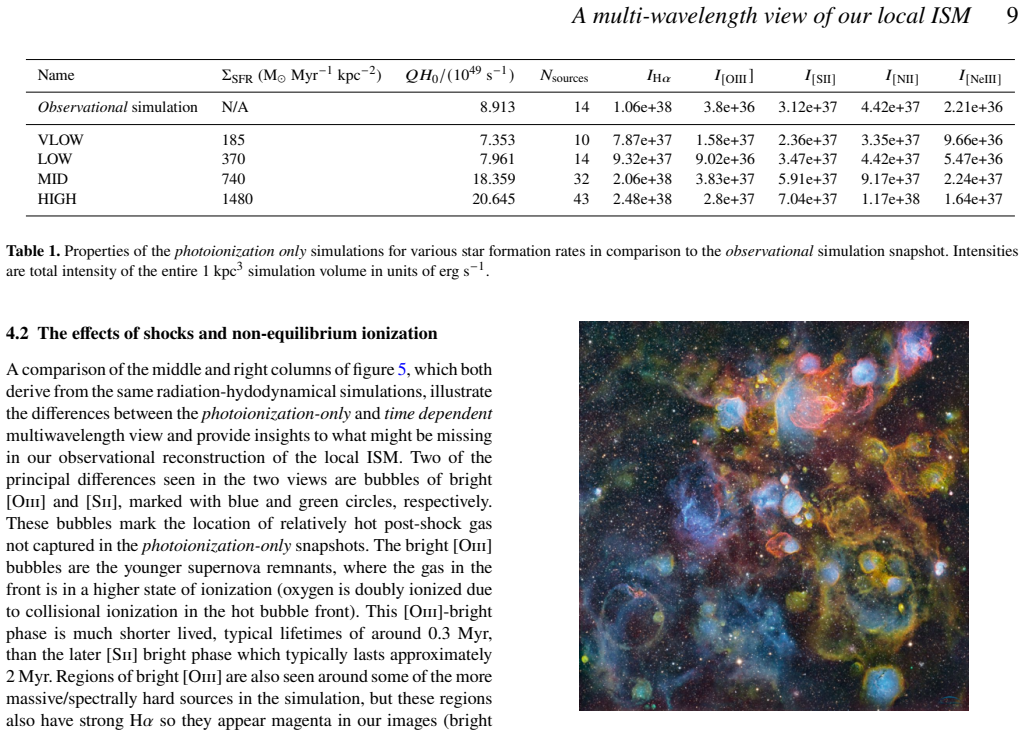
The central claim is that matching the observed structure of the local warm ionized gas requires a star formation rate of $370\,\mathrm{M}_\odot\,\mathrm{Myr}^{-1}\,\mathrm{kpc}^{-2}$, not the $1200\,\mathrm{M}_\odot\,\mathrm{Myr}^{-1}\,\mathrm{kpc}^{-2}$ that earlier tall-box simulations needed to support a kiloparsec-scale diffuse ionized layer. The argument rests on a three-way model comparison: a static 'observational' model built from a 3D dust map and 87 O stars plus one Wolf-Rayet star; a 'photoionization-only' model that re-solves ionization equilibrium on the density field of a radiation-hydrodynamics simulation; and a 'time dependent' model that keeps the non-equilibrium temperatures and ionizations with supernova feedback. At the low star formation rate of 370, the photoionization-only run matches the observational model in ionizing luminosity, number of sources, and H$\alpha$, [S II], and [N II] intensities, while higher rates disrupt the neutral structure and overproduce [O III]. The paper also claims that the diffuse ionized gas is produced by a small number of very luminous O stars in low-density, leaky environments, with $\zeta$ Puppis ionizing 827 times the volume of the Bajamar star despite nearly equal ionizing luminosities.
Load-bearing premise
The argument assumes the observational model is faithful to the real local ISM: gas densities from the 3D dust map and the catalog of 87 O stars plus one Wolf-Rayet star with adopted ionizing luminosities are taken as complete and accurate; if either is wrong, the star formation rate that best matches the data would shift.
Editorial extensions
If this is right
- If 370 is the true local rate, the interstellar medium near the Sun is not in steady state: the high-altitude diffuse ionized gas may be a recombining fossil of an earlier star-forming burst, since recombination times in $0.01\,\mathrm{cm}^{-3}$ gas are roughly 10 Myr.
- The predicted all-sky [S II], [N II], and [O III] maps become direct targets for wide-field optical emission line surveys; regions with elevated [S II]/H$\alpha$ or [O III]/H$\beta$ should mark supernova-driven, non-equilibrium gas.
- Because H$\alpha$ emissivity falls with temperature, time-dependent and shock-heated gas barely changes the predicted H$\alpha$ sky, validating earlier equilibrium H$\alpha$ models; the metal lines are where time dependence shows up.
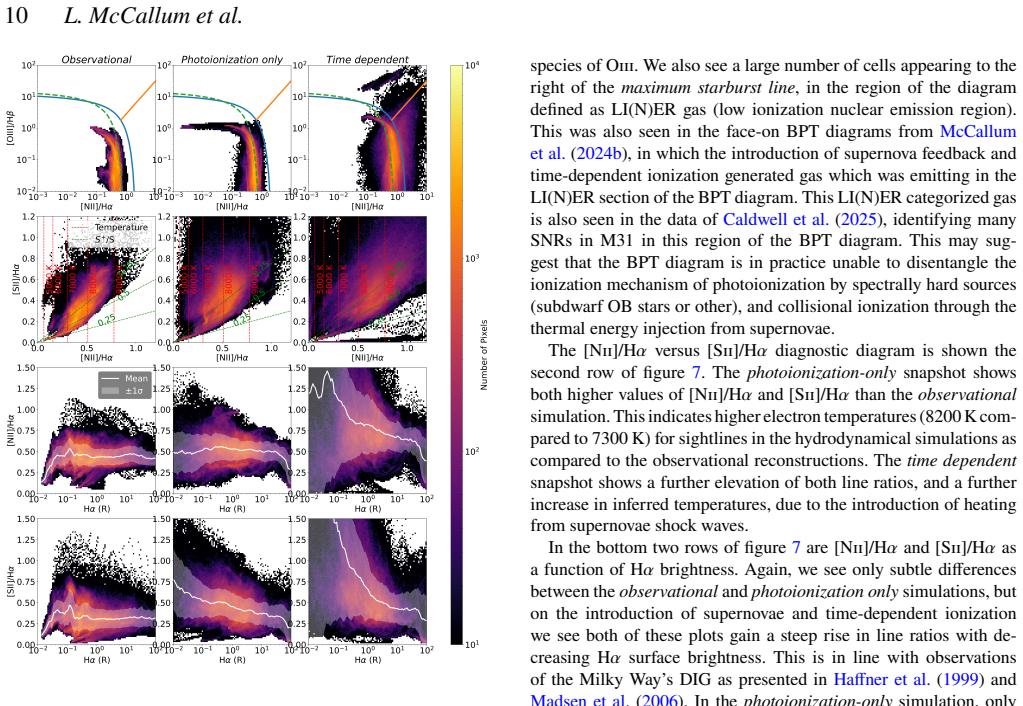
- Supernova-heated, non-equilibrium gas can place pixels in the LI(N)ER region of BPT diagrams without any evolved stellar population or active nucleus, so LI(N)ER classifications should not be read as unambiguous AGN signatures.
- The diffuse ionized gas is best described as the product of a few luminous O stars in porous, low-density regions; star-count interpretations of DIG must be weighted by environment, not just by the number of ionizing photons.
Reading between the lines
- If the current rate is as low as 370 while high-altitude DIG still shines, the layer is a fossil ionization structure: in $10^{-2}\,\mathrm{cm}^{-3}$ gas the recombination time exceeds the recent decline time of star formation, so high-latitude H$\alpha$ should show brightness asymmetries tracking the old burst location rather than the current O-star distribution.
- The 827-fold ratio in ionized volume for nearly equal luminosities implies that a star's DIG contribution is set by the porosity of its surroundings, not by $Q_H$; a direct test would measure individual O stars' Lyman continuum escape fractions from their birth clouds and compare them with the simulated zones of influence.
- Because the paper tunes a constant star formation rate, an imposed, observationally motivated star formation history (a burst peaking roughly 45 Myr ago and declining) could reconcile the 370 value with the 1200 value needed for a kiloparsec-scale DIG layer, if the resulting layer preserves its vertical structure during decline.
Signed reviews
Editorial analysis
A structured set of objections, weighed in public.
Referee Report
Summary. This paper extends the authors' program of modeling the local photoionized interstellar medium by adding collisionally excited optical and infrared line predictions to a static, dust-map-constrained photoionization model, and by comparing it with a suite of radiation-hydrodynamics simulations that include time-dependent metal ionization and supernova feedback. The headline result is an estimate of the very local (1 kpc^2) star formation rate of 370 M_sun Myr^-1 kpc^-2, claimed to be a factor of four lower than the 1200 M_sun Myr^-1 kpc^-2 previously required to support a kiloparsec-scale diffuse ionized gas layer, which the authors interpret as possible evidence for a bursty, currently quiescent solar neighborhood. The paper also presents diagnostics from the static model, a comparison of photoionization-only and time-dependent simulations, and a study of how O-star environments control the volume of ionized gas.
Significance. If the SFR estimate and the comparison to the earlier value were robust, the paper would provide an interesting constraint on recent star formation in the solar neighborhood and a useful set of all-sky predictions for upcoming emission-line surveys. The multi-wavelength cubes made available via Zenodo are a valuable community resource, and the inclusion of non-equilibrium metal ionization in the radiation-hydrodynamics suite goes beyond much previous local ISM modeling. The time-dependent simulations also give concrete, falsifiable predictions for SNR emission-line lifetimes and the [OIII]-to-[SII] bright-phase ratio. However, the headline quantitative claims rest on a like-for-like comparison that is not currently valid, and on a qualitative, parameter-tuned matching procedure without uncertainties.
major comments (5)
- [§2.2, §5, and Abstract] The headline comparison between the new best-matching SFR of 370 M_sun Myr^-1 kpc^-2 and the previous 1200 value is not like-for-like. Section 2.2 states that the molecular-cloud ionizing photon escape fraction was changed from 0.1 in McCallum et al. (2024a) to 1.0 for all simulations in this paper, but Section 5 and the Abstract compare the two SFR values directly without rescaling. Since the escaping ionizing luminosity scales as f_esc times the SFR, the old 1200 run at f_esc=0.1 injects the same ionizing photon rate as a f_esc=1 run with SFR=120, whereas the new 370 run at f_esc=1 corresponds to an old-style (f_esc=0.1) SFR of 3700. Under a common escape fraction, the new constraint is therefore about a factor of three higher than the old value, not a factor of four lower. The claimed quiescent/bursty interpretation in the Abstract and Section 5 rests on this incommensurable comparison; the authors should rerun one of the two setups with matched f_esc or rescale the comparison before drawing that conclusion.
- [§4.1 and Table 1] The selection of 370 M_sun Myr^-1 kpc^-2 as the best-matching SFR is made by qualitative visual comparison of morphology, with no quantitative goodness-of-fit statistic. Table 1 shows that the LOW run matches the observational model in Q_H0, N_sources, Halpha, [SII], and [NII] reasonably well, but overproduces [OIII] and [NeIII] by factors of about 2.4 and 2.5 (9.02e36 vs 3.8e36 and 5.47e36 vs 2.21e36 erg/s), while the VLOW run underpredicts Halpha, [SII], and [NII] by similar factors. With only four grid points (185, 370, 740, 1480) and no uncertainty estimate, the claim that 370 is 'the best match' is not robust; a formal metric over the line-intensity or morphology maps, and a sensitivity test around 370, are needed to support the headline number.
- [§5] The paper openly states that the Kennicutt-Schmidt normalization was tuned to match the structure of the local Milky Way, so the 370 value is a fitted parameter rather than an independent ab initio prediction. The abstract's phrasing 'we use the simulations to estimate ... finding a rate of 370' obscures this circularity: the observational model defines the target, and the simulation normalization is adjusted until the simulation resembles it. The authors should reframe the result as a calibrated SFR, provide an uncertainty for the fit, and avoid implying that the agreement provides independent confirmation. The comparison to the previous 1200 value is also affected because that value was set for a different purpose (reproducing a kpc-scale DIG layer) and with different physics (f_esc=0.1).
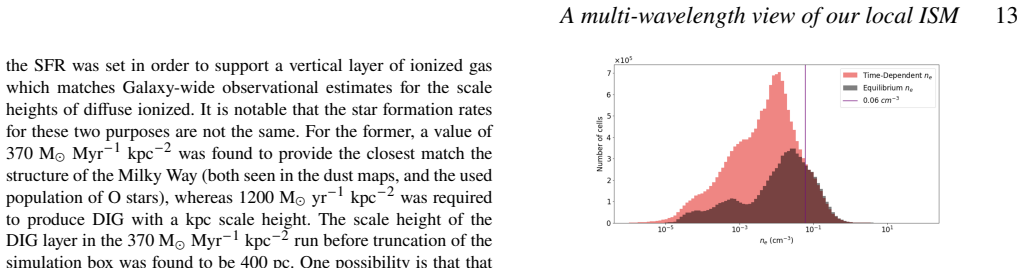
- [§5] The claim that the LOW run produces a DIG scale height of 400 pc before truncation is stated without supporting evidence or a measurement method. This value is used to motivate the quiescent/relaxing interpretation, but no vertical profile, fit, or uncertainty is given. Please show the vertical Halpha or emission-measure profile and the fitting procedure used to obtain the 400 pc scale height.
- [§2.1] The SFR estimate is anchored to the observational model, which depends on the Edenhofer et al. (2024) dust map converted to gas density with Zucker et al. (2021) and O'Neill et al. (2024), and on the completeness of the 87 O-star census and the Martins et al. (2005) luminosities. The paper does not assess how uncertainties in these inputs shift the best-matching SFR; a test varying, for example, the O-star list or the dust-to-gas conversion by plausible factors would establish whether the factor-of-four conclusion survives. This is load-bearing because the simulated SFR is tuned to match this target.
minor comments (5)
- [Caption of Figure 4] The phrase 'as decribed by Baldwin et al. (1981)' contains a typo: 'decribed' should be 'described'.
- [Captions of Figures 9, B1, B2] The possessive form 'it's lifetime' should be 'its lifetime' throughout these captions.
- [Table 1] The line-intensity columns would benefit from explicit units in the column headers rather than only in the caption, to avoid ambiguity when the table is read standalone.
- [Figure 3 caption] The symbol '5007AA' should be '5007 Å' for consistency with the rest of the text.
- [Appendix A, Eq. (A2)] The notation in the displayed equation for I_HeH appears corrupted ('h 𝑄 𝑁𝑉 i 𝑙𝑎'); please reformat it so that the Monte Carlo photon-count estimator is readable.
Circularity Check
The local SFR is a tuned Kennicutt-Schmidt normalization, and the factor-of-four comparison to 1200 ignores the change in escape fraction from 0.1 to 1.0, so the headline constraint is an artifact of input choices.
-
fitted input called prediction
[Section 2.2, Section 5, Section 6 (Conclusions), Table 1]
"In this work, the normalisation of the Kennicutt-Schmidt relation has been tuned in order to morphologically match the structure of the local Milky Way. ... In McCallum et al. (2024a) this factor was set to 0.1 to account for photon losses to unresolved maxima in the density structure. But in order to maintain consistency with the observational model derived from the 3D dust maps, we set this factor to one for all simulations. ..."
The SFR value 370 is the input normalization of the Kennicutt-Schmidt relation, chosen from a grid (185/370/740/1480) by matching the observational model; the paper expressly says it was 'tuned.' It is therefore a fitted parameter presented as a constraint, not an independent prediction. The factor-of-four comparison to 1200 is additionally not like-for-like: the paper changed the ionizing escape fraction f_esc from 0.1 to 1.0 but compares raw SFRs. Because the escaping ionizing luminosity scales as f_esc × SFR, the old 1200 at f_esc=0.1 corresponds to 120 at f_esc=1, and the new 370 at f_esc=1 corresponds to 3700 at f_esc=0.1. The quoted factor of four lower is therefore an artifact of the f_esc input change, not a physics result.
full rationale
One concrete circular/self-constructed step is present: the headline SFR is a tuned Kennicutt-Schmidt normalization, and the comparison that motivates the bursty/quiescent interpretation mixes different escape fractions without rescaling. This is the central claim, so the score is 6. The paper's other contributions are not circular: the synthetic [SII], [NII], and [OIII] skies and the O-star environment comparison are genuine outputs of the stated inputs, and no uniqueness theorem or ansatz is smuggled in via self-citation. The f_esc issue is an arithmetic/comparability flaw rather than a hidden equivalence, but because the central factor-of-four claim reduces to input parameter choices, the derivation chain is partially circular in the pattern-2 sense.
Assumptions & free parameters
free parameters (3)
- Kennicutt-Schmidt normalization (local SFR) =
370 M_sun Myr^-1 kpc^-2 (best of grid 185/370/740/1480)
- Molecular cloud ionizing photon escape fraction =
1.0 (chosen by hand; was 0.1 in previous work)
- Fixed metal abundances =
He 0.1, C 1.4e-4, N 7.5e-5, O 3.19e-4, Ne 1.17e-4, S 1.3e-5 by number relative to H
assumptions (6)
- domain assumption The Edenhofer et al. (2024) 3D dust map, converted to hydrogen density via Zucker et al. (2021) and O'Neill et al. (2024), faithfully represents the local ISM density field out to 1.25 kpc.
- domain assumption The catalog of 87 O stars and 1 Wolf-Rayet star within 1.25 kpc is complete, and their ionizing luminosities, effective temperatures, and spectra (Martins et al. 2005; WMBasic; Crowther 2007) are accurate.
- domain assumption The Kennicutt-Schmidt relation, with star formation depending on gas mass within 250 pc of the midplane, applies on 1 kpc scales in the solar neighborhood.
- domain assumption Photoionization equilibrium holds for the observational model and the photoionization-only models; time-dependent ionization and shock effects are absent from these.
- domain assumption Photon energies above 54 eV, X-ray photoionization from post-shock gas, magnetic fields, cosmic rays, rotational shear, and diffuse ionization from hot gas do not significantly affect the main conclusions.
- domain assumption The RHD simulations have reached states independent of the initial metal ionization conditions, and the chosen snapshot is representative of the quasi-steady state.
Cite this review
Pith. "Pith review of A three-dimensional, multi-wavelength view and time-dependent analysis of the Milky Way's local ionized gas." pith.science (2026). https://pith.science/paper/VWO6ERVX
@misc{pith2026250617689,
  author       = {Pith},
  title        = {Pith review of: A three-dimensional, multi-wavelength view and time-dependent analysis of the Milky Way's local ionized gas},
  year         = {2026},
  howpublished = {\url{https://pith.science/paper/VWO6ERVX}},
  note         = {Machine review of arXiv:2506.17689}
}
abstract
This work is the continuation of a series attempting to characterize the local warm ionized medium through both static and time dependent simulations. We build upon our three dimensional, observationally-derived simulation of the local photoionized interstellar medium - based on static photoionization simulations constrained by 3D dust maps - to include metals required to predict collisionally excited optical and infrared emission lines, providing the first all-sky prediction of a series of lines including [SII] 6716$\mathring{A}$, [NII] 6584$\mathring{A}$ and [OIII] 5007$\mathring{A}$. While these predictions only include O-star photoionization under ionization equilibrium, we also carry out a suite of radiation-hydrodynamics simulations including time-dependent metal ionization and the effects of supernova feedback to highlight missing features in our predicted skies. We use the simulations to estimate the very local (1 $\rm kpc^{2}$) Galactic star formation rate, finding a rate of 370 $\rm M_{\odot}~Myr^{-1}~kpc^{-2}$ provides the best match between the observationally-derived and ab-initio simulations. This is approximately a factor of four lower than previous estimates for the star formation rate required to support an observed layer of high-altitude diffuse ionized gas, possibly suggesting a `bursty' star formation history in the region surrounding the Sun. We also investigate the effects of O-star environments on their ability to ionize large volumes of diffuse ionized gas, and find it is likely ionized by a small number of luminous O-stars located in regions where the leakage of their Lyman continuum photons can produce the vast volumes of ionized gas observed in the midplane and at high galactic altitudes.
Figures


Figures from the paper (7 more)




Forward citations
Cited by 1 Pith paper
-
Cosmic-Ray Feedback from Supernovae in a Parker-Unstable Medium
Injecting 10% of supernova energy as cosmic rays in a Parker-unstable galactic disk drives a longer-lived outflow and lowers the cosmic-ray calorimetric fraction when the magnetic field is well resolved.
Reference graph
Works this paper leans on
-
[1]
Ali A., Harries T. J., Douglas T. A., 2018, @doi [ ] 10.1093/mnras/sty1001 , https://ui.adsabs.harvard.edu/abs/2018MNRAS.477.5422A 477, 5422
-
[2]
Alves J., et al., 2020, @doi [ ] 10.1038/s41586-019-1874-z , https://ui.adsabs.harvard.edu/abs/2020Natur.578..237A 578, 237
-
[3]
Anders F., et al., 2019, @doi [ ] 10.1051/0004-6361/201935765 , https://ui.adsabs.harvard.edu/abs/2019A&A...628A..94A 628, A94
-
[4]
Baldwin J. A., Phillips M. M., Terlevich R., 1981, @doi [ ] 10.1086/130766 , https://ui.adsabs.harvard.edu/abs/1981PASP...93....5B 93, 5
doi:10.1086/130766 1981
-
[5]
Bialy S., et al., 2021, @doi [ ] 10.3847/2041-8213/ac1f95 , https://ui.adsabs.harvard.edu/abs/2021ApJ...919L...5B 919, L5
-
[6]
Binder B. A., Povich M. S., 2018, @doi [ ] 10.3847/1538-4357/aad7b2 , https://ui.adsabs.harvard.edu/abs/2018ApJ...864..136B 864, 136
-
[7]
Blaauw A., 1964, @doi [ ] 10.1146/annurev.aa.02.090164.001241 , https://ui.adsabs.harvard.edu/abs/1964ARA&A...2..213B 2, 213
arXiv 1964
-
[8]
Brown A. G. A., Blaauw A., Hoogerwerf R., de Bruijne J. H. J., de Zeeuw P. T., 1999, in Lada C. J., Kylafis N. D., eds, NATO Advanced Study Institute (ASI) Series C Vol. 540, The Origin of Stars and Planetary Systems. p. 411 ( @eprint arXiv astro-ph/9902234 ), @doi 10.48550/arXiv.astro-ph/9902234
Show all 95 references
-
[9]
C., Long K
Caldwell N., Raymond J. C., Long K. S., Lee M. G., 2025, @doi [ ] 10.3847/1538-4357/adbf98 , https://ui.adsabs.harvard.edu/abs/2025ApJ...983..150C 983, 150
2025 doi
-
[10]
Q., et al., 2019a, @doi [ ] 10.1093/mnras/sty3341 , https://ui.adsabs.harvard.edu/abs/2019MNRAS.483.4277C 483, 4277
Chen B. Q., et al., 2019a, @doi [ ] 10.1093/mnras/sty3341 , https://ui.adsabs.harvard.edu/abs/2019MNRAS.483.4277C 483, 4277
-
[11]
Q., et al., 2019b, @doi [ ] 10.1093/mnras/stz1357 , https://ui.adsabs.harvard.edu/abs/2019MNRAS.487.1400C 487, 1400
Chen B. Q., et al., 2019b, @doi [ ] 10.1093/mnras/stz1357 , https://ui.adsabs.harvard.edu/abs/2019MNRAS.487.1400C 487, 1400
-
[12]
S., 2011, @doi [ ] 10.1088/0004-6256/142/6/197 , https://ui.adsabs.harvard.edu/abs/2011AJ....142..197C 142, 197
Chomiuk L., Povich M. S., 2011, @doi [ ] 10.1088/0004-6256/142/6/197 , https://ui.adsabs.harvard.edu/abs/2011AJ....142..197C 142, 197
2011 doi
-
[13]
P., Reynolds R
Cox D. P., Reynolds R. J., 1987, @doi [ ] 10.1146/annurev.aa.25.090187.001511 , https://ui.adsabs.harvard.edu/abs/1987ARA&A..25..303C 25, 303
1987
-
[14]
P., Smith B
Cox D. P., Smith B. W., 1974, @doi [ ] 10.1086/181476 , https://ui.adsabs.harvard.edu/abs/1974ApJ...189L.105C 189, L105
1974 doi
-
[15]
A., 2007, @doi [ ] 10.1146/annurev.astro.45.051806.110615 , https://ui.adsabs.harvard.edu/abs/2007ARA&A..45..177C 45, 177
Crowther P. A., 2007, @doi [ ] 10.1146/annurev.astro.45.051806.110615 , https://ui.adsabs.harvard.edu/abs/2007ARA&A..45..177C 45, 177
2007 arXiv
-
[16]
E., Bailer-Jones C
Dharmawardena T. E., Bailer-Jones C. A. L., Fouesneau M., Foreman-Mackey D., Coronica P., Colnaghi T., M \"u ller T., Wilson A. G., 2024, @doi [ ] 10.1093/mnras/stae1474 , https://ui.adsabs.harvard.edu/abs/2024MNRAS.532.3480D 532, 3480
2024 doi
-
[17]
K., Speagle J
Edenhofer G., Zucker C., Frank P., Saydjari A. K., Speagle J. S., Finkbeiner D., En lin T. A., 2024, @doi [ ] 10.1051/0004-6361/202347628 , https://ui.adsabs.harvard.edu/abs/2024A&A...685A..82E 685, A82
2024 doi
-
[18]
Elia D., et al., 2022, @doi [ ] 10.3847/1538-4357/aca27d , https://ui.adsabs.harvard.edu/abs/2022ApJ...941..162E 941, 162
2022 doi
-
[19]
J., Soler J
Elia D., Evans N. J., Soler J. D., Strafella F., Schisano E., Molinari S., Giannetti A., Patra S., 2025, @doi [ ] 10.3847/1538-4357/adaeb2 , https://ui.adsabs.harvard.edu/abs/2025ApJ...980..216E 980, 216
2025 doi
-
[20]
V., Mason B
Fabricius C., H g E., Makarov V. V., Mason B. D., Wycoff G. L., Urban S. E., 2002, @doi [ ] 10.1051/0004-6361:20011822 , https://ui.adsabs.harvard.edu/abs/2002A&A...384..180F 384, 180
2002 doi
-
[21]
M., et al., 2023, @doi [ ] 10.3847/1538-4357/acb5f4 , https://ui.adsabs.harvard.edu/abs/2023ApJ...947...66F 947, 66
Foley M. M., et al., 2023, @doi [ ] 10.3847/1538-4357/acb5f4 , https://ui.adsabs.harvard.edu/abs/2023ApJ...947...66F 947, 66
2023 doi
-
[22]
C., Redfield S., Slavin J
Frisch P. C., Redfield S., Slavin J. D., 2011, @doi [ ] 10.1146/annurev-astro-081710-102613 , https://ui.adsabs.harvard.edu/abs/2011ARA&A..49..237F 49, 237
2011 doi
-
[23]
Gagn \'e J., et al., 2018, @doi [ ] 10.3847/1538-4357/aaae09 , https://ui.adsabs.harvard.edu/abs/2018ApJ...856...23G 856, 23
2018 doi
-
[24]
Originally published in: 2021A&A...649A...1G; doi:10.5270/esa-1ug, @doi 10.26093/cds/vizier.1350
Gaia Collaboration 2020, VizieR Online Data Catalog: Gaia EDR3 (Gaia Collaboration, 2020) , VizieR On-line Data Catalog: I/350. Originally published in: 2021A&A...649A...1G; doi:10.5270/esa-1ug, @doi 10.26093/cds/vizier.1350
2020 doi
-
[25]
Gaia Collaboration et al., 2016, @doi [ ] 10.1051/0004-6361/201629272 , https://ui.adsabs.harvard.edu/abs/2016A&A...595A...1G 595, A1
2016 doi
- [26]
-
[27]
Gatto A., et al., 2015, @doi [ ] 10.1093/mnras/stv324 , https://ui.adsabs.harvard.edu/abs/2015MNRAS.449.1057G 449, 1057
2015 doi
-
[28]
M., et al., 2015, @doi [ ] 10.1088/0004-637X/810/1/25 , https://ui.adsabs.harvard.edu/abs/2015ApJ...810...25G 810, 25
Green G. M., et al., 2015, @doi [ ] 10.1088/0004-637X/810/1/25 , https://ui.adsabs.harvard.edu/abs/2015ApJ...810...25G 810, 25
2015 doi
-
[29]
M., Schlafly E., Zucker C., Speagle J
Green G. M., Schlafly E., Zucker C., Speagle J. S., Finkbeiner D., 2019, @doi [ ] 10.3847/1538-4357/ab5362 , https://ui.adsabs.harvard.edu/abs/2019ApJ...887...93G 887, 93
2019 doi
-
[30]
M., Reynolds R
Haffner L. M., Reynolds R. J., Tufte S. L., 1999, @doi [ ] 10.1086/307734 , https://ui.adsabs.harvard.edu/abs/1999ApJ...523..223H 523, 223
1999 doi
-
[31]
M., Reynolds R
Haffner L. M., Reynolds R. J., Tufte S. L., Madsen G. J., Jaehnig K. P., Percival J. W., 2003, @doi [ ] 10.1086/378850 , https://ui.adsabs.harvard.edu/abs/2003ApJS..149..405H 149, 405
2003 doi
-
[32]
Heiles C., 1998, @doi [ ] 10.1086/305574 , https://ui.adsabs.harvard.edu/abs/1998ApJ...498..689H 498, 689
1998 doi
-
[33]
A., Massey P., Strom S
Hillenbrand L. A., Massey P., Strom S. E., Merrill K. M., 1993, @doi [ ] 10.1086/116774 , https://ui.adsabs.harvard.edu/abs/1993AJ....106.1906H 106, 1906
1993 doi
-
[34]
G., 1994, @doi [ ] 10.1093/mnras/268.1.109 , https://ui.adsabs.harvard.edu/abs/1994MNRAS.268..109H 268, 109
Hummer D. G., 1994, @doi [ ] 10.1093/mnras/268.1.109 , https://ui.adsabs.harvard.edu/abs/1994MNRAS.268..109H 268, 109
1994 doi
-
[35]
G., Storey P
Hummer D. G., Storey P. J., 1998, @doi [ ] 10.1046/j.1365-8711.1998.2970041073.x , https://ui.adsabs.harvard.edu/abs/1998MNRAS.297.1073H 297, 1073
1998
-
[36]
L., Reffert S., 2023, @doi [ ] 10.1051/0004-6361/202346285 , https://ui.adsabs.harvard.edu/abs/2023A&A...673A.114H 673, A114
Hunt E. L., Reffert S., 2023, @doi [ ] 10.1051/0004-6361/202346285 , https://ui.adsabs.harvard.edu/abs/2023A&A...673A.114H 673, A114
2023 doi
-
[37]
H., Hernquist L., 1996, @doi [ ] 10.1086/192305 , https://ui.adsabs.harvard.edu/abs/1996ApJS..105...19K 105, 19
Katz N., Weinberg D. H., Hernquist L., 1996, @doi [ ] 10.1086/192305 , https://ui.adsabs.harvard.edu/abs/1996ApJS..105...19K 105, 19
1996 doi
-
[38]
C., Evans N
Kennicutt R. C., Evans N. J., 2012, @doi [ ] 10.1146/annurev-astro-081811-125610 , https://ui.adsabs.harvard.edu/abs/2012ARA&A..50..531K 50, 531
2012 doi
-
[39]
J., Dopita M
Kewley L. J., Dopita M. A., Sutherland R. S., Heisler C. A., Trevena J., 2001, @doi [ ] 10.1086/321545 , https://ui.adsabs.harvard.edu/abs/2001ApJ...556..121K 556, 121
2001 doi
-
[40]
C., 2023, @doi [ ] 10.3847/1538-4357/acbd3a , https://ui.adsabs.harvard.edu/abs/2023ApJ...946....3K 946, 3
Kim C.-G., Kim J.-G., Gong M., Ostriker E. C., 2023, @doi [ ] 10.3847/1538-4357/acbd3a , https://ui.adsabs.harvard.edu/abs/2023ApJ...946....3K 946, 3
2023 doi
-
[41]
Konietzka R., et al., 2024, @doi [ ] 10.1038/s41586-024-07127-3 , https://ui.adsabs.harvard.edu/abs/2024Natur.628...62K 628, 62
2024 doi
-
[42]
L., Katz D., Arenou F., Valette B., Hottier C., Capitanio L., 2019, @doi [ ] 10.1051/0004-6361/201834695 , https://ui.adsabs.harvard.edu/abs/2019A&A...625A.135L 625, A135
Lallement R., Babusiaux C., Vergely J. L., Katz D., Arenou F., Valette B., Hottier C., Capitanio L., 2019, @doi [ ] 10.1051/0004-6361/201834695 , https://ui.adsabs.harvard.edu/abs/2019A&A...625A.135L 625, A135
2019 doi
-
[43]
L., Babusiaux C., Cox N
Lallement R., Vergely J. L., Babusiaux C., Cox N. L. J., 2022, @doi [ ] 10.1051/0004-6361/202142846 , https://ui.adsabs.harvard.edu/abs/2022A&A...661A.147L 661, A147
2022 doi
-
[44]
H., Glatzle M., En lin T
Leike R. H., Glatzle M., En lin T. A., 2020, @doi [ ] 10.1051/0004-6361/202038169 , https://ui.adsabs.harvard.edu/abs/2020A&A...639A.138L 639, A138
2020 doi
-
[45]
J., Reynolds R
Madsen G. J., Reynolds R. J., Haffner L. M., 2006, @doi [ ] 10.1086/508441 , https://ui.adsabs.harvard.edu/abs/2006ApJ...652..401M 652, 401
2006 doi
-
[46]
I., Walch S., Clarke S
Makarenko E. I., Walch S., Clarke S. D., Seifried D., Naab T., N \"u rnberger P. C., Rathjen T.-E., 2023, @doi [ ] 10.1093/mnras/stad1472 , https://ui.adsabs.harvard.edu/abs/2023MNRAS.523.1421M 523, 1421
2023 doi
-
[47]
J., Robin A
Marshall D. J., Robin A. C., Reyl \'e C., Schultheis M., Picaud S., 2006, @doi [ ] 10.1051/0004-6361:20053842 , https://ui.adsabs.harvard.edu/abs/2006A&A...453..635M 453, 635
2006 doi
-
[48]
J., 2005, @doi [ ] 10.1051/0004-6361:20042386 , https://ui.adsabs.harvard.edu/abs/2005A&A...436.1049M 436, 1049
Martins F., Schaerer D., Hillier D. J., 2005, @doi [ ] 10.1051/0004-6361:20042386 , https://ui.adsabs.harvard.edu/abs/2005A&A...436.1049M 436, 1049
2005 doi
-
[49]
S., 2000, @doi [ ] 10.1086/317210 , https://ui.adsabs.harvard.edu/abs/2000ApJ...544..347M 544, 347
Mathis J. S., 2000, @doi [ ] 10.1086/317210 , https://ui.adsabs.harvard.edu/abs/2000ApJ...544..347M 544, 347
2000 doi
-
[50]
McCallum L., Wood K., Benjamin R., Pe \ n aloza C., Krishnarao D., Smith R., Vandenbroucke B., 2024a, @doi [ ] 10.1093/mnras/stae988 , https://ui.adsabs.harvard.edu/abs/2024MNRAS.530.2548M 530, 2548
-
[51]
McCallum L., Wood K., Benjamin R., Krishnarao D., Vandenbroucke B., 2024b, @doi [ ] 10.1093/mnras/stae2549 , https://ui.adsabs.harvard.edu/abs/2024MNRAS.535.2889M 535, 2889
-
[52]
A., Krishnarao D., Zucker C., Edenhofer G., Haffner L
McCallum L., Wood K., Benjamin R. A., Krishnarao D., Zucker C., Edenhofer G., Haffner L. M., 2025, @doi [ ] 10.1093/mnrasl/slaf023 , https://ui.adsabs.harvard.edu/abs/2025MNRAS.tmpL..22M
2025 doi
-
[53]
McClymont W., et al., 2024, @doi [ ] 10.1093/mnras/stae1587 , https://ui.adsabs.harvard.edu/abs/2024MNRAS.532.2016M 532, 2016
2024 doi
-
[54]
F., Dale J
McLeod A. F., Dale J. E., Ginsburg A., Ercolano B., Gritschneder M., Ramsay S., Testi L., 2015, @doi [ ] 10.1093/mnras/stv680 , https://ui.adsabs.harvard.edu/abs/2015MNRAS.450.1057M 450, 1057
2015 doi
-
[55]
Mei J., Chen Z., Jiang Z., Zheng S., Feng H., 2024, @doi [ ] 10.1051/0004-6361/202347952 , https://ui.adsabs.harvard.edu/abs/2024A&A...685A..39M 685, A39
2024 doi
-
[56]
W., Whitford A
Morgan W. W., Whitford A. E., Code A. D., 1953, @doi [ ] 10.1086/145754 , https://ui.adsabs.harvard.edu/abs/1953ApJ...118..318M 118, 318
1953 doi
-
[57]
C., Rushton M., Yang R., Thirlwall J
Natale G., Popescu C. C., Rushton M., Yang R., Thirlwall J. J., Pricopi D., 2022, @doi [ ] 10.1093/mnras/stab2771 , https://ui.adsabs.harvard.edu/abs/2022MNRAS.509.2339N 509, 2339
2022 doi
-
[58]
J., Zucker C., Goodman A
O'Neill T. J., Zucker C., Goodman A. A., Edenhofer G., 2024, @doi [ ] 10.3847/1538-4357/ad61de , https://ui.adsabs.harvard.edu/abs/2024ApJ...973..136O 973, 136
2024 doi
-
[59]
E., Ferland G
Osterbrock D. E., Ferland G. J., 2006, Astrophysics of gaseous nebulae and active galactic nuclei
2006
-
[60]
H., Reed B
Pantaleoni Gonz \'a lez M., Ma \' z Apell \'a niz J., Barb \'a R. H., Reed B. C., 2021, @doi [ ] 10.1093/mnras/stab688 , https://ui.adsabs.harvard.edu/abs/2021MNRAS.504.2968P 504, 2968
2021 doi
-
[61]
Pauldrach A. W. A., Hoffmann T. L., Lennon M., 2001, @doi [ ] 10.1051/0004-6361:20010805 , https://ui.adsabs.harvard.edu/abs/2001A&A...375..161P 375, 161
2001 doi
-
[62]
Poggio E., et al., 2021, @doi [ ] 10.1051/0004-6361/202140687 , https://ui.adsabs.harvard.edu/abs/2021A&A...651A.104P 651, A104
2021 doi
-
[63]
L., Wright N
Quintana A. L., Wright N. J., Mart \' nez Garc \' a J., 2025, @doi [ ] 10.1093/mnras/staf083 , https://ui.adsabs.harvard.edu/abs/2025MNRAS.538.1367Q 538, 1367
2025 doi
-
[64]
Rathjen T.-E., et al., 2021, @doi [ ] 10.1093/mnras/stab900 , https://ui.adsabs.harvard.edu/abs/2021MNRAS.504.1039R 504, 1039
2021 doi
-
[65]
Rathjen T.-E., Naab T., Walch S., Seifried D., Girichidis P., W \"u nsch R., 2023, @doi [ ] 10.1093/mnras/stad1104 , https://ui.adsabs.harvard.edu/abs/2023MNRAS.522.1843R 522, 1843
2023 doi
-
[66]
S., Beuther H., Benjamin R
Rezaei Kh. S., Beuther H., Benjamin R. A., Eilers A.-C., Henning T., Jim \'e nez-Donaire M. J., Miville-Desch \^e nes M.-A., 2024, @doi [ ] 10.1051/0004-6361/202449255 , https://ui.adsabs.harvard.edu/abs/2024A&A...692A.255R 692, A255
2024 doi
-
[67]
J., Cassisi S., 2020, @doi [Nature Astronomy] 10.1038/s41550-020-1097-0 , https://ui.adsabs.harvard.edu/abs/2020NatAs...4..965R 4, 965
Ruiz-Lara T., Gallart C., Bernard E. J., Cassisi S., 2020, @doi [Nature Astronomy] 10.1038/s41550-020-1097-0 , https://ui.adsabs.harvard.edu/abs/2020NatAs...4..965R 4, 965
2020 doi
-
[68]
E., et al., 2014, @doi [ ] 10.1093/mnras/stu1090 , https://ui.adsabs.harvard.edu/abs/2014MNRAS.443.2907S 443, 2907
Sale S. E., et al., 2014, @doi [ ] 10.1093/mnras/stu1090 , https://ui.adsabs.harvard.edu/abs/2014MNRAS.443.2907S 443, 2907
2014 doi
-
[69]
F., et al., 2014, @doi [ ] 10.1088/0004-637X/789/1/15 , https://ui.adsabs.harvard.edu/abs/2014ApJ...789...15S 789, 15
Schlafly E. F., et al., 2014, @doi [ ] 10.1088/0004-637X/789/1/15 , https://ui.adsabs.harvard.edu/abs/2014ApJ...789...15S 789, 15
2014 doi
-
[70]
J., Hou L
Shen X. J., Hou L. G., Liu H. L., Gao X. Y., 2025, @doi [ ] 10.1051/0004-6361/202452712 , https://ui.adsabs.harvard.edu/abs/2025A&A...696A..67S 696, A67
2025 doi
-
[71]
D., et al., 2023, @doi [ ] 10.1051/0004-6361/202347608 , https://ui.adsabs.harvard.edu/abs/2023A&A...678A..95S 678, A95
Soler J. D., et al., 2023, @doi [ ] 10.1051/0004-6361/202347608 , https://ui.adsabs.harvard.edu/abs/2023A&A...678A..95S 678, A95
2023 doi
-
[72]
Spitzer L., 1978, Physical processes in the interstellar medium , @doi 10.1002/9783527617722
1978 doi
-
[73]
Swiggum C., et al., 2022, @doi [ ] 10.1051/0004-6361/202243761 , https://ui.adsabs.harvard.edu/abs/2022A&A...664L..13S 664, L13
2022 doi
-
[74]
Swiggum C., et al., 2024, @doi [ ] 10.1038/s41586-024-07496-9 , https://ui.adsabs.harvard.edu/abs/2024Natur.631...49S 631, 49
2024 doi
-
[75]
Thulasidharan L., D'Onghia E., Poggio E., Drimmel R., Gallagher J. S. I., Swiggum C., Benjamin R. A., Alves J., 2022, @doi [ ] 10.1051/0004-6361/202142899 , https://ui.adsabs.harvard.edu/abs/2022A&A...660L..12T 660, L12
2022 doi
-
[76]
Vandenbroucke B., Camps P., 2020, @doi [ ] 10.1051/0004-6361/202038364 , https://ui.adsabs.harvard.edu/abs/2020A&A...641A..66V 641, A66
2020 doi
-
[77]
Vandenbroucke B., Wood K., 2018, @doi [Astronomy and Computing] 10.1016/j.ascom.2018.02.005 , https://ui.adsabs.harvard.edu/abs/2018A&C....23...40V 23, 40
2018 doi
-
[78]
S., Peters T., 2018, @doi [ ] 10.1093/mnras/sty554 , https://ui.adsabs.harvard.edu/abs/2018MNRAS.476.4032V 476, 4032
Vandenbroucke B., Wood K., Girichidis P., Hill A. S., Peters T., 2018, @doi [ ] 10.1093/mnras/sty554 , https://ui.adsabs.harvard.edu/abs/2018MNRAS.476.4032V 476, 4032
2018 doi
-
[79]
L., Lallement R., Cox N
Vergely J. L., Lallement R., Cox N. L. J., 2022, @doi [ ] 10.1051/0004-6361/202243319 , https://ui.adsabs.harvard.edu/abs/2022A&A...664A.174V 664, A174
2022 doi
-
[80]
J., Heyer M., 2016, @doi [ ] 10.3847/0004-637X/831/1/73 , https://ui.adsabs.harvard.edu/abs/2016ApJ...831...73V 831, 73
Vutisalchavakul N., Evans II N. J., Heyer M., 2016, @doi [ ] 10.3847/0004-637X/831/1/73 , https://ui.adsabs.harvard.edu/abs/2016ApJ...831...73V 831, 73
2016 doi
-
[81]
Walch S., et al., 2015, @doi [ ] 10.1093/mnras/stv1975 , https://ui.adsabs.harvard.edu/abs/2015MNRAS.454..238W 454, 238
2015 doi
-
[82]
Wells M. R. A., Urquhart J. S., Moore T. J. T., Browning K. E., Ragan S. E., Rigby A. J., Eden D. J., Thompson M. A., 2022, @doi [ ] 10.1093/mnras/stac2420 , https://ui.adsabs.harvard.edu/abs/2022MNRAS.516.4245W 516, 4245
2022 doi
-
[84]
S., Ercolano B., 2004, @doi [ ] 10.1111/j.1365-2966.2004.07458.x , https://ui.adsabs.harvard.edu/abs/2004MNRAS.348.1337W 348, 1337
Wood K., Mathis J. S., Ercolano B., 2004, @doi [ ] 10.1111/j.1365-2966.2004.07458.x , https://ui.adsabs.harvard.edu/abs/2004MNRAS.348.1337W 348, 1337
2004
-
[85]
J., Kounkel M., Zari E., Goodwin S., Jeffries R
Wright N. J., Kounkel M., Zari E., Goodwin S., Jeffries R. D., 2023, in Inutsuka S., Aikawa Y., Muto T., Tomida K., Tamura M., eds, Astronomical Society of the Pacific Conference Series Vol. 534, Protostars and Planets VII. p. 129
2023
-
[86]
G., Bian S
Xu Y., Hou L. G., Bian S. B., Hao C. J., Liu D. J., Li J. J., Li Y. J., 2021, @doi [ ] 10.1051/0004-6361/202040103 , https://ui.adsabs.harvard.edu/abs/2021A&A...645L...8X 645, L8
2021 doi
-
[87]
T., Girard T
Zacharias N., Finch C. T., Girard T. M., Henden A., Bartlett J. L., Monet D. G., Zacharias M. I., 2012, VizieR Online Data Catalog: UCAC4 Catalogue (Zacharias+, 2012) , VizieR On-line Data Catalog: I/322A. Originally published in: 2013AJ....145...44Z
2012
-
[88]
Zari E., Brown A. G. A., de Zeeuw P. T., 2019, @doi [ ] 10.1051/0004-6361/201935781 , https://ui.adsabs.harvard.edu/abs/2019A&A...628A.123Z 628, A123
2019 doi
-
[89]
Zari E., Frankel N., Rix H.-W., 2023, @doi [ ] 10.1051/0004-6361/202244194 , https://ui.adsabs.harvard.edu/abs/2023A&A...669A..10Z 669, A10
2023 doi
-
[90]
M., Rix H.-W., 2023, @doi [ ] 10.1093/mnras/stad1941 , https://ui.adsabs.harvard.edu/abs/2023MNRAS.524.1855Z 524, 1855
Zhang X., Green G. M., Rix H.-W., 2023, @doi [ ] 10.1093/mnras/stad1941 , https://ui.adsabs.harvard.edu/abs/2023MNRAS.524.1855Z 524, 1855
2023 doi
-
[91]
Zucker C., et al., 2021, @doi [ ] 10.3847/1538-4357/ac1f96 , https://ui.adsabs.harvard.edu/abs/2021ApJ...919...35Z 919, 35
2021 doi
-
[92]
Zucker C., et al., 2022, @doi [ ] 10.1038/s41586-021-04286-5 , https://ui.adsabs.harvard.edu/abs/2022Natur.601..334Z 601, 334
2022 doi
-
[93]
534, Protostars and Planets VII
Zucker C., Alves J., Goodman A., Meingast S., Galli P., 2023, in Inutsuka S., Aikawa Y., Muto T., Tomida K., Tamura M., eds, Astronomical Society of the Pacific Conference Series Vol. 534, Protostars and Planets VII. p. 43 ( @eprint arXiv 2212.00067 ), @doi 10.48550/arXiv.2212.00067
-
[94]
arXiv:2503.02657
Zucker C., et al., 2025, @doi [arXiv e-prints] 10.48550/arXiv.2503.02657 , https://ui.adsabs.harvard.edu/abs/2025arXiv250302657Z p. arXiv:2503.02657
2025 doi
-
[95]
van Leeuwen F., 2007, @doi [ ] 10.1051/0004-6361:20078357 , https://ui.adsabs.harvard.edu/abs/2007A&A...474..653V 474, 653
2007 doi
-
[96]
write newline
" write newline "" before.all 'output.state := FUNCTION fin.entry write newline FUNCTION new.block output.state before.all = 'skip after.block 'output.state := if FUNCTION new.sentence output.state after.block = 'skip output.state before.all = 'skip after.sentence 'output.stat...
Reviewed August 15, 2026 · model on record in the stance chip above.
Discussion (0). Continue with ORCID to comment.