REVIEW 4 major objections 5 minor 22 references
A Benchmark Library for Distributed Power System Analysis and Optimization
T0 review · 4 major / 5 minor · reviewed 2026-08-06 · deepseek-v4-flash
Pith's one-line read DPLib establishes the first standard benchmark library for distributed power-system analysis and optimization.
desk verdict A useful benchmark library for distributed OPF whose validation claims are undermined by placeholder centralized costs and a missing case inventory. read the letter →
The pith
A machine-rendered reading of the paper's core claim, the machinery that carries it, and where it could break.
The reading
What carries the argument
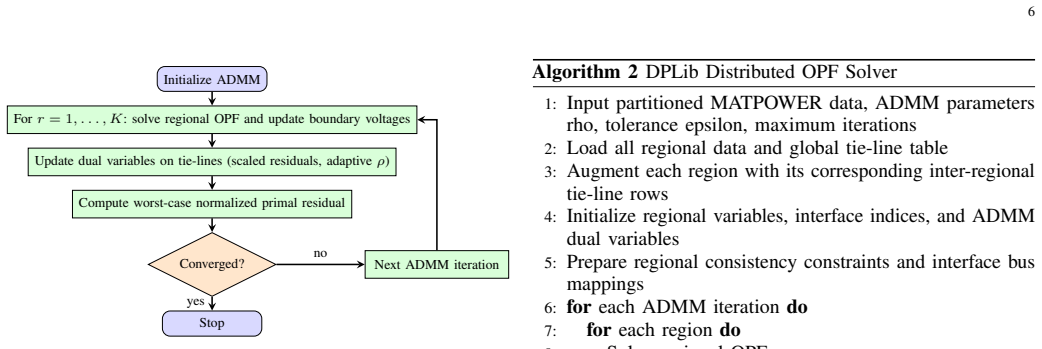
The machinery is a pairing of graph-based spectral partitioning with a virtual-bus ADMM decomposition. In the partitioning step, the power network is an undirected graph whose Laplacian $L=D-A$ is formed from the unweighted adjacency matrix; the $k$ smallest nonzero eigenvectors of $L$ give a spectral embedding whose rows are clustered by $k$-means, and the cluster with the fewest inter-regional tie-lines is selected. In the validation step, each region solves a local DC or AC OPF in which boundary buses of neighboring regions appear as duplicated virtual variables, and an augmented Lagrangian with scaled residuals and adaptively updated penalty parameters enforces angle (and voltage-magnitude) agreement across tie-lines until the worst-case normalized primal residual falls below tolerance.
What would settle it
Take any DPLib case that has converged, reassemble the regional solutions into a global voltage and flow state, and check the power-flow equations on every tie-line against the centralized MATPOWER solution; if any advertised case fails to match the centralized objective within one percent, or if its tie-line mismatches exceed the reported tolerance, the benchmark cannot be considered equivalent to the original system.
Extended reading notes
Core claim
The paper establishes DPLib as a standard, reproducible data layer for distributed power-system research. It contributes a spectral-clustering partitioning toolkit that decomposes standard test systems into balanced regions with explicit inter-regional tie-lines and exports regional cases in .mat, .csv, and .m formats, plus distributed DC and AC OPF solvers built on a virtual-bus ADMM formulation. On all tested cases the distributed solvers converge to the prescribed tolerance and achieve an optimality gap of under one percent relative to the centralized solution, which the authors take as evidence that the partitioned datasets faithfully represent the original systems.
Load-bearing premise
The entire library stands on the assumption that splitting a network into regions and renumbering its buses preserves every bus, branch, generator, and cost entry with no lost cross-references, and that the virtual-bus boundary treatment changes nothing about the original optimization problem.
Editorial extensions
If this is right
- Distributed-optimization papers can report results on the same multi-region cases, making algorithms directly comparable instead of tied to ad hoc partitions.
- The partitioning toolkit turns any MATPOWER-compatible system into a custom multi-region dataset, so new methods can be tested on user-defined region counts and topologies without extra infrastructure.
- The sub-one-percent optimality gaps give a concrete baseline: a distributed solver that cannot match the centralized cost within that gap on DPLib cases is not competitive with the provided ADMM solvers.
- Standardized .mat, .csv, and .m exports let non-MATLAB tools consume the same benchmarks, extending reproducibility beyond the library's own solver stack.
Reading between the lines
- The abstract advertises 40 benchmark cases while the body details seven; a useful check is whether all advertised cases pass the same verification pipeline, since the library's value depends on uniformity.
- Because the default partition uses the unweighted Laplacian, regions follow purely topological clusters; a weighted variant that emphasizes electrical strength or transfer capabilities could create partitions more aligned with congestion patterns, which the paper exposes only as an auxiliary option.
- The same pipeline could be pointed at distributed state estimation or security-constrained OPF, turning the library into a general-purpose testbed rather than an OPF-only one.
- A natural extension is to use DPLib cases as a controlled arena to compare iteration counts and communication loads of different distributed algorithms under identical partitions.
Editorial analysis
A structured set of objections, weighed in public.
Referee Report
Summary. The paper introduces DPLib, an open-source MATLAB library providing multi-region benchmark test cases for distributed power system analysis and optimization. It consists of a graph-based partitioning toolkit that converts MATPOWER/PGLib systems into regional datasets, and ADMM-based distributed DC and AC OPF solvers intended to validate those datasets. The abstract claims 40 multi-region cases ranging from 5 to 20,758 buses, while the introduction states 'over 20' cases; Table I lists seven systems. The paper reports that the distributed solvers achieve optimality gaps below one percent for all feasible cases, relying on centralized costs from MATPOWER. The central claim is that DPLib provides a verified, reproducible benchmark library for distributed power system research.
Significance. If properly validated, DPLib would fill a real gap: there is currently no general-purpose, reproducible library of partitioned test cases for distributed power system studies, and the paper's toolchain (partitioning toolkit plus ADMM validation solvers) is a plausible and useful contribution to the community. The open-source availability of the library and the accompanying verification scripts are tangible strengths. However, the current manuscript's validation is not yet credible: the optimality-gap claims are computed against costs explicitly labeled 'placeholder,' the number of cases is inconsistent across abstract, introduction, and Table I, and promised partitioning comparisons and performance tables are absent from the body. The load-bearing evidence for the library's correctness therefore needs to be reworked.
major comments (4)
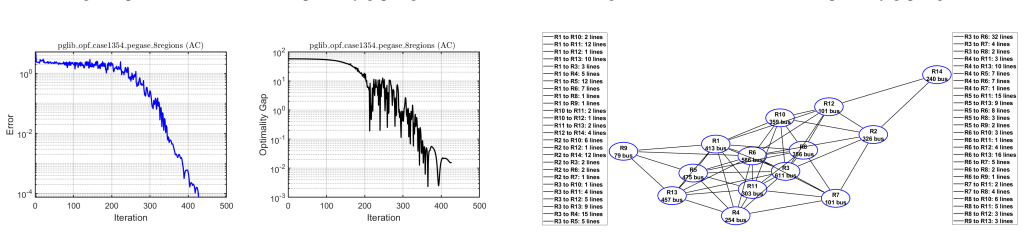
- [Section IV] Table I and the paragraph immediately after it are internally inconsistent: the table labels the centralized DC and AC costs as 'placeholder,' yet the text states that for all feasible cases the distributed solvers 'achieve an optimality gap below one percent.' A gap computed against a placeholder is not a gap to the true optimum, so the paper's core validation claim is unsupported as written. Please recompute the centralized DC and AC objective values for every released case with an independent solver (e.g., MATPOWER's run_dcopf/run_acopf) and report the resulting gaps.
- [Abstract / Section I / Section IV] The number of test cases is inconsistent: the Abstract claims 40 cases, the Introduction says 'over 20,' and Table I lists only 7 systems. The text repeatedly asserts that 'all test cases have been verified,' but no complete case list and no per-case iteration counts, run times, or final optimality gaps are provided for the cases beyond the seven shown. The validation section must cover all cases claimed in the library, or the claim must be narrowed accordingly.
- [Abstract / Section IV] The Abstract promises comparisons with METIS, KaFFPa, and an IPA-inspired baseline, as well as 'partitioning sensitivity, centralized run times, distributed OPF iterations, run times, and optimality gaps.' None of these quantities appear in the body of the paper; the numerical section only displays residual/gap curves for seven cases. Please either include the promised experiments and tabulated results or remove these claims from the abstract and introduction.
- [Section III] The validation uses the authors' own ADMM formulation from [13] with manually chosen hyperparameters (rho0=1, tau_incr=2, tau_decr=0.5, mu in Eq. (8)-(9), and rho_max in Table I). Convergence of this specific solver is necessary but not sufficient to certify that the partitioned regional datasets are equivalent to the original centralized OPF. Since the central claim is the correctness and reproducibility of the benchmark data, the paper should add an independent equivalence check, e.g., recombining the regional files into one system and confirming that the union of constraints matches the original MATPOWER case, or comparing distributed solutions against independently computed centralized optima for all cases.
minor comments (5)
- [Section II.A] The sentence 'Each eigenvalue is associated with an eigenvector that varies smoothly across the graph, meaning that buses that are strongly connected in the physical system will have similar eigenvalues' is imprecise: it is the eigenvector entries that vary smoothly across the graph; eigenvalues are scalars and do not vary across the graph.
- [Table I] The system names 'pglib_opf_case200_tamu200' and 'pglib_opf_case500_tamu500' are inconsistent with the names used in the text ('case200_tamu', 'case500_tamu'); please correct the names to match the PGLib identifiers.
- [Section IV] The functions run_dcopf_centralized and run_acopf_centralized are introduced without reference to MATPOWER's standard functions; please clarify whether these are custom wrappers and what solver settings (e.g., tolerances, starting points) are used for the centralized runs, since those values are the reference basis for the optimality gaps.
- [Section III.A] The description of the scaling factors theta_scale and v_scale says a 'robust statistic (for example, the median)' is used, but the exact choice is left open; please specify the exact statistic used in the released software so that results are reproducible.
- [Section IV] In the case 2869 description, the text says 'the reference bus (Bus 1314) is assigned to Region 6,' while Table I lists the Slack column as 'R6'; please use a consistent notation for region identifiers.
Circularity Check
No circular derivation: datasets are external MATPOWER cases partitioned by graph clustering and validated against centralized MATPOWER costs; only a minor self-citation for the ADMM formulation and a reporting defect around 'placeholder' centralized values.
full rationale
The claimed derivation chain is not circular. DPLib's datasets are produced by Algorithm 1, which loads MATPOWER cases and extracts regional subcases by renumbering buses, branches, generators, and costs; no target quantity is fitted and then relabeled as a prediction. Validation is against centralized DC/AC OPF costs computed by run_dcopf_centralized and run_acopf_centralized, which are external MATPOWER references, not outputs of the DPLib distributed solvers. The distributed ADMM formulation and residual definition are credited to the authors' prior work [13], but the optimality gap is measured relative to the centralized cost, so the validation does not reduce to the solver's own iterates. The one flagged limitation is the literal statement in Section IV that 'Table I reports placeholder centralized DC and AC objective values for all systems'; if taken literally, the reported sub-1% optimality gaps are not supported by the printed table. Also, the abstract promises 40 cases and METIS/KaFFPa comparisons, while the body describes 'over 20' cases and Table I lists 7. These are completeness and reporting defects, not circular reductions: no equation is defined in terms of the quantity it is used to predict, and no self-cited uniqueness theorem forces the benchmarks. Score 2 reflects the minor self-citation for the solver formulation, not a circular derivation.
Assumptions & free parameters
free parameters (5)
- ADMM initial penalty rho0 =
1
- ADMM penalty update factors tau_incr, tau_decr =
2, 0.5
- Adaptive balance factor coefficients =
15 and 10 in mu_theta, mu_v with exponent 0.2
- Penalty cap rho_max =
1e5 to 1e8 per case in Table I
- Cooldown period Nwait =
20 for cases under 2000 buses, 40 otherwise
assumptions (4)
- domain assumption The unweighted Laplacian spectral embedding captures meaningful electrical regions.
- standard math The network graph is connected, so the Laplacian has exactly one zero eigenvalue.
- domain assumption Distributed ADMM solutions that reach low primal residual and below 1% gap certify dataset validity.
- domain assumption Centralized MATPOWER OPF solutions are ground truth.
Cite this review
Pith. "Pith review of A Benchmark Library for Distributed Power System Analysis and Optimization." pith.science (2026). https://pith.science/paper/VX4Q2A23
@misc{pith2026250620819,
  author       = {Pith},
  title        = {Pith review of: A Benchmark Library for Distributed Power System Analysis and Optimization},
  year         = {2026},
  howpublished = {\url{https://pith.science/paper/VX4Q2A23}},
  note         = {Machine review of arXiv:2506.20819}
}
read the original abstract
DPLib is an open-source benchmark library created to support research and development in distributed power system analysis and optimization. Unlike centralized tools such as MATPOWER and PGLib, no general purpose, reproducible data library package currently exists for distributed power system studies. DPLib, available at \href{https://github.com/LSU-RAISE-LAB/DPLib.git}{GitHub}, fills this gap by providing 40 multi-region benchmark test cases ranging from 5 buses to 20758 buses, along with a graph-based partitioning toolkit that converts MATPOWER-compatible systems into distributed regional datasets. The toolkit generates standardized \texttt{.mat}, \texttt{.csv}, and \texttt{.m} files, regional MATPOWER version 2 cases, local and global bus mappings, generator and cost assignments, explicit inter-regional tie-line records, and bus-to-region partition maps. It supports unweighted, electrically weighted, and user-defined partitions, and is compared with METIS, KaFFPa, and an IPA-inspired baseline. DPLib also provides ADMM-based distributed DC and AC OPF solvers for validation. Numerical studies report partitioning sensitivity, centralized run times, distributed OPF iterations, run times, and optimality gaps. These results establish DPLib as a reproducible data layer for distributed power system research.
Figures


Figures from the paper (12 more)




Reference graph
Works this paper leans on
-
[13]
ADMM enhancement techniques for distributed optimal power flow,
M. Hasanzadeh and A. Kargarian, “ADMM enhancement techniques for distributed optimal power flow,”IEEE Transactions on Power Systems, 2025
work page 2025
-
[1]
R. D. Zimmerman, C. E. Murillo-S ´anchez, and R. J. Thomas, “Matpower: Steady-state operations, planning, and analysis tools for power systems research and education,”IEEE Transactions on power systems, vol. 26, no. 1, pp. 12–19, 2010
work page 2010
-
[2]
Zero duality gap in optimal power flow problem,
J. Lavaei and S. H. Low, “Zero duality gap in optimal power flow problem,”IEEE Transactions on Power systems, vol. 27, no. 1, pp. 92–107, 2011
work page 2011
-
[3]
A survey of relaxations and approximations of the power flow equations,
D. K. Molzahn, I. A. Hiskenset al., “A survey of relaxations and approximations of the power flow equations,”F oundations and Trends® in Electric Energy Systems, vol. 4, no. 1-2, pp. 1–221, 2019
work page 2019
-
[4]
The QC Relaxation: Theoretical and Computational Results on Optimal Power Flow
C. Coffrin, H. L. Hijazi, and P. Van Hentenryck, “The QC relaxation: Theoretical and computational results on optimal power flow,”arXiv preprint arXiv:1502.07847, 2015
work page Pith review arXiv 2015
-
[5]
Corrective control to handle forecast uncertainty: A chance constrained optimal power flow,
L. Roald, S. Misra, T. Krause, and G. Andersson, “Corrective control to handle forecast uncertainty: A chance constrained optimal power flow,” IEEE Transactions on Power Systems, vol. 32, no. 2, pp. 1626–1637, 2017
work page 2017
-
[6]
Nesta, the nicta energy system test case archive,
C. Coffrin, D. Gordon, and P. Scott, “Nesta, the nicta energy system test case archive,”arXiv preprint arXiv:1411.0359, 2014
arXiv 2014
-
[7]
A survey of distributed optimization and control algorithms for electric power systems,
D. K. Molzahn, F. D ¨orfler, H. Sandberg, S. H. Low, S. Chakrabarti, R. Baldick, and J. Lavaei, “A survey of distributed optimization and control algorithms for electric power systems,”IEEE Transactions on Smart Grid, vol. 8, no. 6, pp. 2941–2962, 2017
2017
Show all 22 references
-
[8]
Toward distributed/decentralized DC optimal power flow implementation in future electric power systems,
A. Kargarian, J. Mohammadi, J. Guo, S. Chakrabarti, M. Barati, G. Hug, S. Kar, and R. Baldick, “Toward distributed/decentralized DC optimal power flow implementation in future electric power systems,”IEEE Transactions on Smart Grid, vol. 9, no. 4, pp. 2574–2594, 2016
2016
-
[9]
Intelligent partitioning in distributed optimization of electric power systems,
J. Guo, G. Hug, and O. K. Tonguz, “Intelligent partitioning in distributed optimization of electric power systems,”IEEE Transactions on Smart Grid, vol. 7, no. 3, pp. 1249–1258, 2015
2015
-
[10]
Distributed optimal power flow using ADMM,
T. Erseghe, “Distributed optimal power flow using ADMM,”IEEE transactions on power systems, vol. 29, no. 5, pp. 2370–2380, 2014
2014
-
[11]
Distributed optimal voltage control with asynchronous and delayed communication,
S. Magn ´usson, G. Qu, and N. Li, “Distributed optimal voltage control with asynchronous and delayed communication,”IEEE Transactions on Smart Grid, vol. 11, no. 4, pp. 3469–3482, 2020
2020
-
[12]
Parallel and distributed computation of DC optimal power flow,
Q. Zhou and J. Bialek, “Parallel and distributed computation of DC optimal power flow,”IEEE Transactions on Power Systems, vol. 26, no. 4, pp. 2005–2013, 2011
2005
-
[14]
Distributed algorithm for optimal power flow on unbalanced multiphase distribution networks,
Q. Peng and S. Low, “Distributed algorithm for optimal power flow on unbalanced multiphase distribution networks,”arXiv preprint arXiv:1512.06482, 2015
2015 arXiv
-
[15]
Distributed synthesis and stability of cooperative distributed model predictive control for linear systems,
C. Conte, C. N. Jones, M. Morari, and M. N. Zeilinger, “Distributed synthesis and stability of cooperative distributed model predictive control for linear systems,”Automatica, vol. 69, pp. 117–125, 2016
2016
-
[16]
Distributed fixed-time rotating encirclement control of linear multi-agent systems with moving targets,
M. Hasanzadeh, M. Baradarannia, and F. Hashemzadeh, “Distributed fixed-time rotating encirclement control of linear multi-agent systems with moving targets,”Journal of the Franklin Institute, p. 106970, 2024
2024
-
[17]
Distributed dynamic encirclement control for first-order multi-agent systems with communication delay,
M. Hasanzadeh and S.-X. Tang, “Distributed dynamic encirclement control for first-order multi-agent systems with communication delay,” in 2024 American Control Conference (ACC). IEEE, 2024, pp. 1000–1005
2024
-
[18]
Consensus-based distributed optimal power flow algorithm,
J. Liu, M. Benosman, and A. U. Raghunathan, “Consensus-based distributed optimal power flow algorithm,” in2015 IEEE Power & Energy Society Innovative Smart Grid Technologies Conference (ISGT). IEEE, 2015, pp. 1–5
2015
-
[19]
F. Guo, C. Wen, and Y .-D. Song,Distributed control and optimization technologies in smart grid systems. CRC Press, 2017
2017
-
[20]
Yalmip: A toolbox for modeling and optimization in matlab,
J. Lofberg, “Yalmip: A toolbox for modeling and optimization in matlab,” in2004 IEEE international conference on robotics and automation (IEEE Cat. No. 04CH37508). IEEE, 2004, pp. 284–289
2004
-
[21]
On the implementation of an interior-point filter line-search algorithm for large-scale nonlinear programming,
A. W¨achter and L. T. Biegler, “On the implementation of an interior-point filter line-search algorithm for large-scale nonlinear programming,” Mathematical programming, vol. 106, no. 1, pp. 25–57, 2006
2006
-
[22]
Distributed optimization and statistical learning via the alternating direction method of multipliers,
P. Neal, C. Eric, P. Borja, and E. Jonathan, “Distributed optimization and statistical learning via the alternating direction method of multipliers,” F oundations and Trends® in Machine learning, vol. 3, no. 1, pp. 1–122, 2011
2011
Reviewed August 6, 2026 · model on record in the stance chip above.
Discussion (0). Continue with ORCID to comment.