REVIEW 5 major objections 6 minor 47 references
DD-RNO: A Domain-Decomposed Routed Neural Operator for Airfoil Flow Prediction
T0 review · 5 major / 6 minor · reviewed 2026-08-14 · deepseek-v4-flash
Pith's one-line read A neural surrogate with domain routing cuts airfoil RANS velocity error 17-fold and raises drag rank correlation to 0.997.
desk verdict Clever architecture and honest limitations, but the empirical case would be stronger with modern baselines and a less confounded force-integration ablation. read the letter →
The pith
A machine-rendered reading of the paper's core claim, the machinery that carries it, and where it could break.
The reading
What carries the argument
The load-bearing mechanism is a partition-of-unity router combined with a learned quadrature rule. Routing masks $M_{\mathrm{BL}}(x)=\sigma((\delta_{\mathrm{BL}}-\Phi(x))/(0.1\,\delta_{\mathrm{BL}}))$ and $M_{\mathrm{wake}}(x)=\sigma((x-x_{\mathrm{wake}})/0.05)$ are normalized so that the three gate weights sum to one, and the final field is the gate-weighted blend of three FiLM-conditioned decoders. The force module is Eq. (31): $\hat{C}_L,\hat{C}_D = \sum_j W_{\mathrm{canon},j}(w)\, C_p^{(j)}$, where $W_{\mathrm{canon}}(w)$ is emitted by a small network from the global flow latent $w$. This is what lets total drag, including a viscous component, be read off surface pressure alone, bypassing the numerically unstable wall-normal derivative $\partial u/\partial n|_{\mathrm{wall}}$ that standard force integration needs.
What would settle it
Run the trained LCQ module with ground-truth CFD surface pressure coefficients in place of the predicted $C_p$ on the 200 test cases; if the force errors jump well above the reported 1.091% drag error, the drag accuracy comes from cancellation of pressure-field errors rather than from a transferable learned integration rule.
Extended reading notes
Core claim
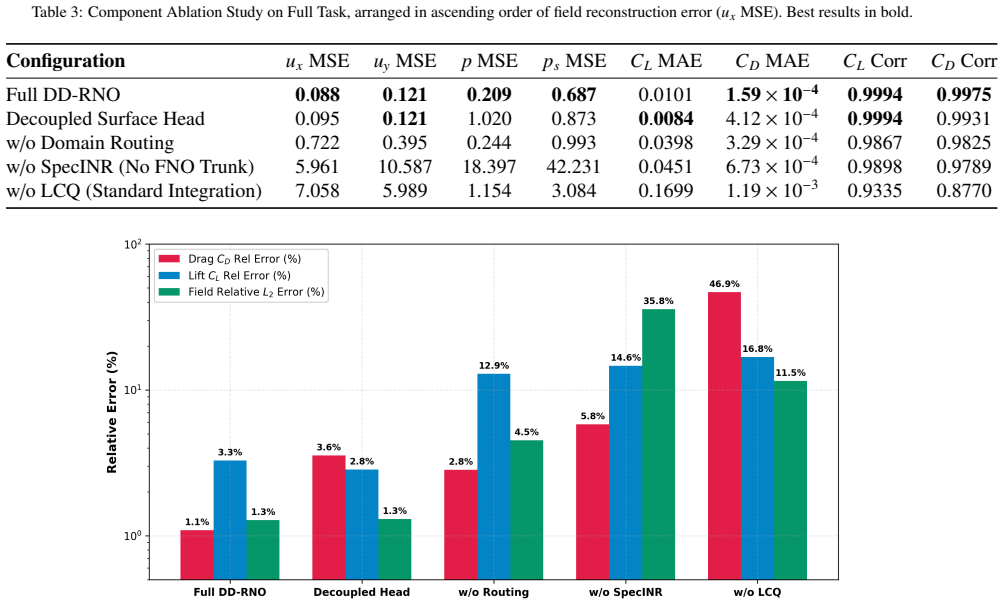
The central discovery is that physically motivated domain decomposition, not more network capacity, is what breaks the spectral-bias bottleneck in airfoil surrogates. A Fourier-neural-operator trunk encodes global geometry into a feature map; query points are enriched with multi-scale Fourier features, signed-distance and wall-normal information, and are routed by smooth gates to three decoders specialized for the inviscid outer flow, boundary layer, and wake, with the boundary-layer envelope scaled as $\delta_{\mathrm{BL}}\propto \mathrm{Re}^{-1/5}$. The second discovery is that forces can be predicted without integrating pressure gradients: learned canonical quadrature takes predicted surface pressure coefficients $C_p$ and forms $\hat{C}_L,\hat{C}_D$ as a flow-conditioned dot product with learned weights $W_{\mathrm{canon}}(w)$. The paper reports on the benchmark's Full task that velocity $u_x$ MSE falls from $1.58\times10^{-2}$ to $9.1\times10^{-4}$, that Spearman drag rank correlation rises from 0.250 to 0.997, and that ablations show removing routing or LCQ increases key errors by about 8x and 40x respectively.
Load-bearing premise
The premise the whole force-accuracy claim rests on is that total lift and drag are statistically determined by surface pressure plus angle of attack and Reynolds number, with no shear-stress input; if skin-friction drag is not recoverable from those quantities for unseen geometries, the learned quadrature weights overfit the training force labels.
Editorial extensions
If this is right
- If the reported benchmark numbers hold, any surrogate that partitions the flow by physical regime can cut velocity-field error by an order of magnitude over uniform-capacity networks on the same data.
- The near-unity drag rank correlation means the surrogate can be used to order candidate airfoil geometries by drag, which is the relevant signal for design screening even when absolute error is imperfect.
- Because the routing gate carries an explicit Reynolds-number scaling, the out-of-distribution improvement suggests the model's inductive bias, not memorization of the training band, drives extrapolation.
- At roughly 144 ms per sample on a 200,000-node mesh, the surrogate is fast enough for interactive and many-query design loops that an iterative RANS solver cannot support.
- If LCQ truly extracts a viscous-drag signal from pressure, the same learned-quadrature pattern could be applied wherever shear-stress integration is the numerically weak link.
Reading between the lines
- Inference: the fixed prefactor $c_{\mathrm{BL}}=5.0$ in the routing envelope is calibrated to attached and mildly separated flow; the paper's own results show errors grow in the wake at high angle of attack, so the envelope may need to become flow-dependent for strongly separated cases.
- Inference: a testable extension not reported in the paper is to feed ground-truth CFD surface pressures into the trained LCQ weights and recompute forces; this would separate genuine learned quadrature from error cancellation between the pressure field and the force head.
- Inference: the same learned-canonical-quadrature idea could in principle extend to three-dimensional wings, where spanwise force integration and tip effects introduce the same instability that motivated LCQ in 2D, provided a canonical surface parameterization can be defined.
Signed reviews
Editorial analysis
A structured set of objections, weighed in public.
Referee Report
Summary. This paper presents DD-RNO, a neural operator surrogate for steady 2D RANS flow around airfoils. The architecture consists of a spectral geometry encoder based on an FNO that processes a signed distance function, a coordinate-based decoder with per-region specialists selected by smooth physics-based routing into inviscid, boundary-layer, and wake regions, and a learned canonical quadrature module (LCQ) that maps surface pressures to lift and drag via flow-conditioned weights. The authors evaluate on AirfRANS using the standard Full, Reynolds OOD, and AoA OOD splits. They report sizeable reductions in velocity-field MSE relative to MLP, GraphSAGE, and Graph U-Net baselines, large improvements in drag rank correlation from LCQ, ablations supporting the two new modules, a single-point extrapolation test at Re=1e6, and a computational-cost comparison showing a 10,000x speedup over a CPU RANS solve.
Significance. If the claims hold, DD-RNO would be a useful step for real-time aerodynamic surrogates: the domain-routing idea is physically motivated, the LCQ formulation removes a numerically fragile gradient computation, and the authors provide code, checkpoints, and reproducible training details. The empirical gains over the three tested baselines are substantial. However, the significance is tempered by the absence of comparisons with the state-of-the-art neural-field and operator methods cited in the paper, and by the manuscript's own diagnostics, which indicate that the LCQ drag model captures only a small fraction of geometry-dependent viscous drag. The paper is therefore a solid engineering contribution whose headline superiority claims need to be re-scoped and verified against current methods.
major comments (5)
- [§3.1.1, Table 1] The comparison set contains only MLP, GraphSAGE, and Graph U-Net. The methods the paper itself motivates as state of the art—CORAL, MARIO, Geo-FNO, FNO, and DeepONet—are not evaluated, so the abstract's claim that DD-RNO cuts velocity MSE by 17x over 'the strongest baseline' is not established against the current best available surrogate; please add these baselines on the same AirfRANS splits or clearly scope the claim to the baselines used.
- [Table 3, 'w/o LCQ' row] Replacing the force module would not be expected to change the volumetric field, yet u_x MSE grows from 0.088 to 7.058 (an 80x increase) and u_y MSE from 0.121 to 5.989. This shows the ablation also removes or alters other components, so the reported 7.5x drag MAE and 43x relative-error reductions attributed to LCQ are confounded; the ablation should keep the field prediction pipeline identical and apply standard pressure integration only to the force head.
- [§2.7, Eqs. (30)–(31)] The LCQ force output is a dot product of flow-conditioned weights W_canon(w) with the predicted surface pressure C_p. Since total drag includes skin friction, which is not generally a linear functional of surface pressure, the paper's own partial-correlation analysis (rho=0.3365, partial R^2=0.081) shows that only about 8% of the geometry-dependent viscous drag variance is explained beyond flow conditions. The statement that LCQ 'implicitly accounts for geometry-dependent viscous drag' is therefore not supported by the evidence presented; please provide a held-out-geometry test or soften the claim.
- [Table 2, AoA OOD row] On this task, DD-RNO's relative drag error (7.119%) is worse than the MLP baseline (4.355%) and GraphSAGE (6.047%), and Table 1 shows volumetric pressure MSE (11.337e-2) and surface pressure MSE (36.766e-2) worse than all baselines. The text highlights only the Spearman correlation improvements and omits these degradations; the central performance claims should be stated per task with all metrics reported, and the paper should explain why the method regresses under AoA extrapolation.
- [Highlights and §2.3.1] The term 'discretization-invariant' is used as a property of DD-RNO, but the experiments always query the native 200,000-node mesh and never vary the mesh resolution. Please either demonstrate resolution independence by evaluating the same trained model on coarsened and refined meshes, or revise the wording to 'mesh-free querying' to avoid overclaiming.
minor comments (6)
- [§2.6.3, Eq. (24)] The wake mask depends only on x, so all points with x>1.05 are routed to the wake decoder regardless of distance from the wake centerline; please justify this choice or add a y-dependence.
- [§2.7] The near-zero correlation between LCQ weights and analytical integration weights (rho=-0.02) is presented as evidence that LCQ learns a different mapping, but many degenerate weight sets would also have zero correlation; this evidence is weaker than the text suggests.
- [§3.4] The 10,000x speedup compares GPU inference (RTX 2050) with single-core CPU RANS (1500 s); a like-for-like comparison, or at least a statement of the hardware difference, would make the speedup claim more meaningful.
- [References] References [23] and [24] both cite arXiv:2207.05209; the Geo-FNO reference (currently [24]) should have its own arXiv identifier.
- [§2.6.3, Eq. (22)] With c_BL=5, the nominal boundary-layer thickness is roughly 27% of chord at Re=2e6, which appears much larger than physical turbulent boundary layers; a sensitivity study for c_BL would help the reader understand the routing behavior.
- [§3.1.4] The extrapolation validation at Re=1e6 is a single case with no baseline comparison; the sentence '3.82% relative error' should specify whether this is a normalized field MAE and how it compares to in-distribution accuracy.
Circularity Check
No significant circularity: field-accuracy and OOD claims rest on held-out AirfRANS splits, and the supervised nature of LCQ is disclosed rather than disguised as a first-principles derivation.
full rationale
DD-RNO's central empirical claims are field-reconstruction comparisons on held-out AirfRANS splits (Full, Reynolds OOD, AoA OOD). Those error numbers are not built from the reported targets: u_x, u_y, p are trained with a field MSE but evaluated on unseen samples, and the OOD splits are disjoint in Re or angle of attack. The routing gate is set by an external boundary-layer scaling law (delta_BL proportional to Re^-1/5) and is not tuned to match the test MSE. Self-citations [10,12,13,14] are background on ML turbulence closures and are not load-bearing; no uniqueness theorem or ansatz is imported from the authors' prior work. The LCQ force module is explicitly supervised: Eqs. (30)-(31) define C_L and C_D as a learned dot product, and Eq. (35) trains it against CFD labels, so the force-accuracy headline is a supervised fit evaluated on held-out data rather than a first-principles derivation. That is disclosed in the paper and is standard empirical prediction, not a claim that drag is derived from pressure without force labels. The paper even provides a falsifiable partial-correlation check of the viscous-drag signal (partial Spearman rho=0.3365, partial R^2=0.081) in Section 2.7, explicitly acknowledging that only about 8.1% of the residual viscous-drag variance is captured beyond flow-condition confounds. If one interpreted LCQ as an unsupported physical guarantee of skin-friction recovery on new geometries or separated flows, that would be a correctness/transfer risk rather than circularity. No step reduces by construction to its input.
Assumptions & free parameters
free parameters (6)
- Boundary layer routing prefactor c_BL =
5.0
- LCQ weights W_canon(w) =
Learned, 2 x 1024 per flow condition
- Static loss weights lambda_field and lambda_force =
100.0 and 10.0
- SDF field weighting exponent and offset =
15.0 and 0.1
- Canonical surface sample count N_canon =
1024
- Wake gate location and transition width =
x_wake=1.05, width=0.05
assumptions (5)
- domain assumption Steady 2D incompressible RANS with Spalart-Allmaras closure is the ground truth the surrogate learns.
- domain assumption Flat-plate turbulent boundary layer scaling delta ~ Re^(-1/5) is valid across all test airfoils and angles, including separated flow at high alpha.
- domain assumption Total drag can be reconstructed from surface pressure and flow latent alone, without shear-stress information.
- domain assumption The three-region decomposition (inviscid, boundary layer, wake) is sufficient to represent the flow.
- standard math Fourier spectral convolution and multi-scale Fourier features provide valid continuous representations for this regression task.
Cite this review
Pith. "Pith review of DD-RNO: A Domain-Decomposed Routed Neural Operator for Airfoil Flow Prediction." pith.science (2026). https://pith.science/paper/VX5W3MFB
@misc{pith2026260813490,
  author       = {Pith},
  title        = {Pith review of: DD-RNO: A Domain-Decomposed Routed Neural Operator for Airfoil Flow Prediction},
  year         = {2026},
  howpublished = {\url{https://pith.science/paper/VX5W3MFB}},
  note         = {Machine review of arXiv:2608.13490}
}
abstract
Deep learning surrogates for RANS flow prediction around airfoils face two persistent bottlenecks. A single neural architecture cannot simultaneously resolve sharp near-wall boundary layers and smooth far-field potential flow. Additionally, force prediction is undermined by the numerical instability of computing wall-normal velocity gradients from continuous-field approximations. Both of these points are addressed with a DD-RNO (domain-decomposed routed neural operator), combining a spectral geometry encoder with two physics-guided innovations: (a) a differentiable domain routing mechanism that partitions the flow field into inviscid, boundary-layer, and wake regimes---dispatching query points to specialized regional decoders, and (b) learned canonical quadrature (LCQ), which replaces unstable pressure integration with flow-conditioned, learned integration weights that predict lift and drag directly from surface pressure. On the AirfRANS benchmark, DD-RNO cuts velocity field mean-square error (MSE) by 17$x$ ($u_x$) and 12$x$ ($u_y$) over the strongest baseline, widening to 23$x$ under out-of-distribution Reynolds extrapolation---evidence that the routing mechanism generalizes with the physics it encodes rather than merely fitting the training distribution. LCQ reduces drag MSE by 7.5$x$ relative to conventional pressure integration and raises drag rank correlation from $\rho = 0.250$ to $\rho = 0.997$. Ablations confirm that both components are indispensable to performance: removing domain routing increases velocity error by 8.2$x$, and removing LCQ increases relative drag error more than 40-fold. At ~144 ms per sample---a 10,000$x$ speedup over conventional RANS solvers---DD-RNO offers a surrogate accurate and fast enough for real-time aerodynamic design and optimization loops.
Figures


Figures from the paper (8 more)



Reference graph
Works this paper leans on
-
[1]
M. D. Ribeiro, A. Rehman, S. Ahmed, A. Dengel, DeepCFD: Efficient steady-state laminar flow approximation with deep convolutional neural networks, arXiv preprint arXiv:2004.08826 (2020)
arXiv 2020
-
[2]
S. L. Brunton, B. R. Noack, P. Koumoutsakos, Machine learning for fluid mechanics, Annual Review of Fluid Mechanics 52 (2020) 477–508
2020
-
[3]
A. I. J. Forrester, A. J. Keane, Recent advances in surrogate-based optimization, Progress in Aerospace Sciences 45 (1–3) (2009) 50–79
work page 2009
-
[4]
N. V . Queipo, R. T. Haftka, W. Shyy, T. Goel, R. Vaidyanathan, P. K. Tucker, Surrogate-based analysis and optimization, Progress in Aerospace Sciences 41 (1) (2005) 1–28
work page 2005
-
[5]
T. Braconnier, M. Ferrier, J.-C. Jouhaud, M. Montagnac, P. Sagaut, Towards an adaptive POD/SVD surrogate model for aeronautic design, Computers & Fluids 40 (1) (2011) 195–209. 24
work page 2011
-
[6]
M. J. Mifsud, S. T. Shaw, D. G. MacManus, A high-fidelity low-cost aerodynamic model using proper orthogonal decomposition, International Journal for Numerical Methods in Fluids 63 (4) (2010) 468–494
work page 2010
-
[7]
S. Bhatnagar, Y . Afshar, S. Pan, K. Duraisamy, S. Kaushik, Prediction of aerodynamic flow fields using convolutional neural networks, Computational Mechanics 64 (2) (2019) 525–545
work page 2019
-
[8]
N. Thuerey, K. Weißenow, L. Prantl, X. Hu, Deep learning methods for reynolds-averaged navier–stokes simulations of airfoil flows, AIAA Journal 58 (1) (2020) 25–36
work page 2020
Show all 47 references
-
[9]
Sekar, B
V . Sekar, B. C. Khoo, Fast flow field prediction over airfoils using deep learning approach, Physics of Fluids 31 (5) (2019) 057103
2019
-
[10]
H. D. Akolekar, R. D. Sandberg, N. Hutchins, V . Michelassi, G. Laskowski, Machine-learnt turbulence closures for low-pressure turbines with unsteady inflow conditions, ASME Journal of Turbomachinery 141 (10) (2019) 101009
2019
-
[11]
Yilmaz, P
E. Yilmaz, P. Cinnella, Deep learning-based turbulence modeling for aerodynamic applications, Journal of Computational Physics 428 (2021) 110065
2021
-
[12]
H. D. Akolekar, Y . Zhao, R. D. Sandberg, R. Pacciani, Integration of machine learning and computational fluid dynamics to develop turbulence models for improved low-pressure turbine wake mixing prediction, Journal of Turbomachinery 143 (12) (2021) 121001
2021
-
[13]
Pacciani, M
R. Pacciani, M. Marconcini, F. Bertini, S. Rosa Taddei, E. Spano, Y . Zhao, H. D. Akolekar, R. D. Sandberg, A. Arnone, Assessment of machine-learned turbulence models trained for improved wake-mixing in low-pressure turbine flows, Energies 14 (24) (2021) 8327
2021
-
[14]
Y . Fang, M. Reissmann, R. Pacciani, Y . Zhao, A. S. Ooi, M. Marconcini, H. D. Akolekar, R. D. Sandberg, Accelerating cfd-driven training of transition and turbulence models for turbine flows by one-shot and real-time transformer integration, Computers & Fluids 306 (2026) 1069...
2026
-
[15]
W. L. Hamilton, Z. Ying, J. Leskovec, Inductive representation learning on large graphs, in: Advances in Neural Information Processing Systems (NeurIPS), 2017
2017
-
[16]
H. Gao, S. Ji, Graph U-Nets, in: International Conference on Machine Learning (ICML), 2019
2019
-
[17]
Pfaff, M
T. Pfaff, M. Fortunato, A. Sanchez-Gonzalez, P. W. Battaglia, Learning mesh-based simulation with graph networks, in: International Con- ference on Learning Representations (ICLR), 2021
2021
-
[18]
Sanchez-Gonzalez, J
A. Sanchez-Gonzalez, J. Godwin, T. Pfaff, R. Webb, P. Battaglia, P. W. Battaglia, Learning to simulate complex physics with graph networks, in: International Conference on Machine Learning (ICML), 2020
2020
-
[19]
Bonnet, J
F. Bonnet, J. A. Mazari, P. Cinnella, P. Gallinari, AirfRANS: High fidelity computational fluid dynamics dataset for approximating reynolds- averaged navier-stokes solutions, in: Advances in Neural Information Processing Systems (NeurIPS), 2022
2022
-
[20]
Kovachki, Z
N. Kovachki, Z. Li, B. Liu, K. Azizzadenesheli, K. Bhattacharya, A. Stuart, A. Anandkumar, Neural operator: Learning maps between function spaces, arXiv preprint arXiv:2108.08481 (2021)
2021 arXiv
-
[21]
Z. Li, N. B. Kovachki, K. Azizzadenesheli, B. Liu, K. Bhattacharya, A. M. Stuart, A. Anandkumar, Fourier neural operator for parametric partial differential equations, in: International Conference on Learning Representations (ICLR), 2021
2021
-
[22]
L. Lu, P. Jin, G. Pang, Z. Zhang, G. E. Karniadakis, Learning nonlinear operators via DeepONet based on the universal approximation theorem of operators, Nature Machine Intelligence 3 (3) (2021) 218–229
2021
-
[24]
Z. Li, D. Z. Huang, B. Liu, A. Anandkumar, Fourier neural operator with learned deformations for PDEs on general geometries, arXiv preprint arXiv:2207.05209 (2022)
2022 arXiv
-
[25]
Rahaman, A
N. Rahaman, A. Baratin, D. Arpit, F. Draxler, M. Lin, F. Hamprecht, Y . Bengio, A. Courville, On the spectral bias of neural networks, in: International Conference on Machine Learning (ICML), 2019
2019
-
[26]
Sitzmann, J
V . Sitzmann, J. N. P. Martel, A. W. Bergman, D. B. Lindell, G. Wetzstein, Implicit neural representations with periodic activation functions, in: Advances in Neural Information Processing Systems (NeurIPS), 2020
2020
-
[27]
Tancik, P
M. Tancik, P. P. Srinivasan, B. Mildenhall, S. Fridovich-Keil, N. Raghavan, U. Singhal, R. Ramamoorthi, J. T. Barron, R. Ng, Fourier features let networks learn high-frequency functions in low-dimensional domains, in: Advances in Neural Information Processing Systems (NeurIPS), 2020
2020
-
[28]
Raissi, P
M. Raissi, P. Perdikaris, G. E. Karniadakis, Physics-informed neural networks: A deep learning framework for solving forward and inverse problems involving nonlinear partial differential equations, Journal of Computational Physics 378 (2019) 686–707. 25
2019
-
[29]
A. D. Jagtap, K. Kawaguchi, G. E. Karniadakis, Extended physics-informed neural networks (XPINNs): A generalized space-time domain decomposition based deep learning framework for nonlinear partial differential equations, Communications in Computational Physics 28 (5) (2020) 2002–2041
2020
-
[30]
L. Sun, H. Gao, S. Pan, J.-X. Wang, Physics-constrained deep learning for predicting steady-state laminar flows, Computer Methods in Applied Mechanics and Engineering 358 (2020) 112732
2020
-
[31]
Hennigh, S
O. Hennigh, S. Narasimhan, M. A. Nabian, A. Subramaniam, L. Tang, Z. Fang, M. Rietmann, S. Byeon, S. Choudhry, NVIDIA SimNet: An AI-accelerated multi-physics simulation framework, in: International Conference on Computational Science (ICCS), 2021
2021
-
[32]
L. Lu, X. Meng, Z. Mao, G. E. Karniadakis, DeepXDE: A deep learning library for solving differential equations, SIAM Review 63 (1) (2021) 208–228
2021
-
[33]
Serrano, L
L. Serrano, L. L. Boudec, A. K. Koupaï, T. X. Wang, Y . Yin, J.-N. Vittaut, P. Gallinari, Operator learning with neural fields: Tackling PDEs on general geometries, in: Advances in Neural Information Processing Systems (NeurIPS), 2023
2023
-
[34]
Catalani, F
M. Catalani, F. Garotta, P. M. Congedo, Towards scalable surrogate models based on neural fields for aerodynamic applications, Computers & Fluids (2026)
2026
-
[35]
Arzani, J.-X
A. Arzani, J.-X. Wang, R. M. D’Souza, Uncovering near-wall blood flow from sparse data with physics-informed neural networks, Physics of Fluids 33 (7) (2021) 071905
2021
-
[36]
A. N. Tikhonov, V . Y . Arsenin, Solutions of ill-posed problems, V . H. Winston & Sons, Washington, DC, 1977
1977
-
[37]
P. R. Spalart, S. R. Allmaras, A one-equation turbulence model for aerodynamic flows, in: 30th Aerospace Sciences Meeting and Exhibit, 1992, p. 439
1992
-
[38]
J. J. Park, P. Florence, J. Straub, R. Newcombe, S. Lovegrove, DeepSDF: Learning continuous signed distance functions for shape represen- tation, in: Proceedings of the IEEE/CVF Conference on Computer Vision and Pattern Recognition (CVPR), 2019
2019
-
[39]
Karras, S
T. Karras, S. Laine, T. Aila, A style-based generator architecture for generative adversarial networks, in: IEEE/CVF Conference on Computer Vision and Pattern Recognition (CVPR), 2019
2019
-
[40]
Perez, F
E. Perez, F. Strub, H. d. Vries, V . Dumoulin, A. Courville, FiLM: Visual reasoning with a general conditioning layer, in: AAAI Conference on Artificial Intelligence, 2018
2018
-
[41]
Schlichting, K
H. Schlichting, K. Gersten, Boundary-Layer Theory, 9th Edition, Springer-Verlag, Berlin, Germany, 2017
2017
-
[42]
F. M. White, Viscous Fluid Flow, McGraw-Hill, 2006
2006
-
[43]
J. D. Anderson, Fundamentals of Aerodynamics, McGraw-Hill, 2017
2017
-
[44]
I. H. Abbott, A. E. V on Doenhoff, Theory of Wing Sections, Dover Publications, 1959
1959
-
[45]
J. A. Hernandez, J. Oliver, A. E. Caicedo, F. G. Flores, Empirical cubature method for hyper-reduction of projection-based reduced-order models in computational mechanics, International Journal for Numerical Methods in Engineering 109 (12) (2017) 1587–1612
2017
-
[46]
Farhat, T
C. Farhat, T. Chapman, P. Avery, A multidimensional framework for project-on-the-fly and database-free energy-conserving sampling and weighting for hyper-reduction of nonlinear structural dynamics models, International Journal for Numerical Methods in Engineering 98 (13) (2014...
2014
-
[47]
Kendall, Y
A. Kendall, Y . Gal, R. Cipolla, Multi-task learning using uncertainty to weigh losses for scene geometry and semantics, in: IEEE/CVF Conference on Computer Vision and Pattern Recognition (CVPR), 2018, pp. 7482–7491
2018
-
[48]
Loshchilov, F
I. Loshchilov, F. Hutter, SGDR: stochastic gradient descent with warm restarts, arXiv preprint arXiv:1608.03983 (2016). 26
2016 arXiv
Reviewed August 14, 2026 · model on record in the stance chip above.
Discussion (0). Continue with ORCID to comment.