Discrete time-multidimensional renewal theory and applications
Pith reviewed 2026-07-01 04:16 UTC · model grok-4.3
The pith
A multi-dimensional discrete renewal theory is constructed on the multi-index lattice using convolution and formal power series.
A machine-rendered reading of the paper's core claim, the machinery that carries it, and where it could break.
Core claim
We develop a discrete-time renewal framework in which renewal events evolve along multiple time coordinates and the sojourn mechanism is described by a general distribution on the multi-index lattice. The resulting processes, called multi-time renewal chains, are studied through multi-index convolution and the associated algebra of multivariate formal power series. This algebraic formulation gives explicit representations for multi-time renewal equations, constructive coefficient formulas, and practical inversion schemes.
What carries the argument
multi-index convolution together with the algebra of multivariate formal power series, which converts renewal equations into explicit algebraic identities on the lattice
If this is right
- Explicit algebraic solutions replace recursive computation for multi-time renewal equations.
- FFT-based multidimensional convolution combined with Newton reciprocal iteration yields practical numerical evaluation on large grids.
- Strong laws and central limit theorems hold for additive functionals and the renewal counting process when all coordinates grow proportionally.
- The terminal age vector under fixed-horizon observation induces a multivariate right-censoring scheme that admits an exact nonparametric maximum-likelihood estimator with asymptotic normality.
- The framework directly supplies closed-form identities for two-attribute warranty costs and alternating-renewal availability.
Where Pith is reading between the lines
- The same power-series machinery could be applied to discretizations of continuous-time multivariate renewal models beyond the bivariate case treated in the applications.
- The proportional-growth central limit theorem suggests analogous limit results for other lattice-indexed processes such as multi-type branching processes.
- Fixed-horizon multivariate censoring may generalize to other incomplete-observation schemes in reliability or queueing when several clocks run in parallel.
Load-bearing premise
A general probability distribution on the multi-index lattice is assumed to exist and to support a well-defined convolution algebra without additional measurability or existence conditions being verified.
What would settle it
A lattice distribution for which the associated multi-index convolution fails to produce a consistent algebra of formal power series, or a proportional-growth regime in which the stated central limit theorem for the renewal counting process does not hold.
Figures
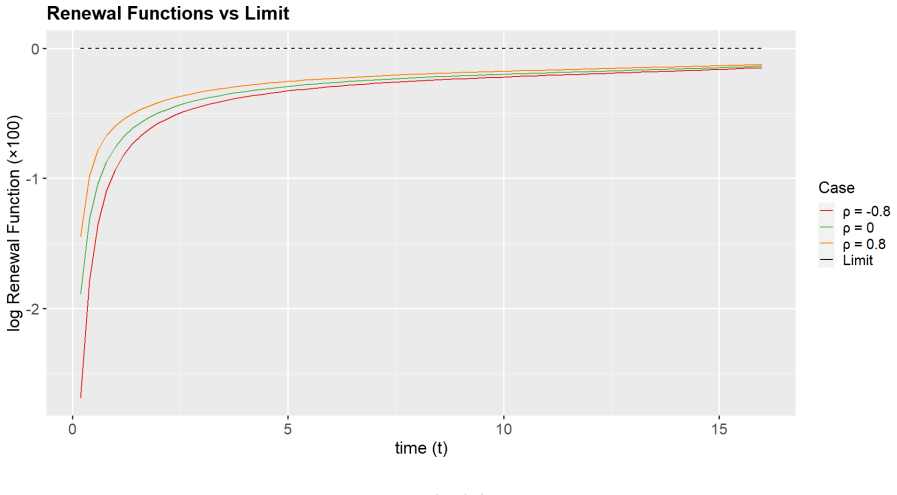
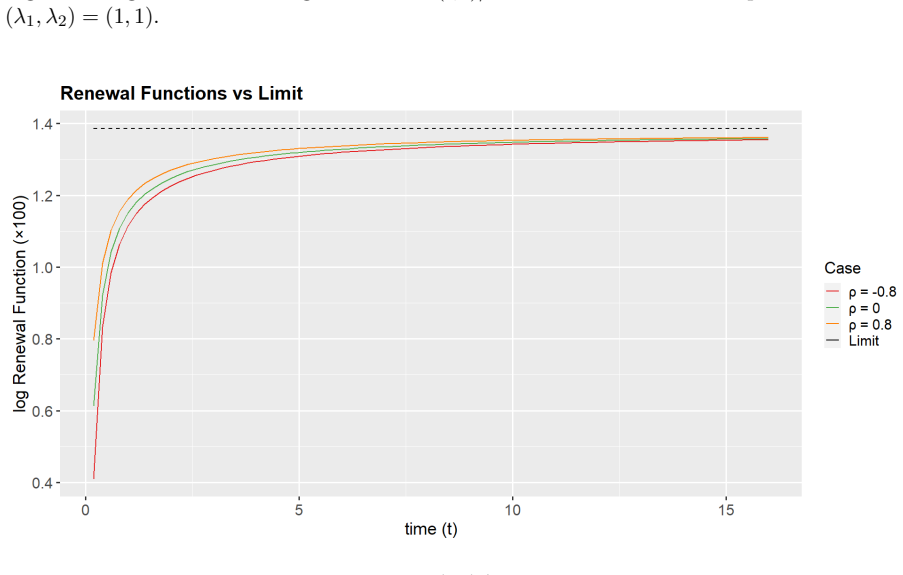
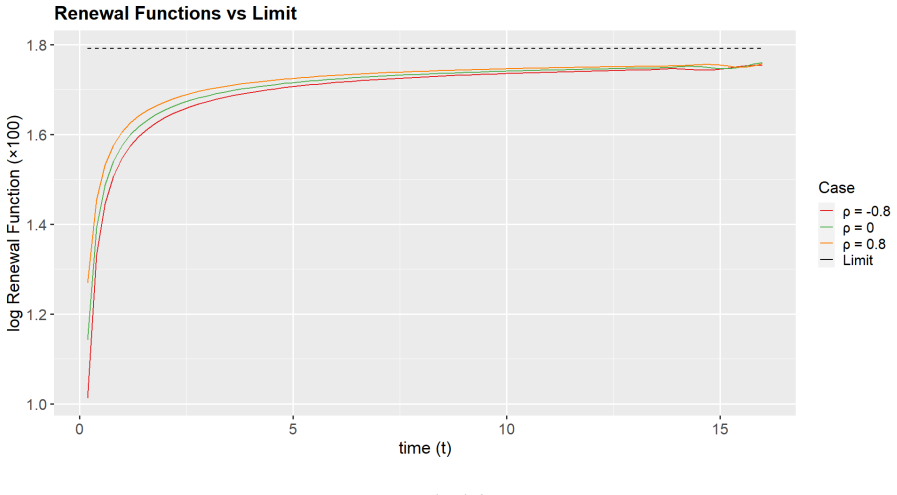
read the original abstract
We develop a discrete-time renewal framework in which renewal events evolve along multiple time coordinates and the sojourn mechanism is described by a general distribution on the multi-index lattice. The resulting processes, called multi-time renewal chains, are studied through multi-index convolution and the associated algebra of multivariate formal power series. This algebraic formulation gives explicit representations for multi-time renewal equations, constructive coefficient formulas, and practical inversion schemes. For computation, we combine FFT-based multidimensional convolution with Newton-type reciprocal iteration to evaluate renewal quantities on large grids. For asymptotics, we prove strong laws and central limit theorems under proportional growth of the observation horizon, including a general central limit theorem for additive functionals and a Gaussian limit for the renewal counting process in directions with a unique rate-determining coordinate. We also study fixed-horizon observations: the terminal age vector induces a genuinely multivariate right-censoring mechanism, leading to an exact nonparametric maximum likelihood estimator and its asymptotic normality. Applications include a binomial--multiset identity, two-attribute warranty evaluation, alternating-renewal availability computation, and discretization-based approximations of continuous-time bivariate renewal and availability models.
Editorial analysis
A structured set of objections, weighed in public.
Referee Report
Summary. The manuscript develops a discrete-time multi-dimensional renewal theory for processes called multi-time renewal chains, defined using a general distribution on the multi-index lattice. It employs multi-index convolution and the algebra of multivariate formal power series to obtain explicit representations for renewal equations and coefficient formulas. Computational methods combine multidimensional FFT with Newton-type reciprocal iteration. Asymptotic results include strong laws and central limit theorems under proportional growth of the observation horizon, with a general CLT for additive functionals and a Gaussian limit for the renewal counting process. For fixed-horizon observations, a nonparametric MLE for the terminal age vector is constructed under multivariate right-censoring, with asymptotic normality established. Applications to a binomial-multiset identity, warranty evaluation, alternating-renewal availability, and approximations of continuous-time models are included.
Significance. If the multi-dimensional framework is properly constructed, the paper provides a valuable extension of classical renewal theory, offering algebraic tools for solving multi-dimensional renewal equations and practical computational schemes. The asymptotic theory under proportional growth and the exact nonparametric MLE for the terminal age vector represent significant contributions, particularly for applications in reliability and warranty analysis. The work is grounded in standard one-dimensional theory but extends it systematically.
major comments (1)
- [Abstract] The framework is built directly on an arbitrary probability distribution on the multi-index lattice N_0^d as the sojourn mechanism (abstract, first sentence). No construction of the underlying probability space, sigma-algebra, or verification that the multi-dimensional convolution remains a probability measure is supplied; this is load-bearing for the renewal equations, power series algebra, FFT inversion, strong laws, CLTs, and MLE, and the one-dimensional case does not automatically extend.
minor comments (1)
- The abstract refers to 'constructive coefficient formulas' without citing specific equations or examples from the main text, making it hard to evaluate their explicitness or novelty.
Simulated Author's Rebuttal
We thank the referee for the careful reading and the recommendation of major revision. The single major comment is addressed below; we agree that an explicit probabilistic construction strengthens the paper and will revise accordingly.
read point-by-point responses
-
Referee: [Abstract] The framework is built directly on an arbitrary probability distribution on the multi-index lattice N_0^d as the sojourn mechanism (abstract, first sentence). No construction of the underlying probability space, sigma-algebra, or verification that the multi-dimensional convolution remains a probability measure is supplied; this is load-bearing for the renewal equations, power series algebra, FFT inversion, strong laws, CLTs, and MLE, and the one-dimensional case does not automatically extend.
Authors: We agree that the manuscript would benefit from an explicit construction of the underlying probability space. In the revised version we will insert a short preliminary subsection (new Section 2.1) that proceeds as follows: let μ be an arbitrary probability measure on the countable set N_0^d; the underlying space is the infinite product Ω = (N_0^d)^ℕ equipped with the product σ-algebra and the product probability P = μ^ℕ. The coordinate maps X_i : Ω o N_0^d are i.i.d. with law μ. The partial-sum process S_n = X_1 + … + X_n is then a random walk on the abelian group Z^d, and the multi-index convolution μ^{*n} is simply the law of S_n, which is again a probability measure because convolution of probability measures on a countable group preserves total mass (by Fubini or direct summation over the countable support). All subsequent objects—renewal measures, generating functions, FFT inversions, strong laws, CLTs, and the nonparametric MLE—are defined pathwise on this space and inherit the required measurability and normalization from the product construction. This is the direct multi-dimensional analogue of the classical one-dimensional construction and requires no additional assumptions. The revision will be purely expository and will not alter any theorems or computational procedures. revision: yes
Circularity Check
No circularity; definitional extension of renewal theory with independent algebraic and asymptotic content
full rationale
The paper defines multi-time renewal chains from an arbitrary distribution on the multi-index lattice and develops multi-index convolutions, formal power series, FFT inversion, strong laws, CLTs, and nonparametric MLE directly from that setup. No step reduces a claimed result to a fitted parameter renamed as prediction, a self-citation chain, or an ansatz smuggled via prior work by the same authors. The derivation chain consists of constructive definitions and standard extensions of one-dimensional renewal theory; the initial distribution is taken as primitive input rather than derived, which is normal for a framework paper and does not constitute circularity under the enumerated patterns.
Axiom & Free-Parameter Ledger
axioms (2)
- domain assumption The sojourn mechanism is described by a general distribution on the multi-index lattice.
- standard math Standard results on multi-index convolution and multivariate formal power series hold in this setting.
invented entities (1)
-
multi-time renewal chains
no independent evidence
Reference graph
Works this paper leans on
-
[1]
Viswanathan Arunachalam and Álvaro Calvache. Approximation of the bivariate renewal function.Communications in Statistics–Simulation and Computation, 44(1):154–167, 2015. doi: 10.1080/03610918.2013.770306
-
[2]
Springer, New York, second edition, 2003
Søren Asmussen.Applied Probability and Queues, volume 51 ofApplications of Mathemat- ics. Springer, New York, second edition, 2003. doi: 10.1007/b97236
-
[3]
Richard P. Brent and Hsien T. Kung. Fast algorithms for manipulating formal power series. Journal of the ACM, 25(4):581–595, 1978. doi: 10.1145/322092.322099
-
[4]
James W. Cooley and John W. Tukey. An algorithm for the machine calculation of complex Fourier series.Mathematics of Computation, 19(90):297–301, 1965. doi: 10.1090/S0025- 5718-1965-0178586-1
-
[5]
Cox.Renewal Theory
David R. Cox.Renewal Theory. Methuen, London, 1962
1962
-
[6]
F. Downton. Bivariate exponential distributions in reliability theory.Journal of the Royal Statistical Society. Series B (Methodological), 32(3):408–417, 1970. doi: 10.1111/j.2517- 6161.1970.tb00852.x
-
[7]
John Wiley & Sons, New York, second edition, 1971
William Feller.An Introduction to Probability Theory and Its Applications, Volume 2. John Wiley & Sons, New York, second edition, 1971. 32
1971
-
[8]
EhsanMoghimiHadji, NirmalSinghKambo, andAlagarRangan. Two-dimensionalrenewal function approximation.Communications in Statistics–Theory and Methods, 44(15):3107– 3124, 2015. doi: 10.1080/03610926.2013.815204
-
[9]
Ahmed Ali Hanandeh and Mohammad Fraiwan Al-Saleh. Inference on Downton’s bivariate exponential distribution based on moving extreme ranked set sampling.Austrian Journal of Statistics, 42(3):161–179, 2013. doi: 10.17713/ajs.v42i3.152
-
[10]
Michel Harel, Livasoa Andriamampionona, and Victor Harison. Asymptotic behavior of nonparametric estimators of the two-dimensional and bivariate renewal functions.Statisti- cal Inference for Stochastic Processes, 22(3):499–523, 2019. doi:10.1007/s11203-018-9192-x
-
[11]
Jeffrey J. Hunter. Renewal theory in two dimensions: asymptotic results.Advances in Applied Probability, 6(3):546–562, 1974. doi: 10.2307/1426233
-
[12]
Jeffrey J. Hunter. Renewal theory in two dimensions: basic results.Advances in Applied Probability, 6(2):376–391, 1974. doi: 10.2307/1426299
-
[13]
Jeffrey J. Hunter. Renewal theory in two dimensions: bounds on the renewal function. Advances in Applied Probability, 9(3):527–541, 1977. doi: 10.2307/1426112
-
[14]
Nat Jack, Bermawi Priyatna Iskandar, and D. N. Prabhakar Murthy. A repair–replace strategy based on usage rate for items sold with a two-dimensional warranty.Reliability Engineering & System Safety, 94(2):611–617, 2009. doi: 10.1016/j.ress.2008.06.019
-
[15]
Charles H. Jones. Generalized hockey stick identities and N-dimensional blockwalking.The Fibonacci Quarterly, 34(3):280–288, 1996. doi: 10.1080/00150517.1996.12429073
-
[16]
H.-G. Kim and B. M. Rao. Expected warranty cost of two-attribute free-replacement war- ranties based on a bivariate exponential distribution.Computers & Industrial Engineering, 38(4):425–434, 2000. doi: 10.1016/S0360-8352(00)00055-3
-
[17]
Chin Diew Lai and Min Xie.Stochastic Ageing and Dependence for Reliability. Springer, New York, 2006. doi: 10.1007/0-387-34232-X
-
[18]
F. Mallor, Edward Omey, and J. Santos. Multivariate weighted renewal functions.Journal of Multivariate Analysis, 98(1):30–39, 2007. doi: 10.1016/j.jmva.2005.07.007
-
[19]
Einfache beispiele zweidimensionaler verteilungen.Mitteilungsblatt für Mathematische Statistik, 8:234–235, 1956
Dietrich Morgenstern. Einfache beispiele zweidimensionaler verteilungen.Mitteilungsblatt für Mathematische Statistik, 8:234–235, 1956
1956
-
[20]
D. N. Prabhakar Murthy, Bermawi Priyatna Iskandar, and R. J. Wilson. Two-dimensional failure-free warranty policies: two-dimensional point process models.Operations Research, 43(2):356–366, 1995. doi: 10.1287/opre.43.2.356
-
[21]
The discrete Weibull distribution.IEEE Transactions on Reliability, 24(5):300–301, 1975
Toshio Nakagawa and Shunji Osaki. The discrete Weibull distribution.IEEE Transactions on Reliability, 24(5):300–301, 1975. doi: 10.1109/TR.1975.5214915
-
[22]
Nelsen.An Introduction to Copulas
Roger B. Nelsen.An Introduction to Copulas. Springer Series in Statistics. Springer, New York, second edition, 2006. doi: 10.1007/0-387-28678-0
-
[23]
Ştefan P. Niculescu. On the asymptotic distribution of multivariate renewal processes. Journal of Applied Probability, 21(3):639–645, 1984. doi: 10.2307/3213624
-
[24]
Advances in Bayesian decision making in reliability.European Journal of Operational Research, 282(1):1–18,
David Ríos Insua, Fabrizio Ruggeri, Refik Soyer, and Simon Wilson. Advances in Bayesian decision making in reliability.European Journal of Operational Research, 282(1):1–18,
-
[25]
doi: 10.1016/j.ejor.2019.03.018. 33
-
[26]
Y. Sarada and R. Shenbagam. Bi-dimensional availability function and its application. Communications in Statistics–Simulation and Computation, 50(5):1333–1347, 2021. doi: 10.1080/03610918.2019.1581891
-
[27]
Charles F. Van Loan.Computational Frameworks for the Fast Fourier Transform, volume 10 ofFrontiers in Applied Mathematics. SIAM, Philadelphia, 1992. doi: 10.1137/1.9781611970999
-
[28]
Cambridge University Press, Cambridge, third edition, 2013
Joachim von zur Gathen and Jürgen Gerhard.Modern Computer Algebra. Cambridge University Press, Cambridge, third edition, 2013. doi: 10.1017/CBO9781139856065
-
[29]
Sang-Chin Yang and Joel A. Nachlas. Bivariate reliability and availability modeling.IEEE Transactions on Reliability, 50(1):26–35, 2001. doi: 10.1109/24.935013. Appendix A Bivariate distributions This appendix collects the bivariate distributions used in the numerical illustrations. We write x= (x 1,x 2),R + := [0,∞), andN0 :={0,1,2,...}. A.1 Continuous m...
discussion (0)
Sign in with ORCID, Apple, or X to comment. Anyone can read and Pith papers without signing in.