REVIEW 2 major objections 3 minor 1 cited by
Fundamental generalized Legendrian rack and classical invariants
T0 review · 2 major / 3 minor · reviewed 2026-08-15 · deepseek-v4-flash
Pith's one-line read Two Legendrian knots with isomorphic fundamental GL-racks must have the same classical invariants, or both reversed.
desk verdict A genuinely new partial converse to Kimura, with the right proof idea, but the proof as written omits cusp relations and a load-bearing case analysis; send to a referee. read the letter →
The pith
A machine-rendered reading of the paper's core claim, the machinery that carries it, and where it could break.
The reading
What carries the argument
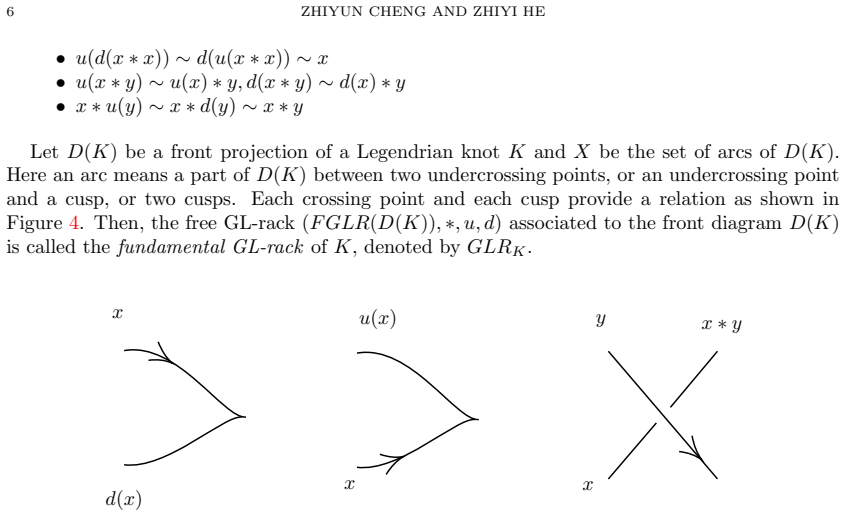
The load-bearing object is the fundamental GL-rack $\mathrm{GLR}_K$ of a Legendrian knot, presented from a front diagram as a free GL-rack on the arcs modulo crossing and cusp relations, and specifically its cyclic presentation with relations $r_i: u^{p_i}d^{q_i}(x_i) *^{\epsilon_i} x_{k_i} = x_{i+1}$ for $1 \le i \le m$ (indices modulo $m$). From these relations the proof forms the three total sums $p = \sum_i p_i$, $q = \sum_i q_i$, and $\omega = \sum_i \epsilon_i$, which are related to the writhe and cusp counts, hence to the Thurston-Bennequin and rotation numbers. The argument then uses permutation GL-racks on $\mathbb{Z}_k$, where $a * b = \sigma(a)$ and $ud = \sigma^{-1}$, choosing three different pairs $(u,d)$ — $(\sigma^{-1}, \mathrm{id})$, $(\mathrm{id}, \sigma^{-1})$, and $(\sigma^{-2}, \sigma)$ — to force the absolute-value equalities $|\omega-p|=|\tilde{\omega}-\tilde{p}|$, $|\omega-q|=|\tilde{\omega}-\tilde{q}|$, and $|\omega-2p+q|=|\tilde{\omega}-2\tilde{p}+\tilde{q}|$. The final step, meant to convert these three absolute equalities into the two sign patterns, is the part of the machinery that carries the theorem's conclusion.
What would settle it
Enumerate all sign patterns for the three pairs $(\omega-p, \tilde{\omega}-\tilde{p})$, $(\omega-q, \tilde{\omega}-\tilde{q})$, and $(\omega-2p+q, \tilde{\omega}-2\tilde{p}+\tilde{q})$ that satisfy the three absolute-value equalities; if any pattern other than all-aligned or all-reversed survives, the proof's final inference is broken. Then search for two Legendrian knots realizing such sums with isomorphic fundamental GL-racks but unequal, non-opposite $(\mathrm{tb}, \mathrm{rot})$ — such a pair would refute Theorem 1.1 directly.
Extended reading notes
Core claim
On the paper's own terms, the discovery is Theorem 1.1: for any two Legendrian knots $K_1$ and $K_2$ with isomorphic fundamental GL-racks, the pair $(\mathrm{tb}(K_1), \mathrm{rot}(K_1))$ is either equal to $(\mathrm{tb}(K_2), \mathrm{rot}(K_2))$ or equal to $(-\mathrm{tb}(K_2), -\mathrm{rot}(K_2))$. The argument packages the front diagram into a cyclic presentation of the fundamental GL-rack with relations $u^{p_i}d^{q_i}(x_i) *^{\epsilon_i} x_{k_i} = x_{i+1}$, then forms the total sums $p$, $q$, and $\omega$ of the exponents and crossing signs. Evaluating the fundamental GL-rack in permutation GL-racks on cyclic sets with three carefully chosen pairs $(u,d)$ yields absolute-value equalities for $\omega - p$, $\omega - q$, and $\omega - 2p + q$. The paper asserts that these three equalities leave only the two sign patterns in the theorem; it also records a slice-knot corollary and asks whether the converse holds.
Load-bearing premise
The theorem stands on two unstated premises: that every front diagram yields a cyclic presentation of the fundamental GL-rack with exactly $m$ relations of the form $u^{p_i}d^{q_i}(x_i) *^{\epsilon_i} x_{k_i} = x_{i+1}$, and that three absolute-value equalities force only the two sign patterns; the latter is asserted without a full case analysis.
Editorial extensions
If this is right
- If two Legendrian knots with the same underlying topological type have isomorphic fundamental GL-racks, their classical invariants cannot be unrelated: the only freedoms are simultaneous equality or simultaneous sign flip.
- For slice knot types, isomorphic fundamental GL-racks imply the Thurston-Bennequin and rotation numbers are equal, since the slice-genus bound forces both Thurston-Bennequin numbers to be negative.
- Any invariant that factors through the fundamental GL-rack must take equal values on Legendrian knots whose $(\mathrm{tb}, \mathrm{rot})$ are either equal or both opposite.
- The paper's Question 3.2 — whether two Legendrian knots with the same classical invariants can have distinct fundamental GL-racks — becomes the natural completeness test for the invariant.
- The two knots in Example 2.13 show the fundamental GL-rack is not a complete Legendrian invariant, because they share it while having equal classical invariants.
Reading between the lines
- The proof's reliance on cyclic presentations suggests the three absolute-value equalities are the entire content of the invariant's classical information; extending the same permutation-rack trick to other rack-valued invariants could yield analogous constraints for those invariants.
- If the asserted 'only two possibilities' step is completed, the theorem would imply that the absolute values $|\mathrm{tb}|$ and $|\mathrm{rot}|$ are invariant under GL-rack isomorphism; one could then use classical knot tables to identify candidate Legendrian knots that might share a fundamental GL-rack.
- A testable extension: for a fixed topological knot type, classify all possible sums $(p,q,\omega)$ arising from front diagrams and check whether any two distinct Legendrian representatives realize a mixed sign pattern of the three equalities; finding one would expose a counterexample to the proof's final step.
- The two knots in Example 2.13 suggest that isomorphism of fundamental GL-racks may be common among Legendrian knots sharing classical invariants, making Question 3.2's converse especially delicate.
Signed reviews
Editorial analysis
A structured set of objections, weighed in public.
Referee Report
Summary. This paper studies the fundamental generalized Legendrian rack (GL-rack) of a Legendrian knot, a rack equipped with two cusp automorphisms u and d, following Kimura and Karmakar--Saraf--Singh. The main result, Theorem 1.1, asserts that if two Legendrian knots K1 and K2 have isomorphic fundamental GL-racks, then either their Thurston--Bennequin numbers and rotation numbers agree, or both are negated. The proof colors front diagrams by finite cyclic permutation GL-racks and derives three absolute-value identities involving the total numbers of up cusps, down cusps, and the writhe, then concludes that only two sign patterns are possible. A corollary states that if one of the knots is slice, the classical invariants are equal. Two examples illustrate that GL-rack colorings can distinguish some Legendrian knots and that isomorphic GL-racks need not imply Legendrian isotopy.
Significance. If Theorem 1.1 is correct, it is a significant partial converse to Kimura's theorem: the fundamental GL-rack, an algebraic invariant of the front, almost determines the two classical Legendrian invariants, fixing them up to a simultaneous sign change. The proof strategy is appealing and elementary, and the three-family permutation-rack argument is a nice tool. The examples are informative, showing both strength (Example 2.12) and limitation (Example 2.13) of the invariant. The main obstacle is that the proof relies on a presentation of the fundamental GL-rack that is not justified and is false for cusp-only fronts; this must be repaired before the theorem can be accepted.
major comments (2)
- [Section 3, Proof of Theorem 1.1, first paragraph] The proof assumes without proof that GLR_K admits a presentation <x_1,...,x_m | r_1,...,r_m> in which every r_i is a crossing relation of the form u^{p_i}d^{q_i}(x_i) *^{\epsilon_i} x_{k_i} = x_{i+1}. This contradicts Definition 2.10 and Figure 4, where cusp relations u(x)=y and d(x)=y are part of the presentation and arcs are cut at cusps as well as undercrossings. For the standard two-cusp unknot front there are no crossing relations at all, so the asserted presentation is not true for that front. The authors need a lemma that chooses a front with at least one crossing, labels the arcs immediately after undercrossings, eliminates cusp generators using the cusp relations, and proves that p=\sum p_i, q=\sum q_i, and \omega=\sum \epsilon_i equal the numbers of up cusps, down cusps, and the writhe; the no-crossing case must be treated separately. As written, the proof of Theorem 1.1 depends on unproved and, for cusp-only fronts, false identities.
- [Section 3, paragraph beginning "Based on these"] The step from the three absolute-value equalities |\omega-p|=|\tilde{\omega}-\tilde{p}|, |\omega-q|=|\tilde{\omega}-\tilde{q}|, and |\omega-2p+q|=|\tilde{\omega}-2\tilde{p}+\tilde{q}| to the dichotomy (\omega-p=\tilde{\omega}-\tilde{p} and \omega-q=\tilde{\omega}-\tilde{q}) or (\omega-p+\tilde{\omega}-\tilde{p}=0 and \omega-q+\tilde{\omega}-\tilde{q}=0) is asserted without proof. The underlying algebraic lemma is true: one checks the cases B=\pm A and D=\pm C in the third equality. However, because this inference is load-bearing for the theorem, it should be stated and proved explicitly. This is a fillable gap rather than a false claim.
minor comments (3)
- [Example 2.13] In the displayed data for the Chekanov--Eliashberg example, 'rot(K3)=rot(K3)=0' should presumably read 'rot(K3)=rot(K4)=0', and in the definition of f, 'f(x6)=d^2(x6)' should be 'f(x6)=d^2(y6)' because f maps into GLR_{K4}.
- [Corollary 3.1] The sentence 'the knot quandle can be recovered from the generalized GL-rack by setting u=d=id' is informal; setting the cusp automorphisms to the identity is not a recovery procedure on a fixed GL-rack. Please phrase this as a quotient or as forgetting the cusp relations, and justify that the result is the knot quandle.
- [Example 2.12] The claimed conclusion Col_{Z_9}(K_1)=0 would be easier to verify if the computation leading to \sigma^{-7}(\psi(x_1))=\psi(x_1) were displayed rather than summarized by an ellipsis.
Circularity Check
No circularity: the proof derives constraints on the classical invariants from independent GL-rack coloring counts.
full rationale
The derivation chain of Theorem 1.1 is not circular. The paper defines the fundamental GL-rack GLR_K from a front diagram (Definition 2.10 and Figure 4), imports the Reidemeister invariance theorem from prior work (Theorem 2.11, citing [14]), and then proves the main implication by counting homomorphisms into permutation GL-racks over Z_k. The colorability constraints phi(x1) = sigma^(omega-p)(phi(x1)) etc. are consequences of the rack relations, and the absolute-value equalities are inferred by comparing existence of homomorphisms; they are not assumed. The final translation into statements about tb and rot uses the standard front-diagram formulas for these invariants, not a fitted parameter or a renaming. The cited prior results about GL-racks are external inputs, not self-citations that carry the main claim, and the paper does not define GLR_K in terms of tb or rot. A reader may object that the proof's claim that GLR_K has a presentation using only crossing relations of the stated form is not justified for fronts with cusp-only arcs, and that the final two-case inference is asserted rather than fully derived; however, those are correctness gaps, not circular reductions. No parameter is fitted and no conclusion is assumed, so the argument is self-contained in the sense relevant to circularity.
Assumptions & free parameters
assumptions (4)
- domain assumption The fundamental GL-rack GLR_K is invariant under Legendrian Reidemeister moves (Theorem 2.11, cited to [14]).
- domain assumption The rack and GL-rack axioms (Definition 2.5) are the correct algebraic mirror of Legendrian front-projection moves.
- ad hoc to paper The algebraic lemma that |A|=|B|, |C|=|D| and |2A-C|=|2B-D| forces either (A=B and C=D) or (A=-B and C=-D).
- standard math Joyce-Matveev quandle classification and Bennequin's inequality are used in Corollary 3.1.
Cite this review
Pith. "Pith review of Fundamental generalized Legendrian rack and classical invariants." pith.science (2026). https://pith.science/paper/VYA7V4JR
@misc{pith2026250718500,
  author       = {Pith},
  title        = {Pith review of: Fundamental generalized Legendrian rack and classical invariants},
  year         = {2026},
  howpublished = {\url{https://pith.science/paper/VYA7V4JR}},
  note         = {Machine review of arXiv:2507.18500}
}
read the original abstract
In this paper, we prove that if two Legendrian knots have isomorphic fundamental GL-racks, then either they have the same Thurston-Bennequin number and the same rotation number, or they have the opposite Thurston-Bennequin numbers and opposite rotation numbers.
Figures


Figures from the paper (4 more)


Forward citations
Cited by 1 Pith paper
-
Good involutions of conjugation subquandles
Good involutions of conjugation subquandles and core quandles are characterized by central-valued functions, with algorithms, enumeration data, new CNS-quandle families, and a category equivalence between racks and Le...
Reference graph
Works this paper leans on
-
[1]
From racks to pointed Hopf algebras.Adv
Nicol´ as Andruskiewitsch and Mat´ ıas Gra˜ na. From racks to pointed Hopf algebras.Adv. Math., 178(2):177– 243, 2003
2003
-
[2]
J. Scott Carter, Alissa S. Crans, Mohamed Elhamdadi, Enver Karadayi, and Masahico Saito. Cohomology of Frobenius algebras and the Yang-Baxter equation. Commun. Contemp. Math. , 10:791–814, 2008
work page 2008
-
[3]
Scott Carter, Daniel Jelsovsky, Seiichi Kamada, Laurel Langford, and Masahico Saito
J. Scott Carter, Daniel Jelsovsky, Seiichi Kamada, Laurel Langford, and Masahico Saito. Quandle cohomology and state-sum invariants of knotted curves and surfaces. Trans. Amer. Math. Soc., 355(10):3947–3989, 2003
work page 2003
-
[4]
Legendrian rack invariants of Legendrian knots
Jose Ceniceros, Mohamed Elhamdadi, and Sam Nelson. Legendrian rack invariants of Legendrian knots. Commun. Korean Math. Soc. , 36(3):623–639, 2021
work page 2021
-
[5]
Differential algebra of Legendrian links
Yuri Chekanov. Differential algebra of Legendrian links. Invent. Math., 150(3):441–483, 2002
2002
-
[6]
A survey of racks and quandles: some recent developments
Mohamed Elhamdadi. A survey of racks and quandles: some recent developments. Algebra Colloq., 27(3):509– 522, 2020
work page 2020
-
[7]
Quandles—an introduction to the algebra of knots , volume 74 of Student Mathematical Library
Mohamed Elhamdadi and Sam Nelson. Quandles—an introduction to the algebra of knots , volume 74 of Student Mathematical Library. American Mathematical Society, Providence, RI, 2015
work page 2015
-
[8]
Classification of topologically trivial Legendrian knots
Yakov Eliashberg and Maia Fraser. Classification of topologically trivial Legendrian knots. In Geometry, topology, and dynamics (Montreal, PQ, 1995) , volume 15 of CRM Proc. Lecture Notes, pages 17–51. Amer. Math. Soc., Providence, RI, 1998
work page 1995
Show all 20 references
-
[9]
Topologically trivial Legendrian knots.J
Yakov Eliashberg and Maia Fraser. Topologically trivial Legendrian knots.J. Symplectic Geom., 7(2):77–127, 2009. FUNDAMENTAL GENERALIZED LEGENDRIAN RACK AND CLASSICAL INV ARIANTS 11
2009
-
[10]
John B. Etnyre. Legendrian and transversal knots. In Handbook of knot theory , pages 105–185. Elsevier B. V., Amsterdam, 2005
2005
-
[11]
Etnyre and Ko Honda
John B. Etnyre and Ko Honda. Knots and contact geometry. I. Torus knots and the figure eight knot. J. Symplectic Geom., 1(1):63–120, 2001
2001
-
[12]
Racks and links in codimension two
Roger Fenn and Colin Rourke. Racks and links in codimension two. J. Knot Theory Ramifications, 1(4):343– 406, 1992
1992
-
[13]
A classifying invariant of knots, the knot quandle
David Joyce. A classifying invariant of knots, the knot quandle. J. Pure Appl. Algebra , 23(1):37–65, 1982
1982
-
[14]
Generalised legendrian racks of legendrian links
Biswadeep Karmakar, Deepanshi Saraf, and Mahender Singh. Generalised legendrian racks of legendrian links. arXiv:2301.06854, 2024
2024
-
[15]
Bi-Legendrian rack colorings of Legendrian knots
Naoki Kimura. Bi-Legendrian rack colorings of Legendrian knots. J. Knot Theory Ramifications, 32(4):Paper No. 2350029, 16, 2023
2023
-
[16]
Dheeraj Kulkarni and T. V. H. Prathamesh. On rack invariants of legendrian knots. arXiv:1706.07626, 2017
2017 arXiv
-
[17]
S. V. Matveev. Distributive groupoids in knot theory. Mat. Sb. (N.S.) , 119(161)(1):78–88, 160, 1982
1982
-
[18]
Rubinsztein
Ryszard L. Rubinsztein. Topological quandles and invariants of links. J. Knot Theory Ramifications , 16(6):789–808, 2007
2007
-
[19]
Classification and structure of generalized legendrian racks
Luc Ta. Classification and structure of generalized legendrian racks. arXiv:2504.12671, 2025
2025 arXiv
-
[20]
On relations and homology of the Dehn quandle
Joel Zablow. On relations and homology of the Dehn quandle. Algebr. Geom. Topol., 8(1):19–51, 2008. School of Mathematical Sciences, Laboratory of Mathematics and Complex Systems, MOE, Beijing Normal University, Beijing 100875, China Email address: czy@bnu.edu.cn School of Mat...
2008
Reviewed August 15, 2026 · model on record in the stance chip above.
Discussion (0). Continue with ORCID to comment.