REVIEW 3 major objections 7 minor 11 references
Shellings of Unbounded Polyhedra
T0 review · 3 major / 7 minor · reviewed 2026-08-07 · deepseek-v4-flash
Pith's one-line read This paper proves that the tight span of any regular subdivision is collapsible, and that compactifying a tropical hypersurface by one point yields a shellable regular cell complex.
desk verdict A genuinely useful shelling toolkit for unbounded polyhedra, wrapped around a headline collapsibility theorem whose proof currently skips the central duality step. read the letter →
The pith
A machine-rendered reading of the paper's core claim, the machinery that carries it, and where it could break.
The reading
What carries the argument
The load-bearing objects are the one-point compactification of the boundary of an unbounded polyhedron, the line shellings of Bruggesser and Mani, and Chari's acyclic matchings from discrete Morse theory. The proof of Theorem 15 also uses the extended Newton polyhedron $U(A,\omega)$ and the dome $D(A,\omega)$ of a height function; the bounded cells of the dome project to the tight span $T(A,\omega)$, while the lower faces of the extended Newton polyhedron project to the regular subdivision $\Sigma(A,\omega)$. The final step passes to the Poincaré dual of the cell decomposition of a sphere to locate the unique critical cell inside the tight span.
What would settle it
Find a regular subdivision of a point configuration whose tight span is homeomorphic to a contractible but non-collapsible complex, such as a triangulated dunce hat; because every collapsible complex admits an acyclic matching with exactly one critical cell, such an example would refute Theorem 15. A smaller check would be to compute the matching constructed in the proof of Theorem 15 for the triangulation in Example 13 and verify that its restriction to the tight span leaves exactly the claimed critical cell unmatched.
Extended reading notes
Core claim
On the paper's own terms, the central discovery is that the shelling idea travels across a duality. A generic vertical line through an unbounded polyhedron orders the compactified facets of its one-point compactification, and this ordering is a shelling whenever the recession cone is one-dimensional or full-dimensional; those are exactly the shapes that occur for the extended Newton polyhedron and the dome of a tropical polynomial. Since a tropical hypersurface is the codimension-one skeleton of the normal complex, shellability of the compactified normal complex yields shellability of the compactified hypersurface. Separately, the same line-shelling, translated through Chari's discrete Morse theory into an acyclic matching on the subdivided ball, then extended to the surrounding sphere and Poincaré dualized, gives an acyclic matching with a unique critical cell on the tight span; uniqueness of the critical cell is exactly collapsibility.
Load-bearing premise
The proof of Theorem 15 takes for granted that the Poincaré dual of the regular cell decomposition of the sphere is again a regular cell complex and that the tight span's cells form a subcomplex of that dual; Remark 17 only sketches this using Munkres and Basak, leaving the details beyond the article's scope.
Editorial extensions
If this is right
- Every tight span of a regular subdivision is collapsible, hence contractible; the stronger conclusion replaces the previously known contractibility of tight spans.
- Compactifying any tropical hypersurface by one point yields a shellable regular cell complex, so the compactified hypersurface is homotopy equivalent to a wedge of spheres.
- The covector decomposition of any tropical polytope is collapsible (Corollary 26), giving a discrete Morse reduction of the polytope to a single vertex.
- For full-support matrices, the closure of a min-tropical hyperplane arrangement in max-tropical projective space is shellable (Corollary 32), and stars of its cells are shellable as well.
Reading between the lines
- If the duality step sketched in Remark 17 can be made fully rigorous, the same line-shelling-plus-dual-block argument may supply a discrete Morse proof of Poincaré duality for arbitrary regular cell decompositions of manifolds, not just the ball/sphere pair used here.
- Collapsibility of tight spans means that algorithms computing homology of tropical polytopes could reduce the complex to a single vertex by a matching, potentially avoiding expensive triangulations of the full normal complex.
- The paper's line-shelling compactification technique is likely to apply beyond tropical hypersurfaces: any unbounded polyhedral complex whose recession cones are either pointed rays or full-dimensional would inherit a shellable one-point compactification.
- Question 27 (shellability of all tropical polytope covector decompositions) might be approachable by checking whether the lexicographic shelling of Theorem 24 can be reordered locally, since Example 25 shows such reorderings can repair a non-shelling.
Editorial analysis
A structured set of objections, weighed in public.
Referee Report
Summary. This paper studies shellability of boundaries of unbounded polyhedra through one-point compactifications. The main results are: a line-shelling theorem for one-point compactified boundaries when the recession cone is one- or full-dimensional (Corollary 4); shellability of one-point compactified tropical hypersurfaces in the tropical torus and in tropical projective space (Corollaries 18, 20, 32); collapsibility of tight spans of arbitrary regular subdivisions (Theorem 15); and a shelling of covector decompositions by lexicographic coarse type (Theorem 24). The proof of Theorem 15 uses Chari's discrete Morse theory and a duality argument that is only sketched; Remark 17 concedes that the general duality statement requires extra work. Several examples illustrate the limits of shellability for tight spans.
Significance. If the main theorem is correct, it strengthens the known contractibility of tight spans to collapsibility, and the shellability results for compactified tropical hypersurfaces are new and potentially useful for the topology of tropical moduli spaces. The paper makes good use of explicit examples (Examples 13, 16, 25) and raises two open questions. The reliance on Chari-Forman discrete Morse theory and on the duality between shellings and dual cell complexes is a promising approach. However, the central proof currently has a gap, and one result (Theorem 24) has a proof that appears inconsistent with its statement; these need to be fixed before the paper's claims are fully supported.
major comments (3)
- [Section 4, Theorem 15] The proof of Theorem 15 is incomplete in its duality step. After forming the sphere Σ_+ and reversing the Hasse diagram, the proof asserts that the Poincaré dual Σ*_+ is a regular cell complex, that the duals of the interior cells of Σ form a subcomplex equal to the tight span, and that the induced matching μ* restricts to that subcomplex with exactly one critical cell. None of these facts is proved; in particular, it is not shown that the line-shelling matching μ pairs every interior cell other than γ with an interior cell and every boundary cell other than α and β with a boundary cell. Proposition 14 only gives existence of an acyclic matching with the stated number of critical cells, not the required interior/boundary separation. Remark 17 explicitly says that the general duality argument is only a sketch and that working out the details is beyond the scope of the article, yet Theorem 15 is the central new result and depends on exactly those details. This gap must be closed.
- [Section 4, Theorem 15] The sentence "Since μ restricts to an acyclic matching on H(∂Σ), it follows that μ* restricts to the dual of ∂Σ in H(Σ*_+)" is not justified. One must prove that the acyclic matching produced by Chari's construction from the shelling of Σ restricts to the acyclic matching produced by the induced shelling of ∂Σ; this compatibility does not follow from the existence statement in Proposition 14. A proof or a precise reference is needed.
- [Section 5, Theorem 24, Eq. (9)] The proof of Theorem 24 appears to establish the reverse of the stated lexicographic order. In Eq. (9), the left-hand side is negative and the denominator ∑ u_i ϵ^i − ϵ^{d+1} is positive, so λ is negative; a smaller value of ∑ u_i ϵ^i gives a larger |λ|, hence the corresponding intersection point is encountered later along the direction −η. Since for sufficiently small ϵ the order of the sums is the lexicographic order of the coarse types, the order along −η is decreasing lexicographic, not increasing. If the theorem intends increasing lexicographic order, the orientation or the statement must be corrected.
minor comments (7)
- [Section 2, Lemma 2] The sentence "the boundary of the compactification F ∪ {∗}, which is a sphere" is misleading; F ∪ {∗} is a ball, and its boundary is a sphere. Please reword.
- [Section 2, Definition 1] In condition (S3), the phrase "appear first in this ordering" should be clarified as "appear first in the ordering of the maximal cells of ∂σ_j".
- [Section 4, Theorem 15] The statement "The cells of the tight span of Σ are in bijection with the interior cells of Σ" is used essentially but not proved or referenced; it should be stated as a lemma.
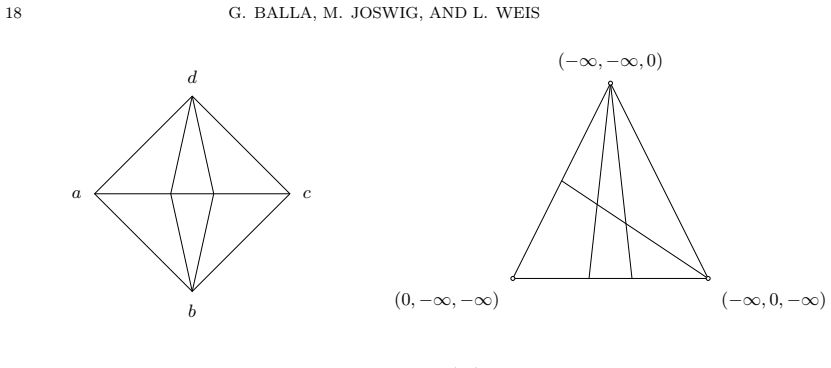
- [Section 4, Example 16] The matched pairs in Fig. 2 are hard to read; listing the pairs explicitly would help the reader verify the example.
- [Section 5, Theorem 24] The role of the very negative value of t in the sentence after Eq. (9) is unclear, since the sign of λ is already determined by the signs of the numerator and the denominator; please explain.
- [Section 6, Corollary 32] The proof invokes a shelling of D(V) with the facet at infinity last, but the preceding results only state that the first facet can be chosen arbitrarily; please justify the last-facet choice.
- [Section 4, Theorem 15] The phrase "because the subdivision Σ is regular" is ambiguous, since "regular" is used both for height-regular subdivisions of point configurations and for regular cell complexes; the proof should state explicitly that Σ_+ is a polytopal (hence PL) cell complex, so the dual block complex is regular.
Circularity Check
No significant circularity: the shelling and collapsibility proofs derive their conclusions from Bruggesser–Mani, Chari, and standard duality facts; the only low-level concern is reliance on a coauthor textbook for background facts, which is not load-bearing.
full rationale
The paper's derivation chain does not assume its own conclusions. Corollary 4 is proved from the Bruggesser–Mani shelling theorem via projective equivalence and contraction of the face at infinity, and it does not presuppose shellability of the one-point compactification. Proposition 7 and Proposition 11 apply Corollary 4 to the extended Newton polyhedron and the dome, respectively, using independent geometric inputs. Corollary 18 uses the standard fact [Jos21, Cor 1.6] that a tropical hypersurface is the codimension-one skeleton of its normal complex, then combines it with Proposition 6; this is background knowledge, not a renamed version of the shellability result. Theorem 15 builds an acyclic matching from a line shelling, extends it to a sphere by adding the polytope as a cell, and dualizes; it invokes Chari's theorem (Proposition 14) and mentions known contractibility only as a comparison point. The proof does contain an omitted technical step: the assertion that the Poincaré dual of Sigma_+ is again a pseudomanifold 'because the subdivision Sigma is regular', and the claim that the dualized matching restricts to the tight span with a unique critical cell, are not fully proved; Remark 17 explicitly relegates those details to future work. This is a correctness gap, not circularity, because the collapsibility conclusion is not used as an input anywhere. The self-citations to [Jos21] supply standard definitions and facts about domes, normal complexes, and tropical hypersurfaces; none of these inputs contains the target theorems. Hence no circular step rises above a minor, non-load-bearing self-citation.
Assumptions & free parameters
assumptions (6)
- standard math Bruggesser-Mani line shelling theorem: every polytope boundary admits a shelling induced by a generic line.
- standard math Every pointed polyhedron is projectively equivalent to a polytope minus a proper face at infinity.
- domain assumption The boundary of a pointed full-dimensional unbounded polyhedron is homeomorphic to R^d, so its one-point compactification is a sphere.
- standard math Chari's theorem: a shellable ball or sphere admits an acyclic matching with exactly one or two critical cells.
- domain assumption The dual block complex of a regular cell decomposition of a sphere is a regular cell complex.
- domain assumption The tight span of a regular subdivision is the bounded subcomplex of the normal complex, with cells in bijection with the interior cells of the subdivision.
Cite this review
Pith. "Pith review of Shellings of Unbounded Polyhedra." pith.science (2026). https://pith.science/paper/VYDTIXXT
@misc{pith2026250607241,
  author       = {Pith},
  title        = {Pith review of: Shellings of Unbounded Polyhedra},
  year         = {2026},
  howpublished = {\url{https://pith.science/paper/VYDTIXXT}},
  note         = {Machine review of arXiv:2506.07241}
}
read the original abstract
The shellability of the boundary complex of an unbounded polyhedron is investigated. To this end, it is necessary to study suitable compactifications first. Results on polyhedra can then be exploited to derive a shellability result for tropical hypersurfaces. Under the hood there is a subtle interplay between the duality of polyhedral complexes and their shellability. Translated into discrete Morse theory, that interplay also gives that the tight span of a regular subdivision is collapsible, but not shellable in general.
Figures


Figures from the paper (3 more)


Reference graph
Works this paper leans on
-
[1]
Subdivisions, shellability, and collapsibility of products
[AB17] K. A. Adiprasito and B. Benedetti. “Subdivisions, shellability, and collapsibility of products.” In:Combinatorica 37.1 (2017), pp. 1–30. [AP21] O.AminiandM.Piquerez. Homology of tropical fans.Preprint arXiv: 2105.01504
arXiv 2017
-
[8]
[JT13] M. Joswig and T. Theobald. Polyhedral and algebraic methods in com- putational geometry. Universitext. Revised and updated translation of the 2008 German original. Springer, London,
work page 2008
-
[128]
[HJ08] S. Herrmann and M. Joswig. “Splitting polytopes.” In: Münster J. Math. 1 (2008), pp. 109–141. [Jos21] M. Joswig. Essentials of tropical combinatorics. Vol
work page 2008
-
[152]
New York: Springer-Verlag, 1995
Graduate Texts in Mathematics. New York: Springer-Verlag, 1995
work page 1995
-
[217]
On stars and links of shellable polytopal complexes
1-3. Formal power series and algebraic com- binatorics (Vienna, 1997). 2000, pp. 101–113. [Cou06] M. Courdurier. “On stars and links of shellable polytopal complexes.” In: J. Combin. Theory Ser. A113.4 (2006), pp. 692–697. [DRS10] J. A. De Loera, J. Rambau, and F. Santos.Triangulations. Vol
work page 2006
-
[1984]
The space of tropically collinear points is shellable
[MY09] H. Markwig and J. Yu. “The space of tropically collinear points is shellable.” In: Collect. Math.60.1 (2009), pp. 63–77. [Sta96] R.P.Stanley. Combinatorics and commutative algebra.Second.Vol.41. Progress in Mathematics. Birkhäuser Boston, Inc., Boston, MA,
work page 2009
-
[1993]
Moduli of tropical plane curves
[Bro+15] S. Brodsky, M. Joswig, R. Morrison, and B. Sturmfels. “Moduli of tropical plane curves.” In:Res. Math. Sci.2.4 (2015). [BW96] A.BjörnerandM.L.Wachs.“Shellablenonpurecomplexesandposets. I.” In:Trans. Amer. Math. Soc.348.4 (1996), pp. 1299–1327. [Cha00] M. K. Chari. “On discrete Morse functions and combinatorial decom- positions.” In: vol
work page 2015
-
[1996]
Shellability of complexes of trees
[TZ98] H. Trappmann and G. M. Ziegler. “Shellability of complexes of trees.” In: J. Combin. Theory Ser. A82.2 (1998), pp. 168–178. [Zie95] G. M. Ziegler. Lectures on polytopes. Vol
work page 1998
Show all 11 references
-
[1999]
Shellable decompositions of cells and spheres
[BM71] H. Bruggesser and P. Mani. “Shellable decompositions of cells and spheres.” In:Math. Scand.29 (1971), pp. 197–205. [Bre93] G. E. Bredon. Topology and geometry. Vol
1971
-
[2010]
Oriented matroids
REFERENCES 19 [FL78] J. Folkman and J. Lawrence. “Oriented matroids.” In: J. Combin. Theory Ser. B25.2 (1978), pp. 199–236. [For98] R. Forman. “Morse theory for cell complexes.” In: Adv. Math.134.1 (1998), pp. 90–145. [GM23] N.GeistandE.Miller.“Globaldimensionofreal-exponentpo...
1978
-
[2021]
Combinatorial cell complexes and Poincaré duality
[Bas10] T. Basak. “Combinatorial cell complexes and Poincaré duality.” In: Geom. Dedicata147 (2010), pp. 357–387. [BH93] W. Bruns and J. Herzog. Cohen-Macaulay rings. Vol
2010
Reviewed August 7, 2026 · model on record in the stance chip above.
Discussion (0). Continue with ORCID to comment.