An Evaluation of ABR Switching for Time-Shifted Clients in MoQ
Pith reviewed 2026-06-26 00:54 UTC · model grok-4.3
The pith
Standard ABR algorithms apply directly to time-shifted MoQ playback without modification and yield substantially higher throughput.
A machine-rendered reading of the paper's core claim, the machinery that carries it, and where it could break.
Core claim
The central claim is that standard ABR algorithms can be directly applied to time-shifted playback without modification, yielding substantially higher throughput. The study further shows that a subscriber can experience increased overall throughput after a rebuffering scenario and identifies focal points for further optimizations of MoQ ABR switching.
What carries the argument
SWITCH-style Adaptive Bitrate (ABR) switching in MoQ Transport, which streamlines quality adaptation to reduce playback gaps during congestion.
If this is right
- Time-shifted clients can reuse existing ABR algorithms without custom changes.
- Subscribers can see higher overall throughput after rebuffering events.
- MoQ ABR switching has identifiable focal points that can be targeted for further gains.
- Live and time-shifted playback exhibit different throughput outcomes under the same ABR logic.
Where Pith is reading between the lines
- Client development for MoQ could reuse standard ABR code across both live and shifted modes.
- If the simulation holds, real deployments might see simpler rate-adaptation stacks than expected.
- The post-rebuffering throughput gain could be tested for interactions with QUIC flow control.
Load-bearing premise
The Mininet simulated topology accurately models real network conditions and client behavior for MoQ time-shifted playback.
What would settle it
Repeating the exact experiments on a physical network testbed with production MoQ clients and observing whether the reported throughput advantage for time-shifted clients disappears.
Figures
read the original abstract
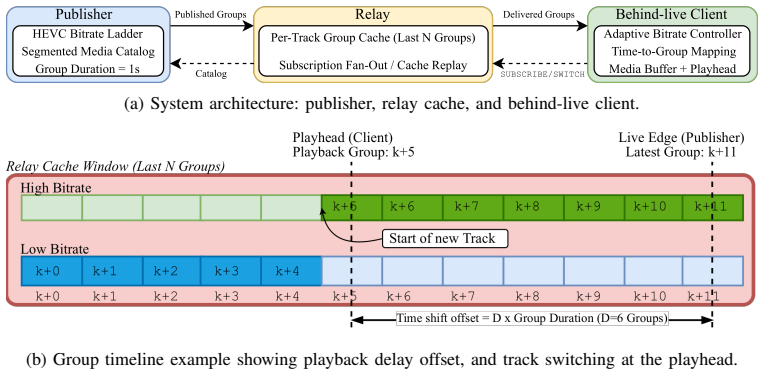
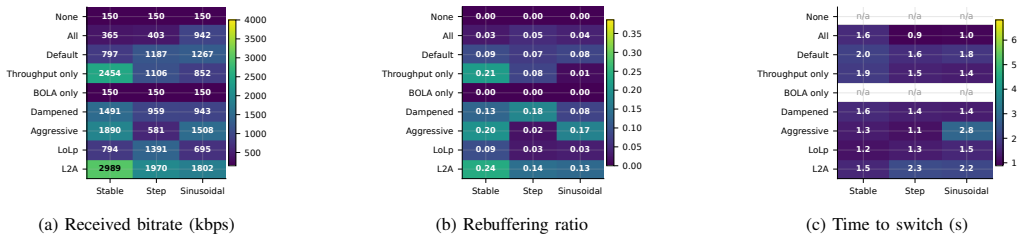
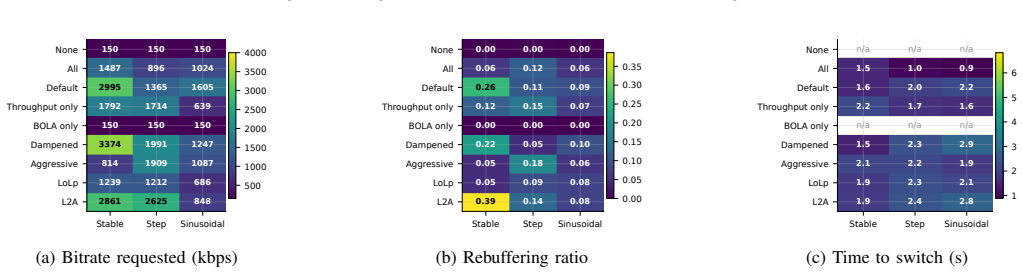
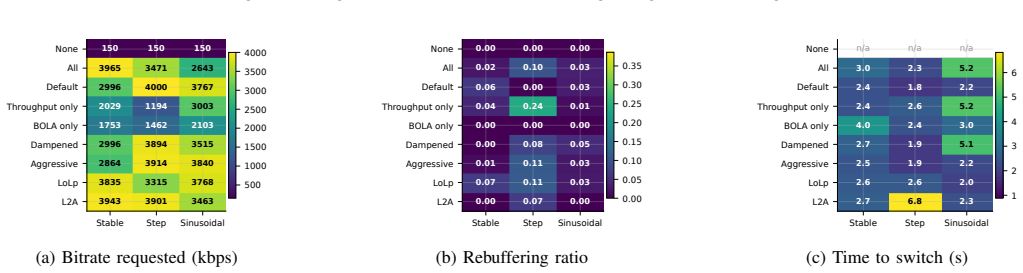
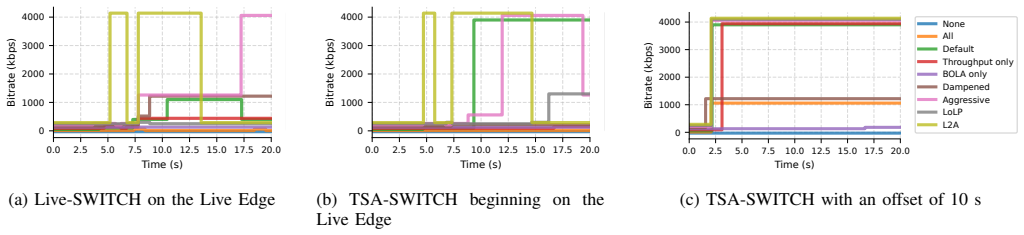
Media over QUIC enables ultra low latency video streaming over QUIC, but its default quality-switching semantics risk introducing playback gaps during periods of network congestion. The in-progress SWITCH specification for MOQ Transport aims to streamline rate adaptation for MoQ. In this work, we characterize the performance of SWITCH-style Adaptive Bitrate (ABR) for both live and time-shifted clients in a Mininet simulated topology. We validate that standard ABR algorithms can be directly applied to time-shifted playback without modification, yielding substantially higher throughput. We demonstrate that a subscriber can experience increased overall throughput after a rebuffering scenario, and we identify focal points for further optimizations of MoQ ABR switching.
Editorial analysis
A structured set of objections, weighed in public.
Referee Report
Summary. The paper evaluates SWITCH-style ABR for live and time-shifted MoQ clients in a Mininet-emulated topology. It claims that unmodified standard ABR algorithms can be applied directly to time-shifted playback and produce substantially higher throughput, that a subscriber can see increased overall throughput after rebuffering, and that focal points for further MoQ ABR optimizations can be identified.
Significance. If the simulation results hold under realistic conditions, the work would support reuse of existing ABR logic for time-shifted MoQ clients, simplifying implementation of the SWITCH specification and highlighting post-rebuffer throughput recovery as a practical benefit.
major comments (2)
- [Simulation Setup] Simulation Setup (inferred from abstract and methods description): the Mininet topology is presented as the sole validation environment for the 'without modification' claim, yet no comparison to real QUIC traces, hardware testbeds, or cross-traffic variability is reported; this is load-bearing because the central throughput gains could be artifacts of idealized scheduling.
- [Evaluation] Results on throughput (abstract and evaluation section): the claim of 'substantially higher throughput' is stated without quantitative deltas, baseline ABR variants, error bars, or statistical tests, undermining the ability to assess whether the gains are robust or specific to the simulated conditions.
minor comments (2)
- [Abstract] Notation inconsistency: 'MOQ' and 'MoQ' appear interchangeably in the abstract; standardize to one form throughout.
- [Abstract] The abstract mentions 'we identify focal points for further optimizations' but provides no concrete list or section reference; add an explicit forward-looking paragraph or table.
Simulated Author's Rebuttal
We thank the referee for the constructive feedback on our simulation-based evaluation of SWITCH-style ABR for MoQ clients. We address the major comments point by point below, focusing on the simulation environment and the presentation of throughput results.
read point-by-point responses
-
Referee: [Simulation Setup] Simulation Setup (inferred from abstract and methods description): the Mininet topology is presented as the sole validation environment for the 'without modification' claim, yet no comparison to real QUIC traces, hardware testbeds, or cross-traffic variability is reported; this is load-bearing because the central throughput gains could be artifacts of idealized scheduling.
Authors: We agree that the evaluation is conducted exclusively in a Mininet-emulated topology and does not include comparisons against real QUIC packet traces, hardware testbeds, or varied cross-traffic patterns. This is a genuine limitation of the current manuscript, as the controlled emulation may not fully capture all real-world scheduling behaviors. The paper's contribution is positioned as an initial characterization in a repeatable simulated setting to isolate ABR switching effects for time-shifted clients. We will revise the discussion and limitations sections to explicitly note the idealized nature of the Mininet environment and the potential for artifacts, while clarifying that the 'without modification' claim is validated within this setup. revision: partial
-
Referee: [Evaluation] Results on throughput (abstract and evaluation section): the claim of 'substantially higher throughput' is stated without quantitative deltas, baseline ABR variants, error bars, or statistical tests, undermining the ability to assess whether the gains are robust or specific to the simulated conditions.
Authors: The evaluation section compares standard ABR algorithms between live and time-shifted playback modes and reports throughput differences, but we acknowledge that the abstract and some result summaries lack explicit quantitative deltas, error bars, or statistical tests. We will revise the abstract and evaluation section to include specific throughput gains (with percentage improvements relative to baselines), error bars on key figures where multiple runs were performed, and clearer identification of the ABR variants used. This will make the robustness of the 'substantially higher throughput' claim more transparent. revision: yes
Circularity Check
No circularity: empirical simulation study with no derivation chain
full rationale
The paper is framed as an empirical evaluation of ABR algorithms in a Mininet-simulated MoQ topology. It reports simulation outcomes for live and time-shifted clients, with the central claim being that standard ABR works unmodified and yields higher throughput. No equations, fitted parameters, predictions derived from inputs, or self-citation chains appear in the provided abstract or description. The work does not invoke uniqueness theorems, ansatzes, or renamings of known results. The simulation fidelity concern raised by the skeptic is a question of external validity, not circularity in any derivation. This is a standard honest non-finding for an evaluation paper.
Axiom & Free-Parameter Ledger
Reference graph
Works this paper leans on
-
[1]
The Global Internet Phenomena Report 2025,
AppLogic Networks, “The Global Internet Phenomena Report 2025,” technical report, AppLogic Networks, Feb. 2025. Accessed: 2026-05- 04
2025
-
[2]
Information technology – dynamic adaptive streaming over http (dash) – part 1: Media presentation description and segment formats,
“Information technology – dynamic adaptive streaming over http (dash) – part 1: Media presentation description and segment formats,” 2022
2022
-
[3]
Low-latency Modes for DASH
DASH-IF and DVB, “Low-latency Modes for DASH.” [Online] Avail- able: https://dashif.org/news/low-latency-dash/, 2020. Accessed: 2026- 05-27
2020
-
[4]
Protocol Extension for Low-Latency HLS
Apple, “Protocol Extension for Low-Latency HLS.” [Online] Available: https://developer.apple.com/documentation/http-live-streaming/ enabling-low-latency-http-live-streaming-hls, 2019. Accessed: 2026-05-27
2019
-
[5]
Low latency live streaming implementation in dash and hls,
A. Bentaleb, Z. Zhan, F. Tashtarian, M. Lim, S. Harous, C. Timmerer, H. Hellwagner, and R. Zimmermann, “Low latency live streaming implementation in dash and hls,” inProceedings of the 30th ACM International Conference on Multimedia, MM ’22, (New York, NY , USA), p. 7343–7346, Association for Computing Machinery, 2022
2022
-
[6]
Scalable high efficiency video coding based http adaptive streaming over quic,
M. Nguyen, H. Amirpour, C. Timmerer, and H. Hellwagner, “Scalable high efficiency video coding based http adaptive streaming over quic,” inProceedings of the Workshop on the Evolution, Performance, and Interoperability of QUIC, EPIQ ’20, (New York, NY , USA), p. 28–34, Association for Computing Machinery, 2020
2020
-
[7]
Take the red pill for h3 and see how deep the rabbit hole goes,
M. Nguyen, C. Timmerer, S. Pham, D. Silhavy, and A. C. Begen, “Take the red pill for h3 and see how deep the rabbit hole goes,” inProceedings of the 1st Mile-High Video Conference, MHV ’22, (New York, NY , USA), p. 7–12, Association for Computing Machinery, 2022
2022
-
[8]
Streaming face-off: A testbed analysis of media-over-quic and low- latency dash,
M. Nguyen, P. Nys, S. Pham, D. Silhavy, S. Arbanowski, and S. Steglich, “Streaming face-off: A testbed analysis of media-over-quic and low- latency dash,” inProceedings of the 16th ACM Multimedia Systems Conference, MMSys ’25, (New York, NY , USA), p. 317–321, Asso- ciation for Computing Machinery, 2025
2025
-
[9]
Media over QUIC Transport
S. Nandakumar, V . Vasiliev, I. Swett, and M. Thomson, “Media over QUIC Transport.” IETF Internet-Draft draft-ietf-moq-transport, 2026. Work in Progress, rev. 17
2026
-
[10]
Media-over-QUIC Transport vs. Low-Latency DASH: A Deathmatch Testbed,
Z. Gurel, T. Erkilic Civelek, D. Ugur, Y . K. Erinc, and A. C. Begen, “Media-over-QUIC Transport vs. Low-Latency DASH: A Deathmatch Testbed,” inProc. 15th ACM Multimedia Systems Conf. (MMSys), pp. 412–418, 2024
2024
-
[11]
Toward accessible and safe live streaming using distributed content filtering with moq,
A. C. Freeman, “Toward accessible and safe live streaming using distributed content filtering with moq,” in2025 IEEE International Conference on Multimedia and Expo Workshops (ICMEW), pp. 1–6, 2025
2025
-
[12]
Client-side video analysis for content moderation with moq,
A. Freeman, J. Bellert, A. Orojo, and G. Speegle, “Client-side video analysis for content moderation with moq,” inProceedings of the 5th Mile-High Video Conference, MHV ’26, (New York, NY , USA), p. 93–99, Association for Computing Machinery, 2026
2026
-
[13]
Moqtail: Open-source, ietf- compliant moqt protocol libraries,
Z. Gurel, D. Ugur, and A. C. Begen, “Moqtail: Open-source, ietf- compliant moqt protocol libraries,” inProceedings of the ACM Mul- timedia Systems Conference 2026, MMSys ’26, (New York, NY , USA), p. 477–483, Association for Computing Machinery, 2026
2026
-
[14]
Http adaptive streaming: A review on current advances and future challenges,
C. Timmerer, H. Amirpour, F. Tashtarian, S. Afzal, A. Rizk, M. Zink, and H. Hellwagner, “Http adaptive streaming: A review on current advances and future challenges,”ACM Trans. Multimedia Comput. Commun. Appl., vol. 21, July 2025
2025
-
[15]
Analysis and design of the google congestion control for web real-time communica- tion (webrtc),
G. Carlucci, L. De Cicco, S. Holmer, and S. Mascolo, “Analysis and design of the google congestion control for web real-time communica- tion (webrtc),” inProceedings of the 7th International Conference on Multimedia Systems, MMSys ’16, (New York, NY , USA), Association for Computing Machinery, 2016
2016
-
[16]
MOQT Streaming Format
W. Law, “MOQT Streaming Format.” IETF Internet-Draft draft-ietf- moq-msf, 2025. Work in Progress
2025
-
[17]
CMSF—a CMAF Compliant Implementation of MOQT Streaming Format
W. Law, “CMSF—a CMAF Compliant Implementation of MOQT Streaming Format.” IETF Internet-Draft draft-ietf-moq-cmsf, 2025. Work in Progress
2025
-
[18]
Track Switching in Media over QUIC Transport,
Z. G ¨urel and A. C. Begen, “Track Switching in Media over QUIC Transport,” Internet-Draft draft-gurel-moq-track-switching-01, Internet Engineering Task Force, Feb. 2025. Work in Progress
2025
-
[19]
SWITCH for Client-side ABR by gwendalsimon · Pull Request #1378 · moq-wg/moq-transport,
G. Simon, “SWITCH for Client-side ABR by gwendalsimon · Pull Request #1378 · moq-wg/moq-transport,” 2026
2026
-
[20]
Media over QUIC Transport,
S. Nandakumar, V . Vasiliev, I. Swett, and A. Frindell, “Media over QUIC Transport,” Internet-Draft draft-ietf-moq-transport-14, Internet Engineering Task Force, Sept. 2025. Work in Progress
2025
-
[21]
Tears of steel
Blender Foundation, “Tears of steel.” Mango Open Movie Project, 2012. Directed by Ian Hubert; released under Creative Commons Attribution 3.0
2012
-
[22]
dash.js: Reference MPEG-DASH player
DASH Industry Forum, “dash.js: Reference MPEG-DASH player.” https://github.com/Dash-Industry-Forum/dash.js/releases/tag/v5.0.3,
-
[23]
Commit:abc1234, accessed 2026-05-10
2026
-
[24]
dash.js ABR Settings Documentation
DASH Industry Forum, “dash.js ABR Settings Documentation.” https:// dashif.org/dash.js/pages/usage/abr/settings.html. Accessed: 2026-05-27
2026
-
[25]
dash.js ThroughputRule Documentation
DASH Industry Forum, “dash.js ThroughputRule Documentation.” https: //dashif.org/dash.js/pages/usage/abr/throughput-rule.html. Accessed: 2026-05-27
2026
-
[26]
BOLA: Near-Optimal Bitrate Adaptation for Online Videos,
K. Spiteri, R. Urgaonkar, and R. K. Sitaraman, “BOLA: Near-Optimal Bitrate Adaptation for Online Videos,”IEEE/ACM Transactions on Networking, vol. 28, no. 4, pp. 1698–1711, 2020
2020
-
[27]
From Theory to Practice: Improving Bitrate Adaptation in the DASH Reference Player,
K. Spiteri, R. Sitaraman, and D. Sparacio, “From Theory to Practice: Improving Bitrate Adaptation in the DASH Reference Player,”ACM Transactions on Multimedia Computing, Communications, and Applica- tions, vol. 15, no. 2s, 2019
2019
-
[28]
dash.js SwitchHistoryRule Documentation
DASH Industry Forum, “dash.js SwitchHistoryRule Documentation.” https://dashif.org/dash.js/pages/usage/abr/switch-history-rule.html. Ac- cessed: 2026-05-27
2026
-
[29]
When They Go High, We Go Low: Low-Latency Live Streaming in dash.js with LoL,
M.-F. Lim, M. N. Akcay, A. Bentaleb, A. C. Begen, and R. Zim- mermann, “When They Go High, We Go Low: Low-Latency Live Streaming in dash.js with LoL,” inProceedings of the 11th ACM Multimedia Systems Conference, MMSys ’20, pp. 321–326, Association for Computing Machinery, 2020
2020
-
[30]
Catching the Moment With LoL+ in Twitch-Like Low-Latency Live Streaming Platforms,
A. Bentaleb, M. N. Akcay, M. Lim, A. C. Begen, and R. Zimmer- mann, “Catching the Moment With LoL+ in Twitch-Like Low-Latency Live Streaming Platforms,”IEEE Transactions on Multimedia, vol. 24, pp. 2300–2314, 2022
2022
-
[31]
Online Learning for Low-Latency Adaptive Streaming,
T. Karagkioules, R. Mekuria, D. Griffioen, and A. Wagenaar, “Online Learning for Low-Latency Adaptive Streaming,” inProceedings of the 11th ACM Multimedia Systems Conference, MMSys ’20, pp. 315–320, Association for Computing Machinery, 2020
2020
-
[32]
A network in a laptop: rapid prototyping for software-defined networks,
B. Lantz, B. Heller, and N. McKeown, “A network in a laptop: rapid prototyping for software-defined networks,” inProceedings of the 9th ACM SIGCOMM Workshop on Hot Topics in Networks, Hotnets-IX, (New York, NY , USA), Association for Computing Machinery, 2010
2010
discussion (0)
Sign in with ORCID, Apple, or X to comment. Anyone can read and Pith papers without signing in.