Locally conservative redistribution limiting and applications to the approximation of conservation equations, Part II
Pith reviewed 2026-06-26 08:04 UTC · model grok-4.3
The pith
A redistribution-based limiting technique enforces local conservation without depending on the discretization or PDE.
A machine-rendered reading of the paper's core claim, the machinery that carries it, and where it could break.
Core claim
The paper claims to introduce a non-intrusive, discretization and PDE agnostic limiting technique based on redistribution. This technique is stated to be conservative and applicable to high-order approximations including spectral methods. It is further claimed to handle both time-dependent and time-independent problems and to apply to elliptic, parabolic, and hyperbolic problems.
What carries the argument
The locally conservative redistribution limiting procedure, which adjusts an approximate solution to restore local conservation properties after the base computation.
If this is right
- The technique applies to spectral methods for high-order accuracy.
- It works for both time-dependent and time-independent problems.
- It covers elliptic, parabolic, and hyperbolic equations.
- Conservation is achieved without modifying the underlying discretization.
Where Pith is reading between the lines
- The approach might allow conservation to be restored as a separate post-processing step in existing codes.
- Its claimed independence from the PDE type could simplify testing across different equation classes.
Load-bearing premise
That a redistribution procedure can be built to enforce local conservation without depending on the details of any particular discretization scheme or PDE.
What would settle it
A concrete high-order spectral discretization of a hyperbolic conservation law in which the redistributed solution fails to satisfy local conservation.
Figures
read the original abstract
A non-intrusive, discretization and PDE agnostic limiting technique is introduced. The method is conservative and can be applied to high-order approximations including spectral methods. It can be applied to time-dependent and time-independent problems. It can be used for elliptic, parabolic and hyperbolic problems.
Editorial analysis
A structured set of objections, weighed in public.
Referee Report
Summary. The manuscript introduces a non-intrusive redistribution-based limiting procedure for enforcing local conservation in numerical approximations of conservation equations. The technique is presented as discretization- and PDE-agnostic, applicable to high-order methods including spectral discretizations, and suitable for both time-dependent and steady problems across elliptic, parabolic, and hyperbolic regimes.
Significance. If the explicit construction and supporting analysis hold, the method supplies a general, non-intrusive tool for restoring local conservation without modifying the underlying scheme or PDE form. This is a potentially useful contribution for practitioners working with high-order or spectral approximations where conservation must be recovered post hoc.
minor comments (2)
- [Abstract] The abstract supplies no equations or concrete algorithmic outline; a one-sentence description of the redistribution step would improve accessibility.
- [Introduction] Notation for the redistribution operator and the local conservation statement should be introduced with a clear reference to the preceding Part I paper to avoid ambiguity for readers.
Simulated Author's Rebuttal
We thank the referee for the positive summary, significance assessment, and recommendation of minor revision. No specific major comments were raised in the report.
Circularity Check
No significant circularity identified
full rationale
The manuscript supplies an explicit construction, algorithm, and supporting analysis for the redistribution limiting procedure. This makes the central claim of a non-intrusive, discretization- and PDE-agnostic conservative limiter self-contained rather than reducing by definition or self-citation to its inputs. No load-bearing step equates a derived quantity to a fitted parameter or prior self-citation by construction; the provided details constitute independent content meeting the load-bearing condition externally to any circular reduction.
Axiom & Free-Parameter Ledger
Reference graph
Works this paper leans on
-
[1]
repair” method introduced in Kucharik et al. [21, §2.3] and the “sweeping method
Introduction.This paper is the second part of a work started in Guer- mond and Wang [12] about limiting. It is also an extension of the “repair” method introduced in Kucharik et al. [21, §2.3] and the “sweeping method” proposed in Griffin and Shu [9], Liu et al. [30]. 1.1. Objectives and content of the paper.This work is part of a long term research proje...
Pith/arXiv arXiv 2008
-
[2]
and in [12] in the context of the steady state neutron transport equa- tion, and in both cases CRL has been demonstrated to be efficient and robust. The method has been shown in [9, 30] to be effective to limit explicit ap- proximations of the compressible Euler equations using various approximation techniques (including Fourier). Notice finally that as o...
-
[3]
generalizedmass
Iterative limiting algorithm: notation, heuristics.Since the al- gorithms presented in the paper are not specific to any particular discretization or system of conservation equations, we start by introducing some abstract no- tation to reflect this generality. 2.1. The convex invariant set and heuristics.Letqbe a natural number larger than or equal to1. W...
-
[4]
good” numerical methods producing the “unlimited
Jacobi Cell limiting.We propose a Jacobi-like algorithm based on a twofold strategy: we first balance the bounds locally on each cell, then average the local limited state at the end of the loop over the cells. The operations done on each cell are independent of the operations done on the other cells. This approach solves the issues with parallelism ident...
-
[5]
The objective of this algorithm is only purely theoretical
Global limiting.As the local limiting algorithm described in §3 is not guaranteed to converge in a fixed number of iterations independent of the cardinality of the index setV, we now propose a global post-processing tech- niqueL g : (B l−1)I → B l (the super-index gstands for “global”) that proceeds as in [12, §2.3]. The objective of this algorithm is onl...
-
[6]
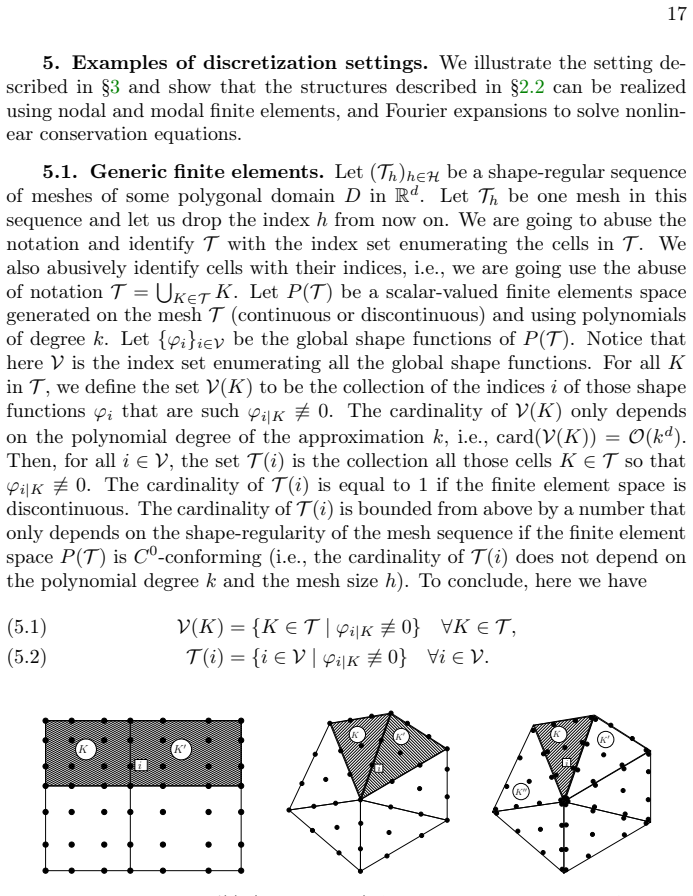
Examples of discretization settings.We illustrate the setting de- scribed in §3 and show that the structures described in §2.2 can be realized using nodal and modal finite elements, and Fourier expansions to solve nonlin- ear conservation equations. 5.1. Generic finite elements.Let(T h)h∈H be a shape-regular sequence of meshes of some polygonal domainDinR...
-
[7]
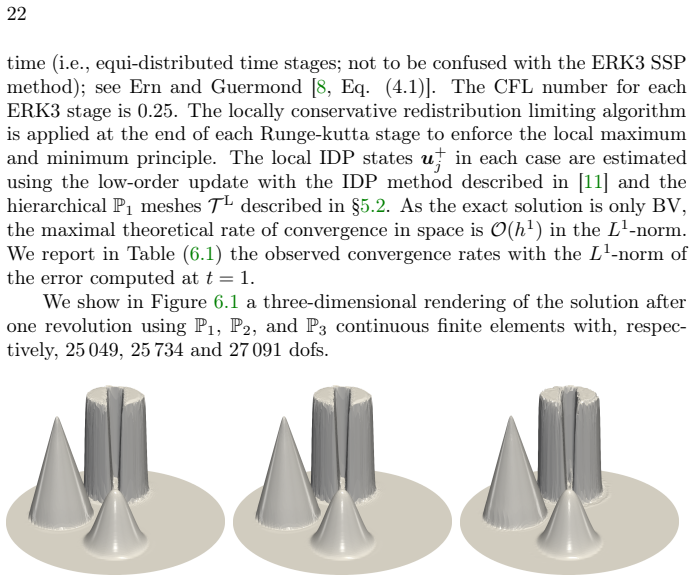
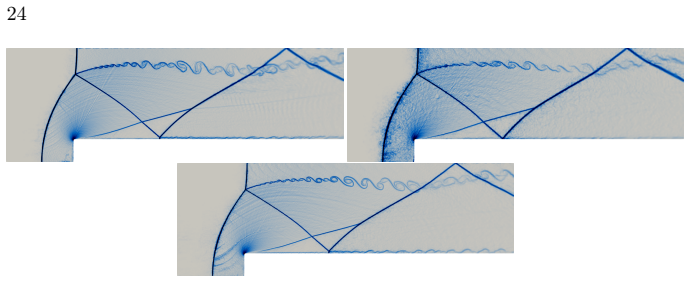
Numerical illustrations.We now go briefly over a standard series of benchmark problems to illustrate the versatility of the proposed conservative redistribution limiting technique. We have verified on tests not reported here for brevity that the proposed limiting technique is indeed consistent, and high- order accuracy is maintained when the exact solutio...
1921
-
[8]
R. Abgrall, Q. Viville, H. Beaugendre, and C. Dobrzynski. Construction of ap-adaptive continuous residual distribution scheme.J. Sci. Comput., 72(3):1232–1268, 2017. ISSN 0885-7474. doi: 10.1007/s10915-017-0399-6. URL https://doi.org/10.1007/s10915-017-0399-6
-
[9]
Abgrall, P
R. Abgrall, P. Bacigaluppi, and S. Tokareva. High-order residual distri- bution scheme for the time-dependent Euler equations of fluid dynamics. Comput. Math. Appl., 78(2):274–297, 2019
2019
-
[10]
F. S. A. Alrashed.Parallel multiphase Navier-Stokes solver. ProQuest LLC, Ann Arbor, MI, 2015. URL https://oaktrust.library.tamu.edu/ bitstream/handle/1969.1/155339/ALRASHED-DISSERTATION-2015. pdf. Thesis (Ph.D.)–Texas A&M University
2015
-
[11]
R. Anderson, V. Dobrev, T. Kolev, D. Kuzmin, M. Quezada de Luna, R. Rieben, and V. Tomov. High-order local maximum principle preserving (MPP) discontinuous Galerkin finite element method for the transport equation.J. Comput. Phys., 334:102–124, 2017. ISSN 0021-9991. doi: 10. 1016/j.jcp.2016.12.031. URL https://doi.org/10.1016/j.jcp.2016.12.031
-
[12]
Bochev, D
P. Bochev, D. Ridzal, and K. Peterson. Optimization-based remap and transport: A divide and conquer strategy for feature-preserving discretiza- tions.J. Comput. Phys., 257:1113–1139, 2014
2014
-
[13]
J. P. Boris and D. L. Book. Flux-corrected transport. i. shasta, 25 a fluid transport algorithm that works.Journal of Computational Physics, 11(1):38–69, 1973. ISSN 0021-9991. doi: https://doi.org/ 10.1016/0021-9991(73)90147-2. URL https://www.sciencedirect.com/ science/article/pii/0021999173901472
-
[14]
Després and R
B. Després and R. Loubère. Convergence and sensitivity analysis of repair algorithms in 1D.Int. J. Finite Vol., 3(1):27, 2006. ISSN 1634-0655
2006
-
[15]
A. Ern and J.-L. Guermond. Invariant-domain-preserving high-order time stepping: I. Explicit Runge-Kutta schemes.SIAM J. Sci. Comput., 44(5): A3366–A3392, 2022. doi: 10.1137/21M145793X. URL https://doi.org/10. 1137/21M145793X
-
[16]
D. C. Griffin and C.-W. Shu. A sweeping positivity-preserving high-order finite difference WENO scheme for Euler equations.Res. Math. Sci., 13 (2):Paper No. 38, 25, 2026. ISSN 2522-0144,2197-9847. doi: 10.1007/ s40687-026-00621-2. URL https://doi.org/10.1007/s40687-026-00621-2
-
[17]
J.-L. Guermond and R. Pasquetti. Entropy-based nonlinear viscosity for Fourierapproximationsofconservationlaws.C. R. Math. Acad. Sci. Paris, 346(13-14):801–806, 2008. ISSN 1631-073X. doi: 10.1016/j.crma.2008.05
-
[18]
URL https://doi.org/10.1016/j.crma.2008.05.013
-
[19]
J.-L. Guermond and B. Popov. Invariant domains and first-order contin- uous finite element approximation for hyperbolic systems.SIAM Journal on Numerical Analysis, 54(4):2466–2489, 2016. doi: 10.1137/16M1074291. URL https://doi.org/10.1137/16M1074291
-
[20]
J.-L. Guermond and Z. Wang. Mass conservative limiting and applications to the approximation of the steady-state radiation transport equations.J. Comput. Phys., 521(part 1):Paper No. 113531, 20, 2025. ISSN 0021-9991. doi: 10.1016/j.jcp.2024.113531. URL https://doi.org/10.1016/j.jcp.2024. 113531
-
[21]
J.-L. Guermond, R. Pasquetti, and B. Popov. From suitable weak so- lutions to entropy viscosity.J. Sci. Comput., 49(1):35–50, 2011. ISSN 0885-7474. doi: 10.1007/s10915-010-9445-3. URL https://doi.org/10. 1007/s10915-010-9445-3
-
[22]
Guermond, M
J.-L. Guermond, M. Nazarov, B. Popov, and I. Tomas. Second-order invariant domain preserving approximation of the Euler equations using convex limiting.SIAM J. Sci. Comput., 40(5):A3211–A3239, 2018
2018
-
[23]
J.-L. Guermond, B. Popov, and I. Tomas. Invariant domain preserving discretization-independent schemes and convex limiting for hyperbolic sys- tems.Comput. Methods Appl. Mech. Engrg., 347:143–175, 2019. ISSN 0045-7825. doi: 10.1016/j.cma.2018.11.036. URLhttps://doi.org/10.1016/ j.cma.2018.11.036
-
[24]
J.-L. Guermond, M. Maier, B. Popov, L. Saavedra, and I. Tomas. First- order greedy invariant-domain preserving approximation for hyperbolic problems: scalar conservation laws, andp-system.J. Sci. Comput., 100(2): 26 PaperNo.46, 26, 2024. ISSN0885-7474. doi: 10.1007/s10915-024-02592-4. URL https://doi.org/10.1007/s10915-024-02592-4
-
[25]
J.-L. Guermond, M. Nazarov, and B. Popov. Finite element-based invariant-domain preserving approximation of hyperbolic systems: beyond second-order accuracy in space.Comput. Methods Appl. Mech. Engrg., 418 (part A):Paper No. 116470, 22, 2024. ISSN 0045-7825. doi: 10.1016/j.cma. 2023.116470. URL https://doi.org/10.1016/j.cma.2023.116470
-
[26]
J. S. Hesthaven and T. Warburton.Nodal discontinuous Galerkin meth- ods, volume 54 ofTexts in Applied Mathematics. Springer, New York,
-
[27]
doi: 10.1007/978-0-387-72067-8
ISBN 978-0-387-72065-4. doi: 10.1007/978-0-387-72067-8. URL https://doi.org/10.1007/978-0-387-72067-8. Algorithms, analysis, and ap- plications
-
[28]
G. E. Karniadakis and S. J. Sherwin.Spectral/hpelement methods for CFD. Numerical Mathematics and Scientific Computation. Oxford Uni- versity Press, New York, 1999. ISBN 0-19-510226-6
1999
-
[29]
V. Kolgan. Application of the principle of minimizing the derivative to the construction of finite-difference schemes for computing discontinu- ous solutions of gas dynamics.Journal of Computational Physics, 230 (7):2384–2390, 2011. ISSN 0021-9991. doi: https://doi.org/10.1016/ j.jcp.2010.12.033. URL https://www.sciencedirect.com/science/article/ pii/S002...
2011
-
[30]
M. Kucharik, M. Shashkov, and B. Wendroff. An efficient linearity- and-bound-preserving remapping method.Journal of Computational Physics, 188(2):462–471, 2003. ISSN 0021-9991. doi: https://doi.org/ 10.1016/S0021-9991(03)00187-6. URL https://www.sciencedirect.com/ science/article/pii/S0021999103001876
-
[31]
Kurganov, G
A. Kurganov, G. Petrova, and B. Popov. Adaptive semidiscrete central- upwind schemes for nonconvex hyperbolic conservation laws.SIAM Jour- nal on Scientific Computing, 29(6):2381–2401, 2007
2007
-
[32]
Kuzmin and M
D. Kuzmin and M. Quezada de Luna. Subcell flux limiting for high-order Bernstein finite element discretizations of scalar hyperbolic conservation laws.J. Comput. Phys., 411:109411, 19, 2020
2020
-
[33]
D. Kuzmin and S. Turek. Flux correction tools for finite elements.J. Comput. Phys., 175(2):525–558, 2002. ISSN 0021-9991. doi: 10.1006/ jcph.2001.6955. URL https://doi.org/10.1006/jcph.2001.6955
-
[34]
Kuzmin, R
D. Kuzmin, R. Löhner, and S. Turek.Flux-Corrected Transport: Prin- ciples, Algorithms, and Applications. Scientific Computation. Springer,
-
[35]
doi: 10.1007/978-94-007-4038-9
ISBN 978-94-007-4037-2. doi: 10.1007/978-94-007-4038-9
-
[36]
M. P. Laiu and C.D. Hauck. Positivity limiters forfiltered spectral approx- imations of linear kinetic transport equations.J. Sci. Comput., 78(2):918– 950, 2019. ISSN 0885-7474,1573-7691. doi: 10.1007/s10915-018-0790-y. 27 URL https://doi.org/10.1007/s10915-018-0790-y
-
[37]
C. Liu, B. Riviere, J. Shen, and X. Zhang. A simple and efficient con- vex optimization based bound-preserving high order accurate limiter for cahn–hilliard–navier–stokes system.SIAM Journal on Scientific Comput- ing, 46(3):A1923–A1948, 2024
2024
-
[38]
C. Liu, D. Milesis, C.-W. Shu, and X. Zhang. Efficient optimization- based invariant-domain-preserving limiters in solving gas dynamics equa- tions.Journal of Computational Physics, 558:114839, 2026. ISSN 0021-
2026
-
[39]
doi: https://doi.org/10.1016/j.jcp.2026.114839. URL https://www. sciencedirect.com/science/article/pii/S0021999126001890
-
[40]
Liu and E
X.-D. Liu and E. Tadmor. Third order nonoscillatory central scheme for hyperbolic conservation laws.Numer. Math., 79(3):397–425, 1998
1998
-
[41]
Y. Liu, Y. Cheng, and C.-W. Shu. A simple bound-preserving sweep- ing technique for conservative numerical approximations.J. Sci. Com- put., 73(2-3):1028–1071, 2017. ISSN 0885-7474,1573-7691. doi: 10.1007/ s10915-017-0395-x. URL https://doi.org/10.1007/s10915-017-0395-x
-
[42]
R. Loubère, M. Staley, and B. Wendroff. The repair paradigm: new algo- rithms and applications to compressible flow.J. Comput. Phys., 211(2): 385–404, 2006. ISSN 0021-9991,1090-2716. doi: 10.1016/j.jcp.2005.05.010. URL https://doi.org/10.1016/j.jcp.2005.05.010
-
[43]
W. Pazner. Sparse invariant domain preserving discontinuous Galerkin methods with subcell convex limiting.Comput. Methods Appl. Mech. En- grg., 382:Paper No. 113876, 28, 2021. ISSN 0045-7825. doi: 10.1016/j. cma.2021.113876. URL https://doi.org/10.1016/j.cma.2021.113876
work page doi:10.1016/j 2021
-
[44]
Quezada De Luna.High-order maximum principle preserving (MPP) techniques for solving conservation laws with applications on multiphase flow
M. Quezada De Luna.High-order maximum principle preserving (MPP) techniques for solving conservation laws with applications on multiphase flow. ProQuest LLC, Ann Arbor, MI, 2016. URL https://oaktrust.library.tamu.edu/bitstream/handle/1969.1/158007/ QUEZADADELUNA-DISSERTATION-2016.pdf. Thesis (Ph.D.)–Texas A&M University
2016
-
[45]
W. Rider, D. Kothe, W. Rider, and D. Kothe.Constrained minimization for monotonic reconstruction. doi: 10.2514/6.1997-2036. URL https:// arc.aiaa.org/doi/abs/10.2514/6.1997-2036
-
[46]
R. Sanders. A third-order accurate variation nonexpansive difference scheme for single nonlinear conservation laws.Math. Comp., 51(184): 535–558, 1988
1988
-
[47]
M. Shashkov and B. Wendroff. The repair paradigm and application to conservation laws.J. Comput. Phys., 198(1):265–277, 2004. ISSN 0021- 9991,1090-2716. doi: 10.1016/j.jcp.2004.01.014. URL https://doi.org/10. 1016/j.jcp.2004.01.014
-
[48]
M. A. Taylor, B. A. Wingate, and R. E. Vincent. An algorithm for com- puting Fekete points in the triangle.SIAM J. Numer. Ana., 38(5):1707– 28 1720, 2000. ISSN 0036-1429. doi: 10.1137/S0036142998337247. URL https://doi.org/10.1137/S0036142998337247
-
[49]
B. van Leer. Towards the ultimate conservative difference scheme. ii. monotonicity and conservation combined in a second-order scheme.Jour- nal of Computational Physics, 14(4):361–370, 1974. ISSN 0021-9991. doi: https://doi.org/10.1016/0021-9991(74)90019-9. URL https://www. sciencedirect.com/science/article/pii/0021999174900199
-
[50]
F. Vilar and R. Abgrall. A posteriori local subcell correction of high-order discontinuous Galerkin scheme for conservation laws on two-dimensional unstructured grids.SIAM J. Sci. Comput., 46(2):A851–A883, 2024. ISSN 1064-8275. doi: 10.1137/22M1542696. URL https://doi.org/10.1137/ 22M1542696
-
[51]
S. T. Zalesak. Fully multidimensional flux-corrected transport algo- rithms for fluids.J. Comput. Phys., 31(3):335–362, 1979. doi: 10.1016/ 0021-9991(79)90051-2. URL http://dx.doi.org/10.1016/0021-9991(79) 90051-2
-
[52]
Zhang and C.-W
X. Zhang and C.-W. Shu. On maximum-principle-satisfying high order schemes for scalar conservation laws.J. Comput. Phys., 229(9):3091–3120,
-
[53]
doi: 10.1016/j.jcp.2009.12.030
ISSN 0021-9991. doi: 10.1016/j.jcp.2009.12.030. URL https://doi. org/10.1016/j.jcp.2009.12.030
-
[54]
X. Zhang and C.-W. Shu. Maximum-principle-satisfying and positivity- preserving high-order schemes for conservation laws: survey and new de- velopments.Proc. R. Soc. Lond. Ser. A Math. Phys. Eng. Sci., 467(2134): 2752–2776, 2011. ISSN 1364-5021. doi: 10.1098/rspa.2011.0153. URL https://doi.org/10.1098/rspa.2011.0153
discussion (0)
Sign in with ORCID, Apple, or X to comment. Anyone can read and Pith papers without signing in.