REVIEW 7 minor 1 cited by
Murnaghan--Nakayama rules for symplectic, orthogonal and orthosymplectic Schur functions
T0 review · 0 major / 7 minor · reviewed 2026-08-12 · deepseek-v4-flash
Pith's one-line read This paper proves Murnaghan–Nakayama rules for symplectic, orthogonal, and orthosymplectic Schur functions, expanding $p_r$ times each character as a signed sum with border-strip additions, removals, and a reflected term.
desk verdict Solid new MN rules for symplectic, orthogonal, and orthosymplectic Schur functions; the proofs are essentially right, with two terse basis-replacement steps that need expanding but are not gaps. read the letter →
The pith
A machine-rendered reading of the paper's core claim, the machinery that carries it, and where it could break.
The reading
What carries the argument
The engine is the determinant form of the characters. For $\alpha$ with integer or half-integer coordinates, set $A_\alpha = \det(x_i^{\alpha_j} - x_i^{-\alpha_j})$ and $N_\alpha = \det(x_i^{\alpha_j} + x_i^{-\alpha_j})$. Lemma 3.1 gives the identity $p_r A_\alpha = \sum_j A_{\alpha+r\epsilon_j} + \sum_j A_{\alpha-r\epsilon_j}$, and the analogous identity for $N_\alpha$; dividing by the denominator $A_\delta$ turns this into a statement about symplectic Schur functions, and similarly for orthogonal characters. The orthosymplectic proof uses the vertical-strip decomposition $\mathrm{spo}_\lambda(X/Y) = \sum_{\lambda/\nu \in \mathrm{VS}} \mathrm{spo}_\nu(X/Y) y_m^{|\lambda|-|\nu|}$ and two lemmas (4.1 and 4.2) that transfer identities from hook Schur functions to orthosymplectic Schur functions by matching coefficients after cancellations. The transfer relies on the fact that the set of hook Schur functions indexed by admissible partitions forms a basis of the supersymmetric function ring.
What would settle it
Compute a concrete case with a nonzero third term, such as $n=3$, $\mu=(4,3,1)$, $r=6$ from Example 3.6, by evaluating both sides of Theorem 3.4 as explicit Laurent polynomials using the determinant character formula; if the coefficient of any $\mathrm{sp}_{\mu^{(q)}}$ fails to match, the rule is false. Similarly, test the orthosymplectic case in Example 4.4 with $\lambda=(2,2)$, $n=2$, $m=2$, $r=3$.
Extended reading notes
Core claim
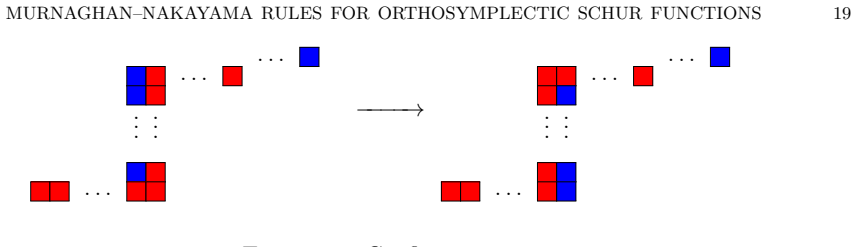
The central claim is Theorem 3.4: for a partition $\mu$ of length at most $n$ and an integer $r \ge 1$, $$p_r \mathrm{sp}_\mu = \sum_{\eta/\mu \in \mathrm{BS}(r)} (-1)^{\mathrm{ht}(\eta/\mu)} \mathrm{sp}_\eta + \sum_{\mu/\xi \in \mathrm{BS}(r)} (-1)^{\mathrm{ht}(\mu/\xi)} \mathrm{sp}_\xi + \sum_{q=m(\mu)+1}^{n} (-1)^{p(q)-q+1} \mathrm{sp}_{\$mu^{{(q)}}$}.$$ The first sum is the classical border-strip addition; the second keeps the same shape and removes a border strip; the third is a new reflection term, where $\mu^{(q)}$ is obtained from $\mu$ by a row deletion and reinsertion procedure. The analogous rules for odd orthogonal characters (Theorem 3.7) and even orthogonal characters (Theorem 3.10, with the factors $(1+\delta_{\eta_n,0})/(1+\delta_{\mu_n,0})$) follow by replacing the symplectic determinant $A_\alpha$ with $N_\alpha$. The orthosymplectic rule (Theorem 4.3) is a hybrid: its third term mixes symplectic Schur functions in the $X$ variables with ordinary Schur functions in the $Y$ variables.
Load-bearing premise
The orthosymplectic rule depends on the claim that an identity proved for hook Schur functions remains true after replacing each hook Schur function by the corresponding orthosymplectic Schur function, because the coefficients on both sides match after cancellations; the paper asserts this transfer without checking every partition that survives cancellation.
Editorial extensions
If this is right
- When $\mu_n + 1 \ge r$, the third term in the symplectic rule vanishes, giving the clean identity $p_r \mathrm{sp}_\mu = \sum_{\eta/\mu \in \mathrm{BS}(r)} (-1)^{\mathrm{ht}(\eta/\mu)} \mathrm{sp}_\eta + \sum_{\mu/\xi \in \mathrm{BS}(r)} (-1)^{\mathrm{ht}(\mu/\xi)} \mathrm{sp}_\xi$ (Corollary 3.5), and analogously for orthosymplectic characters (Corollary 4.6).
- The rules give a direct, combinatorial way to multiply power sums with characters of the symplectic, orthogonal, and orthosymplectic groups, avoiding the determinant form of the character formula.
- The orthosymplectic rule expresses $P_r(X,X/Y)\mathrm{spo}_\lambda(X/Y)$ as a sum of orthosymplectic Schur functions plus a term mixing symplectic and ordinary Schur functions, showing that the orthosymplectic character ring is not closed under multiplication by power sums in the same simple way.
- The third term in the symplectic rule provides a new combinatorial operation on partitions—remove a row, shift intermediate rows, and add a reflected row—which can be studied independently as a statistic on Young diagrams.
Reading between the lines
- Beyond the paper: the coefficient-matching technique used for the orthosymplectic transfer suggests a general basis-replacement principle: any identity among Schur functions with integer coefficients, once checked, transfers to any family $f_\lambda$ indexed by the same partitions by matching supports after cancellations.
- Beyond the paper: the third term of the symplectic rule may correspond to the contragredient involution on the symplectic character ring; if so, the $p(q)$ statistic should match the action of the longest element of the Weyl group.
- Beyond the paper: the border-strip removal term has no classical analogue for ordinary Schur functions, where $p_r s_\mu$ only involves border-strip additions; it arises because the denominator for symplectic and orthogonal characters makes negative shifts $A_{\alpha - r\epsilon_j}$ nonzero, suggesting that similar removal terms should appear in other character settings with Weyl groups of type $B
Signed reviews
Editorial analysis
A structured set of objections, weighed in public.
Referee Report
Summary. The paper establishes Murnaghan–Nakayama rules for symplectic, odd orthogonal, even orthogonal, and orthosymplectic Schur functions. For each family, the product of the relevant power-sum function with a character is expressed as a sum of three terms: a border-strip addition term, a border-strip removal term, and a third term described both algebraically and combinatorially. The proofs use determinantal identities (Lemmas 3.1 and 3.9) and, for the orthosymplectic case, an induction on the number of y-variables that transfers identities from ordinary and hook Schur functions to orthosymplectic Schur functions via basis arguments (Lemmas 4.1 and 4.2).
Significance. If correct, these results provide natural and useful extensions of the classical Murnaghan–Nakayama rule to characters of symplectic, orthogonal, and orthosymplectic groups and supergroups. The symplectic and orthogonal rules are new, and the orthosymplectic rule is a nontrivial hybrid involving both symplectic and ordinary Schur functions. The paper is largely self-contained, with explicit examples, and the algebraic proofs are mostly complete. A notable strength is that the key basis-transfer lemmas are valid: the identities are linear, and the replacement of hook Schur functions by orthosymplectic Schur functions is justified because the coefficient comparison is performed in a basis. The combinatorial descriptions add concreteness, though one combinatorial proof is only sketched.
minor comments (7)
- [Section 4, combinatorial proof of (4.2)] The combinatorial proof ends with the sentence 'One can describe similar cancellations that occur in the left-hand side of (4.2) and, since each of the correspondences is reversible, this completes the proof.' This is a hand-waving clause; since the algebraic proof of Lemma 4.1 is complete, this is not a correctness issue, but the combinatorial proof should either be finished or explicitly labeled as a sketch.
- [Introduction and References] There are several typos: 'Murnaghan–Nakayma' in the Introduction, 'Stanely' should be 'Stanley', and the reference [Nak41] misspells 'Nakayama' as 'Nakayma'.
- [Lemma 4.2 proof] In the last sentence of the proof of Lemma 4.2, 'the equality in (4.3) also holds' should refer to (4.4).
- [Lemma 3.1 proof] The displayed expansion of A_{\alpha+r\epsilon_j} is dense and the indexing is hard to follow; a short explanation of the row-swap argument and the role of each term would improve readability.
- [Example 2.5] The five symplectic tableaux of shape (1,1) are not clearly typeset, making it difficult to verify the count and the resulting polynomial.
- [Theorem 3.7] The statement says the proof is obtained by replacing δ=(n,...,1) with δ=(n-1/2,...,1/2); it would be helpful to note explicitly that the determinant identity in Lemma 3.1 and the reflection argument extend to half-integer shifts without change.
- [Theorem 4.3 proof] When (2.5) is invoked to replace the sum over ν with s_{\lambda'/\mu'}(Y), the argument implicitly uses the conjugate version of (2.5), since the relevant strips are vertical rather than horizontal; this should be stated for clarity.
Circularity Check
No circularity: derivation reduces to classical MN rule, Weyl determinant formulas, and external basis theorems, not to its own conclusions.
full rationale
The derivation chain is self-contained against external classical inputs rather than against its own conclusions. The symplectic rule (Theorem 3.4) is proved from the determinant identity pr A_alpha = sum_j A_{alpha+r epsilon_j} + sum_j A_{alpha-r epsilon_j} (Lemma 3.1), which is proved by induction on n, together with Weyl's symplectic character formula (2.9); no coefficient is fitted and the target product identity is never assumed. The orthogonal rules (Theorems 3.7 and 3.10) are obtained by the same determinant argument with shifted half-integer delta and the analogous determinant N_alpha, again without circular reuse. The orthosymplectic rule (Theorem 4.3) is proved by induction on m, using the hook-Schur Murnaghan-Nakayama rule (Theorem 2.6), which is itself derived from the classical MN rule via plethysm, together with Stembridge's external basis theorem for supersymmetric functions and the vertical-strip recurrence (2.13). The basis-replacement steps in Lemmas 4.1 and 4.2 are terse, but they compare coefficients in Stembridge's known basis and do not invoke the orthosymplectic MN rule being proved; any objection to the terseness of that step is a correctness concern, not a circularity. The self-citations ([Sto18], [Kum24], [PPS22], [SV16]) appear as background or prior context and are not load-bearing; no author-specific uniqueness theorem is used to force the choice of rule, and no parameter is fitted to data. No reduction of the claimed formulas to their own inputs was found.
Assumptions & free parameters
assumptions (4)
- standard math Classical Murnaghan-Nakayama rule (Theorem 2.3)
- standard math Weyl character formulas for symplectic, odd orthogonal, and even orthogonal characters (equations 2.8-2.10)
- standard math Stembridge's theorem that {hsλ(X/Y)} is a basis for the ring of supersymmetric functions
- domain assumption The branching identity (2.5) and its conjugate form for vertical strips in the Y variables
Cite this review
Pith. "Pith review of Murnaghan--Nakayama rules for symplectic, orthogonal and orthosymplectic Schur functions." pith.science (2026). https://pith.science/paper/VYQA56ZW
@misc{pith2026241111447,
  author       = {Pith},
  title        = {Pith review of: Murnaghan--Nakayama rules for symplectic, orthogonal and orthosymplectic Schur functions},
  year         = {2026},
  howpublished = {\url{https://pith.science/paper/VYQA56ZW}},
  note         = {Machine review of arXiv:2411.11447}
}
read the original abstract
We establish new Murnaghan--Nakayama rules for symplectic, orthogonal and orthosymplectic Schur functions. The classical Murnaghan--Nakayama rule expresses the product of a power sum symmetric function with a Schur function as a linear combination of Schur functions. Symplectic and orthogonal Schur functions correspond to characters of irreducible representations of symplectic and orthogonal groups. Orthosymplectic Schur functions arise as characters of orthosymplectic Lie superalgebras and are hybrids of symplectic and ordinary Schur functions. We derive explicit formulas for the product of the relevant power-sum function with each of these functions, which can partly be described combinatorially using border strip manipulations. Our Murnaghan--Nakayama rules each include three distinct terms: a classical term corresponding to the addition of border strips to the relevant Young diagram, a term involving the removal of border strips, and a third term, which we describe both algebraically and combinatorially.
Figures


Figures from the paper (5 more)




Forward citations
Cited by 1 Pith paper
-
Factorization of Schur polynomials twisted by roots of unity and a reciprocal pair
For s_λ(μ_t, z, z^{-1}), the evaluation is zero or a signed product of three hyperbolic sine factors read from the t-residue profile, for every t and every shape.
Reference graph
Works this paper leans on
-
[1]
C. Benedetti, N. Bergeron, L. Colmenarejo, F. Saliola, and F. Sottile. A M urnaghan-- N akayama rule for quantum cohomology of the flag manifold. S\'em. Lothar. Combin. , 89B:Art. 37, 12, 2023
work page 2023
-
[2]
G. Benkart, C. L. Shader, and A. Ram. Tensor product representations for orthosymplectic L ie superalgebras. J. Pure Appl. Algebra , 130(1):1--48, 1998
work page 1998
-
[3]
G. D. James. The representation theory of the symmetric groups. In Lecture Notes in Mathematics , volume 682, Berlin, 1978. Springer
work page 1978
-
[4]
N. Jing and N. Liu. A multiparametric M urnaghan-- N akayama rule for M acdonald polynomials. J. Combin. Theory Ser. A , 207:Paper No. 105920, 34, 2024
work page 2024
-
[5]
M. Konvalinka. Skew quantum M urnaghan-- N akayama rule. J. Algebraic Combin. , 35(4):519--545, 2012
work page 2012
-
[6]
N. Kumari. A determinantal formula for orthosymplectic S chur functions. Ann. Comb. , pages 1--23, 2024
work page 2024
-
[7]
D. E. Littlewood and A. R. Richardson. Group characters and algebra. Phil. Trans. Royal Soc. A , 233:99--141, 1934
work page 1934
-
[8]
N. Loehr and J. B. Remmel. A computational and combinatorial expos \'e of plethystic calculus. Journal of Algebraic Combinatorics , 33(2):163--198, 2011
work page 2011
Show all 23 references
-
[9]
I. G. Macdonald. Symmetric functions and H all polynomials . Oxford Classic Texts in the Physical Sciences. The Clarendon Press, Oxford University Press, New York, second edition, 2015. With contribution by A. V. Zelevinsky and a foreword by Richard Stanley, Reprint of the 200...
2015
-
[10]
A. Mendes. The combinatorics of rim hook tableaux. Australas. J. Comb. , 73:132--148, 2019
2019
-
[11]
Supersymmetric S chur functions and L ie superalgebra representations
Moens, E. Supersymmetric S chur functions and L ie superalgebra representations . PhD thesis, Ghent University , 2007
2007
-
[12]
F. D. Murnaghan. On representations of the symmetric group. Amer. J. Math. , 59:437--488, 1937
1937
-
[13]
Nakayama
T. Nakayama. On some modular properties of irreducible representations of a symmetric group, i. Japan J. Math. , 17:165--184, 1941
1941
-
[14]
Nguyen, D
D. Nguyen, D. Hiep, Tran H., and Do L. A M urnaghan-- N akayama rule for G rothendieck polynomials of G rassmannian type. Ann. Comb. , 28(1):155--168, 2024
2024
-
[15]
Patel, H
A. Patel, H. Patel, and A. Stokke. Orthosymplectic C auchy identities. Ann. Comb. , 26(2):309--327, 2022
2022
-
[16]
J. B. Remmel. The combinatorics of (k, l) -hook S chur functions. In Combinatorics and Algebra (Boulder, Colo., 1983) , pages 253--287, 1984
1983
-
[17]
R. Stanley. Enumerative Combinatorics . Cambridge Studies in Advanced Mathematics. Cambridge University Press, second edition, 2023
2023
-
[18]
J. R. Stembridge. A characterization of supersymmetric polynomials. J. Algebra , 95(2):439--444, 1985
1985
-
[19]
A. Stokke. An orthosymplectic P ieri rule. Electron. J. Combin. , 25(3):Paper No. 3.37, 17, 2018
2018
-
[20]
Sundaram
S. Sundaram. The C auchy identity for Sp (2n) . J. Combin. Theory Ser. A , 53(2):209--238, 1990
1990
-
[21]
Sundaram
S. Sundaram. Orthogonal tableaux and an insertion algorithm for SO (2n+1) . J. Combin. Theory Ser. A , 53(2):239--256, 1990
1990
-
[22]
Stokke and T
A. Stokke and T. Visentin. Lattice path constructions for orthosymplectic determinantal formulas. European J. Combin. , 58:38--51, 2016
2016
-
[23]
V. Tewari. A M urnaghan-- N akayama rule for noncommutative S chur functions. European J. Combin. , 58:118--143, 2016
2016
Reviewed August 12, 2026 · model on record in the stance chip above.
Discussion (0). Continue with ORCID to comment.