Exponential ergodicity of exact and numerical solutions for McKean-Vlasov SDEs driven by L\'evy noise
Pith reviewed 2026-06-26 20:18 UTC · model grok-4.3
The pith
McKean-Vlasov SDEs driven by Lévy noise and their tamed Euler discretizations both exhibit exponential ergodicity, with the numerical invariant measure converging to the exact one.
A machine-rendered reading of the paper's core claim, the machinery that carries it, and where it could break.
Core claim
Exponential ergodicity holds for both the original McKean-Vlasov SDE and the tamed Euler method. Convergence of the numerical invariant measure to the exact invariant measure follows from propagation of chaos combined with strong convergence of the tamed Euler scheme. An explicit convergence rate is obtained by establishing uniform-in-time propagation of chaos and uniform-in-time strong convergence of the tamed Euler method.
What carries the argument
The tamed Euler scheme applied to the McKean-Vlasov SDE, whose uniform-in-time convergence properties, when paired with propagation of chaos, transfer ergodicity and control the distance between invariant measures.
If this is right
- The tamed Euler method inherits exponential ergodicity from the underlying McKean-Vlasov SDE.
- The numerical invariant measure converges to the exact invariant measure.
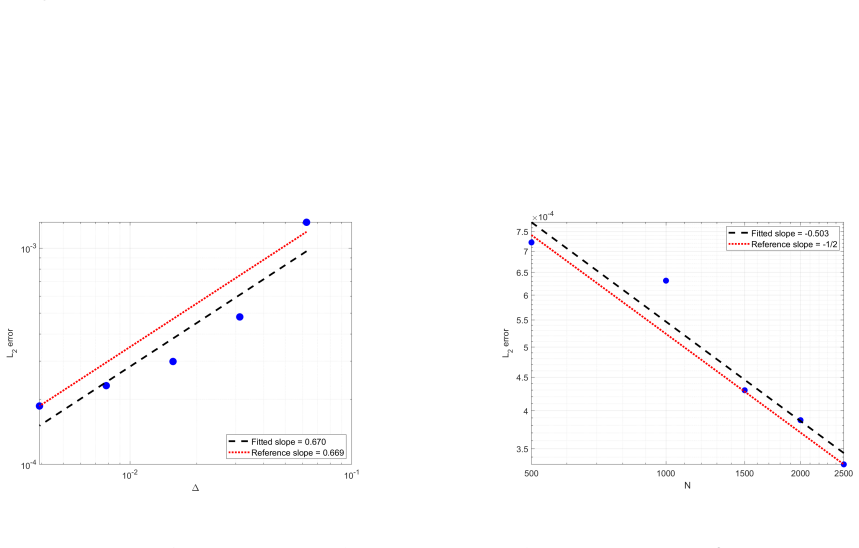
- An explicit rate of convergence between the two invariant measures follows from the uniform-in-time propagation of chaos and uniform strong convergence.
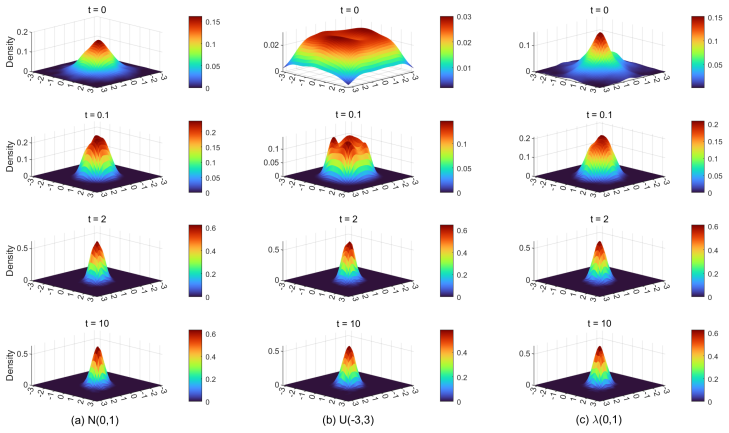
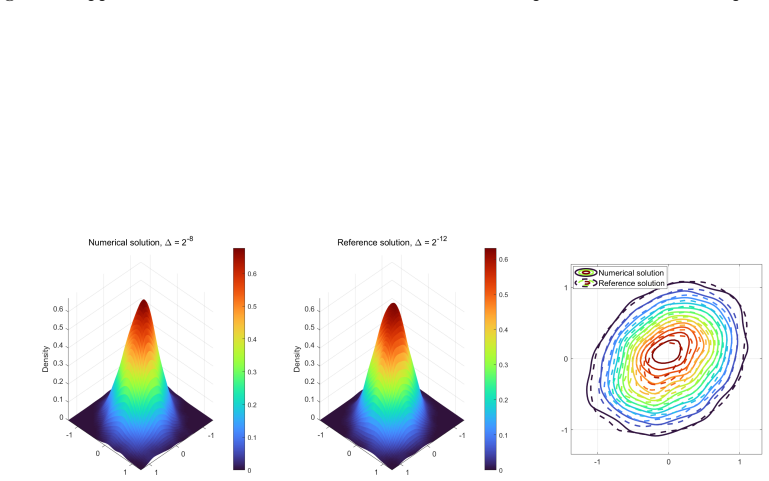
- Numerical experiments can be used to verify the predicted convergence behavior of the invariant measures.
Where Pith is reading between the lines
- The same combination of uniform propagation of chaos and uniform convergence arguments could be tested on other discretization schemes such as Milstein-type methods for jump processes.
- The rate results supply quantitative error bounds that could be used when approximating stationary distributions in applications involving large systems of interacting particles with jumps.
- The framework suggests checking whether adaptive time-stepping versions of the tamed Euler scheme retain the uniform-in-time properties needed for invariant-measure convergence.
Load-bearing premise
The coefficients must satisfy the conditions that deliver propagation of chaos, strong convergence of the tamed Euler scheme, and exponential ergodicity for both the continuous and discrete processes.
What would settle it
A concrete McKean-Vlasov SDE with Lévy noise for which either the exact or numerical solution fails to be exponentially ergodic, or for which the numerical invariant measure does not approach the exact one at the rate predicted by the uniform propagation of chaos and uniform convergence results.
Figures
read the original abstract
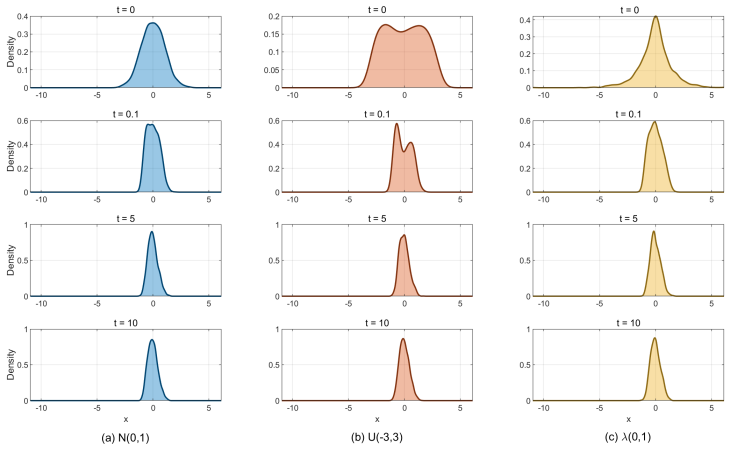
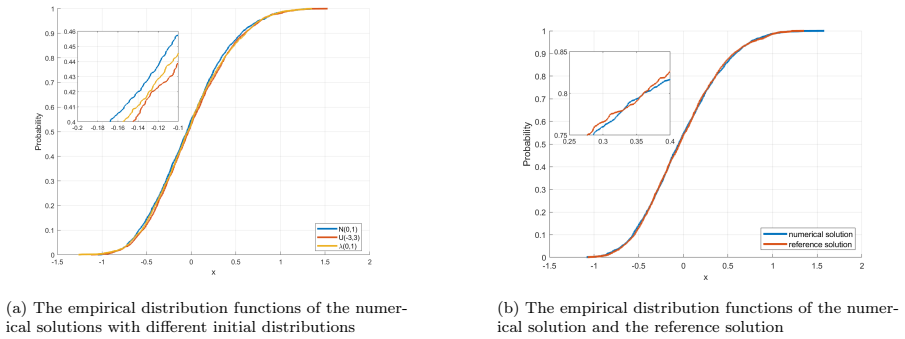
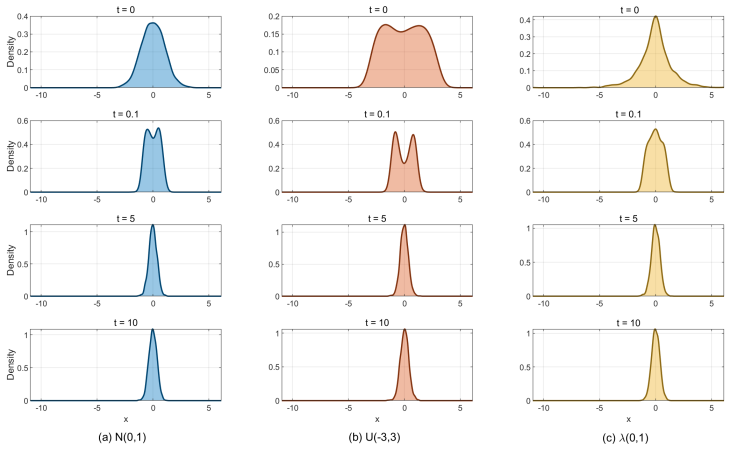
This paper investigates the exponential ergodicity of the exact solution and the tamed Euler solution for McKean-Vlasov stochastic differential equations driven by L\'evy noise. First, we establish exponential ergodicity for both the original equation and the tamed Euler method. Then we prove the convergence of the numerical invariant measure to the exact invariant measure, which is obtained by combining the propagation of chaos (PoC) result with the strong convergence of the tamed Euler scheme. Furthermore, we derive a convergence rate for the numerical invariant measure by establishing uniform-in-time PoC and uniform-in-time convergence of the tamed Euler method. Finally, numerical experiments are presented to illustrate the theoretical results.
Editorial analysis
A structured set of objections, weighed in public.
Referee Report
Summary. The paper claims to establish exponential ergodicity for both the exact solution and the tamed Euler discretization of McKean-Vlasov SDEs driven by Lévy noise. It then proves convergence of the numerical invariant measure to the exact invariant measure by combining propagation of chaos with strong convergence of the scheme, derives a convergence rate via uniform-in-time propagation of chaos and uniform-in-time strong convergence, and includes numerical experiments to illustrate the results.
Significance. If the proofs hold under appropriate conditions on the coefficients, the results would provide a coherent framework for long-time behavior and invariant-measure approximation in numerical schemes for mean-field SDEs with jumps. The combination of ergodicity, propagation of chaos, and uniform-in-time estimates is technically non-trivial and relevant for applications involving Lévy-driven interacting systems.
minor comments (1)
- The abstract refers to coefficient conditions needed for propagation of chaos, strong convergence, and ergodicity, but does not state them; the full manuscript should make these assumptions explicit in the statements of the main theorems to allow verification of the scope.
Simulated Author's Rebuttal
We thank the referee for the careful summary of our manuscript and for acknowledging the technical non-triviality of combining exponential ergodicity, propagation of chaos, and uniform-in-time estimates for Lévy-driven McKean-Vlasov SDEs. We are pleased that the potential relevance to applications is recognized, provided the proofs hold under the stated conditions on the coefficients.
Circularity Check
No significant circularity detected
full rationale
The derivation follows a standard sequential structure: exponential ergodicity is established first for the McKean-Vlasov SDE and its tamed Euler discretization, followed by convergence of invariant measures via propagation of chaos combined with strong convergence, and rates derived from uniform-in-time versions of those results. No self-definitional reductions, fitted inputs renamed as predictions, or load-bearing self-citations appear in the abstract or high-level strategy. The argument relies on external standard tools (PoC, strong convergence under dissipativity conditions) that are independent of the target claims, rendering the chain self-contained.
Axiom & Free-Parameter Ledger
axioms (1)
- domain assumption Coefficients satisfy conditions sufficient for propagation of chaos, strong convergence of tamed Euler, and exponential ergodicity
Reference graph
Works this paper leans on
-
[1]
H. P. McKean, Propagation of chaos for a class of non-linear parabolic equations, Proceedings of the National Academy of Sciences 56 (1967) 1907–1911
1967
-
[2]
Benazzoli, L
C. Benazzoli, L. Campi, L. Di Persio, Mean field games with controlled jump- diffusion dynamics: Existence results and an illiquid interbank market model, Stochastic Processes and their Applications 130 (2020) 6927–6964
2020
-
[3]
Kolokolnikov, J
T. Kolokolnikov, J. A. Carrillo, A. Bertozzi, R. Fetecau, M. Lewis, Emergent be- haviour in multi-particle systems with non-local interactions, Physica D: Nonlinear Phenomena 260 (2013) 1–4
2013
-
[4]
Sabbar, K
Y. Sabbar, K. S. Nisar, A selective review of modern stochastic modeling: SDE/SPDE numerics, data-driven identification, and generative methods with ap- plications in biomathematics, Transactions on Computational Modeling and Intel- ligent Systems 2 (2026) 10028
2026
-
[5]
Neufeld, T
A. Neufeld, T. A. Nguyen, Rectified deep neural networks overcome the curse of dimensionality when approximating solutions of McKean–Vlasov stochastic differ- ential equations, Journal of Mathematical Analysis and Applications 541 (2025) 128661
2025
-
[6]
Baladron, D
J. Baladron, D. Fasoli, O. Faugeras, J. Touboul, Mean-field description and prop- agation of chaos in networks of Hodgkin–Huxley and FitzHugh–Nagumo neurons, Journal of Mathematical Neuroscience 2 (2012) 10
2012
-
[7]
mean-field descriptionandpropagationofchaosinnetworksofHodgkin–HuxleyandFitzHugh– Nagumo neurons
M. Bossy, O. Faugeras, D. Talay, Clarification and complement to “mean-field descriptionandpropagationofchaosinnetworksofHodgkin–HuxleyandFitzHugh– Nagumo neurons”, Journal of Mathematical Neuroscience 5 (2014) 31
2014
-
[8]
Ullner, A
E. Ullner, A. Politi, A. Torcini, Ubiquity of collective irregular dynamics in balanced networks of spiking neurons, Chaos 28 (2018) 081106
2018
-
[9]
Bensoussan, J
A. Bensoussan, J. Frehse, P. Yam, Mean Field Games and Mean Field Type Control Theory, Springer, New York, 2013
2013
-
[10]
Carmona, F
R. Carmona, F. Delarue, Probabilistic Theory of Mean Field Games with Applica- tions I: Mean Field FBSDEs, Control, and Games, volume 83 ofProbability Theory and Stochastic Modelling, Springer, Cham, 2018
2018
-
[11]
Carmona, F
R. Carmona, F. Delarue, Probabilistic Theory of Mean Field Games with Applica- tions II: Mean Field Games with Common Noise and Master Equations, volume 84 ofProbability Theory and Stochastic Modelling, Springer, Cham, 2018. 36
2018
-
[12]
Y. Li, X. Mao, Q. Song, F. Wu, G. Yin, Strong convergence of Euler–Maruyama schemes for McKean–Vlasov stochastic differential equations under local lipschitz conditions of state variables, IMA Journal of Numerical Analysis 43 (2022) 1001– 1035
2022
-
[13]
J. Bao, C. Reisinger, P. Ren, W. Stockinger, First-order convergence of Milstein schemes for McKean–Vlasov equations and interacting particle systems, Proceed- ings of the Royal Society A 477 (2021) 20200258
2021
-
[14]
Reisinger, W
C. Reisinger, W. Stockinger, An adaptive Euler–Maruyama scheme for McKean–Vlasov SDEs with super-linear growth and application to the mean-field FitzHugh–Nagumo model, Journal of Computational and Applied Mathematics 400 (2022) 113725
2022
-
[15]
X. Ding, H. Qiao, Euler–Maruyama approximations for stochastic McKean–Vlasov equations with non-lipschitz coefficients, Journal of Theoretical Probability 34 (2021) 1408–1425
2021
-
[16]
C. Kumar, Neelima, On explicit Milstein-type scheme for McKean–Vlasov stochas- tic differential equations with super-linear drift coefficient, Electronic Journal of Probability 26 (2021) 1–32
2021
- [17]
-
[18]
Andreis, P
L. Andreis, P. Dai Pra, M. Fischer, McKean–Vlasov limit for interacting systems with simultaneous jumps, Stochastic Analysis and Applications 36 (2018) 960–995
2018
-
[19]
Mehri, M
S. Mehri, M. Scheutzow, W. Stannat, B. Z. Zangeneh, Propagation of chaos for stochastic spatially structured neuronal networks with delay driven by jump diffu- sions, The Annals of Applied Probability 30 (2020) 175–207
2020
-
[20]
Agarwal, S
A. Agarwal, S. Pagliarani, A Fourier-based Picard-iteration approach for a class of McKean–Vlasov SDEs with Lévy jumps, Stochastics 93 (2021) 592–624
2021
- [21]
- [22]
-
[23]
N. K. Tran, T.-T. Kieu, D.-T. Luong, H.-L. Ngo, On the infinite time horizon approximation for Lévy-driven McKean–Vlasov SDEs with non-globally lipschitz continuous and super-linearly growth drift and diffusion coefficients, Journal of Mathematical Analysis and Applications 543 (2025) 128982. 37
2025
-
[24]
J. Zhu, Y. Zhao, S. Gan, Euler-type methods for Lévy-driven McKean–Vlasov SDEs with super-linear coefficients: Mean-square error analysis, Communications in Nonlinear Science and Numerical Simulation 161 (2026) 110093
2026
-
[25]
Wang, Distribution dependent SDEs for Landau type equations, Stochastic Processes and their Applications 128 (2018) 595–621
F.-Y. Wang, Distribution dependent SDEs for Landau type equations, Stochastic Processes and their Applications 128 (2018) 595–621
2018
-
[26]
J. Bao, J. Hao, Uniform-in-time estimates for mean-field type SDEs and applica- tions, Journal of Differential Equations 440 (2025) 113445
2025
-
[27]
J. Bao, J. Wang, Long-time behavior of one-dimensional McKean–Vlasov SDEs with common noise, Journal of Mathematical Analysis and Applications 552 (2025) 129819
2025
-
[28]
X. Chen, G. dos Reis, W. Stockinger, Wellposedness, exponential ergodicity and numerical approximation of fully super-linear McKean–Vlasov SDEs and associated particle systems, Electronic Journal of Probability 30 (2025) 1 – 50
2025
-
[29]
Liang, M
M. Liang, M. B. Majka, J. Wang, Exponential ergodicity for SDEs and McK- ean–Vlasov processes with Lévy noise, Annales de l’Institut Henri Poincaré, Prob- abilités et Statistiques 57 (2021) 1665 – 1701
2021
-
[30]
J. Bao, J. Wang, Stationary distributions of McKean-Vlasov SDEs with jumps: Existence, multiplicity and uniqueness, Stochastic Processes and their Applications 198 (2026) 104967
2026
-
[31]
F. Bai, Z. Chen, X. Sun, Existence and approximation of measure attractors and invariant measures for McKean-Vlasov stochastic lattice system with Lévy noise, Journal of Differential Equations 453 (2026) 113784
2026
-
[32]
S. Soni, Neelima, C. Kumar, G. dos Reis, Tamed Euler approximation for fully superlinear growth McKean–Vlasov SDE and their particle systems: sharp rates for strong propagation of chaos, convergence and ergodicity, arXiv preprint arXiv:2510.16427 (2025)
-
[33]
Y.Cui, X.Li, Y.Liu, F.Wang, Numericalapproximationtotheinvariantmeasureof McKean-Vlasov stochastic differential equations, arXiv preprint arXiv:2401.02878 (2025)
work page internal anchor Pith review Pith/arXiv arXiv 2025
- [34]
-
[35]
Gyöngy, N
I. Gyöngy, N. V. Krylov, On stochastic equations with respect to semimartingales I, Stochastics 4 (1980) 1–21
1980
-
[36]
Dareiotis, C
K. Dareiotis, C. Kumar, S. Sabanis, On tamed Euler approximations of SDEs driven by Lévy noise with applications to delay equations, SIAM Journal on Numerical Analysis 54 (2016) 1840–1872. 38
2016
-
[37]
P. D. Hinds, A. Sharma, M. V. Tretyakov, Well-posedness and approximation of reflected McKean–Vlasov SDEs with applications, Mathematical Models and Methods in Applied Sciences 35 (2025) 1845–1887
2025
-
[38]
Zhang, M
Y. Zhang, M. Song, J. Zhu, Dimension-independentLp convergence rate of prop- agation of chaos and numerical analysis for McKean-Vlasov stochastic differential equations, Communications in Nonlinear Science and Numerical Simulation 152 (2026) 109472
2026
-
[39]
H. P. Rosenthal, On the subspaces ofL p spanned by sequences of independent random variables, Israel Journal of Mathematics 8 (1970) 273–303. 39
1970
discussion (0)
Sign in with ORCID, Apple, or X to comment. Anyone can read and Pith papers without signing in.