REVIEW 5 major objections 3 minor 40 references
Inference for Diffusion Processes via Controlled Sequential Monte Carlo and Splitting Schemes
T0 review · 5 major / 3 minor · reviewed 2026-08-06 · deepseek-v4-flash
Pith's one-line read The paper shows that diffusion pseudolikelihoods can be estimated as Feynman–Kac normalising constants via controlled sequential Monte Carlo.
desk verdict Solid, useful packaging of cSMC and splitting schemes for SDE inference; the bias-reduction claim rests on an unproved convergence assumption, but the experiments and code carry the load. read the letter →
The pith
A machine-rendered reading of the paper's core claim, the machinery that carries it, and where it could break.
The reading
What carries the argument
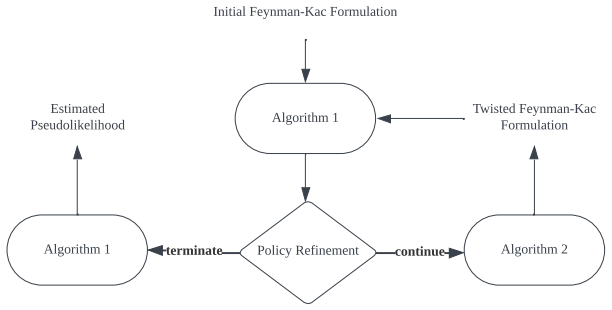
The central object is a Feynman–Kac flow with Markov kernels $M_k$ and potential functions $G_k$ whose normalising constant equals the pseudolikelihood of interest. The Markov kernels come from splitting schemes—Lie–Trotter and Strang—that decompose the SDE into a linear Gaussian part and an ODE part, yielding conditionally Gaussian transition densities. Controlled SMC twists these kernels with quadratic log-policies fitted by linear regression (Algorithm 2), producing Gaussian proposals that reduce the variance of the estimated normalising constant while leaving it unbiased. Diffusion bridges appear as Feynman–Kac segments with unit potentials on intermediate time points and a terminal potential evaluating the observed transition density.
What would settle it
Take a concrete semi-linear SDE from the class, e.g. the cubic SDE, fix a starting value and parameter, and estimate the $L^1$ distance between the $K$-step bridged transition density and the true transition density for increasing $K$ via Monte Carlo; if this distance fails to approach zero, Assumption 4.1 fails and the bridged pseudolikelihood need not converge to the true likelihood.
Extended reading notes
Core claim
The central claim is that the implied pseudolikelihood of a splitting scheme for the SDE $dX_t = (AX_t + \gamma(X_t))dt + \Sigma dW_t$ equals the normalising constant of a Feynman–Kac flow, so it can be estimated unbiasedly and with low variance by controlled sequential Monte Carlo. The authors construct explicit Feynman–Kac representations for the fully observed, partially observed, noiseless, and noisy cases (Propositions 1–3), and pair them with Lie–Trotter and Strang transition densities. When observations are made at coarse times, each interval is augmented with $K$ latent bridged steps; the bridged pseudolikelihood converges to the true likelihood as $K$ grows under an assumed $L^1$ convergence of the bridged transition density. The framework is demonstrated on a cubic SDE and a partially observed hypoelliptic stochastic FitzHugh–Nagumo model, using SPSA for point estimation and particle marginal Metropolis–Hastings for posterior inference.
Load-bearing premise
The load-bearing premise is that the $K$-step bridged transition density converges to the true transition density in $L^1$ as $K$ grows; the paper states this as an assumption rather than proving it.
Editorial extensions
If this is right
- Point and posterior estimation can be performed for semi-linear SDEs with non-globally Lipschitz drift, where Euler–Maruyama-based methods diverge.
- The number of bridging steps $K$ can reduce discretisation bias in the estimated likelihood without switching to custom high-order numerical schemes.
- Partially observed hypoelliptic models, such as the stochastic FitzHugh–Nagumo neuron model, can be analysed with the same machinery as fully observed models.
- Because the likelihood estimates are unbiased and low-variance, they plug into standard pseudo-marginal MCMC and stochastic optimisation routines.
Reading between the lines
- Beyond the paper, the same Feynman–Kac representation should transfer to any numerical scheme whose transition density is an invertible transformation of a Gaussian, not only splitting schemes, since the twisting machinery relies only on that invertibility.
- The convergence study in Section 5.1 suggests a cheap diagnostic: trace the cSMC-estimated bridged log-likelihood at a fixed parameter as $K$ grows; a plateau visibly offset from the true likelihood would flag a failure of Assumption 4.1.
- The discrepancy between the inferred parameters from real data and those from an ABC-based fit reported in the paper points to possible model misspecification; a posterior predictive check could separate that from weak identifiability of the censored mean.
Editorial analysis
A structured set of objections, weighed in public.
Referee Report
Summary. The paper develops a likelihood-based inference framework for semi-linear SDEs (1) with additive noise. For a numerical splitting scheme with explicit transition density, the authors represent the implied pseudolikelihood—in fully observed, partially observed, and noisy settings—as the normalising constant of a Feynman–Kac flow, and estimate that constant with controlled sequential Monte Carlo (cSMC). Diffusion bridging is introduced to reduce time-discretisation bias. Numerical experiments on a cubic SDE and the FitzHugh–Nagumo model support the methodology, and a real neuroscience dataset is analysed.
Significance. The paper is a useful synthesis and extension of existing ingredients: the splitting schemes of Buckwar et al. (2022) and Pilipovic et al. (2024), the Feynman–Kac representation of marginal likelihoods, and the cSMC method of Guarniero et al. (2017) and Heng et al. (2020). The algebraic Feynman–Kac formulations in Propositions 1–3 appear correct, and the code is publicly available. The numerical comparison between BPF and cSMC is convincing, and the hypoelliptic FitzHugh–Nagumo example addresses a genuinely challenging setting. If the theoretical gaps identified below are closed, the framework would be a valuable contribution to SDE inference.
major comments (5)
- [Section 4.1, Assumption 4.1] The paper's bias-reduction guarantee rests on the L1 convergence of the bridged transition density, but this is assumed rather than proved for the Lie–Trotter and Strang schemes. The assumption is also the only route to the claimed pointwise convergence log(f^{[K]}(\tilde X_{0:M})) → log(f^*(X_{0:M})) and to Pedersen's (1995) MLE asymptotics. Please either prove this convergence under Assumption 2.1 for the splitting schemes, or state precisely the class of schemes and SDEs for which it is known, and clarify the mode of convergence and the arguments of f^{[K]}_k and f^*_k in the expectation.
- [Section 4.2, Proposition 3] No analogue of Assumption 4.1 is stated for the K-step bridged partial pseudolikelihood f^{[K]}(v_{0:M}). Since the FHN simulations and the real-data application all use the partial-observation regime, the claim that bridging reduces time-discretisation bias is unsupported for the headline setting. Please add a convergence statement (or a clearly stated conditional assumption) for f^{[K]}(v_{0:M}) as K → ∞, together with a proof or a reference that covers it.
- [Sections 4.1 and 4.2, Propositions 2 and 3] Both propositions are stated with the remark 'proof follows by factorising' and no derivation is included in the main text; Supplement C proves only Proposition 1. Because these propositions define the exact Feynman–Kac formulations used by the algorithm, please provide complete derivations in a supplement or an appendix.
- [Abstract and Section 1.2, observation regime (iii)] The abstract and introduction advertise applicability with observation noise, but Section 4 gives no explicit Feynman–Kac formulation for regime (iii) (full or partial observation with additive noise), and none of the numerical experiments use this regime. Please provide the construction (for example, by absorbing the noise density into the potential functions) or explicitly restrict the claims to the noiseless cases treated in Sections 4–5.
- [Section 5.3] The real-data analysis reports a point estimate that differs strongly from the ABC posterior mean of Samson et al. (2025) on the same dataset (for example, ε = 0.283 vs 0.033, γ = 72.7 vs 6.701). The paper lists possible explanations but does not investigate any of them. Please add a quantitative comparison of the fitted models (such as trajectory summaries, predictive checks, or a profile analysis over the censored mean) so that the discrepancy can be attributed to model misspecification, weak identifiability, or a methodological failure.
minor comments (3)
- [Section 4.3, last displayed equation] In the expression for f^2_{k;K}(u_{k;K}|v_{k;K}, x_{k;K−1}), the term v_{t;M} should be v_{k;K}; please correct this typo.
- [Equations (14)-(15) and Proposition 3] The notation f^1_k and f^1_{k;K} distinguishes unbridged and bridged quantities only through the time index, which is easy to confuse. Please add a sentence at the beginning of Section 4.2 defining the notation for bridged densities.
- [Section 4.3, Strang-implied pseudolikelihoods] The sentence 'the corresponding densities for the bridged case can be immediately recovered replacing ∆ with δ' is not quite accurate for the partially observed Strang case, where the change of variables also requires component-wise invertibility; please rephrase to avoid implying a purely notational substitution.
Circularity Check
No significant circularity: the paper's core constructions are mathematical identities and algorithm applications, while the load-bearing convergence guarantee is explicitly stated as an assumption rather than derived from the paper's own outputs.
full rationale
The paper's central construction—representing the implied pseudolikelihood as the normalising constant of a Feynman–Kac flow—is a mathematical identity, established in Propositions 1–3 by rearrangement and Fubini; these propositions do not define the target in terms of the method or vice versa. The bridged pseudolikelihood (23) is not forced by construction: its bias-reduction claim is conditional on Assumption 4.1, which is an explicit L1-convergence assumption on the bridged transition density rather than a fitted parameter renamed as a prediction, and the paper itself says 'we will assume' this convergence. The cSMC policy approximation in Algorithm 2 is algorithm-internal: it fits quadratic log-policies to reduce variance of an unbiased likelihood estimator, but the final likelihood estimate is not defined as that fit, and the target pseudolikelihood is fixed by the Feynman–Kac formulation. Prior work by Buckwar et al. (2022), which includes one co-author of the present paper, is cited for splitting schemes' convergence and property preservation; this is an independent, peer-reviewed result, not a self-citation chain that forecloses alternatives. The main weaknesses are that Assumption 4.1 and its partially observed analogue are asserted rather than proved, and the 'Simulated Truth' in Section 5.1 is a high-number-of-bridges pseudolikelihood rather than the continuous-model likelihood; however, these are correctness or validation concerns, not circularity. No step in the derivation reduces to its own input by construction.
Assumptions & free parameters
assumptions (5)
- domain assumption Assumption 2.1: local Lipschitz condition and polynomial growth on the nonlinear drift gamma
- ad hoc to paper Assumption 4.1: L1 convergence of the bridged transition density f^[K]_k to the true transition density f^*
- domain assumption Assumption 4.2: existence of the inverse of the ODE flow Gamma_delta for the Strang scheme
- domain assumption Existence of unique strong solution and smooth transition density for SDE (1)
- domain assumption Factorisation (11) of the transition density into marginal and conditional Gaussian components
Cite this review
Pith. "Pith review of Inference for Diffusion Processes via Controlled Sequential Monte Carlo and Splitting Schemes." pith.science (2026). https://pith.science/paper/W4CASM5T
@misc{pith2026250714535,
  author       = {Pith},
  title        = {Pith review of: Inference for Diffusion Processes via Controlled Sequential Monte Carlo and Splitting Schemes},
  year         = {2026},
  howpublished = {\url{https://pith.science/paper/W4CASM5T}},
  note         = {Machine review of arXiv:2507.14535}
}
read the original abstract
We introduce an inferential framework for a wide class of semi-linear stochastic differential equations (SDEs). Recent work has shown that numerical splitting schemes can preserve critical properties of such types of SDEs, give rise to explicit pseudolikelihoods, and hence allow for parameter inference for fully observed processes. Here, under several discrete time observation regimes (particularly, partially and fully observed with and without noise), we represent the implied pseudolikelihood as the normalising constant of a Feynman--Kac flow, allowing its efficient estimation via controlled sequential Monte Carlo and adapt likelihood-based methods to exploit this pseudolikelihood for inference. The strategy developed herein allows us to obtain good inferential results across a range of problems. Using diffusion bridges, we are able to computationally reduce bias coming from time-discretisation without recourse to more complex numerical schemes which typically require considerable application-specific efforts. Simulations illustrate that our method provides an excellent trade-off between computational efficiency and accuracy, under hypoellipticity, for both point and posterior estimation. Application to a neuroscience example shows the good performance of the method in challenging settings.
Figures


Figures from the paper (6 more)


Reference graph
Works this paper leans on
-
[1]
Christophe Andrieu and Gareth O. Roberts. The pseudo-marginal approach for efficient M onte C arlo computations. The Annals of Statistics, 37 0 (2): 0 697--725, 2009
work page 2009
-
[2]
Particle Markov Chain Monte Carlo Methods
Christophe Andrieu, Arnaud Doucet, and Roman Holenstein. Particle Markov Chain Monte Carlo Methods . Journal of the Royal Statistical Society Series B: Statistical Methodology, 72 0 (3): 0 269--342, 05 2010
work page 2010
-
[3]
Alexandros Beskos and Gareth O. Roberts. Exact simulation of diffusions . The Annals of Applied Probability, 15 0 (4): 0 2422 -- 2444, 2005
work page 2005
-
[4]
Parameter Inference via Differentiable Diffusion Bridge Importance Sampling
Nicklas Boserup, Gefan Yang, Michael Lind Severinsen, Christy Anna Hipsley, and Stefan Sommer. Parameter inference via differentiable diffusion bridge importance sampling. arXiv preprint arXiv:2411.08993, 2024
work page Pith review arXiv 2024
-
[5]
Evelyn Buckwar, Adeline Samson, Massimiliano Tamborrino, and Irene Tubikanec. A splitting method for SDE s with locally L ipschitz drift: Illustration on the F itzhugh-- N agumo model. Applied Numerical Mathematics, 179: 0 191--220, 2022
work page 2022
-
[6]
An Introduction to Sequential Monte Carlo
Nicolas Chopin and Omiros Papaspiliopoulos. An Introduction to Sequential Monte Carlo. Springer, Cham, 2020
work page 2020
-
[7]
Statistical inference for stochastic differential equations
Peter Craigmile, Radu Herbei, Ge Liu, and Grant Schneider. Statistical inference for stochastic differential equations. WIREs Computational Statistics, 15 0 (2): 0 e1585, 2023
work page 2023
-
[8]
Feynman-Kac Formulae: Genealogical and Interacting Particle Systems with Applications
Pierre Del Moral. Feynman-Kac Formulae: Genealogical and Interacting Particle Systems with Applications. Springer, New York, 2004
work page 2004
Show all 40 references
-
[9]
Introduction to Stochastic Models in Biology, pages 3--35
Susanne Ditlevsen and Adeline Samson. Introduction to Stochastic Models in Biology, pages 3--35. Springer Berlin Heidelberg, Berlin, Heidelberg, 2013
2013
-
[10]
Hypoelliptic diffusions: filtering and inference from complete and partial observations
Susanne Ditlevsen and Adeline Samson. Hypoelliptic diffusions: filtering and inference from complete and partial observations . Journal of the Royal Statistical Society Series B: Statistical Methodology, 81 0 (2): 0 361--384, 2019
2019
-
[11]
Garland Durham and A. Gallant. Numerical techniques for maximum likelihood estimation of continuous-time diffusion processes. Journal of Business & Economic Statistics, 20: 0 297--316, 02 2002
2002
-
[12]
An introduction to mvnfast
Matteo Fasiolo. An introduction to mvnfast. R package version 0.2.8. University of Bristol, 2014. URL https://CRAN.R-project.org/package=mvnfast
2014
-
[13]
Mathematical models of threshold phenomena in the nerve membrane
Richard FitzHugh. Mathematical models of threshold phenomena in the nerve membrane. Bulletin of Mathematical Biophysics, 17 0 (4): 0 257--278, Dec 1955
1955
-
[14]
Applications in Risk Management, pages 481--537
Paul Glasserman. Applications in Risk Management, pages 481--537. Springer New York, New York, NY, 2003
2003
-
[15]
Gordon, D.J
N.J. Gordon, D.J. Salmond, and A.F.M. Smith. Novel approach to nonlinear/non- G aussian B ayesian state estimation. IEE Proceedings F (Radar and Signal Processing), 140: 0 107--113(6), 1993
1993
-
[16]
Graham, Alexandre H
Matthew M. Graham, Alexandre H. Thiery, and Alexandros Beskos. Manifold M arkov chain M onte C arlo methods for B ayesian inference in diffusion models. Journal of the Royal Statistical Society Series B: Statistical Methodology, 84 0 (4): 0 1229--1256, 2022
2022
-
[17]
The iterated auxiliary particle filter and applications to state space models and diffusion processes
Pieralberto Guarniero. The iterated auxiliary particle filter and applications to state space models and diffusion processes. PhD thesis, University of Warwick, August 2017. URL http://webcat.warwick.ac.uk/record=b3111801 S15
2017
-
[18]
Johansen, and Anthony Lee
Pieralberto Guarniero, Adam M. Johansen, and Anthony Lee. The iterated auxiliary particle filter. Journal of the American Statistical Association, 112 0 (520): 0 1636--1647, 2017
2017
-
[19]
Hairer, S.P
E. Hairer, S.P. N\"orsett, and G. Wanner. Solving Ordinary Differential Equations: Nonstiff Problems. Springer, Berlin, second edition, 2000
2000
-
[20]
Bishop, George Deligiannidis, and Arnaud Doucet
Jeremy Heng, Adrian N. Bishop, George Deligiannidis, and Arnaud Doucet. Controlled sequential Monte Carlo . The Annals of Statistics, 48 0 (5): 0 2904 -- 2929, 2020
2020
-
[21]
Simulating diffusion bridges with score matching
Jeremy Heng, Valentin De Bortoli, Arnaud Doucet, and James Thornton. Simulating diffusion bridges with score matching. arXiv preprint arXiv:2111.07243, 2021
2021 arXiv
-
[22]
Humphries and A.M
A.R. Humphries and A.M. Stuart. Deterministic and random dynamical systems: theory and numerics. In A. Bourlioux, M.J. Gander, and G. Sabidussi, editors, Modern Methods in Scientific Computing and Applications, chapter 75, pages 211--254. Springer Netherlands, 2002
2002
-
[23]
Martin Hutzenthaler, Arnulf Jentzen, and Peter E. Kloeden. Strong and weak divergence in finite time of E uler's method for stochastic differential equations with non-globally L ipschitz continuous coefficients. Proceedings: Mathematical, Physical and Engineering Sciences, 467...
2011
-
[24]
Martin Hutzenthaler, Arnulf Jentzen, and Peter E. Kloeden. Strong convergence of an explicit numerical method for SDE s with nonglobally Lipschitz continuous coefficients . The Annals of Applied Probability, 22 0 (4): 0 1611 -- 1641, 2012
2012
-
[25]
S.M. Iacus. Simulation and inference for stochastic differential equations. Springer, New York, 2008
2008
-
[26]
Statistical Inference for Elliptic and Hypo-elliptic Diffusions: Asymptotic Theory and Numerical Methodologies
Yuga Iguchi. Statistical Inference for Elliptic and Hypo-elliptic Diffusions: Asymptotic Theory and Numerical Methodologies. PhD thesis, University College London, January 2025. URL https://discovery.ucl.ac.uk/id/eprint/10205973/
2025
-
[27]
Singh, Jan Maciejowski, and Nicolas Chopin
Nikolas Kantas, Arnaud Doucet, Sumeetpal S. Singh, Jan Maciejowski, and Nicolas Chopin. On particle methods for parameter estimation in state-space models. Statistical Science, 30 0 (3): 0 328 -- 351, 2015
2015
-
[28]
Kloeden and Eckhard Platen
Peter E. Kloeden and Eckhard Platen. Numerical Solution of Stochastic Differential Equations. Springer Berlin, Heidelberg, 1992
1992
-
[29]
Bayesian inference for stochastic processes
Sean Malory. Bayesian inference for stochastic processes. PhD thesis, Lancaster University, February 2021. URL https://eprints.lancs.ac.uk/id/eprint/151763/
2021
-
[30]
A dataset of action potentials recorded from the l5 dorsal rootlet of rat using a multiple electrode array
Benjamin Metcalfe, Alan Hunter, Jonathan Graham-Harper-Cater, and John Taylor. A dataset of action potentials recorded from the l5 dorsal rootlet of rat using a multiple electrode array. Data in Brief, 33: 0 106561, 2020
2020
-
[31]
Consistency and asymptotic normality of an approximate maximum likelihood estimator for discretely observed diffusion processes
Asger Roer Pedersen. Consistency and asymptotic normality of an approximate maximum likelihood estimator for discretely observed diffusion processes. Bernoulli, 1 0 (3): 0 257--279, 1995
1995
-
[32]
Parameter estimation in nonlinear multivariate stochastic differential equations based on splitting schemes
Predrag Pilipovic, Adeline Samson, and Susanne Ditlevsen. Parameter estimation in nonlinear multivariate stochastic differential equations based on splitting schemes. The Annals of Statistics, 52: 0 842--867, 2024
2024
-
[33]
Pitt, Ralph dos Santos Silva, Paolo Giordani, and Robert Kohn
Michael K. Pitt, Ralph dos Santos Silva, Paolo Giordani, and Robert Kohn. On some properties of M arkov chain M onte C arlo simulation methods based on the particle filter. Journal of Econometrics, 171 0 (2): 0 134--151, 2012
2012
-
[34]
R: A Language and Environment for Statistical Computing
R Development Core Team . R: A Language and Environment for Statistical Computing . R Foundation for Statistical Computing, Vienna, Austria, 2011
2011
-
[35]
Inference for the stochastic F itzhugh-- N agumo model from real action potential data via approximate B ayesian computation
Adeline Samson, Massimiliano Tamborrino, and Irene Tubikanec. Inference for the stochastic F itzhugh-- N agumo model from real action potential data via approximate B ayesian computation. Computational Statistics & Data Analysis, 204: 0 108095, 2025
2025
-
[36]
Silverman
Bernard W. Silverman. Density Estimation. Chapman and Hall, London, 1986
1986
-
[37]
J.C. Spall. Multivariate stochastic approximation using a simultaneous perturbation gradient approximation. IEEE Transactions on Automatic Control, 37 0 (3): 0 332--341, 1992
1992
-
[38]
J.C. Spall. Adaptive stochastic approximation by the simultaneous perturbation method. IEEE Transactions on Automatic Control, 45 0 (10): 0 1839--1853, 2000
2000
-
[39]
Whitaker, Andrew Golightly, Richard J
Gavin A. Whitaker, Andrew Golightly, Richard J. Boys, and Chris Sherlock. Improved bridge constructs for stochastic differential equations. Statistics and Computing, 27 0 (4): 0 885--900, Jul 2017
2017
-
[40]
ggplot2: Elegant Graphics for Data Analysis
Hadley Wickham. ggplot2: Elegant Graphics for Data Analysis. Springer-Verlag New York, 2016
2016
Reviewed August 6, 2026 · model on record in the stance chip above.
Discussion (0). Sign in to comment.