REVIEW 4 major objections 5 minor 12 references
Phase Shift Information Compression in IRS-aided Wireless Systems: Challenges and Opportunities
T0 review · 4 major / 5 minor · reviewed 2026-08-15 · deepseek-v4-flash
Pith's one-line read The paper claims that one prompt-guided encoder-decoder can compress IRS phase-shift information across all tested operating conditions without retraining.
desk verdict A useful survey of PSI compression with a plausible prompt-based idea, but the only experiment is a two-panel figure against a strawman baseline, so the empirical claim is unsupported. read the letter →
The pith
A machine-rendered reading of the paper's core claim, the machinery that carries it, and where it could break.
The reading
What carries the argument
The load-bearing mechanism is the prompt bank: a set of learnable prompt vectors stored as key-value pairs, where keys describe task metadata such as compression ratio, SNR, and channel type, and values are prompts acting as soft controllers inside the encoder. A prompt-matching module retrieves the appropriate prompt from metadata when available, or embeds the input PSI and compares it with prompt keys by cosine similarity when metadata is absent. The selected prompt is injected into the encoder, modulating attention and feature abstraction and controlling output dimensionality to match the target compression ratio. A meta-learning loop updates only the prompt vectors from a small support set at inference time, keeping the encoder and decoder weights fixed, which is what allows one model to behave like many task-specific models.
What would settle it
Run the same NMSE grid with per-task-trained baselines, one model for each compression ratio, channel type, and SNR setting, and with the GAPSCN, ACFNet, and PSFNet methods reviewed in Section III; if any of those matches or beats the prompt-guided framework across the full grid, the claim that one prompt-conditioned model removes the need for retraining would be contradicted.
Extended reading notes
Core claim
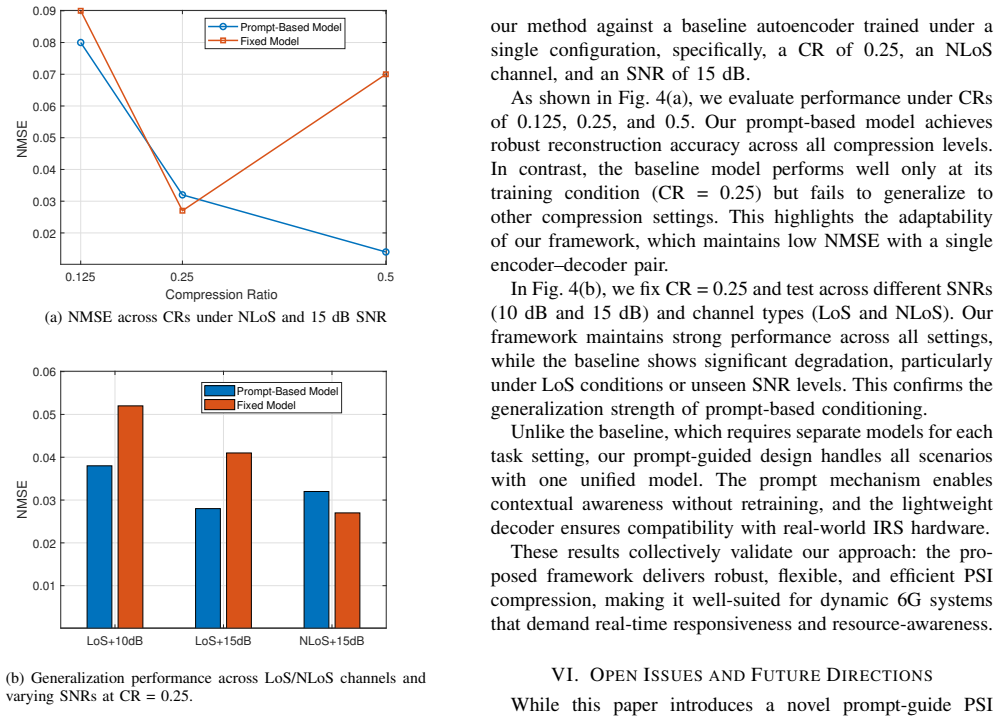
The paper's central claim is that its prompt-guided framework, consisting of a learnable prompt bank, a prompt-matching module, and an asymmetric autoencoder with a transformer encoder and lightweight decoder, preserves reconstruction accuracy across all tested conditions: compression ratios 0.125, 0.25, and 0.5; LoS and NLoS channels; and SNR values of 10 and 15 dB. Section V reports normalized mean square error results as evidence, showing that a baseline trained at CR 0.25, NLoS, and 15 dB degrades outside that single configuration. The paper interprets these results as demonstrating robust, flexible, and efficient PSI compression with one encoder-decoder pair, with prompt conditioning and few-shot meta-learning supplying the adaptability.
Load-bearing premise
The load-bearing premise is that the reference baseline, a single autoencoder trained only at a compression ratio of 0.25, an NLoS channel, and 15 dB SNR, is a meaningful comparison point; if the proper yardstick is per-task-trained models or the strongest existing compressors, the paper's robustness conclusion is not yet established.
Editorial extensions
If this is right
- If the framework's results hold, a single encoder-decoder pair can provide variable-rate PSI compression, removing the need for multiple task-specific compression models.
- Deployments can adapt to unseen SNR levels or channel types by updating only prompt vectors with a small support set, without full retraining of the network.
- Signal-based prompt matching enables adaptation even when task metadata is unavailable, broadening the framework to scenarios where the controller knows only the received phase-shift data.
- The lightweight decoder is designed to fit resource-constrained IRS controllers, so the approach is positioned as deployable where heavier attention-based decoders are not.
- The paper's open issues point to continual learning, semantic compression, and latency-aware design as the next steps for PSI delivery in dynamic 6G systems.
Reading between the lines
- Editorial inference: the same prompt-bank idea could be transferred to other control-signaling problems, such as CSI feedback or beamforming updates, where one model is expected to serve many operating points.
- Editorial inference: if the framework is tested against per-task-trained baselines and still holds, it would support the more general principle that conditioning on task metadata can substitute for model specialization at lower storage cost.
- Editorial inference: a direct extension would be to measure the overhead of the prompt updates themselves; the paper reports reconstruction NMSE but not how many bits are needed to transmit or fine-tune the selected prompt over the control channel.
- Editorial inference: the cosine-similarity prompt matching mechanism predicts that prompt keys form meaningful clusters in embedding space, which could be tested by visualizing or probing those clusters.
Signed reviews
Editorial analysis
A structured set of objections, weighed in public.
Referee Report
Summary. This manuscript addresses the overhead of delivering phase shift information (PSI) to IRS controllers in IRS-aided wireless systems. It describes the IRS system architecture and several use cases where PSI delivery is a bottleneck, reviews five deep-learning compression methods (PSCDN, GAPSCN, S-GAPSCN, ACFNet, PSFNet), and proposes a prompt-guided framework with a learnable Prompt Bank, prompt matching by metadata or cosine similarity, a Transformer-based encoder, a lightweight decoder, and meta-learning-based few-shot adaptation. The central claim, stated in the abstract and in Section V, is that this framework achieves robust reconstruction accuracy across compression ratios, LoS/NLoS channels, and SNR levels with a single encoder-decoder pair, as illustrated by the two NMSE panels in Fig. 4 compared against a baseline trained at one configuration.
Significance. If the framework performed as claimed, it would address a genuine limitation of prior PSI compression methods, which are typically trained for a fixed compression ratio, channel type, and SNR; the use of prompt conditioning to avoid per-task retraining is a plausible and potentially useful idea. The paper also provides a useful compact summary of existing PSI compression approaches in Table I and a thoughtful list of open research directions in Section VI. However, the empirical support is not at the level needed to substantiate the central claim: Fig. 4 contains no error bars or dataset description, compares only with a fixed-configuration baseline, and omits the state-of-the-art baselines the paper itself reviews, so the reported gains may be an artifact of the comparison. The conceptual contribution is not yet validated.
major comments (4)
- [Section V and Fig. 4] The only experimental evidence for the central claim is the comparison in Fig. 4 against a baseline trained under a single configuration, specifically a CR of 0.25, an NLoS channel, and an SNR of 15 dB. Because the baseline is frozen at one operating point, it is structurally guaranteed to degrade at every other compression ratio, channel type, and SNR; this makes Fig. 4 a demonstration of the obvious advantage of any adaptive method rather than a test of the proposed prompt mechanism. The paper should compare against per-task-trained baselines (one model retrained for each configuration) and against the state-of-the-art methods reviewed in Section III, namely GAPSCN, S-GAPSCN, ACFNet, and PSFNet. Without these comparisons, the abstract claim that the framework delivers robust, flexible, and efficient PSI compression is not supported.
- [Fig. 4(a) and Section V] No mechanism is described for evaluating a model trained at CR = 0.25 at CR = 0.125 and CR = 0.5. If the latent vector is simply truncated or zero-padded, the decoder input dimension no longer matches the training distribution; if the model is retrained, it is no longer the fixed baseline described in the text. The figure therefore does not define a well-posed comparison, and the numerical NMSE values cannot be interpreted. A precise description of how the baseline's compression ratio is varied is needed before the results can be assessed.
- [Section IV] The framework is described only at the conceptual level: there are no equations or algorithmic details for the Transformer encoder, prompt injection, latent gating or adaptive pooling, prompt matching, or the meta-learning update. Key hyperparameters such as prompt-bank size, prompt dimension, support-set size, number of adaptation steps, and the PSI dataset generation procedure are omitted. Consequently, the simulation in Section V is not reproducible, and the reader cannot judge whether the prompt mechanism is genuinely responsible for the reported NMSE gains.
- [Abstract and Section VI] The abstract and conclusion assert that the framework delivers robust, flexible, and efficient PSI compression and maintains low NMSE with a single encoder-decoder pair, but Section VI itself acknowledges that further exploration is needed. The stated claims are stronger than the evidence provided: no confidence intervals, no statistical tests, and no quantitative comparison with any previously published method are given. The paper should either soften the claims to the level supported by the experiments or supply the missing validation.
minor comments (5)
- [Fig. 4 caption] The caption reads 'NMSE performance for Different Methods' but only two methods are shown; it should name the baseline and the proposed model explicitly.
- [Fig. 3] There are typos in the figure: 'avaliable' and 'unavaliable' should be 'available' and 'unavailable'.
- [References] Reference [9] is an arXiv preprint; if a published version exists, it should be cited. Also, references [6] and [7] are the authors' prior work but are not compared with the proposed method in the simulations.
- [Section II] The application scenarios described in Section II (spectrum sensing, energy harvesting, cooperative relaying, channel estimation) are not connected to the simulation setup; adding a sentence indicating which scenario the simulations correspond to would improve clarity.
- [General] The paper contains no equations. Given the proposal of a learnable prompt bank and a meta-learning update, at least the prompt-injection operation and the meta-adaptation update rule should be stated formally.
Circularity Check
No derivation-level circularity; the central claim is an empirical framework demonstration, and the weak single-configuration baseline is a validation fairness issue rather than a circular reduction.
full rationale
The paper does not contain a derivation chain: it proposes a prompt-guided PSI compression architecture and supports it with a small simulation study (Fig. 4). There are no equations whose output is equal to an input by construction, and no fitted parameter is renamed as a prediction. The main vulnerability is that the only baseline is 'trained under a single configuration, specifically, a CR of 0.25, an NLoS channel, and an SNR of 15 dB' (Sec. V), so the reported robustness across CRs, channels, and SNRs is less surprising than a comparison against per-task-trained or state-of-the-art baselines would be. That is a comparison-design weakness, not circularity: the prompt model's performance is not logically forced by this choice of baseline. The paper also relies on the authors' own prior work ([6], [7], [12]) for context and for the reviewed methods, but those citations do not carry the load of the new framework's validity; Section VI even concedes that 'further exploration is needed.' No uniqueness theorem or ansatz is imported from prior self-citations to preclude alternatives. Hence no circular step can be exhibited with the required quote-plus-reduction evidence.
Assumptions & free parameters
free parameters (3)
- Baseline training configuration (single fixed operating point) =
CR=0.25, NLoS channel, SNR=15 dB
- Prompt bank size and prompt dimensionality
- Meta-learning support-set size and adaptation steps
assumptions (3)
- domain assumption PSI matrices can be modeled as signals compressible by learned autoencoders, with NMSE as the appropriate performance metric.
- domain assumption PSI delivery over the control channel is a critical bottleneck in the scenarios surveyed (spectrum sensing, energy harvesting, relaying, channel estimation).
- ad hoc to paper A prompt injected into a Transformer encoder can switch its behavior across tasks without weight updates, and cosine-similarity matching selects the correct prompt when metadata is absent.
invented entities (2)
-
Prompt Bank of learnable key-value prompt vectors
-
Signal-based prompt matching via cosine similarity
Cite this review
Pith. "Pith review of Phase Shift Information Compression in IRS-aided Wireless Systems: Challenges and Opportunities." pith.science (2026). https://pith.science/paper/W4JP63UI
@misc{pith2026250504449,
  author       = {Pith},
  title        = {Pith review of: Phase Shift Information Compression in IRS-aided Wireless Systems: Challenges and Opportunities},
  year         = {2026},
  howpublished = {\url{https://pith.science/paper/W4JP63UI}},
  note         = {Machine review of arXiv:2505.04449}
}
read the original abstract
Intelligent reflecting surfaces (IRS) have emerged as a promising technology for future 6G wireless networks, offering programmable control of the wireless environment by adjusting the phase shifts of reflecting elements. However, IRS performance relies on accurately configuring the phase shifts of reflecting elements, which introduces substantial phase shift information (PSI) delivery overhead, especially in large-scale or rapidly changing environments. This paper first introduces the architecture of IRS-assisted systems and highlights real-world use cases where PSI delivery becomes a critical bottleneck. It then reviews current PSI compression approaches, outlining their limitations in adaptability and scalability. To address these gaps, we propose a prompt-guided PSI compression framework that leverages task-aware prompts and meta-learning to achieve efficient and real-time PSI delivery under diverse conditions. Simulation results show improved reconstruction accuracy and robustness compared to the baseline method. Finally, we discuss open challenges and outline promising directions for future research.
Figures


Figures from the paper (1 more)
Reference graph
Works this paper leans on
-
[1]
D. Li, “Ergodic Capacity of Intelligent Reflecting Surface-Assisted Com- munication Systems with Phase Errors,”IEEE Commun. Lett., vol. 24, no. 8, pp. 1646–1650, Aug. 2020
work page 2020
-
[2]
D. Li, “How many reflecting elements are needed for energy and spectral-efficient intelligent reflecting surface-assisted communication,” IEEE Trans. Commun., vol. 70, no. 2, pp. 1320–1331, Feb. 2022
work page 2022
-
[6]
X. Yuet al, “Phase Shift Compression for Control Signaling Reduction in IRS-Aided Wireless Systems: Global Attention and Lightweight Design,” IEEE Trans. Wireless Commun., vol. 23, no. 8, pp. 8528-8541, Aug. 2024
work page 2024
-
[7]
X. Yuet al, “Convolutional Autoencoder-Based Phase Shift Feedback Compression for Intelligent Reflecting Surface-Assisted Wireless Sys- tems,”IEEE comm. Lett., vol. 26, no. 1, pp. 89-93, Jan. 2022
work page 2022
-
[12]
How Much Time Is Required for Phase Shift Delivery in RIS-Aided Wireless Systems?,
H. Xie and D. Li, “How Much Time Is Required for Phase Shift Delivery in RIS-Aided Wireless Systems?,”IEEE Wireless Commun. Lett., vol. 13, no. 3, pp. 819-823, March 2024
work page 2024
-
[3]
Wireless Energy Transfer in RIS-Aided Cell-Free Massive MIMO Systems: Opportunities and Challenges,
E. Shiet al, “Wireless Energy Transfer in RIS-Aided Cell-Free Massive MIMO Systems: Opportunities and Challenges,”IEEE Commun. Mag., vol. 60, no. 3, pp. 26-32, March 2022
work page 2022
-
[4]
Reconfigurable, Intelligent, and Sustainable Wireless Environments for 6G Smart Connectivity,
E. C. Strinatiet al, “Reconfigurable, Intelligent, and Sustainable Wireless Environments for 6G Smart Connectivity,”IEEE Commun. Mag., vol. 59, no. 10, pp. 99-105, October 2021
work page 2021
-
[5]
On the Road to 6G: Visions, Requirements, Key Technologies, and Testbeds,
C. -X. Wanget al., “On the Road to 6G: Visions, Requirements, Key Technologies, and Testbeds,”IEEE Commun. Surv. Tutorials, vol. 25, no. 2, pp. 905-974, Secondquarter 2023
work page 2023
Show all 12 references
-
[8]
Deep Learning-Based Adaptive Phase Shift Compression and Feedback in IRS-Assisted Communication Systems,
Z. Liet al, “Deep Learning-Based Adaptive Phase Shift Compression and Feedback in IRS-Assisted Communication Systems,”IEEE Wireless comm. Lett., vol. 13, no. 3, pp. 766-770, March 2024
2024
-
[9]
mmWave RIS Phase Shift Feedback Based on Knowledge Base Autoencoder Framework,
H. Fenget al, “mmWave RIS Phase Shift Feedback Based on Knowledge Base Autoencoder Framework,”arXiv preprint, arXiv:2304.13974
-
[10]
A comprehensive survey of continual learning: Theory, method and application,
L. Wang, X. Zhang, H. Su, and J. Zhu, “A comprehensive survey of continual learning: Theory, method and application,”IEEE Trans. Pattern Anal. Mach. Intell.doi: 10.1109/TPAMI.2024.3367329
2024
-
[11]
Semantic communications: Overview, open issues, and future research directions,
X. Luo, H.-H. Chen, and Q. Guo, “Semantic communications: Overview, open issues, and future research directions,”IEEE Wireless Commun., vol. 29, no. 1, pp. 210–219, Feb. 2022
2022
Reviewed August 15, 2026 · model on record in the stance chip above.
Discussion (0). Continue with ORCID to comment.