REVIEW 4 major objections 6 minor 42 references
Auto-optimization of Energy Generation for Wave Energy Converters with Active Learning
T0 review · 4 major / 6 minor · reviewed 2026-08-06 · deepseek-v4-flash
Pith's one-line read The paper claims that a wave energy converter in unknown seas can self-optimize by learning just three wave parameters and applying a closed-form PTO profile, and demonstrates that the resulting two-level controller outperforms MPC…
desk verdict Useful DCEE-for-WEC paper with a correct parametric derivation, but the MPC benchmark is set to fail and the single-run results do not support the abstract's claims. read the letter →
The pith
A machine-rendered reading of the paper's core claim, the machinery that carries it, and where it could break.
The reading
What carries the argument
The load-bearing object is Eq. (18), the average-power law that connects PTO profile parameters θu = (Au, Bu, ωu) to wave parameters θ = (A, B, ω). Eq. (18) has two terms: a negative mechanical-impedance term from the PTO acting on its own induced velocity, and a cross term from the PTO interacting with the wave-induced velocity. The paper uses this law three ways: to derive the closed-form optimum (19)-(22), as the measurement model in a particle filter that estimates θ from average energy observations, and as the predictor inside the DCEE cost function, whose two terms reward moving toward the estimated optimum and probing to shrink estimation variance. The random step size αk is added to avoid local minima in the non-convex power surface.
What would settle it
Run the proposed controller in a numerical wave tank with a measured broadband spectrum (for example, a JONSWAP spectrum with a broad peak) and compare the actual average power against the value predicted by Eq. (18) using the estimated dominant frequency, phase and amplitude. If the prediction error is large enough that the DCEE cost function no longer ranks the candidate actions correctly, the central claim fails. A second check is to verify that the low-level loop actually tracks the commanded harmonic PTO force within the stated constraints when the high-level profile changes.
Extended reading notes
Core claim
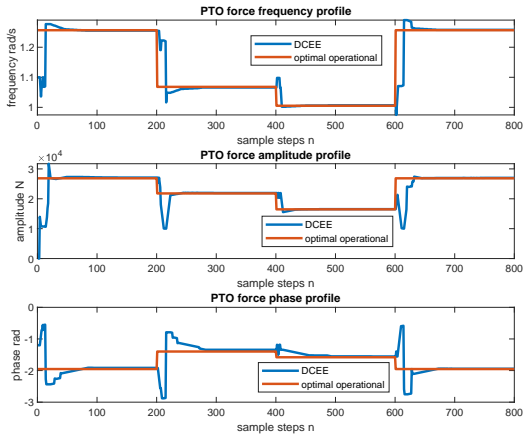
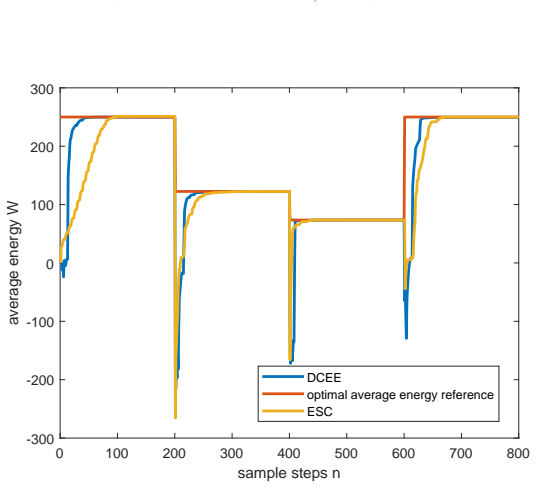
The paper claims that for a point absorber in a regular wave, the average generated power over a horizon T is given by the function Pavg(θu, θ) in Eq. (18), built from the known hydrodynamics and the three PTO parameters Au, Bu, ωu and three wave parameters A, B, ω. Maximizing this function gives the optimal PTO profile in closed form: match the wave frequency (ωu* = ω), set the phase according to Eq. (21), and set the amplitude according to Eq. (22). The maximum average power then depends only on wave amplitude. The paper further claims that by wrapping this formula in a particle filter and a DCEE search over 27 candidate profile adjustments, the controller can learn the unknown wave parameters online, with the DCEE cost function explicitly rewarding actions that reduce future estimation uncertainty, and that the resulting system outperforms the compared benchmarks.
Load-bearing premise
The design assumes the sea is a single-frequency sine wave and the PTO force is a single sine wave of the same shape, so every learned optimum and every predicted measurement follows from Eq. (18); if real waves have energy spread across many frequencies, or the low-level controller cannot track the harmonic force, the learned profile is no longer optimal.
Editorial extensions
If this is right
- If the wave is a single-frequency sinusoid, the PTO should oscillate at exactly the wave frequency; any frequency mismatch reduces average energy through the cross-term in Eq. (18).
- The maximum average power under the optimal profile is A^2 hex^2 / (8 hr), so once the wave amplitude is learned, the achievable energy ceiling is known without further optimization.
- Because the DCEE cost includes an uncertainty term, the controller will intentionally deviate from the current best PTO profile when that deviation yields informative energy measurements.
- The high-level design operates on a slow timescale over many wave periods, so the low-level loop must track the harmonic force; the paper delegates that tracking to an existing method and assumes it succeeds.
Reading between the lines
- A natural extension is to replace the single-sinusoid PTO profile with a truncated Fourier series; the same average-power derivation would produce a set of optimal harmonic coefficients, and the DCEE search would then operate over more parameters.
- The single-frequency assumption means the comparison against MPC under irregular waves likely favors the proposed method whenever the irregular sea has a strong dominant harmonic; in genuinely broadband seas the Eq. (18) model may be biased, and a testable extension is to weight Eq. (18) by the wave spectrum.
- The active-learning logic could be reused for other periodic energy systems whose optimal operating point moves, such as tidal turbines or oscillating water columns, whenever the reward-per-period is a smooth function of a few phase-amplitude parameters.
Editorial analysis
A structured set of objections, weighed in public.
Referee Report
Summary. The paper proposes a two-level autonomous control framework for wave energy converters (WECs). A high-level DCEE (Dual Control for Exploration and Exploitation) controller estimates unknown wave parameters (amplitude, phase, frequency) with a particle filter and generates a sinusoidal PTO force profile, parameterized by amplitude, phase, and frequency. The key analytical result is an expression for average generated power as a function of the PTO parameters and the wave parameters, Eq. (18), from which the closed-form optimal PTO profile is derived, Eqs. (19)-(22). A low-level controller is assumed to track this harmonic force profile. Simulations compare the proposed scheme against extremum seeking, MPC, and Bang-Bang control under regular and irregular waves. The claimed contributions are the extension of DCEE to non-stationary periodic optimal conditions and the active-learning-based auto-optimization architecture.
Significance. If the analytical derivation is made rigorous and the simulation benchmark is made fair, the paper would offer a useful design-oriented parametrization of WEC optimal control: it converts a non-stationary control problem into a parameter-learning problem, provides closed-form optimal PTO parameters with no fitted constants, and explicitly quantifies estimation uncertainty for active learning. The extension of DCEE to periodic optimal operating points is conceptually novel. However, the current evidence is weakened by a singularity at the resonance condition used for the optimality derivation, an MPC baseline with an extremely short prediction horizon, and single-run simulations with no statistical assessment. The paper is internally consistent within its linear regular-wave model, but that model is also used by the controller, the estimator, and the simulated plant, so the simulations mainly demonstrate self-consistency rather than independent validation.
major comments (4)
- [Section 2.3, Eqs. (17)-(22)] Eq. (17) is singular at omega_u = omega because the denominator contains (omega_u - omega), yet the optimality condition (19) selects exactly omega_u = omega. The subsequent derivation of the optimal amplitude (22) substitutes the optimal frequency and phase into the singular expression, which is formally not defined. A limiting argument is needed: for fixed T, as omega_u -> omega, the term (cos(phi) - cos(phi + (omega_u - omega)T)) / (2T(omega_u - omega)) tends to sin(phi)/2, and with the phase condition (21) it tends to 1/2, yielding the positive term Au hex A / (2 sqrt((m omega - K/omega)^2 + h_r^2)). Without this limit, the derivation of (22) and P*_avg in (27) is not rigorous.
- [Section 4.2, Table 2, and abstract] The claim of outperforming model predictive control is not established by the presented MPC baseline. The MPC uses a control interval of 0.01 s and a prediction horizon of 25 steps, i.e., 0.25 s, while the regular wave period is 5 s (omega = 0.4 pi in Section 4.1). A horizon of 5% of the wave period cannot approximate the reactive optimal control that MPC is designed to provide, and the text itself acknowledges that longer horizons improve performance. The abstract's blanket statement that the proposed method outperforms MPC should be either removed or substantiated with a properly tuned MPC baseline with a horizon on the order of the wave period or longer.
- [Section 4, Figures 5-9 and Table 2] All simulation results are single runs with no error bars or multiple noise seeds. The reported margin between DCEE (13.95 W) and MPC (11.65 W) is 2.3 W, but without repeated trials or confidence intervals it is impossible to assess whether this margin is statistically significant, especially given the 5% Gaussian measurement noise. The claim of 'effectiveness and robustness' under irregular waves would be much stronger with an ensemble of simulations under different noise realizations and wave seeds.
- [Section 3.1, Section 3.5, and Eq. (18)] The controller, the particle-filter likelihood, and the simulated plant all use the same linear model and the same average-power expression Eq. (18). The irregular-wave simulation still relies on the dominant-harmonic assumption for the DCEE controller, while the low-level tracking loop is delegated to reference [33] and is not simulated or verified here. Consequently, the simulations demonstrate that the DCEE algorithm is self-consistent with its internal model, but they do not validate that the proposed harmonic PTO force profile maximizes energy in a real broadband sea or that the low-level controller can track the harmonic force with sufficient accuracy. The authors should either include a higher-fidelity plant model that does not share Eq. (18) or explicitly position the results as model-based feasibility rather than physical validation.
minor comments (6)
- [Algorithm 2] The update line 'theta_u,k = theta_u,k-1 + [Delta theta_u; alpha_k Delta theta_u]' is malformed; the notation should be unified with Eq. (35) and the preceding random-step description, e.g., theta_u,k = theta_u,k-1 + alpha_k Delta theta_u.
- [Section 3.4] The sentence 'Upper alpha_min and lower alpha_max bounds' has the words Upper and lower swapped; it should read 'lower alpha_min and upper alpha_max bounds.'
- [Abstract] The sentence 'The generated Power Take-Off (PTO) profile as the reference for the low-level physical system to follow' is missing a verb; it should be 'serves as the reference.'
- [Figure 8, lower-right panel] The y-axis label 'Energy (W)' is dimensionally inconsistent; if the quantity is average power, the label should be 'Power (W)' or 'Energy (J)' if integrated over 60 s.
- [Table 2] The row 'Computational consumption' lists '0.34s 42.68s \'; the backslash appears to be a placeholder and the units should be stated consistently, e.g., seconds per 60-s simulation.
- [Section 3.5] The phrase 'in which the two new average energy durations T1, T2 are set as ( T1 < T2 < T)' is grammatically awkward and should be rephrased for clarity.
Circularity Check
No significant circularity: the analytical derivation is self-contained and the simulations, while model-consistent, do not reduce any prediction to a fitted input.
full rationale
The paper's core chain is analytical rather than circular. It assumes a regular wave (Eq. 3) and a harmonic PTO force (Eq. 4), solves the linear oscillator (Eq. 2) for the velocity phasors (Eqs. 8-11), integrates the instantaneous power to obtain the average-energy map Pavg(θu,θ) in Eq. (18), and then maximizes that map to obtain the closed-form optimality conditions (19)-(22). No parameter in Eq. (18) is fitted to the energy data that the controller later predicts; the optimality conditions follow by calculus and trigonometric identities, not by assuming the answer. The particle filter uses Eq. (18) as a forward measurement model, and the DCEE cost function is built from the same model, but this is standard model-based estimation and control rather than a definitional reduction: the plant could disagree with Eq. (18), and the paper's own irregular-wave benchmark reports that MPC 1 with full wave information outperforms DCEE, so the comparison is not constructed to force DCEE to win. The self-citations to the DCEE framework [17,18,20,39] and to the low-level controller [33] are background for the learning architecture and are not used to derive the WEC-specific energy map or its optimum; the paper even notes that its frequency-matching result is consistent with established complex-conjugate control [29] and MPC [30], which further shows the optimum is not an imported uniqueness claim. Concerns about the short 0.25 s MPC horizon, single-run comparisons, or the regular-wave design assumption are benchmark-fairness and correctness issues, not circularity under the definitions used here. No circular step can be quoted and reduced to an input by construction.
Assumptions & free parameters
free parameters (5)
- PTO action step sizes ΔAu, ΔBu, Δωu =
20 N, 0.002 rad, 0.0005 rad/s
- sample durations T1, T2, T =
20 s, 30 s, 50 s
- random step gain bounds αmin, αmax =
not specified
- Pmax in the DCEE cost function =
not specified
- particle count and downsampling sizes N, M, Q =
N = 5000, M and Q unspecified
assumptions (6)
- domain assumption Linear hydrodynamic model Eq. (2) with constant m, hr, K, and hex.
- domain assumption Regular incident wave Eq. (3): η(t) = A cos(ωt + B).
- domain assumption Harmonic PTO force parametrization Eq. (4): Fu(t) = Au cos(ωu t + Bu).
- standard math Duration T spans many wave periods so cross-frequency sinusoids integrate to zero in Eqs. (15)-(18).
- domain assumption Measurement noise is zero-mean Gaussian with 5% standard deviation, and the particle filter likelihood p(Ek|θi) is well defined.
- domain assumption Low-level PTO controller tracks the desired harmonic force perfectly or with negligible error.
Cite this review
Pith. "Pith review of Auto-optimization of Energy Generation for Wave Energy Converters with Active Learning." pith.science (2026). https://pith.science/paper/W4KFBP3O
@misc{pith2026250701727,
  author       = {Pith},
  title        = {Pith review of: Auto-optimization of Energy Generation for Wave Energy Converters with Active Learning},
  year         = {2026},
  howpublished = {\url{https://pith.science/paper/W4KFBP3O}},
  note         = {Machine review of arXiv:2507.01727}
}
read the original abstract
This paper presents an auto-optimization control framework for wave energy converters (WECs) to maximize energy generation under unknown and changing ocean conditions. The proposed control framework consists of two levels. The high-level controller operating at a longer time scale aims to maximize the average energy generation over several wave periods. The generated Power Take-Off (PTO) profile as the reference for the low-level physical system to follow. The new auto-optimization process leverages the parameterization of the non-stationary operation condition in WECs, establishing the relationship between the average energy generation and the key design parameters of the PTO force subject to the unknown wave parameters. The high-level controller is designed based on the concept of Dual Control for Exploration and Exploitation (DCEE) to quickly learn the unknown wave parameters by actively probing the ocean condition, while generating the optimal PTO profile. During this process, the uncertainty of the estimated wave condition is quantified and embedded in the optimization cost function to enable active learning. Simulation results under unknown regular and irregular waves demonstrate the effectiveness and robustness of this novel auto-optimization WEC systems with active learning, outperforming model predictive control, extremum seeking and classic Bang-Bang control approaches.
Figures


Figures from the paper (6 more)




Reference graph
Works this paper leans on
- [33]
-
[1]
J. Cruz, Ocean wave energy: current status and future prespectives, Springer Science & Business Media, 2007. 27
work page 2007
- [2]
-
[3]
A. Babarit, A. H. Cl´ ement, Optimal latching control of a wave energy device in regular and irregular waves, Applied Ocean Research 28 (2) (2006) 77–91
work page 2006
-
[4]
E. Anderlini, D. Forehand, E. Bannon, Q. Xiao, M. Abusara, Reac- tive control of a two-body point absorber using reinforcement learning, Ocean Engineering 148 (2018) 650–658
work page 2018
-
[5]
P. B. Garcia-Rosa, G. Kulia, J. V. Ringwood, M. Molinas, Real-time passive control of wave energy converters using the hilbert-huang trans- form, IF AC-PapersOnLine 50 (1) (2017) 14705–14710
work page 2017
-
[6]
L. Parrinello, P. Dafnakis, E. Pasta, G. Bracco, P. Naseradinmousavi, G. Mattiazzo, A. P. S. Bhalla, An adaptive and energy-maximizing con- trol optimization of wave energy converters using an extremum-seeking approach, Physics of Fluids 32 (11) (2020) 113307
work page 2020
-
[7]
E. Anderlini, D. Forehand, E. Bannon, M. Abusara, Reactive control of a wave energy converter using artificial neural networks, International journal of marine energy 19 (2017) 207–220
work page 2017
Show all 42 references
-
[8]
Richter, M
M. Richter, M. E. Magana, O. Sawodny, T. K. Brekken, Nonlinear model predictive control of a point absorber wave energy converter, IEEE Transactions on Sustainable Energy 4 (1) (2012) 118–126
2012
-
[9]
S. Zhan, J. Na, G. Li, B. Wang, Adaptive model predictive control of wave energy converters, IEEE Transactions on Sustainable Energy 11 (1) (2018) 229–238
2018
-
[10]
Faedo, S
N. Faedo, S. Olaya, J. V. Ringwood, Optimal control, mpc and mpc- like algorithms for wave energy systems: An overview, IF AC Journal of Systems and Control 1 (2017) 37–56
2017
-
[11]
Fusco, J
F. Fusco, J. V. Ringwood, A study of the prediction requirements in real-time control of wave energy converters, IEEE Transactions on Sus- tainable Energy 3 (1) (2011) 176–184. 28
2011
-
[12]
G. Li, M. R. Belmont, Model predictive control of sea wave energy converters–part i: A convex approach for the case of a single device, Renewable Energy 69 (2014) 453–463
2014
-
[13]
J. V. Ringwood, G. Bacelli, F. Fusco, Control, forecasting and optimi- sation for wave energy conversion, IF AC Proceedings Volumes 47 (3) (2014) 7678–7689
2014
-
[14]
Faedo, G
N. Faedo, G. Scarciotti, A. Astolfi, J. V. Ringwood, Energy-maximising moment-based constrained optimal control of ocean wave energy farms, IET Renewable Power Generation 15 (14) (2021) 3395–3408
2021
-
[15]
J. V. Ringwood, G. Bacelli, F. Fusco, Energy-maximizing control of wave-energy converters: The development of control system technology to optimize their operation, IEEE Control Systems Magazine 34 (5) (2014) 30–55
2014
-
[16]
H. Wang, V. Wijaya, T. Zeng, Y. Zhang, Deep reinforcement learning- based non-causal control for wave energy conversion, Ocean Engineering 311 (2024) 118860
2024
-
[17]
W.-H. Chen, C. Rhodes, C. Liu, Dual control for exploitation and ex- ploration (dcee) in autonomous search, Automatica 133 (2021) 109851
2021
-
[18]
Chen, Perspective view of autonomous control in unknown envi- ronment: Dual control for exploitation and exploration vs reinforcement learning, Neurocomputing 497 (2022) 50–63
W.-H. Chen, Perspective view of autonomous control in unknown envi- ronment: Dual control for exploitation and exploration vs reinforcement learning, Neurocomputing 497 (2022) 50–63
2022
-
[19]
Hutchinson, C
M. Hutchinson, C. Liu, P. Thomas, W.-H. Chen, Unmanned aerial vehicle-based hazardous materials response: Information-theoretic haz- ardous source search and reconstruction, IEEE Robotics & Automation Magazine 27 (3) (2019) 108–119
2019
-
[20]
Li, W.-H
Z. Li, W.-H. Chen, J. Yang, Y. Yan, Dual control of exploration and ex- ploitation for self-optimisation control in uncertain environments, arXiv preprint arXiv:2301.11984 (2023)
2023 arXiv
-
[21]
Li, W.-H
Z. Li, W.-H. Chen, J. Yang, Y. Yan, Autonomous source seeking and estimation via active information-directed reinforcement learning, Neu- rocomputing 544 (2023). 29
2023
-
[22]
Bacelli, J
G. Bacelli, J. V. Ringwood, J.-C. Gilloteaux, A control system for a self- reacting point absorber wave energy converter subject to constraints, IF AC Proceedings Volumes 44 (1) (2011) 11387–11392
2011
-
[23]
Faedo, Y
N. Faedo, Y. Pe˜ na-Sanchez, J. V. Ringwood, Finite-order hydrody- namic model determination for wave energy applications using moment- matching, Ocean Engineering 163 (2018) 251–263
2018
-
[24]
Fusco, J
F. Fusco, J. V. Ringwood, Short-term wave forecasting for real-time control of wave energy converters, IEEE Transactions on Sustainable Energy 1 (2) (2010) 99–106
2010
-
[25]
A. F. Davis, B. C. Fabien, Wave excitation force estimation of wave en- ergy floats using extended kalman filters, Ocean Engineering 198 (2020) 106970
2020
-
[26]
Z. Yu, J. Falnes, State-space modelling of a vertical cylinder in heave, Applied Ocean Research 17 (5) (1995) 265–275
1995
-
[27]
L. E. Borgman, Ocean wave simulation for engineering design, Journal of the Waterways and Harbors Division 95 (4) (1969) 557–583
1969
-
[28]
Bacelli, R
G. Bacelli, R. G. Coe, Comments on control of wave energy converters, IEEE Transactions on Control Systems Technology 29 (1) (2020) 478– 481
2020
-
[29]
Falnes, A
J. Falnes, A. Kurniawan, Ocean waves and oscillating systems: linear interactions including wave-energy extraction, Vol. 8, Cambridge Uuni- versity Press, 2020
2020
-
[30]
Yetkin, S
M. Yetkin, S. Kalidoss, F. E. Curtis, L. V. Snyder, A. Banerjee, Practical optimal control of a wave-energy converter in regular wave environments, Renewable Energy 171 (2021) 1382–1394
2021
-
[31]
U. A. Korde, J. Ringwood, Hydrodynamic control of wave energy de- vices, Cambridge University Press, 2016
2016
-
[32]
Faltinsen, Sea loads on ships and offshore structures, Vol
O. Faltinsen, Sea loads on ships and offshore structures, Vol. 1, Cam- bridge university press, 1993. 30
1993
-
[34]
Anderlini, S
E. Anderlini, S. Husain, G. G. Parker, M. Abusara, G. Thomas, To- wards real-time reinforcement learning control of a wave energy con- verter, Journal of Marine Science and Engineering 8 (11) (2020) 845
2020
-
[35]
Wyatt, L
L. Wyatt, L. Ledgard, C. Anderson, Maximum-likelihood estimation of the directional distribution of 0.53-hz ocean waves, Journal of Atmo- spheric and Oceanic Technology 14 (3) (1997) 591–603
1997
-
[36]
J. P. Grainger, A. M. Sykulski, P. Jonathan, K. Ewans, Estimating the parameters of ocean wave spectra, Ocean Engineering 229 (2021) 108934
2021
-
[37]
X. Shao, B. Huang, J. M. Lee, Constrained bayesian state estimation–a comparative study and a new particle filter based approach, Journal of Process Control 20 (2) (2010) 143–157
2010
-
[38]
S. Tong, D. Koller, Active learning for parameter estimation in bayesian networks, Advances in neural information processing systems 13 (2000)
2000
-
[39]
Li, W.-H
Z. Li, W.-H. Chen, J. Yang, Concurrent active learning in autonomous airborne source search: Dual control for exploration and exploitation, IEEE Transactions on Automatic Control 68 (5) (2022) 3123–3130
2022
-
[40]
Zhang, S
Y. Zhang, S. Zhan, G. Li, Model predictive control of wave energy converters with prediction error tolerance, IF AC-PapersOnLine 53 (2) (2020) 12289–12294
2020
-
[41]
Khedkar, A
K. Khedkar, A. P. S. Bhalla, A model predictive control (mpc)- integrated multiphase immersed boundary (ib) framework for simulating wave energy converters (wecs), Ocean Engineering 260 (2022) 111908
2022
-
[42]
G. Li, G. Weiss, M. Mueller, S. Townley, M. R. Belmont, Wave en- ergy converter control by wave prediction and dynamic programming, Renewable Energy 48 (2012) 392–403. 31
2012
Reviewed August 6, 2026 · model on record in the stance chip above.
Discussion (0). Sign in to comment.