REVIEW 4 major objections 4 minor 1 references
Decay of correlations for certain isometric extensions of Anosov flows
T0 review · 4 major / 4 minor · reviewed 2026-08-14 · deepseek-v4-flash
Pith's one-line read Locally accessible isometric extensions of Anosov flows mix exponentially at all orders when the base foliations are C1.
desk verdict Serious attempt at exponential mixing for isometric extensions, but the key WLOG gauge choice in Theorem 3.20 is invalid and breaks the main proof. read the letter →
The pith
A machine-rendered reading of the paper's core claim, the machinery that carries it, and where it could break.
The reading
What carries the argument
The engine is the family of twisted transfer operators $L^n_{z,\rho}$ acting on C1 functions with values in an isotypic component $V_\rho$ of $L^2(G)$, defined by summing over $\sigma^n$-preimages with weight $e^{\alpha_z^{(n)}}$ and rotation $\rho(\mathrm{Hol}^{(n)})$. The key mechanism is the translation of local $G$-accessibility into uniform local non-integrability: the infinitesimal transitivity group $h^\varphi_\epsilon(x)$ — the Lie-algebra span of differences of infinitesimal unstable holonomies across the strong stable foliation — is shown to equal the full Lie algebra $\mathfrak{g}$ at maximal-dimension bi-recurrent points (Theorems 3.19 and 3.20), and this is converted into a symbolic estimate (Theorem 3.27) that produces two 'twisted' histories whose vectors are uniformly non-parallel under $\rho$. Lemmas 4.9 and 4.28 turn that non-parallelism into a definite contraction factor for $L^n_{z,\rho}$ on a fixed fraction of every small ball; iteration gives the uniform bound in Theorem 4.35, and a Laplace-transform argument converts the spectral bound into exponential decay of all correlation functions.
What would settle it
Compute $h^\varphi_\epsilon(x)$ for a compact locally $G$-accessible isometric extension at a bi-recurrent point $x$: if $\dim h^\varphi_\epsilon(x) < \dim \mathfrak{g}$ while the flow is locally $G$-accessible, then Theorem 3.20 (and hence Theorem A) is false; such a computation can be done on a small Markov rectangle by differentiating the unstable holonomy along the strong stable direction.
Extended reading notes
Core claim
The central discovery is that local $G$-accessibility of a compact isometric extension $f_t$ of a transitive Anosov flow $g_t$ is enough to force uniform spectral contraction for the twisted transfer operators $L^n_{z,\rho}$, and therefore exponential decay of correlations of all orders for the product measure $\nu\times\omega$. The argument defines, at each point $x$, an infinitesimal transitivity group $h^\varphi_\epsilon(x)$ spanned by differences of infinitesimal unstable holonomies along strong stable leaves; local accessibility forces this subalgebra to be the full Lie algebra $\mathfrak{g}$ (Theorem 3.20), and on the symbolic model this yields the uniform local non-integrability estimate of Theorem 3.27. From that estimate, together with C1 regularity of the base foliations and diametric regularity of the unstable conditionals, the paper obtains the bound $\|L^n_{z,\rho}\phi\|_{L^2(\nu^u)} \leq C\|\phi\|_{C^1} r^n$, uniformly over nontrivial irreducible representations $\rho$ and over $z$ near the pressure. Feeding this bound into a Laplace-transform argument for the $k$th-order correlation function gives Theorem A, and the H\"older-potential case follows by approximation. In the frame-flow setting of quarter-pinched negative curvature the same theorem yields Corollary C.
Load-bearing premise
The whole chain collapses if the base flow's strong stable and strong unstable foliations are not C1, because then the Markov rectangles, return map, roof function, and temporal holonomies are no longer smooth enough for the contraction argument; quarter-pinched negative curvature alone does not guarantee this regularity.
Editorial extensions
If this is right
- Any locally $G$-accessible isometric extension satisfying the C1-foliation and measure hypotheses has exponential decay of correlations of all orders for H\"older observables, not just pairwise mixing.
- The exponential rate and constant can be chosen uniformly over all nontrivial irreducible representations of $G$, so no single Fourier mode is slow.
- For closed manifolds of quarter-pinched negative curvature, exponential mixing of all orders for the frame flow follows as soon as the frame flow is locally accessible.
- Since exponential mixing for C1 functions implies exponential mixing for $C^\alpha$ functions by approximation, the result covers all positive H\"older regularities.
Reading between the lines
- Editorial inference: if local accessibility is truly the operative mechanism, then accessible but not locally accessible extensions should be the natural place to look for slow or non-exponential mixing; this dichotomy is not tested in the paper.
- Editorial inference: the C1-foliation hypothesis is likely the first assumption to remove; a contraction argument adapted to H\"older foliations and H\"older holonomies would widen the theorem to the full equilibrium-measure setting and would make Corollary C hold without an extra curvature-dependent regularity check.
- Editorial inference: the same twisted transfer operator scheme may extend to other compact extensions of hyperbolic flows, including extensions by non-connected or non-normal groups, as long as an infinitesimal transitivity group can be defined and shown to generate the relevant algebra.
- Editorial inference: one could numerically test the key estimate by computing, on a small Markov rectangle, whether the two consistent pasts produced by Theorem 3.27 actually separate under $\rho$ by at least $\epsilon\|\rho\|$; a failure in a locally accessible example would locate exactly where the argument breaks.
Signed reviews
Editorial analysis
A structured set of objections, weighed in public.
Referee Report
Summary. The paper claims that a locally G-accessible isometric extension of a transitive Anosov flow has exponential decay of correlations of all orders, provided the base flow has C1 strong stable and strong unstable foliations and the equilibrium measure has diametrically regular unstable conditionals. The proof proceeds by constructing a symbolic suspension model for the extension, defining twisted transfer operators with values in isotypic components of L2(G), proving uniform local non-integrability estimates from local G-accessibility, and then applying a Dolgopyat-type contraction argument to obtain spectral bounds for the twisted transfer operators. The main advertised applications are to frame flows over quarter-pinched negatively curved manifolds. The paper follows the framework of Winter and Dolgopyat and is carefully organized, but the central proof contains a serious gap in the passage from local G-accessibility to the infinitesimal transitivity group statement.
Significance. If the main theorem were established, it would be a substantial contribution: it would extend Dolgopyat's and Winter's methods from frame flows and group extensions of expanding maps to general isometric extensions of Anosov flows with nontrivial fiber bundle structure, and it would yield exponential mixing of all orders for a natural class of partially hyperbolic systems. The paper's strengths are its clear reduction to twisted transfer operators, its use of Peter-Weyl decomposition with explicit dependence on representation norms, and its reliance on external, independent results for the trivial representation. These are real virtues. However, several load-bearing points in the argument are not justified as written, and the most serious one appears to invalidate the proof of the main theorem in its present form. The advertised application to frame flows also requires an additional regularity hypothesis that is not stated or proved.
major comments (4)
- [Section 3, Theorem 3.20] The opening 'Without loss of generality' is not available under the hypotheses of the theorem. The proof assumes a trivialization φ_x such that both the unstable holonomy Θ^+_{φ_x,φ_x}(x,u) and the stable holonomy Θ^-_{φ_x,φ_x}(s1,s2) are trivial on B_{2ε}(x). A gauge change transforms a closed stable-unstable loop holonomy by conjugation, so a loop whose holonomy is a non-identity element of G cannot be made identity in any trivialization. Definition 1.5 requires that for every h∈G and every small ball there is a loop realizing h, so for non-identity h such a trivialization cannot exist unless the extension is locally trivial. The subsequent argument uses this impossible gauge to force all infinitesimal holonomies into the subalgebra h and to conclude that stable-unstable cycles cannot realize g∉H. Without the gauge choice, the conclusion h^φ_x_ε(x)=g is not established. Since Theorem 3.20 is used directly in Theorem 3.24, Theorem 3.27, and ultimately in the spectral bound Theorem 4.35, the main claim is unsupported as written.
- [Section 2, Eq. (2.12)] The displayed inequality ∑_{n1,...,nk≥1} r^{max nj} ≤ k! ∑_{n≥1} r^n is false for k>1. For each m, the number of k-tuples with maximum exactly m is m^k−(m−1)^k, so the left-hand side is ∑_{m≥1}(m^k−(m−1)^k)r^m, which is not bounded by a constant multiple of ∑_{m≥1}r^m. This inequality is used in Theorem 2.10 to justify convergence of the Laplace-transform bound and to extract the exponential decay estimate. The convergence may be repairable by a standard argument splitting the spectral radius, but the displayed reduction is incorrect as written, and the all-orders decay conclusion is not proved by the given argument.
- [Section 2, Lemma 2.13] The proof of the k-dimensional integral convergence is not complete. The text claims the statement follows from the stated decay of the one-dimensional convolution f(x) by 'direct successive integration,' but the claimed decay rate |f(x)|≤C(1+|x|)^{−0.5+2ε} is too slow to control the subsequent iterated convolutions directly. The hypergeometric evaluations are not connected to the remaining k−2 integrations, and the step from the one-dimensional estimate to the k-dimensional statement is not demonstrated. Since this integral is the mechanism by which Theorem 2.10 passes from Laplace transforms back to exponential decay of correlations, the proof of the main correlation decay theorem is incomplete at this point as well.
- [Corollary C] The corollary applies Theorem A to frame flows over quarter-pinched negatively curved manifolds, but it does not establish the C1 regularity of the strong stable and strong unstable foliations of the base geodesic flow. Quarter-pinched negative curvature alone does not imply that these foliations are C1; this is an additional hypothesis of Theorem A. Consequently, as stated, Corollary C is not a consequence of the theorem. The doubling property is cited from [PPS15], but the foliation regularity hypothesis is silently inherited without proof or reference.
minor comments (4)
- [Lemma 1.2] In the choice ε=r^{kt} with k=1/(2(dim(M)+1)), the exponent in the first decay term should be αt/(2(dim(M)+1)); the displayed expression r^{α(dim(M)+1)^{-1}t} appears to be missing the factor 1/2.
- [Section 1.2] The text says the trivializations are modified to be constant along the 'center-stable foliation' but then refers to W^su_ft; this notation should be reconciled, since W^su is used elsewhere for the strong unstable foliation.
- [Theorem 3.27] The step from the existence of a basis of infinitesimal holonomy differences to a uniform lower bound on a neighborhood is abbreviated: the proof asserts that a finite n0 and a Casimir element can be chosen without showing that the finite approximations remain a basis with uniform constants. This is likely repairable, but it needs to be spelled out.
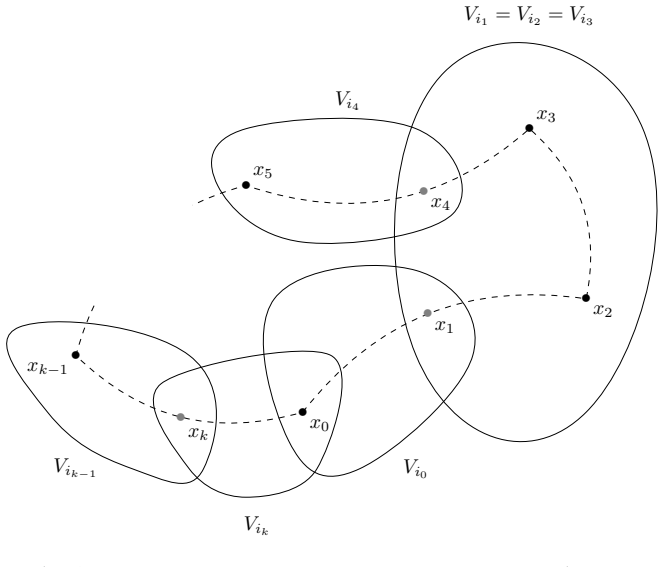
- [Proposition 3.3] The proof refers to Figure 1, but the figure is not included in the arXiv text; either include the figure or remove the reference.
Circularity Check
No circularity: the proof is a forward implication from explicit hypotheses using external Dolgopyat and Winter machinery.
full rationale
The paper's derivation chain is forward-directional: local G-accessibility is used, via Theorems 3.19, 3.20, 3.24, and 3.27, to produce uniform local non-integrability estimates for twisted transfer operators, which are then converted into correlation decay by Laplace-transform arguments in Section 4. The main technical inputs—Dolgopyat's exponential mixing theorem for the trivial representation, Winter's frame-flow strategy, Bowen–Ratner Markov partitions, thermodynamic formalism, and classical representation theory—are external and independent of the paper's conclusion. No parameter is fitted to a subset of data and then renamed a prediction; no definition presupposes the target result; and no load-bearing claim rests on a self-citation chain. The only flagged concern, the 'Without loss of generality' trivializing gauge choice in Theorem 3.20, is a potential mathematical gap about whether such a gauge can coexist with nontrivial local G-accessibility. Even if that concern is correct, it is a correctness issue rather than circularity, because the argument does not reduce the conclusion to its own statement by construction. The central theorem is a new implication derived from stated assumptions with independent external tools, so the circularity score is 0.
Assumptions & free parameters
assumptions (8)
- standard math Markov partitions exist for transitive Anosov flows (Bowen, Ratner).
- standard math Ruelle-Perron-Frobenius and Lanford-Ruelle variational principle for equilibrium states.
- standard math Peter-Weyl decomposition and Sugiura's Fourier decay estimates for compact Lie groups.
- domain assumption Strong stable and strong unstable foliations of the base flow are jointly C1.
- domain assumption Unstable conditional measures νu are diametrically regular (doubling/Federer property).
- domain assumption The extension is locally G-accessible (Definition 1.5).
- domain assumption G is a closed, connected, normal subgroup of Isom(F) acting transitively on F with no proper transitive normal subgroups.
- standard math Topological transitivity and ergodicity of the base Anosov flow, and existence and uniqueness of equilibrium states for Hölder potentials.
Cite this review
Pith. "Pith review of Decay of correlations for certain isometric extensions of Anosov flows." pith.science (2026). https://pith.science/paper/W4PPVZPS
@misc{pith2026190808550,
  author       = {Pith},
  title        = {Pith review of: Decay of correlations for certain isometric extensions of Anosov flows},
  year         = {2026},
  howpublished = {\url{https://pith.science/paper/W4PPVZPS}},
  note         = {Machine review of arXiv:1908.08550}
}
abstract
We establish exponential decay of correlations of all orders for locally $G$-accessible isometric extensions of transitive Anosov flows, under the assumption that the strong stable and strong unstable foliations of the base Anosov flow are jointly $C^1$. This is accomplished by translating accessibility properties of the extension into local non-integrability estimates measured by Dolgopyat's infinitesimal transitivity group, from which we obtain contraction properties for a class of 'twisted' symbolic transfer operators.
Figures

Reference graph
Works this paper leans on
-
[1]
On the ergodicity of partially hyperbolic systems
[AS64] Milton Abramowitz and Irene Stegun. Handbook of mathematical functions with formulas, graphs, and mathematical tables . National Bureau of Standards (1964). mr: 0167642. [App14] David Applebaum. Probability on compact Lie groups. Springer, Cham (2014). doi: 10.1007/978-3-319- 07842-7. mr: 3243650. [Bow73] Rufus Bowen. Symbolic dynamics for hyperbol...
work page Pith review arXiv 1964
Reviewed August 14, 2026 · model on record in the stance chip above.
Discussion (0). Continue with ORCID to comment.