REVIEW 3 major objections 4 minor 50 references
New evidence for weak magnetic fields in Herbig Ae/Be stars
T0 review · 3 major / 4 minor · reviewed 2026-08-14 · deepseek-v4-flash
Pith's one-line read Five Herbig Ae/Be stars show longitudinal magnetic fields between 17 and 209 G, evidence that these young intermediate-mass stars are far less magnetic than their lower-mass T Tauri cousins.
desk verdict A competent measurement letter with new SVD epochs, but the abstract's claim of intrinsically weak HAeBe fields overreaches the sparse phase coverage and the projection geometry. read the letter →
The pith
A machine-rendered reading of the paper's core claim, the machinery that carries it, and where it could break.
The reading
What carries the argument
The central tool is the Singular Value Decomposition (SVD) technique for combining many spectral-line Stokes V profiles. It identifies the small number of eigenprofiles that capture the coherent Zeeman signal shared by all selected unblended lines, then builds a weighted mean line profile in which noisy spectral regions automatically receive lower weight. The longitudinal magnetic field is obtained from the first-order moment of this mean Stokes V profile through a standard velocity-weighted formula, yielding uncertainties of only a few gauss for fields of tens of gauss. This weighting is what makes weak-field measurements in Herbig Ae/Be stars possible.
What would settle it
Measure the radial velocities of the sharp line cores over many epochs and check whether they follow the star's rotation or the Keplerian orbital motion of surrounding material; the photospheric assumption requires the former. Alternatively, rerun the SVD analysis after excluding spectral lines formed in outflow or disk gas and see whether the Stokes V Zeeman signature remains.
Extended reading notes
Core claim
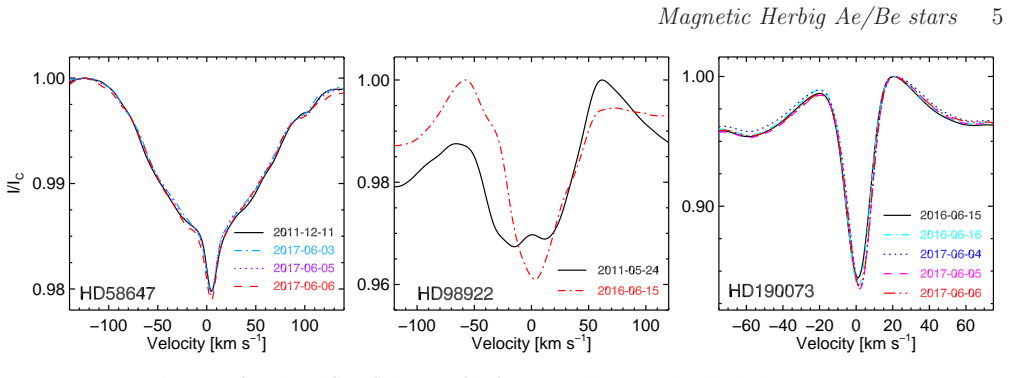
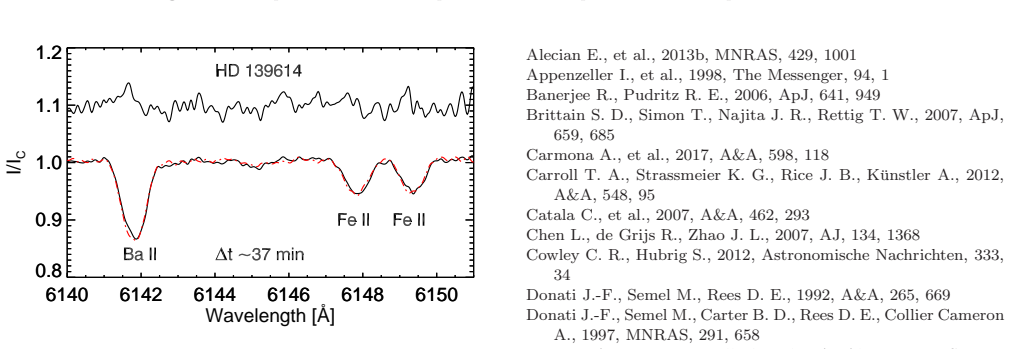
Using the SVD method on high-resolution Stokes V spectra of five Herbig Ae/Be stars, the authors report definite detections of longitudinal magnetic fields in all five: HD 58647 shows -121 +/- 11 G on one night and +209 +/- 10 G two nights later; HD 98922 changed from -33 +/- 4 G in 2011 to +28 +/- 7 G in 2016; HD 139614 shows 25 +/- 3 G; HD 165133 shows 97 +/- 9 G; and HD 190073 shows fields between 17 +/- 1 G and 34 +/- 2 G across four epochs. The authors interpret these values as further evidence that Herbig Ae/Be stars possess much weaker magnetic fields than T Tauri stars, whose fields reach kilogauss strength. They also argue that the large non-detection rate in earlier surveys, where many measurements had uncertainties above 100 G, may reflect measurement limits rather than genuinely non-magnetic stars.
Load-bearing premise
The measurement assumes that the sharp absorption cores in the line profiles are formed in the stellar photosphere; if they instead arise in a circumstellar disk, wind, or accretion flow, the detected Zeeman signatures do not measure a stellar magnetic field.
Editorial extensions
If this is right
- Typical Herbig Ae/Be stars have longitudinal magnetic fields of tens to a few hundred gauss, an order of magnitude below the kilogauss fields measured in T Tauri stars.
- Magnetospheric accretion models used for T Tauri stars, which require kilogauss fields to funnel gas onto the stellar surface, should not be assumed for Herbig Ae/Be systems.
- The polarity change within one night in HD 58647 shows that even weak-field Herbig Be stars can host organized, rotationally structured magnetic fields.
- Earlier non-detections in large Herbig Ae/Be surveys do not prove the absence of fields; most of those measurements had uncertainties worse than 100 G, and SVD-based reobservation can reveal fields below that level.
- Determining rotation periods and field geometry for these stars requires multi-epoch monitoring, since a single snapshot longitudinal field depends strongly on the observer's viewing angle.
Reading between the lines
- If the photospheric-origin assumption holds, the same SVD pipeline applied to a larger magnitude-limited sample should recover a smooth distribution of longitudinal fields extending below 20 G; a blind survey of thirty or more Herbig Ae/Be stars could test whether the median field really is that low.
- The polarity flip of roughly 330 G in HD 58647 within about a day implies a strongly tilted or small-scale field geometry; if a rotation period can be measured, the Stokes V phase curve would distinguish a dipolar field from a complex multipolar one.
- Because the SVD method uses only the narrow, presumably photospheric line cores, masking out variable broad components before analysis would allow a clean test of whether accretion-related line variability contaminates the Zeeman signature.
Signed reviews
Editorial analysis
A structured set of objections, weighed in public.
Referee Report
Summary. The paper presents new HARPSpol spectropolarimetric observations of five Herbig Ae/Be stars and reports longitudinal magnetic field measurements obtained with the Singular Value Decomposition (SVD) technique. The authors report definite detections with low false-alarm probabilities, including the strongest field of 209 G in HD 58647, a weak field of 17 G in HD 190073, and polarity changes for HD 58647 and HD 98922. The paper interprets these results as further evidence that Herbig Ae/Be stars possess much weaker magnetic fields than T Tauri stars, whose fields are of kG order.
Significance. If the detections are correct, the paper provides useful new longitudinal-field measurements for a small sample of Herbig Ae/Be stars, a class for which accurate magnetic measurements remain challenging. The use of SVD with low measurement uncertainties and the display of diagnostic null profiles are strengths, and the reported false-alarm probabilities support the reality of the Stokes V signals. However, the central astrophysical conclusion that these stars have intrinsically weaker fields than T Tauri stars is not justified by the longitudinal-field measurements alone, because such measurements are strongly projection- and phase-dependent. The paper also relies on an unverified assumption that the sharp line cores of HD 58647 are photospheric. The individual measurements remain a useful contribution if the interpretation is appropriately qualified.
major comments (3)
- [Abstract; Sec. 4, Discussion] The claim that the results 'provide further evidence that Herbig Ae/Be stars possess much weaker magnetic fields than their lower mass counterpart T Tauri stars with magnetic fields of kG order' is not supported by the measured longitudinal fields alone. Equation (1) measures the disk-integrated line-of-sight component, and Sec. 4 correctly concedes that 'single snapshot observations are not sufficient' because of the strong dependence on viewing angle. For a dipolar field, a kG-order polar field can easily produce longitudinal fields of 17-209 G depending on inclination, obliquity, and rotation phase; the sparse sampling in Table 1 (one or two epochs per star) does not constrain the intrinsic field strength. The abstract and Discussion should be revised to state that the observations are consistent with weak longitudinal fields, not that they establish intrinsically weak surface fields.
- [Sec. 3.1, HD 58647] The assumption stated in Sec. 3.1 that 'the sharp cores observed in the line profiles are originating in the stellar photosphere' is load-bearing for the interpretation of the HD 58647 detection. The paper itself describes complex line profiles with sharp absorption components and a disk-wind model for this star (citing Kurosawa et al. 2016). If the sharp cores are formed in a circumstellar disk or wind rather than the photosphere, the Stokes V signal and the derived -121 G and +209 G values would not measure a stellar magnetic field. The authors should justify this assumption, for example by showing that the SVD signal is dominated by lines with photospheric origins or by comparing the observed Stokes V profile with a model that includes non-photospheric contamination.
- [Sec. 3.1; Table 1] The text says that the HD 58647 measurements 'show a change of polarity within one day' from -121 G to +209 G, but the tabulated heliocentric Julian dates are 57908.483 and 57910.467, which differ by about 1.98 days, not one day. In addition, the Table 1 entry for HJD 57911.468 lists no field value; the paper should state whether this observation was not usable or yielded a non-detection. These discrepancies should be corrected.
minor comments (4)
- [Abstract] The sentence 'In recent years Herbig Ae/Be stars receive considerable attention' would read better as 'have received considerable attention'.
- [References] In the reference for Järvinen et al. (2019), the author list contains 'Ilyin I.' twice.
- [References] The journal name 'Astronomsche Nachrichten' in Järvinen et al. (2016) is misspelled; it should be 'Astronomische Nachrichten'.
- [Sec. 3.6] The statement that only HD 139614 shows subexposure variability is based on Fig. 3, but the figure caption does not identify which star is shown until the main text; adding an explicit star name to the caption would improve clarity.
Circularity Check
No significant circularity: the field measurements are computed from observed Stokes V profiles via a published moment formula, not from the paper's conclusion.
full rationale
The derivation chain in this paper is the measurement of longitudinal magnetic fields from spectropolarimetric observations. The fields are obtained from SVD-combined Stokes V profiles using the first-order moment formula of Mathys (1989), Eq. (1), with line masks based on stellar parameters and line lists. No parameter is fitted to the target claim that Herbig Ae/Be stars have weak magnetic fields, and the quoted field values are not constructed from any prior conclusion about field weakness. The SVD technique is cited from the authors' earlier work, but the method is presented transparently and the field values are computed directly from observed profiles; the self-citations are methodological, not load-bearing for the astrophysical conclusion. The paper's central interpretation, that the measured longitudinal fields imply intrinsically weaker fields than in T Tauri stars, rests on an astrophysical assumption about the relation between <B_z> and surface field strength, and the paper itself concedes that single snapshot observations are not sufficient owing to the geometric dependence of the longitudinal field. That is a limitation or correctness risk, not circularity. No equation in the paper reduces to its own input, and no fitted parameter is renamed as a prediction. The analysis is therefore self-contained as a measurement study, even if the broader conclusion may be debated on observational grounds.
Assumptions & free parameters
assumptions (4)
- domain assumption SVD of Carroll et al. (2012) yields a mean Stokes V profile from which the first-moment formula (Eq. 1) recovers the true longitudinal field
- ad hoc to paper The sharp absorption cores in HD 58647 are photospheric
- domain assumption FAP thresholds (definite detection below 1e-5) from Donati et al. 1992 classify the detections
- domain assumption Literature Teff and log g for each star are appropriate for building the SVD line masks
Cite this review
Pith. "Pith review of New evidence for weak magnetic fields in Herbig Ae/Be stars." pith.science (2026). https://pith.science/paper/W4WOFT2I
@misc{pith2026190802093,
  author       = {Pith},
  title        = {Pith review of: New evidence for weak magnetic fields in Herbig Ae/Be stars},
  year         = {2026},
  howpublished = {\url{https://pith.science/paper/W4WOFT2I}},
  note         = {Machine review of arXiv:1908.02093}
}
read the original abstract
In recent years Herbig Ae/Be stars receive considerable attention as their disks are believed to be the sites of on-going planet formation. Confirming the presence of magnetic fields in these stars is critical for understanding the transport of angular momentum during the protostellar phase. Furthermore, magnetic fields set the conditions for strongly anisotropic accretion. In this study we present the results of our recent observing campaigns of a sample of Herbig Ae/Be stars aimed at measurements of their magnetic fields applying the Singular Value Decomposition method to high resolution spectropolarimetric observations. The strongest longitudinal magnetic field of 209 G is detected in the Herbig Be star HD 58647, whereas the weakest field of 17 G is measured in the Herbig Ae star HD 190073. A change of polarity is detected for HD 58647 and in the Herbig Be star HD 98922. The obtained results provide further evidence that Herbig Ae/Be stars possess much weaker magnetic fields than their lower mass counterpart T Tauri stars with magnetic fields of kG order.
Figures

Reference graph
Works this paper leans on
-
[1]
Acke B., Waelkens C., 2004, , 427, 1009
work page 2004
-
[2]
Alecian E., Neiner C., Mathis S., Catala C., Kochukhov O., Landstreet J., 2013a, , 549, L8
-
[3]
Alecian E., et al., 2013b, , 429, 1001
-
[4]
Appenzeller I., et al., 1998, The Messenger, 94, 1
work page 1998
- [5]
-
[6]
Brittain S. D., Simon T., Najita J. R., Rettig T. W., 2007, , 659, 685
work page 2007
-
[7]
Carmona A., et al., 2017, , 598, 118
work page 2017
-
[8]
Carroll T. A., Strassmeier K. G., Rice J. B., K\"unstler A., 2012, , 548, 95
work page 2012
Show all 50 references
-
[9]
Catala C., et al., 2007, , 462, 293
2007
-
[10]
L., 2007, , 134, 1368
Chen L., de Grijs R., Zhao J. L., 2007, , 134, 1368
2007
-
[11]
R., Hubrig S., 2012, Astronomische Nachrichten, 333, 34
Cowley C. R., Hubrig S., 2012, Astronomische Nachrichten, 333, 34
2012
-
[12]
E., 1992, , 265, 669
Donati J.-F., Semel M., Rees D. E., 1992, , 265, 669
1992
-
[13]
D., Rees D
Donati J.-F., Semel M., Carter B. D., Rees D. E., Collier Cameron A., 1997, , 291, 658
1997
-
[14]
A., Lane B
Eisner J. A., Lane B. F., Hillenbrand L. A., Akeson R. L., Sargent A. I., 2004, , 613, 1049
2004
-
[15]
P., Bagnulo S., Wade G
Folsom C. P., Bagnulo S., Wade G. A., Alecian E., Landstreet J. D., Marsden S. C., Waite I. A., 2012, , 422, 2072
2012
-
[16]
A., et al., 1996, , 120, 157
Grady C. A., et al., 1996, , 120, 157
1996
-
[17]
M., Kuhn J
Harrington D. M., Kuhn J. R., 2009, , 180, 138
2009
-
[18]
V., 2004, , 428, L1
Hubrig S., Sch \"o ller M., Yudin R. V., 2004, , 428, L1
2004
-
[19]
V., Sch\"oller M., Pogodin M
Hubrig S., Yudin R. V., Sch\"oller M., Pogodin M. A., 2006, , 446, 1089
2006
-
[20]
A., Yudin R
Hubrig S., Pogodin M. A., Yudin R. V., Sch\"oller M., Schnerr R. S., 2007, , 463, 1039
2007
-
[21]
Hubrig S., et al., 2009, , 502, 283
2009
-
[22]
Hubrig S., et al., 2011a, , 525, L4
-
[23]
Hubrig S., et al., 2011b, , 536, A45
-
[24]
F., Elkin V
Hubrig S., Castelli F., Gonz \'a lez J. F., Elkin V. G., Mathys G., Cowley C. R., Wolff B., Sch \"o ller M., 2012, , 542, 31
2012
-
[25]
Hubrig S., Ilyin I., Sch \"o ller M., Lo Curto G., 2013, Astronomische Nachrichten, 334, 1093
2013
-
[26]
A., Sch\"oller M., Ilyin I., 2015, , 449, L118
Hubrig S., Carroll T. A., Sch\"oller M., Ilyin I., 2015, , 449, L118
2015
-
[27]
arvinen S. P., Carroll T. A., Hubrig S., Sch\
J\"arvinen S. P., Carroll T. A., Hubrig S., Sch\"oller M., Ilyin I., Korhonen H., Pogodin M., Drake N. A., 2015, , 584, 15
2015
-
[28]
arvinen S. P., Hubrig S., Sch\
J\"arvinen S. P., Hubrig S., Sch\"oller M., Ilyin I., Carroll T. A., Korhonen H., 2016, Astronomsche Nachrichten, 337, 329
2016
-
[29]
P., et al., 2018, , 858, 18
J\"arvinen S. P., et al., 2018, , 858, 18
2018
-
[30]
arvinen S. P., Carroll T. A., Hubrig S., Ilyin I., Sch\
J\"arvinen S. P., Carroll T. A., Hubrig S., Ilyin I., Sch\"oller M., Ilyin I., Drake N. A., Pogodin M. A., 2019, , 486, 5499
2019
-
[31]
Kraus S., et al., 2008, , 489, 1157
2008
-
[32]
Kupka F., Dubernet M.-L., VAMDC Collaboration, 2011, Baltic Astronomy, 20, 503
2011
-
[33]
Kurosawa R., et al., 2016, , 457, 2236
2016
-
[34]
Mathys G., 1989, Fundam. Cosm. Phys., 13, 143
1989
-
[35]
Mathys G., 1994, , 108, 547
1994
-
[36]
Matter A., et al., 2014, , 561, 26
2014
-
[37]
Matter A., et al., 2016, , 586, 11
2016
-
[38]
Thesis, Universidad Aut\'onoma, Madrid, Spain, http://www.laeff.inta.es/EXPORT/thesis/bmerin\_thesis.pdf
Mer\'in B., 2004, Ph.D. Thesis, Universidad Aut\'onoma, Madrid, Spain, http://www.laeff.inta.es/EXPORT/thesis/bmerin\_thesis.pdf
2004
-
[39]
Montesinos B., Eiroa C., Mora A., Mer\'in B., 2009, , 495, 901
2009
-
[40]
C., Vink J
Mottram J. C., Vink J. S., Oudmaijer R. D., Patel M., 2007, , 377, 1363
2007
-
[41]
L., Stempels H
Ryabchikova T., Piskunov N., Kurucz R. L., Stempels H. C., Heiter U., Pakhomov Y., Barklem P. S., 2015, , 90, 054005
2015
-
[42]
Snik F., Jeffers S., Keller C., Piskunov N., Kochukhov O., Valenti J., Johns-Krull C., 2008, SPIE Conf.\ Series, 7014, E22
2008
-
[43]
A., Pringle J
Tout C. A., Pringle J. E., 1995, , 272, 528
1995
-
[44]
S., de Winter D., P\'erez M
Th\'e P. S., de Winter D., P\'erez M. R., 1994, , 104, 351
1994
-
[45]
E., de Winter D., Tjin A Djie H
van den Ancker M. E., de Winter D., Tjin A Djie H. R. E., 1998, , 330, 145
1998
-
[46]
S., Drew J
Vink J. S., Drew J. E., Harries T. J., Oudmaijer R. D., 2002, , 337, 356
2002
-
[47]
A., et al., 2005, , 442, L31
Wade G. A., et al., 2005, , 442, L31
2005
-
[48]
A., Bagnulo S., Drouin D., Landstreet J
Wade G. A., Bagnulo S., Drouin D., Landstreet J. D., Monin D., 2007, , 376, 1145
2007
-
[49]
Wallenquist ., 1939, Annals of the Bosscha Observatory Lembang (Java) Indonesia, 5, 1
1939
-
[50]
Zwintz K., Guenther D., Kallinger T., 2008, CoAst, 157, 256
2008
Reviewed August 14, 2026 · model on record in the stance chip above.
Discussion (0). Continue with ORCID to comment.